


Introduction
Mass-casualty incidents require prioritizing the greatest good for the greatest number. In this context, triage is a dynamic process for allocating limited resources through rapid assessment, on-scene care, hospital selection, and patient transport.Reference Demir, Tunçbilek and Alinier 1 START classifies casualties as red, yellow, green, or black using respirations, perfusion (capillary refill/radial pulse), and mental status.Reference Aslan, Şahinöz and Şahinöz 2
Paramedics providing prehospital emergency care are the primary professionals responsible for delivering the first and critical medical interventions in mass-casualty disaster management. This role distinguishes them from other professional groups while directly exposing them to on-scene hazards and uncertainties. The need for rapid action and immediate decision-making can impose substantial stress on paramedics.Reference Kerkez and Öztürk 3
In natural disasters, terrorist incidents, and other emergencies, ambulance teams must interpret rapidly changing environments and make accurate decisions under severe time pressure.Reference Penney, Launder and Cuthbertson 4 Paramedics therefore make high-risk decisions under uncertainty and stress through rapid assessment, intervention prioritization, and timely treatment. The START triage system used in multi- and mass-casualty incidents further increases this complexity.Reference Duffee 5
Decision-making aims to achieve the best possible outcome while minimizing regret. The resulting behavioral patterns are termed decision-making styles: rational, intuitive, dependent, spontaneous, and avoidant.Reference Kim, Kim and Min 6 Intolerance of Uncertainty (IU) reflects negative emotional, cognitive, and behavioral responses to uncertainty and includes two dimensions: prospective IU (efforts to reduce uncertainty) and inhibitory IU (avoidance and impaired functioning). Together, these dimensions influence decision-making under uncertain conditions.Reference Choudhary, Mason and Correa 7 Because knowledge of START principles is a foundational component of disaster triage education, identifying cognitive and emotional characteristics associated with theoretical knowledge may help clarify students’ learning needs. However, theoretical knowledge scores should not be interpreted as measures of the application of START in simulated or field settings.
This study was based on a conceptual framework in which theoretical START triage knowledge was considered the primary knowledge-based outcome, whereas intolerance of uncertainty, decision-making styles, perceived decision-making capacity, and professional motivation were conceptualized as interrelated cognitive, emotional, and motivational factors. Intolerance of uncertainty was expected to be associated with less adaptive decision-making patterns because prospective anxiety may increase the need for certainty before action, while inhibitory anxiety may contribute to hesitation, avoidance, or impaired functioning under uncertain conditions. Accordingly, higher intolerance of uncertainty was expected to be related to greater dependent and avoidant decision-making tendencies and to lower perceived capacity to make decisions under stress or cope with uncertainty.
Decision-making styles were considered preferred patterns of information processing. Rational decision-making was expected to be more compatible with structured triage knowledge because START triage requires the sequential application of predefined assessment criteria. In contrast, avoidant, dependent, or spontaneous decision-making styles may be less compatible with independent and time-sensitive triage decisions. Professional motivation was included as a contextual motivational factor; students who chose the paramedic profession because of intrinsic interest in health care or a desire to help people were expected to report more adaptive uncertainty-related and decision-making characteristics than those motivated primarily by external job opportunities. Because the study population consisted of paramedic students rather than experienced field professionals, the conceptual framework was interpreted within an educational context. Previous literature involving practicing emergency, critical care, or prehospital professionals provides an important conceptual basis for understanding decision-making under uncertainty; however, these findings may not be directly transferable to students with limited or no real-world START triage experience.Reference Cole, Pearce and Kenny 8 -Reference Osei-Ahenkan and Dormady 11 Accordingly, intolerance of uncertainty and decision-making styles were examined as student-level cognitive-emotional characteristics potentially related to the learning of theoretical START concepts. They were not conceptualized as indicators of the application of START in clinical, simulation, or field environments.
Within this framework, START triage knowledge was treated as a declarative knowledge-based outcome rather than a direct measure of real-time triage performance. Therefore, the primary analysis examined whether intolerance of uncertainty and decision-making styles were associated with theoretical START triage knowledge, whereas secondary exploratory analyses examined how these cognitive-emotional and motivational factors were related to perceived decision-making capacity, coping with uncertainty, professional motivation, and perceived challenges in prehospital emergency care.
Therefore, the primary research question of this study was: Are intolerance of uncertainty and decision-making styles associated with theoretical START triage knowledge among paramedic students? The secondary, exploratory research questions were whether students’ self-rated decision-making under stress, perceived coping with uncertainty, motivation for choosing the paramedic profession, and perceived challenges in prehospital emergency care differed according to selected dimensions of intolerance of uncertainty and maladaptive decision-making styles. By separating the primary knowledge-based analysis from exploratory psychosocial comparisons, this study aims to provide a more focused understanding of how cognitive and emotional characteristics relate to theoretical disaster triage knowledge in paramedic students.
Methods
Study Design
This study is a cross-sectional and descriptive research conducted to examine the relationships among paramedic students’ decision-making styles, intolerance of uncertainty levels, and START triage knowledge.
This manuscript was prepared in accordance with the Strengthening the Reporting of Observational Studies in Epidemiology (STROBE) guideline. The completed STROBE checklist was used during manuscript drafting and revision and is provided as Supplementary Material (Supplement A).Reference von Elm, Altman and Egger 12
Study Setting and Population
The study included all students in the First and Emergency Aid Program at Çanakkale Onsekiz Mart University. Because the full population was accessible, a full enumeration approach was used without sampling or a sample size calculation, increasing statistical power and minimizing sampling-related error. All questionnaires were checked for completeness before analysis. No questionnaires were excluded because of missing or invalid responses.
Inclusion and Exclusion Criteria
Eligible participants were students enrolled in the First and Emergency Aid Program at Çanakkale Onsekiz Mart University who could understand Turkish and provided voluntary consent. Students who did not meet these criteria or submitted incomplete/invalid questionnaires were excluded. All participants received study information, provided written informed consent, and were informed of their right to withdraw at any time.
Participant Flow, Missing Data, and Reliability Analysis
All eligible students enrolled in the First and Emergency Aid Program during the data collection period were invited to participate, and all agreed to take part in the study. No student declined participation or withdrew after providing consent. All returned questionnaires were checked for completeness before data entry, and no questionnaires were excluded because of missing or invalid responses. Therefore, the final analytic sample consisted of 121 participants, corresponding to a response rate of 100%.
Because some categories in the self-evaluation and exploratory grouping variables contained small subgroup sizes, these analyses were interpreted as secondary and exploratory rather than confirmatory. No categories were combined after data collection, in order to preserve the original response structure; however, findings from small subgroups were interpreted cautiously.
Internal consistency reliability was evaluated in the present sample using Cronbach’s alpha coefficients for the IUS-12 and DMSS subscales. For the dichotomously scored START Triage Knowledge Test, internal consistency was evaluated using the Kuder–Richardson Formula 20 (KR-20), which is appropriate for binary-scored items. The internal consistency coefficients calculated in the present sample are reported in Table 1.
Descriptive statistics and internal consistency coefficients for IUS-12, DMSS, and theoretical START triage knowledge scores

Table 1. Long description
The table describes 121 paramedic students. Mean age was 19.86 years (SD 1.41); 97 participants (80.2%) were female and 24 (19.8%) were male. Sixty-seven students (55.4%) were in the first year and 54 (44.6%) in the second year. Decision-making under stress was most often rated moderate (45.5%), followed by good (30.6%), very good (12.4%), poor (9.1%), and very poor (2.5%). Coping with uncertainty was most often rated moderately successful (50.4%), followed by successful (33.9%), very successful (11.6%), and unsuccessful (4.1%). The main reasons for choosing the profession were interest in health (43.0%), desire to help people (38.0%), and job opportunities (19.0%). The most frequently anticipated challenge was making accurate decisions (29.8%), followed by physical fatigue and time pressure (28.1% each), and communication skills (14.0%).
* Cronbach’s alpha coefficients are reported for the IUS-12 and DMSS subscales; the KR-20 coefficient is reported for the dichotomously scored START Triage Knowledge Test.
Data Collection Tools
The self-administered paper-based questionnaire comprised the following data collection instruments:
Sociodemographic data form
Developed by the researchers, this form includes variables such as gender, age, year of study, reasons for choosing the profession, and perceptions of decision-making under stress and coping with uncertainty.
Decision-Making Styles Scale (DMSS)
Originally developed by Scott and Bruce.Reference Scott and Bruce 13 This scale measures the decision-making styles individuals use and consists of 25 items. It assesses 5 dimensions—rational, intuitive, dependent, avoidant, and spontaneous—using a Likert-type response format from 1 (strongly disagree) to 5 (strongly agree). Higher scores indicate greater endorsement of the corresponding decision-making style.
The Turkish adaptation and the validity–reliability study of the scale were conducted by Taşdelen Karçay.Reference Taşdelen Karçkay 14 The Turkish version demonstrated adequate internal consistency, with a Cronbach’s alpha coefficient at an acceptable level, supporting the reliability of the scale. The adaptation study indicates that the instrument can be used validly and reliably among Turkish-speaking individuals.
Intolerance of Uncertainty Scale (IUS-12)
Developed based on the original form by Carleton, Norton, and Asmundson.Reference Carleton, Norton and Asmundson 15 The Intolerance of Uncertainty Scale–Short Form is a 12-item measure comprising 2 dimensions—prospective anxiety and inhibitory anxiety—that assess cognitive and emotional responses to uncertainty. Items are rated on a 5-point Likert scale (1 = not at all characteristic of me to 5 = entirely characteristic of me), yielding total scores from 12 to 60, with higher scores indicating greater intolerance of uncertainty. The Turkish adaptation and psychometric evaluation were conducted by Sarıçam; analyses supported linguistic equivalence, acceptable test–retest reliability (0.74), strong internal consistency (α = 0.88 overall; 0.84 prospective anxiety; 0.77 inhibitory anxiety), and retention of the original 2-factor structure.Reference Sarıçam, Erguvan, Akın and Akça 16
START Triage Knowledge Test
Developed by Kaplan Afacan and Yazıcı, this instrument assesses on-scene triage knowledge among prehospital emergency care personnel. An 18-item pool was generated from the literature and reduced to 16 items following content validity procedures. Items are answered as true/false/undecided; correct responses are scored 1 and incorrect/undecided responses 0, yielding total scores from 0 to 16, which were converted to a 100-point scale in this study for ease of interpretation.Reference Kaplan Afacan and Yazıcı 17 In the original Turkish validation study, the START Triage Knowledge Test demonstrated high content validity (CVI = 0.920; CVR = 0.780) and excellent test–retest reliability (ICC = 0.958, P < 0.001; Pearson r = 0.956, P < 0.001). The KR-20 coefficient reported for the original validation sample was 0.563. This previously published coefficient should be distinguished from the KR-20 coefficient calculated in the present sample, which is reported in Table 1. In the present study, the START Triage Knowledge Test was used solely as a measure of paper-based declarative knowledge of the START algorithm. It did not assess the application of the algorithm in simulated, scenario-based, or field settings.
Data Collection Procedure
Data were collected between May and June 2025 using self-administered paper-based questionnaires in classroom settings under researcher supervision. Before questionnaire administration, the researchers provided standardized instructions, after which participants completed the questionnaires independently. No individual interviews were conducted, and the researchers did not administer the questionnaire items verbally. Questionnaire completion took approximately 15-20 minutes. Responses were anonymized, coded, and used solely for scientific purposes.
Study Variables and Analytical Roles
The primary outcome variable was paper-based theoretical START triage knowledge score. The main psychosocial variables were intolerance of uncertainty and decision-making style subscale scores. Sociodemographic characteristics, self-rated decision-making under stress, perceived coping with uncertainty, reasons for choosing the paramedic profession, and perceived challenges in prehospital emergency care were used in secondary exploratory analyses. Because several psychosocial variables were conceptually related, they were interpreted according to their analytical role rather than as fully independent explanatory factors. Accordingly, the outcome was interpreted exclusively as a measure of theoretical START knowledge.
Primary and Secondary Research Questions
Primary research question
Are START triage knowledge scores associated with intolerance of uncertainty and decision-making styles among paramedic students?
Primary analysis
Correlation analysis between START triage knowledge scores and IUS-12/DMSS subscale scores.
Secondary exploratory research questions
Self-rated decision-making under stress, perceived coping with uncertainty, professional motivation, and perceived challenges in EMS were examined in relation to selected IUS-12 and DMSS subscales. These secondary exploratory analyses were intended to examine the broader theoretical links among uncertainty-related anxiety, decision-making tendencies, perceived decision-making capacity, professional motivation, and perceived challenges in prehospital emergency care.
Statistical Analysis
Data were analyzed using IBM SPSS Statistics 25.0. Variables were classified as categorical or continuous. Descriptive statistics were reported as frequency/percentage and mean ± SD(min–max). Normality of continuous variables was assessed using the Kolmogorov–Smirnov test (n > 50). Parametric tests (independent samples t-test, one-way ANOVA with Bonferroni post-hoc) were used for normally distributed variables, and non-parametric tests (Mann–Whitney U, Kruskal–Wallis with Bonferroni-adjusted post-hoc) for non-normally distributed variables. Spearman’s rank-order correlation coefficient was used to examine both the associations between theoretical START triage knowledge and the IUS-12/DMSS subscale scores presented in Table 2 and the intercorrelations among the IUS-12 and DMSS subscale scores presented in Table 3. Statistical significance was set at P < 0.05. The primary analysis examined the correlations between START triage knowledge scores and the IUS-12 and DMSS subscale scores. Group comparisons based on self-rated decision-making under stress, perceived coping with uncertainty, reasons for choosing the profession, and perceived challenges in prehospital emergency care were considered secondary exploratory analyses and were interpreted as hypothesis-generating. Because the psychosocial variables were conceptually related, they were not entered into a single multivariable predictive model. Instead, the primary analysis focused on bivariate correlations between START triage knowledge and the IUS-12/DMSS subscale scores, while secondary exploratory analyses were conducted separately. To examine shared variance and interrelationships among the psychological constructs, an additional correlation matrix was generated for the IUS-12 and DMSS subscale scores. This analysis was used to evaluate the extent to which intolerance of uncertainty and decision-making styles were interrelated rather than treating these constructs as isolated predictors.
Primary analysis: Spearman correlations between theoretical START Triage Knowledge and IUS-12/DMSS subscale scores

Table 2. Long description
The table reports descriptive statistics for 121 students. Mean prospective anxiety was 22.25 (SD 5.31) and mean inhibitory anxiety was 12.78 (SD 4.86). Mean DMSS scores were 20.88 for rational, 17.59 for intuitive, 13.87 for dependent, 11.62 for avoidant, and 14.47 for spontaneous decision-making styles. Mean theoretical START triage knowledge was 69.99 (SD 14.76), ranging from 31.25 to 100. Internal consistency coefficients ranged from 0.737 to 0.857 for the IUS-12 and DMSS subscales. The KR-20 coefficient for the theoretical START triage knowledge test was 0.741. The table also provides minimum, maximum, and 95% confidence interval values for each score.
Values are Spearman rank-order correlation coefficients (ρ), 2-tailed P values, and sample sizes (n). IUS-12, Intolerance of Uncertainty Scale–12; DMSS, Decision-Making Styles Scale; PA, prospective anxiety; IA, inhibitory anxiety; RD, rational decision-making style; ID, intuitive decision-making style; DD, dependent decision-making style; AD = avoidant decision-making style; SPD = spontaneous decision-making style.
Spearman correlation matrix among IUS-12 and DMSS subscale scores

Table 3. Long description
The table presents Spearman rank-order correlations between theoretical START triage knowledge and seven psychosocial subscales in 121 students. Correlations were -0.088 with prospective anxiety, -0.096 with inhibitory anxiety, 0.131 with rational decision-making, 0.041 with intuitive decision-making, 0.086 with dependent decision-making, -0.141 with avoidant decision-making, and -0.124 with spontaneous decision-making. None of these correlations was statistically significant; all p values were greater than 0.05.
Values are Spearman rank-order correlation coefficients (ρ); n = 121 for all analyses. IUS-12, Intolerance of Uncertainty Scale–12; DMSS, Decision-Making Styles Scale; PA, prospective anxiety; IA, inhibitory anxiety; RD, rational decision-making style; ID, intuitive decision-making style; DD, dependent decision-making style; AD, avoidant decision-making style; SPD, spontaneous decision-making style. *P < 0.05; **P < 0.01, 2-tailed.
Ethical Considerations
The study was approved by the Ege University Medical Research Ethics Committee (Approval No: 2025-467625-3T/2). Written informed consent was obtained from all participants, data confidentiality was ensured, and the study was conducted in accordance with the Declaration of Helsinki.
Results
In Table 4, the mean age of the 121 participating paramedic students was 19.86 ± 1.41 years. Most participants were female (80.2%, n = 97), and 19.8% were male. Of the students, 55.4% were first-year, and 44.6% were second-year. In self-evaluations of decision-making under stress, 45.5% rated themselves as “moderate,” 30.6% as “good,” and 12.4% as “very good.” For coping with uncertainty, 50.4% reported being “moderately successful,” 33.9% “successful,” and 11.6% “very successful.” The main reasons for choosing the paramedic profession were “interest in the health field” (43%), “desire to help people” (38%), and “job opportunities” (19%). The most anticipated challenges were “making accurate decisions” (29.8%), followed by “physical fatigue” and “time pressure” (28.1% each), and “communication skills” (14%).
Sociodemographic characteristics and self-evaluations of the participants

Table 4 Long description
The table compares mean prospective anxiety, inhibitory anxiety, dependent decision-making, and avoidant decision-making scores across self-rated decision-making under stress and coping with uncertainty groups. Significant omnibus differences were observed for all four outcomes for decision-making under stress: prospective anxiety p=0.005, inhibitory anxiety p=0.004, dependent decision-making p=0.003, and avoidant decision-making p=0.018. Significant differences were also found across coping-with-uncertainty groups: prospective anxiety p<0.001, inhibitory anxiety p=0.021, dependent decision-making p<0.001, and avoidant decision-making p=0.007. Means and standard deviations are reported for each response category; Bonferroni-adjusted pairwise comparisons are described in the manuscript text.
Table 1 presents the descriptive statistics and internal consistency coefficients for the IUS-12, DMSS, and theoretical START triage knowledge scores. The mean scores were 22.25 ± 5.31 for prospective anxiety and 12.78 ± 4.86 for inhibitory anxiety. Among the decision-making styles, the highest mean score was observed for the rational style (20.88 ± 3.13), whereas the lowest was observed for the avoidant style (11.62 ± 5.51). The mean theoretical START triage knowledge score was 69.99 ± 14.76. In the present sample, Cronbach’s alpha coefficients for the IUS-12 and DMSS subscales ranged from 0.737 to 0.857. For the dichotomously scored START Triage Knowledge Test, the KR-20 coefficient calculated in the present sample was 0.741. This present-sample coefficient is distinct from the KR-20 value of 0.563 reported in the original validation study. The corresponding 95% confidence intervals are presented to indicate the precision of the estimated mean scores.
In the primary analysis, paper-based theoretical START triage knowledge was not significantly correlated with any IUS-12 or DMSS subscale score. All correlation coefficients were small and statistically non-significant. Therefore, the positive or negative directions of the individual coefficients were not interpreted. These findings indicate only that the measured psychosocial characteristics were not associated with declarative START knowledge in this sample.
Self-evaluation groups for decision-making under stress differed significantly across both subdimensions of the IUS and the DD (P < 0.05). Bonferroni comparisons showed that students rating themselves as “very good” reported significantly lower prospective and inhibitory anxiety than those in the “moderate” or “poor” groups. The same group also had significantly lower dependent decision-making style scores than the “good,” “moderate,” and “poor” groups. Significant group differences were also observed for the AD (P < 0.05).
Self-evaluation groups for coping with uncertainty similarly showed significant differences in prospective and inhibitory anxiety, as well as DD and AD (P < 0.05) (Table 5). Students who rated themselves as “very successful” had significantly lower prospective and IA than those in the “moderately successful” and “unsuccessful” groups, and lower dependent style scores than the “successful,” “moderately successful,” and “unsuccessful” groups. For the AD, a significant difference was observed only between the “very successful” and “unsuccessful” groups.
Secondary exploratory analysis: self-rated decision-making and coping with uncertainty

Table 5. Long description
The table compares inhibitory anxiety and avoidant decision-making scores according to the primary reason for choosing the paramedic profession. Mean inhibitory anxiety scores were 12.67 for desire to help people, 15.65 for job opportunities, and 11.60 for interest in health, with a significant omnibus difference (p=0.004). Mean avoidant decision-making scores were 12.39, 13.78, and 9.98, respectively, also showing a significant omnibus difference (p=0.030). Values are reported as mean and standard deviation; Bonferroni-adjusted pairwise comparisons are described in the manuscript text.
Values are presented as mean (SD). Reported P values are omnibus P values obtained from Kruskal–Wallis H tests. Bonferroni-adjusted pairwise comparisons are reported in the text. n, Number of participants; SD, standard deviation; PA, prospective anxiety; IA, inhibitory anxiety; DD, dependent decision-making style; AD, avoidant decision-making style.
When reasons for choosing the paramedic profession were compared across intolerance of uncertainty and decision-making styles, significant differences were observed in the inhibitory anxiety subdimension of the IUS and in the AD (P < 0.05) (Table 6). Bonferroni post-hoc comparisons indicated that students who chose the profession due to a “desire to help people” had significantly lower inhibitory anxiety scores than those who chose it for “job opportunities.” In addition, those selecting “job opportunities” had significantly higher IA scores than those reporting an “interest in the health field.” Participants who cited “job opportunities” also showed significantly higher AD scores than those who chose the profession due to an “interest in the health field.”
Secondary exploratory analysis: professional motivation

Table 6. Long description
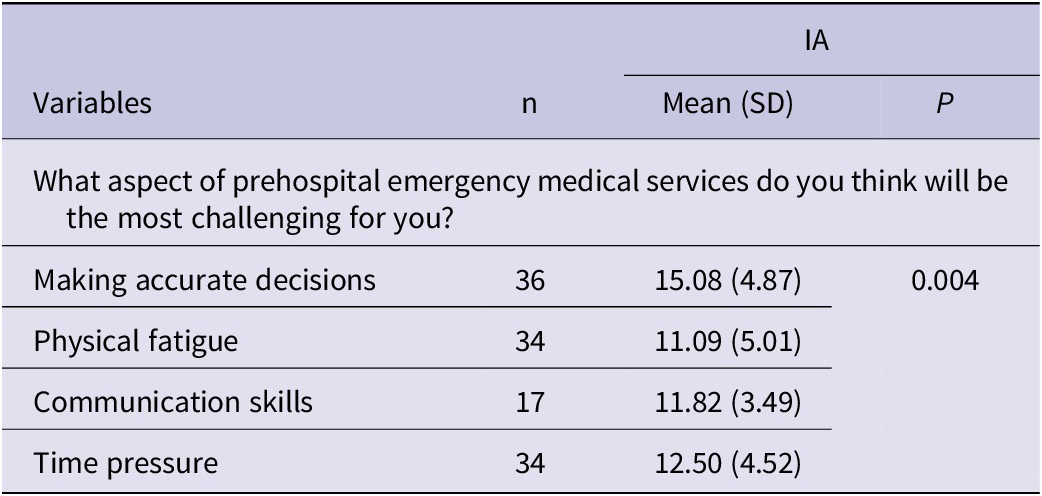
The table compares inhibitory anxiety scores across the challenge that students expected to find most difficult in prehospital emergency medical services. Mean inhibitory anxiety was 15.08 for making accurate decisions, 11.09 for physical fatigue, 11.82 for communication skills, and 12.50 for time pressure. The overall Kruskal-Wallis comparison was statistically significant (p=0.004). Values are reported as mean and standard deviation; Bonferroni-adjusted pairwise comparisons are described in the manuscript text.
Values are presented as mean (SD). Reported p values are omnibus p values obtained from Kruskal–Wallis H tests. Bonferroni-adjusted pairwise comparisons are reported in the text. n = number of participants; SD = standard deviation; IA = Inhibitory Anxiety; AD = Avoidant Decision-Making Style.
When the perceived most challenging aspects of EMS were compared across intolerance of uncertainty and decision-making styles, a significant difference was found only in the IA subdimension of the IUS (P < 0.05) (Table 7). Bonferroni post-hoc analysis showed that participants who identified “making accurate decisions” as the most challenging aspect had significantly higher IA scores than those who reported “physical fatigue” as the primary difficulty (P = 0.003). No other between-group differences in IA were statistically significant (P > 0.05).
Secondary exploratory analysis: perceived challenges

Table 7. Long description
The table presents Spearman correlations among seven IUS-12 and DMSS subscales for 121 students. Prospective anxiety correlated positively with inhibitory anxiety (rho=0.684), dependent decision-making (rho=0.369), and avoidant decision-making (rho=0.412), all p<0.001. Inhibitory anxiety correlated with dependent decision-making (rho=0.343, p<0.001), avoidant decision-making (rho=0.467, p<0.001), and spontaneous decision-making (rho=0.218, p=0.017). Rational decision-making correlated with intuitive decision-making (rho=0.309, p=0.001) and dependent decision-making (rho=0.183, p=0.045). Intuitive decision-making correlated with dependent decision-making (rho=0.249, p=0.006). Dependent decision-making correlated with avoidant decision-making (rho=0.434, p<0.001) and spontaneous decision-making (rho=0.190, p=0.037). Avoidant decision-making correlated with spontaneous decision-making (rho=0.241, p=0.008). No other correlations were statistically significant.
Values are presented as mean (SD). The reported P value is the omnibus P value obtained from the Kruskal–Wallis H test. Bonferroni-adjusted pairwise comparisons are reported in the text. n, Number of participants; SD, standard deviation; IA, inhibitory anxiety.
Spearman’s rank-order correlation analysis was conducted to examine the relationships among PA, IA, RD, ID, DD, AD, and SPD scores. PA was positively correlated with IA (ρ = 0.684, P < 0.001), DD (ρ = 0.369, P < 0.001), and AD (ρ = 0.412, P < 0.001). IA was positively correlated with DD (ρ = 0.343, P < 0.001), AD (ρ = 0.467, P < 0.001), and SPD (ρ = 0.218, P = 0.017). RD was positively correlated with ID (ρ = 0.309, P = 0.001) and DD (ρ = 0.183, P = 0.045). ID was positively correlated with DD (ρ = 0.249, P = 0.006). DD was positively correlated with AD (ρ = 0.434, P < 0.001) and SPD (ρ = 0.190, P = 0.037). AD was positively correlated with SPD (ρ = 0.241, P = 0.008). No other correlations were statistically significant.
Limitations
This study has several limitations. First, the study was conducted with students from a single First and Emergency Aid Program, which limits the generalizability of the findings to paramedic students from other institutions and to practicing prehospital emergency care personnel. Although a full enumeration approach was used within the accessible population, the findings should be interpreted within the educational and institutional context in which the data were collected.
Second, the cross-sectional design does not allow causal inferences. Therefore, the observed associations among intolerance of uncertainty, decision-making styles, perceived decision-making capacity, professional motivation, and START triage knowledge should be interpreted as correlational rather than directional or causal relationships.
Third, several variables, including perceived decision-making under stress and perceived coping with uncertainty, were based on self-report. These responses may be affected by social desirability, recall bias, and individual differences in self-perception. In addition, some of the psychosocial constructs examined in this study are conceptually related. Intolerance of uncertainty, avoidant or dependent decision-making tendencies, and perceived coping with uncertainty may reflect overlapping aspects of students’ cognitive-emotional responses to uncertain situations. Therefore, these variables should not be interpreted as fully independent explanatory factors.
Fourth, some categories in the secondary exploratory analyses included small subgroup sizes, which may reduce the stability of group comparisons and increase the risk of imprecise estimates. For this reason, findings from the secondary exploratory analyses should be interpreted as hypothesis-generating rather than confirmatory. Future studies should use larger, multicenter samples and simulation-based or field-based triage assessments to examine whether intolerance of uncertainty and decision-making styles influence actual START triage performance under realistic prehospital conditions.
Fifth, the START-related outcome was limited to paper-based theoretical knowledge. The instrument assessed declarative understanding of the START algorithm, and the participants were paramedic students with limited or no real-world START experience. Accordingly, the findings should remain confined to theoretical START knowledge and should not be extended to the application of the algorithm in other contexts. Future studies should use simulation-based, scenario-based, or observational measures to investigate applied START outcomes separately.
Discussion
The primary finding of this study was that paper-based theoretical START triage knowledge was not significantly associated with intolerance of uncertainty or decision-making style scores among paramedic students. This null finding indicates only that the measured psychosocial characteristics were not associated with declarative START knowledge in this sample. The outcome did not include the application of START in simulated, scenario-based, or field settings. In the present sample, the START Triage Knowledge Test yielded a KR-20 coefficient of 0.741, whereas the original validation study reported a KR-20 coefficient of 0.563. The current-sample coefficient was used when interpreting the internal consistency of the theoretical knowledge scores in the present analyses; nevertheless, the construct assessed remained limited to theoretical START knowledge.
The secondary exploratory analyses identified differences in self-reported prospective anxiety, inhibitory anxiety, dependent decision-making, and avoidant decision-making scores across categories of perceived decision-making under stress and perceived coping with uncertainty. Students who rated themselves more favorably on these self-evaluations also reported lower scores on selected psychosocial subscales. Because these analyses were cross-sectional, based on self-report, and included small subgroups, the findings should be interpreted only as observed associations among conceptually related constructs and as hypothesis-generating rather than directional or causal evidence.
Professional motivation was associated with selected self-reported psychosocial scores. Students who reported job opportunities as their primary reason for choosing the paramedic profession also reported higher inhibitory anxiety and avoidant decision-making scores than selected comparison groups. This observed association should be interpreted cautiously and does not establish directionality, causality, reduced coping capacity, impaired decision quality, or future professional functioning. Professional motivation was assessed using a single categorical item, and the subgroup findings were exploratory.
The additional consideration of relationships among the IUS-12 and DMSS subscales supports the view that intolerance of uncertainty and decision-making styles should not be treated as isolated psychological predictors. Rather, these constructs may represent overlapping but distinct dimensions of students’ cognitive-emotional responses to uncertainty. Conceptually comparable findings have been reported across clinically and educationally distinct populations. Danışman and Zengin İspir found that intolerance of uncertainty was associated with maladaptive decision-making styles among current opioid users, individuals in remission, and healthy controls.Reference Danışman and İspir 18 Similarly, Sagone and Indiana reported among university freshmen that prospective and inhibitory intolerance of uncertainty were positively associated with doubtfulness and proxy decision-making styles and negatively associated with a more functional “no problem” style.Reference Sagone and Indiana 19 Although both studies used decision-making measures that differed from the DMSS, their findings are broadly consistent with the positive associations observed in the present study between prospective and inhibitory anxiety and dependent and avoidant decision-making styles. Taken together, these findings support the interpretation that uncertainty-related tendencies and decision-making styles may covary across populations and may be more closely related to decision-process characteristics than to declarative knowledge itself. However, this conceptual convergence should not be interpreted as evidence that intolerance of uncertainty influences theoretical START knowledge or applied triage performance. Accordingly, the present findings should be interpreted as describing patterns of association among related psychosocial characteristics within the context of theoretical START triage knowledge.
Overall, the findings suggest that theoretical START triage knowledge and perceived decision-making capacity may represent different educational and psychological domains. While paper-based START knowledge reflects declarative understanding of triage principles, perceived decision-making under stress and coping with uncertainty may be more closely related to affective and cognitive self-appraisal. These findings emphasize the need to maintain a clear distinction between theoretical knowledge acquisition and the application of START in practice-oriented settings. START principles may continue to be taught as a structured knowledge framework. However, whether uncertainty-management training, reflective exercises, or time-pressured simulation activities influence applied START outcomes must be evaluated separately in appropriately designed educational studies.
The interpretation of these findings should also consider the developmental and educational status of the participants. Much of the literature on clinical decision-making under uncertainty is based on practicing clinicians or experienced emergency care professionals. In contrast, the present sample consisted of paramedic students with limited or no real-world START triage experience. Therefore, comparisons with professional samples should be made cautiously. The findings may be more appropriately understood as reflecting students’ perceived decision-making capacity, uncertainty-related anxiety, and theoretical triage knowledge during training, rather than established decision-making behavior in actual prehospital practice.
Theoretical START triage knowledge was not significantly associated with prospective anxiety, inhibitory anxiety, or any decision-making style subscale. Because all coefficients were statistically non-significant, their positive or negative directions should not be interpreted as evidence favoring or disadvantaging any particular decision-making style. The present findings therefore do not support conclusions regarding how rational, intuitive, dependent, avoidant, or spontaneous tendencies relate to the application of START. Such relationships should be investigated in future studies using simulation-based or observational outcome measures.
Croskerry’s framework concerns cognitive biases in clinical decision-making and therefore provides conceptual background rather than directly comparable evidence for the present knowledge-based outcome.Reference Croskerry 20 Because none of the correlations between decision-making style scores and theoretical START knowledge was statistically significant, the present data do not support conclusions regarding cognitive bias, error risk, or the comparative value of specific decision-making styles in the application of START. These questions may be examined in future simulation-based studies designed to capture applied decision processes.
Conclusion
In this sample, paper-based theoretical START triage knowledge was not significantly associated with intolerance of uncertainty or decision-making style scores. The secondary exploratory findings were limited to associations among self-reported psychosocial characteristics, including perceived decision-making under stress, perceived coping with uncertainty, professional motivation, and perceived challenges in prehospital emergency care. These findings should remain confined to declarative START knowledge and self-reported psychosocial constructs. The study did not assess the application of START in simulated or field settings. Future research using simulation-based, scenario-based, or observational outcome measures is required before conclusions can be drawn regarding applied START decision-making.
During manuscript preparation, an AI-based language model (ChatGPT; OpenAI) was used solely for grammatical editing, spelling, and improving clarity and readability of the text. The tool was not used for study conceptualization, design, data collection, statistical analysis, interpretation of findings, or generation of results. The authors take full responsibility for the scientific content, analyses, and the final version of the manuscript.
Author contribution
BT: Study conception and design, data collection, data analysis and interpretation. GÖY: Study conception and design, interpretation, drafting of the article, critical revision of the article. AT: Study conception and design, data analysis and interpretation, drafting of the article.
Competing interests
None.





 Open access

