Introduction
There is a growing epidemic of chronic disease in developing countries, with 80% of all chronic disease deaths occurring in low and middle income countries.1 Mounting evidence has linked a poor fetal environment to adverse cardiometabolic outcomes in later life. Small size at birth has been associated with an elevated risk of hypertension and type 2 diabetes among adults.Reference Huxley, Shiell and Law2, Reference Whincup, Kaye and Owen3 Long-term studies of survivors of famineReference Roseboom, van der Meulen and Ravelli4 and dietary manipulation studies in animals have provided evidence that maternal undernutrition, specifically, may be one of the root causes of these adverse outcomes. Yet, most of the studies have focused on global dietary restriction or protein restriction during gestation.Reference McMillen and Robinson5 Specific micronutrients have received little attention, particularly among human populations,Reference Christian and Stewart6 despite evidence of the prevalence of micronutrient deficiencies in the developing world.
Vitamin A deficiency is common in much of the developing world. World Health Organization (WHO) has estimated that 190 million preschool-aged children and 19.1 million pregnant women have low serum retinol concentrations (<0.70 μmol/l).7 Approximately 6% of deaths and 5% of the disability-adjusted life years lost among children <5 years have been attributed to vitamin A deficiency.Reference Black, Allen and Bhutta8 In the terai region of Nepal, we reported that maternal supplementation with vitamin A or β-carotene resulted in a 40% reduction in maternal mortality in a placebo-controlled trial.Reference West, Katz and Khatry9 Vitamin A deficiency during pregnancy was common in that setting, as indicated by a prevalence of night blindness during pregnancy of 16%,Reference Katz, Khatry and West10 a risk that was associated with increased maternalReference Christian, West and Khatry11 and infant mortality.Reference Christian, West and Khatry12 Supplementation, however, had no impact on neonatal or early infant mortalityReference Katz, West and Khatry13 or neonatal weight.Reference Dreyfuss, West and Katz14
Normal fetal cardiovascular and renal development is dependent upon retinoic acid, the biologically active form of vitamin A.Reference Pan and Baker15, Reference Burrow16 Severe deficiency has been associated with cardiac malformations, including interventricular septal defects and deformities of the ventricular outflow tract and aortic arch.Reference Wilson, Roth and Warkany17, Reference Wilson and Warkany18 Even relatively mild vitamin A deficiency has been found to cause defects in nephrogenesis,Reference Lelievre-Pegorier, Vilar and Ferrier19 one of the key pathways proposed in the development of hypertension.Reference Bhat and Manolescu20 Data are lacking in population-based studies, however, particularly in the context of randomized micronutrient interventions.
Given the high likelihood of in utero vitamin A deficiency in this setting, we hypothesized that maternal supplementation with vitamin A or β-carotene, as a vitamin A precursor, may have enhanced fetal cardiovascular development and conferred protection against early development of cardiovascular risk factors later in life. To examine this possibility, in 2006–2008, we revisited the children born in that trial, who were between 9 and 13 years of age at follow-up, to measure a variety of cardiometabolic, pulmonary and anthropometric outcomes. We report here on the effect of maternal supplementation with vitamin A or β-carotene on markers of cardiometabolic risk, including blood pressure, plasma glucose and lipid levels and microalbuminuria.
Methods
This study has drawn upon a cohort of children whose mothers had been participants in a randomized, placebo-controlled trial of vitamin A or β-carotene supplementation from 1994 to 1997, the details of which have been previously described.Reference West, Katz and Khatry9 Briefly, the study was conducted in the rural, low-lying Sarlahi District of Nepal, enrolling approximately 45,000 married women of reproductive age. The study area comprises 30 village development communities, each divided into 9 administrative wards. Women were randomized by ward to receive weekly supplementation with a placebo or 7000 μg retinol equivalents of either preformed vitamin A (23,300 IU retinyl palmitate) or β-carotene (42 mg). Over a study period from July 1994 to June 1997, a total of 17,531 infants were born to women enrolled in the trial. Women were supplemented before, during and after pregnancy throughout the study period. Infants born during the trial were visited at 3 and 6 months of age to assess health and vital status. Within 27 contiguous wards, selected for access purposes, a subsample of women and children were invited to participate in an enhanced set of assessments including biospecimen collection from the mothers and infants.
Periodic contact with participants has been maintained due to the project’s continued presence in the study area. Although not recorded, from 6 to 59 months of aged children in the study area had likely received semi-annual vitamin A supplementation through the Nepal National Vitamin A Program, a highly successful program targeting children semi-annually with high-dose capsules (100,000 IU for children 6–12 months and 200,000 IU for children 12–59 months), which has reported a national coverage rate >90%.21 Also from 2000 to 2001, a complete census of the population residing in the study area was conducted, during at which time participants’ household addresses and vital status were updated. Individuals who had moved were tracked to their new household. In 2006, just prior to the start of the follow-up study, a study-wide update of addresses was undertaken at which time the vital status of individuals within households was also updated. From 2006 to 2008, children born to women in the vitamin A/β-carotene supplementation trial who were known to be alive and with confirmed household addresses were targeted for follow-up (n = 15,942) during a series of up to three household visits.
During the first visit, field workers conducted interviews with the child’s caregiver on the household socioeconomic status, child education and literacy. With the child rested and in a seated position with back and feet supported, the child’s blood pressure was measured four times on the right arm using an automated measurement device (BPM-300, BPTrue, Canada) with a cuff size appropriate for the arm circumference of the child. The first measure was dropped and the mean of the last three used for analysis. Children born to women in the substudy area were also visited by a specialized team who conducted anthropometry, measured lung function using a portable handheld spirometer (Spiropro, JAEGER/Cardinal Health, Hoechberg, Germany), and measured grip strength using a Jamar handheld dynamometer (Sammons Preston, Bolingbrook, IL, USA). Anthropometric assessments included standing height measured by using a portable stadiometer (Harpenden, Crosswell, UK), weight using an electronic scale (Model 881, Seca, Hamburg, Germany), mid–upper arm circumference using a standard insertion tape, triceps skinfold and subscapular skinfold thicknesses using precision calipers (Holtain, Crymych, UK) and waist circumference using a long insertion tape (Model 200, Seca). Children were then asked to fast overnight and were visited the following morning by a team of phlebotomists who collected early morning venous blood and urine specimens. Specimens were transported on ice to the field laboratory for processing.
In urine specimens, the microalbumin/creatinine ratio was assessed using standard test kits with the DCA 2000 analyzer (Bayer Diagnostics, New York). Glycated hemoglobin (HbA1c) was measured in whole blood on the day of collection, also using the DCA 2000 analyzer. Total and high-density lipoprotein cholesterol, triglycerides and glucose were measured in plasma specimens using standard enzymatic methods (LDX Analyzer, Cholestech, Hayward, CA, USA). Low-density lipoprotein cholesterol was calculated by using the Friedewald equation.Reference Friedewald, Levy and Fredrickson22 Of the children who provided blood specimens (n = 1170), 305 (26%) were not fasted, defined as no food or drink other than water within 8 h of the blood draw. Glucose and triglyceride data were only analyzed among children who were fasted (n = 864).
This original trial received ethical approval from the Joint Committee on Clinical Investigation at the Johns Hopkins School of Medicine and the Nepal Health Research Council, Kathmandu, Nepal. The follow-up study was approved by the Institutional Review Boards at the Johns Hopkins Bloomberg School of Public Health and the Institute of Medicine in Kathmandu, Nepal.
Data analysis
The children who were enrolled in the follow-up study were compared with those who were lost to follow-up on the basis of data collected from the mother and the household during pregnancy. Children who were enrolled were compared with all of the children born during the trial, who could not be contacted at follow-up, excluding known deaths. Continuous variables were examined by using the t-test and categorical outcomes using the χ 2 test. In addition, these baseline characteristics were compared across supplement groups in the follow-up cohort to examine whether comparability between the randomized groups was maintained. Factors that differed significantly between supplement groups were controlled for in final analyses of effect estimation.
As blood pressure was measured in all children, but anthropometry that included height was measured only in the subsample, high blood pressure was defined in two ways: (1) ⩾120/80 mm Hg (for the entire sample) and (2) ⩾90th percentile for age, gender and height23 (for the subsample with height measurements). The first is the recommended cutoff for pre-hypertension in adultsReference Chobanian, Bakris and Black24 and the second is the recommended definition of pre-hypertension in children.23 Adult cutoffs may be too high in child populations given the correlation between blood pressure and height.23 Microalbuminuria was defined as a urinary microalbumin/creatinine ratio ⩾30 mg/g. High waist circumference and body mass index (BMI) were defined as ⩾85th percentile of the study cohort.
The primary outcome measures for this analysis were blood pressure, evaluated both as a continuous and dichotomous variable and microalbuminuria. The difference in mean blood pressure was tested by using generalized estimation equations (GEE) with a robust estimation of the variance to account for the fact that randomization occurred by ward, not individually.Reference Zeger and Liang25 Odds ratios and 95% confidence intervals for high blood pressure and microalbuminuria were calculated by using GEE logistic models. Adjusted models controlled for the children’s sex and age at follow-up because of their known correlation with the microalbumin/creatinine ratio and blood pressure among children.23, Reference Jones, Francis and Eberhardt26 HbA1c followed a normal distribution and was analyzed by using a GEE linear regression model. Glucose, triglycerides and cholesterol had a skewed distribution and were thus analyzed on the log scale using a GEE linear regression model with a log link.Reference Zeger, Liang and Albert27
Interactions between maternal supplementation and child BMI and waist circumference were tested because of previously documented interactions between the prenatal and postnatal nutritional environment.Reference Hawkesworth, Prentice, Fulford and Moore28 We also tested for interactions with child age and gender. Models were tested by including an interaction term with each of the supplementation groups and examining its significance. A P-value for interaction <0.1 was considered statistically significant. Data were analyzed by using Stata v.11 (StataCorp., College Station, TX, USA).
Results
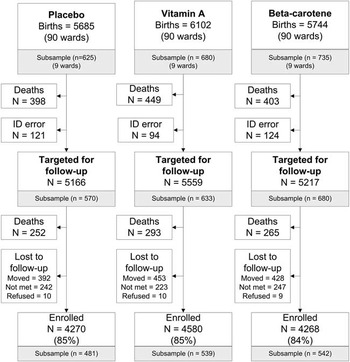
Of the 17,531 children born during the trial, a total of 15,942 children were targeted for follow-up because these infants were known to have survived through the end of the study period and there were sufficient identified data to track the children. Of these targeted children, a total of 810 children had died, and 1273 children had moved out of the study area, 712 children could not be met at their home despite repeated attempts and 29 children refused to participate in all follow-up visits (Fig. 1). Roughly, 85% of surviving children were enrolled in the follow-up study, which was comparable across original supplement groups. There were no differences in survival or loss to follow-up between groups. Within the substudy area, the proportion of targeted children who were successfully contacted was similar to the study as a whole (84%). Of these, 204 children (15%) refused to provide a blood sample and 305 (26%) children had not fasted when their blood was drawn. The mean (s.d.) age at follow-up was 11.1 (0.8) years, which did not differ by intervention group. Age and gender distributions of the children who had moved out of the study area or were not met by study staff (i.e. missed) were comparable with those enrolled at the follow-up visit (data not shown). However, there were some other differences. Children missed at follow-up tended to reveal home settings during the original trial that reflected a more ‘urban’ nature: they were slightly less likely to own land (71% v. 78%; P < 0.001) and livestock, such as cattle (58% v. 71%; P < 0.001) and goats (46% v. 53%; P < 0.001), but more likely to own a radio (33% v. 29%; P = 0.001). Their mothers were more likely to be literate (23% v. 15%; P < 0.001) and their fathers were less likely to report a primary occupation of farming (44% v. 56%; P < 0.001). They were also more likely to be members of ‘higher’ castes (i.e. Brahmin or Chetri) than those followed (21% v. 15%; P < 0.001).
Follow-up rates of children born during the trial at the age of 9–13 years in 2006–2008. Twenty-seven wards served as a selected subsample area for an enhanced series of assessments. The follow-up rates for children in the subsample wards are shown in gray. Children were considered lost to follow-up if we were unable to contact them due to errors in their identifying information (2%), who moved out of the study area (7%), who were not met in their household during the follow-up period (4%) or who refused to participate (<1%).

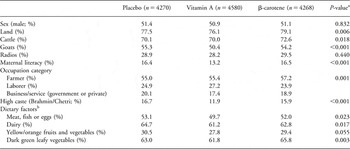
Small and inconsistent, although statistically significant, differences in original trial characteristics revealed the three groups of offspring to be comparable in their household socioeconomic status and maternal dietary patterns, serving as a proxy for ambient nutritional exposures, during pregnancy (Table 1). Ages of children at the time of follow-up were comparable, with a mean age of 10.4 ± 0.71 years. Just over 50% were male, which did not differ by supplement group. Girls were asked about menstrual history and only 1.6% reported that they had reached menarche. Households in the substudy area were fairly comparable with those in the rest of the study area in terms of livestock ownership, educational attainment, literacy and child characteristics such as age and gender. However, the families of children in the substudy area were somewhat more likely to own land (82% v. 76%) or a radio (33% v. 28%) and less likely to report an occupation of farming (50% v. 57%) compared with families in the rest of the study area.
Comparability across supplement groups at follow-up, comparing child gender and household characteristics assessed during pregnancy, 1994–1997, for children assessed in the follow-up study

aP-values calculated using the χ 2 test.
bReported consumption in a 1-week period during late pregnancy: meat, fish or eggs includes one or more servings of any meat, large fish, small fish, snails or eggs; dairy includes one or more servings of milk, yoghurt, whey or cream; yellow/orange fruits and vegetables includes one or more servings of carrots, ripe pumpkin, mango, papaya, or oranges; dark green leafy vegetables (DGLV) includes one or more servings of either fresh or dried DGLV.
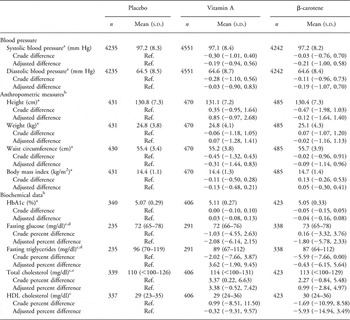
The mean systolic blood pressure (SBP) of children in the placebo group was 97.2 ± 8.3 mm Hg (Table 2). Children in the vitamin A or β-carotene groups did not differ significantly from this in crude models (mean difference, vitamin A: −0.30; 95% CI: −1.01, 0.40 and β-carotene: −0.03; −0.76, 0.70), or after adjustment for the child’s age or gender. There were no differences after further adjustment for socioeconomic factors such as land or livestock ownership, maternal literacy, paternal occupation and caste or maternal dietary intakes of meat, dairy, fruit and vegetables during late pregnancy. There were also no significant differences in HbA1c, glucose, cholesterol or triglycerides between supplement groups.
Differences in cardiometabolic characteristics of children aged 9-13 years in 2006-2008 by maternal supplement group

aDifferences tested using a GEE linear regression model comparing each supplement group to the placebo. Adjusted models controlled for age, gender, land or livestock ownership, maternal literacy, paternal occupation and caste, or maternal dietary intakes of meat, dairy, fruits and vegetable during late pregnancy. No differences were significantly different in adjusted models (P > 0.05 for all).
bAnthropometric and biochemical data were only collected in the subsample.
cGlucose, triglycerides, total cholesterol and HDL cholesterol had skewed distributions and are expressed with median (Intraquartile range, IQR). Differences were tested using a GEE linear regression model with a log link comparing each supplement group to the placebo. No differences were significantly different in adjusted models (P > 0.05 for all).
dGlucose and triglycerides were only analyzed for children who had fasted on the morning that blood was collected (n = 864).
e26% of children had a total cholesterol estimate lower than the detectable limit of the assay (100 mg/dl) and thus, the lower IQR is reported as <100.
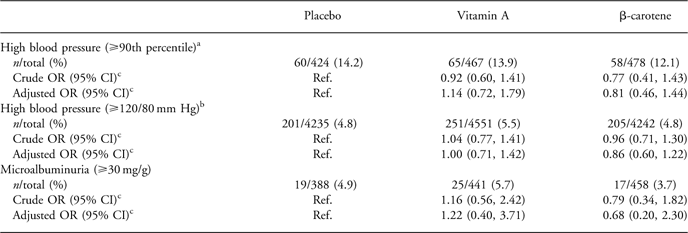
There was no overall difference in the risk of hypertension or microalbuminuria between supplement groups (Table 3). Among the entire sample, 657 (5.0%) children had either an SBP or diastolic blood pressure ⩾120/80 mm Hg; 201 (4.8%) children in the placebo, 251 (5.5%) children in the vitamin A and 206 (4.8%) children in the β-carotene groups. Within the subsample, a total of 183 children – 60 (14.1%) in the placebo, 65 (13.9%) in the vitamin A and 58 (12.1%) in the β-carotene groups – were classified as hypertensive (⩾90th percentile). Using a more stringent cutoff of ⩾95th percentile, 24 (5.6%), 38 (8.1%) and 26 (5.4%) children were classified as hypertensive in the placebo, vitamin A and β-carotene groups, respectively. In addition, the number (%) of children with a high urinary microalbumin/creatinine ratio was 19 (4.9%), 25 (5.7%) and 17 (3.7%) in the placebo, vitamin A and β-carotene groups. None of these differences were statistically significantly different in crude or adjusted models (P > 0.05 for all).
Risk of hypertension and micro-albuminuria among children 9–13 years of age in 2006–2008, by maternal supplement group
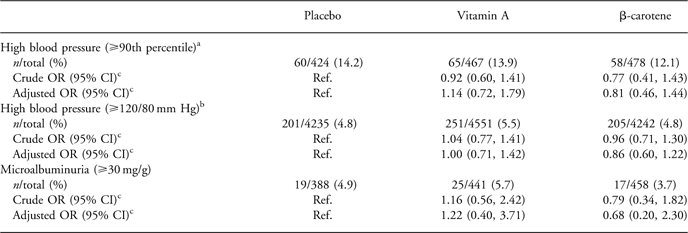
OR, odds ratios; CI, confidence interval.
aIn the sub-sample, risk of hypertension defined as ⩾90th percentile of the reference population,23 controlling for age, gender and height.
bIn the whole sample, a definition of hypertension of ⩾120/80 mm Hg was used.
cOR and 95% CI were calculated by using a generalized estimation equations logistic model with a robust variance estimation. Adjusted models controlled for age, gender, land or livestock ownership, maternal literacy, paternal occupation and caste or maternal dietary intakes of meat, dairy, fruits and vegetable during late pregnancy.
There was an interaction (P < 0.10) between maternal supplement group and waist circumference in childhood on the risk of hypertension. Among children with a high waist circumference (⩾85th percentile), there was evidence of a protective effect of both vitamin A and β-carotene, although it was statistically significant only for the latter. Compared with children in the placebo group in the high waist circumference stratum, the risk of hypertension was 58% lower (OR: 0.42; 95% CI: 0.16–1.09) among children in the vitamin A group and 71% lower (OR: 0.29; 95% CI: 0.09–0.97) among children in the β-carotene group. For those in the low waist circumference stratum, there were no differences between the supplement groups. In contrast, there was no evidence of an interaction of the maternal supplement group with current child BMI, child age or sex. There was also no interaction between maternal supplement allocation and any of these factors on the risk of microalbuminuria.
In general, female children had higher blood pressure than male children and blood pressure increased with age. On average, females had an SBP that was 1.01 mm Hg greater than males (95% CI: 0.72–1.29). The difference became greater after adjustment for age and height (1.33 mm Hg; 95% CI: 0.48–2.19). SBP increased 0.20 mm Hg (95% CI: −0.05, 0.45) and 0.51 mm Hg (95% CI: 0.24, 0.78) per year for males and females, respectively. Child BMI and waist circumference were also both significantly associated with blood pressure. SBP rose by 1.09 mm Hg (95% CI: 0.67–1.52) and 0.76 mm Hg (95% CI: 0.33–1.18) with each s.d. increase in BMI and waist circumference, respectively.
Discussion
We report here the findings of a randomized controlled trial of maternal vitamin A or β-carotene supplementation from pre-pregnancy through the post partum period on child cardiovascular risk factors at the ages of 9–13 years in a poor, rural community with a high prevalence of maternal vitamin A deficiency.Reference Christian, West and Khatry11 We found no evidence of an overall effect of maternal supplementation with vitamin A or β-carotene on blood pressure or risk of microalbuminuria up to this age in this population. However, maternal supplementation with vitamin A or β-carotene may have conferred some benefit by reducing the risk of hypertension among children who had a relatively high waist circumference, an interaction not observed among those with high BMI. There were no other significant differences among supplemented groups on other biochemical indices of health measures at follow-up.
Undernutrition in early life was common in this cohort. Although few infants were measured at birth, neonatal weights were measured at a mean of 10 ± 4.2 days after delivery. At that time, the mean weight was 2.7 ± 0.5 kg and 30% were below 2.5 kg.Reference Dreyfuss, West and Katz14 During pregnancy, 8.4% of the mothers experienced night blindness,Reference Christian, West and Khatry11 a clinical symptom of vitamin A deficiency, and of the subsample of women with biochemical measures, 11.6% had low serum retinol.Reference West, Katz and Khatry9 Vitamin A is critical for normal fetal cardiovascular and renal development. Retinoic acid, the biologically active form of vitamin A, serves as an important cardiovascular and nephrogenic signaling molecule and morphogen during the embryonic and fetal periods.Reference Pan and Baker15, Reference Zile29, Reference Zile30 Animal studies reveal a linear association between circulating fetal plasma retinol and the number of glomeruli within the kidney.Reference Lelievre-Pegorier, Vilar and Ferrier19 Moreover, experimental maternal vitamin A deficiency may result in a permanent nephron reduction.Reference Lelievre-Pegorier, Vilar and Ferrier19 Retinoids control c-ret gene expression, which regulates the growth and development of the ureteric bud, a critical step in nephron development.Reference Gilbert31 In adulthood, rats exposed to vitamin A deficiency in utero go on to develop hypertension.Reference Merlet-Bénichou32 Thus, there is evidence from animal models to suggest that vitamin A deficiency during gestation has long-term consequences.
Although a number of randomized controlled trials of prenatal protein energy,Reference Hawkesworth, Prentice, Fulford and Moore28 calciumReference Hiller, Crowther, Moore, Willson and Robinson33–Reference Hawkesworth36 and multiple micronutrientReference Vaidya, Saville and Shrestha37–Reference Stewart, Christian and Schulze39 supplements have reported effects on blood pressure in the offspring, this paper is, to our knowledge, the first to report the effects of maternal vitamin A or β-carotene supplementation on cardiovascular health in a human population. In this same community in Nepal, we have recently reported the effects of maternal micronutrient supplementation during pregnancy on similar outcomes in the offspring between the ages of 6–8 years.Reference Stewart, Christian and Schulze39, Reference Stewart, Christian, LeClerq, West and Khatry40 We found that antenatal supplementation with folic acid was associated with a 44% reduction in the risk of microalbuminuria, an indicator of kidney dysfunction, and a 37% reduction in the risk of metabolic syndrome compared with children in the control group, but none of the supplements had an effect on blood pressure.Reference Stewart, Christian and Schulze39 In that trial, vitamin A served as the control and was contained in each of the intervention supplements, preventing any opportunity to examine the effects of maternal vitamin A receipt on long-term health indicators among offspring. A maternal intervention trial in a neighboring region of Nepal with similar nutritional characteristics reported a significant reduction of 2.5 mm Hg (95% CI: 0.5–4.6) at age 2.5 years of age with a maternal multiple micronutrient supplement that contained vitamin A compared with iron + folic acid as the control.Reference Vaidya, Saville and Shrestha37 The apparent lack of an effect in this paper suggests that the vitamin A in that multiple micronutrient supplement did not contribute to this effect.
Some have suggested that a mismatch between the prenatal and postnatal nutritional environment is an important contributor to the development of cardiovascular risk.Reference Gluckman, Hanson and Beedle41 There was some indication that this may have occurred in this cohort, where vitamin A or β-carotene appeared to be protective only among children who had a higher waist circumference relative to other members of this population. Blood pressure did increase with BMI and waist circumference, as has been reported in numerous populations. Yet, overweight or obesity is virtually absent in this context. The mean BMI for age z-score in this cohort was −1.83 and only four children had a BMI >85th percentile of the WHO child growth standard.Reference de Onis, Onyango and Borghi42 It is possible that if more children had gone on to become overweight, a greater difference between groups may have been observed. Blood pressure is known to vary with age, gender and anthropometric measures of body size, such as height, in children.23 Roughly 5% of children had a blood pressure measure ⩾95th percentile for age, gender and height of the US reference population. We observed that girls had a slightly higher SBP than boys, which remained significant after controlling for age and height. This differs from what has been reported in other populations,23, Reference Jafar, Islam and Poulter43, Reference Syme, Abrahamowicz and Leonard44 although the reasons for this difference are unclear. In the United States, the prevalence of hypertension at similar ages (8–17 years) was reported to be lower, at 2.6% for boys and 3.4% for girls in 2003–2006.Reference Stewart, Christian, LeClerq, West and Khatry40 In comparison, a nationally representative study in Pakistan reported the prevalence of hypertension (⩾95th percentile of the US reference population) to be 15.8% and 8.7% in 5–14-year-old boys and girls, respectively.Reference Ostchega, Carroll and Prineas45
This study has a number of important strengths and limitations. It presents data from a large cohort of more than 13,000 children who were born to mothers who had enrolled in a randomized controlled trial of vitamin A or β-carotene supplements that began prior to pregnancy and continued through the post partum period.Reference West, Katz and Khatry9 More than half of all women consumed ⩾80% of their intended supplements through pregnancy and postpartum.Reference West, Katz and Khatry9 A high rate of follow-up was achieved, with no differential losses and a high degree of comparability across groups. This study design therefore minimized the risk of confounding and allowed us to draw potential causal inferences into the effects of these two nutrients during gestation on blood pressure and microalbuminuria. On the other hand, there are some important limitations to note. Although all of the children had blood pressure measured at follow-up, a smaller subsample, defined at the outset of the earlier trial, was targeted for the enhanced series of assessments, including biochemical measures and complete anthropometry. Thus, there was a relatively high percentage of missing data on some of the biochemical measures because of refusals. Notably, glucose and triglycerides had the greatest amount of missing data because only fasting data were analyzed. With this smaller sample size, we had a power of only 15–38% to detect the observed differences between groups. In addition, the prevalence of hypertension and micro-albuminuria was only 5% in this cohort, reflecting a low disease risk and power to detect risk factors, at the age of 9–13 years, in this population. Finally, differences between those who were not followed and those who were revisited suggest that the present observations may be more relevant to a strictly rural population, having excluded more individuals with a slightly more urban orientation.
Conclusion
In conclusion, maternal vitamin A or β-carotene supplementation under conditions of persistent undernutrition does not appear to affect cardiovascular risk factors among pre-pubescent offspring. There was a suggestion of an interaction with high waist circumference, but more data are needed to draw stronger conclusions. It is possible that improved fetal vitamin A nutriture achieved via maternal supplementation could offer a benefit if these children go on to develop an increased prevalence of overweight or at older ages. Future follow-up assessments in this population could evaluate this effect in the presence of any transition toward overweight and obesity in the population.
Acknowledgements
This follow-up study was carried out by the Center for Human Nutrition at the Johns Hopkins Bloomberg School of Public Health in collaboration with the National Society for the Prevention of Blindness (Kathmandu, Nepal) with funding from Grant no. 614 from the Bill and Melinda Gates Foundation, Seattle, WA, USA. The original Nepal Nutrition Intervention Project – Sarlahi (NNIPS)-2 trial was supported through the Vitamin A for Health Cooperative Agreement no. HRN-A-00-97-00015-00 between Johns Hopkins University and the Office of Health, Infectious Diseases and Nutrition, United States Agency for International Development (USAID), Washington, DC, USA, with additional support from the Sight and Life Research Institute, Baltimore, MD, USA and Basel, Switzerland.
Statement of Interest
None.