1. Introduction
Rev 17.14 and 19.16 apply the title βασιλεὺς βασιλέων (‘king of kings’) to Jesus Christ as a victorious epithet, but its significance and meaning has been a subject of much debate. The former passage uses the title within the context of the first act of the judgement on ἡ πόρνη ἡ μεγάλη (‘the Great Whore’) and τό θηρίον (‘the Beast’) in 17.1–18.Footnote 1 The latter passage applies the title to Jesus, presented as defeating the forces of wickedness, riding a white horse (Rev 19.11–16). Some commentators suggest that the title derives from the Septuagint of Dan 4.37, ‘where it is a title for God’.Footnote 2 Others argue that the title is especially apposite during the reign of Domitian, of whom it is said: ‘he dictated the form of a letter to be used by his procurators, he began: “Our lord and god commands so and so.”’Footnote 3 Still others suggest that the title is borrowed from a Babylonian context, and therefore operates as a polemic against Revelation's latter day Babylon, that is, Rome.Footnote 4 This broad spectrum of scholarly views reveals a fundamental disagreement on the relevant cultural and textual foreground/background of the title in Revelation. The present analysis will explore inscriptions on relevant numismatic material and investigate whether the title in Revelation is indebted to a particular cultural context.
The trajectory of this paper is part of a larger project entitled Numismatics and Greek Lexicography,Footnote 5 which explores the implications of the numismatic material for contributions to lexicography, particularly as it pertains to linguistic features of post-classical Greek. The working aim and methodology adopted in both that larger work and this paper can be summarised as follows: to employ dated and geographically legitimate comparative numismatic data in order to refine, illuminate and clarify the relevant semantic domains of New Testament vocabulary, with a particular interest in New Testament exegetical difficulties.
2. The History of ΒΑΣΙΛΕΥΣ ΒΑΣΙΛΕΩΝ
The Greek title βασιλεὺς βασιλέων (‘king of kings’) has a long history. Although J. C. Rolfe states that it is ‘a title originally applied to the king of Persia and transferred to the king of the Parthians’,Footnote 6 Lowell Handy finds earlier attestation. Handy traces the earliest reference of the title ‘king of kings’ (šar šarrāni) to a royal title for king Tukulti-Ninurta I of Assyria who reigned 1244–1208 bce.Footnote 7 Within the expanding Assyrian empire, the title was applied literally, that is, the Assyrian rulers installed themselves as rulers over the existing structure of the local city-state kings. The Babylonian king Nebuchadnezzar is referred to in Hebrew as מֶלֶךְ מְלָכִים (Ezek 26.7) and in Aramaic as מֶלֶךְ מַלְכַיָּא (Dan 2.37). These and other attestations establish the phrase as derivative of Semitic background.Footnote 8 However, the title is also regularly employed in a Persian context: ‘Artaxerxes, king of kings (מֶלֶךְ מַלְכַיָּא), to the priest Ezra, the scribe of the law of the God of heaven’ (Ezra 7.12).Footnote 9 Ernst Fredricksmeyer tabulates thirty-nine occurrences of ‘king of kings’ in the Persian Achaemenid dynasty inscriptions (553–330 bce) published by Ronald Kent.Footnote 10 The phrase in an Egyptian context is attested by Diodorus of Sicily, the first-century bce historian, who in a description of a monument of Ozymandias (one of the royal names for Ramses)Footnote 11 relates: ἐπιγεγράφθαι δ᾿ ἐπ᾿ αὐτοῦ· Βασιλεὺς βασιλέων Ὀσυμανδύας εἰμί. εἰ δέ τις εἰδέναι βούλεται πηλίκος εἰμὶ καὶ ποῦ κεῖμαι, νικάτω τι τῶν ἐμῶν ἔργων (‘Inscribed upon it is: “King of kings Ozymandias I am. If anyone wishes to know how great I am and where I lie, let him outdo me in my deeds”’).Footnote 12
3. Numismatic Evidence
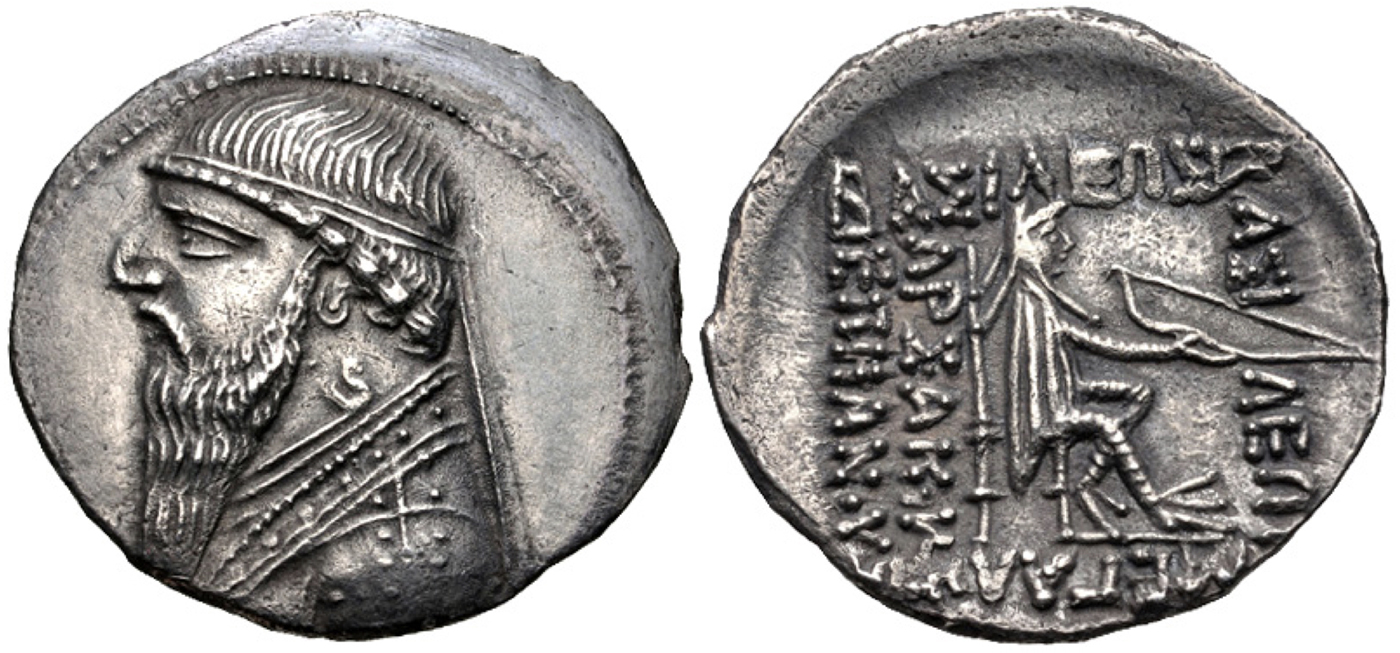
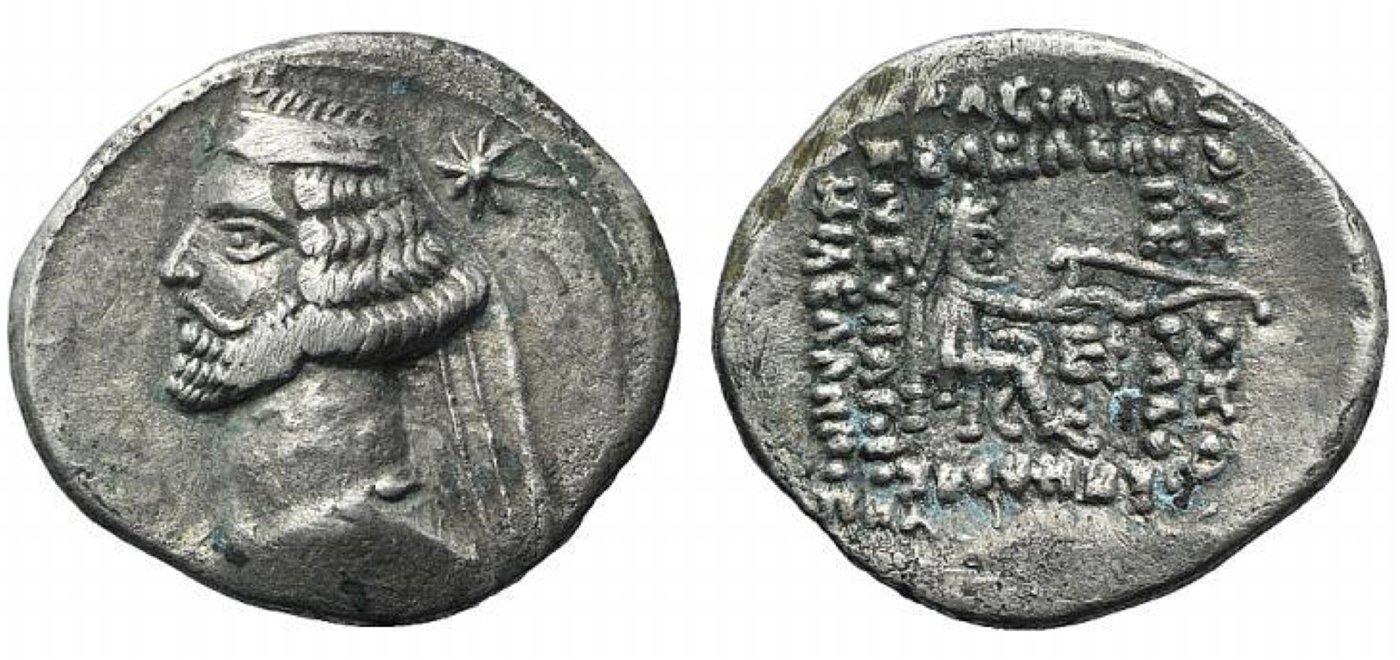
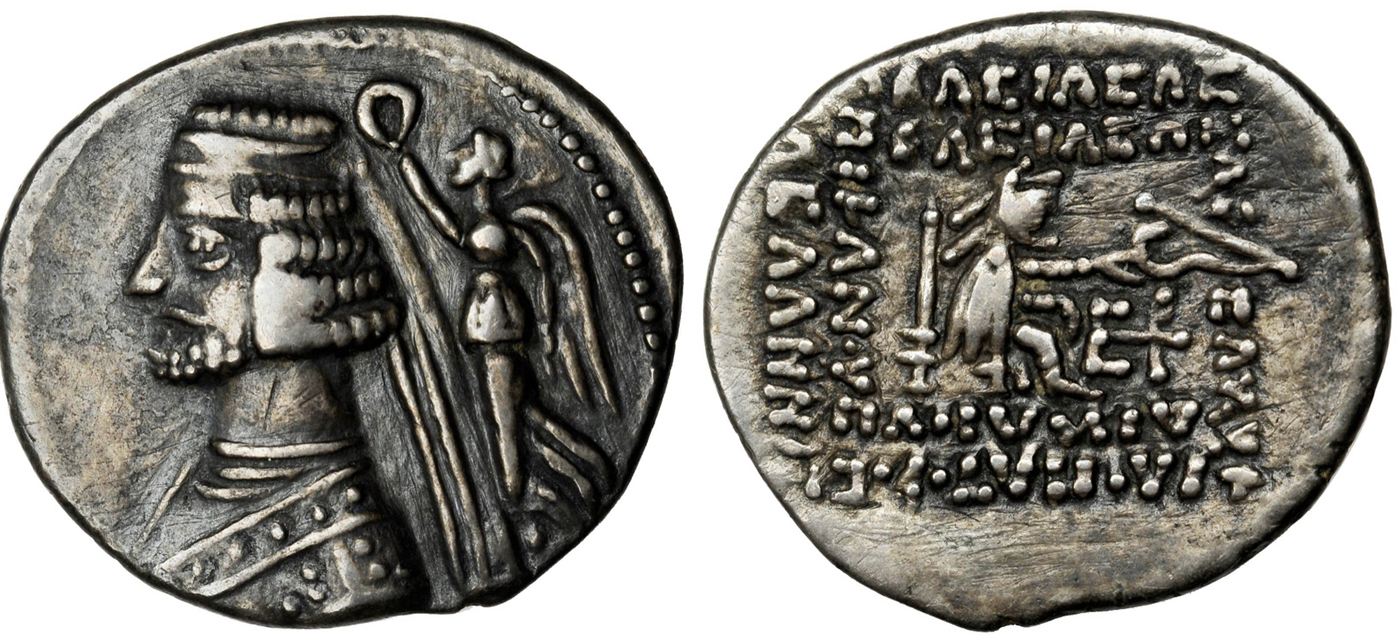
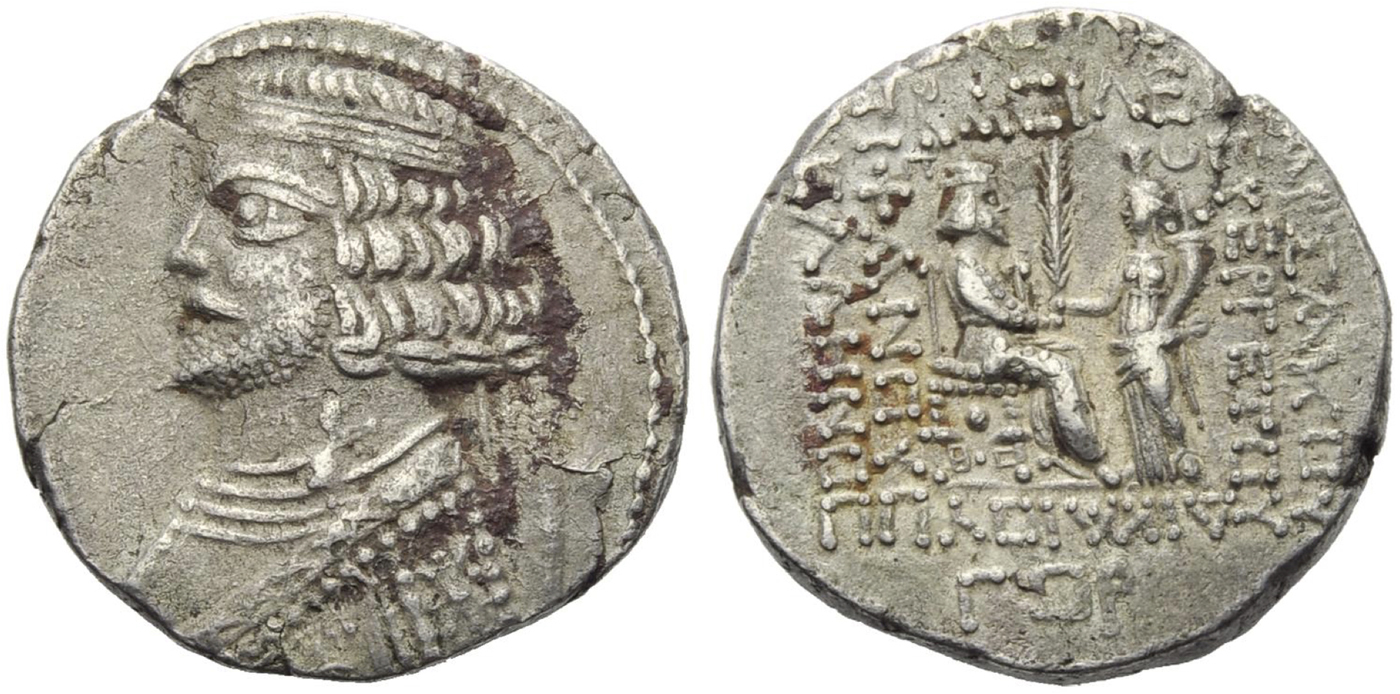
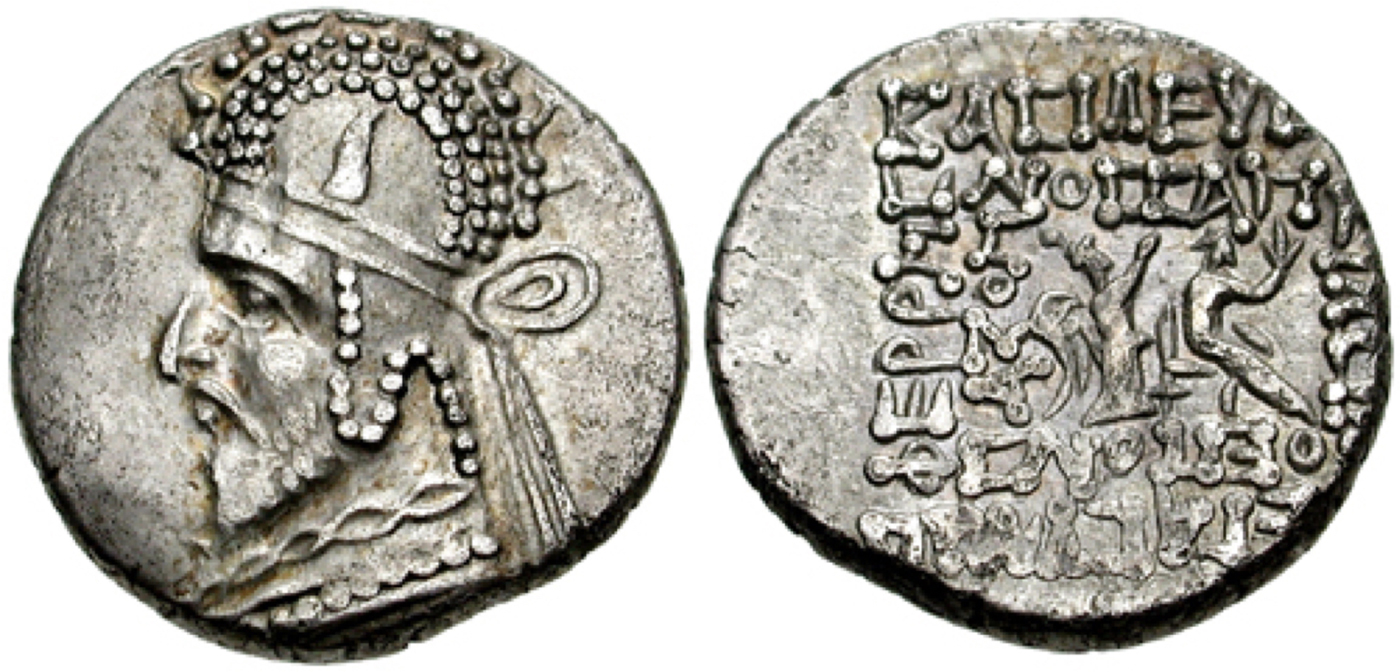
The titulature βασιλεὺς βασιλέων was pervasive in many cultures, including prominent attestation in the Parthian kingdom. Silver drachms of Mithradates II (123–88 bce) depict on the obverse the diademed bust of Mithradates II facing left, and on the reverse an archer seated facing right on a throne, holding a bow, with the accompanying inscription ΒΑΣΙΛΕΩΣ ΒΑΣΙΛΕΩΝ ΜΕΓΑΛΟΥ ΑΡΣΑΚΟΥ ΕΠΙΦΑΝΟΥΣ (‘king of kings, great Arsaces, the notable’) (Fig. 1). Example 27.2 in Sellwood's catalogue is notable for being the first use of the title βασιλεὺς βασιλέων on Parthian coinage.Footnote 13 Part of the reason why he was able to include longer inscriptions on his coinage was the space-effective square arrangement of the legend, which all subsequent Arsacid coinage maintained. Mithradates II is also known for his military success in expelling the rebel Hyspaosines and overstriking his coinage with his own.Footnote 14 But this example is the chronological starting point of the most prominently attested legends on the coins of Parthia in the first century bce. Of the 233 coin-types and variants of Mithradates II, 91 have βασιλεὺς βασιλέων as the first title of the king.Footnote 15 Of the 60 coin-types and variants of Mithradates III (57–54 bce), 25 have βασιλεὺς βασιλέων. For example, Sellwood 41.8 (Fig. 2) is a silver drachm which on the obverse depicts a short-bearded bust facing left, wearing a double-banded diadem and segmented necklace with medallion. The reverse has a beardless archer wearing a hooded cloak, seated facing right, holding a bow in his right hand. The Greek inscription reads: ΒΑΣΙΛΕΩΣ ΒΑΣΙΛΕΩΝ ΑΡΣΑΚΟΥ ΜΕΓΑΛΟΥ ΔΙΚΑΙΟΥ ΕΠΙΦΑΝΟΥΣ ΘΕΟΥ ΕΥΠΑΤΟΡΟΣ ΚΑΙ ΦΙΛΕΛΛΗΝΟΣ (‘king of kings, great Arsaces the just, notable god, well-born and friend of the Greek’). Orodes II (57–38 bce) had 269 types and variants issued, and 206 name him as βασιλεὺς βασιλέων. For example, Sellwood 42.2 (Fig. 3) is a silver drachm which on the obverse depicts a short-bearded bust facing left, wearing a diadem; behind the bust Nike is portrayed as flying left with a wreath. The reverse is similar to 41.8, but the Greek inscription reads: ΒΑΣΙΛΕΩΣ ΒΑΣΙΛΕΩΝ ΑΡΣΑΚΟΥ ΦΙΛΟΠΑΤΟΡΟΣ ΔΙΚΑΙΟΥ ΕΠΙΦΑΝΟΥΣ ΦΙΛΕΛΛΗΝΟΣ (‘king of kings, Arsaces, Philopator the just, notable and friend of the Greek’). Of the 26 types and variants Phraates IV (38–2 bce) issued, 6 include the title ΒΑΣΙΛΕΩΣ ΒΑΣΙΛΕΩΝ. Sellwood 51.9 (Fig. 4) is a silver tetradrachm, which together with 23 other examples has a (royal) wart on Phraates’ brow line on the obverse,Footnote 16 as well as a segmented necklace and diadem. The reverse depicts the king seated on the throne, receiving a palm branch from Tyche, who faces left and also holds a cornucopia in her left hand. The inscription reads: ΒΑΣΙΛΕΩΣ ΒΑΣΙΛΕΩΝ ΑΡΣΑΚΟΥ ΕΥΕΡΓΕΤΟΥ ΔΙΚΑΙΟΥ ΕΠΙΦΑΝΟΥΣ ΦΙΛΕΛΛΗΝΟΣ (‘king of kings, Arsaces, benefactor, the just, notable and friend of the Greek’). Indeed, each one of the Parthian kings in the principal line of succession in the first century ce, without a single exception, issued coins with the title βασιλεὺς βασιλέων as part of their self-representationFootnote 17, as did two of the rival claimants.Footnote 18
Sellwood 27.2. Silver drachm. Obverse: Mithradates II, long-bearded bust facing left; reverse: archer seated holding bow. 123–88 bce. Used with permission.

Sellwood 41.8. Silver drachm. Obverse: Mithradates III, short-bearded bust facing left; reverse: archer seated holding bow. 57–54 bce. Used with permission.

Sellwood 42.2. Silver drachm. Obverse: Orodes II, short-bearded bust facing left; reverse: archer seated holding bow. 57–38 bce. Used with permission.

Sellwood 51.9. Silver tetradrachm. Obverse: Phrates IV, short-bearded bust facing left with wart on brow line, with segmented necklace and diadem; reverse: king seated on throne receiving a palm branch from Tyche, who also holds cornucopia. 38–2 bce. Used with permission.

Greeks and Romans were also familiar with the title.Footnote 19 Plutarch records that Pompey encountered the title during the campaigns against Mithridates VI. When writing to the king of Parthia, he refused his usual title, βασιλεὺς βασιλέων, ‘for many leaders and princes and twelve barbarian kings had come to him. Wherefore, to gratify these other kings, he would not deign, in answering a letter from the king of Parthia, to address him as King of Kings, which was his usual title.’Footnote 20 Dio Cassius 37.6 notes another occasion where Pompey also refused Phraates III, king of Parthia, title by referring to him as only ‘king’ rather than ‘king of kings’:
καὶ προσέτι καὶ πρὸς τὴν ἐπίκλησιν αὐτοῦ ὕβρισεν, ᾗπερ πρός τε τοὺς ἄλλους πάντας ἠγάλλετο καὶ πρὸς αὐτοὺς τοὺς Ῥωμαίους, οὗτοί τε αὖ πρὸς ἐκεῖνον ἀεί ποτε ἐκέχρηντο. βασιλέως γὰρ αὐτοῦ βασιλέων καλουμένου, τό τε τῶν βασιλέων ὄνομα περιέκοψε καὶ βασιλεῖ αὐτῷ μόνον ἐπιστέλλων ἔγραψε.
Furthermore, he showed contempt for the title of Phraates, in which that ruler delighted before all the world and before the Romans themselves, and by which the latter had always addressed him. For whereas he was called ‘King of Kings’, Pompey clipped off the phrase ‘of Kings’ and addressed his demands merely ‘to the King’ when writing.Footnote 21
Immediately after this in the same passage, Dio Cassius notes that Pompey gave the title to Tigranes when he had captured him and was celebrating a triumph over him at Rome, undoubtedly to highlight the greater significance of Pompey's own achievement.Footnote 22 Appian comes close to affording the title to Pompey when he says, αὐτὸς δ᾿, οἷα δὴ βασιλεὺς βασιλέων, αὐτοὺς περιθέοι καὶ ἐφορῴη μένοντας ἐφ᾿ ὧν ἐτάχθησαν (‘while he, Pompey, like a king of kings, should move to and fro among them to see that they remained where they were stationed’),Footnote 23 when referring to his pursuit of the pirates in one episode of the Mithridatic Wars in 67 bce.
Other sources from the Roman period indicate the widespread knowledge of the title. Cicero refers to the memory of Agamemnon as the regum regi (‘king of kings’) in his correspondence with Dolabella, dated to 3 May 44 ce,Footnote 24 as does Velleius Paterculus (19 bce–31 ce) in recounting, ‘Agamemnon, king of kings (rex regum), cast by a tempest upon the island of Crete, founded there three cities, two of which were Mycenae and Tegea.’Footnote 25 Quintus Curtius Rufus’s History of Alexander includes reference to Darius’s eventual demise:
Hunc vitae finem sortitus est ille quem modo contumelia affici putabant, nisi regem regum et deorum consanguineum salutarent; magnoque denuo experimento comprobatum est neminem magis patere Fortunae quam qui, plurimis eius beneficiis ornatus, iugum eius tota cervice receperit.
Such was the end of life allotted to that king whom shortly before men thought to be insulted unless they addressed him as king of kings and kinsman of the gods; and once more it was proved by a striking example, that no one is more exposed to Fortune's changes than one who, having been honoured by very many of her favours, has bowed his neck wholly under her yoke.Footnote 26
Hellenistic Jews were aware of the title as evidenced in Philo of Alexandria's description of God: παγγέλοιον γὰρ οἴεσθαι, ὅτι ὁ μὲν νοῦς ὁ ἐν ἡμῖν βραχύτατος ὢν καὶ ἀόρατος ἡγεμὼν τῶν αἰσθητικῶν ὀργάνων ἐστίν, ὁ δὲ τοῦ παντὸς ὁ μέγιστος καὶ τελειότατος οὐχὶ βασιλεὺς βασιλέων εἶναι πέφυκε, βλεπομένων οὐ βλεπόμενος (‘For it is quite ridiculous to deny that if the mind in us, so exceedingly small and invisible, is yet the ruler of the organs of sense, the mind of the universe, so transcendently great and perfect, must be the king of kings who are seen by Him though He is not seen by them’).Footnote 27 Strabo's Γεωγραφικά, first published in 7 bce, makes mention of the title in book 13 which pertains to the northern Aegean region:
ἔοικε δὲ ὁ ποιητὴς μικρὰν ἀποφαίνειν τὴν πόλιν ἐν τῷ περὶ Ἡρακλέους λόγῳ, εἴπερ ἓξ οἴῃς σὺν νηυσὶ καὶ ἀνδράσι παυροτέροισιν Ἰλίου ἐξαλάπαξε πόλιν. καὶ φαίνεται ὁ Πρίαμος τῷ τοιούτῳ λόγῳ μέγας ἐκ μικροῦ γεγονὼς καὶ βασιλεὺς βασιλέων, ὡς ἔφαμεν.
… and it appears that the poet, in what he says about Heracles, represents the city as small, if it be true that ‘with only six ships and fewer men he sacked the city of Ilium’. And it is clearly shown by this statement that Priam became great and king of kings from a small beginning, as I have said before.Footnote 28
The title βασιλεὺς βασιλέων is also used in the Roman period for recalling heroes in Greek history. Dio Chysostom (40–115 ce), the Greek orator, used the title in reference to Zeus: ὁμοίως δὲ καὶ οἱ θεοὶ καὶ ὁ δὴ μέγας βασιλεὺς βασιλέων, ἅτε κηδεμὼν καὶ πατὴρ κοινὸς ἀνθρώπων καὶ θεῶν, Ζεύς (‘In like manner do the gods act, and especially the great king of kings, Zeus, who is the common protector and father of men and gods’).Footnote 29
In further attestation of knowledge and use of the title in the Roman world during the first century bce, Plutarch, Ant. 54 has Antony give the title during the Donations of Alexandria:
δεύτερον δὲ τοὺς ἐξ αὑτοῦ καὶ Κλεοπάτρας υἱοὺς βασιλεῖς βασιλέων ἀναγορεύσας Ἀλεξάνδρῳ μὲν Ἀρμενίαν ἀπένειμε καὶ Μηδίαν καὶ τὰ Πάρθων, ὅταν ὑπαγάγηται, Πτολεμαίῳ δὲ Φοινίκην καὶ Συρίαν καὶ Κιλικίαν.
In the second place, he proclaimed his own sons by Cleopatra Kings of Kings, and to Alexander he allotted Armenia, Media and Parthia (when he should have subdued it), to Ptolemy Phoenicia, Syria, and Cilicia.Footnote 30
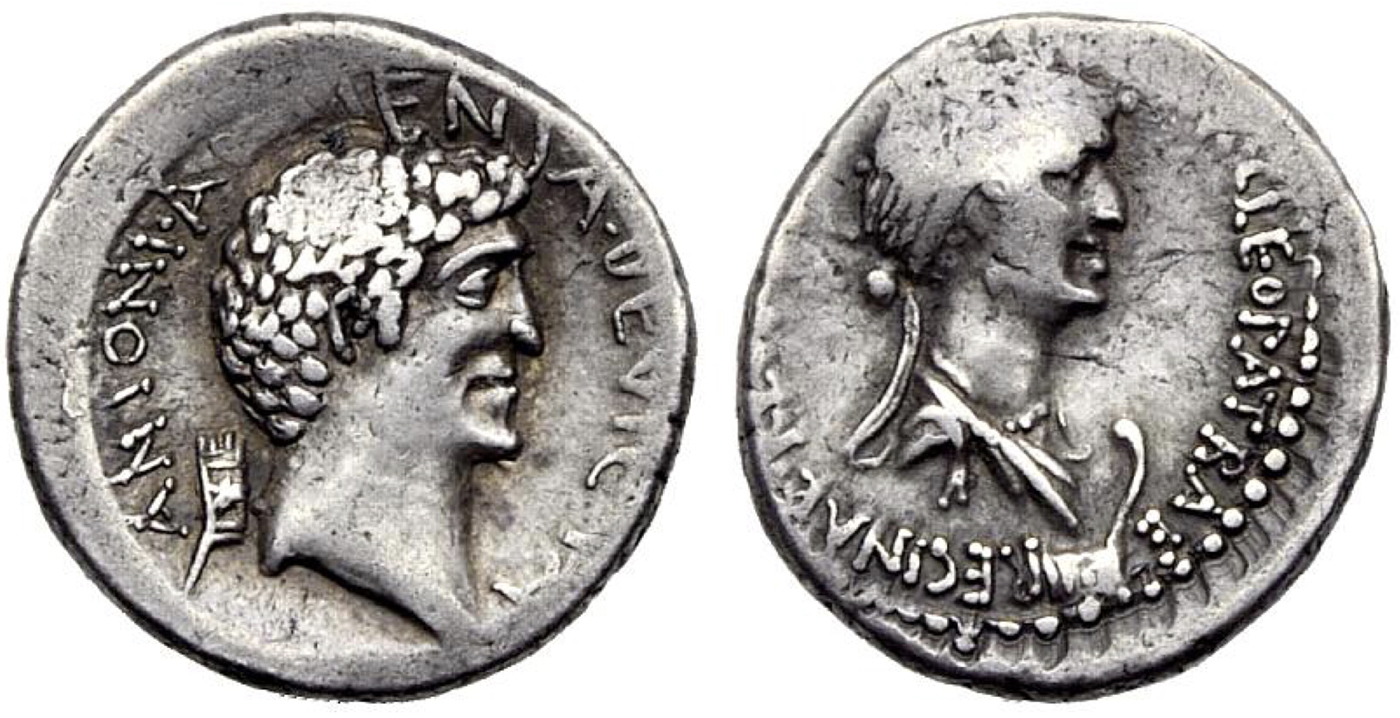
This political act by Cleopatra VII and Antony of the division of land among Cleopatra's children in 34 bce was ultimately a significant catalyst for the deterioration of Antony's relationship with Rome and a cause of the war between Antony and Octavian.Footnote 31 Caesarion was honoured above Antony's two sons in the Donations of Alexandria; he received the title ‘king of kings’ and was recognised as heir to Julius Caesar. A Latin inscription of interest appears on a silver denarius issued after the successful campaign against Armenia in 34 bce. In Crawford's catalogue of Roman Republican coinage,Footnote 32 item 543/1 (Fig. 5) depicts, on the obverse, the bare head of Mark Antony facing right, an Armenian tiara to the left and the inscription ANTONI ARMENIA DEVICTA (‘Of Antony who conquered Armenia’). The reverse has a diademed and draped bust of Cleopatra facing right, with the inscription CLEOPATRAE REGINAE REGVM FILIORVM REGVM (‘Of Cleopatra, queen of kings and of the sons who are kings’). The phrase filiorum regum is somewhat ambiguous and could also be rendered ‘whose children are kings’. This ambiguity permitted Cleopatra to ‘simultaneously tout her illustrious heritage, while also highlighting the fact that she had given birth to children with two of Rome's most powerful generals, Julius Caesar and Mark Antony’.Footnote 33 The genitive singular noun (reginae) joined with a genitive plural (regum) of the same root is a well attested construction in Latin,Footnote 34 GreekFootnote 35 and Hebrew.Footnote 36
RRC 543/1. Silver denarius. Obverse: head of Mark Antony facing right, with Armenian tiara to left; reverse: diademed and draped bust of Cleopatra. 34 bce. Used with permission.

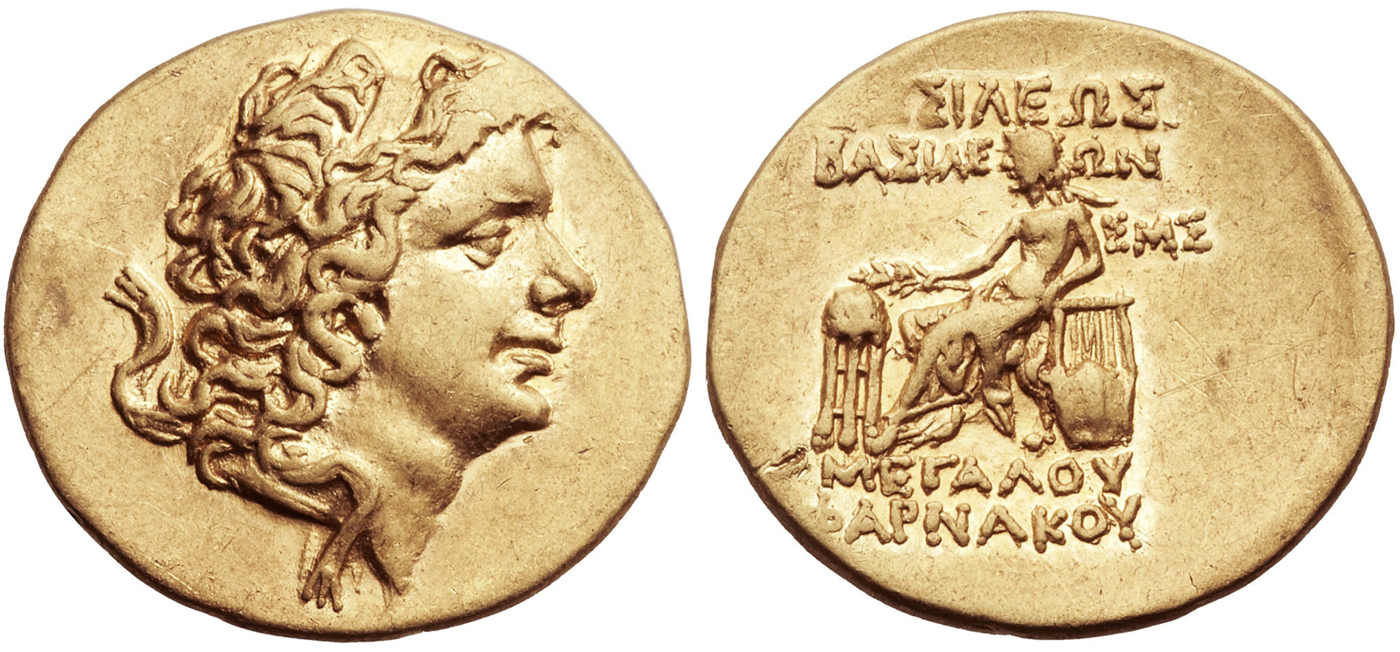
We now turn to a discussion to the phrase βασιλεὺς βασιλέων in the east, with particular attention to the Indo-Greek and Indo-Scythian titular examples on coinage. A series of gold Bosporan and Pontic staters of Pharnaces II dated to Pontic Year 245 (53/52 bce) portray the diademed head of Pharnaces facing right, with luxuriant hair, on the obverse (Fig. 6). The reverse has Apollo enthroned facing left in a relaxed pose, holding in his right hand a laurel branch over a tripod, his left elbow resting on a lyre at his side, and the inscription BAΣIΛEΩΣ BAΣIΛEΩN above, and MEΓAΛOY ΦAPNAKOY below, with date ΕMΣ to the right.Footnote 37 The Scythians were originally a nomadic people from Central Asia who made their way into Bactria in the second century bce, settling north-west of the Bosporan kingdom. Several distinct groups of Indo-Scythian coin inscriptions preserve multiple attestations and variations of the title βασιλεὺς βασιλέων.Footnote 38 Vonones of Indo-Scythia (to be distinguished from Vonones I (8–12 ce) and Vonones II (51 ce) of Parthia) ruled from 75 to 65 bce and issued several coins from the Arachosian mint in the Arghandab valley.Footnote 39 The Vonones family of coins (Vonones with Splahores, Vonones with Spalagadames, Spaliries with Azes, Azes and Azilises) regularly depict, on the obverse, the king mounted on horseback riding to the right, with a spear, with a Greek inscription identifying the individual with titles. The reverse depicts a radiate Zeus standing facing, leaning on a sceptre in his left hand, carrying a thunderbolt in his right hand and a monogram indicating the weight standard (Kandahar or Bannu) at either the right or left, with a Kharoshthi inscription.Footnote 40
Pharn. 1. Gold stater. Obverse: Pharnaces II facing right; reverse: Apollo enthroned, facing left in relaxed pose, holding laurel branch over tripod and resting on lyre on side. 53–52 bce. Used with permission.

Mitchiner's catalogue (IGISC)Footnote 41 item iii.681 (with three sub-varieties based on varying weight standards) is a silver tetradrachm weighing 9.68 g with a diameter of 26 mm (Fig. 7). The obverse, as noted above, depicts the king holding a spear, mounted on a horse riding right. The inscription reads: ΒΑΣΙΛΕΩΣ ΒΑΣΙΛΕΩΝ ΜΕΓΑΛΟΥ ΟΝΩΝΟΥ (‘king of kings, great Vonones’). The reverse depicts Zeus standing facing, holding a long sceptre in his left hand and thunderbolt in his right, surrounded by an inscription in Kharoshthi which reads: Maharajabhrata dhramikasa Spalahorasa (‘of Spalahores, the king's brother, the just’). It is noteworthy that having two names (Vonones on the obverse and Spalahores on the reverse) is somewhat unusual in that the Greek and Kharoshthi inscriptions are not translations of one another as is the case on most examples of Indo-Greek and Indo-Scythian coinage. IGISC iii.682 depicts similar iconography and inscriptions as iii.681 and its sub-variations, but is a silver drachm weighing 2.42 g.
IGISC iii.681. Silver tetradrachm. Obverse: Vovones mounted on horseback holding spear; reverse: radiate Zeus leaning on sceptre and carrying thunderbolt. 75–65 bce. Used with permission.

IGISC iii.683 is a rectangular hemi-obol (4 chalkoi) weighing 8.50 g. On the obverse it depicts Hercules standing facing, holding a club and lion skin, with the Greek inscription ΒΑΣΙΛΕΩΣ ΒΑΣΙΛΕΩΝ ΜΕΓΑΛΟΥ ΟΝΩΝΟΥ (‘king of kings, great Vonones’). On the reverse it has Pallas standing left, holding a spear and shield, with the Kharoshthi inscription Maharajabhrata dhramikasa Spalahorasa (‘of Spalahores, the king's brother, the just’). A smaller Di-chalkoi denomination (IGISC iii.684) is also attested in rectangular bronze (4.25 g) which has similar inscriptions to iii.683 but an uncertain control mark.
IGISC iii.686, sub-varieties a and b, is from a slightly later period within Vonones’ reign, depicting Spalagadames, son of Spalahores, as viceroy. The obverse has the typical depiction of the king mounted on a horse, holding a spear and riding right, with the Greek inscription ΒΑΣΙΛΕΩΣ ΒΑΣΙΛΕΩΝ ΜΕΓΑΛΟΥ ΟΝΩΝΟΥ (‘king of kings, great Vonones’). The obverse depicts Zeus standing facing, holding a long sceptre and thunderbolt, with the ‘Kharoshthi inscription Spalahora putrasa dhramiasa Spalagadamasa (‘of the son of Spalahores, Spalagadames the just’). As with iii.681, iii.686 also has smaller denominations. iii.687 (a–c) is a silver drachm with inscriptions similar to iii.686, and iii.688 (a–b) consists of a bronze rectangular Tri-chalkon (6.38 g) with inscriptions and iconography similar to iii.683.
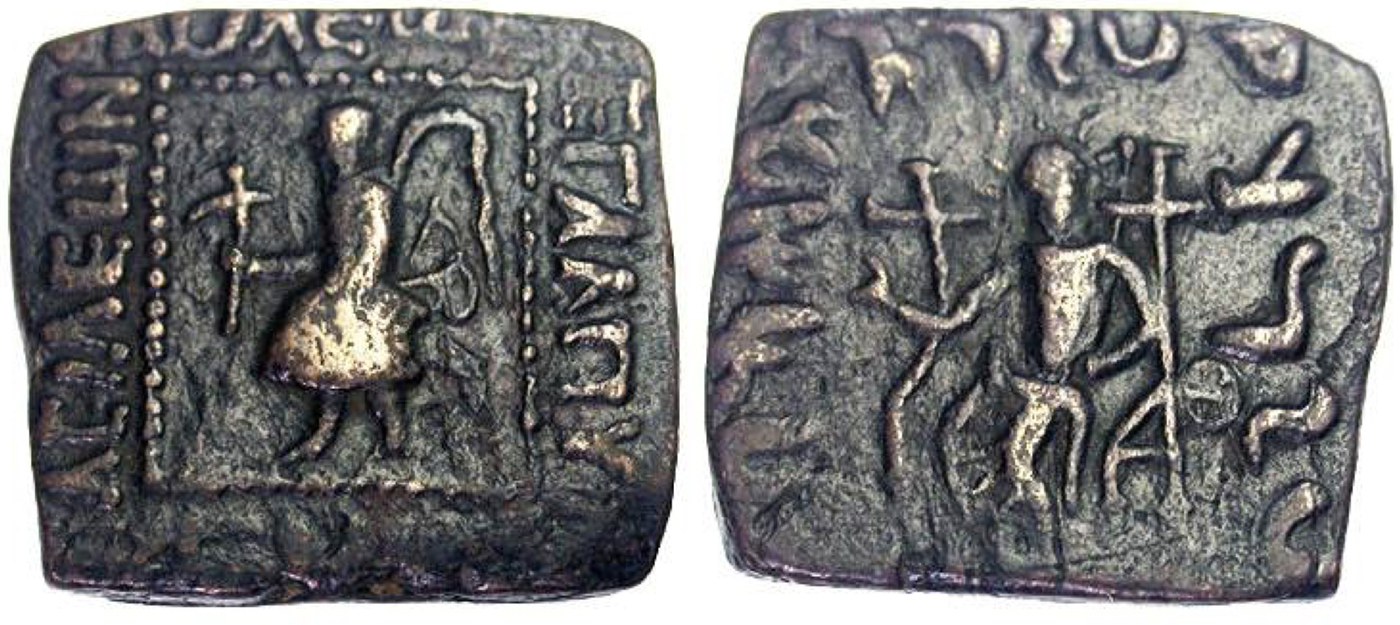
Similar titles are attested on the coinage of King Spalirises during the period 65–40 bce. IGISC iii.694 (a–c) is a bronze hemi-obol weighing 8.50 g, and on the obverse depicts the king walking left, holding an ankus (elephant hook) and bow, with a whip over his shoulder. The Greek inscription reads: ΒΑΣΙΛΕΩΣ ΒΑΣΙΛΕΩΝ ΜΕΓΑΛΟΥ ΡΠΑΛΙΡΙΣΟΥ (‘king of kings, great Spalirises’) (Fig. 8). iii.694 and other coins of Spalirises spell his name in Greek with a Scythian-Yeuh Chi, which looks like a rho, but actually attempts to transliterate the ‘sh’ phoneme. The reverse depicts Zeus enthroned, with his right hand outstretched; the Kharoshthi inscription reads: Maharajasa mahatakasa Spalirishasa.
IGISC iii.694. Bronze hemi-obol. Obverse: Spalirises mounted on horseback holding spear; reverse: radiate Zeus leaning on sceptre and carrying thunderbolt. 75–65 Kbce. Used with permission.

Coinage of the eastern Bactrian provinces continues the chronological trajectory that we have established thus far. Orodes II, ca. 57–38 bce, minted IGISC 642 with sub-varieties a (from Margiana) and b (from Nyssa). This coin portrays, on the obverse, a diademed bust of the king facing left, with a short beard. The reverse has an archer seated right upon a stool. The inscription on the reverse reads: ΒΑΣΙΛΕΩΣ ΒΑΣΙΛΕΩΝ ΕΠΙΦΑΙΝΟΥΣ ΚΑΙ ΦΙΛΕΛΛΗΝΟΣ ΑΡΣΑΚΟΥ ΦΙΛΟΠΑΤΟΡΟΣ ΔΙΚΑΙΟΥ (‘king of kings, illustrious, friend of the Greeks, Arsaces, Philopator the just’). Another silver drachm of Orodes, IGISC iii.643 (a–e) weighing 2.42 g, is similar to iii.642, but adds a star (in front of the bust) and a crescent (behind the bust) on the obverse. The reverse maintains the seated archer, but has the following inscription: ΒΑΣΙΛΕΩΣ ΒΑΣΙΛΕΩΝ ΑΡΣΑΚΟΥ ΕΥΕΡΓΕΤΟΥ ΔΙΚΑΙΟΥ (‘king of kings, Arsaces, benefactor, the just’). IGISC iii.644, a coin of Phraates IV, ca. 38–2 bce, has an identical Greek inscription to iii.642, but depicts the diademed bust facing left, with an eagle behind. It similarly portrays a seated archer with a bow on the reverse and includes the following inscription: ΒΑΣΙΛΕΩΣ ΒΑΣΙΛΕΩΝ ΑΡΣΑΚΟΥ (‘king of kings, Arsaces’).
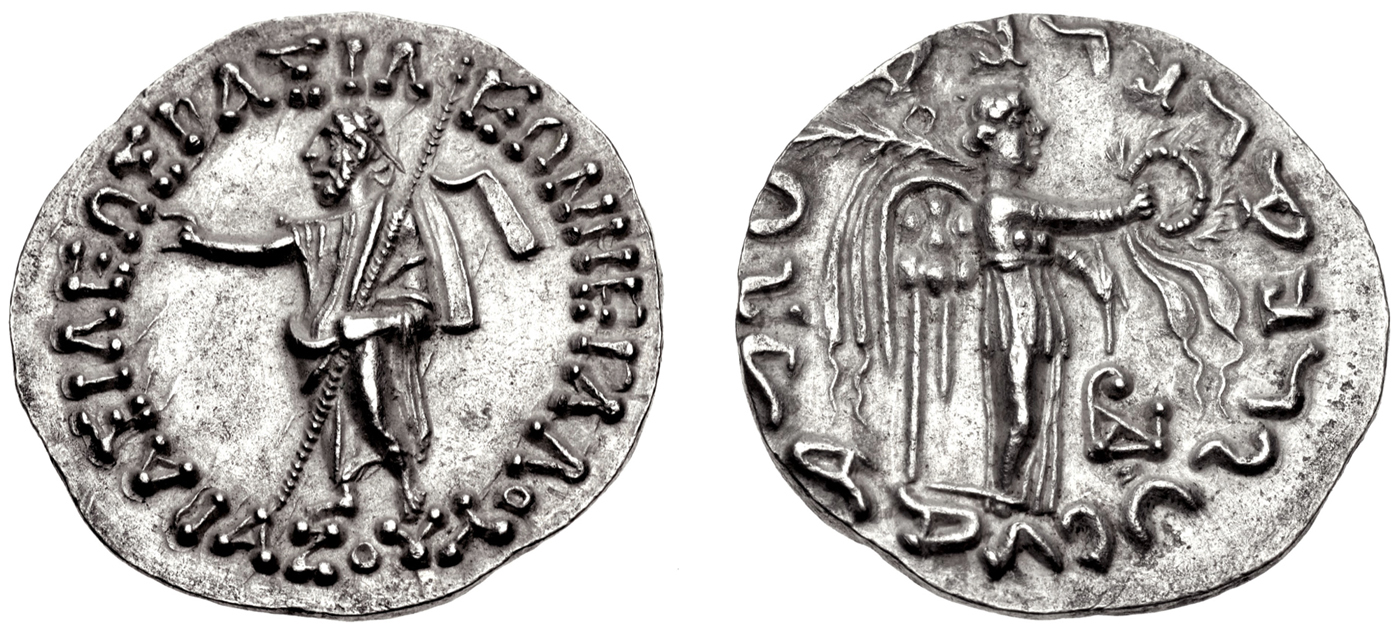
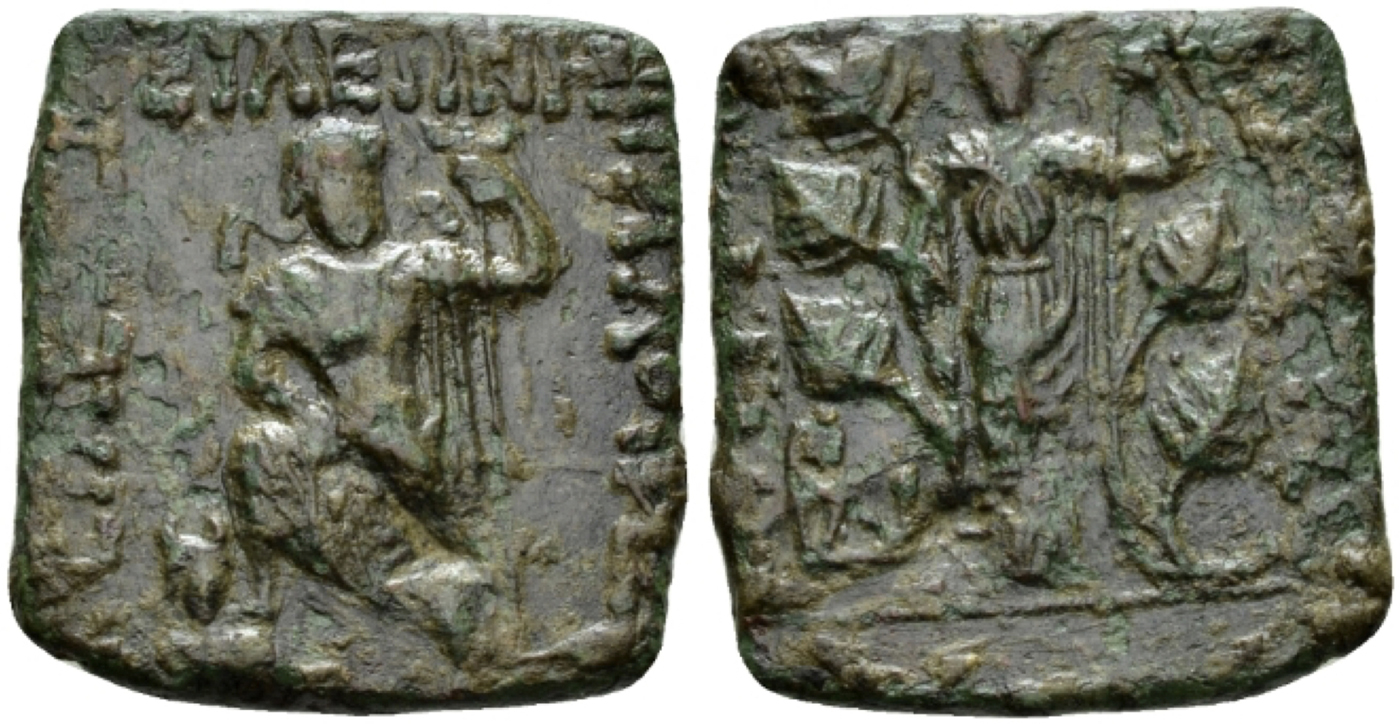
The Indo-Scythian dynasty of Azes I and Azilises (57–35 bce) demonstrates a further and widespread use of the title in the first century bce. IGISC vi.737 (Fig. 9) is a silver tetradrachm (9.68 g), and on the obverse depicts Zeus standing left, holding a long sceptre, with an accompanying inscription, ΒΑΣΙΛΕΩΣ ΒΑΣΙΛΕΩΝ ΜΕΓΑΛΟΥ ΑΖΟΥ (‘king of kings, great Azes’). The reverse has a winged Nike standing right, holding a wreath and palm, with an equivalent inscription in Kharoshthi script. IGISC vi.738 has similar iconography and inscription but is the lower denomination of a drachm (2.42 g). Type vi.739 (silver tetradrachm, 9.68 g) has an identical inscription but depicts the king holding a spear and mounted on a horse on the obverse. Copper issues are extant in rectangular penta-chalkons; IGISC vi.740 (Fig. 10) has the same inscriptions but portrays, on the obverse, Poseidon standing facing, with his right foot on a river god and right hand on his knee, holding a long trident in his left hand. The obverse has Yakshi (female pagan nature spirit) standing between vines.Footnote 42 IGISC vi.742 has the same inscription and iconography as 740 but is issued as a rectangular chalkous (2.42 g). IGISC vi.743 portrays the king holding spear, mounted on a horse walking right on the obverse, with the inscription ΒΑΣΙΛΕΩΣ ΒΑΣΙΛΕΩΝ ΜΕΓΑΛΟΥ ΑΖΟΥ (‘king of kings, great Azes’). The reverse has a depiction of the city goddess standing left, holding a palm and lamp, with a Kharosthi inscription. In addition, there are twenty further examples, in varying denominations, with the inscription ΒΑΣΙΛΕΩΣ ΒΑΣΙΛΕΩΝ ΜΕΓΑΛΟΥ ΑΖΟΥ on the obverse.Footnote 43 The joint coinage of Azes I and Azilises adds to this number almost fifty distinct issues (with several hundred sub-varieties) with the inscription on the obverse reading ΒΑΣΙΛΕΩΣ ΒΑΣΙΛΕΩΝ ΜΕΓΑΛΟΥ ΑΖΙΛΙΣΟΥ, and with various elements of iconography already discussed.Footnote 44
IGISC vi.737. Silver tetradrachm. Obverse: Zeus standing left with long sceptre; reverse: winged Nike standing right holding wreath and palm. 57–35 bce. Used with permission.

IGISC vi.740. Silver tetradrachm. Obverse: Poseidon standing facing right with foot on river god and hand on knee, holding long trident in left hand; reverse: Yakshi standing between vines. 57–35 bce. Used with permission.

During the period of the Scythians in the east, in particular throughout the age of the Satraps (1–35 ce), several notable numismatic issues deserve attention. IGISC vii.895 is a silver tetradrachm (9.90 g) issued by Arsakes, ruler of Sakastan (ca. 30 ce), and depicts, on the obverse, the king holding a whip, mounted on a horse and riding to the right. The inscription reads: ΒΑΣΙΛΕΥΟΝΤΟΣ ΒΑΣΙΛΕΩΝ ΔΙΚΑΙΟΥ ΑΡΣΑΚΟΥ (‘king of kings, Arsakes the just’). The reverse depicts Zeus standing left, holding a winged Nike on his outstretched right hand, and a long sceptre in his left hand. IGISC vii.896 is also a silver tetradrachm (9.90 g), and has the same obverse iconography and inscription as vii.895, but with a longer Kharosthi inscription on the reverse. Both these examples are particularly interesting as they preserve the title as a participle plus noun form. As we will see in our discussion below, the only morphological variation in the New Testament attestation of the title is precisely this, with a substitution of a participle for one of the nouns.
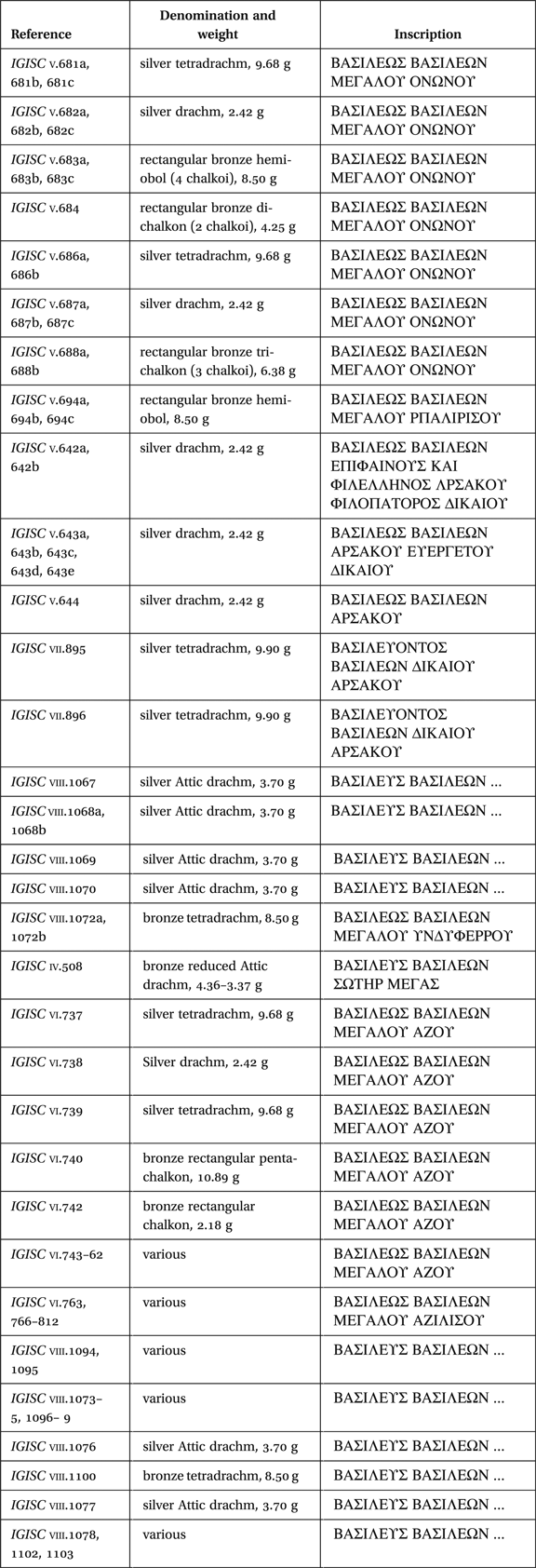
Later coins from the first-century ce period of the Indo-Parthians also attest to similar titulature. From the province of Sakastan there are more than a dozen examples, of which we will highlight only the most salient for our discussion. IGISC viii.1067 is a silver Attic drachm (3.7 g) of Gondophares minted between 20 and 55 ce. It is iconographically in the Indo-Parthian style, with the bust facing left, wearing a close-fitting undecorated non-radiate cap with posterior cords on the obverse. The reverse has the king enthroned right, being crowned by a winged Nike standing behind the throne. The inscription begins with ΒΑΣΙΛΕΥΣ ΒΑΣΙΛΕΩΝ (‘king of kings’). IGISC viii.1068 attests similar iconography on the obverse, with only a slight variation in the latter part of the inscription on the reverse, which does however begin identically, ΒΑΣΙΛΕΥΣ ΒΑΣΙΛΕΩΝ, as do IGISC viii.1069 and 1070 (Fig. 11). IGISC viii.1072 (a–b) is an Arachosian silver tetradrachm countermarked for use in Sakastan. The obverse has a bust of Gondophares facing left, with the inscription, ΒΑΣΙΛΕΩΣ ΒΑΣΙΛΕΩΝ ΜΕΓΑΛΟΥ ΥΝΔΥΦΕΡΡΟΥ (‘king of kings, great Gondophares’). The reverse depicts a winged Nike standing right, holding a wreath and palm.Footnote 45 Again, there are several dozen relevant examples that support the general picture sketched thus far, namely the widespread Parthian use of the title βασιλεὺς βασιλέων for their rulers. Further evidence is readily available from other many other Indo-Parthian first-century ce numismatic inscriptions (see Table 1).Footnote 46
IGISC viii.1070. Silver tetradrachm. Obverse: bust of Gondophares facing left; reverse: winged Nike standing facing, holding wreath and palm. 20–55 ce. Used with permission.

Selective Table of Numismatic Inscriptional Evidence

4. Interpretive Implications for the Book of Revelation
We now turn our attention to the implications of the above discussion for the interpretation of the New Testament. Jesus is referred to as the ‘king of kings’ once in the Pastorals and twice in the Apocalypse:
… which he will bring about at the right time – he who is the blessed and only Sovereign, the king of kings (ὁ βασιλεὺς τῶν βασιλευόντων) and Lord of lords (1 Tim 6.15)
… they will make war on the Lamb, and the Lamb will conquer them, for he is Lord of lords and king of kings (βασιλεὺς βασιλέων), and those with him are called and chosen and faithful (Rev 17.14)
On his robe and on his thigh he has a name inscribed, ‘King of kings (βασιλεὺς βασιλέων) and Lord of lords’. (Rev 19.16)
The focus of the current discussion will be on the title in the Apocalypse due to the morphological similarity of its use there with that in the evidence discussed above.Footnote 47
The book of Revelation was composed as an apocalyptic prophetic circular letter (Rev 1.1–3) addressed to churches in Asia Minor in order to encourage Christians who were suffering persecution under the Roman Empire. A key symbol in the work occurs within the vision of the heavenly throne room in chapters 4–5, where Jesus is portrayed as the slain lamb who defeats his enemies by dying for them.Footnote 48 The fall of Babylon in chapters 17.1–19.16 is portrayed as a woman riding a symbol (a seven-headed, ten-horned beast, Rev 17.3) of the rebellious nations who is intoxicated on the shed blood of the followers of Jesus and all the innocent (Rev 17.6; 18.24). She is referred to as ‘Babylon the great, mother of whores and of earth's abominations’ (Rev 17.5) and personifies the military and economic power of the Roman Empire. The final battle (19.11–20.15) results in the vindication of the martyrs and leads to the arrival of the οὐρανὸν καινὸν καὶ γῆν καινήν (‘new heaven and new earth’). Within this thematic presentation the author twice uses the title βασιλεὺς βασιλέων (Rev 17.14; 19.16) for the conquering Jesus.
The Roman emperor was not styled or titled as ‘king’ or its superlative variations.Footnote 49 The Romans, at least for the last six centuries bce, had been defined by their anti-regal stance after the overthrowing of King Tarquinius Superbus by Junius Brutus and the founding of the Roman Republic in 509 bce.Footnote 50 Most commentators commenting on Revelation 19 therefore view βασιλεὺς βασιλέων in light of Old Testament texts such as Deu 10.17, Dan 2.47Footnote 51 or Dan 4.37,Footnote 52 even though the title does not appear verbatim there. J. Massyngberde Ford suggests that it would be especially appropriate in the time of Domitian, ‘our lord and god’ (Suetonius, Dom. 13).Footnote 53 Others interpret βασιλεὺς βασιλέων in Rev 19.16 as expressing the generic idea of ‘ultimate ruler over all kings’,Footnote 54 insofar as the genitive functions as a genitive of subordination ‘with the idea being that the βασιλεύς is superior over the βασιλέων in the genitive (“king over and above all other kings”)’.Footnote 55 Some, rather dubiously, attempt to retro-translate the phrase βασιλεὺς βασιλέων καὶ κύριος κυρίων into Aramaic (excluding the word ‘and’) and calculate via gematria the number of the letters, which is 777, ‘the victorious counterpart and antidote to 666’.Footnote 56 However, as is extensively documented in our analysis above, the title βασιλεὺς βασιλέων was ubiquitous in the eastern Roman Empire, in particular in Parthia but also among the Indo-Scythians, Indo-Parthians and Indo-Greeks, so much so that there was not a single Parthian ruler in the first century ce who did not use it on his coinage. Although some commentators do refer to Parthia in their exegetical discussions on Revelation 19, C. R. Koester glosses over the titulature,Footnote 57 David A. Thomas focuses on the Parthian iconography of the diadem without any substantive discussion of the inscriptions,Footnote 58 and most (as noted above) focus on the relevant Old Testament passages as background to the interpretation of the phrases. The interpretation that will be argued for presently is that the figure of Christ in both Rev 17.14 and 19.16 is a symbolic depiction of Christ as Parthia, that is, the author uses the symbols and titles of Rome's feared enemy to depict the lamb's victory.Footnote 59 This identification is supported by four lines of evidence.
First, the Parthians were Rome's most notorious military enemy during the first century bce and first century ce. The Roman–Parthian wars stretched from the 53 bce to 217 ce. The Battle of Carrhae in 53 bce saw the Parthian general Surena decisively defeat Marcus Licinius Crassus’ seven Roman legions in upper Mesopotamia. Plutarch recounts the encounter in considerable detail: οἱ δὲ Πάρθοι διαστάντες ἐκ μήκους ἤρξαντο τοξεύειν ἅμα πανταχόθεν (‘but the Parthians now stood at long intervals from one another and began to shoot their arrows from all sides at once’).Footnote 60 Plutarch offers further vivid descriptions of the Parthian archers, ‘making vigorous and powerful shots from bows which were large and mighty and curved so as to discharge their missiles with great force’.Footnote 61 The only hope the Romans had was that the missiles would eventually be exhausted, ‘but when they perceived that many camels laden with arrows were at hand, from which the Parthians who first encircled them took a fresh supply, then Crassus, seeing no end to this, began to lose heart’.Footnote 62 The result was a devastating loss for the Romans, with over 20,000 killed and 10,000 captured,Footnote 63 one of the most catastrophic defeats in Roman military history. Other significant defeats of the Roman forces by Parthian armies occurred in the Syrian invasion of 40 bce, in which all the cities of the coast were taken (except Tyre), the Roman client Hyrcanus II was overthrown and Antigonus was installed in his place (40–37 bce). Despite a compromise between Augustus and Phraataces in 1 ce over the Roman control of Armenia, much of the region continued to be contested by both for decades.Footnote 64 In 36 ce Artabanus II installed his son Arsaces on the vacant Armenian throne, an action which triggered a war. A similar incident occurred on the occasion of the installation of Tiridates on the Armenian throne by the Parthian king (and brother) Vologases I in 58 ce.Footnote 65 Roman forces replaced Tiridates with a Cappadocian prince, which in turn lead to a series of Parthian invasions over five years until an agreement was settled on which allowed the Parthian control of Armenia on the condition that kingship was granted by the Roman emperor. Despite the two states agreeing in principle, there continued to be significant conflict between them well into the second century, culminating in Trajan's Parthian campaign (115–17 ce).
Second, two specific geographic references within the Apocalypse support the identification of Parthia as the (symbolic) threat.Footnote 66 After the sixth angel's trumpet blast instructions are given to ‘release the four angels who are bound at the great river Euphrates’ (Rev 9.14). Similarly, the outpouring of the sixth bowl is described as follows: ‘the sixth angel poured his bowl on the great river Euphrates, and its water was dried up in order to prepare the way for the kings from the east’ (Rev 16.12). Historical memory is preserved by Herodotus, who records that when Babylon was overtaken by the Persians in 539 bce, they diverted the river Euphrates and marched into the city on the riverbed:
He [Cyrus] posted his army at the place where the river enters the city, and another part of it where the stream issues from the city … Having so arrayed them … [he drew] off the river by a canal into the lake, which was till now a marsh, he made the stream to sink till its former channel could be forded. When this happened, the Persians who were posted with this intent made their way into Babylon by the channel of the Euphrates, which had now sunk about to the height of the middle of a man's thigh.Footnote 67
Strabo confirms that the Euphrates marked the eastern boundary of the Roman Empire: ‘The Euphrates and the land beyond it constitute the boundary of the Parthian empire. But the parts this side the river are held by the Romans.’Footnote 68 The specific motif of the eastern forces crossing the Euphrates boundary in attack is attested in earlier apocalyptic literature. 1 En. 56.5–6, composed in the period 105–64 bce, has the following in description of the struggle of Israel with her enemies:
In those days, the angels will assemble and thrust themselves to the east at the Parthians and Medes. They will shake up the kings (so that) a spirit of unrest shall come upon them, and stir them up from their thrones; and they will break forth from their beds like lions and like hungry hyenas among their own flocks. And they will go up and trample upon the land of my elect ones and the land of my elect ones will be before them like a threshing floor or a highway.Footnote 69
Revelation too has angels letting foreign forces loose at the Euphrates eastern border. Whereas in Rev 9.14 the hostile forces gather at a ford on the Euphrates, now (16.12) that riverbed is dried up, and the eastern Parthian forces can cross the mighty Euphrates’ bed at any point of their choosing.
Third, other descriptive features also enhance this symbolic Parthian threat. The first of the four riders in Rev 6.2 has been variously understood, including Christ himself and the conquering as the spreading gospel.Footnote 70 One of several issues with this identification is that the rider holds a bow whereas Christ does war with the sword of his mouth (1.16; 2.16; 19.15, 21), or indeed that the riders are best taken as a group, and no interpreter in the major commentaries has seen the plausibility of identifying the other three as Christ-like. More probable is the view that all four horsemen represent the threat of human war and conquest.Footnote 71 Adding to this portrayal, the rider of the white horse has a bow and crown (Rev 6.2). As is evident from historical accounts of Parthian military activity, the favoured form of offensive was mounted bowmen, although they obviously did not limit themselves to this single form of attack.Footnote 72 The iconography of the king mounted on a horse in the Parthian coins surveyed above also confirms this symbolic image, as do the multiple examples of bowmen on the reverse of coins discussed above.Footnote 73
Fourth, after Nero's demise in 68 ce, there arose speculation as to whether he was actually dead or had departed to the east to raise an army and would return to reclaim his throne. Suetonius records:
He met his death in the thirty-second year of his age, on the anniversary of the murder of Octavia, and such was the public rejoicing that the people put on liberty caps and ran about all over the city. Yet there were some who for a long time decorated his tomb with spring and summer flowers, and now produced his statues on the rostra in the fringed toga, and now his edicts, as if he were still alive and would shortly return and deal destruction to his enemies. Nay more, Vologaesus, king of the Parthians, when he sent envoys to the senate to renew his alliance, earnestly begged this too, that honour be paid to the memory of Nero. In fact, twenty years later, when I was a young man, a person of obscure origin appeared, who gave out that he was Nero, and the name was still in such favour with the Parthians that they supported him vigorously and surrendered him with great reluctance.Footnote 74
Ian Boxall observes that ‘this would not have been lost on Roman hearers of the Apocalypse … Nero was about to return, backed by his Parthian allies.’Footnote 75
5. Conclusion
We began by noting the varied ways in which the titular phrase βασιλεὺς βασιλέων has been understood in the secondary literature, governed primarily by differing views of its proposed textual foreground and background (LXX, Babylonian, Roman etc.). Although it was acknowledged that the origin of the phrase derived, according to the earliest primary sources, from a Semitic context (possibly Akkadian), the title was more regularly used of kings from the ‘east’. This was demonstrably the case for Babylonia, Persia, Indo-Greek, Indo-Scythian and Bactrian states. The title was, however, most regularly attested on the coins of Parthia, both in terms of numerical attestations and consistency of application to the rulers in the first century bce and the first century ce. As was highlighted in our analysis above, in the first century ce there was not a single Parthian ruler who did not use the title βασιλεὺς βασιλέων on his coinage. It was also seen that although Greeks, Romans and Hellenistic Jews were familiar with the title, as evidenced in its use for Zeus and the children of Cleopatra and Antony, the phrase was never adopted and applied to a human ruler.
Within the book of Revelation Jesus is thus presented triumphantly conquering Rome in the image of Rome's feared enemy; he shares both the title and the form of transport. Ironically, or perhaps quite suitably, the ultimate conqueror of Rome is portrayed in the form of her historic enemy. Koester states that ‘the Roman fear of Parthia is often overstated’,Footnote 76 citing the occasion on which the brother of the Parthian king formally submitted to Nero in 66 ce in support of his statement. However, Koester (a) underestimates the volatile nature of the Roman–Parthian relations in the final decades of the first century (after all the Parthian conflict in 115 ce under Hadrian did not occur in a vacuum), and (b) seems to overlook the fact that the image in Revelation is drawing on the historic memory of the Parthians rather than on them being an imminent threat, although this should not necessarily be ruled out. In sum, the title and figure of Jesus in Rev 17.14 and 19.16 play on the historic fears and anxieties of a Parthian invasion through the memory of multiple points of reference, but in particular the title given to Jesus as βασιλεὺς βασιλέων.