Late diagnosis of a haemodynamically significant patent ductus arteriosus may cause established and irreversible pulmonary vascular diseases. Reference Schneider and Moore1–Reference D'Alto and Mahadevan3 Chronic excessive pulmonary blood flow results in mechanical damage to the pulmonary arteriole walls, leading to an irreversible pulmonary vascular disease. It is, therefore, imperative that these patients are treated earliest possible before irreversible pulmonary vascular disease sets in. Current guidelines and recommendations advised against the closure of patent ductus arteriosus with a high pulmonary vascular resistance. Reference Baumgartner, De Backer and Babu-Narayan4–Reference Rosenzweig, Abman and Adatia8 While the closure of patent ductus arteriosus with such haemodynamics is largely not recommended, the potential benefits of a successful reversal of severe pulmonary hypertension after the closure of their patent ductus arteriosuss and the favourable long-term prognosis that follows has led many physicians to close these patent ductus arteriosuss. However, such favourable long-term outcomes are not universally seen. Reference Jarutach, Roymanee and Wongwaitaweewong9 Some of these patients continue to experience progressive pulmonary vascular disease even after closure. The long-term outcomes of patent ductus arteriosus occlusion in these patients with severe pulmonary arterial hypertension non-conclusive. Reference Zhang, Zhu and Lv10–Reference Xu, Wang, Shen, Geng and Chen14 Moreover, predictive factors for a favourable long-term outcome remain elusive.
This study aimed to examine the long-term outcomes of patients over 15 years old with patent ductus arteriosus and severe pulmonary hypertension with and without closure.
Materials and methods
This study was a multi-institutional, retrospective study of all consecutive patients aged more than 15 years with patent ductus arteriosus and severe pulmonary hypertension diagnosed from December 1997 to December 2018. Some of these patients had undergone transcatheter patent ductus arteriosus occlusion between July, 1998 and February, 2019. Severe pulmonary hypertension was defined as pulmonary vascular resistance index >8 WU x m2 and pulmonary to systemic vascular resistance ratio (Rp: Rs) >0.5 according to the guideline set forth by the European Pediatric Pulmonary Vascular Disease Network (EPPVDN) in 2019. Reference Hansmann, Koestenberger and Alastalo6 Patients aged <15 years, those with PVRi <8 WU x m2, Rp: Rs <0.5, or who had less than 1 year of follow-up were excluded. In patients who underwent PDA occlusion, a follow-up duration >1 year after PDA closure was required for inclusion. The patients were recruited from Institut Jantung Negara, Malaysia, Prince of Songkla University, Thailand, Serdang Hospital, and Sarawak Heart Center of Malaysia. The study was approved by the Institutional Ethics Committees and was conducted according to the principles of the Declaration of Helsinki. Informed consent was not required due to the retrospective nature of this study.
The indications for transcatheter patent ductus arteriosus occlusion were decided upon based on the local protocol, after evaluating the patients’ general condition, baseline cardiac catheterisation parameters, and the direction of the shunt through the PDA. If the patient is in established Eisenmenger Syndrome which was defined as oxygen saturation at rest <95%, no attempt was made to close the patent ductus arteriosus. Pulmonary vasodilators were started before or after patent ductus arteriosus closure according to institutional protocols and resources. If the pulmonary arterial hypertension worsened, pulmonary vasodilators would be increased accordingly. A repeat right heart catheterisation was not uniformly repeated prior to the escalation of pulmonary arterial hypertension targeted therapy or post-patent ductus arteriosus closure.
The patients’ baseline characteristics and cardiac catheterisation parameters were obtained from the medical records. Comparisons were made between patients who underwent transcatheter patent ductus arteriosus occlusion (Closed Group) and those who were treated medically (Non-closure Group). The long-term outcomes of patients from the Closed Group and the Non-closure Group were assessed and compared using Kaplan-Meier curves and log-rank analyses.
The Closed Group was further divided into two subgroups based on the long-term outcomes, i.e., the Good Outcome and Poor Outcome groups. A good outcome was defined as the absence of death or hospital admissions due to worsening pulmonary arterial hypertension whereas a poor outcome is defined as the need for escalation of pulmonary arterial hypertension therapy, death or hospital admissions due to worsening pulmonary arterial hypertension. The patients’ baseline characteristics and cardiac catheterisation parameters were compared between these two subgroups to identify predictive factors for favourable outcomes.
Statistical analysis
Categorical data were presented as number and frequency, and continuous data were presented as median and interquartile range or mean and standard deviation, as appropriate. The patients’ baseline characteristics were compared between the Closed and Non-closure groups using Student’s t-tests for continuous data and Chi-square tests for categorical data. Kaplan–Meier curves and log-rank analyses were used to compare the morbidity and mortality between the two groups. The clinical and haemodynamic data of patients in the good and poor outcome subgroups were also analysed. Receiver-operating characteristic curves were used to determine the appropriate cut-off values of the variables that potentially affect long-term outcomes. The parameters were mean pulmonary arterial pressure, Qs/Qp, PVRi, Rs: Rp, shunt direction, and haemoglobin concentration. Survival analysis was then performed, with survival defined as the time from transcatheter patent ductus arteriosus occlusion, or if the patent ductus arteriosus was not closed, when the diagnosis was made, to mortality or hospital admission due to worsening PAH. Kaplan–Meier curves, stratifying patients according to the cut-off value obtained from the ROC curves were constructed. A p-value of <0.05 in the context of a two-sided test was considered significant. All statistical analyses were performed using JMP version 15 (SAS Institute, Cary, NC).
Results
Forty-three patients from four institutions in Malaysia and Thailand were identified to have patent ductus arteriosus and severe pulmonary hypertension. Among them, six patients were excluded because they were lost to follow-up (n = 1), or had insufficient follow-up data (n = 5). The remaining 37 patients [male: 9 (24.3%); mean age: 30.49 years ± 9.56 years] were included in this study. Twenty-two (59.5%) patients underwent occlusion of the patent ductus arteriosus (Closed Group) and 15 (40.5%) patients did not (Non-closure Group). All patent ductus arteriosus closures were performed transcatheterly. Two patients in the Non-closure Group underwent initial occlusion of the patent ductus arteriosus but the device was removed shortly after they could not tolerate the occlusion.
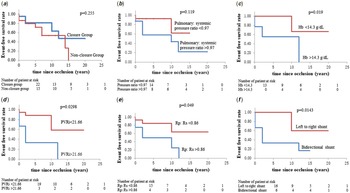
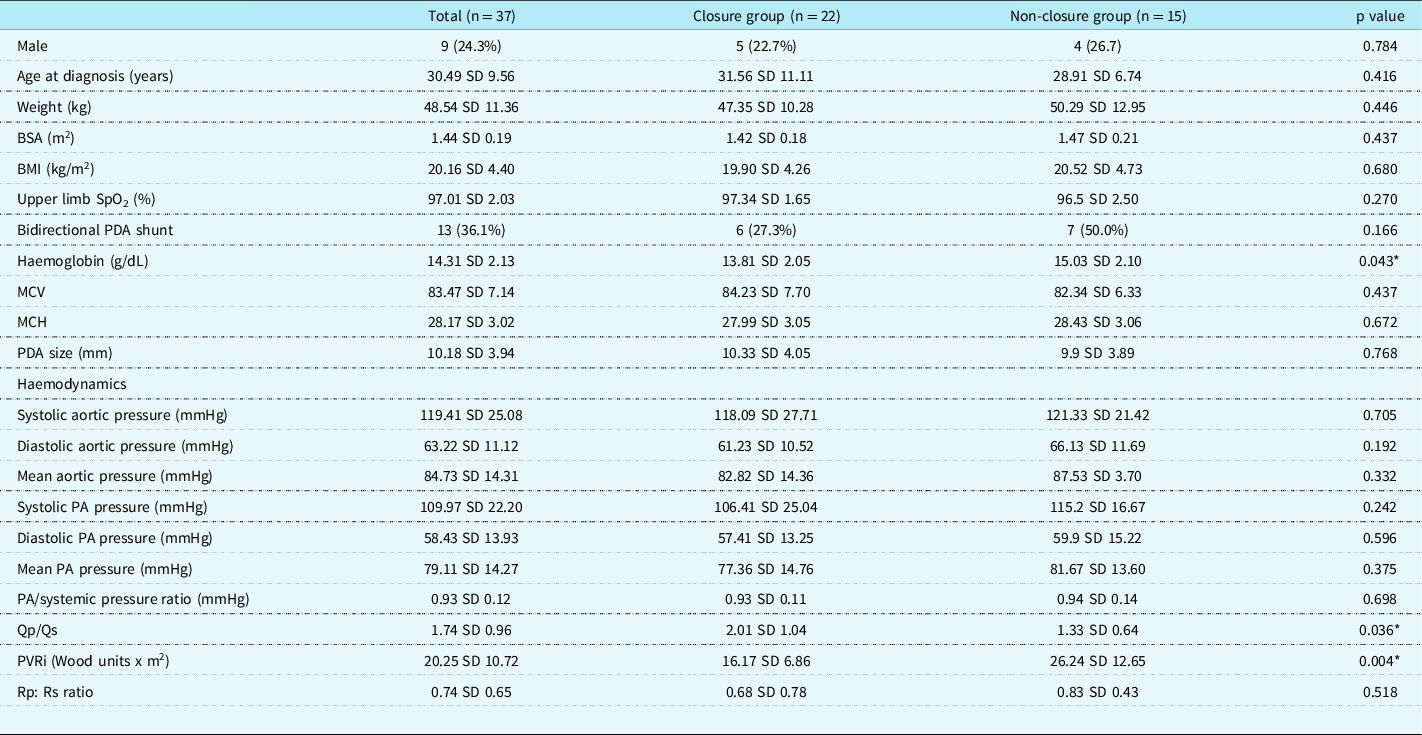
The baseline demography, resting upper limb oxygen saturation, patent ductus arteriosus size, and shunt direction, were not significantly different between the Closed and Non-closure Groups (Table 1). However, the mean haemoglobin concentration was significantly higher in the Non-closure Group at baseline (Closed Group: 13.81 ± 2.05 g/dL versus Non-closure Group: 15.03 ± 2.10 g/dL; p = 0.043). The mean Qp/Qs was significantly lower in the Non-closure Group (Closed Group: 2.01 ± 1.04 versus Non-closure Group: 1.33 ± 0.64; p = 0.036) and the mean pulmonary vascular resistance index was significantly higher in the Non-closure Group (Closed Group: 16.17 ± 6.86 WU x m2 versus Non-closure Group: 26.24 ± 12.65 WU x m2; p = 0.0035). Both groups had comparable durations of follow-up (Closed Group: 6.95 ± 5.39 years versus Non-closure Group: 6.53 ± 4.91 years; p = 0.811). During follow-up, no difference was seen in the event-free survival rate between the Closed and Non-closure Groups (Fig 1). The number of patients who died in our cohort was 4 (26.7%) in the Non-closure Group and 7 (31.8%) in the Closed Group. The 5-, 10-, and 15-year survival rates were 80.1% (95% confidence interval, CI 64.5–97.8), 63.1% (95% CI 37.5–88.7), and 45.0% (95% CI 14.4–80.3), in the Closed Group and 80.0% (95% CI 58.7–100.0), 67.5% (95% CI 25.7–81.6), and 36.1% (95% CI 0.0–66.5), respectively in the Non-closure Group.
Event free survival according to Closed and Non-Closure groups and in the Closed Group, pulmonary-to-systemic pressure ratio, haemoglobin concentration, pulmonary vascular resistance index, pulmonary-to-systemic vascular resistance ratio and shunt direction. A. Closed versus Non-Closure Groups; B. Pulmonary-To-Systemic Pressure Ratio (Closed Group); C. Hahemoglobin Concentration (Closed Group); D. Pulmonary Vascular Resistance Index, PVRi (Closed Group); E. Pulmonary-To-Systemic Vascular Resistance Ratio, Rp: Rs (Closed Group); F. Shunt Direction (Closed Group).

Baseline characteristics

Abbreviations: BSA: body surface area; BMI: body mass index; SpO2: oxygen saturation; PDA: patent ductus arteriosus; PA: pulmonary arterial; Qp/Qs: pulmonary /systemic shunt ratio; PVRi: pulmonary vascular resistance index; PVR: pulmonary vascular resistance; SVR: systemic vascular resistance.
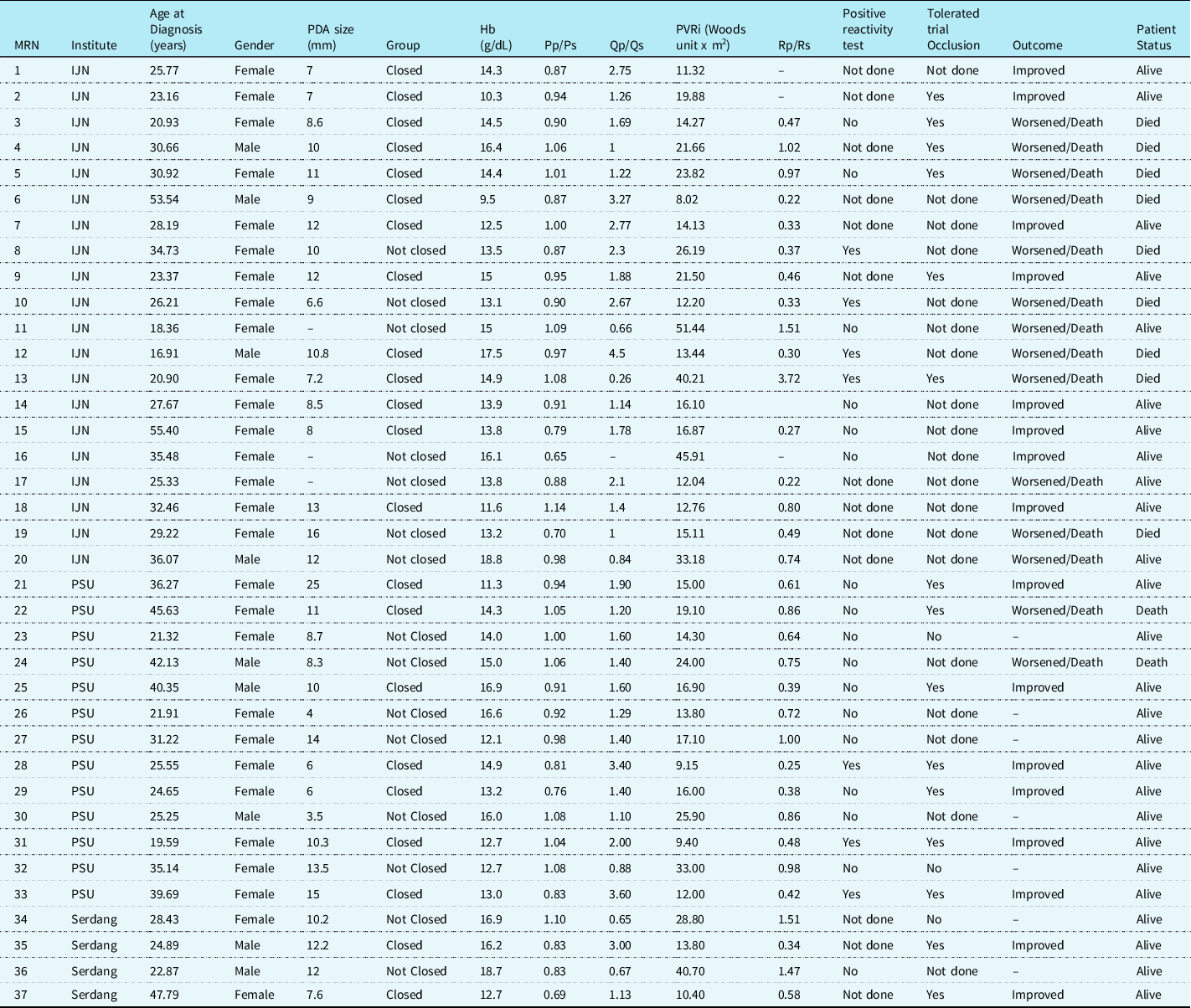
Trials of PDA occlusion were performed in 15 (68.2%) patients while acute vasoreactivity tests were performed in 13 (59.1%) patients prior to closure (Table 2). Four patients with a Qp/Qs and PVRi of 2.75, 3.27, 2.77, and 1.4 and 11.3, 8.02, 14.13, and 12.76 WU x m2, respectively, underwent neither acute vasoreactivity testing nor trial occlusion of the PDA.
Hemodyanmic data of the entire cohort at baseline and outcomes at the end of the study

Pp/Ps : systolic pulmonary to systemic pressure ratio; Qs/Qs = pulmonary to systemic flow ratio; PVRi : pulmonary vascular resistance index; Rp/Rs = pulmonary to systemic vascular resistance ratio.
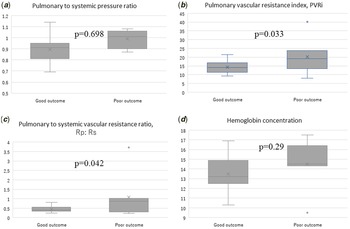
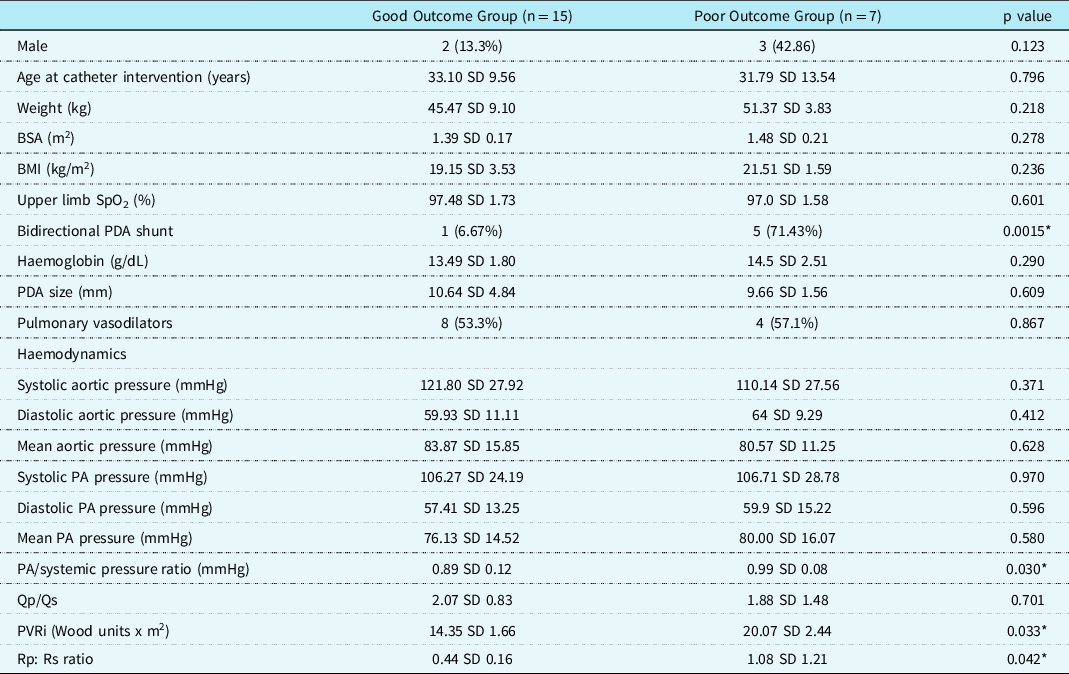
Table 3 summarised the baseline characteristics of the patients who had undergone patent ductus arteriosus occlusion with Good Outcome (n = 15) and Poor Outcome (n = 7). The proportion of males, age at catheter intervention, weight, body mass index, upper limb SpO2, PDA size, and haemoglobin concentration were comparable between the two groups. However, patients in the Poor Outcome group were associated with higher number of patients with bidirectional shunt (Good Outcome: n = 1 (6.67%) versus Poor Outcome: n = 5 (71.43%); p < 0.01), higher mean pulmonary-to-systemic arterial pressure ratio (Good Outcome: 0.89 ± 0.12 versus Poor Outcome: 0.99 ± 0.08; p = 0.030), higher pulmonary vascular resistance index (Good Outcome: 14.35 ± 1.66 WU x m2 versus Poor Outcome: 20.07 ± 2.44 WU x m2; p = 0.033), and higher Rp: Rs (Good Outcome: 0.44 ± 0.16 versus Poor Outcome: 1.08 ± 1.21; p = 0.042) suggestive a worse degree of PAH (Fig 2). The mean Qp/Qs was similar between the Good (2.07 ± 0.83) and Poor (1.88 ± 1.48) Outcome groups (p = 0.701). The mean follow-up duration was similar between the Good (6.27 ± 1.47 years) and Poor (5.14 ± 2.14 years) Outcome groups (p = 0.670).
Comparisons of the pulmonary-to-systemic pressure ratio, pulmonary vascular resistance index, pulmonary-to-systemic vascular resistance ratio, and haemoglobin concentration between the Good and Poor Outcome Groups. A. Mean Pulmonary-To-Systemic Pressure Ratio; B. Pulmonary Vascular Resistance Index, PVRi; C. Pulmonary-To-Systemic Vascular Resistance Ratio, Rp: Rs; D. Haemoglobin Concentration.

Characteristics of patients in the Closed Group

Abbreviations: BSA: body surface area; BMI: body mass index; SpO2: oxygen saturation; PDA: patent ductus arteriosus; PA: pulmonary arterial; Qp/Qs: pulmonary /systemic shunt ratio; PVRi: pulmonary vascular resistance index; PVR: pulmonary vascular resistance; SVR: systemic vascular resistance.
Receiving Operating Characteristic curves (supplementary materials) were constructed to acquire cut-off values of patent ductus arteriosus closure. The cut-off values for the pulmonary-to-systemic arterial pressure ratio used to predict good outcomes after patent ductus arteriosus occlusion was 0.97 (area under the curve (AUC): 0.77); PVRi was 21.66 WU x m2 (AUC: 0.69); Rp: Rs was 0.86 (AUC: 0.69), and haemoglobin concentration was 14.3 g/dL (AUC: 0.70) (Fig 2). The absence of shunt reversal, PVRi <21.66 WU x m2, Rp: Rs ratio <0.86, and haemoglobin concentration <14.3 g/dL were associated with good long-term outcomes (Fig 1).
Discussion
In this study, the long-term outcomes were similar between the Closed and Non-closure groups. Although there have been attempts to differentiate them via haemodynamic data, none has managed to provide a clear cut-off value to allow for an effective differentiation between patients who would improve and those who would not. One of such studies examined its cohort of patients with pulmonary hypertension who had undergone PDA occlusion. Additional to the conventional haemodynamic measurements, acute vasoreactivity testing using 100% oxygen and trial occlusion of the PDA using a balloon as the pulmonary arterial pressure was measured were conducted. Reference Sadiq, Rehman, Hyder, Qureshi, Kazmi and Qureshi13 The study found that only 20 out of 24 (83%) of the patients experienced regression of their pulmonary hypertension and recommended that patent ductus arteriosus closure should not be performed in patients with PVRi >8 WU x m2. In another study, patent ductus arteriosus closures were performed in patients with Eisenmenger after pre-treatment with pulmonary hypertension targeted therapy. Reference Xu, Wang, Shen, Geng and Chen14 Of the four patients, two had regression of pulmonary hypertension while another two did not. The initial good response after closure does not translate to excellent long-term outcomes as some of these patients experienced continual progression of pulmonary hypertension over time. In the same vein, previous studies reported a better long-term prognosis in patients with Eisenmenger Syndrome in whom patent ductus arteriosus were left open than those with shunt removal. Reference Haworth and Hislop15–Reference Manes, Palazzini, Leci, Bacchi Reggiani, Branzi and Galiè16
We found that the pulmonary vascular resistance index and Rp: Rs ratio were significantly lower in patients with good outcomes. There was also an absence of reversal of shunt in them. This suggests that the patients with good outcomes had a milder disease. We then proceeded to examine for cut-off values that potentially aid the identification of patients who may potentially regress post PDA occlusion. We found that a PVRi <21.66 WU x m2, and an Rp: Rs ratio <0.86 were associated with a better long-term outcome. These cut-off values were substantially higher than the current recommended values and should be interpreted with caution. Haemodynamic data from cardiac catheterisation is known to be flawed. Reference Moustafa, Kolokythas, Charitakis and Avgerinos17 Firstly, the calculation of haemodynamics during cardiac catheterisation is often made with oxygen consumption data extracted from a previous study. Reference Lundell, Casas and Wallgren18 The oxygen saturation of the pulmonary arteries was assumed to be uniform but, often it varies based on the shunt direction of the patent ductus arteriosus and the compliance of the lungs. In addition, patients are often examined at rest while in reality, haemodynamics change with activity and physiological state. Such a single time point evaluation could not represent the dynamic state of the patients and is often misleading. These flaws led to inaccuracies when these cardiac catheter-derived parameters were relied upon for decision-making. In fact, previous study has reported discrepancies between patients’ hemodynamics and histopathological findings, further supporting the inadequacies of cardiac catheterisation derived data. Reference Yamaki, Mohri, Haneda, Endo and Akimoto19 As such, non-cardiac catheterisation parameters are needed to allow for more wholesome decision-making.
In this study, haemoglobin concentration was found to be a good predictor of good long-term outcomes after patent ductus arteriosus closure. Usually, patients undergo the cardiac cathaterisation at rest. Reversal of shunt may not be apparent during rest. A higher haemoglobin may be an early sign of Eisenmenger’s physiology. Some patients with advanced pulmonary vascular disease may yet to reach full-fledged Eisenmenger’s Syndrome thus may not exhibit differential cyanosis. However, the reversal of shunt is unmasked during exercise and this intermittent hypoxia increases the production of erythropoietin leading to erythrocytosis. Reference Siegel and Petrides20–Reference Ou, Salceda and Schuster21 In patient who are iron repleted, the haemoglobin level reflects the oxygen saturation and the degree of bidirectional shunting. We found the threshold to be Hb >14.3 g/dL but this figure will require future studies for validation. The finding of a high Hb level, in addition to the discovery of the extent of oxygen desaturation during exercise may aid in decision making in the closure of such patients.
Limitations
The main limitation in this study was the absence of a repeat cardiac catheterisation post closure. Patients who underwent repeat cardiac catheterisation were mostly, patients who had deteriorated and required a repeat workup. Meanwhile, patients who responded to the PDA closure was less likely to undergo cardiac catheterisation. The repeat cardiac catheterisation data would therefore, be skewed and hence not examined. Being a retrospective, multicenter study, there was no uniformity in the decision-making process of patent ductus arteriosus closure and the treatment plan of the patients before and after patent ductus arteriosus closure. These were such as adoption of different thresholds for patent ductus arteriosus closure, initiation and escalation of pulmonary arterial hypertension targeted therapy, and the practice of acute vasoreactivity test during cardiac catheterisation, despite the guidelines recommending so. Reference Lopes, Barst and Haworth5–Reference Rosenzweig, Abman and Adatia8,Reference Caicedo, Hopper and Garcia22 Additionally, patients who were not hospitalised or did not succumb were considered well. These patients might still have significant pulmonary hypertension but the disease was well controlled medically.
Conclusion
Patients with patent ductus arteriosus with severe pulmonary arterial hypertension have a dismal outcome with or without closure. Haemoglobin concentration <14.3 g/dL aids in stratifying patients with potential good long-term outcomes.
Acknowledgements
We would like to thank Dr Yuri Ito and Daisuke Nishioka for their technical support and statistical assistance. We would also like to thank IJN Foundation for supporting the database from which some of the data is sourced from.
Financial support
This research did not receive any specific grant from funding agencies in the public, commercial, or not-for-profit sectors.
Conflicts of interest
None