INTRODUCTION
In recent decades, many observers have warned that Americans are becoming less concerned with the well-being of others. Writing in the 1980s, Bellah et al. (Reference Bellah, Madsen, Sullivan, Swidler and Tipton1985, vii) lamented that “individualism . . . grown cancerous” had undermined Americans' sense of responsibility to others. In the 1990s, McKnight (Reference McKnight1995) argued that with the exponential growth of the “caring” professions such as social work, medicine, education and psychology, and the concomitant rise of formal caring organizations such as the Salvation Army and the Red Cross, Americans were losing their capacity to care personally about the fate of others. More recently, Putnam (Reference Putnam2000) decried the erosion of social capital — collective caring, interpersonal trust, and civic engagement — over the last decades in the United States.
Yet despite the alarm over the withering away of Americans' capacity for compassion, we still know relatively little about what fosters compassionate feelings and what the political implications of such feelings are. Compassion — literally “suffering with” others — is “at the core of what it means to be human” (Kanov et al. Reference Kanov, Maitlis, Worline, Dutton, Frost and Lilius2004, 808). It is, for Schopenhauer (Reference Schopenhauer and Payne[1840] 2000, 145), the essence of moral action. Compassion involves a selfless caring and feeling of personal responsibility for the troubles and problems of others. It often entails an intensity of feeling that impels action to alleviate suffering through individual volunteering and donating or — our focus here — through support of government efforts to ameliorate disadvantage and misfortune. Many scholars argue that religion encourages compassionate feelings, but there is little agreement on which specific dimensions of religion foster such feelings, why these dimensions matter and whether they actually have an effect.
Most studies of religion and compassion have focused on how religion affects charitable giving and volunteering. Our approach in this article is different: We explore how religion affects compassionate feelings and how such feelings are, in turn, associated with support for government efforts to alleviate poverty, improve the conditions of African-Americans, and help the sick with their medical bills. We analyze data from a unique module of the 2004 General Social Survey (2004 GSS) that includes questions on feelings of compassion as well as measures of three religion dimensions — affiliation with a religious tradition, attendance at religious services, and adherence to religious orthodoxy — that scholars see as linked to compassionate feelings and economic policy preferences.
ARE RELIGIOUS PEOPLE MORE COMPASSIONATE?
We examine how three dimensions of religion — what Leege and Kellstedt (Reference Leege and Kellstedt1993) referred to as “belonging, behaving, and believing” — are associated with compassionate feelings toward others. Specifically, we test whether affiliating with specific religious traditions (belonging), attending religious services (behaving), and adhering to religious orthodoxy (believing) foster compassionate feelings, and whether such feelings mediate the effects of religion dimensions on support for government assistance to the disadvantaged.
Belonging: Affiliation with a Religious Tradition
Belonging — affiliating with a specific “religious tradition” — is the basis of the “old religion gap” in the United States according to Green (Reference Green2007, 21). Defining “religious tradition” as “a set of religious denominations, movements, and congregations with similar doctrines, practices, and origins,” Green (Reference Green2007, 23) argues that religious traditions set off groups that have traditionally differed in their beliefs, identity, and politics. There is little consensus among scholars on how belonging relates to compassion and economic policy preferences. With regard to compassion, some scholars argue that Catholics have a distinctive “communitarian” or “communal” ethic of neighborliness, sharing, and concern for the welfare of others that contrasts with the “individualistic” ethic of Protestants (Greeley Reference Greeley1990, 44–45; Tropman Reference Tropman1995, xiii). With regard to economic policy preferences, Greeley (Reference Greeley1990, 48) argues that Catholics are more conservative in their policy preferences than Protestants on issues of family life (e.g., abortion, same-sex marriage) but more liberal on government social welfare efforts. The National Conference of Catholic Bishops' (1986) statement, “Economic Justice for All,” draws on Catholic social teaching to argue that “all members of society have a special obligation to the poor and vulnerable.” And D'Antonio et al. (Reference D'Antonio, Davidson, Hoge and Gautier2007, 24) report that 84% of American Catholics, in response to a question on how important 12 elements of Catholicism were to them, rated “helping the poor” as “very important” — a percentage equaled only by their “belief in Jesus' resurrection from the dead.”
Other scholars regard Evangelical Protestants as distinctive in ways that bear on their compassion and economic policy preferences. Regnerus, Smith, and Sikkink (Reference Regnerus, Smith and Sikkink1998) find that Evangelicals are more likely than affiliates of other traditions to give to the poor — suggesting their compassion — but that they view this as a form of private charity. Smith et al. (Reference Woodbury and Smith1998, 189; Emerson and Smith Reference Emerson and Smith2000) find that Evangelicals are “anti-structuralist” and “freewill individualists,” who tend not to recognize social structural causes of poverty and misfortune, and therefore do not seek governmental solutions to these. Commenting on a quotation from an Evangelical woman in their sample, Smith et al. (Reference Woodbury and Smith1998, 192) note that, for her, “The solution [to poverty] is not a more equitable restructuring of income distribution, but for rich people to come to Christ and then practice voluntary generosity toward those around them.” Thus, we test whether Evangelicals are more compassionate but generally eschew government efforts to aid the poor and misfortunate.
Still other scholars emphasize the distinctiveness of mainline Protestants. The authors of the studies in Wuthnow and Evans' (2002) edited volume find that mainline Protestant congregations tend to support the poor and emphasize racial justice. Specifically, these authors find that mainline Protestant congregations tend to be more involved with volunteering and community-based efforts to alleviate poverty and promote racial understanding, as well as more supportive of government intervention toward these ends (Green Reference Green2007, 31–32; Brint and Abrutyn Reference Brint and Abrutyn2010).
Prior research on the effects of religious tradition has yielded inconsistent results. While we could find no research on how belonging affects compassion, Woodbury and Smith's (Reference Woodbury and Smith1998) review article notes that white Evangelical and fundamentalist Protestants were on average more economically liberal in their policy orientations than mainline Protestants. More recently, Starks and Robinson (Reference Starks and Robinson2009) find that Catholics and self-identified liberal Protestants were most favorable toward government intervention to reduce the gap between rich and poor and provide jobs for all, followed by self-identified moderate Protestants and lastly by self-identified Evangelical and fundamentalist Protestants. And Brint and Abrutyn (Reference Brint and Abrutyn2010) find that mainline Protestants were more favorable to government social spending than Evangelical Protestants or Catholics. Given the range of expectations and findings on the effects of specific religious traditions, we test whether any tradition is distinctive in its compassionate feelings and support of greater government assistance to disadvantaged groups.
Behaving: Attendance at Religious Services
Many scholars argue that all of the world's major faith traditions — not just the specific ones discussed in the previous section — urge or require their followers to treat others with compassion (Wuthnow Reference Wuthnow1991, 122; Clark Reference Clark1997, 41, 94; Kanov et al. Reference Kanov, Maitlis, Worline, Dutton, Frost and Lilius2004, 232). Here, because our analyses are, of necessity, restricted to Catholics and denominations of Protestants (and the unaffiliated), we limit our discussion to the Christian tradition. Jesus' reminder to his followers of the commandment to “Love your neighbor as yourself” (Leviticus 19:18, New International Version) and his exhortation to “Do unto others as you would have them do to you” (Matthew 7:12, New International Version), his parable of the Good Samaritan, and his warning that “Whatever you did for one of the least of these brothers of mine, you did for me” (Matthew 25:40, New International Version) have been the basis of Christian compassion.
To the extent that Christianity fosters compassion, we would expect that greater exposure to this tradition should increase compassionate feelings. Many scholars see service attendance as capturing exposure to religious content and fellow worshippers who reinforce the theological messages heard in church (Brooks Reference Brooks2002; Djupe and Gilbert Reference Djupe and Gilbert2006; Olson and Warber Reference Olson and Warber2008). Among the content to which frequent attendees are exposed, according to many scholars, is the prescription to be caring toward others. Ellison (Reference Ellison1992, 414) argues that because sermons and liturgies often impart pro-social content, “one might expect individuals who are exposed to these messages to exhibit greater kindness toward others.” Wuthnow (Reference Wuthnow2004, 68) reports that 70% of worshippers who attended religious services every week, compared to 35% of those who attended only a few times a year, said they had heard a sermon about caring for the poor in the last year.
It is, of course, possible, as Allport and Ross (Reference Allport and Ross1967) observe, that people attend services for purely extrinsic reasons, such as to network with fellow congregants to find a job or meet business clients. And we note that scholarship emphasizing the pro-social message of Christianity tends to minimize the fact that this faith tradition, like all of the world's major traditions, has sometimes also been associated with intolerance, persecution, and war. Green (Reference Green2007) and Olson and Warber (Reference Olson and Warber2008), among others, expect, in contrast to the scholars seeing frequent attendance as imparting compassionate values, that frequent worshippers, which Olson and Warber (Reference Olson and Warber2008, 195) refer to as “religious conservatives,” are more conservative in their ideology and Republican in their party preference. Nonetheless, to the extent that Christianity primarily imparts compassion, exposure to religious messages and fellow believers should lead those who frequently attend services to report more compassionate feelings than those who rarely or never attend. An extension of this logic is that frequent attendees should be more supportive than infrequent attendees of government efforts to help the disadvantaged and misfortunate. Of course, some compassionate people may feel that it is more caring to encourage the needy to solve their own problems, without government assistance, and others may feel that private charity and volunteer work, not government, is the most effective solution to problems of poverty, racial disadvantage, and inadequate health insurance coverage. Whether those exposed to more religious content and to fellow worshippers support specifically government efforts to solve social problems is an empirical question that we test through our analyses.
Prior studies have found that service attendance is positively related to “humanitarianism” (Feldman and Steenbergen Reference Feldman and Steenbergen2001, 675) and “social concern” (Keyes Reference Keyes2002), both of which were measured using similar items to our measure of compassion (see below). Yet studies of the effect of service attendance on support for government efforts to address issues of poverty, racial inequality and/or inadequate health coverage have found either a negative relationship or no relationship (Davis and Robinson Reference Davis and Robinson1996; Curry, Koch, and Chalfant Reference Curry, Koch and Chalfant2004; Edgell and Tranby 2007; Starks and Robinson Reference Starks and Robinson2009).
Believing: Adherence to Religious Orthodoxy
A third religion dimension theorized to be related to compassion is “believing” or “the strictness with which an individual interprets and understands the teachings of his or her particular faith tradition” (Olson and Warber Reference Olson and Warber2008, 195). Hunter (Reference Hunter1991) distinguished between the religiously orthodox, who view God as the ultimate judge of good and evil, regard sacred texts as divinely revealed and hence without error and timeless, and see the deity as watching over, affecting and judging people's daily lives, and modernists,Footnote 1 who see individuals as having the freedom to make moral decisions in the context of their times, view religious texts as human creations that should be considered in cultural context, and regard individuals as responsible for themselves and largely independent from God in making their lives. Orthodoxy, in Hunter's conceptualization, is a broad moral cosmology present among Catholics, Jews and Protestants (and within subcategories of these) in the United States, rather than adherence to the tenets of specific religious traditions (e.g., the divinity of Jesus, the interceding role of Mary). Note that modernists include believers, agnostics and secularists (most modernists in the United States are believers; Davis and Robinson Reference Davis and Robinson1996).
Drawing out the theological and political implications of Hunter's distinction, Davis and Robinson's (1996; 1999; 2006; Reference Davis and Robinson2009; 2012) “moral cosmology theory” posits that the orthodox cosmology is theologically “communitarian” in seeing individuals as subsumed by a larger community that is subject to the laws and greater plan of God, while the modernist cosmology is theologically “individualistic” in viewing individuals as largely responsible for their own moral decisions and fates. For these authors, the theological communitarianism of the orthodox inclines them to an authoritarian strand of cultural communitarianism, whereby the community must enforce divinely mandated moral standards on abortion, sexuality, family, and gender, but also inclines them to economic communitarianism, in which it is the community's or state's responsibility to look out for those in need (Davis and Robinson Reference Davis and Robinson2006, 169). Thus, the communitarianism of the orthodox, with its notion of “watching over” community members, has a strict or authoritarian side on cultural issues but a caring side on economic issues. Following Davis and Robinson, we test the hypothesis that the religiously orthodox report more compassionate feelings than modernists and are more supportive of government efforts to help the poor, blacks and the sick.
To our knowledge, no studies have examined the effect of religious orthodoxy on compassionate feelings. The orthodox have been found to be more supportive than modernists of government intervention to help the poor and unemployed in 20 countries that are predominantly Protestant (Norway, the United States), mixed Protestant and Catholic (West Germany), Catholic (Austria, Ireland, Italy, Poland, Portugal), Eastern Orthodox (Bulgaria, Romania), Jewish (Israel), and Muslim (Algeria, Bangladesh, Egypt, Indonesia, Jordan, Kazakhstan, Kyrgyzstan, Pakistan, and Saudi Arabia (Davis and Robinson Reference Davis and Robinson1996; Reference Davis and Robinson1999; Reference Davis and Robinson2006; Starks and Robinson Reference Starks and Robinson2009; Junisbai Reference Junisbai2010).
Wuthnow (Reference Wuthnow1988), Hunter (Reference Hunter1991) and other scholars argued that divisions within religious traditions have largely supplanted differences between them. Both behaving (frequent attendance) and believing (adherence to orthodoxy) may be the basis of what Green (Reference Green2007, 45) calls “the new religion gap” — a gap within each of the religious traditions between frequent and infrequent attendees and between the religiously orthodox and modernists. We test for the effects of these within-tradition divisions using interactions of attendance with religious tradition and of orthodoxy with tradition.
DO COMPASSIONATE FEELINGS AFFECT ECONOMIC POLICY PREFERENCES?
If compassionate feelings have no effect on people's behavior or policy choices, then there is little utility in studying them. We expect compassionate feelings for others to lead to support for government efforts to aid the poor, blacks, and the sick. Feldman and Steenbergen (Reference Feldman and Steenbergen2001, 658) introduce an important distinction between “humanitarianism,” defined as “a sense of obligation to help those in need,” and “egalitarianism,” a desire for “an extensive economic role for the government.” Feldman and Steenbergen argue that humanitarianism, nearly identical to what we call compassion, leads Americans to support modest government efforts to address immediate needs, while egalitarianism leads to support for broader government intervention in the economy via progressive taxation, a guaranteed minimum income, etc. Since the questions that we use to assess economic policy refer to government support to help the poor, blacks, and the sick, and are addressed to a specific need, we expect that compassionate feelings will be associated with support for such policies. While, as we noted above, compassionate feelings could lead to private charity or volunteering as the solution to problems of poverty, racial disadvantage, and illness, we expect that such feelings also have consequences for support of government efforts to help the disadvantaged and misfortunate. Feldman and Steenbergen's (2001) findings are in accord with this hypothesis: Americans holding a humanitarian orientation were more supportive of government efforts to help the poor and elderly.
Since we expect that religion dimensions affect compassionate feelings and that such feelings affect policy preferences, we expect that some of the effects of religion dimensions on support for government intervention to help the disadvantaged will be mediated through compassionate feelings. Feldman and Steenbergen did not include religion dimensions as independent variables in their models of how humanitarianism (compassionate feelings) affects policy preferences; therefore we do not yet know what role, if any, religion and compassion together play in support for government aid to the disadvantaged. Thus, we test whether compassionate feelings mediate some or all of the effects of religion dimensions on support for government efforts to help the poor, blacks and the sick.
DATA
We test these hypotheses with data from the 2004 GSS, which includes a special module on compassion. The randomly assigned split-ballot design in the 2004 GSS for the module on compassion and for questions on economic policy resulted in an initial sample of 876. Because of their small numbers, we drop Jewish respondents (N = 10) from the analysis. We also exclude the “other religion” category (N = 55) because the diversity of denominations/faith traditions in this category makes interpretation of its effects difficult.
With an initial sample of over 800, list-wise deletion of missing data would reduce our number of cases to 565. Instead, we impute missing values for independent variables using multiple imputation modeling via chained equationsFootnote 2; the number of cases in the imputed sample is 782 after dropping cases with missing values on dependent variables.Footnote 3
MEASURES
Dependent Variables
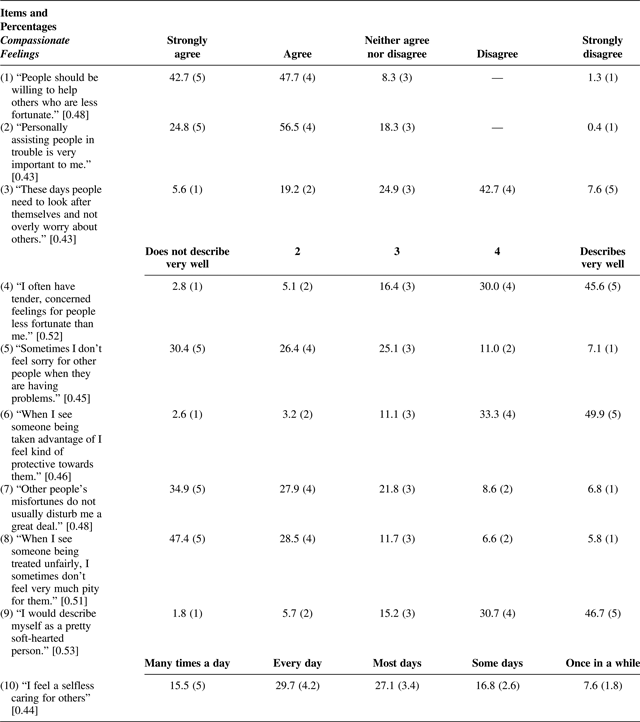
We measure Compassionate Feelings with a 10-item index (Table 1). Six of the items (1, 2, 4, 6, 9, and 10) are worded positively and four (3, 5, 7, and 8) negatively, which should help to reduce acquiescence bias or the tendency of respondents to satisfice by agreeing with the interviewer. A principal factors exploratory factor analysis, without rotation and without limiting the number of factors, showed that all of the items load highly (>0.41) on the first of four factors (see loadings in brackets in Table 1), and that only this factor has an eigenvalue greater than 1.00 (2.22; the second factor has an eigenvalue of only 0.47).Footnote 4 The Compassionate Feelings index ranges from 10 to 50, with high values indicating compassionate feelings. The mean is 39.20, and the cases are distributed about the mean more or less normally (S.D. = 5.54; see the Appendix). In our regression analyses, we standardize the index to have a mean of 0 and a standard deviation of 1 to facilitate comparisons with ideology and party identification.
Distributions of Measurement Items for the Compassionate Feelings Index, 2004 General Social Survey, N = 767–782
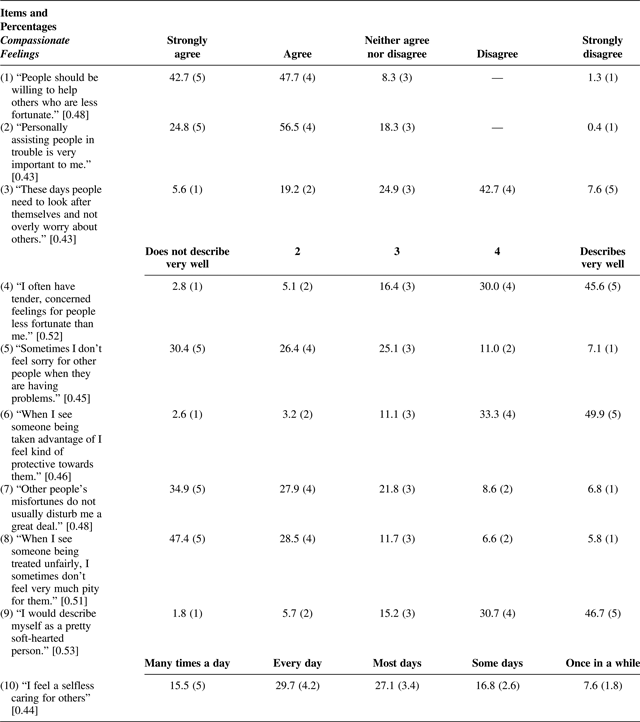
Notes: Items are listed in original codebook order. Numbers in parentheses are codes used for the indexes. Numbers in brackets are factor loadings.
We also analyze three economic policy choices: Government Should Help the Poor is self-placement on a five-point scale from “each person should take care of himself” (coded 1) to “the government in Washington should do everything possible to improve the standard of living of all poor Americans” (coded 5). Government Should Help Blacks is self-location on a five-point scale from “the government shouldn't give special treatment” (coded 1) to “the government is obliged to help blacks” (coded 5). Government Should Help the Sick is respondents' self-placement on a five-point scale from “people should take care of these things themselves” (coded 1) to “it is the responsibility of the government in Washington to see to it that people have help in paying for doctors and hospital bills” (coded 5).
Independent Variables
As an indicator of belonging, we use Steensland et al.'s (Reference Steensland, Park, Regnerus, Robinson, Wilcox and Woodberry2000) typology of religious traditions, which identifies Catholic (reference category), Mainline Protestant, Evangelical Protestant, Black Protestant, and No Affiliation. Evangelical Protestant subsumes both fundamentalist and Evangelical churches, while Mainline Protestant subsumes both mainline and liberal churches. Black Protestant is determined by membership in historically black denominations. Since not all members of such denominations are black and not all blacks are members of such denominations, we include race as a control variable.
Service Attendance, our indicator of behaving, is a nine-point scale ranging from 0 (never attends) to 8 (attends several times a week). In the regression analyses, we standardize this variable to have a mean of 0 and standard deviation of 1, thus facilitating comparison with the effects of religious orthodoxy, compassionate feelings, ideology and party identification.
Finally, as an indicator of believing, we use a two-item index of Orthodoxy. In accord with Hunter's (1991) conceptualization of orthodoxy, but in contrast to operationalizations of orthodoxy as “doctrinal” orthodoxy or the ratification of a specific set of religious beliefs, our measure applies to both the Catholic and Protestant traditions in the United States. The first item, which was used as part of a three-item index by Davis and Robinson (Reference Davis and Robinson1996) and Starks and Robinson (Reference Starks and Robinson2009) and as a single item measuring orthodoxy by Olson and Warber (Reference Olson and Warber2008), is whether respondents believe that the Bible is “ancient book of fables, legends, history, and moral precepts recorded by men” (1), “the inspired word of God but not everything in it should be taken literally, word for word” (2), or “the actual word of God and is to be taken literally” (3). In believing that the Bible should be taken literally, respondents prioritize divine truths and limit individual interpretive authority, whereas the opposite is the case when they believe that the Bible is simply a book of fables and moral tales.
The second item, “I feel guided by God in the midst of daily activities,” indicates the extent to which respondents see themselves as being directed, supported or protected by God in their daily lives. The six responses are “never” (1), “once in awhile” (1.4), “some days” (1.8), “most days” (2.2), “every day” (2.6), and “many times a day” (3). As in the Bible item, the responses are coded to range from 1 (most modernist) to 3 (most orthodox). Those who disagree with this item see themselves as being largely on their own in making their lives and moral decisions and perhaps, therefore, less accountable to God's will on a day-to-day basis. The item is comparable to Davis and Robinson's (1996) item: “The course of our lives is directed by God,” and to Starks and Robinson's (2009) item, “I believe in a God who watches over me.”Footnote 5 The index ranges from 2 to 6, with low values indicating modernism and high values orthodoxy. In our regression analyses, we standardize the index to have a mean of 0 and standard deviation of 1 for comparability with service attendance, compassionate feelings, ideology, and party identification. The three religion dimensions — service attendance, religious tradition, and orthodoxy — overlap to some degree, but not enough to cause problems in estimating their independent effects on compassionate feelings and policy preferences.Footnote 6
Control Variables
We control for variables that might predict compassionate feelings and economic attitudes: Race is coded as African-American, Asian, Latino, and Other Race (with non-Latino White as the reference category). Age is chronological age. Female codes women as 1 and men as 0. We include South, residence in the South (1) vs. any other region (0), because Southern states have historically had distinctive race relations and are today less generous than other regions on spending for the poor (Schott and Finch Reference Schott and Finch2010, 16–17). Education is in years. We also expect, following the rational-choice, “underdog principle” (Robinson and Bell Reference Robinson and Bell1978), that socially disadvantaged people — those in less prestigious occupations, with low family incomes, and who work for others — are more likely to report compassionate feelings for the less fortunate and more liberal in their economic policy preferences than people in prestigious occupations, with high family incomes and who are self-employed. Occupational Prestige, a continuous measure ranging from 17 to 75 in our sample, is coded by National Opinion Research Center (NORC) (with missing cases coded to the mean for employed people, so the variable captures the effect of prestige among the employed). Family Income is coded to midpoints of categories. Self-Employed is coded (1) vs. not coded (0).
In our analyses of economic policy preferences, we include two variables, in addition to Compassionate Feelings, as mediating the effect of the religion dimensions (and controls) on economic policy preferences: Ideology, which is self-placement on seven-point scale ranging from “extremely conservative” (1) to “extremely liberal” (7), and Party Identification, which is self-placement on a seven-point scale ranging from “strong Republican” (1) to “strong Democrat” (7). If we did not include ideology and party identification, the religion dimensions or the Compassionate Feelings index might pick up effects that are actually due to these variables, and our models would be misspecified. Ideology and party identification are coded so as to be positively related to support for government assistance to the disadvantaged. In our regression analyses, we standardize ideology and party preference to have means of 0 and standard deviations of 1, so that their effects can be assessed relative to those of compassionate feelings, service attendance and orthodoxy, which are also standardized. Descriptive statistics for all variables, without standardization or imputation of missing values, are given in the Appendix.Footnote 7
Statistical Analyses
Our models assume no causal order among the three religion dimensions. As we show below, these dimensions overlap to some extent but have independent, often different, and sometimes opposite effects on compassionate feelings and economic policy preferences.
Our models estimate simultaneous equations in which Compassionate Feelings, Ideology, and Party Identification are treated as multiple mediating variables between the religion dimensions (and controls) and the three economic policy preferences. Preacher and Hayes (Reference Preacher and Hayes2008) highlight the utility of this simultaneous equation approach for estimating multiple mediation models. Each of our models can be described as a recursive (triangular) system with correlated errors, and we estimate them using seemingly unrelated regression (SUREG) in Stata.Footnote 8
RESULTS
Are Religious People More Compassionate?
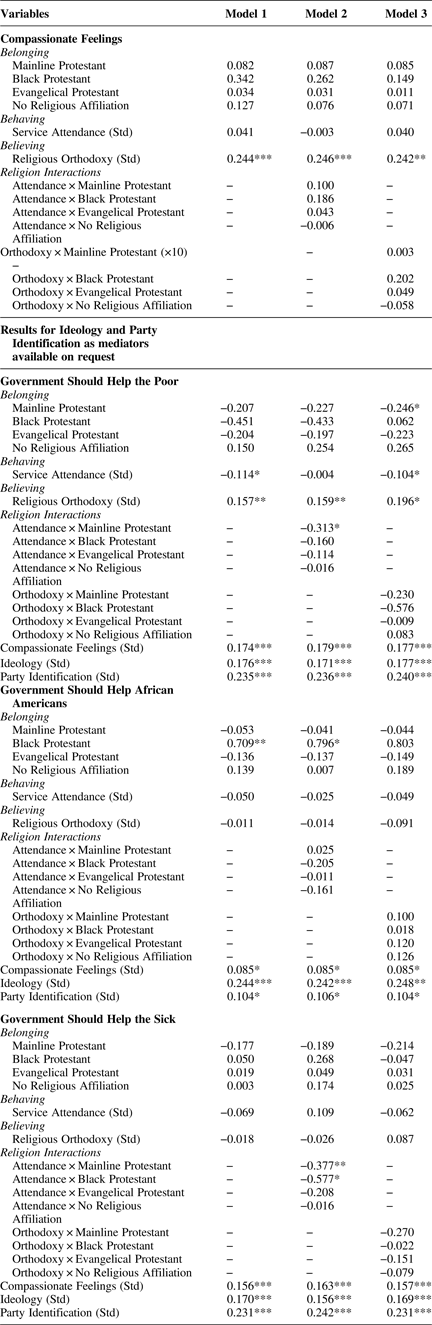
In Table 2, we show coefficients in SUREG models. All coefficients control for race, sex, age, education, self-employment, occupational prestige, family income, and region (not shown; available on request from the authors). We begin by discussing the effects of religion dimensions on Compassionate Feelings. Scholars who emphasize “belonging” as a factor in compassion differ in which religious tradition they see as most caring or compassionate, with some arguing that Catholics are the most caring, others Mainline Protestants, and still others Evangelical Protestants. Yet in Model 1, we see that there is no difference among the religious traditions in compassionate feelings.
SUREG (Seemingly Unrelated Regression) Models Explaining Compassionate Feelings (Standardized) and Economic Policy Preferences, N = 782

Notes: All models control for race, sex, age, education, self-employment, occupational prestige, family income and region, with missing values imputed. The reference category is Catholic, non-Latino white males who are self-employed. *p < 0.05, **p < 0.01, ***p < 0.001 (two-tailed tests).
Several scholars expect that “behaving” — frequent attendance at church services, reflecting greater exposure to the compassionate religious content that they see as present in all Christian traditions — is linked to compassionate feelings. We find no effect of attendance on such feelings (Model 1). Moreover, in Model 2, where we include interactions of attendance with religious tradition, we find no tendency for frequent attendees in any tradition to be exceptionally compassionate. This holds even for frequent worshippers at Evangelical Protestant churches, which especially privilege biblical texts (Green Reference Green2007, 26; Table 2) that some scholars see as enjoining compassion.
The only religion dimension that is related to compassionate feelings is “believing” or adherence to religious orthodoxy. As we expected following Davis and Robinson's (2012) argument that the religiously orthodox are communitarian, the orthodox report significantly more compassionate feelings than modernists. Model 1 estimates that for each one standard deviation increase on the Orthodoxy index from the modernist toward the orthodox pole, Americans are 0.244 standard deviation units higher on the Compassionate Feelings index. Davis and Robinson (Reference Davis and Robinson2012) argue that orthodoxy has communitarian effects, regardless of the specific religious tradition of those who hold orthodox beliefs. In Model 3, we include interactions of orthodoxy by religious tradition. None of these is significant, confirming this expectation.
Compassionate Feelings and Economic Policy Preferences
Table 2 also reports the effects of belonging, behaving, and believing on economic policy preferences. Regarding belonging, some scholars argue that Catholics are exceptionally likely to support government efforts to help the disadvantaged, others that mainline Protestants are most likely to support state aid for such purposes, and still others that Evangelical Protestants are exceptionally unlikely to support such assistance. The only difference we find in Model 1 among religious traditions is for Black Protestants to be more supportive of government assistance to blacks. Otherwise, there are no differences among religious traditions. The support of Black Protestants (and of blacks more generally, not shown) for government aid to blacks cannot unambiguously be interpreted as selfless caring or compassion. We found above that Black Protestants are not exceptionally compassionate, and the only economic policy preference on which adherents of this religious tradition are distinctive is support for assistance to African-Americans.
While some scholars have argued that behaving — or frequent attendance — at any Christian church should foster compassionate feelings and support for efforts to help the disadvantaged and misfortunate, we find no such tendency in Table 2. To the contrary, consistent with the argument and findings of scholars such as Green (Reference Green2007) and Olson and Warber (Reference Olson and Warber2008) that those frequently exposed to religious content and worshippers at church are more conservative in their politics, we find that frequent attendance is associated with less support for government efforts to help the poor (Model 1) and has no effect on support for state efforts to help blacks or the sick. Green (Reference Green2007) and others have argued that differences in behaving within religious traditions may today be as important as — or more so — differences between them. Model 2 shows interactions of attendance with religious tradition. Here we see that high-attending Mainline Protestants are distinctively unsupportive of government assistance to the poor and, along with high-attending Black Protestants, are exceptionally unfavorable to state aid to the sick. In short, just as we found that frequent exposure to religious messages and fellow worshipers at church is not associated with compassionate feelings, we find no evidence that frequent attendance makes people more supportive of government efforts to help the disadvantaged.
As we expected, following Davis and Robinson (Reference Davis and Robinson2012), believing — adherence to religious orthodoxy — is significantly associated with support for state assistance to the needy. For each standard deviation unit increase in the Orthodoxy index, support for government aid to the poor increases by 0.157 (Model 1). Yet the greater compassion of the orthodox than modernists apparently does not extend to blacks — a historically disadvantaged group that is disproportionately poor. The issue of government aid for blacks undoubtedly confounds compassion and racial attitudes. The extension of compassion to another group requires that it be seen as both disadvantaged and morally worthy or “deserving” (Steensland Reference Steensland2007). Emerson and Smith (Reference Emerson and Smith2000) find that white Evangelicals attribute black disadvantage to individual flaws, such as lack of motivation, failure to take advantage of opportunities, or resistance to God's will, rather than to structural conditions, such as discrimination or lack of opportunity, and thus may oppose government help for blacks. In our own analyses of Model 1, (white) Evangelicals, like the religiously orthodox, are not distinctive in their position on government aid to blacks. The compassion that the orthodox extend to the poor appears not to extend to blacks, suggesting that their communitarianism may have its limits. Nor are the orthodox more supportive than modernists of government efforts to help people with their medical bills, suggesting further limits to their communitarianism. While Wuthnow (Reference Wuthnow1988), Hunter (Reference Hunter1991), Green (Reference Green2007), and Olson and Warber (Reference Olson and Warber2008), among other scholars, see orthodoxy as the basis of divisions within religious traditions, we find that interactions of orthodoxy with religious tradition shed no further light on these relationships; none of them is significant (Model 3).
Note again that the questions on assisting the poor, blacks, and the sick refer specifically to government as the solution to problems of poverty, racial disadvantage, and inadequate medical coverage. As we noted above, some respondents who do not support greater efforts by the state to assist the poor, blacks, or the sick may favor private charity or volunteer work as the solutions to these problems. Our focus in this article is specifically on whether compassion affects policy that could be undertaken by the state to alleviate these problems.
We expected, following Feldman and Steenbergen (Reference Feldman and Steenbergen2001), that compassionate feelings (humanitarianism in their conceptualization) would be associated with support for state aid to the disadvantaged. Consistent with this expectation, Model 1 in Table 2 shows that compassionate feelings are associated with support for government efforts to help the poor, blacks, and the sick. For each one standard deviation increase in the Compassionate Feelings index, the model estimates that preference for government intervention to help the poor increases by 0.174 points, preference for efforts to help blacks increases by 0.085 points, and preference for efforts to help the sick increases by 0.156 points. With one exception (government aid to assist blacks), the effects of compassion are comparable to those of ideology and party identification.
We expected compassionate feelings (along with ideology and party identification) to mediate some or all of the effects of the religion dimensions on economic policy preferences. Because religious traditions do not differ in their compassionate feelings and because frequent attendees at church are no more likely than infrequent attendees to report compassionate feelings, belonging and behaving cannot affect economic preferences through compassionate feelings. Moreover, because religious orthodoxy has a significant positive total effect only on support for government aid to the poor, there is no need to discuss its indirect effects through compassionate feelings on state aid to blacks or the sick. Yet because the orthodox report more compassionate feelings than modernists and are more supportive of state efforts to aid the poor, we estimate the effects of orthodoxy, through compassionate feelings, on support for such efforts. We find that just under one-third of the total effect of orthodoxy acts indirectly through compassionate feelings: (0.042/0.139) = 0.302. The orthodox are more supportive of state aid to the poor in their own right, but are even more so because they tend to hold more compassionate feelings, which in turn are associated with support for government assistance to the poor. At the same time, however, because the orthodox are overall less liberal in their ideology and less likely to identify as Democrats, and because conservative ideology and Republican party identification are associated with less support of efforts to help the poor, the indirect effects of orthodoxy through ideology (−0.029) and party identification (−0.027) counterbalance that through compassionate feelings (0.042).
DISCUSSION AND CONCLUSION
Through analyses of a unique module of the 2004 GSS, we have explored whether affiliating with specific religious traditions (belonging), attending religious services (behaving), and adhering to religious orthodoxy (believing) are linked to compassionate feelings and support for government assistance to the disadvantaged. Regarding belonging, some scholars have argued that Catholicism has a “communitarian” ethic, in contrast to the “individualistic” ethic of Protestantism (Greeley Reference Greeley1990, 44–45; Tropman Reference Tropman1995, xiii). We find no support for this argument. Catholics are no more compassionate and no more supportive of government efforts to help the poor, blacks, and the sick than affiliates of any other religious tradition. Contrary to the arguments of other scholars (Wuthnow and Evans Reference Wuthnow and Evans2002), Mainline Protestants are not exceptionally compassionate or supportive of government efforts to help the disadvantaged. And while Regnerus, Smith, and Sikkink (Reference Regnerus, Smith and Sikkink1998) expected Evangelical Protestants to be more compassionate and Smith et al. (Reference Woodbury and Smith1998) and Emerson and Smith (Reference Emerson and Smith2000) expected Evangelical Protestants to be less willing than affiliates of other religious traditions to support government efforts to aid the needy, we find that they are no more compassionate than adherents of other religious traditions and no less likely to support government efforts to help the disadvantaged.
Other scholars argue that because the Christian tradition, like all the world's major faith traditions, exhorts followers to be caring toward others, exposure to any Christian tradition fosters compassion and caring toward others (Wuthnow Reference Wuthnow1991, 122; Clark Reference Clark1997, 41, 94; Kanov et al. Reference Kanov, Maitlis, Worline, Dutton, Frost and Lilius2004, 232). We find, however, that behaving — frequent attendance at religious services and the greater exposure to sacred texts and teachings and to fellow worshippers that this entails — has no effect on compassionate feelings. We find this even for frequent attendees at Evangelical Protestant churches — a tradition that especially privileges biblical texts that some scholars argue enjoin compassion toward others. Regarding economic preferences, we find that frequent attendees are actually less likely to support government efforts to help the poor and that high-attending Mainline Protestants are exceptionally unsupportive of state aid to the poor and along with high-attending Black Protestants, are distinctively unfavorable to government assistance to the sick. It may be that the social justice oriented, “prophetic” tradition in religion (Weber Reference Weber and Fischoff[1922] 1964, 46–59) is de-emphasized in most United States churches in favor of the “priestly” tradition that legitimates the status quo. Even when the prophetic tradition is present, voluntary solutions to poverty, racial inequality, and inadequate health coverage may be promoted over governmental solutions.
We expected, following Davis and Robinson's (2012) argument that the religiously orthodox are communitarian relative to modernists, that the orthodox would be more compassionate. We find, consistent with this hypothesis, that the religiously orthodox report more compassionate feelings than do modernists, and in part because of these feelings, are more likely to support government efforts to help the poor. Yet the orthodox are no more likely to support government efforts to help blacks or the sick; their caring side in the United States appears to be limited to the poor.
Consistent with Feldman and Steenbergen's (2001) argument that a pro-social, humanitarian orientation is associated with support for modest state efforts to ameliorate the problems of disadvantaged groups, we find that compassionate feelings are a factor in support of government intervention in the economy to assist the three disadvantaged groups (the poor, blacks, and the sick) that we consider in our analyses. While we expected compassionate feelings to mediate the effects of religion on such governmental efforts, we find only one tendency for this — one-third of the effect of religious orthodoxy on support for the poor is due to the fact that the orthodox report more compassionate feelings and these feelings lead to a desire for greater state intervention to ameliorate poverty.
We note two important limitations of our study. First, the 2004 GSS data include only two items comparable to those that had been used in previous operationalizations of religious orthodoxy (usually three-item, but see Olson and Warber (Reference Olson and Warber2008) for a measure using one of our items). Methodologically, this may attenuate correlations of our measure with other independent variables and with the dependent variables.
Second, given our interest in the policy implications of compassionate feelings, we have focused on government as a means of addressing problems of poverty, racial injustice, and inadequate health coverage. Many Americans may prefer to volunteer through formal organizations or give contributions to charitable organizations rather than involve the government. Nonetheless, the religiously orthodox are more supportive of state efforts to help the poor. And compassionate feelings are important in bolstering preferences for governmental efforts to help the disadvantaged. We find that such feelings are of similar magnitude in their effects on support for state efforts to help the poor, blacks and the sick as ideology and party identification.
The support that we find among the religiously orthodox for state efforts to assist the needy belies the “Religious Right” label that is often applied to them. Increasingly, however, a more nuanced account of religious traditionalists is emerging. A 2007 CBS poll of white Evangelicals found that fighting poverty was the most important issue that they thought Evangelicals should be involved in, with abortion a distant second, and genocide third (CBS News 2007). Evangelical Jim Wallis (Reference Wallis2008, 5) observes:
The hard-core Religious Right continues to get it wrong, still attempting to restrict the language of “moral values” to just two issues — abortion and gay marriage. But evangelicals are deserting the Religious Right in droves, especially among a new generation of pastors and young people. The evangelical social agenda is now much broader and deeper, engaging issues such as poverty and economic justice, global warming, HIV/AIDS, sex trafficking, genocide in Darfur, and the ethics of the war in Iraq.
Yet our analyses suggest that it is not Evangelicals but the religiously orthodox that are most likely to report compassionate feelings and to support government efforts to help the poor. These are individuals who, regardless of which religious tradition they are affiliated with, adhere to a communitarian theology, based on a literal interpretation of the Bible and a God-centered moral universe, which Davis and Robinson (Reference Davis and Robinson2012) argue fosters “watching over” community members. Since earlier analyses of the 1991 and 1998 GSS surveys found support for similar economic policies among the religiously orthodox (Davis and Robinson Reference Davis and Robinson1996; Starks and Robinson Reference Starks and Robinson2009), the compassion of the orthodox for the poor appears to have existed for some time, no doubt overshadowed by their conservative stances on cultural issues of abortion and same-sex marriage. While Republicans have been successful in recent decades in winning votes of the religiously orthodox by highlighting such cultural issues, the support we find among the orthodox for government efforts to aid the poor suggests that they may be open to Democratic policy appeals on economic issues, especially if these are framed as government assistance to address a specific problem, such as poverty. That the religiously orthodox may not extend this compassion to blacks suggests, however, that they may need to be courted with “race-neutral,” universalistic programs to help the poor and unemployed, along the lines that Wilson (Reference Wilson1997) has suggested would have broad public support.
Are religious people more compassionate? Frequent attendees at worship services are no more compassionate and are less supportive of government efforts to help the poor. Affiliates of specific religious traditions (Catholicism, Evangelical Protestantism, or Mainline Protestantism) are not distinctive in their compassionate feelings or preferences for state aid. Yet the religiously orthodox report more compassionate feelings toward others than do modernists and, in part because of this, are more supportive of government intervention to help the poor. Politically, this means that people of faith, variously defined, do not constitute a monolithic “Religious Right” and are potentially open to policy appeals from both political parties.
APPENDIX. DESCRIPTIVE STATISTICS FOR VARIABLES IN THE ANALYSES