INTRODUCTION
Sport-related concussion has been the focus of increased attention in both the academic and the popular press over the past two decades. Since the 1980s, more than two dozen separate sets of guidelines/rating scales have been published for the medical management of sport-related concussion (Johnston et al., Reference Johnston, McCrory, Mohtadi and Meeuwisse2001). In the United States, both the National Hockey League and the National Football League (NFL) have adopted mandatory “baseline” neurocognitive testing programs as part of a strategy to manage sport-related concussion, and commercially distributed computerized test batteries for this purpose are widely marketed at all levels of play (Grindel, Reference Grindel2006). Concussions are usually identified on a clinical basis as an alteration in mental status following a blow to the head. Typically, guidelines then attempt to grade concussions on some indices of severity or symptom expression and then recommend management techniques (type of evaluations, return-to-play recommendations) on the basis of the concussion grade (Kelly & Rosenberg, Reference Kelly and Rosenberg1997; McCrory et al., Reference McCrory, Johnston, Meeuwisse, Aubry, Cantu, Dvorak, Graf-Baumann, Kelly, Lovell and Schamasch2005).
Despite this high level of concern and extensive proliferation of management strategies, there has been a lack of focus on the nature and extent of the specific risks associated with sport-related concussion. None of the published guidelines derive directly from evidence regarding outcome from sport-related concussion, and the utility of methods such as neurocognitive testing for the detection of concussion-related impairments is questionable on a psychometric basis (Randolph et al., Reference Randolph, McCrea and Barr2005). As a result, perhaps, there is little consensus regarding methodologies for the management of sport-related concussion, and the vast majority of management decisions in this context are still based on subjective clinical judgment rather than any evidence-based guideline or algorithm (Notebaert & Guskiewicz, Reference Notebaert and Guskiewicz2005). The purpose of this study was to identify the specific risks associated with sport-related concussion, review available data regarding the incidence of specific risks, and discuss the extent to which individual risks are potentially modifiable via management strategies.
RISKS
It is clear from the literature to date that the vast majority of sport-related concussions resolve quickly and completely, and most prospective controlled studies fail to identify significant levels of subjective symptomatology or impairment of neurocognitive functioning or balance after approximately 7 days postinjury (Belanger & Vanderploeg, Reference Belanger and Vanderploeg2005; McCrea et al., Reference McCrea, Guskiewicz, Marshall, Barr, Randolph, Cantu, Onate, Yang and Kelly2003). The following, however, are the atypical outcomes or potential risks that have been identified for sport-related concussions: 1) permanent brain injury or death (including delayed cerebral swelling or “second-impact syndrome”), 2) prolonged recovery, 3) same-season repeat concussion, and 4) late-life consequences of repeated concussions. These risks are discussed with specific reference to American football; this is the sport that has been most extensively studied with respect to concussion and also has one of the highest rates of concussion of any sport (Powell & Barber-Foss, Reference Powell and Barber-Foss1999). It therefore provides a useful frame of reference for exploring risk.
Permanent Brain Injury or Death
The National Center for Catastrophic Sport Injury Research at the University of North Carolina (http://www.unc.edu/depts/nccsi/) maintains a database of sport-related injuries to the brain and spinal cord that result in permanent disability or death. Over the past 10 American football seasons for which data were available at the time of our review (1997–2006), there have been 50 cases of “permanent disability” (classified by evidence of some disability at a 2- to 3-month postinjury survey) and 38 deaths due to cerebral injuries, at all levels of play (from sandlot through professional). This survey is based on approximately 180,000 annual participants. The great majority of these deaths were due to subdural hematoma.
Although the classification of permanent disability within this database may be open to criticism as it was based on evidence of some type of residual impairment at a single follow-up point only 2- to 3- month postinjury, the overall incidence of death or disability is still quite low. The risk of permanent disability or death as a result of cerebral injury in American football is therefore approximately 1 for every 20,500 player/seasons (there is one season in American football, and therefore, a player/seasons represents annual risk per athlete). For a squad size of 100 players, this would translate to one such injury on average every 205 seasons.
As this type of outcome almost invariably ensues from the immediate consequences of a single traumatic brain injury (TBI), the risk thereof is only likely to be modified by rule/equipment changes and/or acute medical/neurosurgical monitoring and intervention. There is evidence that certain rule changes (e.g., outlawing spear tackling) have decreased the incidence of these injuries (Cantu, Reference Cantu1997). There is obviously no way that this risk can be modified by baseline neurocognitive testing, nor would there appear to be a role for grading systems or return-to-play guidelines in the reduction of this particular risk.
Delayed cerebral swelling or second-impact syndrome
The rare phenomenon of diffuse brain swelling with delayed catastrophic deterioration has been labeled “second-impact syndrome” due to the belief held by some that it occurs as the result of a second concussion before the effects of the initial concussion have resolved. This is the syndrome that is often cited by distributors of computerized neurocognitive tests as a rationale for the use of baseline neurocognitive testing (www.impacttest.com). Their contention is that by ensuring that players have completely recovered from the effects of the initial concussion, this catastrophic outcome can be prevented.
In fact, the majority of cases of this entity reported in the literature do not seem to have involved a “second” impact. In the only systematic review of this, a total of 17 cases of reported second-impact syndrome were identified in the world literature (McCrory & Berkovic, Reference McCrory and Berkovic1998). Of these, only five cases involved a repeat injury, and all these occurred within 7 days of the initial injury. Even in these cases, it was not clear that the initial injury played a contributory role. Of the 14 cases in this series that went to autopsy, 11 had evidence of intracranial bleeding (typically a subdural hematoma) in addition to cerebral swelling. A more recent literature review of the pathophysiology of this syndrome, involving a total of 18 cases, confirmed the presence of thin subdural hematomas on all cases in which computed tomography (CT) scanning had been obtained (Mori et al., Reference Mori, Katayama and Kawamata2006).
Given how common sport-related concussions are [perhaps 300,000 per year in the United States alone (Thurman et al., Reference Thurman, Branche and Sniezek1998)] and how exceedingly rare second-impact syndrome is, it seems unlikely that the etiology for this catastrophic outcome is purely mechanistic, that is, resulting from closely spaced concussions. Instead, some type of underlying vulnerability likely mediates this unusual outcome, which can clearly occur as the result of a single injury. Interestingly, minor head trauma can also trigger attacks of familial hemiplegic migraine, and this is sometimes also associated with brain swelling and permanent neurological disability or death. The latter condition has been linked to a calcium channel subunit gene mutation (Kors et al., Reference Kors, Terwindt, Vermeulen, Fitzsimons, Jardine, Heywood, Love, van den Maagdenberg, Haan, Frants and Ferrari2001).
Delayed cerebral swelling has also been reported in children following a single head injury unrelated to sports. Bruce et al. (Reference Bruce, Alavi, Bilaniuk, Dolinskas, Obrist and Uzzell1981) described this as “malignant brain edema” in a report on CT findings in a series of 15 children who had a lucid period following the initial head injury, and Snoek et al. (Reference Snoek, Minderhoud and Wilmink1984) described a series of 42 children who developed worsening neurological signs following minor head injury, 3 of whom died. Delayed diffuse brain swelling was also reported in 16% of a series of 166 children admitted to a hospital neurosurgical service following mild TBI, most of which were due to traffic accidents or falls (Mandera et al., Reference Mandera, Wencel, Bazowski and Krauze2000).
In sum, therefore, it would seem that delayed cerebral swelling can occur following minor head injuries, although very rarely, and that this typically does not require multiple closely spaced injuries. It seems that children are preferentially vulnerable to this outcome, and this syndrome may conceivably be related to a calcium channel gene mutation, although the latter association remains speculative. It is also unclear whether young age is an independent risk factor. If this condition is in fact secondary to a genetically mediated dysregulation of neurotransmitter response to minor brain trauma, it stands to reason that it would emerge after one of the first instances of such cerebal trauma likely at some point during childhood or adolescence, given how common these injuries are.
There was only one case of delayed cerebral swelling recorded by the National Center for Catastrophic Sport Injury Research as the result of American football–related injuries over the past 10 seasons (1997–2006). This resulted in death and was included among the 38 total deaths reported above during that period. The independent risk of this outcome is therefore approximately 1 in 1.8 million player-seasons, or once in every 18,000 seasons for an American football squad size of 100.
The potential for management strategies to modify outcome in this very rare condition of delayed cerebral swelling is unclear. Close monitoring of symptoms in order to detect worsening would seem to be clearly indicated, but it is unclear whether or not this would lead to improved outcome (McCrory, Reference McCrory2001). There is no evidence to suggest that baseline neurocognitive testing is superior to the use of clinical examination or symptom checklists in monitoring recovery from sport-related concussion, and the poor reliability of these cognitive tests in this setting is likely to result in a high number of false negatives, that is, concluding that a player has returned to baseline neurocognitive status when he or she has not (Randolph et al., Reference Randolph, McCrea and Barr2005).
A recent study explored the reliability of three commercially distributed computerized neurocognitive baseline test batteries in normal college students under test–retest intervals of 45 days (Broglio et al., Reference Broglio, Ferrara, Macciocchi, Baumgartner and Elliott2007). This interval was chosen to more closely approximate “real-world” intervals than the very brief retest intervals relied on by the test distributors to establish reliability. This independent study found stability coefficients to be far worse than those reported by the manufacturers. For the most widely used test, the “ImPACT” (used by almost all NFL football teams), these stability coefficients ranged from only 0.15 to 0.39 across the five composite scores, with an average intraclass correlation coefficient (ICC) of only .29. The other two batteries (Headminder Concussion Resolution Index and Concussion Sentinel) fared only slightly better, with average ICCs of .43 and .49, respectively. This suggests that these tests are essentially not capable of reliably detecting change in neurocognitive status on an individual basis due to extreme normal variability in performance. For comparison purposes, it has been suggested that a stability coefficient in the range of .90 is necessary for sensitive detection of individual change on a psychological test (Nunnally & Bernstein, Reference Nunnally and Bernstein1994). The stability coefficient of the Wechsler Adult Intelligence Scale Processing Speed Index (PSI), composed of only two subtests, is approximately .88 (Wechsler, Reference Wechsler1997). To exceed the 80% confidence interval for change on the PSI, a subject would have to improve or decline by 7 or more points (in other words, a decline of 7 or more points would occur less than 10% of the time by chance). The size of this confidence interval would be more than doubled if the stability coefficient of the PSI was in the range of that reported for the ImPACT test by Broglio et al. (Reference McCrea, Guskiewicz, Marshall, Barr, Randolph, Cantu, Onate, Yang and Kelly2007), and this would generally exceed the effect size reported in group studies of concussed players compared to controls.
In addition, the cost of implementing a baseline testing program to potentially prevent this outcome would seem to be prohibitive, particularly given the lack of evidence supporting the utility of such testing in this context. The cost of baseline testing programs has been estimated to range from about $20 per player using brief pencil-and-paper tests to approximately $670 per player using certain computerized tests (Grindel, Reference Grindel2006). Even using the lowest estimate of $20 per player for baseline testing, this would translate to $36,000,000 in baseline testing costs for American football players before encountering a single case of delayed cerebral swelling.
Prolonged Recovery
Although frequently cited in the lay literature as a risk of sport-related concussion, prolonged “post-concussion syndrome” appears to be relatively rare in prospective controlled studies of sport-related concussion. These investigations typically document a relatively rapid return to baseline levels of function for concussed players. A comprehensive review of the data on neurocognitive recovery in such studies concluded that concussed and control groups were often not statistically different from one another within 48 hours postinjury and that no study had documented reliable group differences on cognitive variables after 7 days postinjury (Randolph et al., Reference Randolph, McCrea and Barr2005). This is consistent with a recent meta-analysis of the same literature, which failed to identify any effects of concussion on neurocognitive status beyond 7 days postinjury (Belanger & Vanderploeg, Reference Belanger and Vanderploeg2005).
Studies of the resolution of subjective symptoms following sport-related concussion typically describe similar recovery curves, with concussed players returning to control levels between 2 and 7 days on various versions of concussion symptom inventories (Belanger & Vanderploeg, Reference Belanger and Vanderploeg2005; Echemendia et al., Reference Echemendia, Putukian, Mackin, Julian and Shoss2001; Macciocchi et al., Reference Macciocchi, Barth, Alves, Rimel and Jane1996; McCrea et al., Reference McCrea, Guskiewicz, Marshall, Barr, Randolph, Cantu, Onate, Yang and Kelly2003; Peterson et al., Reference Peterson, Ferrara, Mrazik, Piland and Elliot2003; Piland et al., Reference Piland, Motl, Ferrara and Peterson2003). Finally, similar data have been reported for recovery of postural stability, with injured players returning to baseline/control levels of performance on various balance testing measures within 2–7 days (Cavanaugh et al., Reference Cavanaugh, Guskiewicz and Stergiou2005; Guskiewicz et al., Reference Guskiewicz, Ross and Marshall2001; McCrea et al., Reference McCrea, Guskiewicz, Marshall, Barr, Randolph, Cantu, Onate, Yang and Kelly2003; Peterson et al., Reference Peterson, Ferrara, Mrazik, Piland and Elliot2003).
These prospective controlled studies have been remarkably consistent in documenting the natural history of recovery from sport-related concussion. The prototypical finding is of significant elevation of subjective symptoms immediately following injury, with concomitant impairments of balance and cognition. This is followed by a rapid recovery, with essentially complete overlap with control groups and no significant group differences by approximately 1 week postinjury. The importance of using a prospective controlled design to establish the incidence of “delayed” recovery in this context cannot be overemphasized, and we are unaware of any such studies that have documented specific percentages of players exhibiting a prolonged recovery.
These group studies do not rule out the occasional case of prolonged recovery, although such cases must be relatively rare, as they consistently fail to occur in sufficient numbers to affect statistical comparisons in prospective controlled studies. It is generally agreed that a sport-related concussion that is not complicated by cerebral bleeding or swelling is not expected to result in any permanent or even long-lasting (beyond several weeks) deficits. It should be noted that the subjective complaints recorded in most concussion symptom inventories (e.g., headache, difficulty concentrating) are nonspecific and occur at relatively high levels in various nonconcussed populations (Iverson & Lange, Reference Iverson and Lange2003). These symptoms may also clearly be produced or prolonged due to psychological factors (Luis et al., Reference Luis, Vanderploeg and Curtiss2003; Mickeviciene et al., Reference Mickeviciene, Schrader, Obelieniene, Surkiene, Kunickas, Stovner and Sand2004; Trahan et al., Reference Trahan, Ross and Trahan2001), and psychological interventions (typically psychoeducational) can reduce or eliminate persistent postconcussive symptoms in clinical studies of mild TBI (Mittenberg et al., Reference Mittenberg, Canyock, Condit and Patton2001; Paniak et al., Reference Paniak, Toller-Lobe, Reynolds, Melnyk and Nagy2000; Ponsford et al., Reference Ponsford, Willmott, Rothwell, Cameron, Kelly, Nelms, Curran and Ng2002). These findings contributed to the World Health Organization’s Collaborating Centre Task force on mild TBI conclusion that early educational interventions are effective in reducing long-term symptoms (Borg et al., Reference Borg, Holm, Peloso, Cassidy, Carroll, von Holst, Paniak and Yates2004). There is a risk, therefore, in individual cases of misattributing symptoms that may arise from other factors (or that are prolonged due to psychological factors) to the effects of a prior concussion. This is particularly likely in studies of clinical samples that may suffer from selection bias (involving patients who self-refer for persisting complaints that they attribute to an injury), as opposed to prospective controlled studies of athletes who are generally believed to be motivated to recover from injuries.
In any event, to date, there have been no prospective controlled studies that have quantified the percentage of athletes who could be classified as symptomatic beyond specific time frames (e.g., beyond 7 days postinjury) or that have attempted to operationalize delayed recovery via prospective controlled studies. In addition, there have been several studies comparing neurocognitive test performance and subjective symptomatology in athletes with a history of one or more concussions to athletes who have never sustained a concussion (Broglio et al., Reference Broglio, Ferrara, Piland and Anderson2006; Collie et al., Reference Collie, McCrory and Makdissi2006; Iverson et al., Reference Iverson, Brooks, Lovell and Collins2005; Macciocchi et al., Reference Macciocchi, Barth, Littlefield and Cantu2001). These have been generally consistent in reporting a lack of any residual effects from sport-related concussion, even following multiple concussions, although one recent study reported that athletes with a self-reported history of three or more concussions endorsed more subjective symptoms at preseason baseline than athletes with no history of concussion (Iverson et al., Reference Iverson, Gaetz, Lovell and Collins2004). The weakness of most of these studies, of course, is that they rely on self-reported history of concussion, and there has been little focus on individual rates of recovery in the literature. This is due, perhaps, to the consistent lack of any group differences in prospective studies on various measures (e.g., cognitive, balance, symptoms) after approximately 1 week.
It should be noted that neuropsychologists are uniquely equipped to evaluate all potential contributory mechanisms (e.g., preexisting developmental learning disability or attentional disorder, concurrent effects of stress, depression, anxiety) in cases of prolonged or atypical recovery from concussion. Further research is necessary to identify the incidence of atypically delayed recovery from sport-related concussion, and greater emphasis should probably be made on the rationale for (clinical) neuropsychological evaluation of these cases for diagnostic and treatment planning purposes. Finally, there may be a role for some type of short-term rehabilitative strategy that can speed recovery; this remains an essentially unexplored area of research in the management of sport-related concussion.
Same-Season Repeat Concussion
It is commonly posited, primarily on the basis of animal models, that the brain is in a state of vulnerability for some period following a concussion (Giza & Hovda, Reference Giza and Hovda2001; Hovda et al., Reference Hovda, Prins, Becker, Lee, Bergsneider, Martin, Bailes, Lovel and Maroon1999; Laurer et al., Reference Laurer, Bareyre, Lee, Trojanowski, Longhi, Hoover, Saatman, Raghupathi, Hoshino, Grady and McIntosh2001; Longhi et al., Reference Longhi, Saatman, Fujimoto, Raghupathi, Meaney, Davis, Mcmillan, Conte, Laurer, Stein, Stocchetti and McIntosh2005). As such, one of the potential risks following sport-related concussion would be vulnerability to a second concussion. This concept is the basis of the one common feature to all of the more than two dozen guidelines for the management of sport-related concussion: that players have some period of time during which they are completely symptom free before returning to competition. The hypothesis that a second closely spaced concussion could eventuate in a catastrophic outcome (delayed cerebral swelling or second-impact syndrome) has in the past been used to lend additional weight to this recommendation.
A surprisingly few number of prospective studies, however, have reported on the actual risk of same-season repeat concussion. One early study (Guskiewicz et al., Reference Guskiewicz, Weaver, Padua and Garrett2000) surveyed 242 high schools and colleges over three seasons, collecting data on 17,549 football players. Of this sample, 888 (5%) players sustained a concussion, and 131 (14.7%) of these injured players incurred a same-season repeat concussion. The interinjury intervals were not reported in this publication. In a more intensively supervised prospective study involving 25 U.S. colleges over three seasons (the National Collegiate Athletic Association study), this same research group collected detailed baseline data on players involving 4251 player-seasons, and 184 (4.3%) of these athletes suffered a concussion (Guskiewicz et al., Reference Guskiewicz, McCrea, Marshall, Cantu, Randolph, Barr, Onate and Kelly2003). Of this group, 12 (6.5%) had a same-season repeat concussion, and 11 (92%) of these occurred within the first 10 days following the initial injury. Macciocchi et al. (Reference Macciocchi, Barth, Littlefield and Cantu2001) reported on a separate sample of 195 concussed collegiate football players, collected from a prospective 4-year study. Of this sample, only five (2.6%) players suffered from a same-season repeat concussion. The average interinjury interval in this study was 33 days (range 14–70 days).
Based on the data from the latter two studies, both of which involved a prospective controlled design, the same-season repeat concussion rate does not appear to be markedly higher than the base-rate incidence for single concussions (typically reported to be between 3 and 6% of player-seasons). Obviously, the season must have been foreshortened for those players who suffered a repeat injury, which does suggest at least a modest increase in risk. While the latter two studies are consistent with respect to the risk of same-season repeat concussion, they differ regarding the time course of this risk. The numbers of reinjured players remains relatively small, overall, and it remains unclear whether or not there is a period of vulnerability following sport-related concussion, as the basic science literature would suggest. Assuming such a period of vulnerability based on this literature would, of course, require that human brains exhibit the same pattern and duration of disturbed homeostasis demonstrated in the animal models and that such a disturbance actually render humans vulnerable to further injury. To our knowledge, there are no prospective controlled trials in humans that have reported on the natural history of recovery of brain function following sport-related concussion based on any imaging technology (e.g., functional magnetic resonance imaging), although some studies are currently ongoing. There are a number of studies that have reported on relationships between functional and anatomical imaging findings and a history of mild TBI or concussion, but these are fraught with a variety of methodological issues that complicate interpretation (e.g., selection bias, baseline differences, confounding influence of depression). A full review of this literature is beyond the scope of the present article, which is focused on specific quantifiable risks posed as the result of sport-related concussion.
Late-Life Consequences of Repeated Concussions
A broad body of recent literature has suggested that the clinical expression of late-life neurodegenerative disorders, such as Alzheimer’s disease, may be influenced by a multitude of factors. In addition to genetic etiologies or other biological mechanisms involved in directly mediating the neuropathophysiology of these disorders, it has become clear that lifestyle factors and other influences on “cerebral reserve” can either hasten or delay the clinical expression of cognitive impairments. Lifestyle factors that are presumed to enhance cerebral or “cognitive” reserve, such as increased years of education, higher cognitive demands of employment, and increased levels of physical and cognitive activity in aging, have been associated with delayed onset of dementia (Fratiglioni & Wang, Reference Fratiglioni and Wang2007; Helzner et al., Reference Helzner, Scarmeas, Cosentino, Portet and Stern2007; Kemppainen et al., Reference Kemppainen, Aalto, Karrasch, Nagren, Savisto, Oikonen, Kailajarui, Scheinen, Parkkola and Rinn2008; Potter et al., Reference Potter, Helms and Plassman2008). On the other hand, moderate-to-severe TBI earlier in life may predispose an individual to the earlier expression of dementia, presumably as the result of diminished reserve to compensate for the effects of neurodegeneration (Borenstein et al., Reference Borenstein, Copenhaver and Mortimer2006; Guo et al., Reference Guo, Cupples, Kurz, Auerbach, Volicer, Chui, Green, Sadovnick, Duara, DeCarli, Johnson, Growdon, Haines, Kukull and Farrer2000).
It might therefore be reasonable to be concerned that multiple concussions over the course of a long athletic career might result in diminished cerebral reserve, thereby rendering the athlete vulnerable to the early expression of late-life neurodegenerative disorders. Furthermore, it should be noted that athletes in certain sports, notably American football, routinely incur substantial subconcussive blows to the head. Some very recent studies have begun to document the frequency and force of these blows, using accelerometers built into football helmets (Duma et al., Reference Duma, Manoogian, Bussone, Brolinson, Goforth, Donnenwerth, Greenwald, Chu and Crisco2005; Mihalik et al., Reference Mihalik, Bell, Marshall and Guskiewicz2007; Schnebel et al., Reference Schnebel, Gwin, Anderson and Gatlin2007). These studies have reported extremely high rates of significant (nonconcussive) head impacts (>10 g) among players during both practice and games. These impacts have been found to vary in frequency and intensity as a function of position played.
It is conceivable, therefore, that multiple concussions in a given player might be simply a sign of diminishing reserve, in the context of ongoing frequent head trauma. This perspective is supported by observations that the risk of concussion continues to increase with each observed concussion, that is, a player with a history of one concussion has an increased risk of concussion in comparison to a player who has never been concussed, and this risk of future concussion increases with each additional concussion (Delaney et al., Reference Delaney, Lacroix, Leclerc and Johnston2000; Guskiewicz et al., Reference Guskiewicz, McCrea, Marshall, Cantu, Randolph, Barr, Onate and Kelly2003; Macciocchi et al., Reference Macciocchi, Barth, Littlefield and Cantu2001). This observation suggests some type of increased sensitivity, possibly secondary to diminishing cerebral reserve.
To our knowledge, only one investigation has been undertaken to date to explore the potential connection between multiple sport-related concussions and late-life cognitive decline (Guskiewicz et al., Reference Guskiewicz, Marshall, Bailes, McCrea, Cantu, Randolph and Jordan2005). This involved an extensive health questionnaire (including questions about sport-related injuries and current and past health status), completed by 2552 retired professional American football players; this was followed up by a second questionnaire sent to all respondents older than 50 years, with specific questions related to memory and mild cognitive impairment. Of the 1754 respondents older than 50 years, 758 responded to the second questionnaire.
The results of this survey suggested a possible increase in the incidence of early-onset Alzheimer’s disease in this sample, in comparison to population-based estimates of expected rates of this disease. There also appeared to be a significant relationship between concussion history and a medical diagnosis of mild cognitive impairment (MCI), and with self- and spouse-observed memory problems. There was a reported three- to five-fold increase in the rates of these reported negative outcomes for players with a history of three or more concussions in comparison to players who denied any history of concussion.
These data are based, of course, on a survey and are therefore subject to criticisms of ascertainment bias (less than 100% response rate) and possibly attribution bias (e.g., players experiencing current cognitive problems might be inclined to overreport a history of concussion). The findings are intriguing, however, and suggest the need for further research. A more rigorous examination of the incidence of dementia in retired football players compared to an appropriately matched cohort would be an appropriate next step. Obviously, a truly prospective study to explore the relationship between sport-related concussion and late-life dementia would be a decades-long endeavor, but this may be an association worthy of closer scrutiny. One other approach to investigating this relationship would involve the hypothesis of a dose–response relationship between sport-related head trauma and late-life cognitive status. As noted above, recent studies using helmet accelerometer systems have suggested systematic variation in cumulative trauma on the basis of position played. Estimates of cumulative trauma might therefore be reliably made on the basis of position and years played, but these studies have not yet been undertaken.
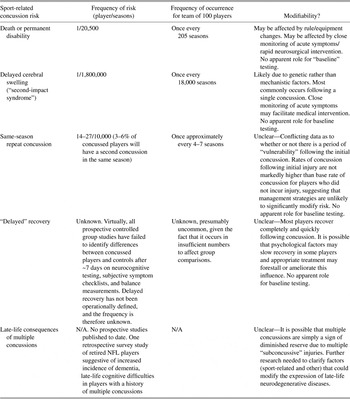
Summary of risks and the potential for management strategies to modify risk

Note
Risk frequency based on American football: base rate of concussion typically reported to be 3–6 per 100 player/seasons N/A, not applicable.
DISCUSSION
Over the past two decades, there has been a proliferation of guidelines for the management of sport-related concussion, publication of multiple review and “consensus” papers on this topic, and widespread use of computerized neurocognitive testing for the (putative) tracking of recovery from concussion. Despite the intense interest in this topic, however, there has been little discussion of the nature and epidemiology of the risks associated with sport-related concussion or of the mechanisms by which management strategies might be expected to modify these risks.
As the result of several recent prospective studies of the natural history of recovery from sport-related concussion, the nature of these risks has become clearer. Potential risks identified through a review of this literature include death or permanent disability, delayed recovery, same-season repeat concussion, and the late-life consequences of multiple concussions. American football, a sport with one of the highest rates of concussion, was used as a model for exploring risks. Approximately 3–6% of football players suffer a concussion during each season of play.
Over the 10-year period ending in 2006, involving American football players at all levels (sandlot through professional), there have been 38 deaths and 50 cases of permanent disability due to cerebral injuries recorded among 180,000 annual participants (1.8 million player-seasons). The vast majority of these were due to subdural hematomas. There may be some role for rule changes in preventing these injuries, and rapid medical/neurosurgical intervention has the potential for modifying outcome in these cases. There is no discernible role for baseline testing, however, in either preventing or modifying outcome for such injuries, as they result from a single acute trauma.
The exact incidence of delayed recovery is unknown, as this particular outcome has never been operationalized. Most prospective controlled studies of sport-related concussion fail to identify any residual effects of concussion after just a few days postinjury, however, suggesting that such cases are relatively rare. Given the probable rarity of delayed recovery and lack of any evidence that recovery following sport-related concussion can be modified by any intervention, it remains unclear whether or not management strategies can affect this outcome. There is a clear role for routine clinical neuropsychological evaluation in cases of atypical/delayed recovery, as neuropsychologists are the professionals best equipped to explore all possible contributory factors (e.g., preexisting developmental deficits, somatoform personality characteristics, current stressors/depression/anxiety) that may be involved in persistent subjective symptomatology following concussion. Further research is necessary to quantify the incidence of delayed/atypical recovery and to systematically explore short-term rehabilitative or other treatment approaches that might have the potential for speeding recovery.
Same-season repeat concussions are also relatively rare. These appear to occur at a rate that is only marginally higher than the base rate of sport-related concussions. Given the fact that repeat concussions do not typically eventuate in an outcome that is markedly different from a single concussion, it would be difficult to justify any management strategy involving significant resources/effort in order to reduce the rate of same-season repeat concussions to that of the base rate. Even if such a management strategy existed and was completely successful, this would amount to preventing approximately one concussion for every 1000 player-seasons.
Finally, there is a rationale for concern about the late-life outcome of repeated concussions or substantial cumulative subconcussive head trauma resulting in diminished cerebral reserve. One theoretical effect of diminished cerebral reserve would be to allow the earlier clinical expression of age-related neurodegenerative diseases, such as MCI, Alzheimer’s disease, and Parkinson’s disease. It remains unclear whether lifetime exposure to regular head trauma or the experience of multiple clinically evident concussions are independent risk factors, but there is some initial evidence that this is a concern, based on one recent study of retired NFL players. The finding that multiple concussions seem to result in a linear increase in risk for future concussion suggests the possibility that concussions are a sign of diminishing reserve, but this remains largely speculative.
The implications of this review for ongoing management of sport-related concussion, by contrast, are relatively clear. To date, there is essentially no evidence that any management strategy can affect short-term outcome of sport-related concussion. The adverse short-term outcomes of these injuries (death, permanent deficit, delayed recovery, and same-season repeat concussion) are rare, and there is little rationale to suggest that these outcomes can be modified by management strategies that rely on baseline testing or any generic return-to-play algorithm. It is reasonable to conclude that the most severe consequences (death, permanent deficit) may be modified by close observation of concussed players to detect evidence of a deteriorating neurological status and initiate medical/neurosurgical intervention without delay. As the vast majority of these catastrophic consequences occur as acute or subacute effects of a TBI, this intervention must be rapid, and there is little or no role for baseline testing or other time-consuming evaluations designed to detect subtle changes in neurological status in this endeavor.
The less serious adverse short-term outcomes (“delayed recovery,” same-season repeat concussion) are also relatively rare, unlikely to be significantly modified by management strategies, and do not appear to eventuate in any lasting disability that would warrant the degree of media concern and proliferation of management guidelines that have characterized this field of study over the past one to two decades. This degree of attention might be better focused on the potential risks associated with the years of exposure to subconcussive traumatic head injuries that are experienced by athletes in sports like American football. More prospective controlled studies are also necessary to establish the frequency, characteristics, and potential interventions for delayed or atypical recovery from sport-related concussion. The role of clinical neuropsychology in the evaluation of such cases should remain paramount.
There is currently no evidence to suggest that any specific guidelines, or the use of baseline testing, is of utility in modifying outcome from sport-related concussions, and these injuries are probably best managed on an individual basis by clinicians with suitable training until such evidence is generated. A conservative approach to the management of these injuries in younger athletes is warranted until additional evidence is accrued to support specific strategies.
ACKNOWLEDGMENTS
The authors report no conflict of interest. Both authors engage in some forensic consultation, including cases of TBI, but neither engages in a preponderance of consultation for plaintiff or defense. No human or animal data were obtained for this review article. The information in this manuscript and the manuscript itself has never been published either electronically or in print.