1. Introduction
This is the second of a pair of papers that generate and analyze quantitative estimates of the development of English caselaw and associated legal ideas before the Industrial Revolution. The companion paper (Grajzl and Murrell, Reference Grajzl and Murrell2020) focused on analytics. There we described how we extracted 100 topics on the development of English caselaw and legal ideas from 52,949 raw text documents (The English Reports). Each of these topics captures the ideas in a clearly delineated area of substantive caselaw and corresponding legal thought. We assigned topic names and interpreted the nature of the topics. Then, we generated 100 time series of topic prevalences, showing how much of the corpus was devoted to each topic at any specific time. The interpretation of timelines, however, required some theory. We generated a simple model of the way in which ideas are selected to appear in reports of legal cases. Importantly, this model can explain why an inverted-U topic-prevalence timeline will occur for a legal idea that is eventually completely accepted by the legal profession. We now proceed to build on these insights, providing examples of the use of our data to elucidate the flow of legal history.
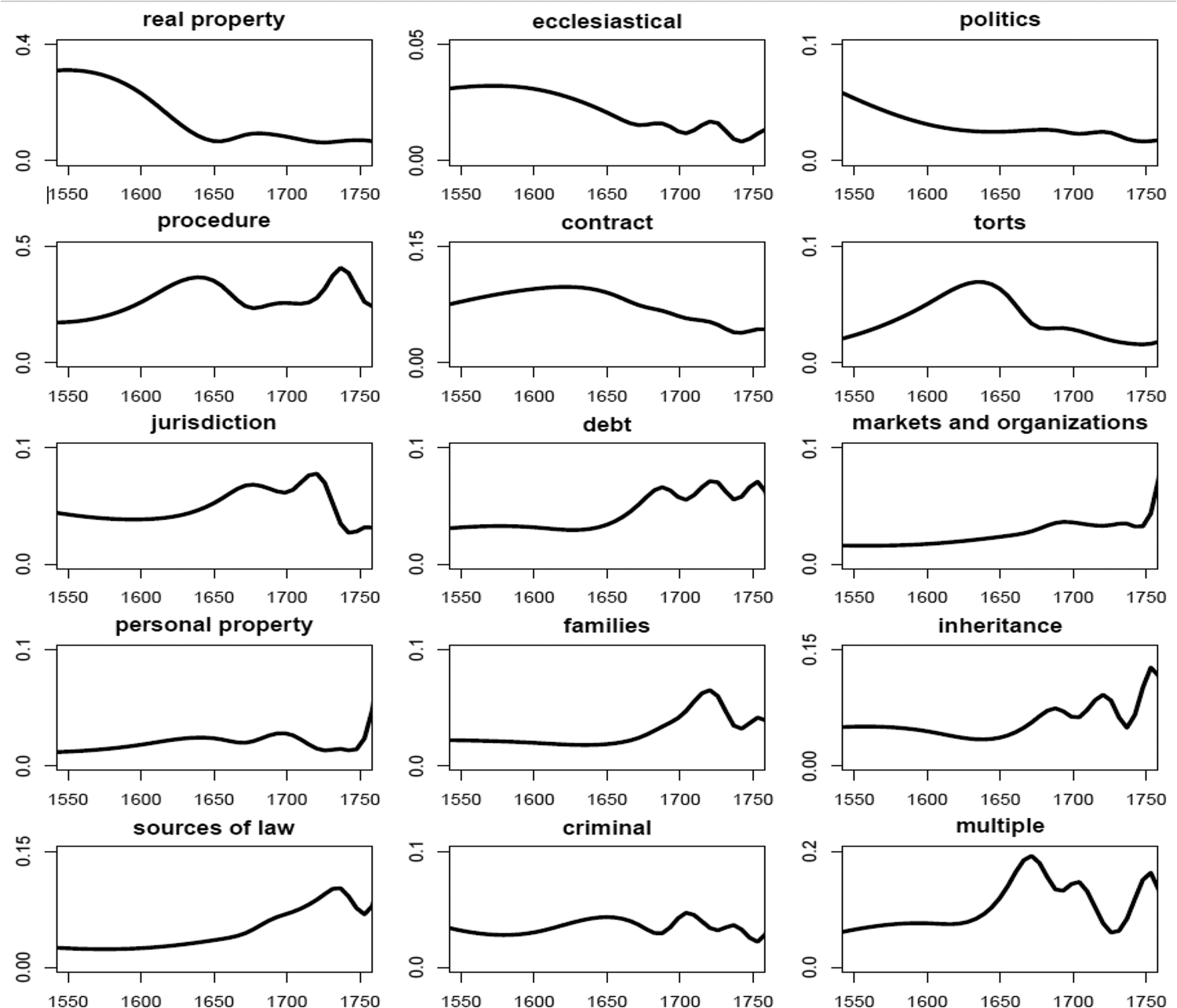
We first present an even more terse aggregation than 100 topics. If a reader is interested in gaining an overall impression of the development of English caselaw and legal ideas, then even 100 topics place a strain on the human intellect in terms of gathering an overall picture of developments over two centuries. Thus, in Section 2 we provide a bird's-eye view, grouping our 100 topics into 15 aggregate themes. We provide prevalence timelines for each of the themes. Examples of the themes are real-property, contracts, torts, and procedure. We use the 15 themes to provide a highly aggregated overview of the development of the emphases within English caselaw and its associated ideas, interpreting the timelines using the theoretical framework developed in Grajzl and Murrell (Reference Grajzl and Murrell2020). We show, for example, that legal ideas pertaining to many real-property issues were settled already by the mid-17th century. Ideas concerning procedure constitute a major portion of the corpus. Nevertheless, by mid-18th century, overall attention to procedural topics decreases sharply, an indication that the institutions of the court had solidified by then, leaving the courts themselves in a position to focus more on substantive and doctrinal issues. Notably, the measured prevalence of contracts and torts follows an inverted-U pattern as the 17th and 18th centuries unfold. This suggests that, although legal development in these central substantive areas of law was still ongoing, major ideas had already gained a strong foothold by the start of the Industrial Revolution.
The information on the 15 themes is the most user-friendly for those looking to understand broad developments across the spectrum of law. However, the 100 topic timelines will be the most informative aspect of the data for those who are interested in much more specific areas of English caselaw. In Sections 3 and 4, we provide two examples of how the topic timelines can be used to generate new insights.
The first example examines the new caselaw and associated legal ideas that arose in the 17th and 18th centuries as England's financial economy underwent a revolution. What is largely missing from the institutional narratives on the financial revolution is a quantitative, evidence-based portrayal of the development of lower-level legal institutions. Our timelines imply that many of the new legal ideas relevant to finance had already been accepted by the legal profession before the Glorious Revolution of 1688. Moreover, because these legal ideas were generated within decisions on real disputes reaching the courts, the financial revolution itself, in terms of the practices of real economic actors, was a development of the whole 17th century and not exclusively, or even predominantly, a by-product of political events at the century's end.
The second example focuses on the sources of law used in the courts. Our estimates cast new light on the emergence of precedent-style reasoning and the diffusion of ideas concerning the interpretation of legislation by the courts. We show that in the 16th century, English cases had hardly any emphasis on precedent-based reasoning, but by 1650 the emphasis on precedent increases. Nevertheless, the diffusion of the idea was gradual: topic prevalence for Precedent peaks in 1730, suggesting that the general idea of precedent-based reasoning solidified in the legal profession only after that time. Our estimates identify two related, yet distinct, sets of ideas on interpretation of legislation. Our timelines indicate that ideas on the applicability of statutes were fairly well-accepted by the mid-16th century. In contrast, ideas on clarification of the legislature's intent were still in contention by the mid-18th century.
It is worth noting that the exercises in Sections 3 and 4, on finance and sources of law, use only a small proportion of our 100 timelines. The dataset containing the numerical estimates underpinning all of those timelines will afford many opportunities for other researchers to generate new insights into how English law developed before the Industrial Revolution.Footnote 1 In addition to providing a brief synopsis of this and its companion paper in Section 5, we also suggest avenues of future research that have been opened by the production of the data that we have generated in this study.
2. From topics to themes: interpreting the development of macro-emphases in the corpus
Armed with the understanding of how to interpret individual topic timelines that was developed in Grajzl and Murrell (Reference Grajzl and Murrell2020), we examine an aggregated overview of the corpus. We view the 100 individual topics and associated timelines as providing the essential results that readers would want to use if they aim to build upon our contribution. However, a discussion of each of the 100 topics would be prohibitively long and would hardly facilitate a practical understanding of the major emphases in the corpus. Therefore, to offer an even more aggregated overview of developments within English caselaw from the late-16th century to the onset of the Industrial Revolution, we group topics into 15 broader themes and then discuss the evolution of emphases across the 15 themes.
The 15 themes and the associated topics are listed in Table 1.Footnote 2 Figure 1 shows temporal developments in the relative proportions of the corpus devoted to each of the 15 themes, with the relative proportion of each theme in a given year defined as the sum of the estimated topic proportions for the topics that comprise the theme. Figure 1 therefore provides a highly aggregated overview of the attention given to the broad groups of ideas identified in the corpus at different points in time.
Timelines of themes.

Estimated topics by themes

Early in the time period under consideration, real-property issues were a core focus of English cases, with nearly a third of the corpus emphasizing that theme. This finding resonates with the arguments that land-related issues constituted the bulk of early common law (Baker, Reference Baker2019: 31). With the decline of feudalism, however, the amount of attention devoted to this theme decreases notably. Indeed, within the 14 real-property topics identified by our estimates, only two (Implementing Trusts and Equitable Waste) exhibit a clear increase in topic prevalence during the latter part of the time period under consideration (Grajzl and Murrell, Reference Grajzl and Murrell2020: Figures F11a and F11b).Footnote 3 By the mid-17th century, therefore, legal ideas pertaining to most real-property issues were settled within the legal profession.
The ecclesiastical and politics themes exhibit a similar pattern. The pattern for the ecclesiastical theme reflects the fact that the authority of the common-law over most religion-related issues was resolved by the mid-17th century. Accordingly, attention to legal issues pertaining to Temporal & Spiritual Jurisdiction as well as Ecclesiastical Appointments generally decreases. Controversy over Tithes does last into the 18th century, with the new commercial age calling into question such issues as whether the tithe on turnips should be paid if the turnips were to be used as feedstock.Footnote 4 At the same time, the gradual emergence of a de facto tripartite separation of powers reduced the need for litigation concerning royal prerogative as captured by Royal Patents & Tenures, the major topic in the politics theme (Grajzl and Murrell, Reference Grajzl and Murrell2020: Figure F9). Consequently, in the late-17th and the first part of the 18th century, the dynamics of English caselaw pertinent to the political sphere is no longer dominated by major constitutional issues, but rather by issues pertaining to Local Administrative Appointments and the conduct of proceedings involving Dignitaries.Footnote 5
Complex procedures were a prominent feature of adjudication in English courts already by the late medieval period. Procedural rigor was a key to the success of early common-law courts in acquiring and solidifying the leading position in the market for dispute resolution. At the same time, the use of an elaborate system of writs and adherence to the ‘due process’ of common-law courts also revealed the need for alternative remedies and swifter, less formal, procedures (Baker, Reference Baker2019: 16, Chs. 3–6). Our estimates identify two key periods of especially prominent attention to the procedure theme in English cases: the middle of the 17th century and the first third of the 18th century. The former is a result of increased attention to judgments (Rendering Judgment, Procedural Rulings on Actions, and Coke's Procedural Rulings), as well as procedural issues concerning court errors (Writs of Error) and conduct of trials (Jury Procedures & Trials). The latter is driven especially by greater attention to Motions as well as to Equity Appeals, a topic that signifies the growing importance of equity as a separate area of law where remedies were not constrained by strict common-law procedure.
Importantly, our estimates demonstrate that overall attention to the procedure theme decreases by the mid-18th century. Specific procedural topics that in the 18th century exhibit a distinctly decreasing trend in topic prevalence include Motions, Rendering Judgment, Correct Pleas, Procedural Rulings on Writs, Procedural Rulings on Actions, Writs of Error, Mistakes in Court Records, Reviewing Local Orders, Jury Procedures & Trials, and Arbitration & Umpires. This is an indication that many of the core ideas that critically shaped litigation and the functioning of the courts were largely settled by the time of the Industrial Revolution. One may argue that the resulting solidification of procedure in turn facilitated a focus on, and thereby innovation in, substantive and doctrinal legal domains as the nation was embarking on the path to early industrialization (see, e.g. Lieberman, Reference Lieberman1989: Part II; Lobban, Reference Lobban1991: Ch. 9).
Attention to contracts (dominated by Assumpsit) and torts (dominated by Actionable Defamation) increases before decreasing as the 17th and 18th centuries unfold. This suggests that, by the start of the Industrial Revolution, major ideas in these central areas of law had already gained widespread acceptance. Of course, legal development within these themes had not ceased. For example, the topics Contract Interpretation & Validity, Executable Purchase Agreements, and Employment of Apprentices & Servants within the contracts theme show evidence of considerable fluctuations in the late-17th and early-18th centuries (Grajzl and Murrell, Reference Grajzl and Murrell2020: Figure F1).Footnote 6 This indicates that controversial new issues within those topical areas of law continued to arise, with some of them occasioned by the advent of new types of disputes, for example, in the burgeoning market for shares. Indeed, it is significant that our timelines show that major aspects of contract law were still in contention at the start of the Industrial Revolution. Similarly, although overall attention to the jurisdiction theme tends to decline after early-1700s, there is active development especially with respect to jurisdictional issues pertinent to equity (Equity Jurisdiction and Equitable Relief).
Six themes feature increasing attention over time, indicating that contentious new legal ideas are appearing in the latter part of the time period covered by our data. These six themes are debt (all topics other than Pleadings on Debt), markets and organizations (especially the topic Publishing & Copyright), personal property (eventually dominated by Ownership of War Bounty), families (dominated by Geographic Settlement of Children), inheritance, and sources of law (dominated by Precedent). As we will elaborate in the following section, the legal debates about debt are one element of the set of changes that have come to be called the financial revolution. The reason for the increased attention to inheritance-related issues is less obvious and is in need for much further research. Our analysis indicates that inheritance-related issues (especially as captured by the topics Implementing Ambiguous Wills, Validity of Wills, Contingency in Wills, and Intestacy) continued to generate new ideas throughout the late-17th and early-18th century. Some of this was occasioned by particular events; for example, the 1670 Statute of Distribution led to controversies about its interpretation, which are reflected in the topic Intestacy.
Only one theme, criminal, exhibits relatively limited change with regard to the relative attention that it evokes over the time period under consideration. Indeed, in contrast to the importance of crime-related issues within society, this theme receives comparatively scant attention. This is at least partially an artifact of the way in which The English Reports were generated. Historically, criminal trials were usually conducted without any involvement of the higher courts: this is in stark contrast to civil trials, where interesting legal issues could be reserved for the element of the hearing held in the higher courts (Baker, Reference Baker2019: Chs. 29–30). Nevertheless, within this theme, there are important developments (Grajzl and Murrell, Reference Grajzl and Murrell2020: Figure F2). For example, the topic Habeas Corpus shows the spread of new ideas that became controversial in the aftermath of the 17th-century regime changes. Additionally, the 1679 Habeas Corpus Act gave rise to applications in a very wide range of scenarios involving deprivation of personal liberty (Baker, Reference Baker2019: 157–158).
The final theme, multiple, reflects the diverse dynamics associated with a group of very heterogeneous topics, including the ‘residual’ ones (Non-Translated Latin) A subset of the topics comprising this theme does encompass substantive issues that span many conventional areas of law (Determining Damages & Costs and Revocation). The fact that the prevalence of these topics exhibits considerable fluctuation in the late-17th and early-18th centuries (Grajzl and Murrell, Reference Grajzl and Murrell2020: Figure F15) is one piece of evidence that connected legal ideas were emerging across many, even ostensibly disparate, legal domains.
In this section, we have endeavored to give a very, very broad overview of one aspect of our estimates – timelines of the development of macro-categories of law and associated legal ideas as reflected in our themes. Given the breadth of legal developments covered within any one of our themes, this overview has necessarily been cursory. Indeed, as already emphasized, we envisage that the most important use of our estimates will be examination of the details of each of the timelines for the 100 individual topics, an exercise that extends beyond the scope of the present research.Footnote 7 Nevertheless, we do want to provide examples of the power of the insights that can be obtained on the basis of examination of individual topic timelines. Therefore in the next two sections, we focus on the timelines pertaining to two specific and especially prominent areas of legal development. The first examines the new caselaw and associated legal ideas that arose in the 17th and 18th centuries as England's financial economy underwent a revolution. The second examines the legal ideas on the sources of law used in the courts. This latter example provides insights into the genesis and diffusion of fundamental approaches to law-making.
3. Lessons from topic timelines: the development of the legal ideas pertinent to the financial revolution
That a financial revolution occurred in England before the Industrial Revolution, no one doubts. Where there is controversy is when exactly the financial revolution happened, whether institutional changes spurred the financial revolution, and, if so, which institutions were important. The focal point of the controversy has been the North and Weingast (Reference North and Weingast1989) hypothesis that the constitutional changes consequent on the Glorious Revolution of 1688 led to increased government credibility and subsequent changes in credit markets. Follow-up studies investigating this hypothesis have produced mixed results.Footnote 8 Other studies have noted the existence of vibrant private-credit financial markets in England well before the Glorious Revolution.Footnote 9
In deliberating on which institutional changes were especially important, many have followed North and Weingast (Reference North and Weingast1989), attributing overarching prominence to constitutional changes.Footnote 10 Among those who have not, there is considerable heterogeneity in views on both the nature and the timing of pertinent institutional changes. For example, some scholars have emphasized lower-level legal institutions, such as usury laws and assignability of notes, while still placing critical developments in the late-17th or early-18th centuries (Carruthers, Reference Carruthers1999; Hodgson, Reference Hodgson2017; Rudolph, Reference Rudolph, Coffman, Leonard and Neal2013; Wennerlind, Reference Wennerlind2011).Footnote 11 Others have highlighted the fiscal arrangements of the state and mechanisms to develop Parliamentary control of spending, dating these developments as early as the mid-17th century (Coffman, Reference Coffman, Coffman, Leonard and Neal2013; O'Brien, Reference O'Brien2011).Footnote 12
What is largely missing from the institutional narratives is an assessment of when lower-level legal institutions developed. These include the set of enormously detailed, and often prosaic, legal rules that coordinate the activities of economic agents as they undertake their day-to-day operations. Without a common understanding of such institutional details, commercial transactions are fraught with uncertainty, to the extent that they might not go forward. To a lender eager to capitalize on a commercial opportunity, knowing whether a new financial instrument is assignable might be much more important than a Bill of Rights. It is preeminently the development of these lower-level legal institutions that our data captures.
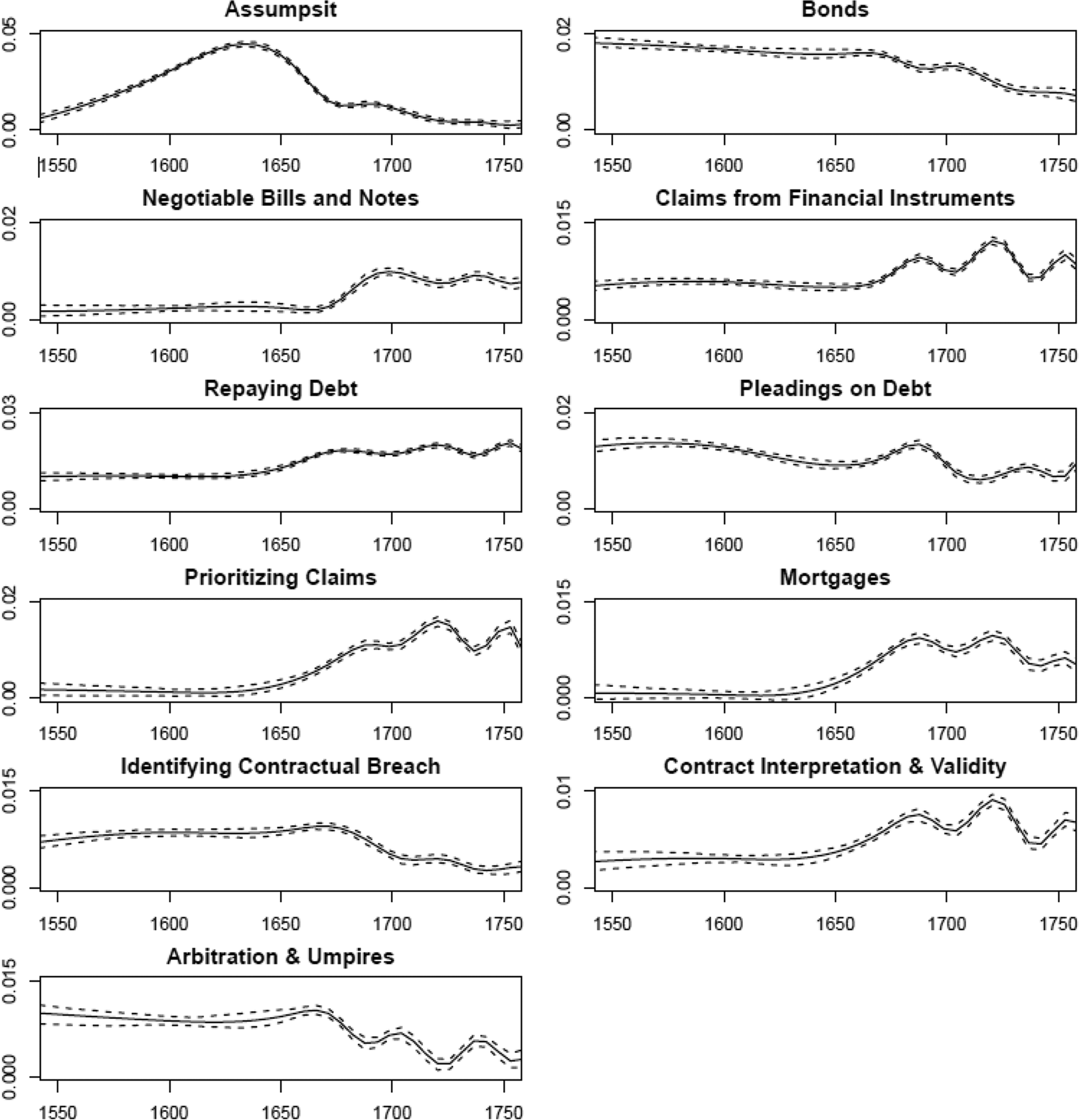
Within the 100 estimated topics, we have identified 11 as central in the law relevant to the financial revolution: Assumpsit, Bonds, Negotiable Bills and Notes, Claims from Financial Instruments, Repaying Debt, Pleadings on Debt, Prioritizing Claims, Mortgages, Identifying Contractual Breach, Contract Interpretation & Validity, and Arbitration & Umpires. Although our empirical methods inherently produce distinct topics that capture sets of ideas within particular areas of law, the law itself is a seamless web. For example, assumpsit boosted the enforceability of credit and insurance contracts (Swain, Reference Swain, Dyson and Ibbetson2013) and facilitated later developments in the enforcement of payments on negotiable bills of exchange (Baker, Reference Baker2019: 394). Conditional personal bonds were used to make all types of agreements much more easily enforceable. Bonds were particularly useful in ameliorating problems that resulted from deficiencies in contract law, allowing parties to sidestep litigation of the original contract and focus on the words of a simple, easily enforceable, financial instrument. In turn, private arbitration became commonplace, helped by the courts which provided enforcement and which were reluctant to question arbitration decisions (Musson, Reference Musson, Dyson and Ibbetson2013). Bonds were also vital in supporting the private arbitration system by making sure that all agents (including the arbitrators) carried out their obligations. Old common-law practice on the role of custom facilitated the use of the law merchant (Baker, Reference Baker1979).
Figure 2 presents the timelines for the 11 topics associated with the financial revolution. A central finding that readily emerges is that ideas about several pertinent areas of law were settled well before the period typically associated with the financial revolution. In particular, the timelines on Assumpsit, Bonds, Identifying Contractual Breach, and Arbitration & Umpires all suggest that major ideas relevant to finance were widely accepted by the middle of the 17th century. At that time, new areas of contention about Negotiable Bills and Notes and Claims on Financial instruments begin to appear prominently. Spillover effects in more traditional areas of legal activity occur: new ideas on Mortgages arise in the middle of the 17th century. Simultaneously, ideas on Prioritizing Claims began to become more common in court cases. The settlement of debts was an important focus: a 1663 case featuring this topic prominently considered which parts of an estate should pay debts, in which proportion, and which creditors should be paid if the estate was not large enough to satisfy all.Footnote 13
Timelines of topics relevant to finance.

Notably, all of the 11 topics have a significant presence in our data well before the end of the 17th century. Indeed, in 5 of the 11 featured timelines, the inverted-U's exhibit downward phases before 1688. Therefore prior to the Glorious Revolution there was broad acceptance by the legal profession of many ideas relevant to the financial revolution.
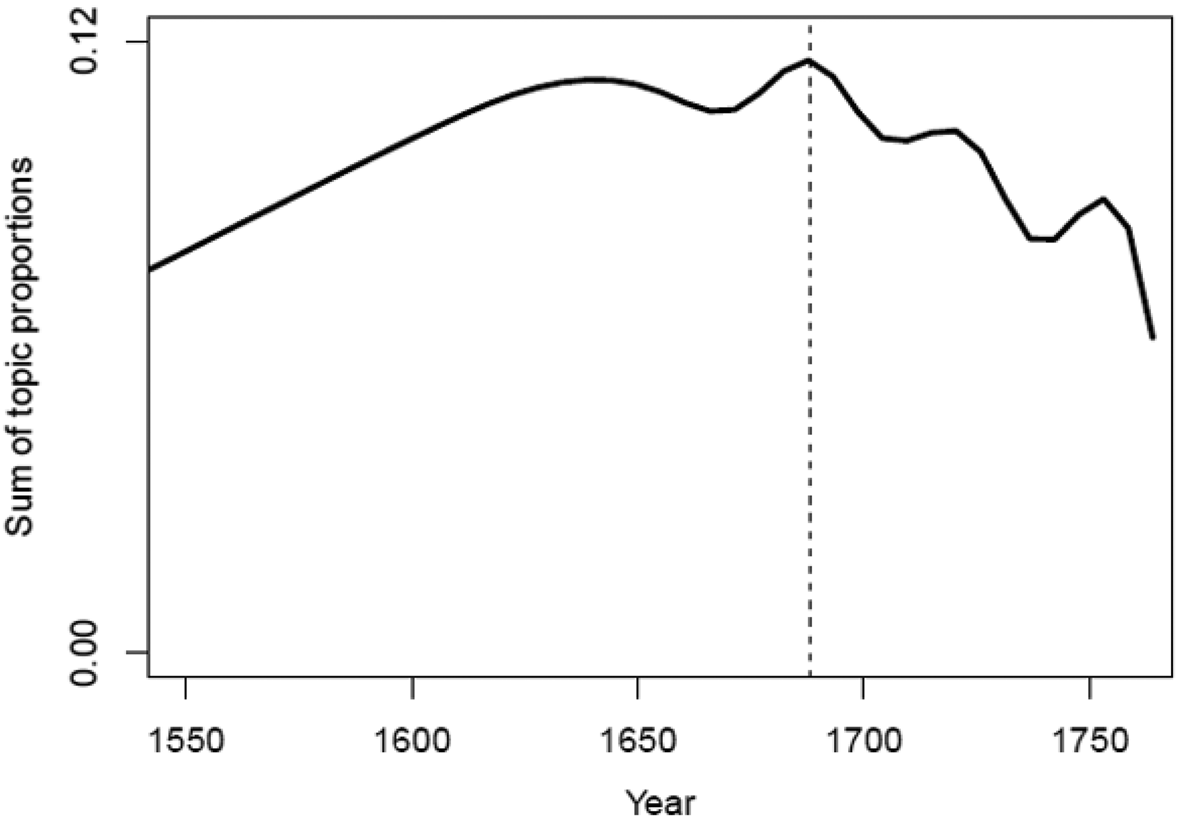
To aggregate all the data pertinent to finance, we follow the procedure used in Section 2, where we constructed timelines for themes. That is, for the 11 finance-related topics, we sum the topic proportions at each point in time and produce a single timeline that summarizes the development of the aggregate body of micro-institutional law relevant to finance. That timeline appears in Figure 3, with the dashed vertical line indicating the year 1688. A first peak in approximately 1633 corresponds to the beginning of wide acceptance of a set of ideas on debt contracts; the second peak in 1688 corresponds to the beginning of wide acceptance of caselaw on the new financial instruments. After 1688, developments in caselaw and legal thought relevant to finance become comparatively less pronounced. A small peak in the 1720s aligns with cases dealing with the ramifications of the bursting of the South-Sea Bubble. Later developments are driven by the emergence of novel ideas in the context of Claims from Financial Instruments, Repaying Debt, Prioritizing Claims, Mortgages, and Contract Interpretation & Validity. Nevertheless, the inverted-U in Figure 3 is at its peak in 1688 (coincidentally), implying that many of ideas in the caselaw relevant to finance were accepted by the legal profession by that time.
Timeline for the aggregate of eleven topics relevant to finance.

Our timelines also provide indirect evidence of when financial markets themselves were developing. English courts have never dealt in hypotheticals: all case reports in our data summarize real disputes. Such disputes arise naturally when there are commercial innovations: a purchaser of a debt instrument might need to know whether that purchase gives a right to file suit or a plaintiff might seek interest on delayed interest payments. These mundane issues, and a plethora of others, appear in our corpus, indicating the presence of the underlying financial activity in the economy.
Given these observations, a simple theory of the development of pertinent institutions immediately suggests itself. Important issues in the law of debt contracts were settled in the first half of the 17th century. These developments facilitated the exploration by private agents of new financial instruments and new ways of using traditional instruments. As the century proceeded, legal disputes concerning these new types of transactions entered the courts and caselaw gradually developed. Therefore, the explosion of financial activity in the early-18th century, much emphasized in existing scholarship, critically rested on, and naturally followed from, prior legal developments that had occupied much of the 17th century.
Our evidence provides a new level of precision to the history of the development of micro-institutions pertinent to finance.Footnote 14 Legal historians have well understood the salience of the type of institutional developments that we emphasize (Baker, Reference Baker2019). Yet, the primary focus of the legal historian is on the nuances of prominent cases and specific pieces of legislation. In contrast, our estimates summarize the overall flow of new ideas into the legal system and their acceptance over time. Indeed, most of the cases that provide data for our timelines are so mundane as to never be mentioned in legal history books. This, then, is the value of aggregating the information from 52,949 cases using topic modeling. Our estimates capture not only famous cases and great constitutional measures: they also reflect the nuts and bolts of the legal rules and decisions that facilitate the actions of the myriad agents whose sights are set far below the heights of the political system.
4. Lessons from topic timelines: sources of law
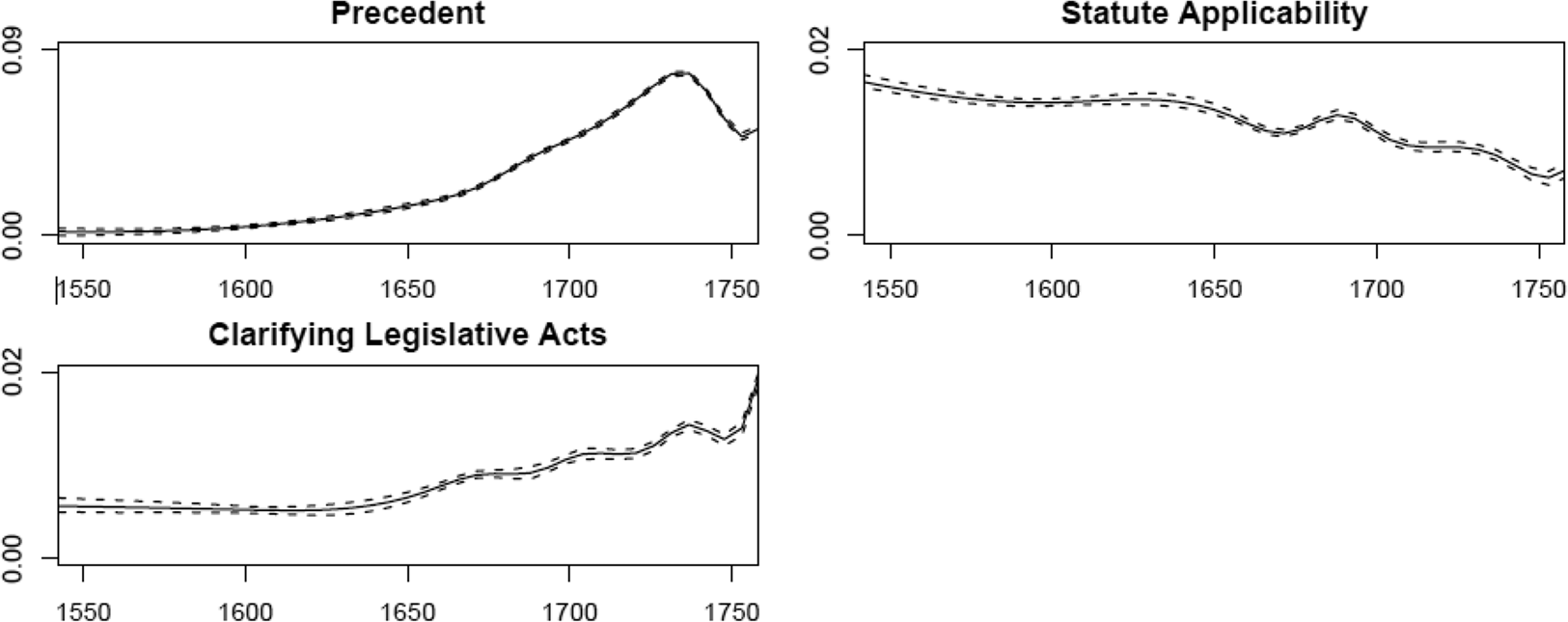
We now use the timelines to provide insights into the emergence and evolution of fundamental ideas about law-making. Figure 4 shows the timelines of three key topics included in the theme entitled sources of law: Precedent, Statute Applicability, and Clarifying Legislative Acts.Footnote 15 Precedent is not only the dominant topic within this theme, but also the most prevalent topic in the whole corpus. We first turn our attention to this topic and then in the subsequent subsection discuss Statute Applicability and Clarifying Legislative Acts.
Timelines of topics relevant to the sources of law.

Precedent-style reasoning
Analysis of the emergence of precedent-style reasoning has occupied a substantial body of literature in the jurisprudence and history of English law. There exists a consensus in this literature that the practice of invoking past cases was a feature of dispute adjudication as early as the 13th century (Harding, Reference Harding1973; Healy, Reference Healy2001).Footnote 16 In fact, early modes of engagement with past cases may have been inspired by legal thought based on the Roman tradition (McSweeney, Reference McSweeney2012). Then, the extent to which past cases have been viewed as authoritative incrementally increased over time until the much later solidification of the modern doctrine of stare decisis under which judges are generally bound by past decisions (Allen, Reference Allen1964; Baker, Reference Baker2019; Holdsworth, Reference Holdsworth1934; Kiralfy, Reference Kiralfy1962; Lobban, Reference Lobban1991).
Yet to date, there has been little systematic, quantitative evidence on the timing of the increases in the general emphasis on precedent-based reasoning in English caselaw. According to the prevailing view (see, e.g. Baker, Reference Baker2019; Duxbury, Reference Duxbury2008; Holdsworth, Reference Holdsworth1934; Lewis, Reference Lewis1932), an emphasis on reasoning involving past decisions emerged in the common-law courts sometime after the substitution of written for oral pleadings and the associated procedural changes in the conduct of trials. Yet, there is much ambiguity on timing. Existing scholarship attributes the key procedural changes to a wide time period, ranging from as early as in the middle of the 15th century (e.g. Lewis, Reference Lewis1930b: 357) to the first decades of the 16th century (e.g. Duxbury, Reference Duxbury2008; Holdsworth, Reference Holdsworth1934).Footnote 17 Similarly, although the literature acknowledges the tremendous importance of early, prominent law reporters, such as Plowden and Coke, for their emphasis on precedent-based thinking (Baker, Reference Baker2019; Lewis, Reference Lewis1930a; Reference Lewis1932), an enduring point of debate has been the timing of the legal profession's widespread acceptance of the authority of past decisions (Healy, Reference Healy2001: fn. 71). Coke himself, for example, did not view prior cases as the only, or even the primary, source of common law, but rather regarded common law as based on a variety of methods of reasoning (Lobban, Reference Lobban1991: 6, 59).
Our STM estimates offer direct evidence pertinent to debates about the timing of the acceptance of precedent-based thought. We identify three broad stages in the development of ideas on precedent. First, in the 16th century, English cases had hardly any emphasis on precedent-based reasoning (Figure 4). Of course, reports referred to previous cases: scholarship utilizing conventional text analysis has demonstrated that past decisions were referred to already during the Year Book period that preceded the reporting embodied in The English Reports (Gray, Reference Gray1921; Lewis, Reference Lewis1930a, Reference Lewis1930b; Reference Lewis1931; Plucknett, Reference Plucknett1948). Our estimates suggest, however, that although references to past cases were common before the start of the 17th century, such references did not place emphasis on the logic of reasoning based on precedent. Thus, little change in ideas about precedent was occurring at this time.
Second, our STM estimates suggest that an emphasis on precedent-style reasoning begins to enter reports during the 17th century, as evidenced by the estimated topic proportion curve for Precedent featured in Figure 4. Hence, the developments were very gradual, as commonly posited by legal historians (Allen, Reference Allen1964: 187; Green, Reference Green1946; Healy, Reference Healy2001; Lobban, Reference Lobban1991: 83). Indeed, our estimates show that it is only after 1650 that the emphasis on Precedent notably increases. For a while thereafter, it accelerates. Thus, the time period between 1650 and the early-1700s is the era when devotees of precedent-based logic found it especially incumbent on themselves to emphasize this mode of reasoning. This is the phase in the development of a successful idea when the spread of the idea is about to enter the steepest portion of the S-shaped diffusion curve.
Third, our STM estimates pinpoint the time period when precedent-based reasoning had acquired widespread acceptance. Figure 4 shows that the estimated topic proportion for Precedent, and thus the rate of change in adherence to precedent-based reasoning, is at its greatest in approximately 1730. This suggests that the general idea of precedent-based reasoning solidified in the legal profession only after the 1730s. Our analysis therefore provides quantitative evidence for the widespread conviction among legal historians that during the post-Coke era (after 1634), the idea of precedent-based thinking was still met with mixed professional reactions (Baker, Reference Baker2019: 211; Lobban, Reference Lobban1991: Ch. 4). Indeed, the debate has been viewed as remaining ‘in a highly fluctuating condition’ all the way until the mid-18th century (Allen, Reference Allen1964: 209) and continued to be met with skepticism even later, including by the profession's preeminent members such as Lord Mansfield (Lieberman, Reference Lieberman1989: 86–87, 126).Footnote 18
Statutory interpretation
As Parliament was beginning to slowly functionally separate itself from the monarchy and as the volume of statute law grew, courts had to develop modes of reasoning to put into effect a variety of legislative acts.Footnote 19 Our empirical analysis provides a first comprehensive overview showing the timelines of the diffusion of ideas within the courts on the interpretation of legislation, starting from the late medieval period.
Our STM-estimated topics show that English cases featured two related, yet conceptually distinct, emphases that resonate with the modern notion of statutory interpretation. Statute Applicability focuses on whether a particular statute applies to a specific case, often clarifying how the statute interacts with the common law. Clarifying Legislative Acts, in contrast, revolves around the literal meaning of legislative acts and the legislator's intent. Comparatively more modern in spirit than Statute Applicability, Clarifying Legislative Acts foreshadows modes of reasoning found in present-day conceptions of statutory interpretation (see, e.g. Popkin, Reference Popkin1999).
The timelines cast new light on the emergence and evolution of different sets of ideas concerning the courts' interpretation of legislation. Figure 4 shows that, as time unfolds, the estimated topic proportion for Statute Applicability decreases, whereas the estimated topic proportion for Clarifying Legislative Acts increases. Thus, ideas about the applicability of statutes and their relationship with the common law had been relatively well-accepted already by the start of Elizabeth I's reign. This evidence provides novel confirmation of the legal historians' assertion that ‘when Bentham began his legal theorizing in the 1770s by assessing the rival claims of common and statute law, he was entering into a well-rehearsed argument’ (Lieberman, Reference Lieberman1989: 219). In contrast, ideas about the clarification of legislators' words and intent began to gain acceptance only in the second half of the 17th century. This is a time when the amount of legislation increases (Harding, Reference Harding1973: Ch. 9; Jenks, Reference Jenks1938: Ch. 13; Maitland and Montague, Reference Maitland and Montague1915: Ch. 7; Popkin, Reference Popkin1999), a marked trend that continued into the 18th century (Bogart and Richardson, Reference Bogart and Richardson2011; Hoppit, Reference Hoppit1996, Reference Hoppit2011, Reference Hoppit2017) and stimulated a vibrant professional discourse (Lieberman, Reference Lieberman1989). Our estimates of topic prevalences for Clarifying Legislative Acts therefore correspond to the lower portion of the S–curve associated with the diffusion of the underlying ideas. That is, legal arguments revolving around legislative intent that puzzled and often infuriated both the practitioners and jurisprudential scholars of the era (Lieberman, Reference Lieberman1989) were still very much in contention at the beginning of the Industrial Revolution.
Finally, the temporal evolution of topic prevalences for both Statute Applicability and Clarifying Legislative Acts exhibit multiple inverted-U-shaped patterns, an indication of a flow of new ideas. The timeline for Statute Applicability, for example, features an inverted-U in the 17th century. This is evidence that, even though earlier ideas pertaining to Statute Applicability had been largely accepted by the end of the 16th century, in the 17th century new pertinent ideas arose. Our analysis thereby lends empirical credibility to those legal-historical arguments that stress the importance of the 17th century for interpretation of statute applicability. For example, the 17th century saw debates about the relationship between statutes and common law – a discussion re-ignited by Coke – and about the judicial scope for extending or restricting the applicability of statutes via consideration of the ‘equity of a statute’ (Allen, Reference Allen1964; Plucknett, Reference Plucknett1948). Similarly, the evolution of the prevalence of Clarifying Legislative Acts exhibits a mildly pronounced inverted-U-pattern in the second quarter of the 18th century. This finding, on the one hand, echoes Plucknett (Reference Plucknett1948: 317–318) who argues that the 18th century featured a lively discourse concerning the appropriate interpretation of legislative acts, especially with regard to the pros and cons of the admissibility of external evidence: that is, evidence about the legislature's intent that could not be discerned from the wording of the statute, consideration of prior law, and understanding of the substantive issue that the act was supposed to address. At the same time, the confirmation of an active professional debate concerning legislative intent, implied by our estimates, resonates with Lieberman's (Reference Lieberman1989) thesis that, throughout the 18th century, the profession actively sought ways to improve the process of parliamentary lawmaking.
5. Synopsis and suggestions for further research
In Grajzl and Murrell (Reference Grajzl and Murrell2020) and this paper, we have assembled and processed a comprehensive corpus of 52,949 reports of decisions rendered in England's high courts of law between the 14th- and mid-18th centuries, a formative era in the history of English law. Utilizing machine-learning tools for analysis of text-as-data, we have drawn on the resultant dataset to characterize the history of caselaw and associated legal ideas in the centuries before the onset of the Industrial Revolution. One hundred estimated topics from a structural topic model were interpreted and named. Each topic captures a very distinctive aspect of law and related legal ideas that is reflected in the corpus of case reports. We then generated time series of the estimated topic prevalences. The topic-prevalence timelines constitute the crux of our empirical contribution: no existing study has developed such a detailed, quantitative picture of the evolution of English caselaw and legal thought during this era.
To facilitate the interpretation of the topic-prevalence timelines, we developed a tractable model that captures the diffusion of legal-cultural ideas and their reporting in cases, as original devotees convert those who are initially skeptics. The resultant theoretical framework highlights the fundamental distinction between the observed prevalence of a legal-cultural idea in a set of texts at a given time and the related, yet conceptually distinct, notion of the overall acceptance of that legal-cultural idea. This fundamental distinction is very often ignored in existing contributions that focus on word frequencies to interpret the popularity of an idea.
The estimated topic time series facilitate a bird's-eye view of the development of the most prominent areas of law. This was accomplished by grouping the estimated topics into 15 broader substantive themes, thereby providing an aggregated overview of the development of major areas of English caselaw and corresponding legal ideas. Perhaps the most salient pattern that emerges from the resulting analysis is that legal debates about procedure, and to a lesser extent also about existing features of contracts, appear to have been largely settled by the time of Industrial Revolution.
Finally, in the opposite spirit, we focused on the detailed lessons that can be obtained from a small sampling of the 100 topic time series. First, we provided new information on the micro-institutional changes pertinent to the 17th and 18th century financial revolution. The many studies of this important phase in English economic history have previously proceeded without the help of the insights generated from the type of detailed information on institutional change embodied in our estimates. Those estimates suggest that major developments in financial markets were already ongoing in the first part of the 17th century, earlier than mooted in most previous studies. Second, we cast light on the accumulation of fundamental legal ideas on the sources of law that were to be considered in the deliberations of English courts. Our analysis imparts empirical precision to a long-standing scholarly debate about the timing of the increased emphasis on precedent-based reasoning, a paramount feature of English jurisprudence. Our estimates also identify different categories of ideas regarding statutory interpretation, revealing that over time the courts moved from questions concerning the applicability of statutes in general to debates that focused on clarifying the meaning of statutes.
Just a glance at the amount of information in our 100 topic timelines suggests multiple promising avenues for further research. Beyond our preliminary investigation of finance and the sources of law, there is much scope to cast new empirical light on the evolution of legal institutions that are associated with England's early economic rise. One lively and still unsettled debate in recent research in economic history revolves around the relative importance for economic development of the institutions governing family and personal relations versus the institutions governing markets and organizations (Ogilvie and Carus, Reference Ogilvie, Carus, Aghion and Durlauf2014: 461–469). Our topic timelines capture the development of caselaw and legal ideas directly pertinent to both domains, offering the potential for new findings relevant to this scholarly discussion. Similarly, scholars have not yet reached a consensus on many questions concerning the development of property rights in England (Ogilvie and Carus, Reference Ogilvie, Carus, Aghion and Durlauf2014: 436–460). When did generalized, secure property rights fully emerge, in ownership, in use, and in transfer? To what degree were developments in the security of property rights independent of developments in contracting institutions? How much did specific formative events such as the Glorious Revolution alter, if at all, the nature of property rights? With real and personal property, as well as contracting topics, featured prominently in our estimates, our data could provide valuable new insights into these central questions on the nature of institutional and economic development in England. Our estimates on the development of caselaw offer a wholly new source of information that can be brought to bear on this topic.Footnote 20
Finally, the time series that underlie our topic timelines offer scope for empirical investigation of the temporal interconnections between the development of different types of legal ideas. The appropriate empirical techniques could be borrowed from macroeconomists who have been the primary users of methods for analyzing similar types of datasets. In this way, it would be possible to investigate how earlier developments in one domain of law later spurred new ideas in a completely different domain. Similarly, one might find that developments in thoroughly distinct legal domains were an outcome of co-evolution. Of course, such research lies in the future. But the suggested inquiry is now possible given the detailed micro-institutional data that we have generated in the current study.
Acknowledgements
We especially thank Martin Schmidt and Nona Karalashvili for suggestions and for sharing data both for this paper and for Grajzl and Murrell (Reference Grajzl and Murrell2020). Christoph Engel, Michael Livermore, Joe Miller, Lincoln Mullen, and participants at the 2020 OWCAL workshop offered helpful insights. Three anonymous reviewers provided valuable comments. Finally, we are grateful to Geoffrey Hodgson, the editor of this journal, for his encouragement and for his gracious help in facilitating the process of moving this project into print.