Over the last few decades, typological studies have become quite a niche field when compared to the importance attached to this subject by earlier generations of scholars. As a consequence, existing typological classification schemes have remained in use, often without being critically reassessed against the backdrop of new evidence. One prominent example is the carp's-tongue sword, one of the most diagnostic objects of the Atlantic Late Bronze Age, where limitations both in the choice of morphological traits and in the corpus of material used for classification have caused serious problems with regard to their typo-chronology.Footnote 1 This has also led to distortions in our understanding of Late Bronze Age hoard chronology at large.Footnote 2
To address these issues, the first part of this paper will compare different approaches to classifying carp's-tongue swords, in order to calibrate their typo-chronology and ultimately gain a better insight into the spatial and chronological dimensions of their manufacture. For this we are drawing on the considerable advances that have recently been made regarding the typological differentiation between distinct morphological subgroups of carp's-tongue swords.Footnote 3 The validity of the typology we employ seems to be corroborated by metal analyses providing evidence for the use of different alloys with different types of carp's-tongue swords.Footnote 4
As a consequence of the general shift from object-centred to landscape-focused approaches in archaeology over the last few decades, recent studies of Bronze Age metalwork depositional practice have concentrated on putting finds in their regional context with regard to what might be called a ‘topography of ritual’, considerably enhancing our understanding of how Bronze Age communities conceived space and interacted with their socially constructed environment.Footnote 5 With few notable exceptions,Footnote 6 however, there have been no recent attempts to look at variation in the composition of metalwork assemblages and in hoarding practices at a supra-regional level in Atlantic Europe. This holds particularly true for the end of the Late Bronze Age – the Ewart Park, Covesea and Dowris metalwork traditions – for which at present no similarly thorough treatment is available to match that offered by Coombs's study of metalwork assemblage composition during the preceding Wilburton period.Footnote 7 The last broad comparison of Late Bronze Age metalwork assemblages on both sides of the Channel was undertaken by O'Connor more than three decades ago.Footnote 8
The second part of this paper will thus focus on the so-called ‘carp's-tongue complex’, a prominent group of hoards characterising the final stages of the Late Bronze Age in much of south-eastern Britain and northern France. A number of recent discoveries and fresh studies of earlier finds now allow for a much more detailed and more nuanced picture than that drawn up by previous generations of scholars,Footnote 9 which still largely defines our current perception of this particular group of hoards.Footnote 10 The main questions which we shall try to address are the following: can we discern any differences in terms of depositional context between different types of carp's-tongue sword; do any other significant regional or temporal patterns emerge from an analysis of their find contexts; what degree of regional variation is there in the composition of carp's-tongue hoards?
Finally, we shall also have to touch on the question why specific types of metalwork were deposited in specific types of location. Did different types of deposition play different roles in the system of social and economic reproduction of Late Bronze Age communities either side of the Channel?
Carp's-tongue sword typology
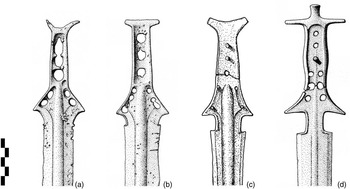
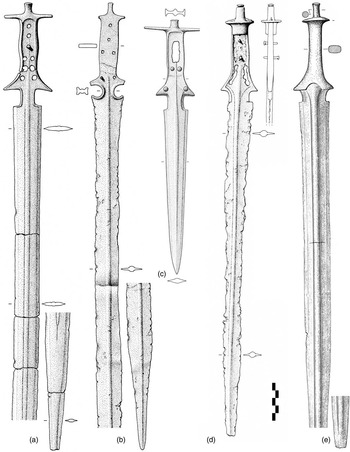
It has long been recognised that a considerable degree of morphological variation exists among what Cowen termed ‘the great family of carp's-tongue swords’ when he first defined Monte Sa Idda swords as a distinct type within this ‘family’ (fig 1).Footnote 11 Indeed, it is not easy to name diagnostic criteria shared by all members of this rather varied group. As far as the shape of the blade is concerned, its edges run parallel or almost parallel for most of its length.Footnote 12 While the diagnostic carp's-tongue point is not always present, a pronounced midrib with rounded section is rarely lacking, as are ricassi (unsharpened sections of the blade just below the hilt).Footnote 13 The only decoration commonly found in carp's-tongue swords consists of a single groove running either side of the midrib. With regard to the shape of the hilt, the shoulders are either V-shaped or concave. In most cases the grip ends in either a fish-tail or a T-terminal, although some varieties show disc-shaped pommels or finials. Fan-shaped terminals do not occur.
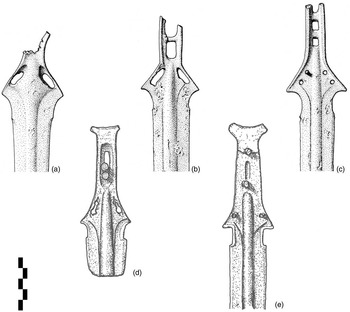
(a) and (b) Ría de Huelva (nos 43, 326); (c) Saint-Yrieix-sur-Charente ‘Vénat’ (no. 144); (d) Villaverde del Río (no. 296). Scale bar: each division = 10mm. Drawings: (a), (b) and (d) after Brandherm Reference Brandherm2007a; (c) after Coffyn et al Reference Coffyn, Gómez and Mohen1981

These features are found in a wide range of different combinations, and scholars trying to make sense of this variability have tended to attribute pieces with more pronounced ricassi to a later date than swords with only light ricassi or no ricassi at all.Footnote 14 This assumption is not based on any systematic analysis of the available evidence, however, and apart from Cowen's Monte Sa Idda study and the work of other authors on some late Italian and Iberian varieties dating from the Iron Age, little attempt has been made to distinguish between carp's-tongue sword subgroups based on morphology.Footnote 15 It was left to Meijide CameselleFootnote 16 to recognise the shape of the shoulder–hilt transition as a much more significant feature than the shape of the ricassi in any morphological classification of carp's-tongue swords. In his study, however, he looked only at the pieces from Iberia, not realising the implications his results held for Atlantic Late Bronze Age chronology in general.
When both BurgessFootnote 17 and Giardino,Footnote 18 without knowledge of Meijide Cameselle's work, later arrived at similar conclusions and first argued that the majority of carp's-tongue swords found south of the Pyrenees were typologically distinct from the bulk of pieces encountered in the hoards of the carp's-tongue complex either side of the English Channel, they did not clearly spell out the diagnostic criteria of that distinction. This made it difficult for other scholars to engage with their argument. Thus it is only in the last few years that studies have begun to explore the wider implications of a revised typology for carp's-tongue swords.Footnote 19 Based chiefly on the shape of the hilt, this revised classificatory scheme distinguishes between three main types of carp's-tongue sword: Huelva, Nantes and Monte Sa Idda.Footnote 20
The main criterion for distinguishing between the Huelva and Nantes types lies in the shape of the transition between the grip and the shoulder. In Huelva-type weapons it is defined by an abrupt angle or break (fig 1a), whereas in Nantes-type swords there is an even, unbroken curve (fig 1c).Footnote 21 A small number of pieces show a shoulder–grip transition that falls in between, neither forming an abrupt angle nor an even curve (fig 1b). In Monte Sa Idda swords the shoulder–grip transition resembles that found on Nantes pieces, but the shoulders in Monte Sa Idda weapons are much more pronounced, and – unlike other types of carp's-tongue swords – the grip here ends in a terminal with exaggerated sideways projecting prongs (fig 1d).
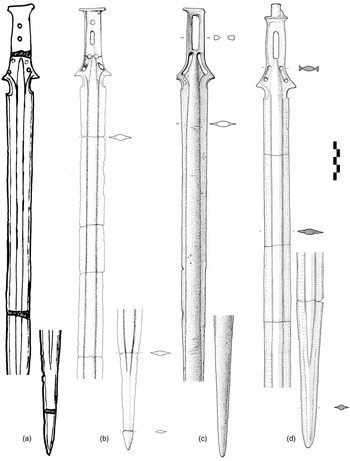
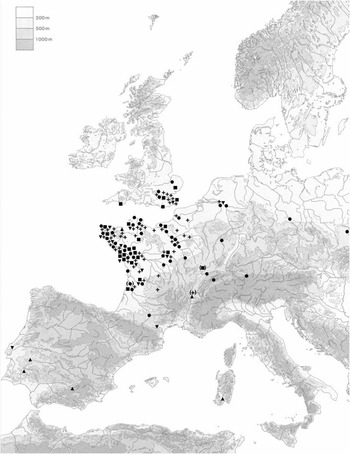
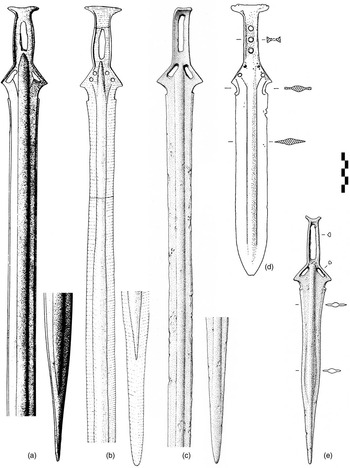
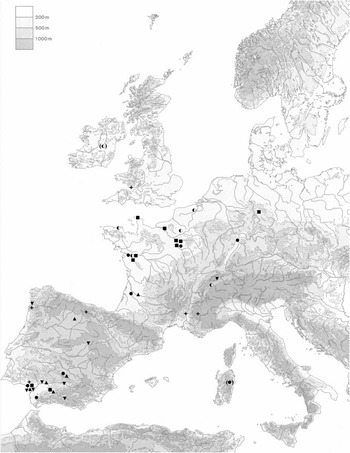
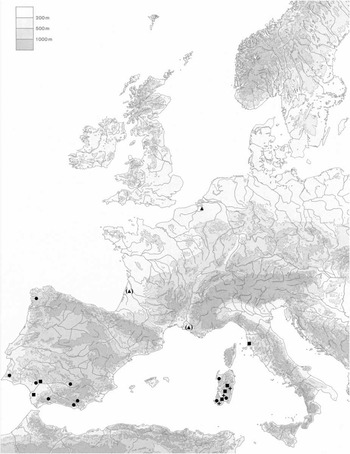
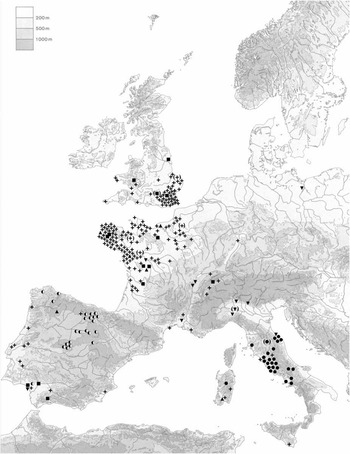
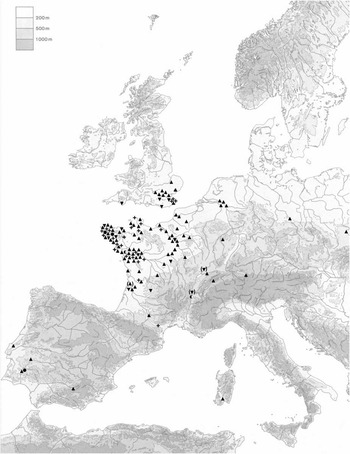
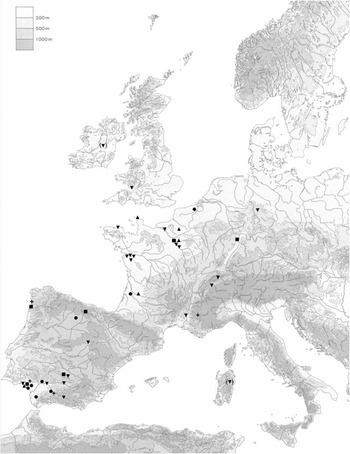
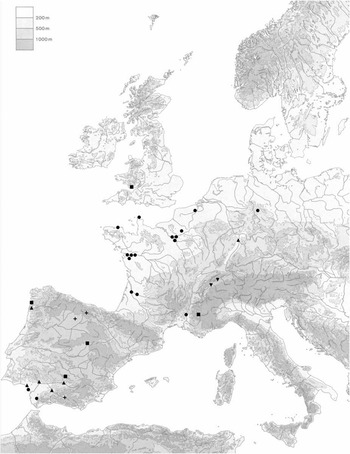
These three types show distinct differences with regard to their numbers, distribution and prevalent find contexts. By far the most numerous, making up the bulk of carp's-tongue swords found in France and Britain, are the swords of the Nantes type, and they provide one of the defining elements of the carp's-tongue complex (figs 2 and 3). Huelva-type swords, on the other hand, are encountered mainly south of the Pyrenees, with only a few examples known either side of the Channel (figs 4 and 5). The latter are mostly single finds and remain conspicuously absent from the hoards of the carp's-tongue complex. Least numerous are Monte Sa Idda-type swords. Only a very small number of these are known from France, none of them from a closed association or from a well-defined context, and none at all from Britain. Most Monte Sa Idda-type swords are found in Sardinia and southern Iberia, where they mark the last stage in the development of Bronze Age sword types (figs 6a–c and 7). Finally, the ‘transitional’ group of carp's-tongue swords is found chiefly in north-western France, with some pieces from Britain and southern Iberia (fig 8).
Nantes type: (a) variant Amboise (no. 104); (b) variant Challans (no. 165); (c) variant Safara (no. 191); (d) variant Vénat (no. 207). Scale bar: each division = 10mm. Drawings: (a) after Bastien Reference Bastien1966; (b) after Verney Reference Verney1990; (c) after Brandherm Reference Brandherm2007a; (d) after Coffyn et al Reference Coffyn, Gómez and Mohen1981

Nantes type: distribution of variants (see the online Appendix for the variant lists). Key:  =variant Amboise (list 7);
 =variant Challans (list 8);
 =variant Safara (list 9);
 =variant Vénat (list 10);
 =variant undetermined (list 11)

Huelva type: (a) variant Cambes (no. 7); (b) variant Mouy (no. 12); (c) variant Marmolejo (no. 36); (d) variant Oissel (no. 68); (e) variant Puertollano (no. 79). Scale bar: each division = 10mm. Drawings: (a) after Coffyn Reference Coffyn1985; (b) after Blanchet Reference Blanchet1984; (c) and (e) after Brandherm Reference Brandherm2007a; (d) after Billard et al Reference Billard, Desard and Lajoie1993

Huelva type: distribution of variants. Key:
 =variant Cambes (list 1);
 =variant Mouy (list 2);
 =variant Marmolejo (list 3);
 =variant Oissel (list 4);
 =variant Puertollano (list 5);
 =variant undetermined (list 6)

Monte Sa Idda type: (a) variant Villaverde del Río (no. 296); (b) variant Alcalá del Río (no. 308); (c) variant Boom (no. 317); (d) semi-solid hilt as a secondary modification through casting a Vénat-style pommel on what was originally a variant Safara sword (no. 197); (e) solid-hilted carp's-tongue sword (no. 411). Scale bar: each division = 10mm. Drawings: (a), (b) and (d) after Brandherm Reference Brandherm2007a; (c) after Gallay Reference Gallay1988; (e) after Cordier and Gruet Reference Cordier and Gruet1975

Monte Sa Idda type: distribution of variants. Key:
 =variant Villaverde del Río (list 12);
 =variant Alcalá del Río (list 13);
 =variant Boom (list 14);
 =variant undetermined (list 15)

Miscellaneous and undetermined carp's-tongue weapons: distribution. Key:
 =carp's-tongue swords with ‘transitional’ hilts (list 16);
 =Italian ‘Griffzungenschwerter’ with carp's-tongue points (list 17);
 =Iberian Iron Age weapons with carp's-tongue points (list 18);
 =carp's-tongue swords with semi-solid hilts (list 19);
 =solid-hilted carp's-tongue swords (list 20);
 =variant undetermined (list 21)

Some other minor varieties of carp's-tongue swords feature solid and semi-solid hilts, clearly modelled on Urnfield prototypes, but without achieving the same degree of morphological homogeneity (fig 6d and e). This seems to reflect the more ad hoc design of these pieces. Atlantic workshops apparently did not develop specific and consistent type models for solid and semi-solid sword types of their own. This is also borne out by the lack of clear distribution patterns for these varieties.
Within each of the three main types of carp's-tongue sword a number of variants can be identified, but the weighting of criteria employed in this has varied between authors. As a result, some morphological subgroups that were previously categorised as types in their own right (eg, Vénat and Safara) are here considered variants within the Nantes type.Footnote 22 The authors of this paper have themselves experimented with different criteria for defining variants in earlier studies, mainly concerning the shape of the ricassi, the outline of the grip and the configuration of the rivet holes.Footnote 23 The classificatory scheme proposed here builds on the results from this previous work, showing that, irrespective of which criterion is given priority, the outcome in many cases will be broadly similar. However, for the Huelva and Nantes types, further classification according to the shape of the grip and the constellation of rivet holes produces variants that are more consistent and also more homogeneous in terms of their geographical distribution than any classification based on the shape of the ricassi (fig 9; for distribution patterns compare figs 3, 5 and 7 with figs 10, 11 and 12).Footnote 24 This is hardly surprising, given that the ricassi are much more likely to become subject to secondary modification from wear and resharpening than the hilt.
Ricasso shapes: (a) ricassi without notches (no. 100); (b) curved ricassi notches (no. 42); (c) widely curved ricassi notches (no. 325); (d) arched ricassi notches (no. 185); (e) rectangular and sub-rectangular ricassi notches (no. 125). Scale bar: each division = 10mm. Drawings: (a), (b) and (c) after Brandherm Reference Brandherm2007a; (d) after Colquhoun and Burgess Reference Colquhoun and Burgess1988; (e) after Briard Reference Briard1958

Nantes type: distribution. Key:
 =curved ricassi notches;
 =widely curved ricassi notches;
 =arched ricassi notches;
 =rectangular and sub-rectangular ricassi notches;
 =ricassi of undetermined type

Huelva type: distribution. Key:
 =ricassi without notches;
 =curved ricassi notches;
 =arched ricassi notches;
 =rectangular and sub-rectangular ricassi notches;
 =ricassi of undetermined type

Carp's-tongue swords with a ‘transitional’ hilt: distribution. Key:
 =widely curved ricassi notches;
 =arched ricassi notches;
 =rectangular and sub-rectangular ricassi notches;
 =ricassi of undetermined type

In any case, some degree of correlation in the occurrence of different traits used on various occasions as criteria in the definition of individual variants seems evident. Either chronological or geographical factors may be at work here, but while it is tempting to think of variants with swollen grip and less pronounced, rounded ricassi as early and of those with straight-sided grips and more pronounced, arched or rectangular ricassi as late in the sequence, there is hardly any contextual evidence to support such a notion. Without such evidence there is always the danger of circular reasoning when arguing for a chronological sequence based on minute typological variation.Footnote 25
On the other hand, the clear coincidence in the geographical distribution of certain variant-defining traits across different types of carp's-tongue sword is undeniable. In the case of Huelva- and Nantes-type swords, variants characterised by rivet slots in both shoulders and grip are found mostly in the Iberian Peninsula and are largely lacking north of the Loire, while the reverse holds true for variants featuring individual rivet holes. This might provide some clue to distinct regional workshop traditions.
While the purpose of this paper is not to explore these typological issues in detail, a few words need to be said about the relationship between carp's-tongue swords and other types of Late Bronze Age sword. At present it is not entirely clear whether the high degree of morphological variation observed among carp's-tongue swords in northern France – and among those of Type Huelva in particular – should be understood as a consequence of secondary influence from an unusually wide range of other sword types present in this area, or whether this is indicative of a formative process. In the latter case we might have to seek the origin of carp's-tongue swords in this area. On the other hand, there are also good arguments for an origin of carp's-tongue swords in southern Iberia, where they could have originated from a hybridisation of early Urnfield-inspired leaf-shaped swords and late rapiers.Footnote 26 At any rate, Cowen's original hypothesis that carp's-tongue swords emerged through gradual development from Saint Nazaire-type weapons seems no longer feasible, as all available evidence now indicates a synchronous development of the Huelva and Saint Nazaire types.Footnote 27
Find contexts
Carp's-tongue swords of all types are known mainly from hoards and as single finds. Very few have been discovered in a funerary context, and these are invariably of the Nantes or Monte Sa Idda types.Footnote 28 So far no Huelva-type sword has been found associated with any burial, and no burials with any type of carp's-tongue sword are known from the Channel area. This is quite in line with the general picture also offered by other types of Atlantic Late Bronze Age swords.Footnote 29
Whereas carp's-tongue swords recovered as single finds or from burials are usually found unfragmented or nearly complete, those from hoards tend to be in fragments. This holds particularly true for the hoards of the carp's-tongue complex of southern Britain and Atlantic France. While the vast majority of pieces here are non-diagnostic blade fragments, in those cases where the specific type of carp's-tongue sword can be discerned we are, except for a very small number of ‘transitional’ hilts, invariably dealing with Nantes-type weapons.Footnote 30
The largest number of carp's-tongue swords so far found as part of a single assemblage was recovered from the Ría de Huelva in southern Spain. The many swords from this ‘wet’ multi-piece deposit show a considerably lesser degree of fragmentation than is typically encountered in hoards of the carp's-tongue complex. In this as well as in its overall composition the Ría de Huelva deposit – like some other Iberian assemblages with carp's-tongue swords, from both ‘wet’ contexts and dry ground – is much more akin to the large weapon assemblages of both the Wilburton period and the Broadward complex than to the characteristic carp's-tongue hoards found either side of the Channel.Footnote 31 Apart from the odd piece featuring a ‘transitional’ hilt, carp's-tongue swords from Iberian assemblages displaying fragmentation patterns similar to Wilburton-period and Broadward-complex hoards are invariably of Huelva type. While the Ría de Huelva deposit is not a closed assemblage, contrary to the hoards of the carp's-tongue complex, these differences require explanation.
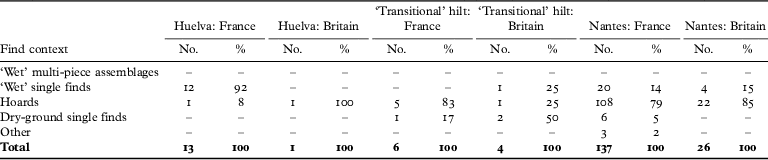
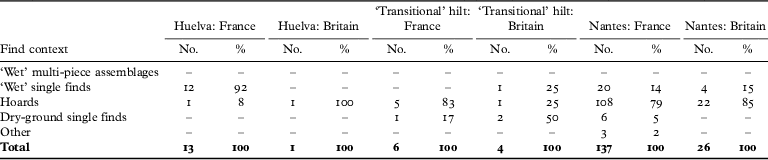
A number of clear regional differences also emerge from an examination of the find contexts of single swords. Whereas the only certain Huelva-type sword known from Britain to date was discovered as part of a hoard, all Huelva-type swords from northern and western France are single finds from ‘wet’ contexts, mostly rivers (table 1). If two Swiss pieces from pile dwellings are classed as ‘wet’ deposits rather than settlement finds, the latter statement can be extended to nearly all Huelva-type weapons found north of the Pyrenees, with the sole exception of a specimen from the Ribiers ‘Vallon de Claret’ hoard in the French Alps (no. 102).
Find contexts of Huelva-type, ‘transitional’-hilt-type and Nantes-type carp's-tongue swords in Britain and France. Pieces listed in the online Appendix as ‘find circumstances unknown’ are not included in these figures
In Iberia the situation is slightly more complex and it would seem that different rules for deposition apply either side of the Pyrenees. The overwhelming majority of Iberian Huelva-type swords were recovered as part of multi-piece assemblages from ‘wet’ locations, whereas only two ‘wet’ single finds are currently known from the Iberian Peninsula, along with a few hoards from dry ground and two pieces from settlement contexts (table 2). No geographical zoning is apparent in this, as the various types of find contexts occur throughout the Iberian distribution area of Huelva-type swords.Footnote 32
Find contexts of Huelva-type, ‘transitional’-hilt-type and Nantes-type carp's-tongue swords in Iberia, and of Monte Sa Idda-type carp's-tongue swords in general. Pieces listed in the online Appendix as ‘find circumstances unknown’ are not included in these figures

Regarding carp's-tongue swords with ‘transitional’ hilts, there are five instances where these occur in hoards of the carp's-tongue complex from France, compared to only one single find. In Britain, on the other hand, the Grays Thurrock I hoard from Essex is the only metalwork assemblage containing a carp's-tongue sword with a ‘transitional’ hilt (no. 334), the three other British instances of this type being single finds (table 1). In stark contrast to Huelva-type swords, none of the carp's-tongue swords with ‘transitional’ hilts from either Britain or Atlantic France is a river find, with the single exception of a piece recovered from the Thames. This is even more striking as all ‘transitional’ pieces found elsewhere are from streams or rivers, and it sets this group apart from both Huelva- and Nantes-type swords.
Turning to the find contexts of Nantes-type swords on either side of the Channel, the picture becomes much more uniform. Of French Nantes-type swords 14 per cent are single finds from ‘wet’ contexts, while 79 per cent were recovered as part of typical carp's-tongue hoards (table 1). The remainder include single finds from dry ground and the odd piece from a settlement or funerary context. It has to be stressed that most ‘dry’ single finds of French Nantes-type swords are poorly documented, so that the relevant percentage (5 per cent) may actually be too high, at the expense of ‘wet’ single finds and unspecified other types of find context. The corresponding figures for Britain are 15 per cent ‘wet’ single finds and 85 per cent from hoards.
As will be argued in more detail below, Nantes-type weapons are likely to be of later date than Huelva-type and most ‘transitional’ carp's-tongue swords. Differences with regard to find contexts between the Huelva and the Nantes types are most likely to be a reflection of this chronological divide. A coherent deposition pattern for carp's-tongue swords emerges on both sides of the Channel only when, during the phase characterised by Nantes-type swords, the diagnostic hoards of the carp's-tongue complex enter the scene.
The number of Nantes-type swords found south of the Pyrenees is far too small for comparing percentages of different find contexts in any meaningful way (table 2). However, with three pieces from dry-ground hoards and just one ‘wet’ single find, it is immediately apparent that the rules governing their deposition are much more in line with the pattern observed among Nantes-type swords north of the Pyrenees than with the picture offered by Huelva-type weapons.
The somewhat different pattern observed with Monte Sa Idda-type swords is a likely consequence of different traditions and norms regarding the deposition of metalwork in the central and western Mediterranean at this stage. The low total number of pieces renders separate statistics for Iberia and Sardinia/Italy impractical (table 2). Only 11 per cent of Monte Sa Idda-type swords with known find circumstances are ‘wet’ single finds, while 54 per cent are from dry-ground hoards and about 15 per cent each from burials in southern Iberia and from a single Sardinian cave sanctuary. The category of dry-ground hoards for Sardinia includes a number of depositions within settlements. The remaining pieces are from other settlement contexts or dry-ground single finds.
The general picture emerging from this examination of find contexts is one in which Huelva-type carp's-tongue swords are predominantly associated with ‘wet’ deposition practices, whereas deposition of Nantes- and Monte Sa Idda-type swords is clearly dominated by dry-ground hoards. While there can be little doubt about the factual existence of this basic dichotomy and the validity of its criteria for classifying find context, reducing the range of topographic settings to only two basic categories may mask more subtle differences and encourage overly simplistic interpretation. Further differentiation is required, and ‘dry ground’ does not always mean that there is no connection to water. In their study of Middle and Late Bronze Age metalwork depositions from south Hampshire, Sussex and parts of Kent and Surrey, Yates and Bradley were able to demonstrate that many hoards from dry ground bear a specific spatial relationship to watercourses – for example, by being situated along spring lines.Footnote 33
There may also be scope for further differentiation among ‘wet’ depositions of carp's-tongue swords. The most relevant distinction within this group is certainly that between rivers or other bodies of running water and still-water contexts, such as ponds, bogs or the dead arms of rivers.Footnote 34 While only limited information is available on the exact nature of ‘wet’ contexts that have produced carp's-tongue swords, very few pieces would appear to have been deposited in still bodies of water, as, for example, a sword from the Marais de Coincourt at Mouy (no. 12). With some finds recovered from the dead arms of rivers – for example, the Bobenheim-Roxheim ‘Silbersee’ sword (no. 9) – we are left to guess at the nature of the environment at the time those pieces were actually deposited. In any case, the vast majority of carp's-tongue swords from ‘wet’ contexts were recovered from stretches of rivers that certainly qualify as flowing bodies of water today, and are likely to have been so in the early first millennium bc. A few pieces were recovered from the sea bed – such as those from Palos de la Frontera ‘Matalascañas’ (no. 38), Cap de la Hague (no. 65) and Salcombe ‘Moor Sand’ (no. 189) – but all these sites have more in common with inland bodies of running water than with bogs or ponds. Finally, the Ría de la Huelva assemblage from the Odiel estuary holds an intermediate position between river finds and pieces recovered from the sea (nos 2–4, 20–35, 43–64, 76, 77, 89–98 and 326).Footnote 35
The distinction between ‘wet’ and ‘dry’ locations for the deposition of metalwork is often equated with a putative dichotomy between ritual and utilitarian depositions.Footnote 36 The rationale behind this assumption is that recovering objects from bogs or bodies of water would have been impractical, so it would have been preferable for items being hidden for some mundane reason – with the intention of retrieving them later – to be deposited in dry ground. This is certainly an over-simplistic reading of the evidence. From both mythological tradition and historical records it is clear that many objects deposited in ‘wet’ locations during later periods were indeed intended to be retrieved.Footnote 37
The strong correlation between the specific type of site chosen for deposition and specific treatment of the deposited objects still calls for an explanation. Single carp's-tongue swords from ‘wet’ contexts were usually deposited more or less intact, whereas the swords from multi-piece ‘wet’ deposits tend to be more heavily damaged, while not showing the same degree of fragmentation displayed by swords recovered from ‘dry’ assemblages of the carp's-tongue complex.Footnote 38 While this pattern may be crucial when it comes to identifying the raison d’être for different kinds of deposition, we need first to take a closer look at their chronological backdrop, as not all would necessarily have been practised contemporaneously.
Chronological implications
That morphological variation in carp's-tongue swords might reflect chronological factors is not an entirely new realisation. As far back as the 1940s, Savory had suspected an earlier date for Huelva-type than for Monte Sa Idda-type swords, based on differences in the range of object types associated in the two eponymous assemblages.Footnote 39 With respect to Iberian carp's-tongue swords, Savory even made an explicit distinction between early and late specimens and, while he was not very clear about his criteria, his early group includes mostly pieces of our Huelva type, while our Nantes type predominates in his late group.Footnote 40 Other scholars, however, did not pick up on this and a sound footing for the chronology of carp's-tongue swords did not emerge until much more recently, when systematic examination of find contexts and associations showed that Huelva- and Nantes-type swords never occur together in closed assemblages.Footnote 41 Indeed, Huelva-type swords are lacking altogether from hoards of the carp's-tongue complex, while Nantes-type pieces constitute one of their defining elements. As distribution areas of both types significantly overlap, it is more than likely that chronological discrepancies lie behind this striking disparity.
Further support for the notion of a chronological divide between the two types comes from metal analysis. While all Huelva-type swords that have been analysed so far are made from binary tin bronze, Nantes-type weapons are usually ternary alloys with significantly higher lead content.Footnote 42 Considering the general tendency towards increased amounts of lead in bronzes towards the very end of the Bronze Age, this would clearly seem to indicate a later date for Nantes-type swords.
Composition in terms of object categories and fragmentation patterns is another factor lending support to this notion. It has already been explained elsewhere how assemblages with Huelva-type swords from Iberia have more in common in this respect with Wilburton and Blackmoor-phase hoards than with carp's-tongue assemblages of the Ewart Park phase.Footnote 43 An early date for Huelva-type swords now seems to be confirmed by the identification of such a piece in a French hoard with Urnfield bronzes that can be tied directly into the sequence of dendrochronological dates from Alpine pile dwellings, and also by the discovery of the first assemblage from Britain containing a definitive Huelva-type specimen.
The Urnfield hoard from Ribiers ‘Vallon de Claret’, in the French Alps, has traditionally been dated to the very end of the Late Bronze Age, but it can now be placed in the later eleventh or early tenth century bc on the basis of its knife and pin types.Footnote 44 This is consistent with the chronology of its other elements, some of which date earlier, but none later, than Hallstatt B1. In the Llancarfan I hoard from Glamorgan a Huelva-type hilt was found associated with blade fragments of a Saint Nazaire- and another pre-Ewart Park-type sword as well as with a variety of axe types whose exact chronology is more difficult to determine, but which would not necessarily seem out of place in a Blackmoor-phase assemblage.Footnote 45
Prior to the re-dating of the Ribiers hoard and the discovery of the Llancarfan assemblage, only some non-type-specific blade fragments in earlier hoards, such as Isleham, provided evidence for the presence of carp's-tongue swords in Britain before the Ewart Park phase.Footnote 46 It is now apparent that although non-diagnostic from a typological point of view, for chronological reasons these cannot be from Nantes-type weapons but must belong to some earlier variety of carp's-tongue sword.Footnote 47
There is no indication so far that Huelva-type swords continued to be used after the end of the Blackmoor phase, while the Nantes type makes its appearance only in the Ewart Park phase.Footnote 48 Owing to the general paucity of closed assemblages containing swords from the period that separates late Wilburton from the carp's-tongue complex, it is not entirely clear to what extent swords with a ‘transitional’ hilt bridge this chronological divide. At least one of the pieces dredged from the Ría de Huelva belongs to this group,Footnote 49 and almost half of all swords with a ‘transitional’ hilt are single finds, which is a significantly higher proportion than is found among Nantes-type weapons. On the other hand, all swords with a ‘transitional’ hilt from closed assemblages are from typical carp's-tongue-complex hoards.Footnote 50 Compared with the Huelva type, which does not occur in the carp's-tongue assemblages of the Ewart Park phase, this clearly indicates a later date for the end of this group's lifespan.Footnote 51
In terms of absolute chronology, the transition from the Huelva to the Nantes type seems to have occurred at some stage between the mid-tenth and the earlier ninth century bc.Footnote 52 Despite the considerable advances made in the field of independent dating methods over the last few decades, it remains a challenging task to establish a precise chronological correlation between Late Bronze Age metalwork assemblages in northern France and southern Britain on the one hand and in the western Mediterranean on the other. In any case, the presence of a Nantes-type sword in the eponymous Monte Sa Idda hoard would clearly seem to indicate some chronological overlap between the Nantes and Monte Sa Idda types.Footnote 53
As far as the internal chronology of the Nantes type is concerned, frequent association of different variants in the same assemblage demonstrate their general contemporaneity. With the exception of variant Safara, which is found mainly south of the Pyrenees, the other three variants (Amboise, Challans and Vénat) occur together in various combinations in a number of French carp's-tongue hoards.Footnote 54
The most significant chronological implication that emerges from distinguishing between Huelva- and Nantes-type swords and from the comparison of their respective find contexts is the confirmation of a late date for the carp's-tongue complex. The total lack of Huelva-type swords in these assemblages renders it highly unlikely that their deposition would have started until well into the ninth century bc.Footnote 55 This is also supported by cross links with Urnfield chronology, suggesting a general synchronicity of the carp's-tongue complex with Hallstatt B3, and certainly survival of the former into the eighth century, as a number of both French and British carp's-tongue hoards already include Hallstatt C types.Footnote 56
One consequence of all of this is that we are left with a terminological paradox that is bound to cause no little confusion. Not only are two of the three main types of carp's-tongue sword alien to what we have become used to call the carp's-tongue complex, but the hoards that comprise the latter in chronological terms are also much more limited than the currency of carp's-tongue swords generally.Footnote 57 There are two possible routes out of this dilemma. We could adopt a more narrow definition of what makes a carp's-tongue sword, effectively limiting the use of this term to Nantes-type weapons. Clearly this is not a feasible option, any more than it would be feasible to try and limit the use of the term ‘leaf-shaped’ to any specific sword type among the many sharing the feature of a leaf-shaped blade. The other option entails introducing a new term to refer to the group of hoards hitherto known as the carp's-tongue complex, bringing it in line with the naming conventions applied to other assemblages of Atlantic Late Bronze Age metalwork. In our opinion, this is the route to take.
To account for its cross-Channel distribution, it seems appropriate to choose namesakes from the two ends of its geographical spectrum. The respective British and French assemblages including the widest range of elements characteristic of this group are those from Boughton Malherbe and Saint-Yrieix-sur-Charente ‘Vénat’.Footnote 58 Henceforth, then, we shall refer to these hoards not as the carp's-tongue complex, but as the Boughton–Vénat complex.
Regional diversity in hoard composition
A leading question in this paper is the degree of regional variation in the composition of Boughton–Vénat assemblages. Earlier studies have already shown how the main distribution area of some of the complex's characteristic types is more limited than the geographical scope of the Boughton–Vénat complex as a whole.Footnote 59 As a consequence, there is no full consensus as to exactly which object types – beyond the characteristic swords – should be considered diagnostic of the Boughton–Vénat complex.Footnote 60 Here we will focus on those individual types whose diagnostic character as elements of the Boughton–Vénat complex is undisputed, while grouping ‘supplementary’ types together under general object categories.
This approach was chosen for very practical reasons. Many of the larger Boughton–Vénat hoards have only been partially published, and one cannot rely on all individual types represented in these assemblages having been included among the published material, a problem that affects most parts of southern England and Normandy in particular. Here the composition of a substantial number of hoards is not known in sufficient detail to allow for a statistically meaningful analysis based on individual types. This is compounded by the presence of many heavily damaged and incomplete items, hindering exact identification of object types and detailed quantitative analysis, which would need to compare the number of fragments, the calculated minimum number of pieces prior to fragmentation and the weight per object category or type.
These problems severely limit the resolution one can reasonably expect to achieve in any literature-based study of the subject, not only in typological but also in geographical terms. Ideally, one would approach this issue by breaking down the distribution area of the Boughton–Vénat complex on both sides of the Channel into smaller regions – eg, East Anglia, Kent, Sussex, Brittany and Normandy – and by looking at the relative quantities of different types of object within the assemblages from each of those individual regions. However, such a breakdown into individual areas has proved to be impractical. Owing to the limited number of hoards in regions other than Brittany, Kent and East Anglia, no statistically significant figures emerge. Thus we can here make a comparison only between the composition of Boughton–Vénat assemblages on the two sides of the Channel – southern Britain on the one hand, northern and western France north of the Garonne on the other – omitting any further regional detail. For the same reason, rather than trying to take into account the quantity in which a given object type is present in individual hoards, we can look only at the number of assemblages in which an object type occurs.
The results outlined below thus come with the caveat that more subtle differences with potential cultural or chronological underpinnings may exist (our various categories of axes and spearheads in particular are likely to allow for further meaningful differentiation), but they remain undetected by the method employed. In order to overcome most of these problems, a full first-hand survey of all those Boughton–Vénat assemblages which so far have not been fully published would be needed. While some individual assemblages were studied at first hand by the authors, the provision of a comprehensive corpus of Boughton–Vénat hoards, based on a systematic survey of museum collections, remains beyond our present scope. Notwithstanding these limitations in typological resolution it certainly seems advisable to distinguish between hoards containing different types of carp's-tongue swords.
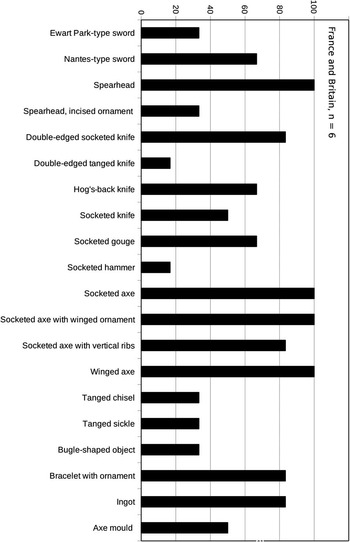
As already pointed out, Monte Sa Idda-type swords are entirely lacking from hoards either side of the Channel, and except for the Llancarfan I hoard none contain any clearly identifiable Huelva-type specimen. While the general composition of this latter assemblage tallies with the overall make-up of Boughton–Vénat hoards, a lack of any more diagnostic Boughton–Vénat-complex elements and the presence of generally earlier sword types set this find apart from hoards containing Nantes-type swords and also from the vast majority of hoards with carp's-tongue sword fragments of undetermined type. In contrast, all those carp's-tongue swords featuring a ‘transitional’ hilt that were found as part of a closed assemblage are from typical Boughton–Vénat hoards. Between them, the respective assemblages contain all categories of item considered typical of the Boughton–Vénat complex (fig 13).Footnote 61 However, their small number – five French assemblages and just a single British hoard – renders impractical any detailed comparison of their compositions on a geographical basis. Instead, as most of the hoards in question also contain Nantes-type swords, the relevant assemblages are included in the comparative statistics for that type.
The occurrence of object categories in hoards with carp's-tongue swords featuring a ‘transitional’ hilt (the Y axis indicates the percentage of hoards containing a specific category of object)

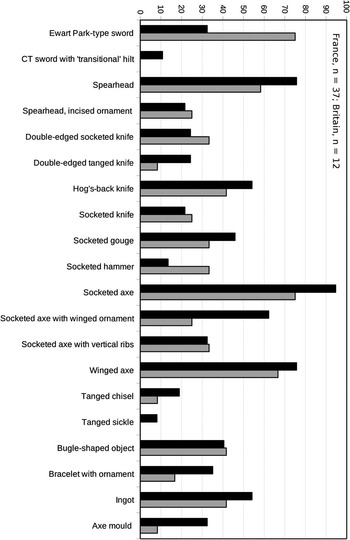
Hoards with definite Nantes-type swords are considerably more numerous than those containing carp's-tongue swords with a ‘transitional’ hilt. Twelve assemblages with Nantes-type swords are known from Britain and forty-five from northern and western France, this latter figure also including three Boughton–Vénat hoards from the Channel Islands.Footnote 62 As hoards with Nantes-type swords in northern and western France are not only more numerous than in Britain, but on average also contain a larger quantity of items, it comes as no surprise that they should contain the odd object type so far lacking from corresponding assemblages north of the Channel. This applies to carp's-tongue swords with ‘transitional’ hilts and also to tanged sickles.
Another pronounced difference between French and British assemblages is the percentage of hoards in which Ewart Park-type swords are associated with Nantes-type weapons. More than 70 per cent of British assemblages feature this association, in comparison to just one-third of the French hoards (fig 14). Given the much higher incidence of Ewart Park-type swords in Britain generally, such a disparity is not unexpected. A further difference concerns the relative frequencies of socketed axes with winged ornament. While in France these are present in more than 60 per cent of relevant hoards, in Britain we find fewer than half this figure. A similar discrepancy is apparent with regard to double-edged tanged knives, tanged chisels, ornamented bracelets and axe moulds.
The occurrence of object categories in hoards with Nantes-type swords. Key: black=France (including the Channel Islands); grey=Britain (the Y axis indicates the percentage of hoards containing a specific category of object)

Overall, however, the composition of the assemblages on either side of the Channel is not too dissimilar. The vast majority of hoards with Nantes-type swords, both in Britain and in France, contain spearheads, generic socketed axes and winged axes. Hog's-back knives and ingots are found in more than half of the French assemblages, but are somewhat less prominent in their British counterparts. This difference, as well as some of the other less pronounced variations that can be observed between hoards from opposite sides of the Channel, may be due to the comparatively low number of British hoards with Nantes-type swords, limiting the viability of any detailed comparison with the much larger French sample in statistical terms.
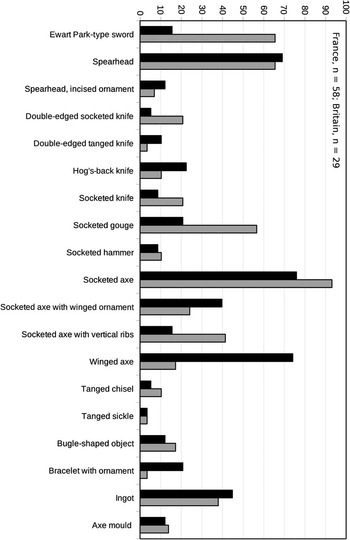
Sample size is less of a problem with those hoards that contain undistinguished fragments of carp's-tongue swords. From Britain, forty such assemblages are known, whereas in northern and western France – including the Channel Islands – a total of ninety-eight hoards contain carp's-tongue swords of undetermined type. Omitting assemblages that also include swords of Huelva and Nantes types or pieces with a ‘transitional’ hilt, which have already been looked at above, the respective figures come to twenty-nine hoards containing carp's-tongue swords of undetermined type from Britain and sixty-nine from the opposite side of the Channel. As not all of the latter have been published in sufficient detail to allow for a meaningful inclusion in our statistical analysis, the relevant chart actually draws on a total of fifty-eight French assemblages (fig 15).Footnote 63
The occurrence of object categories in hoards with carp's-tongue swords of undetermined type (other than hoards also containing Nantes-type swords). Key: black=France; grey=Britain (the Y axis indicates the percentage of hoards containing a specific category of object)

The lack of typologically diagnostic hilt fragments in these hoards usually means they contain fewer sword fragments than would be found in hoards incorporating specific types of carp's-tongue sword. Fewer sword fragments in turn are characteristic of smaller assemblages, which consequently are proportionally more numerous among this group of hoards. As individually these tend to contain a somewhat more limited range of object types than larger assemblages, the corresponding values in figure 15 are generally lower than those seen in figure 14.
This tendency is more pronounced among the French hoards of this group than among their British counterparts. Percentages for the presence of Ewart Park-type swords, all varieties of knives, socketed gouges, socketed axes with vertical ribs, tanged chisels, bugle-shaped objects and axe moulds with French hoards from the present group are less than half compared to assemblages with Nantes-type swords from the same area. Among British hoards this sort of disparity can be observed only for hog's-back knives, winged axes and bugle-shaped objects. Quite the reverse, here a number of object categories are present in a somewhat higher percentage than among assemblages containing more specific types of carp's-tongue sword. This holds true for socketed gouges, generic socketed axes, socketed axes with vertical ribs and axe moulds.
The higher percentage of different types of socketed axes might be seen as compensating for the comparatively low incidence of winged axes in these hoards. Other than that, these figures clearly indicate that the British hoards have a somewhat more homogeneous composition in comparison with their French counterparts. Such a trend was not apparent among Boughton–Vénat hoards containing Nantes-type swords, but the more pronounced discrepancy in sample size either side of the Channel might well obscure such a disparity in that group. The question of what factors contribute to the less homogeneous composition of French hoards in the present group remains. Variation in hoard size, while probably responsible for some of the differences that exist between assemblages containing Nantes-type swords on the one hand and hoards with only unspecific carp's-tongue sword fragments on the other, seems much less likely to cause such variation in homogeneity between British and French assemblages within the latter group, as it is the French hoards which tend to contain a larger number of items. However, without a fully quantitative analysis, hoard size cannot be ruled out entirely as a contributing factor here.
One might also suspect a higher percentage of objects alien to the Boughton–Vénat metalwork tradition, mainly of Urnfield origin, in French Boughton–Vénat hoards to be at least partially responsible for their more heterogeneous composition. This compares with the much lower instance of winged axes in British Boughton–Vénat hoards, which may be viewed as an indication that ‘foreign’ types feature less prominently in their make-up. The rather generic object categories used in the present analysis, though, should eliminate most of the ‘noise’ caused by such elements. Again, only a future study on a fully quantitative basis with considerably higher typological resolution will be able to clarify this.
Otherwise, the general tendencies seen in hoards with Nantes-type swords are mostly confirmed by our analysis of hoards with only unspecific carp's-tongue sword fragments. If anything, the disparity between both sides of the Channel concerning the presence of Ewart Park-type swords is even more pronounced in the latter group of assemblages. Also, as has already been pointed out for hoards containing Nantes-type swords, whereas in Britain socketed axes with vertical ribs are found in considerably more assemblages than socketed axes with winged ornament, for France the reverse is true. Again, the presence of ornaments – chiefly bracelets – is more common in French hoards than among British assemblages. These are the main differences between French and British Boughton–Vénat hoards overall, though regional diversity does of course exist at a smaller scale. It is probably no coincidence that a ‘personal’ hoard like that from Eastbourne (‘Beachy Head’) is not only found outside the main distribution area of Boughton–Vénat hoards, but with its gold bracelets also stands out from the bulk of Boughton–Vénat assemblages in terms of its composition.Footnote 64
When comparing the typical make-up of Boughton–Vénat hoards from southern Britain and Atlantic France to the composition of assemblages with carp's-tongue swords from other geographical areas, it is immediately apparent that most object types diagnostic of the former are absent from the latter. In particular this holds true for metalwork depositions from the central and western Mediterranean.Footnote 65 In general, assemblages with carp's-tongue swords found south of the Pyrenees – or east of the River Rhine for that matter – also display a much lower incidence of bric-à-brac ‘scrap’ metal. The smaller degree of fragmentation in most Iberian hoards containing carp's-tongue swords has already been stressed. Considering these differences it seems quite misleading to talk about an ‘Iberian’ carp's-tongue complex as some authors have done.Footnote 66 Most of the elements defining the Boughton–Vénat complex in France and Britain quite simply do not occur in Iberian hoards.Footnote 67
The same holds true of the few deposits with carp's-tongue swords from the central Mediterranean. While some of the Sardinian assemblages in particular contain a high proportion of imported scrap metal from Iberia, and while their degree of fragmentation in some instances is much higher than that found among the Ría de Huelva bronzes, their composition differs markedly from that of most Boughton–Vénat hoards. In general, the make-up of hoards with carp's-tongue swords from Sardinia, Sicily and mainland Italy is considerably less homogeneous than that of most Boughton–Vénat assemblages. Despite the unquestionable existence of close links between those three areas, we do not seem to be looking at a maritime interaction zone, or ‘maritory’, to the same extent here as is the case for southern Britain and much of northern and western France.Footnote 68
Discussion
Earlier sections of this paper have focused on disentangling the chronology and distribution patterns of different types of carp's-tongue sword, on contrasting different kinds of depositional context and on comparing the composition of Boughton–Vénat hoards either side of the English Channel. What has become apparent is the geographical variation that exists in the distribution of the three main types of carp's-tongue sword: Huelva, Nantes and Monte Sa Idda. Furthermore, within each of these three types a number of variants may be distinguished that show diagnostic regional distribution patterns.
While Huelva-type swords are found throughout most of Continental western Europe between northern France and southern Iberia, usually as single depositions or in weapon hoards of the later eleventh and the tenth centuries bc, subsequently a clear dichotomy emerges between the areas north and south of the Pyrenees. In the former, early carp's-tongue swords of the Huelva type are succeeded by the Nantes type, in the latter by the Monte Sa Idda type. Both continue to be deposited as individual pieces and in small sword-only assemblages. The vast bulk of Nantes-type and Monte Sa Idda-type swords, however, comes from scrap-metal hoards. In particular this holds true for south-eastern Britain and Atlantic France, where highly fragmented carp's-tongue swords and other diagnostic object types define the hoards of the Boughton–Vénat complex. The relevant types in chronological terms cover a fairly limited range, and deposition of these hoards seems to have lasted for no more than a century at most (c 900/875–800/775 bc), potentially for even only a few decades around c 800 bc.Footnote 69 This limited temporal range notwithstanding, the composition of the hoards still displays some regional variation. Our analysis has shown that French Boughton–Vénat hoards tend to be more heterogeneous in composition than their British counterparts. On both sides of the Channel, though, we find a broadly similar mix of tools, weapons and ornaments.
The question remains, however, of what role the deposition of these weapons and of the hoards of the Boughton–Vénat complex may have played in the system of social and economic reproduction either side of the Channel during the closing stages of the Atlantic Late Bronze Age. Given the clear dichotomy that exists between finds of unfragmented or near-complete specimens on the one hand, mostly from ‘wet’ contexts, and the occurrence of carp's-tongue sword fragments in scrap-metal hoards from dry ground on the other, it seems more than likely that these two groups of depositions represent quite different aspects of this system. Conventionally, the former have been linked to ritual practice, whereas the latter have been viewed mainly as a utilitarian phenomenon, closely related to metalworking and the metal trade.Footnote 70 Interpretation of either category usually draws on pre- and peri-depositional treatment of objects, composition of assemblages, location and site context.
More specifically, at a European scale, finds of Bronze Age swords from ‘wet’ contexts have often been interpreted as cenotaph deposits.Footnote 71 This would appear to be a plausible rationale, particularly where a decline in the number of swords deposited in graves coincides with a rise in the number of swords from rivers.Footnote 72 However, direct evidence to support such a notion is extremely scarce, and a number of scholars have cautioned against a generalised reading of such depositions as cenotaph deposits.Footnote 73 An interpretation of swords deposited in ‘wet’ contexts as votive offerings seems equally plausible, and perhaps more so where we are dealing not with single, but multi-piece depositions, which are not paralleled in the funerary record.Footnote 74 Here the fact that ‘wet’ multi-piece deposition of carp's-tongue swords in Iberia is much more common than that of single pieces, whereas north of the Pyrenees we are dealing almost exclusively with the latter, might indicate a slightly different background.
It has been argued elsewhere that paired sword depositions in particular may bear some relationship to the cosmological motif of the divine twins, well attested in various parts of Europe from later periods.Footnote 75 The general scarcity of such assemblages in the Channel core area, and the apparent exclusion there of carp's-tongue swords from this practice, might then shed some rare light on regional variation in Late Bronze Age belief systems. As many of the relevant pieces are poorly documented dredge finds, however, this suggestion should be taken with a pinch of salt. In any case, the choice of ‘wet’ locations for most of these seems significant in that water in many folk traditions – which may or may not hark back to prehistory – provides a gateway to the Otherworld, if not necessarily the afterlife.Footnote 76 Hence, while there is clear indication of somewhat different roles for single and multi-piece deposition of carp's-tongue swords in liminal locations, it is probable that both should be read as votive offerings.
In contrast to the deposition of swords in ‘wet’ contexts, the general occurrence of scrap-metal hoards remains limited to specific chronological phases. They have often been viewed, therefore, as indicative of particular historical events. The hoards of the Boughton–Vénat complex are an example. At different points in time they were interpreted as reflecting the material culture of an invading people, evidence for the immigration of a new generation of metalworkers and dumped surplus metal from the opening stages of the Iron Age.Footnote 77 More recent studies, however, have moved away from a strictly utilitarian reading of the Boughton–Vénat complex, as many objects included in the relevant hoards show clear signs of purposeful decommissioning that go beyond the kind of damage normally expected in an assemblage of broken-up scrap items.Footnote 78
Still, differences in composition and fragmentation patterns between the hoards of the Boughton–Vénat complex and other types of assemblage require explanation. Whereas in most other categories of deposition some kind of relationship may be assumed to have existed between the role of an object in living material culture and the reason for its deposition, this does not seem to be the case with Boughton–Vénat hoards. These assemblages contain weapons, tools, ornaments, sundry fittings, casting debris and fresh ingot metal in quite variable proportions. In contrast to what one would usually expect of votive deposits, positive rules of inclusion do not seem to apply here.Footnote 79 Needless to say, such a motley composition also demolishes any notion of trying to read these hoards as testimony for the competitive consumption of prestige items.
This is not to imply that their composition is utterly random. As Needham has argued, it is quite likely that all Bronze Age hoards represent some practice of selective deposition and thus do not provide us with a full ‘life’ assemblage of object types.Footnote 80 While in general this holds true also of Boughton–Vénat hoards, some of the larger assemblages – such as the eponymous Saint-Yrieix-sur-Charente ‘Vénat’ hoard or that from Bangor ‘Keriéro’ – do contain a very wide spectrum of object types indeed, and might actually come quite close to the original ‘life’ assemblage.Footnote 81
Hence, rather than looking at strict positive rules of inclusion, in the case of most Boughton–Vénat hoards we might be dealing with negative norms, or rules of exclusion. In the case of some object types (eg, specific personal ornaments) it simply may not have been socially acceptable to keep them together with otherwise fairly random collections of scrap and ingot metal. On top of such negative selection, object types that were extremely rare in the ‘life’ assemblage might of course always escape discovery or identification, particularly if present only as fragments.Footnote 82
A reading as true scrap-metal assemblages is not necessarily contradicted by the systematic decommissioning of metalwork observed in Boughton–Vénat hoards. Particularly if objects were seen as animate, a symbolic ‘killing’ might have been required in order to transfer them from the sphere of living material culture to that of lifeless raw metal. Fragmentation patterns also lend support to such a notion. Boughton–Vénat hoards typically present a thorough mix of objects in various states of fragmentation, unbroken items deliberately rendered unserviceable and a few undamaged pieces. As a general rule, smaller items are more likely to survive undamaged, whereas swords are always broken up into several pieces. It is unusual for all fragments from a broken-up object to be present in the same hoard, and clearly the degree of fragmentation in Boughton–Vénat hoards is much higher than in most assemblages with a more limited number of object categories.Footnote 83 Reduction of items to a certain maximum size would thus appear to have been an important objective in the process of breaking up individual objects in these hoards. This could have been for purposes of more compact storage and transport, to obtain crucible-sized portions for recycling, or to arrive at more scalable units of value in a pre-monetary currency system without fixed nominals.
Still, while fragmentation patterns might indeed provide further indication that here we are dealing with true scrap items rather than with objects that at the time of deposition retained much of their original ‘life’ meaning, it is also obvious that the assemblages they make up represent some share of metal excluded from (immediate) recycling. Why this is so remains difficult to ascertain. If one accepts that objects in Boughton–Vénat hoards are deposited primarily as bullion metal or raw material ready for recycling, any attempt to deduce the motives behind their deposition from their composition or from the treatment of individual objects must prove futile. Under such circumstances, hoard composition and treatment of deposited objects are unlikely to provide any key to understanding the rationale for the deposition of these assemblages. While the act of decommissioning here may have been a prerequisite for the inclusion of these items in a scrap-metal assemblage, it is not necessarily indicative of a non-utilitarian background to their deposition.
To overcome these limitations, an analysis of siting and contextual data would be needed that drew on a geographically wider sample than previous studies in this field and that examined more closely the temporal and spatial relationship of the Boughton–Vénat complex with other groups of hoards. Full contextual information, however, will always be available only for a small minority of finds and, despite some lucky and well-documented discoveries from recent years, the overall situation in this respect is unlikely to change.Footnote 84 For the time being then, we can only draw on the general patterns highlighted here.
An interesting model for trying to explain the differential distribution of single deposits in ‘wet’ contexts versus scrap-metal hoards from dry ground in terms of different social contexts was formulated by Bradley a number of years ago.Footnote 85 According to his line of argument, the deposition of unfragmented or near-complete carp's-tongue swords mainly in the lower Thames, lower Loire and middle Seine, and, to a lesser extent, in the lower Rhine and the Gironde with their respective tributaries, would constitute a specific elite ritual reflecting not only shared elite ritual practice but also the movement of prestige items between distant elites.Footnote 86 By contrast, the inclusion of carp's-tongue sword fragments in scrap-metal hoards found primarily in the geographical interstices between the riverine regions highlighted above would bear witness to a commodification of these items along a periphery not sharing that particular set of elite symbols and symbolic behaviour.Footnote 87
This model is not entirely dissimilar to our own explanatory proposal, outlined below, to the extent that single deposition of swords is seen as ritually motivated, while Boughton–Vénat hoards are viewed as potentially – but not necessarily – utilitarian deposits.Footnote 88 In our perspective, however, the differential geographical distribution of single depositions and of Boughton–Vénat hoards is unlikely to reflect a series of distinct core areas characterised by elite ritual deposition on the one hand and a number of overlapping peripheries on the other, where the same items became commodified through the metal trade with neighbouring communities.
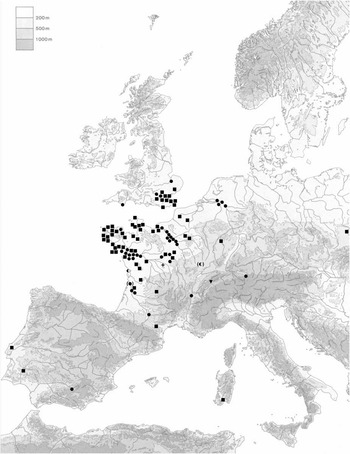
If this were indeed the case, one might reasonably expect scrap-metal hoards to be concentrated primarily along the outer perimeter of the Boughton–Vénat complex rather than along internal divisions dictated largely by natural land–sea boundaries. However, the exact opposite is true. In the big picture, it is the stretches of river valley – those of the Gironde, lower Loire, lower Thames, middle Seine and lower Rhine – that define the periphery of the Boughton–Vénat complex (fig 16).Footnote 89 Hence we would interpret the Boughton–Vénat complex not as a series of interlinked peripheries, but as the core area of a single socio-economic interaction zone.Footnote 90 That we are indeed dealing with a coherent interaction zone is borne out less by the general nature of the relevant hoards as scrap-metal assemblages, but more by their specific make-up in terms of object categories, containing a number of diagnostic types which are not usually found in hoard assemblages elsewhere.
Nantes type: find contexts. Key:
 =single finds;
 =burials;
 =hoards;
 =pile dwellings;
 =other settlements. Pieces listed in the online Appendix as ‘find circumstances unknown’ are not mapped

The (presumably) ritual deposition of individual swords mainly along its outer perimeter suggests that the Boughton–Vénat complex is not merely a modern-day construct. Nor should it come as a great surprise that stretches of river valley with significant concentrations of singly deposited pieces girdle the periphery of the Boughton–Vénat complex, given that throughout the Bronze Age ritual deposition of weaponry in ‘wet’ contexts, and particularly in rivers, seems to reflect socially significant boundaries. At the same time, these concentrations seem to indicate gateway locations between contiguous socio-economic interaction spheres.Footnote 91
In this context it is relevant that a substantial proportion of carp's-tongue swords from French rivers are of the Huelva type, which so far is entirely lacking from Boughton–Vénat hoards and is almost certainly of an earlier date than these (fig 17). The deposition of single carp's-tongue swords in rivers would therefore appear to pre-date to some considerable extent the deposition of Boughton–Vénat hoards.Footnote 92 As in northern and western France single deposits of both Huelva- and Nantes-type swords cluster in the same areas, on the Continent at least, these boundaries and gateway locations would clearly have been in place before the hoards of the Boughton–Vénat complex entered the scene.Footnote 93 With regard to south-eastern Britain the situation is not quite as clear cut. Huelva-type weapons are wanting here so far. Instead, the earliest carp's-tongue swords found in the south east are pieces with a ‘transitional’ hilt, one of which occurs in a hoard of the Boughton–Vénat complex. We have no means of establishing whether any of the single deposits of carp's-tongue swords with ‘transitional’ hilts in southern Britain pre-date the deposition of these hoards.
Huelva type: find contexts. Key:
 =single finds;
 =hoards;
 =‘wet’ multi-piece depositions;
 =pile dwellings;
 =other settlements. Pieces listed in the online Appendix as ‘find circumstances unknown’ are not mapped

Overall there can be little doubt, however, that at least some of the basic structures underlying the distribution of both ‘wet’ single depositions and ‘dry’ scrap-metal assemblages containing carp's-tongue swords were already in place before the characteristic hoards of the Boughton–Vénat complex enter the scene. To some extent this also goes for the flow of metal from the Continent across the Channel, but if the number of ‘foreign’ objects in these hoards is any measure of the quantity of imported metal, we would seem to be looking at a significant increase in metal imports at this time.Footnote 94 Although the relative proportion of raw material from different sources remains difficult to quantify, it is also clear that at least some of the metal in question still originated from western Urnfield lands.Footnote 95
It seems more than likely that without this flow of metal the Boughton–Vénat complex would not have taken its familiar shape. On the other hand, the fact that the hoards of the Boughton–Vénat complex reflect a flow of raw material from the Continent into southern Britain, and that their distribution area seems to mirror a distinct socio-economic interaction zone, does not by itself imply that their deposition would necessarily have been driven by strictly utilitarian motives. As finds of individual ‘carp's-tongue’ objects are scattered across a much wider area than the homonymous hoard assemblages, it is quite likely that the shared practice of the latter's deposition is not just an outflow of metal-supply economics. A broadly similar backdrop would seem to underpin the deposition of scrap-metal hoards containing Monte Sa Idda-type swords in Sardinia. Based on ‘foreign’ object types represented in the assemblages, it has long been recognised that they reflect a flow of metal from Iberia to the central Mediterranean, notwithstanding an unfortunate lack of analytical data and despite the fact that most of the relevant Sardinian finds still await full publication.Footnote 96
Unlike the situation witnessed with the Boughton–Vénat complex, however, here corresponding scrap-metal hoards are largely lacking from the area of origin of these ‘foreign’ types – the Iberian Peninsula. The reasons for this – as for the general paucity of metalwork depositions in Iberia – probably have to be sought in systemic differences regarding the accumulation and display of wealth. In contrast to many parts of Atlantic Europe, where we generally appear to be looking at metal-based wealth-finance systems by the Late Bronze Age, throughout much of Iberia a staple-finance economy with a focus on livestock herding seems to persist.Footnote 97
What the hoards of the Boughton–Vénat complex and the Sardinian scrap-metal assemblages with Monte Sa Idda-type swords have in common with each other is that both coincide with a period of pronounced socio-economic change. The same holds true for previous episodes of intensive scrap-metal deposition, such as the Early to Middle Bronze Age transition and the early Urnfield period in central Europe.Footnote 98 We clearly are not looking at a phenomenon peculiar just to the closing stages of the Bronze Age, and it would appear that studies focusing on the rise in the number of scrap-metal hoards at the Bronze Age to Iron Age transition may in many cases have been overemphasising the role of suspected shortages in metal supply and of shifting supply-demand ratios.Footnote 99
In Brittany at least, the deposition of significant quantities of bronze continued long after the demise of the Boughton–Vénat complex, although no longer in the form of scrap metal, but of units in a standardised format, probably representing fixed nominals in a pre-monetary currency system. These are the Armorican socketed axes, deposited in vast numbers during the Early Iron Age, whose high lead content must raise serious doubts about their functional nature.Footnote 100 Their hoarding pattern remarkably resembles that of ingot torques in the Early Bronze Age of north Alpine Europe – before scrap-metal hoards first enter the archaeological record.Footnote 101 In the Early Iron Age of southern Britain many Sompting-type and linear-faceted axes are equally non-functional and thus may have played a similar role, although their numbers are much more limited.Footnote 102
On the southern fringes of the carp's-tongue sword distribution the situation is somewhat different. In Iberia, except for the north west, where likewise we find non-functional axes in considerable numbers,Footnote 103 the deposition of standardised units of metal remains as rare throughout the Bronze Age as that of substantial scrap-metal assemblages. In the central Mediterranean, on the other hand, oxhide ingots clearly serve during the earlier stages of the Late Bronze Age as units of exchange in a wide-ranging metal trade, although the extent to which they might have functioned as nominals in a pre-monetary currency system is far from clear. Their variable but generally large dimensions and weight render them rather lacking in versatility in such a role. It is thus unsurprising that in Sardinia they occur mainly as fragments in contexts of the later second millennium bc.Footnote 104 The relevant finds, however, are quite distinct from the later scrap-metal hoards with Monte Sa Idda-type swords, which are characterised by a much higher proportion of small objects and bric-à-brac.
As currencies based on fixed nominals generally call for a higher degree of systemic stability and cohesion than currency systems operating without them, this transition might perhaps be viewed as indicative of a decline in these qualities. In any case, there can be little doubt that the Nuraghic culture in Sardinia was undergoing considerable structural change at this time.Footnote 105
While it would be difficult to identify a similar system of fixed nominals for the Channel core area before the appearance of the Boughton–Vénat complex, it is clear that by the ninth century bc the overall economic and social cohesion of societies within the Atlantic Late Bronze Age had passed its apex, and that maritime long-distance networks along the Atlantic facade were profoundly affected by the incremental incorporation of southern Iberia into the Mediterranean world system.Footnote 106
Ultimately, then, the rise of the Boughton–Vénat complex seems to indicate more than anything else a process of societal restructuring that goes beyond a simple increase in social dynamism and probably involves a change in the way metal was used as an economic medium, or even more fundamentally, in the way economic wealth was transformed into symbolic capital.Footnote 107 In this perspective, both the Boughton–Vénat hoards of the Channel core area and the Sardinian scrap-metal assemblages of the ninth and eighth centuries bc – notwithstanding geographical distance – owe their deposition to some extent to the same historical dynamics.
Dedication
This paper is dedicated to Colin Burgess on the occasion of his seventy-fifth birthday.
Acknowledgements
For information on individual pieces or assemblages, critical comments and inspiration the authors would like to thank Grahame Appleby, Aimé Bocquet, Sylvie Boulud-Gazo, Anna Depalmas, Muriel Fily, Adam Gwilt, Fulvia Lo Schiavo, Steven Matthews, Muriel Mélin, Claude Mordant, Renaud Nallier, Stuart Needham, Peter Northover, Brendan O'Connor, Gabriele Rasbach, Ben Roberts, José Suarez Otero, Stefan Wirth and particularly Colin Burgess.