‘Character’ and the ‘characteristic’ were two of the most commonly used terms in German art criticism and theory from the late eighteenth up to the middle of the nineteenth century. It is thus surprising how little attention they have received in scholarly work on the aesthetics of this period.Footnote 1 ‘Beauty’ and the ‘sublime’ are all too often regarded as the twin points around which aesthetic theory orbited – both transcendental categories that seem naturally to express the idealist strivings of the time. They have been seen as universal terms of valuation, whereas the word ‘characteristic’ is more often explored as a description of specific genres – the Charakterstück or charakteristische Sinfonie.Footnote 2 This was indeed one very common contemporary use of such terms, at first glance synonymous with ‘programmatic’: Beethoven, for instance, referred to the Pastoral Symphony as a ‘sinfonia caracteristica’ on the first page of the main sketchbook for the work, and to ‘Les Adieux’ in a letter as a ‘große karakteristische Sonate’.Footnote 3 On the occasion of its London debut the Ninth Symphony was advertised as a ‘Grand Characteristic Sinfonia’.Footnote 4 Richard Will's book-length study of the ‘characteristic symphony’ defines it as ‘instrumental music in which a subject is specified, usually by a text’.Footnote 5 But as F. E. Kirby points out, the epithet ‘characteristic’ ought not to limit criticism to works with the kind of programmatic interpretations that became common only later. In fact at one point Beethoven, reacting to the poet Karl Iken's descriptions of the Second and Seventh Symphonies, expressly discouraged over-specific interpretation, and notably used the word ‘Charakteristik’ (a critical offshoot of this whole complex of terms) in order to oppose it: ‘Seyen Erklärungen notwendig, so sollen sie sich lediglich auf die Charakteristik des Tonstückes im Allgemeinen beschränken, welche gebildeten Musikern nicht schwer fallen dürfte, richtig zu geben.’ (Should explanations be necessary, they should be restricted solely to a general characterization of the piece, something that a well-educated musician should not find it difficult to give accurately.)Footnote 6 For Beethoven and his contemporaries, this conception of the ‘characteristic’ emerged from mid-eighteenth-century ideas of unity of feeling (Einheit des Affekts), establishing a ‘relation between the fundamental poetic idea underlying the composition as a whole and the older conception … that a musical composition should be unified by the expression of a single emotional character or quality throughout’.Footnote 7 The difference was that character was found in the music, rather than being conveyed through it: what made a piece individual and distinct – and defined its appropriate performance – was specified in human, not merely compositional, terms.Footnote 8 This was a general aesthetic principle, not merely a description of individual genres, which makes it worth asking whether the theory of the characteristic had a music-aesthetic role commensurate with the frequency of the term's use in everyday critical discourse at the turn of the century.
The most important attempt to date to place the terms ‘character’ and ‘characteristic’ within a narrative of the history of music aesthetics is that of Carl Dahlhaus, and, as with much else in the German context, a confrontation with his viewpoint is unavoidable.Footnote 9 For Dahlhaus the ‘characteristic’ did at least belong to aesthetic theory, but it remained a singularly unfocused concept, more or less excluded from the theory of ‘absolute music’ that, according to him, constituted ‘the leading idea in classical and romantic music aesthetics’. Long trusted as a historiographical interpretation, even by scholars such as Lydia Goehr who remain wary of its implicit valuation of musical autonomy, Dahlhaus's ‘idea of absolute music’ has nevertheless been put fundamentally in question by recent scholarship.Footnote 10 As a complement to this revisionist initiative, it is worth seeing what can be drawn from those aesthetic precepts – such as character, expression and the poetic idea – whose significance Dahlhaus himself played down in order to construct nineteenth-century music as an ‘absolute’ realm of aesthetic autonomy. Among these, character is of special importance.
Dahlhaus discusses this issue in a number of places, but it is significant that his one essay directly addressing the topic appeared for the first time in a volume devoted to the issue of ‘local colour’ in nineteenth-century opera.Footnote 11 Though Dahlhaus's theoretical discussion includes authors of the most idealist cast – the brothers Schlegel, Goethe, Humboldt and Hegel – the concept's sphere of musical application largely restricts itself in his eyes to the ‘scenic’ or realistic elements in opera and programme music. This impression is confirmed in the chapter ‘Die Ästhetik des Charakteristischen und des Hässlichen’ (The Aesthetics of the Characteristic and the Ugly) from his book Musikalischer Realismus, which includes analyses of Weber's Freischütz and Berlioz's Symphonie fantastique.Footnote 12
In this chapter Dahlhaus presents the characteristic as an anticipation of musical realism, itself a concept of the second half of the century: ‘the controversies which raged after 1850 under the heading of realism had their origin, at least in part, among the themes developed in the first half of the century in the aesthetics of the characteristic’.Footnote 13 A qualification has to follow at some point, since Dahlhaus cannot ignore the idealist tendencies of authors such as Friedrich Schlegel.Footnote 14 But his bracketing of the characteristic alongside the ‘ugly’ (to which the Hegelian Karl Rosenkranz devoted an aesthetic treatise in 1830, and which was taken up as a critical watchword by the music critic Gottfried Wilhelm Fink) is clearly meant to stamp it as a piece of wilful nineteenth-century aesthetic grotesquerie. Whatever it might have meant – and Dahlhaus obviously finds the term's ambiguities frustrating – it was anti-beauty: ‘When reference was made to the characteristic in the early nineteenth century, regardless of whether the interpretation put on it was idealist or realist, regardless of whether the intent was polemical or apologetic, it was always in explicit or implicit opposition to the beautiful, the central category of classicist aesthetics.’Footnote 15 Although ‘both sides in the debate recognized the characteristic as the aesthetic hallmark of their age’,Footnote 16 this was during a period soaked in historicism, in which any such manifestation of the Zeitgeist was inevitably regarded with either distrust or impatience. The prominence of the characteristic must thus either have been a sign of the impending ‘end of art’ (an outcome forecast by a number of contemporaries from Heine to Hegel) or a staging-post on the road to a still more extreme ‘realism’. What it cannot have been was a stable aesthetic concept in its own right.
On closer examination, however, it is far from clear that Dahlhaus can muster the historical evidence required to support this case. For one thing, the idea of character had already, prior to 1800, acquired an aesthetic importance stretching far beyond its previous applications to comedy and satire. It was crucial to the Enlightenment's freeing itself from purely imitative, neo-Aristotelian dogmas in literature during the second half of the eighteenth century, in the work of Lessing, Diderot and Lenz. The term continues to be central for the Weimar circle of Goethe, Schiller and their associates. ‘Could one say that the discussion of terms such as character and characteristic formed the centre of aesthetic debate in Weimar classicism?’ asks Thomas Bremer.Footnote 17 His tentativeness must be attributed to the simple unfamiliarity of such an assertion, for once one actually looks into it, the evidence can almost be described as overwhelming:
At a rough estimate, Goethe uses these concepts in c2000 passages; in Schiller's work they appear repeatedly in a central position … for Wilhelm von Humboldt they form a singular focus for aesthetic and anthropological meditations; in the circle of [Schiller's journal] Die Horen one can distinguish at least two fundamental debates between 1795 and 1797 (some prolonged subsequently) that aspired by means of the idea to come to a collective agreement … about central aesthetic conceptions of the period.Footnote 18
As Marlene Schmidt writes in the introduction to her study of the idea:
The idea of musical character is not given a separate discussion in any of the larger music-aesthetic works of the eighteenth and nineteenth centuries. Yet interest in it … is justified by the important, indeed central role that it plays in questions about beauty in the work of art and in the vehemently conducted discussion about form and content in the musical theory and aesthetics of classicism. Here character is a key concept.Footnote 19
It is important to emphasize that the concepts of character and the characteristic were an expression of central ideals in classical literature and theory, and not simply acknowledgements of the prevailing tendency in contemporary artistic production. One can see this most clearly in Schiller's call for a reassessment of the characteristic in Greek art:
Es wäre, däucht mir, jetzt gerade der rechte Moment, daß die griechischen Kunstwerke von seiten des Charakteristischen beleuchtet und durchgegangen würden, denn allgemein herrscht noch immer der Winckelmannische und Lessingische Begriff, und unsre allerneuesten Ästhetiker, sowohl über Poesie als Plastik, lassen sichs recht sauer werden, das Schöne der Griechen von allem Charakteristischen zu befreien, und diese zum Merkzeichen des Modernen zu machen.
This seems to me entirely the right moment to illuminate and discuss Greek art from the point of view of the characteristic. In general, Winckelmann's and Lessing's concept [of classical art as balanced and ‘colourlessly’ beautiful] is still predominant, and our latest aestheticians make a special effort, in poetry as well as in sculpture, to free the Greek view of beauty from everything that is characteristic, and to make the latter a distinguishing feature of modern art.Footnote 20
Exactly what Schiller and the other contributors to Die Horen meant by the ‘characteristic’ is something to which I shall return. But as a final confirmation of the term's importance to a classical and idealist aesthetic, it is worth noting how the terms ‘character’ and the ‘characteristic’ were used during the 1830s and 40s.Footnote 21 If Dahlhaus were right in seeing them as signposts pointing forward to a post-1850 realism, one would expect to find them used before the middle of the century in debates about ‘progressive’ tendencies in romantic opera and programme music, above all, and to be absent in criticism of ‘absolute’ music (pre-eminently that of the Viennese Classics). In fact, just the opposite is true. Character and the characteristic were the watchwords of the old guard, not the avant garde – of writers such as Amadeus Wendt, Carl Seidel, Ferdinand Hand and Johann Christian Lobe, brought up on Viennese symphonies and eighteenth-century literature and aesthetics.Footnote 22 Their work was grounded in the tenets of idealist philosophy: Seidel's treatise on the ‘poetics of pure music’ quotes no lesser an authority than Schelling (author of the System des transzendentalen Idealismus) as its epigraph – ‘characteristic beauty is beauty at its root’ (‘Charakteristische Schönheit ist die Schönheit in ihrer Wurzel’).Footnote 23 For A. B. Marx, too – a progressive of a non-realist cast – character was an essential critical category in the discussion of instrumental music, though not an exclusive one (being subordinated in most contexts to the poetic idea). Its abandonment finally signified, not an indifferent substitution of terms and a seamless transition into late nineteenth-century realism, but the end of idealist aesthetics tout court. Bremer says ‘In terms of the history of ideas, the discussion of character and the characteristic as aesthetic categories comes to a conclusion [with Karl Gutzkow in 1839]; from the 1840s onward, at the very latest … this group of concepts rapidly loses its relevance.’Footnote 24 The introspective domain to which the idea of ‘character’ belonged must have seemed increasingly ineffectual in the face of the social and political forces unleashed by the revolutions of mid-century; and when a coherent focus for music aesthetics re-emerged in the 1850s, it came in the much more sharply controversial form of the Wagnerian music drama and its polarizing theses of dramatic–musical relations.
What, then, is the aesthetic idea of character in music of this period? As with Kant's aesthetic idea itself, positive definition is a troublesome business. One thing can, however, be confirmed: although it identifies the level at which the artwork is unified, the ideal conception of unity of character cannot be reduced to a material – that is, thematic or stylistic – unity. The mistaken assumption that unity of character is a disguised synonym for material or thematic unity has been most persistent in readings of one key text in the contemporary literature on this subject: Christian Gottfried Körner's ‘Über Charakterdarstellung in der Musik’ (On the Representation of Character in Music), published in 1795 in his friend Schiller's journal Die Horen.Footnote 25 The misreading is crucial, for despite its North German origins and lack of reference to the Viennese school (or indeed to any specific modern musical repertoire), the ‘classical’ associations of Körner's text have given it the status of a key to interpreting the aesthetics of Viennese classicism.Footnote 26 From Heinrich Besseler via Wolfgang Seifert to Carl Dahlhaus and Jacob de Ruiter, it becomes ever more obvious why Körner's thesis needs (from a twentieth-century standpoint) to be interpreted as a ‘classical’ defence of material coherence. Like the twentieth-century analytical strategies with which it becomes aligned, it can be used to validate the ‘absolute’ or pure instrumental music of Viennese classicism as an autonomous product of technical mastery.Footnote 27 In the 1950s Heinrich Besseler connected the classical style back to Bach through their common use of a principle of Einheitsgestaltung (formal unity). He identified this as the real subject of Körner's essay: ‘Unity is recognized by Körner as the fundamental law of every classical type of art. If he introduces alongside this the idea of character, then this signifies a strengthening of the principle.’Footnote 28 Seifert, the first to republish Körner's essay in the twentieth century, concurs:
When Körner refers particularly to instrumental music, music which produces an effect through itself alone, in relating the representation of character to musical unity he unquestionably has the thematic unity of the musical work in mind, as in Viennese classicism … That – generally speaking – character in music without words manifests itself through thematicism, and that consequently unity signifies nothing other than the creation of thematic unity, is self-evident.Footnote 29
If this were really so ‘self-evident’, why did Körner himself discuss melody and rhythm rather than theme? And why did he refer to the ‘representation of character’, rather than formal or thematic unity, in the title of his essay?
The reasons reflect significant differences between eighteenth- and twentieth-century notions of musical material, form and technique. Besseler and Seifert's idea of unity belongs to a twentieth-century analytical tradition beginning around the time of the First World War. Its two strands, stylistic analysis (associated particularly with Guido Adler) and motivic analysis (as practised by Arnold Schoenberg), both rest on the belief that musical coherence is achieved through the consistent patterning of purely musical elements, such as rhythm or interval. The unity of a piece of music can thus be demonstrated by highlighting such elements within the score. There is no need to ask what a composer might have ‘meant’ by, or how a listener experiences, such a pattern – such issues are supposed to be ‘subjective’ and irrelevant next to the objective control evident in the musical ‘material’ itself. As Besseler put it, ‘it is in this area [unity] that an artist discloses whether he has remained on or surmounted the level of the subjective and personal’.Footnote 30
To most music analysts, including those who are concerned to inflect or deconstruct notions of ‘unity’, the deeper metaphor of musical ‘material’ remains self-evident – a fact that may prevent us from seeing that for the early nineteenth century it did not exist in anything resembling the twentieth-century sense. A homogeneous substratum of musical ‘substance’, sound or notes, which are sculpted into a configuration or ‘form’, is a conception of music foreign to the thinking of this period, however natural it may seem to us today.Footnote 31 The contemporary German word most nearly covering the same range of phenomena (below the level of cadence and phrase structure analysed by theorists such as Koch) was Mittel, or ‘means’, a term with quite different connotations from ‘material’.Footnote 32 ‘Means’ obviously imply an ‘end’, towards which they are directed; on the negative side, the word lacks any suggestion that the means being used need to have any consistency among themselves. Critics did not write of the composer working with musical material that ‘had’ certain properties, such as a 3/4 metre, large intervals, a staccato articulation; rather, they referred to the composer's direct use of those properties to achieve a certain end. (A listing of such attributes, which to us may sound quite abstract, often replaced direct musical quotation of a theme: the reviewer obviously felt that specifying the ‘means’ used was enough to give an idea of the aesthetic purpose of the composition.) This end was defined either in socially functional terms or in expressive ones, never through reference to form, style or unity as a materially identifiable product. Parameters such as a slow tempo, long note values, deep register and small or chromatic intervals, as used in a movement like the Largo e mesto from Beethoven's Sonata Op. 10 No. 3, cohere not because they create formal unity or a single sensuous impression of a ‘style’, but because they communicate a single feeling or mood, which Beethoven specified as ‘melancholy’. This is something that exists ‘ideally’ or imaginatively, rather than being susceptible to analytical demonstration in the musical material.
It will of course be objected that the concept of ‘thematic material’ is indispensable in analysing classical sonata movements. Certainly instrumental works expanded in size very largely as a consequence of applying techniques of repetition and development to a small number of themes or motives. Yet in the early nineteenth-century theory of motivic work, or thematische Arbeit (which constitutes an extensive, and largely overlooked, theoretical corpus),Footnote 33 the ‘exploitation’ of material was not regarded as a central aim of the technique. It was the extent to which the preservation and development of opening material could be made to reflect the analogous preservation and development of the piece's overall character that was the crucial test of quality. The aesthetic significance of ‘material’ was not itself material, but ideal. As Beethoven's student friend Anton Reicha wrote in 1814, ‘melody expresses different characters, or more precisely, different kinds of feeling. Two arias composed in the same key and time signature, with the same modulations, rhythm, and form, may nevertheless be entirely opposite in character … to summarize, the difference lies principally in the choice of melodic figures [dessins].’Footnote 34 When these dessins, which A. B. Marx would reframe in German as Motive, are developed, ‘the piece will reflect the character of these developed figures; it will be gay, sad, fresh, or tender, etc.’. But ‘a theme may be charming and yet not suitable for this kind of development’; the extent to which the composer uses the technique at all must depend both on the suitability of his theme's ‘figures’ and on the character of the piece or movement in which they appear.Footnote 35 Reicha's principal example is the theme from the finale of Mozart's ‘Hunt’ Quartet, k458, in which Reicha not only identifies constituent motives, but also discusses how, why and which of these constituent phrases should be developed over the course of a movement.Footnote 36 For Johann Christian Lobe, writing in 1844, even the development of motives within an opening melodic period has its own ‘characteristic’ logic: ‘not every motive is suitable for every kind of melody formation; rather each [motive] seems to call for an individual application, according to its own individual nature, if even a [merely] sensuous and pleasing, let alone an expressive and beautiful, melody is to develop from it’.Footnote 37
Such direct subordination of theoretical concerns to aesthetic ones is typical of the period, as Robin Wallace has noted, and it still creates problems today for readers schooled in twentieth-century traditions of analysis. Some writers were even more stubborn in their determination to address the aesthetic ends of music over the compositional means used to achieve them – and among these was Körner. The brevity of Körner's music-theoretical remarks had been noticed by the essay's first audience. To Schiller's criticism on this score Körner responded that there was already ‘little lack of prescriptions about the means [of music]’ (‘An Vorschriften über die Mittel … schien es mir weniger zu fehlen’) – his own concerns lay elsewhere.Footnote 38 This is in fact just what distinguishes his approach as genuinely idealist, laying down the terms for nineteenth-century aesthetics. Unlike other theorists from the mid-eighteenth century onwards, Körner was less concerned with the immediate and local means of communicating emotion than with how these emotional states could be controlled and unified, not compositionally but at a still more ideal level which he termed ‘character’. Although it is by no means true to say, as Heinrich Besseler did, that when Körner used it ‘the word character was completely new in music theory’,Footnote 39 in previous decades, character, Affekt and emotion had not been strongly distinguished, and the interest of figures such as C. P. E. Bach, Beethoven's teacher Christian Gottlob Neefe and J. G. Sulzer had been centred on the creation of a flexible and immediately expressive, or ‘speaking’, discourse in sound. Whilst recognizing that the static baroque representation of a single Affekt could no longer engage the modern, subjective, sympathetic mode of aesthetic experience, they struggled to integrate the emotional contrasts that music now dealt in. Neefe wrote in 1785 in an essay on ‘Das Charakteristische der Instrumentalmusik’:
Man pflegt zwar Leidenschaften auszudrücken z. B. Traurigkeit – Fröhlichkeit. Allein man drückt sie immer nur in ihrer völligen letzten Äußerung aus, und detaillirt sie nicht nach ihren ersten Keimen und stufenweisen Fortgängen. Am wenigsten beobachtet man die Nüancen derselben, oder die Punkte, wo eine Leidenschaft in die andere übergeht; man macht dadurch Sprünge die der Natur in allen Dingen entgegen sind.Footnote 40
[Composers] are accustomed to expressing passions, for instance sadness and joyfulness. Yet they always express them as the starkest and most extreme utterance, and do not specify them in their initial stirrings and gradual progression. Least of all are their nuances taken note of, and the points where one passion transforms into another; through [such neglect of nuance and transition] one introduces discontinuities that are quite contrary to nature.
Contemporaries obviously sensed problems as well as potential in the passionate style of the 1760s and 70s, but rather than expressing them in the modern musicological terms of formal or thematic incoherence, it was the lack of any emotional restraint and stability that created the area of concern. Without such stability, how could music be defended against the accusation that it was no fine art, but a mere fleeting, temporarily indulged stimulation that left no permanent impress behind? (In 1790 Kant was still sceptical enough on this score to call music ‘more pleasure than culture’ (‘mehr Genuss als Kultur’).Footnote 41) It was this issue that Körner's distinction between emotions and character was supposed to address. ‘In that which we call the soul’, he wrote in echo of Schiller's aesthetic theory, ‘we distinguish between constant and temporary factors: the spirit, character or ethos; and the emotions, passionate state[s] or pathos. Is it inconsequential which of these two the musician attempts to represent?’Footnote 42 The question was, in both senses, a rhetorical one, and one that the Greek terms make obvious was not new. At the same time as Körner, Lacépède and Le Pileur d'Apligny were developing it to good effect in the context of French music-dramatic theory.Footnote 43 As it was for them, so it was to Körner a matter of literally ethical responsibility that the artist should not content himself with the local transmission of pathos, but should strive to depict a unity of character that would make of music a genuinely human and personal art.Footnote 44
Only for Körner, writing on instrumental music, there was an extra degree of moral urgency: as he observed, it was only instrumental music that possessed the peculiar, and at the same time rather suspect, advantage of being able to depict an emotion without at the same time depicting a person displaying that emotion. The question of the essay was whether, if that person's physical appearance could not be given in music as it could be in painting or on the stage, at least the essence of his or her personality could be.Footnote 45 The positive answer he gave rested on the idea that, not only in art but in life, the marks of what was permanent and belonged to someone's essential personality could be read only by close and prolonged observation of the individual's moods or individual states of mind, states that music already had the means to depict: ‘If music does not lack distinct signs for illustrating a specific state, then it also has the potential to represent character. That which we call character cannot be perceived directly, either in the real world or in any work of art. Rather, we can only deduce it from that which is contained in the features of individual states.’Footnote 46
Whereas the expression of emotional states could occur in an apparently straightforward fashion, Körner's use of the word ‘deduce’ implies that character was not immanent in the ‘music itself’, but had to be constructed by a separate agent – the listening subject. In other words, the creation of character was not the sole responsibility of the composer, but invited, and indeed required, the participation of the listener and his or her imagination. It was this freedom in the imaginative creation of character, both on the part of the composer (who was made aware that his powers of representation went further than mimicking the individual sentiments of a poetic text) and on the part of the listener (who was raised above the individually captivating moments of the music in the very attempt to relate them to one another), that for Körner, as for Kant and Schiller, was of the greatest aesthetic worth. Kant's ‘free play’ of the imagination, which Schiller renamed the Spieltrieb, was the faculty that made aesthetic perception possible. Schiller's Letters on the Aesthetic Education of Man (1795) were intended as a demonstration of how this aesthetic play could emerge harmoniously out of individual states of feeling and their moral or ethical regulation. The result of such play was ‘living form … a concept serving to designate all the aesthetic qualities of phenomena and, in a word, what in the widest sense of the term we call beauty’.Footnote 47
Character is thus not opposed to the classical German conception of beauty, but is at its very core. Yet this conception is classical most of all in the retrospective sense – that according to which intellectual German circles at the turn of the century construed Mozart and Haydn as ‘classics’ of modern instrumental music, hearing and judging them according to a post-Kantian idealist aesthetic of which they could have known little.Footnote 48 Undoubtedly character formed part of the Viennese frame of reference: according to Haydn's biographer Griesinger, Haydn referred to his symphonies as being representations of ‘moral characters’, while Mozart refers in a letter to his father to his ability as a musician to express thoughts and ‘casts of mind’ (Gesinnungen) in tones. But in the sophisticated form in which we find it developed for the first time in Körner, musical classicism qua aesthetic doctrine is something virtually contemporary with romantic aesthetics, and just as idealist in approach. One should imagine them less as forming distinct, successive phases, or even competing alternatives, than as interpretations of different sides of musical character: the romantic (as in Hoffman) focused on the sublime, the classical on beauty.
As confirmation of this, one continues to find the ‘classical’ standpoint being taken well into the nineteenth century. The essentials of Körner are reprised – it would appear independently, though the common source in Kant guarantees this to some extent – in a short 1811 article by G. von Weiler, ‘On the Concept of Beauty as Foundation for the Aesthetics of Music’.Footnote 49 Here again, character is placed over passion or affect as a higher category precisely because it allows for imaginative freedom on the part of the listener; here again, character is identified as the chief precondition of beauty. The earlier doctrine of the affects is not completely disabled, since Weiler allows that ‘the particular passion which a piece of music is supposed to express is attributed to it as its end [Zweck]’. Only according to Kant, as Weiler correctly summarizes, ‘the beautiful pleases without any interest as to whether it serves a particular, thought-out end or not’,Footnote 50 and thus the individual Affekt ‘as such [that is, as an end] is not aesthetic’.Footnote 51 Only its execution can be, the particular way in which it is modulated or varied:
Wol aber verträgt die Darstellung der Leidenschaft allen ästhetischen Aufwand, indem sie das Innere nach allen Abstufungen in Bewegung setzt, und hier der Einbildungskraft offenes Feld lässt. Die Vorstellung einer bestimmten Leidenschaft zum Zwecke kann also nur insofern ästhetisch seyn, als sich freyes Spiel der Einbildungskraft in ihr äussert…. Eben darum ist es möglich, dass dieser Zweck erreicht, die Leidenschaft treu dargestellt werde, ohne dass diese Darstellung darum schön heissen kann.Footnote 52
However, the representation of passions may well support aesthetic attention by setting one's faculties in all degrees of movement, and leaving the imagination room for manoeuvre. The presentation of a particular passion as end can thus be aesthetic only insofar as a free play of the imagination is expressed within it… . For this very reason it is possible that this end is reached, and the affect is faithfully represented, without one being able to call the representation itself beautiful.
This is something that explicitly fulfils Kant's criterion for beauty as a free play of feeling, sensed as a feeling of ‘self-consistency’ which has its ‘end within itself’ [‘übereinstimmend mit sich, und daher als zweckmässig in sich’]:Footnote 53
Jeder, der die Schönheit fühlt, wird bey der Reflexion hierüber einsehen, dass sein Gefallen nicht blosser Ohrenreitz, dass es nicht auf einen bestimmten Zweck … berechnet sey; dass es in der freyen Bewegung der Empfindungen bestehe, welche (sey es nun im Ausdauern einer gleichartigen Empfindung, oder in ihrem Wechsel,) das Gemüth in Regsamkeit erhalten, und eine unter sich harmonische Stimmung der Seelenkräfte hervorbringen.Footnote 54
Everyone who is sensitive to beauty will in reflecting upon it perceive that his pleasure is not a mere aural stimulus, that it is [also] not calculated to a particular end … [rather] it consists in the free movement of feelings, which (whether by the prolongation of one sort of emotion or the interchange of several) hold one's sensibility [Gemüth] engaged, and produce among themselves a harmonious attunement of the spiritual faculties.
For this feeling of free self-consistency Weiler has no better word than Charakter:
[Es] geht … aus dem richtig aufgefassten Begriffe der Schönheit hervor, dass ein Tonstück jeder Art seinen Charakter haben müsse; denn dieser ist eben jene Uebereinstimmung, unter welche das freye Spiel der Empfindung zusammengefasst werden muss, wenn es nicht in das Bizarre ausarten, oder das Gemüth nicht in ungleichartige Empfindungen sich verwirren soll. Der Charakter wird in dem Tonstücke, welches eine bestimmte Tendenz hat, durch diese vorgezeichnet, wie z. B. zu dem Texte eines Gesangstückes; er ist aber auch dann unerlässlich, wo, wie in der Kammermusik, völlige Freyheit herrscht, sich ihn auszuwählen. Der Ernst, der Frohsinn – das tief aufgeregte Gefühl, das leichte Dahinschweben, machen die Hauptmomente des Charakters aus; ihre unendlichen Abstufungen bieten das Feld zu einer eben so grossen Mannigfaltigkeit dar.Footnote 55
It follows … from the idea of beauty correctly understood that every piece of music of whatever sort must have its own character; for this is just that self-consistency under which the free play of feeling must be subsumed, if it is not to degenerate into the bizarre, or one's sensibility is not to be disturbed by contradictory feelings. In a piece with a particular subject, the character is prescribed by this, as for example by the text of a vocal piece; but character is also indispensable where, as in chamber music, one has complete freedom to select it. Seriousness, mirth; a feeling of deep agitation, or of lightly floating along: these constitute principal elements of character, and their infinite gradations present scope for just as great a variety [as in vocal music].
Character thus had both a unifying and an individualizing role within a particular piece of music. Its most significant aesthetic function emerges from Weiler's schema as that of synthesis, the ideal and imaginative production of ‘self-consistency’ in one's emotional response; but the last sentence also emphasizes the variety and individuality of possible characters. It was this particular dialectic of unity and variety that governed the application of the idea of character to early nineteenth-century music criticism. Amadeus Wendt's appreciation of Mozart's operas, for instance, assigned great importance to the individuality of both the theatrical characters and the aesthetic character given to certain acts or works, distinguishing this property from the more anonymous procedure of other composers in the operatic field:
Componisten wie Paer z. B. bekümmern sich um ihren Text gar wenig … Wenn sie dem Dichter folgen, so ist es immer nur im Allgemeinen. Sie haben für jede Art der Gemüthsbewegungen z. B. Hass, Liebe, Freude, nur eine Farbe …
Ein Componist hingegen, den wir den musikalischen Seelenmaler nennen – Mozart war es im vollkommenen Sinne, indem nicht nur jede seiner Opern, sondern auch grösstenteils jede Partie derselben ihren verschiedenen Charakter hat, der sich lebendig und unveränderlich dem Geiste einprägt – beseelt auch das weniger ausgezeichnete Gedicht dadurch, dass er, da wo sein Dichter nur im Allgemeinen Liebe, Hass, Verzweiflung etc. schildert, mit einem genialen Blick auf die gegebne Situation, die ganz bestimmte Liebe, den bestimmten Hass u. s. w. ausspricht und mittheilt, wodurch sein Tonwerk zu einem lebendigen Tongemälde kräftig ausgebildet wird. Dass diese Bestimmtheit des Zustandes, welche der geniale Tonkünstler hervorzubringen vermag, sich nicht durch Worte erschöpfen lasse, mithin etwas Unaussprechliches sey, haben wir schon oben angedeutet; demohngeachtet ist sie von jedem Tonkenner anerkannt, der eines Mozarts Don Juan, Figaro u. s. w. zu fassen und zu fühlen fähig ist.Footnote 56
Composers such as [Ferdinand] Paer, for example, show little concern for their text … When they follow the librettist, then they always do so merely in general. For every kind of emotion, for example hate, love, joy, they have only one colour …
By contrast, a composer whom we would call a musical portraitist of the soul – Mozart was one in the fullest sense, for not only each of his operas, but to a great extent each individual role has its own distinct character, which sticks in one's mind vividly and unalterably – fills with life even the less distinguished text, in that, where the librettist only portrays in general love, hate, despair etc., he, with an inspired glance at the given situation, articulates and communicates the most individual love, individual hate and so forth, so that his musical work is powerfully developed into a vivid musical picture. We have already hinted above that this individuality of emotion which the inspired composer is able to produce cannot be exhausted in words, and is thus something inexpressible; nevertheless it is recognized by every musical connoisseur who is capable of comprehending and feeling the Don Juan or Figaro of a Mozart.
Wendt's praise of Mozart echoes J. K. F. Triest's fourteen years earlier in his important series of articles on the development of eighteenth-century German music, in which he singles out Don Giovanni for the consistency, individuality and (just as importantly) ‘ideality’ (Idealität) of the musical characters created by the composer.Footnote 57 Wendt then goes on to a description of ‘Beethovens musikalischer Charakter’ (and not only as manifested in Fidelio).Footnote 58 He thus demonstrates nicely how the aesthetic of the characteristic comprehended both vocal and instrumental music within the same sphere,Footnote 59 treating the former not according to the limited principle of ‘doing justice to the text’ but according to its independent ability to create ideal and unified characters.
It seems as if Beethoven himself was aware of his power to create such a characteristic form of instrumental music, for whatever respect he may have had for Mozart's genius as an operatic composer, he at any rate tolerated, and possibly supported, the following criticisms from his friend Holz of Mozart's lack of ‘specific character’ as a writer of instrumental works:
As Robert Riggs has observed, the same valuation of specific character underlay Beethoven's 1817 decision to replace Italian tempo indications on the one hand with Mälzel's metronome marks – since these would be more precise as a guide for the performer – and on the other with (often quite lengthy or unusual) characterizations of affective content, whose ‘individuality’ (Wendt's Bestimmtheit) and struggle to capture the subtle emotional compounds crystallized in certain movements are surely a reflection of Beethoven's deepening concern with the values of musical characterization. His letter of the same year to Ignaz von Mosel clarified that, in contrast to Allegro, Largo and so forth, ‘the words describing the character of a composition are a different matter. We cannot give these up. Indeed the tempo is more like the body but these certainly refer to the spirit of the composition’.Footnote 61
Looking into the aesthetics of even later composers, it becomes abundantly clear that the idea of character such as we find it in Körner is not only a ‘classical’ phenomenon, confined to a ‘narrow zone’ of late eighteenth-century aesthetic history.Footnote 62 Edward Lippmann notes of Schumann's aesthetics that ‘the heart of his conception is the notion of character’, and quotes from a dictionary definition that Schumann himself offered for the term:
Charakter, musikalischen, hat eine Komposition, wenn sich eine Gesinnung vorherrschend ausspricht, sich so aufdrängt, daß keine andere Auslegung möglich ist. So in der heroischen Sinfonie von Beethoven und in der militärischen von Haydn. Im höheren Sinne ist er sogar der moralische Hintergrund des Kunstwerks; denn wenn auch die Musik ohne Worte nichts Böses hinstellen kann, so hängt doch der moralische Mensch mit dem ästhetischen, das sittliche Wesen mit dem künstlerischen dergestalt zusammen, daß das, was in unsittlicher Leidenschaft erzeugt ist, auch im Kunstwerk seinen Ursprung nicht verbergen kann. Charakteristische Musik unterscheidet sich von der malerischen (pittoresken), daß sie die Seelenzustände, während die andere Lebenszustände darstellt; meistens finden wir beides vermischt.Footnote 63
Character, musical, is expressed by a composition when a disposition expresses itself predominantly, or so obtrudes itself that no other interpretation is possible, as in the Eroica Symphony of Beethoven or the Military of Haydn. In a higher sense it is even the moral background of the work of art; for although music without words can represent nothing evil, yet the moral man is connected in such a fashion with the aesthetic, the ethical nature with the artistic, that whatever is created in unethical passion also cannot conceal its origin in the artwork. Characteristic music is distinguished from pictorial (picturesque) in that it represents the states of the soul, while the other represents the circumstances of life; mostly we find the two mixed.
The moral defence is strongly reminiscent of Schiller and Körner; but notice too the theoretical distinction from ‘pictorial’, realistic or programme music, as an external type of musical representation. Schumann notes the practical possibility and likelihood of mixture, for reasons I shall come to. Yet it is the ‘characteristic’ element which is, as Lippman says, ‘covariant with aesthetic worth’, because of the unique synthetic power it offers to music as an idealizing art, opening up an ‘ideal meeting ground of the external and the autonomous constituents of music’.Footnote 64
This is a convenient moment to address the question of what relationship musical character has with its verbal designations or descriptions. It was taken for granted in many quarters in the early nineteenth century, as Wendt's observations on Mozart make clear, that the experience of character was to a degree ineffable, that ‘the individuality of emotion which the inspired composer is able to produce cannot be exhausted in words’ – not for the reason that it had become part of an infinite, unified realm of feeling, but because, as Mendelssohn later put it, it was ‘too individual’ for words.Footnote 65 The generalized type of Affekt that served less inspired composers, summed up prosaically in the fourfold categorizations (typically sadness, joy, love and anger) of eighteenth-century theorists,Footnote 66 was being replaced by more compound, individualized characters that were less easy to label. (Doubtless it was this difficulty in articulating character that led one of the concept's detractors, Hans Georg Nägeli, to remark caustically, ‘whenever one talks of the definite [bestimmt] character of a musical work, then one tends to speak in the vaguest terms’.)Footnote 67 In this sense, then, the following warning from Dahlhaus is salutary:
It is by no means always the case that the underlying mood of a movement can be given a verbal label; such defining by words and concepts is the exception rather than the rule… . The fact that we are so ready to find the ‘essence’ of a musical form expressed in a verbal phrase … must be laid at the door of a ‘popular Platonic’ aesthetics … which tends to fasten on the paraphrases that are set up ‘around’ a thing, and treats them as the ideas that lie ‘behind’ the concrete phenomena and manifest themselves through them.Footnote 68
What this helps us clarify is that characters at this period were not ‘topics’ – not limited associative nodes, activated and manipulated semiotically and thus publicly interchangeable with corresponding verbal signs. The concept of character is fundamentally extra-semiotic. There is an irremovable component of experience to it – we recognize, but also sympathize [einfühlen] and identify with musical character – which does have a coherent claim to be something standing ‘behind the concrete phenomena’, even if its verbal labels cannot possibly occupy such a position. Any word or concept associated with a character will constitute, not its ‘essence’, but, as Dahlhaus writes, ‘paraphrases … set up around it’.
Yet the essence of a musical character is not identical with a ‘musical form’ either – it does not lie in ‘the music itself’, in the concrete sense in which we have become accustomed to interpret that phrase, but in an imaginative, emotional synthesis of one's listening. When Dahlhaus argues that any attempt to ‘refine the verbal definition’ of a particular musical character must fail, since ‘sooner or later it becomes unavoidable to place more emphasis on compositional descriptive language and less on aesthetic terminology’,Footnote 69 he sets up a dilemma according to which the discourse of musical character must in the end either reduce itself to poverty-stricken essentialism (the Largo e mesto from Beethoven's Op. 10 No. 3 ‘equals’ melancholy) or fall back into pure formal description. The dilemma is false insofar as it ignores the solution posited by most of the nineteenth century, which was to ‘characterize’ music further by fostering a stronger bond between it and the other (principally literary) arts in compositional practice and criticism alike. In Robert Schumann's ‘new poetic age’, Friedrich Schlegel's motto ‘poetry can be criticized only through more poetry’ became generalized to music too.Footnote 70 Rather than testing the idea of ‘exclusive’ character by simply imagining the creation of a poetic equivalent, as Holz had done, critics and composers undertook to realize such equivalents, thus mixing still further Schumann's theoretical categories of the ‘characteristic’ and the ‘pictorial’ or programmatic in music.
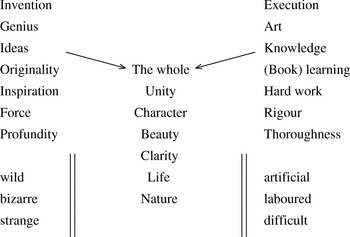
To define character in the way that Körner and Weiler did, as the imaginative synthesis created by the listener, has much to recommend it from the aesthetic-philosophical point of view. It does, however, put responsibility in the wrong place from the point of view of everyday music criticism, which is concerned with music as evidence of the composer's capabilities; and it is to this we now turn. What it is in a composer's creative disposition (Anlage) that decides whether or not a work will be successful was the question asked by early nineteenth-century critics – and to answer it they had a range of typical categories available. Despite Kant's assertion that ‘genius gives the rule to art’,Footnote 71 the essential division of creative capacity was an equal one between genius and the rule(s). The quarrel between Rousseau and Rameau had been resolved into a practical-critical synthesis: the best composers needed both mastery of the rules (of traditional counterpoint) and the guidance of their own (primarily melodic and expressive) genius. Peter Schnaus identifies these categories in critical notices of Beethoven's work from the first issues of the Allgemeine musikalische Zeitung, encapsulating their interaction in the following helpful diagram:
Peter Schnaus, E. T. A. Hoffmann als Beethoven-Rezensent der Allgemeinen musikalischen Zeitung (Munich: Katzbichler, 1977), 26

As Schnaus comments:
The successful work, or the part of a work that was successful, is stereotypically presented as resulting from two constituents of the creative process, one irrational-spontaneous (left side) and one rational and acquired (right side)…. The majority of these concepts can thus be applied both to the composer and the composition [footnote: for instance, Beethoven ‘possesses’, and one of his symphonies ‘shows’, invention, inspiration, learning, thoroughness and so forth].
The formation of critical judgments depends to a large extent on how far the composer has integrated these two components. If one remains exposed and unsupported by the other, then it elicits a negative response: the work that shows untamed genius – by which was meant pure expressive ability, quite differently from its connotations post-Schenker – was ‘wild’, ‘bizarre’ and ‘strange’; the work demonstrating uninspired control of technique was ‘artificial’, ‘laboured’ and ‘difficult’ (both sets of terms blocked off by double vertical lines in Schnaus's diagram). Only when the two came together in the middle column could a positive judgment be given. The work formed a whole, it had unity, not merely in terms of the formal correspondence of parts, but as that overall control of emotion within the total form which was known as ‘character’:
‘Character’ and ‘the whole’ are the two central and correlating terms of [the central column]. It is essentially by means of its character that a work becomes a whole, and only when it is a whole does it possess or show a character. Throughout these reviews, what is meant [by character] is a ruling emotion or a mutually adjusted succession of emotions which, qua ‘content’, make up the essence of a composition. It consequently pertains to character that it should be ‘adhered to’, in other words that the basic emotion of a composition should remain the same, at least over a certain period, and that it should be ‘well-defined’…. This implies as a basic condition that the content of feeling of a piece of music must be regarded as a decisive criterion for its meaning…. Looking forward to E. T. A. Hoffmann, it is worth recording that this universally recognized axiom of the eighteenth-century view of music maintained its unchallenged validity well into the second and third decades of the nineteenth century.Footnote 72
One could quote numerous passages confirming Schnaus's claim for the continuing validity of his schema. Christian Friedrich Michaelis distinguishes a certain ‘moral effect’ as the key element in the music of Haydn, Mozart and the best of the contemporary generation of composers (he lists Clementi, Beethoven and Spohr). Criticism has the task of separating the expression of moral character from both idle skill, on the one hand, and unrestrained fantasy on the other:
Die Kritik wird … fragen dürfen: hat diese Composition Charakter, Adel, Würde? … Oder ist sie ein eitles Spiel mit sinnlichen Reitzen? oder qüalt sie uns fast mit dem blossen Ausdrucke zügelloser Leidenschaftlichkeit und charakterloser Willkür, ohne eine versöhnende Milderung eintreten zu lassen? Wahr ist es, der Tonkunst wird immer Charakteristik … als ein eigenes Gebieth ihrer bedeutendsten Wirksamkeit zukommen.Footnote 73
Criticism … will be entitled to ask: does this composition have character, nobility, dignity? … Or is it a vain playing with sensuous charms? Or does it torment us, almost, with its expression of unbridled passion and arbitrariness lacking all character, never permitting any conciliatory alleviation? It remains a fact: characterization … will always belong to music, as a realm of the most significant potency.
The high-flown, classical philosophical idealism woven around the notion of ‘character’ thus did not inhibit critics from applying it in a much more down-to-earth fashion as an everyday standard of artistic worth. Unlike the generalized literary-romantic idea of the musical absolute hymned by Tieck and Wackenroder, character and the characteristic were concepts eminently suited to critical engagement with, and differentiation between, the artistic productions of the time. Nor should we think of them as entirely post facto constructs, irrelevant to the way composers themselves thought. Although I noted earlier that a gap existed at first between German music aestheticians, critics and publicists and the classical Viennese composers they placed at the head of their tradition, this was significantly narrowed by the early nineteenth century. German Romantics from Hoffmann to Schumann and beyond continued to take inspiration from the great Viennese composers, of course. But Beethoven himself published with Schott in Mainz, read their house journal Caecilia and appreciated the efforts of A. B. Marx on his behalf in Berlin. As for Viennese critics, one need only look at the essays of Friedrich August Kanne in the pages of the Vienna Allgemeine musikalische Zeitung to see at work a native Austrian theoretical ability fully equal to that of Marx or Hoffmann further north.Footnote 74 It is not going too far to assert that both the music of, and the aesthetic-critical discourse surrounding, composers from Beethoven to Schumann were based on a unified, consistent and pragmatic foundation – and character was one of the foundation stones.
If character was as fundamental a concept to music aesthetics from c1780 to 1850 as I have been claiming, then some questions are in order concerning how we approach the music of this period. For a start, we will need to reassess the nature of its autonomy. On the one hand, for all the objections I have made to formalist or ‘materialist’ definitions of it, there can be little doubt that the idea of character defined a certain kind of autonomy in music aesthetics. Although variable in its application to the work, composer or even national school, it was invariably integrative and holistic, and often phrased in organicist terms. It resisted direct subordination to non-artistic functions, whether social, political or intellectual – something that would not endear it to ‘new musicologists’ or their descendants today, just as it provoked the impatience of mid-nineteenth-century musical revolutionaries. On the other hand, musical character was emphatically not autonomous in the metaphysical, transcendent sense associated with Hanslick or, later, Schenker. The emotional level on which it existed was just what those last-named figures wished to eliminate from musical discourse: the ‘rotten aesthetics of feeling’, as Hanslick called it,Footnote 75 was part and parcel of the idea of the characteristic.
Moreover, unlike the ‘idea of absolute music’, the idea of character invites interpretative activity. Undoubtedly, as a governing assumption it is harder for analysts to engage with – even for those who have now given up ‘proofs’ of material coherence and belatedly acquiesced in Stanley Fish's defining maxim of critical theory, ‘like it or not, interpretation is the only game in town’.Footnote 76 Its refusal of well-defined semiotic classifications or neat interpretative homologies has a tendency to make one's critical arguments more ‘impressionistic’ and less impressive than one might like; but also, perhaps, more honest and less unnecessarily technical. Joseph Kerman's criticism has remained the most prominent modern example of such writing: it is no accident that his critical sensitivity and eschewal of system goes together with a belief in the ‘personalities of individual works of art’.Footnote 77 For these same reasons the idea of character has traditionally attracted, and continues to attract, listeners and performers, whose interpretations need not observe the academic proprieties by which the musicological ‘interpretative community’ is bound. In the less scholarly institutions of instrumental pedagogy, to ask ‘what is the character of this piece?’ is typically the first stage in creating an interpretation; even Alfred Brendel continues to pose similar questions.Footnote 78 These modern uses of the term scarcely approach the self-awareness and theoretical sophistication of their early nineteenth-century antecedents; but that is true of a good many ideas that survive from the same period (organicism or the ‘work concept’, to give two examples). Character's social-interpretative role remains as indispensable as it ever was, even if today it is less skilfully and prominently performed.
The idea of character lives on, then: its displacement from the centre of music aesthetics in the mid-nineteenth century did not entirely eliminate it from Western musical culture. Rather it lost confidence and prestige to later, less ambiguous approaches to the problem of musical meaning: on the one hand the New German insistence on music's combination with words, on the other the Hanslickian denial that music had any meaning beyond its own form and substance. The quarrel split apart an earlier, fragile, but subtle and sophisticated network of musical communication that did far more to involve all the contributors to musical culture than we realize. Character was never utterly composer- or work-centred. For both the performer and the listener, apprehending musical character requires imaginative participation – a power of creative synthesis that goes far beyond the ‘structural’, and a channel of communication that has been no less socially important for its exclusion of politics. This is, finally, the source of that ‘noble pleasure’ in music that Johann Christian Lobe, one of the last spokesmen for the characteristic, tried to defend against the Wagnerian partisans of the 1850s.Footnote 79 When we talk of musical character today, we should have confidence that it is not merely the recourse of the analytically uneducated but an idea with a significant intellectual pedigree of its own.