Childlessness and the informal support of older people
Being childless is increasingly common in many western developed societies, so it is not surprising that recent demographic and sociological research has given attention to this phenomenon and its social consequences. The first strand of research focused on the motivations behind the recent increase in the rate of childlessness (and the low fertility rate), particularly among the youngest birth cohorts (González and Jurado-Guerrero Reference González and Jurado-Guerrero2006). A second interest has been in the individual consequences of childlessness, particularly the impact of childlessness on psychological and physical wellbeing (Jeffries and Konnert Reference Jeffries and Konnert2002; Nomaguchi and Milkie Reference Nomaguchi and Milkie2003; Weitof, Burstrom and Rosen Reference Weitof, Burstrom and Rosen2004). Thirdly, several studies have examined the connection between the absence of children and social isolation, in terms of both friendship and support networks (O'Bryant Reference O'Bryant1985; Pinquart Reference Pinquart2003). A point that is often (over) stressed in sociological and social policy research is the weakness of childless people's informal support networks, and the implication that the increasing number of childless people will create a rising demand for public care services. The present study is framed within this third approach, but we go beyond the usual view of childlessness as problematic and show what childless elderly people contribute, in terms of financial and social support, to their kin and friends and to society at large.
According to an influential theory of the modern transition to low fertility, in the past one of the main reasons for having children was that they provided social and economic support for parents who became old and frail and were no longer able to be self-reliant (Caldwell Reference Caldwell1976), while today the welfare state – and in particular the provision of pensions, health care and social services – has made older people's wellbeing independent of the support of their descendants (Nuget Reference Nuget1985). In less affluent societies that lack fully developed state-funded social protection, such old-age security motives for having children – ensuring material support and care in old age – are still widespread and important (Knodel, Chayovan and Siriboon Reference Knodel, Chayovan and Siriboon1992; Schröder-Butterfill and Kreager Reference Schröder-Butterfill and Kreager2005). Some authors claim that, to some extent, these motives for having children still apply in contemporary affluent societies (Kreager and Schröder-Butterfill Reference Kreager and Schröder-Butterfill2004; Rendall and Bahchieva Reference Rendall and Bahchieva1998). While this controversy is not yet resolved, it has been well documented that older people in affluent societies continue to be embedded in dense intergenerational family networks of support (Attias-Donfut Reference Attias-Donfut1995; Kohli Reference Kohli1999). As for their exchanges with adult children, older parents to a large extent are net providers (Albertini, Kohli and Vogel Reference Albertini, Kohli and Vogel2007). Children also provide some direct support, and are moreover important intermediaries between parents and the health and social care services, so enabling better access to publicly-provided services and resources for the older people (Choi Reference Choi1994).
Given the enduring relevance of children's support for elderly parents, it may be expected that childless older people are at higher risk than parents of deficient social and moral support when they become frail and dependent, but evidence to date only partially confirms this expectation. In comparison to parents, childless people tend to compensate for the absence of exchanges with their own children by more frequently extending their networks to neighbours and friends, and by getting more involved in community activities. They also tend to develop stronger ties with other family members – parents, siblings and, along the generational line, nephews and nieces. Moreover, childless couples usually enjoy higher levels of marital support than parents (Chappell and Badger Reference Chappell and Badger1989; Eriksen and Gerstel Reference Eriksen and Gerstel2002; Ishii-Kuntz and Seccombe Reference Ishii-Kuntz and Seccombe1989; Rubinstein et al. Reference Rubinstein, Alexander, Goodman and Luborsky1991; Wenger and Burholt Reference Wenger and Burholt2001; Wenger, Scott and Patterson Reference Wenger, Scott and Patterson2000). The evidence also indicates, however, that when strong support is needed, these compensatory arrangements work only partially. When getting frail and acquiring limitations in their ability to carry out the activities of daily living, childless people receive much less support than parents, are more likely to enter residential care, and do so at lower levels of dependency (cf. Wenger Reference Wenger2009).
To the extent that an increasing rate of childlessness will make family support less available to dependent elderly people, we may expect the demand for public health and social care services to increase significantly in the coming decades. Given the constraints to the expansion of welfare-state spending, it is likely that this additional demand will not be met, and that childless older people will have to look to the private market for alternative solutions. One problem with these alternatives is that they fail to meet the criteria for redistributive justice that are the basis of the modern welfare state, and create additional demographic disequilibria (cf. Anderson Reference Anderson2000; Da Roit Reference Da Roit2007). Such pessimistic projections are not endorsed by all scholars, however, for factors such as the improving health of older people make it difficult to forecast exactly the future demand or requirement for social care (cf. Connidis Reference Connidis and Cheal2002). Within the entire debate about the consequences of increasing childlessness for future social care demand, the opposite flows of support have been largely neglected: in other words, how the absence of children affects what older people give to others. In concentrating on what childless older people need, we forget to ask what they contribute to their families and to wider society.
Childless older people's giving
The keen inspection of what childless older people lack and need, as compared to older parents, has biased our perception of their situation. Childless people are seen as disadvantaged and socially excluded, and it is presumed that an increase in their number will create additional burdens for the welfare system, but this is too limited a view. The evidence does show that, in comparison to older parents, childless older people receive less help when they need it, and the relatively numerous and strong ties that they establish with non-kin and next-of-kin are not as effective when they are in need, but it does not necessarily follow that they contribute less to their families and communities. Two opposed hypotheses are available. On the one hand, we may expect that the weaker support networks of childless people are characterised not only by deficient support when they are in need but also by a low frequency of transfers to others. Alternatively, childless adults might adapt to their status by developing compensatory strategies that offset the risks of social isolation and deficient support, and furthermore they may have more resources to transfer and a greater incentive to make transfers that could generate a reciprocal benefit (cf. Hurd Reference Hurd2009). If all this applies, we may expect that childless people provide more support to others than parents. Having a greater need for constructing outside-family social networks, childless people may also be expected to participate more in charitable or community activities, thus contributing more than parents to society at large.
The main aim of the present analysis is to provide evidence about this ‘active’ dimension of childless people's informal support networks and thereby to move the focus on childless people from what need to what they give. After assessing whether childless older people indeed tend to be more isolated and to receive less support from informal networks than older parents, the analysis turns to three questions: (a) Are childless older people less likely than parents to give support to others? (b) Does childlessness break the generational link within the family? (c) Do childless older people differ from parents in their contributions to society through participation in charitable and voluntary associations and in community activities?
Data and analytic strategy
The data for the analysis were drawn from the first wave of the Survey of Health, Ageing and Retirement in Europe (SHARE), a longitudinal, multidisciplinary survey that represented the population aged 50 or more years in ten European countries: Austria, Denmark, France, Germany, Greece, Italy, The Netherlands, Spain, Sweden and Switzerland.Footnote 1 The first wave of data collection took place in 2004, and the number of respondents was 22,777. SHARE collected detailed information on social support and financial transfers given and received from people aged 50 or more years, and in particular has information about: (a) financial transfers or gifts – worth at least €250 – given to or received from up to three persons by the respondent during the 12 months before the interview; (b) social support given or received to or from up to three persons living outside the respondent's household during the previous 12 months; (c) participation in voluntary or charity work or in religious, sports, social or political organisations during the previous month. Through this analysis, we can see how childless people differ from parents, both in providing financial or social support, and in what they give to larger society.
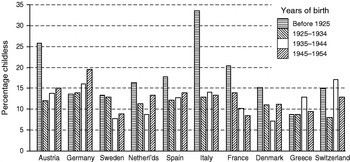
As SHARE is a multi-purpose survey of the older population and was not specifically designed to cover socio-demographic issues, it is important to establish whether childless older people were well represented.Footnote 2 Overall 14 per cent of the respondents had no living children, but there were substantial variations by country and birth cohort, e.g. the percentages were 16 in Germany and 10 in Greece, and 38 for those born during 1904–09 but only 11 for the 1945–49 birth cohort (see Figure 1). Both the country and the cohort variations correspond quite well with the estimates provided by Rowland (Reference Rowland2007). It is worth noting, however, that SHARE did not include those born after 1954 and therefore does not capture the markedly higher rates of childlessness among them. For the cohorts born before 1925, in some countries the SHARE estimate of the prevalence of childlessness is rather different from Rowland's, which may be because of SHARE's few respondents in these birth cohorts. Almost one-half (48%) of the childless respondents in SHARE were never married, nearly one-third (31%) were currently married or in a registered partnership, seven per cent were divorced, and 14 per cent were widowed. It therefore seems that a substantial proportion of the childless respondents did not have children because they never had a partner. This was more the case in Italy and Spain than in the other countries; and least so in Germany and Switzerland.
Percentage of older people who are childless by birth cohort in ten European countries, 2004.

We begin the empirical analyses by presenting the descriptive statistics of the differences between parents and the childless in the likelihood and intensity of financial transfers and social support given and received. Then we use logistic, multi-logit and ordinary least-squares linear regressions to analyse the effect of childlessness on transfer behaviour when controlling for relevant characteristics of the respondent.Footnote 3 First, we examine to what extent previous research findings on support received in various European national contexts are confirmed. Second, and most importantly, we show if and to what extent the childless differ from parents in the support that they provide to their families and friends. Third, we examine how the links between older people and the younger generations within the family are affected by the absence of children. Finally, we examine participation in voluntary or charitable activities as an alternative form of giving.
Results
The descriptive analyses reveal that the socio-demographic and economic characteristics of the childless respondents and of the parents were similar except for household composition. In 2004, the childless tended to be younger than parents, but the differences in mean age were significant in only Germany, Sweden and France. The gender distributions in the two groups were substantially the same, with women being in the majority. As expected, childless people lived in households which, on average, were significantly smaller than those of parents (1.49 versus 2.25 persons). Moreover, 67 per cent of the childless respondents lived without a partner, whereas among parents the figure was only 28 per cent. Regarding their material circumstances, the childless tended to have higher incomes and more wealth than parents, but the differences were not significant in any country. Similarly, when considering health status – namely limitations with the activities of daily living – parents fared slightly worse than the childless, but the differences were again not significant.
Childlessness, financial transfers and support received and given
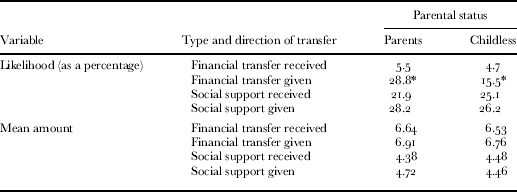
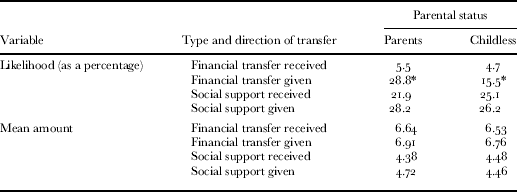
As mentioned above, the evidence to date points to a lack of social support for the childless when they get old and frail, but this does not necessarily also apply to the flow of resources in the other direction. We may even expect that older childless people transfer more to family and friends than older parents. The SHARE data indicate that in 2004 the childless were less likely than parents both to receive and to give transfers or social support (see Table 1). In addition, when they received or gave, the transferred amounts were lower, the only exception being social support received, for which both the likelihood and the mean amount were higher – contrary to the general thrust of the previous evidence. Most differences between the two groups were small, however, and – with the exception of the likelihood of making a financial transfer – not significant (at the 5 per cent level). Table 1 presents only the crude differences and does not take into account the age, gender, education, income, employment status, health, living arrangements and country of residence composition of the two groups. To control for these effects, we proceed to a series of multivariate analyses.
Likelihood and amounts of social support and financial transfers given and received by parental status, ten European countries, 2004
Notes: Amount is measured as the natural logarithm of total amount of financial transfers in Euros, and total amount of social support in hours per year.
Source of data: SHARE 2004 release (see text).
Significance level:* p<0.05.
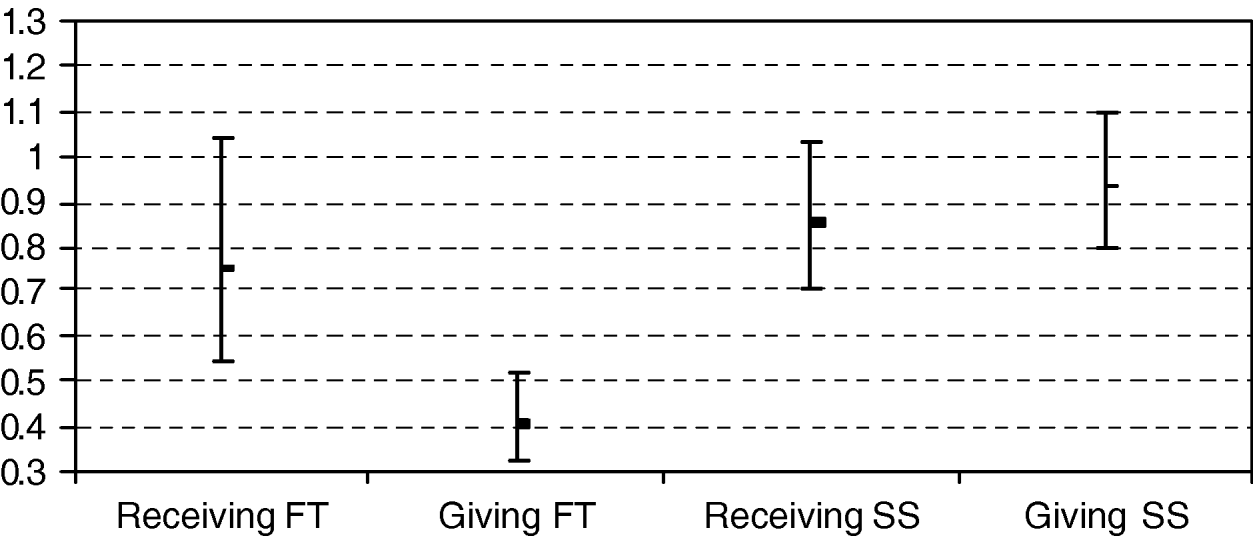
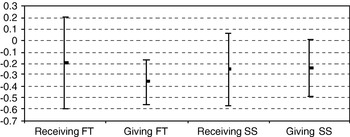
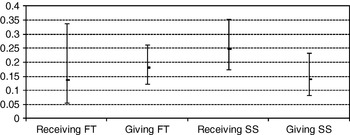
Figures 2 and 3 present the results of the regressions of the respondents' transfers and support exchanges by their parenthood status controlling for the above-mentioned compositional factors. The results are similar to the descriptive statistics, except that the likelihood and amount of social support received followed the expected pattern of being lower for the childless. When the compositional effects are controlled, being childless in old age had a negative effect on the likelihood of both receiving and giving social and financial support to others, and the overall amount of support exchanged was also negatively affected by the absence of living children. These results therefore appear to confirm previous findings about the weak informal networks of childless people, in terms of the support they receive when it is needed. In addition, there is some evidence that for the support given by older people, childlessness affected negatively both the likelihood of providing help to others and the amount of resources transferred. It is worth noting, however, that the observed differences between parents and childless people were statistically significant only for financial transfers to others. We cannot therefore be entirely sure whether there was a negative effect of childlessness on the other three observed types of transfers. If the effect existed, it does not seem to be a strong. Besides this general finding, it would also be interesting to know if the result holds whatever the identity of the ‘other’ from (or to) whom support is received (or given), for this would throw further light on the consequences of childlessness on the intergenerational link. We deal with this issue in the next section.
Influence of being childless on likelihood of transfers or support.
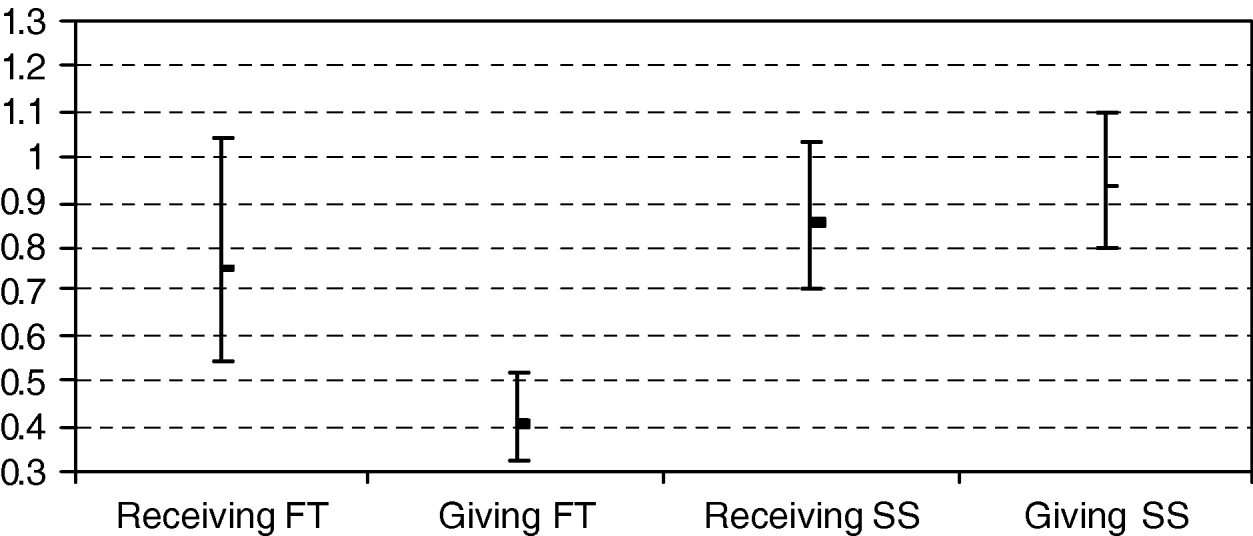
Influence of being childless on amount of transfers or support.

The effect of childlessness on family generation links
As just shown, childless older people were less likely to receive and give support. One immediately suspects that this was because they lacked the most relevant providers and receivers of informal financial and social transfers, i.e. children, but as mentioned before, previous research has shown that people without children tend to develop stronger connections with other members of the younger family generations, particularly the son or daughter of the emotionally closest sibling. The following analyses examine with whom childless older people exchanged financial transfers or support, and to what extent the pattern differed from that of older parents.
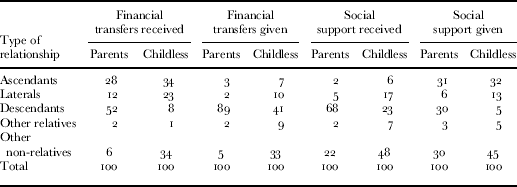
The distribution of transfers by relationship to the provider/recipient of older parents and older childless were markedly different (see Table 2). For financial transfers, the childless were much more likely than parents to receive support from people outside the family: more than one-third of the financial transfers they received were from non-relatives. Descendants were the main financial providers for parents but almost irrelevant for childless people: only eight per cent of the financial transfers they received came from someone of the younger generations.Footnote 4 The results for financial transfers given show the same pattern: childless older people had stronger links with non-relatives and with relatives of the previous and their own generation; whereas their transfers to descendants were much fewer than for parents. For social support, the differences between the parents and the childless were slightly less but in the same direction. It is striking that the main receivers of social support from childless older people as well as their main providers were non-relatives. The childless thus relied more on non-relatives as providers and directed their own help more to them. Ascendant, lateral and other relatives were also more often the providers and beneficiaries.
Distribution of transfers and support, according to relationship to the provider/recipient, by older people's parental status, ten European countries, 2004
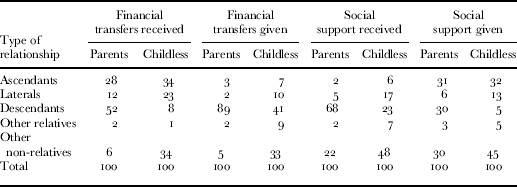
Note: The unit of analysis is the respondent–provider/recipient dyad. Descendants include any members of the younger family generations.
Source of data: SHARE 2004 release (see text).
The links with members of the younger generation although not absent were much weaker for the childless than for parents. By establishing closer links with nephews and nieces, some childless people avoid breaking the intergenerational link, but the compensation is no more than partial. This generalisation was supported by the multivariate regression analyses of the likelihood of receiving/giving support from/to the following generations. Figure 4 confirms that being childless massively decreased the probability of giving or receiving social or financial support from/to descendants. The relative odds amount to about 0.2, and all differences were highly significant.
Influence of being childless on likelihood of transfer or support to and from descendants.

How childless older people contribute to society
Beyond their own families and friends, another strategy that childless older people can adopt to support others is to undertake voluntary or charitable work or to donate money to charitable foundations or institutions. Giving to charities is certainly not a ‘perfect’ substitute for giving to family. As argued in this special issue by Hurd (Reference Hurd2009), for example, financial transfers made to children probably do not satisfy the same needs as donations made to charities. On the other hand, as shown by Adloff's (Reference Adloff2009) paper in this issue, this form of civic engagement is particularly suited to meeting the needs of childless people, for example by perpetuating the family name or as a way of organising their bequests. Furthermore, there is some evidence that childless people tend to participate more in community activities, which may be seen as an additional dimension of the adaptive network development strategy that they pursue (cf. Wenger Reference Wenger2009). The last step of our analyses took up this issue by considering the differences between parents and the childless with regard to their participation in activities promoted by religious, sports, political and social organisations, and charities.
The results indicate that, in general, parents and childless people had a similar likelihood of making such contributions to wider society. The proportion of those attending educational training courses or participating in political and community-related organisations was the same in the two groups. Childless people tended to participate slightly more in sports, social or other kinds of clubs (17% versus 16%), and in religious organisations (11% versus 9%), but neither difference was statistically significant. The same applied to the likelihood of contributing to the community through charitable and voluntary organisations (10% for parents versus 9% for the childless). Differences emerged, however, in the intensity of participation: 28 per cent of childless older people provided charitable or voluntary work to their community every day, whereas among parents the comparable figure was only 16 per cent. At least for the amount of support provided to the community, it therefore seems that a compensatory strategy is adopted by the childless; or we may think that these differences – just as Hurd assumes for financial transfers – arise from fewer time constraints among the childless.
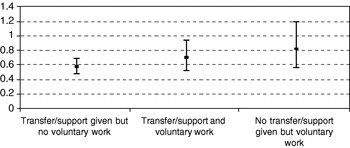
We have also analysed the extent to which childless people and parents had different support-giving strategies. To this end, another variable was created that takes into account simultaneously what people give to their family, to their friends and to the community.Footnote 5 The results are shown in Figure 5. In general, they are in line with the earlier findings: once the usual compositional factors are controlled, it is found that childless people were less likely to provide support to others. This was true for all three possible combinations of transfers or support given to close persons (within or outside the family), and for support through charitable or voluntary work. This negative effect of childlessness was weakest (and not statistically significant) for those who participated in voluntary work but did not give transfers or support. Thus, the giving strategies of childless older people as compared to parents more often involve donating resources to the wider society.
Influence of being childless on likelihood of giving transfer/support and/or voluntary or charitable work.

Conclusions
Childlessness is becoming more prevalent in affluent European societies. According to many scholars and policy makers, the growing number of childless older people and the decreasing number of informal care providers – consequences of low fertility and the increased participation of women in employment – will markedly increase the demand for public social care services. In this article we have moved the focal interest in childless people from what they need to what they give – to their families, friends and wider society. We have also analysed the extent to which intergenerational links within the family are negatively affected by childlessness.
The analyses have confirmed the previous finding about the relatively low support available to childless people in old age. Extending the analysis to the support given, we show that the absence of children also negatively affects the likelihood and the amount of resources transferred to people outside the person's household. We have found, moreover, a negative effect of the absence of children on the link with the succeeding family generation. Substituting children with nephews or nieces provides only limited compensation. On the other hand, the results also show that the differences in transfer and support behaviour between parents and the childless are more complex than usually thought. First, the contribution of childless older people to others' wellbeing is substantial, and the differences with parents are small and significant only for the likelihood and the amount of the financial transfers to others. Second, the support networks of the childless tend to be more diverse. While parents' exchanges are often limited to parent–child relations, people without children establish stronger links with kin from the ascendant and their own generation and with non-relatives. Finally, there is some evidence that the childless also tend to give more support than parents to the society through voluntary and charitable work. The findings support the argument that researchers and policy makers should take into consideration not only what childless older people need but also what they give. The absence of children does not eliminate the motivation for or the practice of generativity. Older people without children partly compensate for the absence of immediate descendants through cultivating more diverse personal support networks, and partly by volunteering and involvement in charities. In this respect, they might be seen as the pioneers of a culture of post-familial civic engagement.