Introduction
Mouse-ear cress is a Brassicaceae winter annual weed in small grains and no-till fields. It originated from western Eurasia; however, it can now be found all over the globe including the United States (Mitchell-Olds Reference Mitchell-Olds2001). Mouse-ear cress is a model organism for plant genomics, where it has been extensively studied. However, very little is known about it as a weedy species. Mouse-ear cress is small and has a short life cycle of about 6 wk (Meyerowitz Reference Meyerowitz1989). It establishes in the fall and spring, with most emergence occurring in the spring. It has high fecundity (one plant produces approximately 5,000 seeds) and is acclimated to wide geographical areas. Its seeds are minute (around 0.5 mm long at maturity) and are dispersed via dehiscence, in which the silique splits apart via mechanical pressure, forcefully ejecting the seed. Subsequent spread may be via wind or rain (Dinneny and Yanofsky Reference Dinneny and Yanofsky2005). Mouse-ear cress seeds possess secondary dormancy and can remain viable for more than a decade if stored dry at 4 C to 20 C (Hays Reference Hays2002; Meinke et al. Reference Meinke, Cherry, Dean, Rounsley and Koornneef1998; Stewart Reference Stewart2009).
In 2015, winter wheat growers in Essex and Westmoreland counties, VA, reported failures of thifensulfuron, an acetolactate synthase (ALS)–inhibiting herbicide (WSSA group 2) to control mouse-ear cress. An informal survey of the region found that many wheat and fallow fields were infested with mouse-ear cress. In some fields, the weed was present at very high densities (more than 100 plants m–2). Mouse-ear cress resistant to several ALS herbicides was confirmed in 2016 using a whole-plant assay in the greenhouse (Randhawa et al. Reference Randhawa, Flessner, Cahoon and Westwood2017). Herbicides tested included sulfonylurea herbicides (tribenuron and mesosulfuron), triazolopyrimidines (pyroxsulam), and triazolinones (flucarbazone).
ALS-susceptible mouse-ear cress is readily controlled by thifensulfuron (Harmony) and thifensulfuron + tribenuron (Harmony Extra), which are widely used in wheat production (Anonymous 2010, 2012). For this reason, mouse-ear cress has not previously been a concern. However, with the evolution of ALS resistance, Virginia winter wheat growers are concerned about its management and possible effect on winter wheat yield. With almost all ALS-inhibiting herbicides registered for use in winter wheat being ineffective because of cross-resistance, alternative herbicides are needed, but little is known regarding their efficacy.
There are no reports on the impact of mouse-ear cress on winter wheat yield. Weed density is a primary factor affecting crop-weed interference (Faria et al. Reference Faria, Barros and Santos2014). Yield loss in wheat due to weed competition can be highly variable; Friesen and Shebeski (Reference Friesen and Shebeski1960) report a range of 0 to 62% yield loss in winter wheat across a variety of weeds and densities. Brassicaceae weeds, the same family as mouse-ear cress, can reduce winter wheat yield. Large-statured Brassicaceae weeds consistently reduced wheat yield. Wild mustard (Sinapis arvensis L.), field pepperweed (Lepidium campestre L., R. Br.), field pennycress (Thlaspi arvense L.), flixweed [Descurainia sophia (L.) Webb ex Prantl], and bushy wallflower (Erysimum repandum L.) have been documented to reduce wheat yield 38% to 50% (Alex Reference Alex1970; Burrows and Olson Reference Burrows and Olson1955; Carter et al. Reference Carter, Lefforge and Shenberger1946; Northam et al. Reference Northam, Stahlman and Abd El-Hamid1993). Wild radish (Raphanus raphanistrum L.) and blue mustard [Chorispora tenella (Pall.) DC.] can cause greater than 50% wheat yield loss (Hashem and Wilkins Reference Hashem and Wilkins2002; Swan Reference Swan1971). Wheat competition from Brassicaceae weeds similar in stature to mouse-ear cress are not as well documented. Spring whitlowgrass (Draba verna L.), in addition to common chickweed (Stellaria media L.) and henbit (Lamium amplexicaule L.) reduced yield 13% to 18% when left uncontrolled (Vrabel Reference Vrabel1987).
Other winter annual broadleaf weeds similar in stature to mouse-ear cress have been examined. Conley and Bradley (Reference Conley and Bradley2005) report that henbit competition can result in decreased winter wheat yield up to 38%. Conversely, Scott et al. (Reference Scott, Peeper and Koscelny1995) report that henbit (among other weeds) did not result in yield reductions when controlled with herbicides, and this report is corroborated by Refsell (Reference Refsell2013), who report no effect on winter wheat yield from henbit density up to 156 plants m–2. However, Farahbakhsh et al. (Reference Farahbakhsh, Murphy and Madden1987) report a 0.3% to 32% yield loss from common chickweed infestations up to 160 plants m–2 in winter wheat.
Though mouse-ear cress is small and has a short life cycle, its production of many seeds and its high density in winter wheat fields could potentially result in a yield reduction—a matter of concern among growers in the region. Therefore, objectives of this study were to evaluate ALS-resistant mouse-ear cress control in winter wheat with alternative PRE and POST herbicides and to assess mouse-ear cress interference with winter wheat.
Materials and Methods
Herbicidal Control
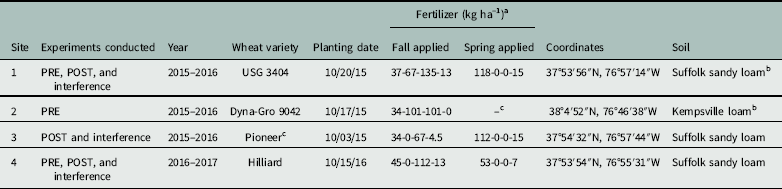
ALS-resistant mouse-ear cress control from non-ALS herbicide options was evaluated under field conditions in 2015 to 2016 and 2016 to 2017. Field trials were established in Essex and Westmoreland counties, VA, where farmers have reported ineffective mouse-ear cress control with thifensulfuron-based herbicides. Two experiments were established: one evaluated PRE control options, and a second evaluated POST control options. The PRE and POST experiments were conducted twice in 2015 to 2016 and once in 2016 to 2017 (Table 1). All field studies were in proximity to Tappahannock, VA. Winter wheat was grown using standard no-tillage practices for the region across all sites; a nonselective herbicide (glyphosate or paraquat, varying by site) was applied such that all sites were weed-free at planting.
Winter wheat production information for PRE and POST control trials and interference studies of ALS-resistant mouse-ear cress in Essex and Westmoreland counties, VA, in 2015–2017.

a Fertilizers are listed in order of N-P2O5-K2O-S.
b Suffolk sandy loam: fine-loamy, siliceous, semiactive, thermic Typic Hapludults. Kempsville loam: fine-loamy, siliceous, subactive, thermic Typic Hapludults.
c Variety or fertility unknown.
PRE Herbicide Options for Mouse-Ear Cress Control
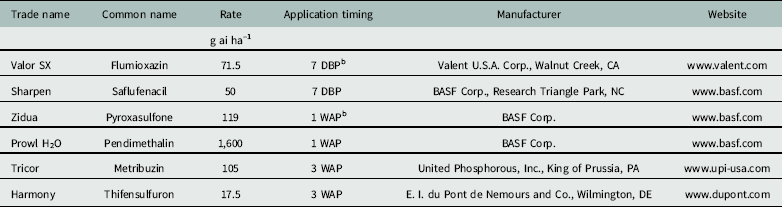
The PRE herbicide control study consisted of seven treatments including a nontreated check (Table 2). The herbicide rates were based on the labeled rate for weed control in winter wheat. Plots were 3 by 7.6 m and arranged in a randomized complete block design with four replicates. Herbicide treatments were applied 7 d before planting, 1 wk after planting (WAP), or 3 WAP (Table 2) according to the product label using a CO2-pressurized hand-held spray boom equipped with four TeeJet 11002 AIXR nozzles (Spraying Systems Co., Wheaton, IL) with 46-cm spacing calibrated to deliver a total spray volume of 140 L ha–1 at 207 kPa. Weed control and crop injury were evaluated visually relative to the nontreated check on a scale of 0 (no control or injury) to 100 (complete plant necrosis) (Frans et al. Reference Frans, Talbert, Marx and Crowley1986). Data were collected 15 wk after planting, corresponding to a typical late winter scouting time, prior to spring fertilizer and POST herbicide applications in commercial production. Wheat was harvested from the center of the plot using a 1.5-m-wide combine harvester, and yield data were adjusted to 13.5% moisture. Data analyses were performed using JMP 11.0 (SAS Institute Inc., Cary, NC). ANOVA was performed, and effects were considered significant when P<0.05. Subsequently, significant means were separated using Tukey’s HSD pairwise comparison (P<0.05).
PRE treatments for control of ALS-resistant mouse-ear cress in winter wheat in Essex and Westmoreland counties, VA, in 2015–2017.a

a All treatments included 0.25% vol/vol of non-ionic surfactant (Activator 90; Loveland Industries, Inc., Greeley, CO).
b Abbreviations: DBP, d before planting; WAP, wk after planting.
POST Herbicide Options for Mouse-Ear Cress Control
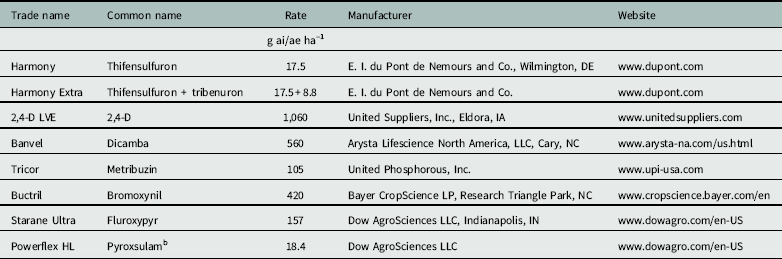
Mouse-ear cress was assessed for POST control under field conditions across the three site-years previously mentioned. The study consisted of a nontreated check, eight herbicide treatments, and one nitrogen (fertility) treatment (Table 3). Nitrogen was broadcasted by hand at the same time as herbicide application at 25.7 kg N ha–1. This treatment was included to determine if additional nitrogen would compensate for the weed competition. Blackman and Templeman (Reference Blackman and Templeman1938) reported fertilization of a weedy cereal crop resulted in yields similar to or greater than a weed-free crop. Similarly, Nakoneshny and Friesen (Reference Nakoneshny and Friesen1961) reported additional fertility compensated for weed competition with improved yields compared to no additional fertility. Herbicide rates evaluated were in accordance with product labels, with the exception of dicamba. Dicamba product labels recommend tank-mixing with other herbicides for Brassicaceae weeds; therefore, a higher rate was evaluated as dicamba was applied alone. Experimental design, treatment application, data collection, and data analyses were conducted as previously described in the PRE study. Treatments were applied in first week of March. Mouse-ear cress was flowering at the time of herbicide application across all three sites. Visible control was assessed 3, 5, and 7 wk after treatment (WAT). Wheat yield data were collected as previously stated in the PRE study.
POST treatments for control of ALS-resistant mouse-ear cress in wheat winter wheat in Essex County, VA, in 2015–2017. a

a All treatments included 0.25% vol/vol of non-ionic surfactant (Activator 90; Loveland Industries, Inc., Greeley, CO).
b Treatment included ammonium sulfate at 3,360 g ha–1 as per product label recommendation.
In addition, POST herbicidal control options were assessed for mouse-ear cress control under greenhouse conditions in 2015 and 2016. ALS-resistant mouse-ear cress seeds were collected from fields in Essex County, VA. Initial screening at the labeled herbicide rate (26.3 g ha–1) confirmed resistance (Randhawa et al. Reference Randhawa, Flessner, Cahoon and Westwood2017). Mouse-ear cress seeds collected from this screening were germinated in flat trays (42 by 32 by 7 cm) containing a potting mixture (Metro Mix 360; Sun Gro Horticulture, Seba Beach, AB, Canada). Single seedlings were transplanted into 590-cm3 plastic pots containing Hayter loam soil (fine-loamy, mixed, active, mesic Ultic Hapludalfs) with 5.1% organic matter and a pH of 6.4 and allowed to acclimate for 2 wk prior to further testing. Pots were maintained in greenhouse conditions (15 to 27 C and average relative humidity of 80%) with day length of 12 h under supplemental light, with watering to maintain field capacity. Treatments evaluated were the same as the field POST herbicide study (Table 3) with one exception: The nitrogen treatment was replaced with bromoxynil + pyrasulfotole (Huskie; Bayer CropScience LP, Research Triangle Park, NC) + ammonium sulfate at 207 + 37 + 1,120 g ai ha–1, respectively. Plants were at rosette growth stage with an average height and diameter of 2.5 cm and 10 cm, respectively, at the time of application. The study utilized a randomized complete block design with six replicates. The study was duplicated in time under similar greenhouse conditions for a total of two experimental repetitions (runs).
Herbicide treatments were applied using a CO2-pressurized spray chamber equipped with a single 8001 EVS nozzle calibrated to deliver total spray volume of 140 L ha–1 at 172 kPa. For herbicide efficacy evaluation, visible weed control data were collected 2, 4, and 6 WAT as previously described. Aboveground biomass was collected 6 WAT and oven-dried at 65 C for 72 h. Data analyses were as previously described for the PRE study.
Mouse-Ear Cress Interference in Wheat
A field study was conducted to assess the effect of mouse-ear cress density on winter wheat yield. Experiment sites were the same three site-years previously mentioned in the POST herbicide study and had a history of ALS-resistant mouse-ear cress infestation. Winter wheat was grown using standard practices for the region (Table 1). A two-treatment study was established in a randomized complete block design with six replicates for a total of 12 plots. Each plot measured 6.1 by 10.7 m. Treatments included thifensulfuron at 17.5 g ai ha–1 and a nontreated check. Herbicide application method was similar to the POST study; however, treatments were applied in the last week of February in each year. Thifensulfuron was included to remove any ALS-susceptible mouse-ear cress and ensure that a homogeneous ALS-resistant mouse-ear cress population was examined for this treatment. Two weeks after treatment, nine randomly assigned 1-m2 subplots were marked within each plot (treatment), and mouse-ear cress density counts were taken at the full-flowering growth stage. This subplot size is similar to that used by Friesen and Shebeski (Reference Friesen and Shebeski1960). One of the nine subplots in each plot was selected randomly and maintained weed-free by hand weeding at the time of the census. All other weeds were removed by hand from all subplots at the time of the census. Winter wheat was hand harvested within subplots and fed into a combine harvester for threshing, and yield data (adjusted to 13.5% moisture) were collected. Data analyses were performed using JMP 11.0. ANOVA and effects were considered significant when P<0.05. Subsequently, yield was regressed against mouse-ear cress density. Data were analyzed using a nested model in which mouse-ear cress density was nested into treatment as a fixed effect.
Results and Discussion
PRE Herbicide Options for Mouse-Ear Cress Control
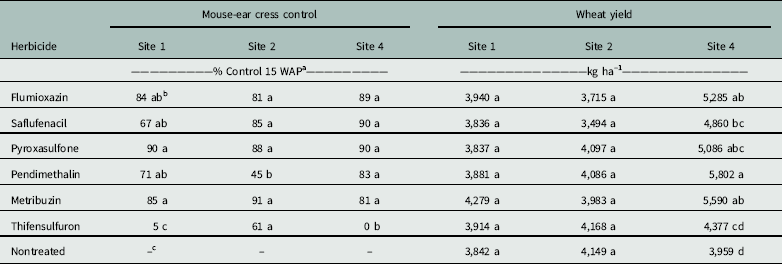
As a significant interaction between herbicide treatment and site was observed, data are presented separately for each site. In general, mouse-ear cress control varied among herbicide treatments (Table 4). Metribuzin, flumioxazin, and pyroxasulfone resulted in greater than 80% control across all three sites 15 WAP. Saflufenacil resulted in 67% mouse-ear cress control at site 1, 15 WAP. Conversely, saflufenacil resulted in greater than 85% control at sites 2 and 3. Pendimethalin resulted in 71% mouse-ear cress control at site 1, 15 WAP, whereas 45% and 83% control were observed at sites 2 and 3, respectively. Differences in control from saflufenacil and pendimethalin may be due to differences in activating rainfall (rainfall data not available). Previous research has reported that saflufenacil controlled Brassicaceae species, specifically 78% control of blue mustard (Geier et al. Reference Geier, Stahlman and Charvat2009). Thifensulfuron resulted in no more than 40% mouse-ear cress control except at site 2, where it resulted in 61% control 15 WAP, corroborating the field histories of ALS-resistant mouse-ear cress. No crop injury was observed with any of the herbicide treatments (data not shown).
Control of ALS-resistant mouse-ear cress and wheat yield with PRE herbicides in Essex and Westmoreland counties, VA, in 2015–2017.

a Abbreviations: WAP, wk after planting.
b Treatment means within columns with no common letters are significantly different according to Tukey’s HSD pairwise comparison (P<0.05).
c Visible mouse-ear cress control data for nontreated were not included in analysis.
Treatment effect on wheat yield was not significant for sites 1 and 2, and yield averaged 3,937 and 3,956 kg ha−1, respectively (Table 4). Lack of differences at these two sites indicates that mouse-ear cress may not a competitive weed in wheat. However, yield differences were observed in site 4. These differences are attributed to common chickweed present in the trial; common chickweed control was less than 30% from saflufenacil and thifensulfuron; these were the only two herbicide treatments that were not in the top statistical grouping. Previous research reports wide variation (0 to 62%) in wheat yield loss due to weeds (Conley and Bradley Reference Conley and Bradley2005; Farahbakhsh et al. Reference Farahbakhsh, Murphy and Madden1987; Friesen and Shebeski Reference Friesen and Shebeski1960), including little to no yield loss (Refsell Reference Refsell2013; Scott et al. Reference Scott, Peeper and Koscelny1995). Vrabel’s (Reference Vrabel1987) report that spring whitlowgrass in combination with other weeds did reduce wheat yield was similar to what we observed in site 4.
POST Herbicide Options for Mouse-Ear Cress Control
Weed control data were pooled across sites and all rating timings, as no significant treatment-by-site or treatment-by-rating timing interactions were observed. Additionally for yield data, no significant treatment-by-site interaction was observed; however, site effect (Table 5) was significant. Data were pooled across sites for each treatment.
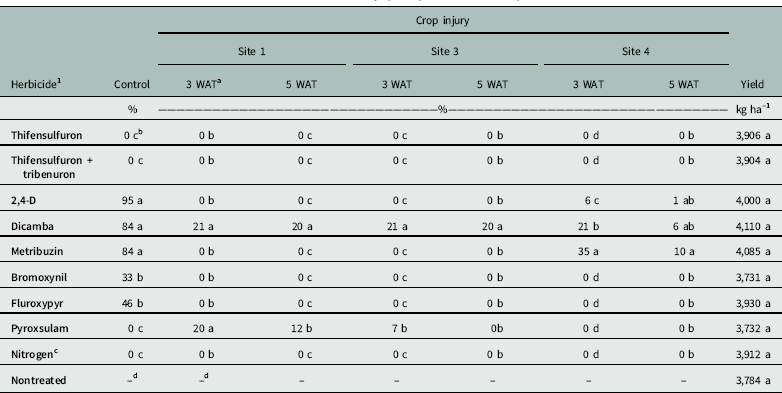
POST control of ALS-resistant mouse-ear cress and winter wheat injury and yield in Essex County, VA, in 2015–2017.

a Abbreviation: WAT, wk after treatment.
b Treatment means within columns with no common letters are significantly different according to Tukey’s HSD pairwise comparison (P<0.05).
c Urea was broadcast by hand at the time of herbicide application at 25.7 kg N ha-1.
d Visible mouse-ear cress control and injury data for nontreated were not included in analysis.
2,4-D resulted in 95% mouse-ear cress control, whereas dicamba and metribuzin resulted in 84% control (Table 5). These three herbicides resulted in greater control than all other treatments. Similar control of the Brassicaceae species wild radish and wild mustard has been reported (Cahoon Reference Cahoon2016). Control obtained from dicamba could be attributed to higher herbicide rates used beyond product label recommendations. No other herbicide treatments, including thifensulfuron, controlled mouse-ear cress more than 50%.
Dicamba resulted in 20% crop injury 3 WAT across all three field sites, but injury ratings declined by 5 and 7 WAT (Table 5). Less upright stems compared to the nontreated characterized dicamba injury. Dicamba injury results corroborate past research, wherein 20% wheat injury was observed 2 WAT and plants eventually recovered (Orr et al. Reference Orr, Canevari, Jackson, Wennig, Carner and Nishimoto1996; Robinson et al. Reference Robinson, Letarte, Cowbrough, Sikkema and Tardif2015). Pyroxsulam caused 20% and 7% crop injury at site 1 and site 2, respectively, 3 WAT, characterized by stunting; however, no injury was observed at site 3. Metribuzin resulted in 35% crop injury 3 WAT at site 3 characterized by foliar necrosis; however, recovery was observed 5 WAT, when only 10% injury was observed. No crop injury was observed 7 WAT from any of the treatments (data not shown), indicating that crop injury was transient.
Yield data indicated that although mouse-ear cress control differences were observed, these did not result in a yield improvement relative to the nontreated check. That no differences were observed between the nontreated check and any herbicide treatment could be attributed to its very small mature plant size and a very short life cycle of 6 wk (Meyerowitz Reference Meyerowitz1989). These results are similar to previous research on small-statured weeds in wheat. Conley and Bradley (Reference Conley and Bradley2005) reported no yield loss with henbit density of 18 plants m–2, and Refsell (Reference Refsell2013) also reported no yield loss with henbit densities up to 156 plants m–2. However, the result is in contrast to other reports. Conley and Bradley (Reference Conley and Bradley2005) report 13% and 38% wheat yield loss from henbit at 82 and 155 plants m–2, respectively, and Farahbakhsh et al. (Reference Farahbakhsh, Murphy and Madden1987) reported 32% yield loss from common chickweed at 160 plants m–2. Previous research examining corn cockle (Agrostemma githago L.) noted that winter wheat yield was not affected if weeds were controlled prior to the two-tiller growth stage (Rydrych Reference Rydrych1981); this result is similar to the current research when wheat was two to four tillers when treatments were applied in early March.
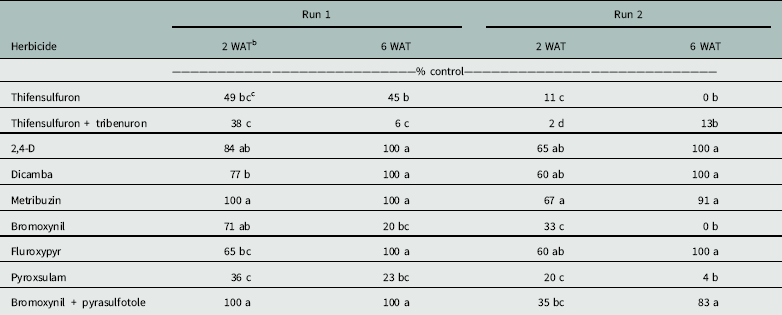
For greenhouse studies, a significant treatment-by-experimental run interaction was observed, so data were analyzed and presented separately for each experimental run. Weed control was similar between field and greenhouse conditions for 2,4-D, dicamba, metribuzin, pyroxsulam, and thifensulfuron treatments. 2,4-D and dicamba resulted in 100% mouse-ear cress control 6 WAT in both experimental runs (Table 6), whereas metribuzin resulted in 100% and 91% control 6 WAT in experimental runs 1 and 2, respectively. Previous research documented similar results where ALS-resistant wild mustard was controlled by 2,4-D (Heap Reference Heap2017). None of the thifensulfuron-including treatments resulted in greater than 55% mouse-ear cress control.
ALS-resistant mouse-ear cress control with POST herbicides under greenhouse conditions in Blacksburg, VA, in 2015–2016.a

a Visible mouse-ear cress control data for nontreated were not included in analysis.
b Abbreviation: WAT, wk after treatment.
c Treatment means within columns with no common letters are significantly different according to Tukey’s HSD pairwise comparison (P<0.05).
Bromoxynil + pyrasulfotole resulted in 100% and 83% control 6 WAT in experimental runs 1 and 2, respectively (Table 6). Bromoxynil + pyrasulfotole had greater efficacy in greenhouse conditions compared to bromoxynil alone in field conditions. Bromoxynil alone in the field had a lower application rate than labeled, and control is best when applied at the rosette growth stage. The mouse-ear cress was flowering at the time of application, which probably reduced herbicide efficacy. Fluroxypyr had greater efficacy in greenhouse conditions (100% control 6 WAT in both experimental runs) than field conditions (46% control). This difference is probably due to differences in the growth stage of mouse-ear cress, which was at rosette stage when treated in greenhouse experiments compared to flowering in field experiments. Additionally, greenhouse conditions were consistently warm, favoring greater herbicidal activity, unlike springtime field conditions, which are typically variable and colder.
Mouse-Ear Cress Interference in Wheat
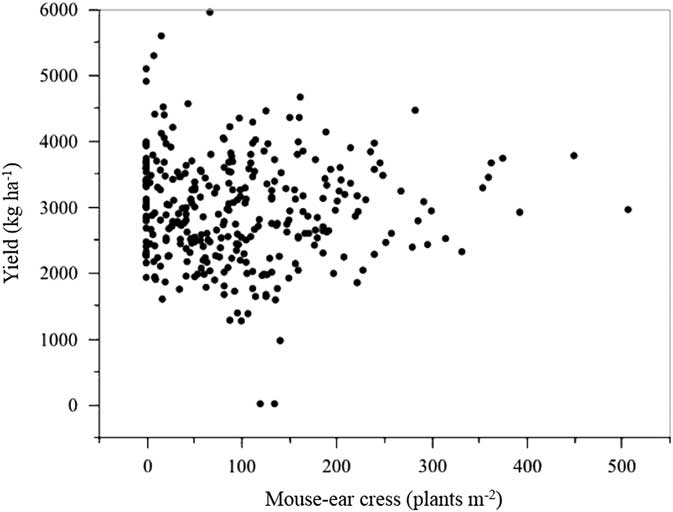
There was no treatment-by-site interaction, so data were pooled across sites. Herbicide treatment and mouse-ear cress density did not affect yield. Linear and nonlinear regression of yield data against mouse-ear cress density was not significant, indicating that there was no relation between mouse-ear cress density and winter wheat yield (Figure 1). Mouse-ear cress at densities ranging from 0 to more than 300 plants m–2 did not result in yield loss. Previous research reports little to no wheat yield response to other small-statured winter annual broadleaf weeds (Conley and Bradley Reference Conley and Bradley2005; Refsell Reference Refsell2013; Scott et al. Reference Scott, Peeper and Koscelny1995). However, most studies examining larger statured Brassicaceae species consistently reported yield loss (Alex Reference Alex1970; Burrows and Olson Reference Burrows and Olson1955; Carter et al. Reference Carter, Lefforge and Shenberger1946; Hashem and Wilkins Reference Hashem and Wilkins2002; Northam et al. Reference Northam, Stahlman and Abd El-Hamid1993; Swan Reference Swan1971; Vrabel Reference Vrabel1987), including similar densities observed in this study. Swan and Furtick (Reference Swan and Furtick1962) reported that winter wheat can successfully compete with weeds when established early. Blackman and Templeman (Reference Blackman and Templeman1938) reported fertilization of a weedy cereal crop resulted in yields similar or greater than a weed-free crop; the current experiments were conducted in commercial production wheat fields, which were fertilized (Table 1).
Relationship between mouse-ear cress density (x-axis) and winter wheat yield (y-axis) in Essex County, VA, in 2015 to 2016. Linear and nonlinear regression were not significant.

These results are corroborated by yield trends observed in the PRE and POST herbicide study, in which wheat yield was similar among treatments that resulted in greater than 80% mouse-ear cress control and treatments that resulted in no (0%) control (Tables 4 and 5). Field observations from these studies offer two likely explanations: a short life cycle and a short, poorly competitive plant. Mouse-ear cress completed its life cycle by the end of April, eliminating competition with wheat at or before this time. As previously noted, mouse-ear cress is a short-statured plant, which was easily outgrown by wheat tillers. Additionally, the majority of mouse-ear cress germination occurred in late winter as opposed to fall; weeds that emerge after the crop are known to be less competitive than those that emerge with the crop. Other researchers have reported little or no yield loss with other short statured weeds, namely henbit, particularly when present at low densities (Conley and Bradley Reference Conley and Bradley2005; Refsell Reference Refsell2013; Scott et al. Reference Scott, Peeper and Koscelny1995).
Overall results indicate that flumioxazin, metribuzin, saflufenacil, and pyroxasulfone are effective PRE herbicide options for mouse-ear cress control, whereas 2,4-D, metribuzin, and dicamba provide effective POST control. Metribuzin can provide effective mouse-ear cress control when applied either PRE or POST. Metribuzin, 2,4-D, and dicamba may result in transient wheat injury. The interference study indicates that mouse-ear cress does not result in yield loss in winter wheat when present at densities up to 300 plants m–2. Growers should make herbicide decisions based on other weeds in the field and can incorporate the aforementioned herbicides for mouse-ear cress control.
Acknowledgments
The authors are grateful for the help of Virginia Cooperative Extension Agent Keith Balderson and the financial support of the Virginia Small Grains Board, the Virginia Agricultural Experiment Station, and the Hatch Program of the National Institute of Food and Agriculture, US Department of Agriculture. No conflicts of interest have been declared.