Introduction
In studying reforms aimed at making welfare states more ‘active’, it is useful to distinguish two types of reforms (Carmel and Papadopoulos, Reference Carmel, Papadopoulos and Millar2003; Van Berkel and Borghi, Reference Van Berkel and Borghi2008): firstly, reforms that are focused on the content of social policy programmes (formal policy reforms); and, secondly, reform processes that aim at restructuring service provision models, that is the design of the organisational arena through which policy programmes are administered and delivered (operational policy reforms). During the last decade, formal policy reforms aimed at activating welfare states have been studied extensively (for example, Lødemel and Trickey, Reference Lødemel and Trickey2001; Goul Andersen et al., Reference Goul Andersen, Clasen, Van Oorschot and Halvorsen2002; Gilbert, Reference Gilbert2002; Serrano Pascual and Magnusson, Reference Serrano Pascual and Magnusson2007). These studies showed, among others, how income protection schemes were made less generous in order to introduce stronger work incentives; how activation programmes were introduced and subsequently often transformed into Work First or labour attachment programmes that were gradually targeted at more and more groups of unemployed people; how eligibility for income protection increasingly became subjected to an individual ‘responsibility test’ concerning unemployed people's efforts to promote their labour-market integration and employability; and how the behaviour of the unemployed was subjected to stricter monitoring practices and the use of sanctions and incentives.
This article will focus on the second type of reforms, and in particular on the ways in which income protection and activation programmes for unemployed people are provided. These reforms are receiving increasing attention from social policy and public administration scholars (for a literature review, see Van Berkel and Borghi, Reference Van Berkel and Borghi2008). As is the case with formal policy reforms, operational policy reforms have had considerable consequences for the ‘old’ public agencies involved in providing income protection and employment services for the unemployed: benefit agencies, the Public Employment Service and the local agencies administering social assistance. Whereas formal policy reforms affect the core tasks and services of these agencies, operational policy reforms influence the agents involved in service provision and the structure of their relationships, as well as the ways in which the ‘old’ agencies are governed and managed. In a study of the public management of welfare to work policies, Mark Considine (Reference Considine2001) distinguished four types of governance, which can be used to classify operational policy reforms: procedural governance, a concept that refers to the traditional hierarchical public management; corporate governance, which points at attempts to manage public agencies as if they were private organisations by, for example, separating service delivery agencies from Ministries and introducing instruments such as management by objectives, contractualism, performance indicators and performance monitoring; market governance, which involves the introduction of competition and quasi-markets in the provision of publicly funded social services; and network governance. Concerning the latter, Considine distinguished two sub-models, which, as we shall see, are both relevant for the operational policy reforms we will discuss in this article. The first sub-model refers to social partnership: organised interests (trade unions and employers’ organisations) are involved in policy-making and policy implementation processes. The second sub-model refers to processes of networking, co-production, cooperation and co-financing in service provision that involve a variety of public and private actors, as well as citizens and clients.
Both types of welfare state reforms are linked in complex ways. It has been argued that operational policy reforms are not without consequences for the content of social services. Bredgaard and Larsen (Reference Bredgaard and Larsen2008), for example, discussed this issue in the context of the marketisation of the provision of activation services, which, in their view, contributes to a shift in the content of activation by making it increasingly focused on quick labour-market reintegration rather than on investing in human capital and promoting sustainable labour-market participation. In this article, we will argue that formal policy reforms may trigger operational policy reforms, in the sense that the former create a need for the latter: formal policy reforms have created a pressure to reform operational policies. This does not mean that the specific reforms we will discuss in this article are the unavoidable consequence of formal policy reforms; such a determinist account of operational policy reforms would be untenable. For example, the introduction of new service provision models in the policy areas of social security and activation cannot be seen in isolation from broader debates about the functioning of the public sector and the presumed inefficiency and ineffectiveness of public service provision, or from the increasing popularity and dominance of new governance and new public management thinking (Clarke and Newman, Reference Clarke and Newman1997; Pollitt and Bouckaert, Reference Pollitt and Bouckaert2000; McLaughlin et al., Reference McLaughlin, Osborne and Ferlie2002). We do argue, however, that we cannot adequately understand operational policy reforms without reference to some of the core substantial characteristics of active welfare states.
The objectives of this article are the following. Firstly, an analysis (in the next section) and a comparison (in the third section) are undertaken of four major operational policy reform programmes in the policy areas of income provision and activation in four EU countries:Footnote 1
• the merger of the Benefit Agency and the Employment Service into Jobcentre Plus in the UK (2002);
• the Hartz reforms in Germany, an extensive reform package involving significant formal and operational policy changes (2003–2005);
• the Structural Reform in Denmark, which involves the entire Danish public sector and includes the governance of labour-market policies (2007);
• the SUWI reforms (SUWI stands for Structure of the Administration of Work and Income) in the Netherlands (2002).
The second objective of the article is to contribute to the understanding of these reforms by analysing how they can be interpreted as responses to reform pressures that arose as a consequence of transforming passive into active welfare states (the fourth section).
It should be emphasised that this article will focus on systemic changes only, without paying attention to how the reforms are practically implemented. Because of this, the article only tells the ‘official’ reform story, which may (or rather, will) be different from what new service provision models look like in practice. Given the objectives of this article, we believe this limitation to be acceptable.
Operational policy reforms in four EU countries
Germany
Before the Hartz reforms, the German social security system for unemployed people was more differentiated than the social security systems in the other three countries. Germany had a wage-related unemployment benefit system, a wage-related and means-tested unemployment assistance system and social assistance. The unemployment assistance system provided income support for unemployed people who had exhausted their unemployment benefit entitlements. Social assistance was a safety net targeted at people who were not entitled to unemployment benefits or unemployment assistance. It could also be a supplementary income provision for people whose income from unemployment benefit or assistance was too low (Finn et al., Reference Finn, Knuth, Schweer and Sommerville2005).
Both unemployment benefits and unemployment assistance were administered by the Federal Employment Agency. This agency was also responsible for the activation of unemployment benefit and unemployment assistance recipients; income provision and activation were integrated for these groups of unemployed. Already in 1998, local offices of the Federal Employment Agency gained significant autonomy in implementing activation as a consequence of a decentralisation process through which a variety of activation measures were integrated into one reintegration budget. This budget gave local offices more room in deciding about the mix of measures that would be available (Mosley, Reference Mosley, Giguère and Higuchi2005). During the pre-Hartz period, municipalities were responsible for administering social assistance payments, which consisted of two parts: income provision and an allowance for housing and heating costs. Municipalities were expected to refer social assistance recipients who were able to work to the local office of the Federal Employment Agency for activation. However, as the Federal Employment Agency prioritised its own clients, many municipalities started to develop activation programmes for their clients (Finn et al., Reference Finn, Knuth, Schweer and Sommerville2005).
The Hartz reforms – in contrast with the other reforms discussed in this article – combined formal and operational policy reforms, which is probably related to the fact that Germany is a late reformer (Seeleib-Kaiser and Fleckenstein, Reference Seeleib-Kaiser and Fleckenstein2007). One of the core formal policy reforms introduced was the integration of unemployment assistance and social assistance, for the unemployed who were able to work, into one benefit system: unemployment benefit II. Municipalities remain responsible for social assistance recipients who are unable to work, as well as for the payment of housing and heating costs of recipients of unemployment benefit II. In terms of operational reforms, the main issue was how to streamline service provision for the long-term unemployed, the recipients of the new unemployment benefit II (Ebbinghaus and Eichhorst, Reference Ebbinghaus and Eichhorst2007). Eventually, a mainstream and an experimental model were introduced. In the mainstream model, a new local agency (the so-called Arbeitsgemeinschaft or ARGE) was established, which is jointly managed by the Federal Employment Agency and the municipality and joins their services (benefit administration, activation and social services) in order to create a one-stop shop for the long-term unemployed. The ARGE agency is located in the local Job Centre, the new name for the local offices of the Federal Employment Agency. This Job Centre also houses a second agency, the Service Centre of the Federal Employment Agency, which provides income and activation to the short-term unemployed (recipients of unemployment benefit I). Besides this mainstream model, 69 municipalities work with an experimental model in which the municipality is fully responsible for the provision of income, activation and social services for the long-term unemployed, without the involvement of the Federal Employment Agency.
One of the main targets of the Hartz reforms was the functioning of the Federal Employment Agency, which was considered to be inefficient, ineffective and too bureaucratic. The Hartz Commission that prepared the reforms considered the traditional corporatist governance of the Agency to be one of the main reasons for this (Ebbinghaus and Eichhorst, Reference Ebbinghaus and Eichhorst2007). Because of that, the role of social partners was reduced; their direct executive influence was curtailed. Instead, social partners are now represented in a tripartite supervisory board. Another instrument that was introduced to improve the effectiveness and efficiency of activation was the increased use of competition in service provision. In itself, the involvement of external providers of activation services is not new. Already, in the period preceding the Hartz reforms, extensive use was made of services delivered by external (training) agencies. However, the Hartz reforms introduced more pronounced quasi-market mechanisms into the German service provision model; among others, through the use of so-called placement and training vouchers (Konle-Seidl, Reference Konle-Seidl, Sol and Westerveld2005; Hipp and Warner, Reference Hipp and Warner2008). Finally, new public management tools have been introduced in managing the Federal Employment Agency. For example, the Ministry concludes performance agreements with the Agency, and local offices have to realise specified quantitative goals. Another example is that the Agency has to pay approximately 10,000 euros to the federal government for each unemployment benefit I recipient that is transferred to unemployment benefit II.
United Kingdom
Contrary to many continental countries, the UK does not have a wage-related unemployment benefit system. Instead, it has a flat-rate unemployment benefit, which was integrated with UK social assistance (Income Support) in 1996 into the Jobseekers’ Allowance (JSA). This allowance consists of two parts: a flat-rate contribution-based JSA for a maximum of six months, and an income-based, means-tested JSA, which is not limited in duration. Another striking difference from many other European countries concerns the administration of income protection schemes: social partners and municipalities are not involved, and the administration is fully under national government control. Municipalities do have a role, however, in the administration of other forms of financial support, such as housing benefit and council tax benefit (Clasen, Reference Clasen2007).
As far as activation is concerned, a process of modernising Employment Services in the 1970s established a network of local Job Centres and separated benefit administration from employment assistance (Finn et al., Reference Finn, Knuth, Schweer and Sommerville2005). Social partners were represented in the tripartite Manpower Services Commission (MSC), which supervised the process of building the Jobcentre network and a training system. Finn (Reference Finn, Sol and Westerveld2005) points out that this Commission was one of the first public agencies that made extensive use of contracting-out service provision to public, private and voluntary agencies. Both the corporatist nature of governing employment services and the separation of benefit administration and activation started to change in the late 1980s (Finn et al., Reference Finn, Knuth, Schweer and Sommerville2005). The MSC was abolished, and responsibility for the delivery of training programmes was privatised. In addition, coordination of the Employment Service and Benefit Agency, which were transformed into so-called Next Steps agencies and became subject to new public management (Considine, Reference Considine2001), was gradually strengthened. This process was accelerated when, after the introduction of the JSA in 1996, pilots were started that established one-stop shops where the services provided by the Jobcentres, the Benefit Agency and the municipalities were brought together. These pilots eventually turned out to be the predecessors of Jobcentre Plus, which was established in 2002, though municipalities were left outside; Jobcentre Plus integrated the services provided by the Jobcentres and the Benefit Agency and, thus, merged income provision and activation for all unemployed people of working age who were able to work (Finn et al., Reference Finn, Knuth, Schweer and Sommerville2005).
As mentioned before, municipalities do not have a role in the administration of JSA. They are involved, however, in implementing activation, especially through their participation in local partnerships through which local Jobcentre Plus agencies organise and provide employment services (Clasen, Reference Clasen2007). In general, activation in the UK has been more centralised than in many other EU countries, although local discretion has been extended in order to tailor service provision (Turok, Reference Turok, Giguère and Higuchi2005).
Although all four countries have seen the introduction of new public management instruments, this development is probably most pronounced in the UK (see Caulfield, Reference Caulfield2004). For example, each Jobcentre Plus has a target of a certain number of points that can be gained by supporting people in finding a job. For various subgroups of unemployed people, a different number of points is awarded, in order to avoid a situation in which only the unemployed, who are most ready to work, are being served (Pendleton, Reference Pendleton2006). Other performance indicators include customer service towards clients and employers, and business delivery performance, which focuses on the efficiency and effectiveness of service delivery (Karagiannaki, Reference Karagiannaki2007).
Denmark
Denmark has a two-tier system of income protection for the unemployed: unemployment insurance and social assistance. The insurance funds that administer unemployment insurance are independent from government, although they are supervised by the Ministry. The funds, often closely connected to the trade unions, are governed by a board elected by their members. Unemployed people who are not, or no longer, entitled to unemployment benefits may claim means-tested social assistance, which is administered by the municipalities and jointly financed by the state and the municipalities. Since 2001, both unemployment insurance and social assistance have been the responsibility of the Ministry of Employment; until then, social assistance used to be the responsibility of the Ministry of Social Affairs. Up until the introduction of the Structural Reform in 2007, the two-tier income protection system for unemployed people was also reflected in the way in which activation services for both groups were organised. The Public Employment Service (PES) was responsible for the activation of the insured unemployed. Characteristic for the governance of the Danish PES was the strong involvement of social partners: the Danish variety of corporatism involved social partners in drafting legislation as well as in implementation (Madsen, Reference Madsen2007). At the national level, they were represented in the National Labour Market Council, which was consulted by the Ministry in determining national and regional targets. In addition, there were 14 tripartite regional Labour Market Councils, which, since 1994, had larger budgets for, and increased autonomy in, deciding about regional labour market and activation policies. New public management has been introduced in Denmark as well; the regional PES negotiates yearly with the Ministry about objectives and targets, which are very specific and are monitored rigorously (Hendeliowitz and Bastlund Woollhead, Reference Hendeliowitz, Bastlund Woollhead, Giguère and Higuchi2005), although the regional PES has a great deal of discretion in deciding how to reach these objectives and targets (Madsen, Reference Madsen2007). Since 2001, private providers (in Denmark referred to as ‘other actors’) can be contracted for activation services, although the PES itself remains an important provider as well. Interestingly, trade unions and insurance funds are important private providers of activation services (Bredgaard and Larsen, Reference Bredgaard and Larsen2008). During the pre-reform period, the municipalities were responsible for the activation of social assistance recipients who are considered able to work. At the local level, social coordination committees exist with representatives from, among others, the PES, the municipalities and the social partners. These committees exchange information and coordinate activities aimed at preventing unemployment and promoting labour-market participation (Madsen, Reference Madsen2007).
The Structural Reform of 2007 affected the governance of employment and activation policies, but had a far broader scope, involving the entire Danish public sector. Hendeliowitz and Bastlund Woollhead (Reference Hendeliowitz, Bastlund Woollhead, Giguère and Higuchi2005: 134) list the objectives of the reform, which include decentralisation, improving the accessibility of public services, facilitating the implementation of national policies and more efficiency. The regions, which were reduced in number and now cover a larger territory, still have a tripartite regional Council (called Employment Council), but their responsibilities are mainly advice and monitoring. Thus, the influence of social partners has been reduced as they lost their influence over decisions regarding the allocation of resources to activation measures (Madsen, Reference Madsen2007). At local level, Job Centres are established which function as one-stop shops for the services provided by the PES and the municipalities, although the financing and administration of social assistance and unemployment benefits are not integrated. The Job Centres are populated by two categories of staff: those employed by the PES and those employed by the municipalities. Thus, the Job Centres and the co-location of services from PES and municipalities will primarily promote coordination and cooperation in the area of activation policies. About a dozen municipalities will experiment with an alternative system, in which the municipalities are fully responsible for the activation services of all unemployed in their community (Madsen, Reference Madsen2007).
The Netherlands
Like Denmark, the Netherlands has a two-tier system of income protection for unemployed people: unemployment insurance and social assistance. Social assistance as well as the activation of social assistance recipients are administered by the municipalities and funded by national government, though national funding is budgeted since 2004 when a new Social Assistance Act was introduced. This budgeting system intended to provide a strong incentive for municipalities to reduce the numbers of social assistance recipients, as it confronts municipalities directly with the financial consequences of over- or under-spending (Van Berkel, Reference Van Berkel2006). For most of the post-war period, the administration of Dutch unemployment insurance was the responsibility of sectoral trade associations, governed by the social partners, who delegated administrative tasks to administration offices. These associations were supervised by a national tripartite social insurance council. During the 1990s, however, successive governments started to reduce the dominant role of social partners in the administration of social insurance schemes. One of the main reasons was that social partners were held responsible for the enormous increase in the numbers of social insurance claimants during the 1980s. Social partners were accused of using disability insurance in particular as a relatively generous labour-market exit route, frustrating rather than contributing to the national government's aim of increasing labour-market participation rates. The process of dismantling the corporatist administration of social insurance (Van der Veen, Reference Van Der Veen, Berghman, Nagelkerke, Boos, Doeschot and Vonk2002) was completed in 2002, with the implementation of the SUWI reform (Structure for the Administration of Work and Income). In that year, the UWV (Administrative Agency for Employees’ Insurance, including unemployment and disability benefits) was established. The only role left for social partners is their representation (together with municipalities) in a national advisory council, the Council for Work and Income.
SUWI not only brought a new administration agency for, and the de-corporatisation of the administration of, social insurance, it also introduced competition and marketisation into the provision of activation services (Van Berkel and Van der Aa, Reference Van Berkel and Van der Aa2005) and put an end to the provision of activation by the Public Employment Service. The PES department that used to provide activation was privatised, but did not manage to survive in the market. Initially, both the benefit agency (UWV) and the municipalities were obliged to spend most of their activation budgets on the market, which is dominated by private for-profit providers. This obligation was abolished for the municipalities, however, after the introduction of the new Social Assistance Act of 2004. For the UWV, the situation remained unchanged.
After the privatisation of activation, the remaining parts of the PES organisation were reorganised into a national network of local Centres for Work and Income (CWI). These Centres are the gateway to Dutch social security for the unemployed; they provide work intake interviews (focused on determining the labour-market distance of benefit claimants), income intake interviews (focused on collecting the information that UWV and the municipalities need to determine unemployment benefit and social assistance eligibility respectively) and activation for the easiest to reintegrate unemployed during the first six months of unemployment. CWI's activation services mainly consist of in-house job mediation; CWI is not allowed to purchase activation services from private providers. There is no role for social partners in the management of CWI: the involvement of social partners in PES management was abolished in the 1990s.
Both UWV and CWI are independent public agencies that operate under ministerial supervision. Yearly, the Ministry negotiates with the agencies about budgets and performance indicators. Performance indicators include norms on a variety of objectives, such as: placement rates, timely processing of benefit claims, prevention (that is, the proportion of benefit claims that do not result in actual benefit dependency) and client satisfaction. As far as the municipalities are concerned, the main steering instrument is the budgeting of financial resources for social assistance payments and activation. Even though municipalities have considerable autonomy in deciding about activation programmes, the budget system provides a strong incentive for municipalities to reduce social assistance dependency by strengthening the gate-keeper function and by promoting social assistance exits (Van Berkel, Reference Van Berkel2006).
Comparing operational policy reforms in four welfare states
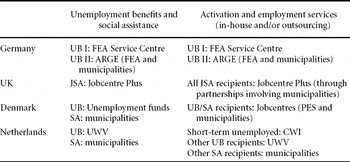
Summarising our discussion of operational policy reforms, the administrative structure for the provision of income and activation to unemployed people in the four countries appear as shown in Table 1 (2008).
Administrative structure for income provision and activation in four EU countries, 2008.

Notes: Abbreviations: UB = unemployment benefits; SA = social assistance; FEA = Federal Employment Agency. Other abbreviations are explained in the text.
When we compare the reforms discussed in the former section, we find common trends as well as differences in the ways in which the four countries have reorganised the organisational arena for the delivery of income protection schemes and activation services for the unemployed.
First of all, all countries have created local one-stop agencies: Jobcentre Plus in the UK, Job Centres in Germany and Denmark, the Centres for Work and Income in the Netherlands. The status and responsibilities of these agencies differ, however, and with this the actual degree and nature of service integration. In some cases, the agencies integrate income protection and activation; in others, they integrate service provision for the insured and uninsured unemployed. Since the introduction of Jobcentre Plus, the UK has one agency responsible for the activation and income protection of all unemployed, realising the highest level of integration among the four countries discussed in this article. In Germany, the Hartz reforms created a situation in which income protection and activation have been integrated through separate agencies for the short-term (unemployment benefit I recipients) and long-term (unemployment benefit II recipients) unemployed. In Denmark, Job Centres are mainly focused on activation, not on income protection, which remains the responsibility of the Insurance Funds and municipalities. The provision of activation services for all unemployed is co-located in the Job Centres, but the Centres are divided into two sections, one for the insured under responsibility of the state, and one for the non-insured under responsibility of the municipalities. A higher degree of integration of activation for all unemployed is achieved in the Danish pilot municipalities. The Dutch CWI has no responsibilities in benefit or social assistance administration (apart from collecting information), and only a limited task in activation. The activation of people who are unemployed for more than six months is the responsibility of the agency from which they receive income support (UWV or municipalities). Service integration mainly concerns the gate-keeper function of social insurance and social assistance.
Secondly, all countries introduced decentralisation, specifically in the area of activation, in order to promote service provision tailored to local and individual circumstances. Various forms of decentralisation can be distinguished: firstly, increased room for regional and local offices of national agencies in implementing activation programmes; secondly, the devolution of policy authority to municipalities, for example in the context of social assistance schemes; and, thirdly, the promotion of local partnerships in the provision of services for the unemployed. In this context, it should be noted that the role of municipalities in the four countries is different. Danish and Dutch municipalities are responsible for the income protection of the non-insured unemployed, and play a leading role in funding and organising (which does not necessarily imply providing) activation as well as additional social services for social assistance recipients. British municipalities are responsible for additional income support only; in addition, they have a role in providing social services. In the UK, municipalities participate in local partnerships and supply services, but the leading role lies with Jobcentre Plus. In Germany, municipalities share responsibility for the activation and income protection of the long-term unemployed with the Federal Employment Agency, with the exception of the 69 experimental municipalities that have full responsibility.
Despite these decentralisation trends, decentralisation is not a straightforward and unambiguous process. In fact, centralisation trends are visible in all countries as well. For example, the introduction of new public management instruments such as budgeting systems or performance contracts between government and public agencies, as well as processes of de-corporatisation, can be interpreted as a way of strengthening national government control over local policy making and implementation, thus affecting the freedom of regional or local actors to act (Newman, Reference Newman2007; Bonvin, Reference Bonvin2008). This is, for example, very clear in the Dutch context, where social assistance reforms increased local policy autonomy. However, the budgeting system has a clear impact on how policy autonomy is used, namely to develop programmes aimed at minimising numbers of social assistance recipients.
A third common trend in the four countries is the introduction of out-sourcing and quasi-markets in the provision of activation services. The UK started this process well before the introduction of Jobcentre Plus, contracting a variety of public and private actors. In the other countries, quasi-markets for activation services are a more recent phenomenon, and the reforms discussed in this article are intended to strengthen the role of markets in service provision. The Dutch SUWI reforms represented the most radical form of marketisation, as they obliged the benefit agency and the municipalities to contract private companies for the provision of most activation services. In the other countries, mixed service provision models exist: part of the services are produced in-house, part are contracted. Furthermore, whereas Dutch marketisation mainly involved private for-profit providers, the other countries contract a more diversified set of providers, including trade unions, voluntary and third sector organisations.
As was the case with decentralisation, marketisation is not a straightforward process. As we saw, recent developments have weakened the marketised character of the activation of Dutch social assistance recipients, as municipalities are now free to decide whether they want to make use of private providers or not. For Denmark, Bredgaard and Larsen (Reference Bredgaard and Larsen2008) concluded that a process of deregulation through marketisation was followed by a process of reregulation to correct what were considered to be ‘market failures’.
A fourth common trend in all countries is a decrease in the involvement of social partners in policy making or policy implementation: for example, in the administration of social insurance and employment services. The UK – where the role of social partners was far less extensive than in the continental countries – excluded the trade unions from the management of employment services as early as the 1980s; social partners were not involved in the administration of unemployment benefits, unlike in the other countries. In those countries, social partners were confronted with a considerable loss of influence, especially in Germany and the Netherlands. In both countries, social partners were blamed for ‘misusing’ social security as a labour-market exit strategy, and for impeding reforms aimed at making welfare states more activating. In Denmark, the decrease in the influence of social partners concerned labour-market policies only: trade unions still play an important role in the insurance funds, although this role is currently under pressure.1
Finally, new public management is now a core characteristic of the ways in which national agencies in the four countries are managed. They were de-coupled from the Ministries and are now steered through contracts with the Ministries that define the targets and performance levels that the agencies are expected to realise. In many cases, contractualism also regulates relationships between national and regional or local agency offices. Decreasing the role of social partners also seems to have contributed to a more managerial style of governing activation and income protection.
Active welfare states and the need for operational policy reforms
As was argued in the introduction, the reforms analysed and compared in the former two sections were, at least partly, triggered by the efforts to make welfare states more activating and to adjust policy programmes accordingly. Firstly, many national governments experienced that official policy reforms aimed at activating the welfare state did not automatically produce new practices at implementation level. For a variety of reasons, the organisations involved in policy implementation did not do what was expected from them in the context of active welfare states: for example, to reduce welfare dependency, to treat unemployed people in new ways, to promote their employability and labour-market participation and to make income provision conditional upon participation in activation programmes. This was one of the reasons for curtailing the influence of social partners in the governance and management of benefit and public employment services agencies; this way, national governments hoped to strengthen their control over policy implementation and to restore the ‘primacy of politics’. This does not imply that social partnership has always been considered incompatible with active welfare state reforms; in the 1990s, Danish and Dutch governments strengthened the role of social partners in the provision of activation and employment policies, as their involvement was considered crucial in making these policies successful. The introduction of new public management instruments is another strategy national governments use to safeguard the actual implementation of active welfare state reforms. Incentive mechanisms should encourage public agencies to reduce benefit dependency and promote labour-market participation and, thus, to contribute to national government's policy objectives.
Secondly, the shift from income protection to activation as the core objective of policy interventions targeted at unemployed people implies that the agencies involved in the provision of services for the unemployed have to change their ‘core business’ and introduce new technologies for social interventions. Whereas providing income protection services requires ‘“people-sustaining” activities, that are designed to maintain the well-being of clients without attempting to change their personal attributes’, activation calls for ‘“people-changing” or transforming services that are designed to alter the personal attributes, motivation, and behaviours of clients’ (Meyers et al., Reference Meyers, Glaser and Mac Donald1998: 9). One of the governance issues arising in this context concerns the management of street-level discretion, which is considered required to make activation successful: traditional rule-oriented modes of implementation aimed at reducing or eliminating discretion are inadequate or at least insufficient given the individualised nature of activation processes (Van Berkel and Valkenburg, Reference Van Berkel and Valkenburg2007; Jewell, Reference Jewell2007). Although bureaucratic modes of regulation have been introduced in activation to control discretion (for example, by developing precise rules regarding what activation offers should be made to what categories of unemployed people and by introducing profiling procedures), alternative strategies to deal with discretion have been developed as well. Brodkin (Reference Brodkin2007) discussed two alternative strategies, which are also used in the countries discussed here: firstly, the introduction of new public management instruments such as management by objectives and performance measurement; and, secondly, the marketisation of service provision, which in a way exports the problem of (controlling) discretion. As the literature on marketisation (for example, Bredgaard and Larsen, Reference Bredgaard and Larsen2008) and new public management (for example, Bonvin and Moachon, Reference Bonvin and Moachon2007) shows, however, these strategies may produce new ‘implementation hazards’.
Thirdly, even though the process of activating welfare states takes different shapes in different countries (Dingeldey, Reference Dingeldey2007), a stronger integration of income protection and activation programmes and an increased conditionality of entitlements to income support seem to be universal trends in active welfare state reforms. In terms of operational policy reforms, this is seen as requiring more cooperation between, and coordination of, the activities of the agencies responsible for income protection and activation programmes (Lindsay and McQuaid, Reference Lindsay and McQuaid2008). One-stop shop agencies are clear examples of how cooperation and coordination are being promoted, even though the actual degree of service integration differs significantly from country to country. A core issue in this context, especially in the continental countries, is how to coordinate the responsibilities and tasks of national and municipal organisations. Denmark and Germany are interesting cases in this respect. Both countries have created agencies where services of national and local agencies are co-located, but at the same time started experiments where traditional national responsibilities were devolved to local agencies.
Fourthly, the issues of service coordination and integration and the involvement of local actors become even more urgent where the activation of the long-term unemployed is concerned. Many countries have experienced difficulties in activating these groups of unemployed who dropped out of, or were excluded from, activation. Decreasing strict dividing lines between activation services aimed at the short-term and long-term unemployed is one of the reforms that took place. Marketisation was expected to contribute to a reduction of creaming processes as well, but turned out not to be a panacea for the exclusion of the long-term unemployed from activation (Van Berkel and Van der Aa, Reference Van Berkel and Van der Aa2005). One of the conclusions drawn from the unsuccessful experiences with activating long-term unemployed people has been that social services beyond activation are required to make their activation successful: for example, services in the areas of housing, child care, family support, health, debts or addiction problems. Often, these services are provided by municipalities or other local agents. Against this background, the development of local social services networks and other forms of network governance – such as the local partnerships in the UK and the ARGE in Germany – are considered of major importance (cf. Genova, Reference Genova2008; Bifulco et al., Reference Bifulco, Bricocoli and Monteleone2008).
Conclusions
In this article, operational policy reforms in the areas of income protection and activation of unemployed people were discussed. It was argued that one of the pressures that triggered these reforms concerns the problems arising in the practical realisation and implementation of the objectives that active welfare state reforms want to accomplish: the activation of unemployed people which is seen as requiring individualised people changing interventions; the inclusion of more and more groups of unemployed people in activation; the conditionality of income support and its underlying emphasis on unemployed people's individual responsibilities. The article revealed that several common reform trends can be identified. In terms of Considine's typology of governance models, procedural governance has lost its dominant position; but, contrary to the expectations of those who predicted the end of the old public administration, procedures and regulations remain of importance. At the same time, elements of ‘new’ governance models have been introduced. Firstly, as far as corporate governance is concerned, many public agencies involved in delivering social services are now expected to operate in a more business-like manner. Secondly, for market governance, all countries are contracting other actors (to use the Danish expression) to provide activation services. Thirdly, elements of network governance have been introduced. Whereas Considine's first sub-model of network governance (social partnership) has been eroded, especially in the continental countries, his second sub-model is gaining importance, as is exemplified by the aim of operational policy reforms to strengthen inter-agency cooperation and coordination and to promote local partnerships and strategic cooperation between local actors. Summarising, we may conclude that all countries now have hybrid governance models in the administration of social security and the provision of activation services.
However, the reforms are not only characterised by similarities; significant differences exist as well. For example, some countries have opted for a more radical marketisation strategy than others, and the providers are different in the countries as well. This may reflect different political preferences, as well as different histories of involving third parties in service provision. In addition, even though countries may be confronted with similar problems in making the welfare state more active, they do so in specific national contexts, which may give rise to specific national challenges and demand specific national solutions. For example, the continental social assistance schemes raise governance issues concerning the coordination of national and local responsibilities that are far less urgent in the UK social security system; and the traditional integration of income protection and activation of the insured unemployed in Germany safeguarded this country from coordination and integration problems that active welfare state reforms raised in countries where benefit administration and activation used to be separated.
Finally, the reforms are characterised by their whimsicality. Even though this article only presented a snapshot of service provision models at a given moment in time, focusing on four specific reform programmes rather than intending to provide a historical account of reform trajectories, the discussion of national developments made clear that reforming operational policies involves processes of decentralisation as well as re-centralisation, deregulation as well as re-regulation, marketisation as well as de-marketisation, decreasing as well as increasing the role of social partners. Of course, one could interpret this whimsicality as an inherent trait of learning processes in search of ‘best practices’. In our view, however, the whimsical nature of operational policy reforms shows that these reforms are not merely a technical issue about ‘what works best’, they are as much subject to conflicting values and disputes about prioritising certain values over others as formal policy reforms are.
In the introduction, it was mentioned that operational policy reforms may not be without consequences for substantial characteristics of activation programmes. Although these consequences were not studied in this article, we came across several examples: new public management may strengthen an emphasis in activation on short-term labour-market integration; marketisation may strengthen rather than weaken creaming processes. Further research is necessary to study the (unintended or intended) impact of operational policy reforms on the content of activation services.