INTRODUCTION
An expert panel of the National Comprehensive Cancer Network (NCCN) has defined cancer-related distress as:
an unpleasant emotional experience of a psychological…, social, and/or spiritual nature that may interfere with the ability to cope effectively with cancer… Distress extends along a continuum, ranging from common normal feelings…to problems that can become disabling, such as depression… (National Comprehensive Cancer Network, 2003).
Up to 43% of patients in treatment for cancer have been reported to experience distress beyond common normal feelings (Von Essen et al., Reference Von Essen, Larsson, Oberg and Sjoden2002). In a recent study of 1,281 patients in treatment in a community-based oncology practice, 410 patients (32%) reported clinically significant distress (Kendall et al., Reference Kendall, Glaze, Oakland, Hansen and Parry2011).
This clinically significant distress often involves depression. In a landmark study by Derogatis and colleagues, 47% of patients with cancer presented with a psychiatric disorder. Of these, 68% had depressed mood (Derogatis et al., Reference Derogatis, Morrow, Fetting, Penman, Piasetsky, Schmale and Carnicke1983). In another study, 58% of patients with advanced cancer were depressed (Teunissen et al., Reference Teunissen, de Graeff, Voest and de Haes2007). The depression of patients with advanced cancer has been associated with a host of physical symptoms, but also with worse overall well-being (Delgado-Guay, Parsons, Li, Palmer, & Bruera, Reference Delgado-Guay, Parsons, Li, Palmer and Bruera2009).
The distress of newly diagnosed patients' arises more from emotional than physical sources (Schneider, Reference Schneider, Kellogg and Peterson Sullivan1978). This coheres with Worden and Weisman's description of the pivotal period of diagnosis as a time when existential concerns are paramount for patients (Worden & Weisman, Reference Worden and Weisman1980). Because of the prevalence of depression among patients with advanced cancer, and because depression is associated with physical symptoms and worse overall well-being, newly diagnosed patients need to be screened for distress that arises from depression.
In this study of baseline data collected from patients within 100 days of diagnosis of advanced cancer, we asked whether the Distress Thermometer (DT) (Roth et al., Reference Roth, Kornblith, Batel-Copel, Peabody, Scher and Holland1998) can be used as a rapid screening instrument to screen in possible cases of depression and whether the DT's screening properties could be improved by the DT's 6-item Emotional Problem List (17). This study aimed 1) to describe the sample, including cases of depression among the sample, 2) to determine the optimal cut-off score on the single-item DT for detecting possible cases of depression; 3) to examine the agreement and the relation of the single-item DT at the identified optimal cut-off score with the Physician Health Questionnaire-2 (PHQ-2) as a rapid screen for detecting possible of depression (Arroll et al., Reference Arroll, Goodyear-Smith, Crengle, Gunn, Kerse, Fishman and Hatcher2010); and 4) to identify associations between the DT Emotional Problem List items and possible of depression. The Patient Health Questionnaire-9 (PHQ-9) was selected as the criterion measure as it can generate a diagnosis of depression (Kroenke et al., Reference Kroenke, Spitzer and Williams2001).
METHODS
Design
This cross-sectional secondary analysis is based on baseline data collected within thirty days of diagnosis from patients with advanced cancer participating in the translational TEAMS Study conducted at at Smilow Cancer Hospital at Yale-New Haven, New Haven, CT. The TEAMS Study is a longitudinal randomized trial to test a nursing intervention to improve patient outcomes, including depressive symptoms.
Participants
One hundred twenty-three patients were recruited from the gastrointestinal (GI), gynecological, head-and-neck, and lung disease-specific oncology clinics. Criteria for entry of patients into the study included: 1) within 30 days of a definitive primary diagnosis of Stage 3 or 4 GI (including pancreatic and esophageal), gynecological, head-and-neck, or lung cancers; 2) post-surgical (including biopsies) with a physician's order for ongoing oncologic treatment; 3) life expectancy of at least six months as confirmed by a medical oncologist; 4) age of 21 years or older; and 5) living within the State of Connecticut. The Yale School of Medicine Human Investigation Committee approved the current study. Informed consent was obtained from all patients and study identification numbers were used in place of names or personal identifying data to protect their rights.
Measures
Patient History and Clinical Treatment Form. An investigator developed form used to obtain data related to sociodemographic, health history, insurance, cancer treatment, and clinical information was administered at baseline. Non-participants were asked their reason for non-participation.
Distress was measured by the DT which asks patients to indicate their level of distress on a scale of 0 to 10. The patient was asked “How would you rate your distress in the past week including today, on a scale of 0 to 10?” (Roth et al., Reference Roth, Kornblith, Batel-Copel, Peabody, Scher and Holland1998). Along with the scale to quantify the level of distress, the patient was asked to identify the types of issues causing the patient's emotional distress by placing a check mark next to each item of the 6-item Emotional Problem List: 1. Depression; 2. Fears; 3. Nervousness; 4. Sadness; 5. Worry; 6. Loss of interest in usual activities.
Depression was measured with the 9-item PHQ-9. The PHQ-9 can generate a diagnosis of depression, as well as a continuous score to monitor treatment. On the PHQ-9 patients indicate the frequency with which they have been bothered by 9 problems in the past two weeks: 0 (not at all), 1 (several days), 2 (more than half the days), and 3 (nearly all the time). Scores of 5, 10, 15, and 20 represent mild, moderate, moderately severe, and severe depression (maximum score = 27) (Kroenke et al., Reference Kroenke, Spitzer and Williams2001). The first two questions of the PHQ-9, the PHQ-2 has been shown to have good sensitivity for identifying cases of depression at a score of ≥2 (range 0–6) (Arroll et al., Reference Arroll, Goodyear-Smith, Crengle, Gunn, Kerse, Fishman and Hatcher2010).
Analysis
Specific Aim 1. We described the sample using frequencies and measures of central tendency.
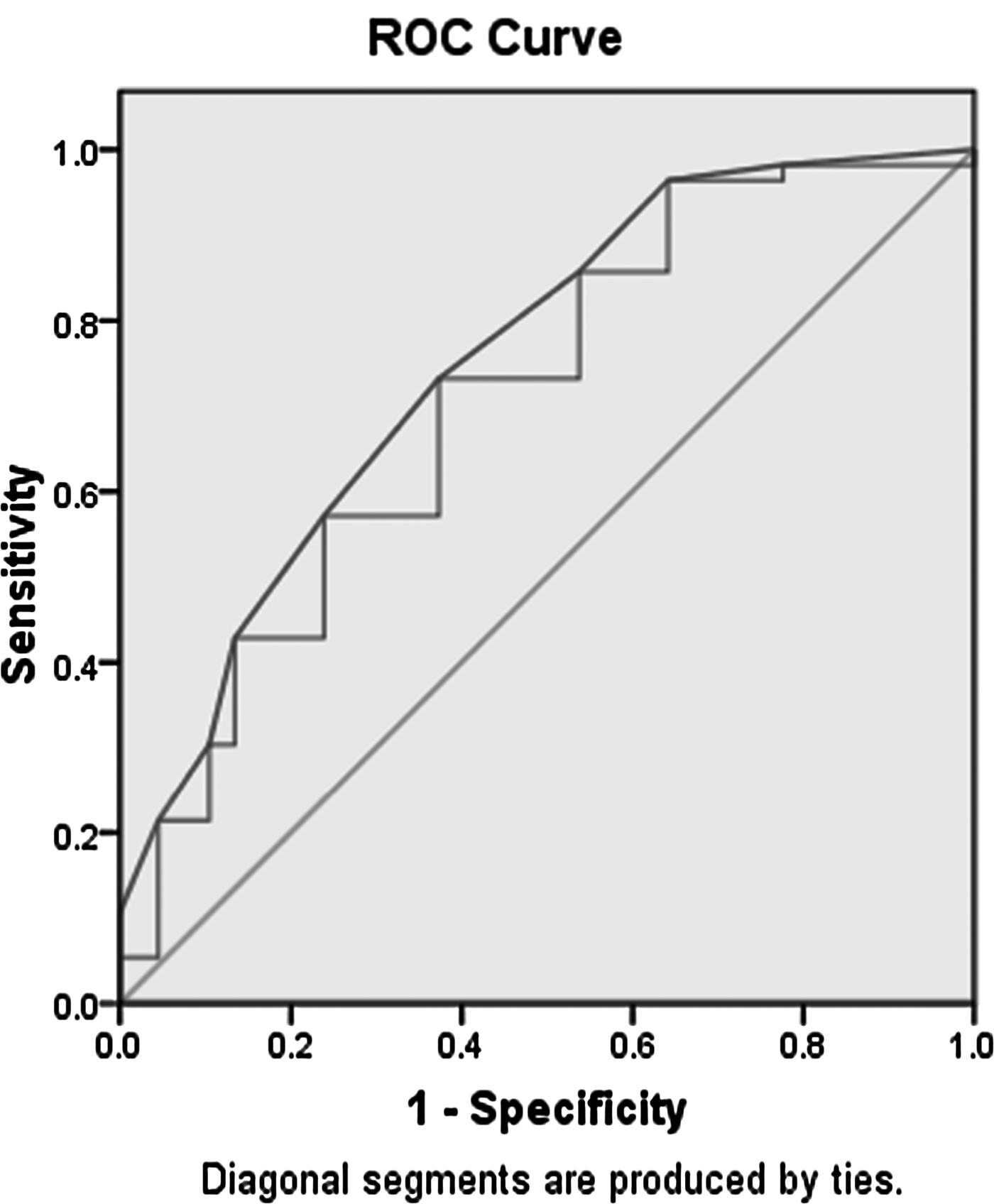
Specific Aim 2. The sensitivity and specificity of the DT with the PHQ-9 score ≥5 as the criterion was calculated for each DT level. We chose PHQ-9 ≥5 in order to rule in as many cases of depression (from mild to severe) as possible, as our concern is the use of the DT as a screening instrument, not a diagnostic tool. Sensitivity refers to the proportion of cases identified by the PHQ-9 that were correctly identified by the DT; specificity refers to the proportion of non-cases as identified by the PHQ-9 that are correctly identified as non-cases by the DT. The optimal cut-off score was determined by finding the DT value that achieved the best balance between sensitivity and specificity. A receiver operating characteristic (ROC) curve was used to examine the ability of possible cut-off points to detect cases of depression as identified by the PHQ-9 score ≥5. The area under the curve (AUC) estimate was used as an indicator of the overall accuracy of the DT to identify cases of depression.
Specific Aim 3. To analyze the relation of DT ≥2 and PHQ-2 ≥2 with the PHQ-9 ≥5, the sensitivities of both were determined. Cohen's κ coefficient and correlation coefficients were used to examine agreement of the DT ≥2 with the PHQ-2 ≥2 to screen in cases of depression.
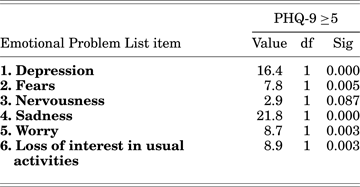
Specific Aim 4. Chi-square was used to examine possible associations between the 6-item DT Emotional Problem List and cases of depression as measured by the total score of the PHQ-9. A log-linear model with stepwise entry, allowing those items with greater significance on bivariate analysis to enter first, was used to calculate association (Behrens et al., Reference Behrens, Taeger, Wellmann and Keil2004).
All analyses were conducted on SPSS version 20 (www-01.ibm.com/software/analytics/spss/).
RESULTS
Sample Characteristics
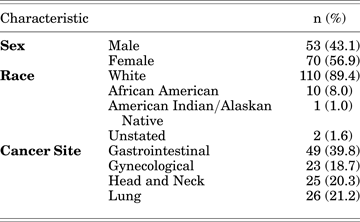
A total of 123 patients within 30 days of diagnosis with advanced cancer participated in the study. The average age of participants was 59.9 (SD = 12.9; range = 27.9 – 86.8) years. Sample characteristics are in Table 1.
Sample characteristics.

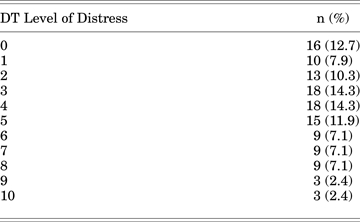
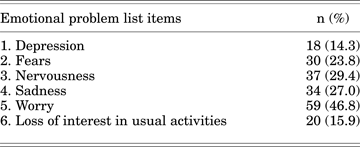
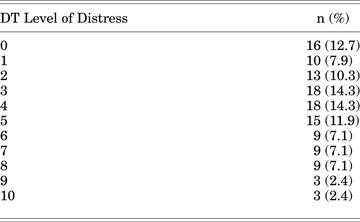
The mean score on the DT was 3.9 (SD = 2.7; range = 0 – 10). The frequencies of levels of distress reported by participants on the DT and the relative frequencies of the Emotional Problem List items as checked by participants being a source of their emotional distress are in Tables 2 and 3, respectively.
Frequencies of DT level of distress (N = 123)
Frequencies of emotional problem list item being checked as source of emotional distress by participant.
Fifty-six (45%) of participants were identified as depressed by a score on the PHQ-9 ≥5.
Optimal Cut-Off Score of the DT for Identifying Possible Cases of Depression
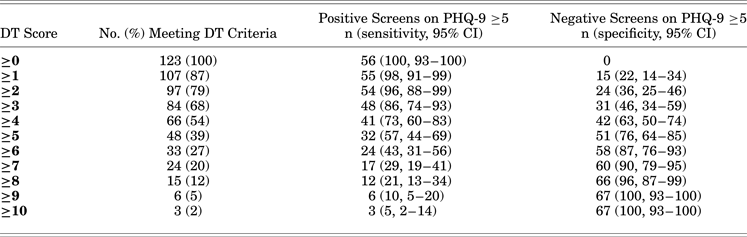
The sensitivity and specificity for all levels of distress of the DT with the PHQ-9 ≥5 are in Table 4.
Performance of DT scale by levels of distress compared to PHQ-9 total score ≥5 for indentifying cases of depression (N = 123).
The ROC curve comparing the DT to the PHQ-9 ≥5 (Fig. 1) showed an AUC of 0.752 (standard error of 0.043; 95% CI = 0.667-0.836; p = 0.000).
ROC curve of DT scores with PHQ-9 (score ≥5) as Gold Standard.
A DT cut-off score of ≥2 correctly identified 96% of cases of depression (sensitivity) and 36% of non-cases (specificity), which, as a screening tool, reflects our priority to sensitivity over specificity for a screening measure. Hence, for the remainder of the analysis, DT ≥2 has been used as the optimal cut-off score.
Relation and Agreement of the DT ≥2 and PHQ-2 ≥2 with the PHQ-9 ≥5
The DT ≥2 screened in 54 (96%) of the cases of depression identified by the PHQ-9 ≥5, while the PHQ-2 ≥2 screened in 18 (32%). The DT ≥2 did not screen in one of the 18 cases screened in by the PHQ-2 ≥2. However, the PHQ-2 ≥2 did not screen in 37 cases of depression screened in by the DT ≥2. Cohen's κ for the DT ≥2 was 0.304 (standard error = 0.064; p = 0.000); Cohen's κ for the PHQ-2 ≥2 was −0.221 (standard error = 0.086; p = 0.013). The correlation coefficients for the DT ≥2 and the PHQ-2 ≥2 with the PHQ-9 ≥5 were 0.393 and −0.246, respectively; the mean of the correlations was 0.074.
Association between the PHQ-9 ≥5 and the 6-Item Emotional Problem List
Results of bivariate analysis to determine whether any of the 6 items of the Emotional Problem List were associated with depression are in Table 5.
Chi-square between presence of depression as measured by the PHQ-9 ≥5 and a positive response to a DT Emotional Problem List item.
On multivariate analysis, only Emotional Problem List item 1 Depression (OR = 0.146; 95% CI 0.025, 0.850; p = 0.032) and item 4 Sadness (OR = 0.206; 95% CI 0.059, 0.720; p = 0.013) were associated with PHQ-9 ≥ 5.
DISCUSSION
In this cross-sectional analysis of baseline data from a parent study of 123 patients with newly diagnosed advanced cancer, we sought to describe the numbers of patients who, within 30 days of their diagnosis of cancer, presented with depression as measured by the PHQ-9 ≥5. Fifty-six (46%) patients had measurable depression. This is higher than the some estimates—18.7% (Mitchell et al., Reference Mitchell, Chan, Bhatti, Halton, Grassi, Johansen and Meader2011; Zabora et al., Reference Zabora, BrintzenhofeSzoc, Curbow, Hooker and Piantadosi2001), 16% (Mitchell et al., Reference Mitchell, Chan, Bhatti, Halton, Grassi, Johansen and Meader2011), and 12% (Kendall et al., Reference Kendall, Glaze, Oakland, Hansen and Parry2011)—but on a par with others (Derogatis et al., Reference Derogatis, Morrow, Fetting, Penman, Piasetsky, Schmale and Carnicke1983; Teunissen et al., Reference Teunissen, de Graeff, Voest and de Haes2007).
We also sought to determine the overall accuracy of the DT in capturing depressed patients and the optimal cut-off score of the DT to screen in possible cases of depression. With an AUC of 0.752, the DT shows good accuracy overall. With 96% sensitivity, the DT score of ≥2 was the optimal cut-off score for a rapid screening instrument, not ≥4 as has been recommended (Jacobsen et al., Reference Jacobsen, Donovan, Trask, Fleishman, Zabora, Baker and Holland2005; National Comprehensive Cancer Network, 2003; Roth et al., Reference Roth, Kornblith, Batel-Copel, Peabody, Scher and Holland1998). Our findings cohere with the recent study by Boyes and associates (Boyes et al., Reference Boyes, D'Este, Carey, Lecathelinais and Girgis2013).
We also compared the DT ≥2 with the PHQ-2 ≥2 as a screening instrument. The DT ≥2 screened all but two of the cases of depression, while the PHQ-2 ≥2 missed 39 cases. The DT ≥2 showed greater agreement with the PHQ-9 ≥5 than did the PHQ-2 ≥2, thus strengthening the case for the DT ≥2 as a screening instrument for depression. When the DT ≥2 is combined with Emotional Problem List items 1 and 4, which we found to be associated with depression, the case for the DT being used as a screening instrument over the PHQ-2 is strengthened.
The American College of Surgeons Commission on Cancer described a process we call the comprehensive distress screening process. Comprehensive distress screening, first, involves a rapid screen of patients for distress at pivotal moments along the cancer care continuum, including at the time of diagnosis (American College of Surgeons, 2012). A rapid and sensitive instrument is necessary for such screening. When choosing which rapid screening instrument to use in clinical practice sensitivity ought to be preferred over specificity, for as few cases as possible should be missed. Our findings suggest that the DT is a more sensitive screen than the PHQ-2 ≥2 and can be used at the time of diagnosis, with near 100% sensitivity, to identify patients who may be depressed.
If patients endorse distress at a level of ≥2 on the DT, they will need further evaluation, the second step in the comprehensive distress screening process. If patients also endorse either items 1 or 4 on the Emotional Problem List—at whatever level of distress—we suggest they be moved up higher in the order of priority for further evaluation. This evaluative step might use a fuller assessment instrument, such as the PHQ-9 in toto; but whatever evaluation used, the evaluative step is to refer patients with clinically significant emotional distress to psychosocial health care providers—the third step in the comprehensive distress screening process.
The importance of this comprehensive distress screening process is that, if patients are found to have depression, there are effective treatments. A recent meta-analysis showed that psychological and pharmacologic interventions were more effective than control conditions in improving depressive symptoms among patients with cancer (Hart et al., Reference Hart, Hoyt, Diefenbach, Anderson, Kilbourn, Craft and Stanton2012).
Our study is limited by a small sample size and by its cross-sectional nature, representing only one data collection point, baseline, in a longitudinal randomized trial to test a nursing intervention to improve patient outcomes, including symptoms such as depression. Although our sample was homogeneous, representing people with newly diagnosed advanced cancer, there were different types of cancers included. Patients with late stage lung cancer were treated very differently from late stage ovarian cancer or pancreatic cancer. In addition, ethnic representation among the sample was low. Finally, participants in our study are in the existential crisis Worden and Weisman described over 30 year ago (Worden & Weisman, Reference Worden and Weisman1980; Reference Worden and Weisman1984). While this is the same existential crisis as all patients who have been newly diagnosed with cancer, the crisis of our participants may be more severe with the knowledge of an incurable cancer diagnosis.
CONCLUSION
The DT did well in discriminating cases of depression as identified by the PHQ-9 ≥5 at the time of diagnosis among patients with advanced cancer. Our results suggest that the optimal DT threshold for identifying possible cases of depression is ≥2, and that this threshold is more sensitive than the PHQ-2 ≥2. The DT ≥2 may best be used to rule in possible cases of depression than to rule out, and thus, its use should be as a rapid screening instrument to identify patients in need of further evaluation as part of a comprehensive distress screening process. The screener may use DT Emotional Problem List items 1 and 4 along with the DT score to triage patients for evaluation and referral to a psychosocial health care professional.
ACKNOWLEDGMENTS
Ruth McCorkle, Mei Bai, and Elizabeth Ercolano are supported by the NIH/NINR grant R01NR011872, McCorkle (PI). The authors have no financial or personal relationships that might bias the work to disclose.