Gender hierarchy has been a crucial component of Indian society since ancient times. A famous verse in The Laws of Manu (5.148), written about 2,000 years ago by Brahman lawgivers, declares that: ‘In childhood a woman should be under her father's control, in youth under her husband's, and when her husband is dead, under her sons’. She should not have independence.’Footnote 1Manu, of course, is normative prescription, not sociological description, but the inferiority and subordination of women within the family and beyond it have long been key features of hierarchical society and culture among Hindus (and other communities) in India; in many contexts, they still are. In general, though, gender inequality was, and is, more pronounced among high castes. Hence the conduct of daughters, wives, mothers, and widows is most severely constrained by purity and pollution rules, seclusion practices, moral rigidity, and obsessive control of female sexuality among Brahmans and other high-ranking castes. Low-caste women, by contrast, are more relaxed about purity, commonly work outside the home so they cannot be secluded, are less influenced by Brahmanical norms, and are often less subject to male authority, although these features themselves contribute to the low status of their families and communities.
Carol Mukhopadhyay and Susan Seymour examine the interconnection between caste and gender hierarchies by identifying a distinctive ‘patrifocal family structure and ideology’ made up of a series of linked features: notably, emphasis on the family's importance as opposed to the individual's; patrilineal descent and inheritance; gender-differentiated roles and responsibilities; male authority; strong control of female sexuality and reproduction; arranged marriage, especially for girls at a young age; and an ideological stress on female chastity, obedience, modesty, and allied virtues. Mukhopadhyay and Seymour also discuss the variable impact of modern female education on this patrifocal complex. They specifically note that ‘ironically. . . elite, upper-status women’ from the ‘most prototypically patrifocal’ groups ‘have achieved the most educationally and. . . appear to be challenging traditional patrifocal structures and ideology’, although they also ask whether this apparent challenge will merely modify the old complex, rather than undermine it.Footnote 2
The Tamil Brahmans: introductory remarks
In the Conclusion to this paper, we shall return to Mukhopadhyay and Seymour's question because it is highly pertinent to the case of Tamil Brahmans, traditionally the highest-status caste in Tamilnadu, South India. Brahmans, mostly Tamil-speaking, make up no more than 2.5 per cent of Tamilnadu's population. Since the nineteenth century, Brahmans have migrated in large numbers from villages to towns and cities, as they have entered new fields of modern, professional employment, from administration and law to engineering and information technology (IT). Many Brahmans have also moved from Tamilnadu to other parts of India and, in recent decades, to foreign countries. By the end of the twentieth century, an old elite of Brahman landlords had been transformed into a predominantly urban, middle-class group with a significant presence across India and overseas.Footnote 3
A hundred years ago, gender hierarchy was extreme among Tamil Brahmans and markedly more so than among non-Brahman groups in the region. A diacritical aspect of this hierarchy was pre-puberty marriage for girls, which in Tamilnadu was largely confined to Brahmans. Brahman girls received little or no education at that time. This was the position not only in old-fashioned rural families, but also in those headed by the educated, English-speaking, professional men who formed the new urban middle class of colonial Madras. As Nita Kumar comments, members of this ‘new intelligentsia’ were usually as conservative as their fathers, who ‘typically honoured caste and sectarian rules, practised gender and age hierarchies, and believed in child marriage’.Footnote 4 Thus Tamil Brahman girls—including the daughters of even high-ranking administrators and lawyers in Madras city—were normally married before puberty and mostly received only minimal education.
By the mid-twentieth century, child marriage had largely ended and the standard of girls’ education was improving, so that more and more of them, like their brothers, completed their schooling and even went to college. By then, too, the Tamil Brahmans were clearly becoming a predominantly urban, middle-class caste. By the end of the twentieth century, Brahman girls’ educational standards more or less matched that of boys’, and are nowadays higher overall than those of non-Brahman girls. Most Brahman girls today—like other middle-class girls in India—marry in their twenties after finishing their education. Many Brahman women are also employed outside the home, which was previously uncommon. In relation to marriage and education in particular, therefore, the position of Tamil Brahman women has greatly improved during the last hundred years or so. That improvement is regarded today, at least by Brahmans themselves, as one sign of their collective status as a modern, educated, professional, middle-class elite, whereas previously conformity to Manu's norms was indicative of their traditional, high-caste status.
In tracing the modern history of Tamil Brahman women, the end of pre-puberty marriage and the associated improvement in female education were crucial developments. Partly because the majority of Tamil Brahmans had given up child marriage by the 1940s, there is no ethnographic material about it. Apart from general survey data, most of the available evidence concerns members of the urban elite. Quite possibly—for example, in newspapers and magazines of the kind studied by Mytheli SreenivasFootnote 5—there might be evidence about ordinary Brahmans and their attitudes to child marriage and girls’ education, but as yet it has not been uncovered by historians. However, in one Tamil Brahman subcaste—the Eighteen-Village Vattimas— child marriage continued until the 1970s, so that many older Vattima women can talk about the custom from personal experience. The Vattimas, among whom we have conducted fieldwork, have been unusually conservative in several respects, not only in relation to marriage. Thus Vattima men moved to towns and cities for education and employment later than other Brahmans of comparable economic standing, and Vattima landlords tended to stay in their villages until the 1960s or 1970s, two or three decades longer than many other Brahman landlords.Footnote 6 The Eighteen-Village Vattimas are also a fairly small subcaste with a very high rate of endogamous marriage, so that its members are linked by dense kinship networks that tend to encourage social conformity.Footnote 7
The ethnographic data in this paper mainly concern the Vattimas, but we discuss them against the historical background of Tamil Brahmans collectively. We also look at how the difference between Vattima women and other Brahman women has practically disappeared in very recent times. Simply generalizing from the Vattimas to the rest of their caste would obviously be unwarranted; nonetheless, our data show in some detail how marriage, education, and employment for women were and are interconnected in a particular subcaste and, extrapolated carefully, they also help to clarify change among Tamil Brahmans as a whole.
Child marriage and social reform
According to Brahmanical tradition, marriage is a kanyadana—a ‘gift of a virgin’ who is ritually pure—and parents failing to marry their daughters before the onset of ‘polluting’ menstruation commit a grave sin. On this matter, scriptural authorities were never entirely unanimous, but pre-puberty marriage for Brahman girls became widespread from the sixth or seventh centuries.Footnote 8 In Tamilnadu, unlike many other regions of India, pre-puberty marriage was mainly confined to Brahmans. A girl went to live with her husband and the marriage was consummated after she came of age.
In the late nineteenth century, social reformers throughout India began to campaign against child marriage. In 1891, the Age of Consent Act became law in British India and raised the age of consent for sexual intercourse from 10 to 12 to protect young girls from older husbands (or other men). In the 1920s, the age of consent was reconsidered and the outcome was the Child Marriage Restraint Act, popularly known as the Sarda Act after its principal sponsor. This Act, which was passed in 1929 and came into force in 1930, fixed the minimum age for marriage at 14 for girls and 18 for boys.
In the debates about reform, the primary issue was the health and welfare of girls who became wives when they were very young, and one important consideration was their education or lack of it. Another issue was the harsh fate of child widows, who were not allowed to remarry and were therefore condemned to remain inauspicious celibates for life. Yet there was also a lot of argument over Indian ‘public opinion’, especially about whether ordinary people would accept reform, as well as other questions about, for example, the scriptural veracity of Brahman orthodoxy. Particularly contentious was the question of how reform enacted by a colonial government would affect the honour of the nation and its women.Footnote 9
Prior to the 1920s, nearly all public debate over reform was conducted by men and, as many writers have commented, they were often really arguing about colonialism and nationalism, or tradition and modernity, not about the condition of the women actually living in their country. Controversy over the ‘woman question’, in which marriage and female education were at the forefront, first arose in the mid-nineteenth century, especially in Bengal. Middle-class nationalist reformers—almost all belonging to the upper castes—overwhelmingly favoured improved education for girls, mainly to make them better wives and mothers, but reform was coloured by deep anxiety. As Sanjay Seth puts it: ‘The middle-class and nationalist project was to educate women so that they would become modern and yet able to represent Indianness; the anxiety that was the underside of this project was the fear that Indianness might be effaced by the pursuit of modernity.’Footnote 10 It was vital that Indians, not foreign overlords, should control this project to modernize women, which affected the ‘inner’ spiritual domain of ‘essential’ Indian values, as opposed to the ‘external’ material domain.Footnote 11 Marriage, belonging to the inner domain, was a serious matter for reformers, but they disagreed about it: progressive liberals opposed child marriage, which precluded the emergence of modern educated women, whereas traditionalist conservatives defended the custom as part of true Indian culture and a guarantor of female purity and virtue.
In the Madras Presidency (which incorporated modern Tamilnadu), all the issues about child marriage reform were debated at one time or another. Argument about the age of consent in the late nineteenth century was less vociferous than in Bengal. It was also mainly confined to Brahmans, but it quickly polarized opinion within Madras's elite, most of them Brahman educated professionals. A few men supported reform, but others vehemently opposed it, and yet others either remained silent or expressed reservations about using legislation to reform child marriage. The controversy in Madras sharpened the division between progressives and traditionalists within the nationalist movement, but specifically, too, it dispelled the popular myth that the majority of ‘the Western-educated class were allies in the cause of social reform’.Footnote 12 Tamil Brahmans in particular mostly opposed measures that might undermine their caste superiority within South Indian society, for, as Charles Heimsath observed, ‘social innovation by Madras Brahmins. . . could mean the extinction of the privileges which separated them, and their entire families, from the benighted lower orders’.Footnote 13 Moreover, in M. S. S. Pandian's words, the Tamil Brahman elite ‘claimed Brahminical culture as the essence of the nation’, while also dominating the material domain through their power in the colonial system.Footnote 14 Hence Chatterjee's inner-outer dichotomy was significantly modified in Madras by the opposition among Brahmans and non-Brahmans, which steadily strengthened during the twentieth century.Footnote 15
The debate about the age of consent and child marriage in advance of the Sarda Act occurred in a different political climate from earlier debates. In her examination of the Act and its accompanying controversy, Mrinalini Sinha argues that the most significant novel feature was probably ‘the mobilization of a collective identity for and by women in the public realm’. Female voices were heard, as they had not been earlier, and women campaigning for reform claimed—more or less convincingly—to represent the views of all women, irrespective of caste or community. By the early twentieth century, too, marriage ‘had become an especially dense site for indigenous reformist public concerns’ and there was widespread nationalist support for modern marriage reform, even if it did interfere with supposedly essential Indian values.Footnote 16 Conservative Hindu hostility to the Sarda Act was strongest in Bengal and Madras;Footnote 17 in Madras, although some liberal Tamil Brahmans supported the Bill, much of the fiercest opposition came from Brahmans, including Congress supporters and nationalists.Footnote 18 Thus, for example, in the Indian Legislative Assembly in 1929, the Sarda Act was most strenuously opposed by two Brahman members from Madras.Footnote 19 The arguments against reform resembled those that had made against the Age of Consent Act, but by the 1920s nationalist politics in Madras had been changed by the non-Brahman Justice Party, which had emerged to oppose the Brahman-dominated Congress. As Sreenivas explains, there was now a non-Brahman, Dravidian nationalist debate about marriage, as well as an Indian nationalist one.Footnote 20 Brahmans did not care how non-Brahmans chose to marry, but the political changes meant that, unlike 40 years earlier, the Tamil Brahman legislators’ ‘rather desperate defense of pre-puberty marriage had lost its claims to nationalist authority’, so that they could not block the Sarda Act.Footnote 21 On paper at least, the new Act prohibited most pre-puberty marriages, so that an ostensibly vital and cherished custom of Tamil Brahmans was eradicated.
Concurrent with the debate about child marriage—and often involving the same Tamil Brahman protagonists—was another about joint-family reform, which also had to do with the position of women. Many educated professionals, both Brahman and non-Brahman, advocated legal reform to permit men to retain individually acquired property and to guarantee the property rights of their conjugal families ahead of their joint families. The new laws, which were enacted in the 1930s, scarcely improved female property rights, however; instead, as Sreenivas and Eleanor Newbigin show, they tended to reinforce women's dependence on fathers and husbands in a modified form of patriarchy.Footnote 22 Thus even reformers opposed to child marriage often supported ‘traditional’ female dependency, as indeed the majority of ordinary Tamil Brahmans of both sexes and all classes most probably did as well.
In any case, by 1929 more Tamil Brahmans probably favoured marriage reform than had been the case a generation earlier and more were concerned with improving the welfare of girls.Footnote 23 Sister Subbalakshmi (1886–1969), the first notable Brahman women reformer in Madras, did much to change attitudes.Footnote 24 Subbalakshmi was married in 1898 when she was 11, and was widowed soon afterwards. Her unconventional parents and widowed aunt decided that Subbalakshmi should resume her education, instead of being secluded as an inauspicious widow, and in 1911 she became one of the first women to graduate from Madras University. After graduating, Subbalakshmi—who never remarried—dedicated herself to helping other young Brahman widows by establishing a home, supported by the government, where they were educated and then trained as teachers. When the government opened a teachers’ training college for women in 1922, Subbalakshmi became its principal and she eventually became a leading educationalist in South India. The welfare of Brahman child widows was therefore not the sole focus of Subbalakshmi's life's work, but it was probably the most important for a former child widow who exemplified the role widows played in pioneering social reform and girls’ education.Footnote 25 Subbalakshmi, though restrained by her official position, also campaigned in support of the Child Marriage Restraint Act.Footnote 26
Subbalakshmi's school for widows did admit a few other girls and its evident success encouraged Brahman parents to think about educating their daughters.Footnote 27 Moreover, as Sita Anantha Raman comments, Subbalakshmi's ‘success in freeing widows like herself from mental torpor was a more powerful argument for liberalism than vociferous debate’.Footnote 28 Ameliorating the lives of widows and improving female education were increasingly seen as closely related issues. As time passed, Subbalakshmi gained the support of other powerful liberals in Madras—mostly men and most (but not all) Brahmans. They also favoured better education for all girls, which would also encourage the postponement of marriage, because girls were normally withdrawn from school after marriage or, at the latest, when they reached menarche. In reality, even in elite circles in Madras where support for girls’ education was most vocal, some of it was probably rhetorical and did little to dispel the social pressure on parents to marry off their daughters before puberty in accordance with ‘respectable’ norms. Thus an elderly Brahman widow told us in 2010 that she was married aged ten, one month before the Sarda Act came into force in 1930. Her father, an engineer, objected to the marriage, but he was overruled by senior relatives, including his own father, who retorted that he (the girl's father) had married his wife, a High Court judge's daughter from one of Madras city's most illustrious families, when she was only eight. The girl (our informant) was then married to a subordinate judge's son, a law student at the time, although her father did flout convention by allowing her to stay at school after the wedding. She came of age at 13 and went to her husband's house a year later.
As soon as it was passed, the Sarda Act's weaknesses were obvious to both supporters and opponents. Its provisions were ‘so toothless. . . as to have little practical effect’ and its first result was actually ‘a drastic spate of child marriages’ immediately before the law came into force.Footnote 29 One of these has just been described, and in Madras there were many more like it in the ‘rush’ to get girls married, as the 1931 census reveals.Footnote 30 On the other hand, it is also noteworthy that even though pre-puberty marriage was the ideal norm among Tamil Brahmans, it was far from universal. The 1911 and 1921 censuses contain data on the civil condition of Tamil Brahmans in Madras and Tanjore districts, and the 1931 census on all Tamil Brahmans in Madras Presidency.Footnote 31 In 1911, 80.0 per cent of girls in the 12–15 age cohort were married or widowed, but in 1921 the proportion had fallen to 60.5 per cent, so that the frequency of child marriage was declining and a large minority of girls reached 14 without being married. By 1931, 84.1 per cent of girls in the 7–13 age cohort, as well as 13.1 per cent in the 14–16 cohort, were recorded as being unmarried. Unfortunately, developments after 1931 cannot be traced, because the relevant data were not provided by subsequent censuses.
Obviously, people may have misled the census enumerators to disguise child marriages; the 1931 figures, following the Sarda Act, look particularly unreliable. Furthermore, statistics on child marriage tell us little about attitudes towards it, although the downward trend after 1911 suggests declining popularity. Yet it is also salient that the majority of post-puberty marriages were almost certainly not occurring in elite progressive families, but in poor families who were unable to pay bountiful dowries and wedding expenses. Sometimes, too, desperate parents would try to pass girls off as pre-pubertal, even though they had started to menstruate. For poor Brahmans especially, post-puberty marriage was usually a misfortune, not a progressive choice.
In truth, though, there is next to no evidence available about ‘public opinion’ concerning child marriage among ordinary Tamil Brahmans in the early twentieth century, notwithstanding the claims made by both sides in the Sarda Act debate.Footnote 32 However, the scanty information we have collected, some of it from elderly Brahman informants, suggests that by the late 1940s child marriage had largely disappeared. Maybe the new law, albeit ineffectual, did have an ‘educational impact’ among Tamil Brahmans.Footnote 33 Or maybe the debate surrounding it changed some conservative minds, affected by growing concern for the welfare of child brides and especially widows, as well as increasing support for girls’ education. The lack of census data after 1931 is not rectified by other sources and later ethnographic studies hardly mention child marriage. Thus C. J. Fuller briefly reports that child marriage has not occurred among the Brahman temple priests in Madurai since the 1940s, while E. Kathleen Gough, who did intensive fieldwork in a Brahman village in the early 1950s and must have met many former child brides, merely noted that ‘marriage formerly took place before puberty but now occurs about the age of fifteen’.Footnote 34 In the final analysis, the explanation for the disappearance of pre-puberty marriage among the mass of Tamil Brahmans is far from clear.
Vattima women's marriage and education
In contrast with other Tamil Brahmans, pre-puberty marriage continued among the Eighteen-Village Vattimas until the 1970s, notwithstanding the Sarda Act. The last case on which we have information occurred in 1973, when a boy of 18 married a girl of 12, although another one that took place in 1976 was mentioned to us. Plainly, the Vattimas are an unusual case, but investigating how child marriage worked and how it ended in this one subcaste is revealing. The agraharam or Brahman quarter of Tippirajapuram, a Vattima village near the temple town of Kumbakonam, was the main site in which fieldwork was undertaken, although we have also visited Vattimas in their other villages and interviewed them in Chennai and other Indian towns and cities, as well as in the United States.Footnote 35
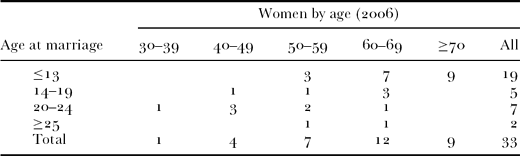
Table 1 shows the age at marriage of Vattima women living in Tippirajapuram in 2006. All nine women aged 70 or over were married aged 13 or under in the 1930s or 1940s, but seven out of 12 women aged 60–69 and three out of seven aged 50–59 were equally young when they married in the 1950s and 1960s. The minority of women aged 50 or over who married after puberty usually did so because their parents were too poor to afford a respectable marriage. Husbands were (and are) older than their wives, but about half the senior men in Tippirajapuram had married before they reached 20.
Age at marriage of married Vattima women in Tippirajapuram.
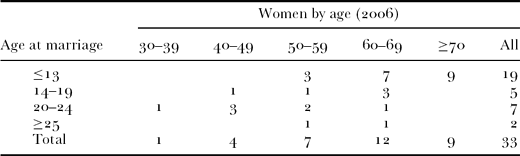
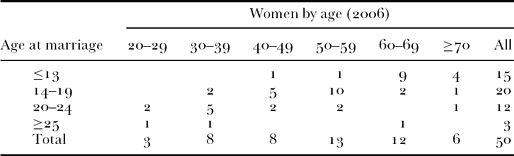
Table 2 shows the age at marriage of Vattima women living in Chennai and other Indian cities. These data were collected in interviews, but no systematic survey was done among urban Vattimas. Far more younger women live in cities than villages, so the age distribution in Tables 1 and 2 differs. In the urban sample, four out of six women aged 70 or over and nine out of 12 aged 60–69 were married as children, so that the profile is very similar to the women living in Tippirajapuram. On the other hand, in the 50–59 age cohort, ten out of 13 women living in cities were married between 14 and 19, and only one had married as a child, which reflects changes in girls’ education and hence later marriage apparent by the 1960s. The sole child marriage of a women in her forties is the late case from 1973 mentioned above.
Age at marriage of married Vattima women in cities.
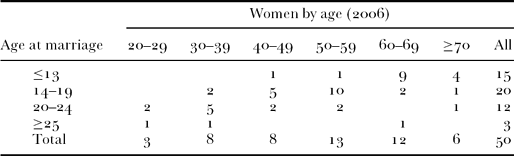
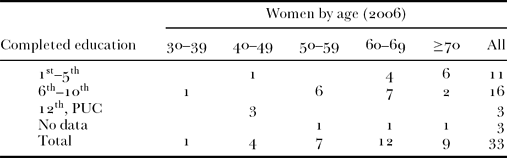
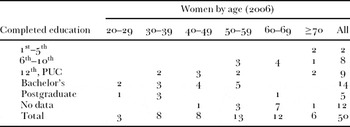
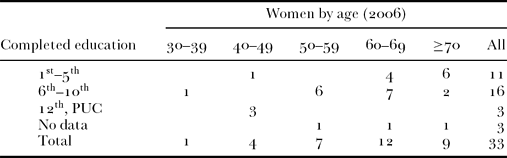
Table 3 shows that the large majority of Vattima women in Tippirajapuram had school education only and, among women aged 60 or over, half only attended elementary school.Footnote 36 Many of their husbands, in contrast, were well educated and half of them, in all age cohorts, obtained degrees and later worked in professional jobs. Our data on Vattima women in the cities are incomplete, but Table 4 (covering the same women as Table 2) shows that their standards of education have been rising. Among urban women aged 50 or over, four had some post-secondary school education, five more have a Bachelor's degree and another has a higher, medical degree. (Almost without exception, all the urban Vattima women's husbands have degrees or other professional qualifications.) Despite our small samples, the figures in Tables 3 and 4 are consistent with how our Vattima informants perceive female education within their community, which we will now discuss using case-studies.
Completed education of married Vattima women in Tippirajapuram.
Completed education of married Vattima women in cities.

Pre-puberty marriage and schooling for Vattima girls
Several elderly women brought up in Tippirajapuram described the primary school (pallikkudam) that they attended in the 1930s or 1940s, which was typical of those in most Vattima (and other Tamil Brahman) villages. Lessons were held in the agraharam in a Brahman's house, often on its veranda (tinnai), so that these schools were called tinnai pallikkudam.Footnote 37 Both boys and girls attended the Tippirajapuram school and most were Brahmans, although there were a few non-Brahman pupils as well. Unlike the girls, almost all the boys would later proceed to secondary school and many to college as well. The principal was a local Vattima paid a salary by the government, and there were one or two assistant teachers. Pupils of different ages and standards were only loosely split up into classes and were often all taught together. Reading, writing, and arithmetic in Tamil, together with basic English, made up most of the curriculum and rote-memorization was the primary pedagogical method. These elementary skills were regarded as adequate for girls to become competent housewives and mothers. In towns and a few villages, purpose-built primary schools existed in the 1940s and earlier; after Independence, tinnai pallikkudams were progressively replaced by schools run by local councils (panchayats) or by private schools.
A Vattima widow born in 1919, who lives in Tippirajapuram, said she was educated only to third standard in her native village; this minimal schooling was common in her generation as women were expected only to be able to read and write a simple letter. Another widow we met in Chennai, who was born in 1922, did study until the fifth standard but, as she put it, ‘Back then we were not allowed to study. . . I don't like to talk about it.’ In the preceding generation of women born around 1900, though, many were illiterate and could at best just sign their names.
The marital experiences of Lalitha and Sarada, two Vattima women in Tippirajapuram who were both born in 1934, have been described elsewhere.Footnote 38 Lalitha and Sarada were both brought up in other Vattima villages, not Tippirajapuram. Lalitha was married at 12 to a 19-year-old man, who became a landlord and accountant in Tippirajapuram, but she did not live with him until she was 20. Sarada was married at 7 to a boy aged 15, who grew up to be a landlord in Tippirajapuram, and she began to live with him at 15. Lalitha completed primary schooling in her native village; she continued into the next year (sixth standard) until she married and left school. Her formal education then ended, even though she only joined her husband several years later when he had completed his college education. Sarada also attended primary school in her native village, but after marriage she went to a secondary school in Mayavaram, the town near her village, where she completed the eighth standard before she came of age and joined her husband, who had finished his secondary schooling.
Although some women, like Lalitha, left school straight after marriage, the general consensus among elderly Vattimas is that in the past a girl's education did not have to stop until the onset of menstruation, as in Sarada's case. As a result, how much education most girls received depended on their age at menarche, and women in Sarada's generation typically left school between the fifth and eighth standards. Thus, for instance, Mahalakshmi, now resident in Tippirajapuram, was born in 1944 and brought up in the town of Trichy (Tirucchirappalli); she was married at 11 to a landlord aged 19, and left school three years later when she came of age and was in the eighth standard. Uma was born in 1936, brought up in Tippirajapuram, and married at 11; her husband was then a 16-year-old law student. (Uma's mother completed only the third standard and her grandmother was probably illiterate.) Uma attended the village school and left at 14, but during the next three years before joining her husband, her parents arranged private tuition for her at home, so that she reached the ninth standard. Once she had moved to her in-laws’ house, though, her education ceased because, leaving aside all her domestic duties, young wives like her ‘weren't even allowed to come to lighted areas of the house’. An unusual case is Sridevi, born in 1945, who was married at 11 to a schoolteacher and landlord who was 21. Sridevi did not start to menstruate until she was 16 and lived next door to her school in a town, which made it easier to allow her to complete the Secondary School Leaving Certificate before she went to live with her husband at 19. Compared with other women of her generation living in Tippirajapuram, Sridevi was fortunate.
In the 1950s and earlier, attendance at secondary school would have required girls living in Tippirajapuram and most other villages to travel several miles to and from a town, which was impractical when slow bullock carts were the sole means of transport. (For village boys, this problem was usually solved by sending them to stay with relatives living near a school or to one with a boys’ residential hostel.) Girls living in or close to towns, or in Vishnupuram—the one Vattima village with a high school established in the early twentieth century—would not have had a problem with travelling. But the fundamental reason why nearly all married Vattima (and other Brahman) girls had to leave school after menarche pertained to morality. No mature married girl was permitted to risk her moral reputation through an encounter with a male stranger—or even the rumour of one—outside the safety of her own home, so that, apart from rare exceptions like Sridevi, they could not be allowed to stay at school. Were a young wife to be accused of immorality before cohabitation, her husband's family might refuse to accept her, and in any event the public reputations of both her natal and affinal families would be seriously damaged.
Urban life and the improvement of Vattima girls’ education
The majority of elderly Vattima women whom we met in Chennai and other cities were born and raised in villages, had pre-puberty marriages, and experienced the same restricted schooling as women in Tippirajapuram. Like the widow in Chennai quoted above, many of these women look back on their curtailed education with regret and even the most conservative agree that the opportunities available for young women today are a vast improvement on the past.
In understanding how girls’ education improved, the exceptional cases are significant. Kamala, born in 1935, is the daughter of an eminent doctor. Kamala was married after puberty at 16 because her father, who was employed by the Madras government, had to comply with the Sarda Act. Kamala married a 23-year-old engineer and air force officer, and started to live with him in Pune, Maharashtra, when she was 19. By then she had completed her school education and a two-year Intermediate course at college. She had also been offered a place in medical college, but did not take it up. Neither Kamala nor her husband ever thought that she would go out to work, so training as a doctor seemed pointless.
Karpagam was born in 1937 and brought up in Trichy; she married Kamala's brother, who became a company manager, when she was 12 and he was 19. Thus Karpagam's marriage contravened the Sarda Act, but any repercussions would have befallen her parents, not her father-in-law, the doctor. Karpagam's father was a liberal-minded writer, whose mother apparently had modern views about girls’ education. Before joining her husband, Karpagam was allowed to complete her Secondary School Leaving Certificate. She won admission to a women's college in Chennai and her husband encouraged her to study there, but Karpagam explained that she was nervous about her competence in English. She does not regret missing college, as she has been happy as a homemaker and would never have taken a paid job anyway.
Kalyani and Prema are the daughters of a wealthy Vattima who lived in Kumbakonam. Kalyani was married in 1948 when she was 10 and her husband, a future engineer and industrialist, was 15; their marriage was consummated in 1954. Mainly because going to school was easy in town, Kalyani continued until the tenth standard, although she did not complete her Secondary School Leaving Certificate. Prema was married in 1959 when she was 14 and her husband, also an engineer, was 19; we are not sure whether Prema's was a pre-puberty marriage. Unlike Kalyani, Prema insisted on completing her Secondary School Leaving Certificate and fought with her father to do so. Kalyani said that her own education was strongly supported by her grandmother; possibly, she intervened on Prema's behalf. Prema wanted to go to college as well, but her father refused permission, even though her father-in-law, who was also her mother's brother, supported her.
Mohambal, born in 1946, married Venkataraman, an engineer, when she was 12 and he was 24. Mohambal went to her village school and then to a high school in a nearby town to finish her Secondary School Leaving Certificate, before moving to Chennai at 16 to join her husband. Venkataraman had insisted on Mohambal completing her education and made it a condition for agreeing to the marriage, because he was sure that he wanted an educated wife. Venkataraman's father, a banker, was agnostic about Mohambal's education, whereas his mother opposed it, regarding it as demeaning. Mohambal's own father worried that her reputation might be damaged if she went to school, with the result that she would be stuck in his house after her husband and the rest of the Vattimas rejected her. However, Venkataraman got his way.
Dr Sundari, born in 1942, is the first Vattima woman doctor and she practises in Chennai. Her father, a graduate, worked as a teacher and a practitioner in Indian medicine, and he eventually became rich. Sundari was brought up in Vishnupuram and attended its high school, before completing her Pre-University course at a women's college in Trichy, where she stayed in its hostel. At this stage in her education, said Sundari, her elder brother played a key role, because he was also studying in Trichy and living in a boys’ hostel. Sundari demanded of her father, ‘If he can study, why can't I?’, and her father agreed. In 1958, she became a medical student in Chennai. Her father strongly objected to pre-puberty marriage, which made him unpopular, but he was ‘able to defy the village [because] the village needed him’ for his medical skills. In her late twenties, Sundari married a man who does not belong to her subcaste, so that her marriage was doubly unusual.
The most unconventional Vattima family we have come across was headed by a high-ranking government official born around 1910. His wife had only elementary education in her village. Their first daughter, born around 1930, was married at 14, just after coming of age, and had school education only. Their next child was a son, followed by two more daughters who both went to college, strongly encouraged by their father. The youngest daughter, born around 1940, graduated from Madras University and later gained a doctorate in economics in the United States, where she stayed to become a college professor. She married a Tamil Brahman, but not a Vattima, who was a scientist. For many decades, however, this family has had hardly any contact with other Vattimas and our other informants never mentioned the American professor and her sisters, whereas all the other educated women described here are well-known figures.
After Dr Sundari—apart from the professor and her sisters—Vijaya was probably the first Vattima woman to obtain a degree. Vijaya, born in 1949, married a doctor when she was 17. Vijaya's father, like her son and several other family members, were or are doctors as well. Vijaya, too, wanted to be a doctor, but in 1966 her father refused to let her go to medical school because her new husband was a doctor, so they would not need her income. He also objected to a science degree, but Vijaya was eventually allowed to do an economics degree, partly because it was not a ‘job-fetching’ subject. Whether Vijaya's husband's family had any say in these decisions is unknown to us. By Vattima standards in the 1960s, however, her father was quite progressive about female education and post-puberty marriage, despite his conservative views about working women.
For these women born in the 1930s or 1940s, support from a father, father-in-law or husband with unconventionally progressive views about female education was critical, although a mother or grandmother sometimes gave support as well, and one woman, Prema, did stand up to her father. Some—but not all—of these men opposed pre-puberty marriage too, but the key factor in their attitude towards girls’ education was that they disapproved of secluding young wives after menarche. Fathers and fathers-in-law had the authority to enforce their will—Venkataraman could do so because he was already an employed graduate aged 24 when he married. Often, though, husbands were too young to have any say and several senior men reported that they were never consulted about their wives’ education, or indeed anything else related to their marriage. Thus Kalyani's husband told us that today he wishes he could have insisted that Kalyani continue her education, but at 15 he was too young even to think about it.
Family opposition to girls’ schooling, like that expressed by Venkataraman's mother, was not uncommon, even in later years. One woman told us about her brother's wife, who was married aged 10 in 1963 and reached menarche four years later. Her parents then wanted to send her to live with her husband, a bank officer, but he insisted that she should complete her Secondary School Leaving Certificate. The girl's parents asked her grandfather to intervene to stop her education; when that failed, her mother set out to obstruct it by making her daughter do domestic work late at night and keeping her at home when she was menstruating. The girl retaliated by refusing to eat during her periods until she was sent back to school and finally triumphed by passing her Secondary School Leaving Certificate.
Victories of this kind were extremely rare, however. The great majority of older women, reflecting on their own shortened education, simply say that it never crossed their minds that things could have been different and, in any case, girls in their day were never consulted about anything that mattered to them. Instead, as we have seen, for the first few Vattima women who completed their school education or went to college, the critical decisions were made for them by their fathers, fathers-in-law or husbands. These men were mainly influenced by their own college education, their experience of urban life, and professional employment, and their exposure in Chennai and other cities to the more enlightened opinions of many non-Vattima Tamil Brahmans, as well as other people. Even though the majority of well-educated Vattima men still retained a conservative outlook, new ideas about female education and child marriage slowly percolated from the cities through the whole Vattima community during the first two decades after Independence.
Vattima girls’ education and the end of pre-puberty marriage
By the 1960s, pre-puberty marriage had not disappeared among the Eighteen-Village Vattimas, but it was no longer so prevalent. Few Vattima informants cited any specific reasons why the custom was abandoned, but several mentioned the growing importance of girls’ education and saw the two issues as interdependent, as other Tamil Brahmans had done. Reflecting on the slow spread of modernist discourse into her subcaste, Mahalakshmi in Tippirajapuram attributed the demise of child marriage to the ‘force of time’ (kalattin kattayam), a feeling that the custom's time was over, but she too had in mind the new need for girls to be properly educated. That, she said, could not be left to affines; it had to be the parents’ responsibility.
Mahalakshmi's remark is a telling one. Pre-puberty marriage and good education for girls are not intrinsically incompatible, as long as young wives can stay at school and college even after they come of age. But since that was not allowed, the primary issue—as Mahalakshmi saw—was not really pre-puberty marriage itself, but the control of girls after menarche and responsibility for them. This was the true point of contention when Venkataraman refused to allow Mohambal to be sent to him as soon as she came of age, and instead insisted that his father-in-law should ensure that she finished her schooling first. In effect, since his marriage in 1958, Venkataraman's attitude has come to prevail. As a result, for Vattima girls born after about 1950, secondary education—preferably completed with the Secondary School Leaving Certificate—has increasingly been regarded as desirable and even necessary before marriage, which in turn has ruled out pre-puberty marriage and post-puberty seclusion. What changed, too, was that parental responsibility for daughters, which was formerly transferred to their husbands’ families when they came of age, was now prolonged until each girl had completed her education and was deemed ready for marriage, although growing sensitivity about abusive exploitation of very young wives by their in-laws was probably a factor as well. (Actually, Vattima women used to return to their parental homes for unusually long periods after marriage, but that custom only partly protected them from abuse and did not undermine their in-laws’ authority over them.) Whether consciously aware of it or not, the progressives who favoured better girls’ education were simultaneously insisting that parents should care for their daughters for longer than they had done when pre-puberty marriage was the norm. For Vattimas, at least, the demand for improved female education foreclosed pre-puberty marriage, whereas for other Tamil Brahmans who had abandoned it earlier, it was the rising age of marriage for girls that probably led to better education.Footnote 39
Among Vattima women born in the 1950s or later, the majority have had at least some secondary schooling and in the younger cohorts most have finished their Secondary School Leaving Certificates or even have a college degree. In Tippirajapuram, three out of five women aged 49 or under completed secondary education, whereas in the cities more than half have degrees and some young women also have postgraduate degrees (see Tables 3 and 4). One major reason for this difference is that women who married into urban families, many of whom were also raised in cities, are generally better educated than their village cousins and were thus more suitable partners for urban, middle-class, professional men. An evolution in types of higher education has occurred as well, which is discussed further below. The majority of women appearing in Table 4 studied for general arts or sometimes science degrees; for a commerce degree, which used to be a popular choice; or for a teaching qualification, although four younger women also have postgraduate degrees. Young women today, many still unmarried so that they are excluded from Table 4, more often study for specialized science or engineering degrees, and continuing to higher degrees is fairly common.
Vattima women's education and employment since the 1970s
In relation to women's marriage and education, as well as employment, there is no longer any noticeable divergence between the Eighteen-Village Vattimas and other Tamil Brahmans who also belong to the predominantly urban middle class. Thus Vattima women have caught up, so to speak, with other Brahman women for whom child marriage had ended a generation earlier, in the 1940s rather than the 1970s. Yet they have only fully caught up in the last 20 years or so; in other words, among women who have become adult since around 1990, there is no difference between Vattima and other Tamil Brahman women, but in the preceding generation, Vattimas tend to be less well educated and also less likely to be employed. An equally important development is that among Vattimas and Tamil Brahmans in general, male and female standards of education have been converging and in the youngest generation, especially in cities, they are almost equal.
By the 1970s, completed family size was diminishing among middle-class Tamil Brahmans. Moreover, the old preference for sons over daughters has steadily faded away; certainly by the 1990s, few Brahman parents—Vattimas or others—minded about it very much and few have more than two children, even if both are girls. In relation to their general welfare, as well as their education, girls and boys are treated much more equally today than in the past.
In most people's eyes, though, matrimonial considerations have most powerfully driven rising standards of female education. Venkataraman, who wanted Mohambal to finish at school in the 1950s, was unusual, but in the next decade and definitely by the 1970s, well-educated Vattima men usually insisted on wives who had at least completed their Secondary School Leaving Certificates. By the 1980s or 1990s, they wanted wives who were graduates. In these respects, Vattima men were like other middle-class Tamil Brahmans—and countless other Indians throughout the country—who preferred educated wives for the usual reasons: they would be more congenial partners for the companionate marriages that were emerging as the norm, as well as more competent mothers who could help with their own children's education. Educating daughters—initially to Secondary School Leaving Certificate and later to degree standard—therefore became a sound strategy for parents hoping to arrange good marriages for them, although ‘over-educating’ girls caused problems, because men generally preferred partners with qualifications below their own. Moreover, whereas sons preferably studied vocational subjects such as engineering, law, and accountancy—the paths to well-paid, high-status professional jobs—daughters pursued general arts, science or commerce degrees, precisely because marriageability, not employment, mattered most.Footnote 40 Indeed, as Vijaya's case showed above, vocational education for girls might be opposed because it was considered unsuitable for a married woman who would not go out to work.
Medicine, an esteemed profession always open to both sexes, is an exception to these generalizations about female education and employment, although only a relatively small number of Tamil Brahman women have ever been doctors. In recent decades, too, medicine has become less attractive in practice for Brahmans in South India, mainly owing to the reservations policy. As operated in Tamilnadu, this policy—India's version of ‘affirmative action’—reserves more than half the places in government medical colleges for lower-caste students, so that there is ferocious competition for the ‘open seats’ for which Brahmans can apply. Most applicants are therefore disappointed and very few families can afford the high fees at private medical colleges.
Despite rising standards of education, until recently Vattima women rarely took paid employment outside the home. Men consistently opposed it, women rarely disagreed with them, and Vattimas were mostly well-off enough not to need two incomes. Apart from Dr Sundari and the American professor mentioned above, both unusual exceptions, the first employed Vattima woman was probably Sita, a bank officer in Bangalore, who was born in 1955. Sita was brought up in Calcutta, where she finished her Secondary School Leaving Certificate before going to a women's college in Trichy to study for a degree in mathematics, an unusual degree for a woman in her day. Immediately after graduation in 1976, Sita married and moved to Bangalore, where she soon got a job in a bank. She was encouraged to do so by her husband and his parents, and says that other Vattima women did not criticize her. This may partly have been because Bangalore, as Sita also observed, was and is a much less conservative place than Chennai or anywhere else in Tamilnadu. The same characterization applies to Mumbai, where we met two Vattima working women born in the 1960s; one is a qualified teacher, who actually started to work when her only daughter was a child, and the other, who has a commerce degree, worked in a private company until she got married.
Even compared with slightly younger Vattimas, especially in Tamilnadu, Sita and the two Mumbai women remain unusual. Gita, born in 1970, who was brought up in Chennai, is more typical. Gita graduated with a commerce degree from a Chennai women's college in 1990 and was married immediately afterwards. She had wanted to postpone her marriage to study for a Master's degree, but that was not allowed and after her wedding she soon became pregnant. Gita, however, had only wanted to study for longer and, unlike some of her non-Vattima Brahman friends at college, she never desired a paid job.
Gita's comment about her friends was echoed by other Vattima women, but solid evidence about education and employment among the generality of Tamil Brahman women is sparse. Our research in Chennai in 2003–2005 included interviews with seven middle-class Tamil Brahman women then aged 40–59 and three others aged 20–39. All seven older women have degrees and three also have teaching qualifications; two of the younger woman have degrees, but the third only completed the Pre-University course. Unlike their Vattima contemporaries, most of these Brahman women, even after marriage, worked as teachers or in banks and insurance company offices. On the other hand, Patricia Caplan's research in Chennai in the mid-1970s among upper-middle-class women, many of them Brahmans, revealed considerable resistance to female employment at that time. As well as working with women who stayed at home, Caplan studied an exceptional minority of senior professional women and described the difficulties they faced in deviating from the ideal norm of a non-working wife and mother. For the majority, Caplan found, ‘employment outside the home is not considered at all desirable’ and most of those ‘who are now housewives in their thirties and forties have never worked, and never really contemplated doing so’.Footnote 41 She also reported that most younger women had degrees and married immediately after leaving college, which is consistent with Srinivas's observation from the same period that colleges were ‘respectable waiting places’ for single girls and that—among higher caste, middle-class people—a degree had by then become ‘essential for obtaining a “good” groom’.Footnote 42
Inadequate data preclude definite conclusions being drawn about female employment trends, but the balance of evidence suggests that, for the majority of middle-class Tamil Brahman women—but not Vattimas—going out to work probably became acceptable—though not necessarily desirable—by the 1980s. In almost all cases then and now, however, working women firmly put their families’ interests before their careers, and only work when their children are young if they can rely on childcare provided by other family members, normally mothers or mothers-in-law.
Engineering, IT and contemporary change
More recently, especially since the early 1990s, middle-class Tamil Brahman attitudes towards female education and employment have evolved further, so that many more women now than in the past see higher education as a path to professional employment. This is partly because young women brought up as equal to their brothers and as well educated as them, or nearly so, are much less inclined than their mothers were to confine themselves to motherhood and domesticity. These young women actively want to work and in this ambition they are often supported, or at least not opposed, by their parents. Many older women, though not all, positively encourage their daughters and granddaughters to take up opportunities that they missed out on. Some older people disapprove of young women's assertiveness, especially when they drag their feet about getting married, but everyone agrees that a marked change has occurred.
For example, a non-Vattima Brahman woman in her forties who lives in Chennai was discussing her two daughters’ education and stated that the decisions made by her and her husband would have been the same had they had sons. Both daughters studied maths, science, and computing; the elder, 20 at the time of the interview in 2004, was then an engineering student who also wanted to carry on to an MBA. When she finished at college in the 1980s, our informant said, most women graduated ‘for the sake of it’, not for job and career reasons, but now, like her own elder daughter, ‘girls know what they're doing’. Gita's daughter is another such girl; in 2009, she became the first Vattima girl to enter the prestigious Indian Institute of Technology in Chennai and she intends to work after graduating, probably in IT. Like many other students from the Institute, female or male, she also wants to study for a further degree, probably an MBA, either in India or abroad. Gita's daughter's admission to the Institute makes her exceptional, but her attitude to further study and employment is typical of young middle-class Tamil Brahman women.
IT has been critical in altering young women's perceptions. Since the mid-1980s, numerous private professional colleges, especially engineering colleges, have opened in Tamilnadu. In private colleges, unlike government colleges, the reservations system does not apply to all the places, so that it is easier for Brahmans to gain admission, which is one important reason why engineering has become so popular among them. The fees charged by private engineering colleges (unlike medical colleges) are also affordable for many middle-class families. Since the Indian government's economic liberalization policy started in earnest in 1991, private-sector employment has rapidly expanded in urban South India, especially in service industries, including IT, whose demand for personnel has in turn stimulated the growth in engineering colleges. Some of these colleges provide high-quality education—though others do not—and graduates from the top colleges are recruited in large numbers by India's leading software and services companies, as well as other IT firms, based in Chennai, Bangalore, Hyderabad, and some other Indian cities. In India today, IT recruits many more graduate engineers than the manufacturing and construction industries that previously provided most of the jobs.Footnote 43
Particularly salient in relation to gender are the differences between IT companies and older, ‘core’ engineering ones. Based on her research in the late 1980s, partly with students at the Indian Institute of Technology-Madras, Mukhopadhyay commented on the overwhelmingly male environment of engineering departments, as well as the working conditions in manufacturing and construction, where engineers regularly work in dirty factories or on outdoor sites alongside gangs of low-status, male manual workers. As a result, in comparison with other sciences or medicine, for girls the ‘most socially dangerous field by far is engineering’ and most parents actively steered their daughters away from it, thus further reinforcing male dominance over the profession.Footnote 44 The IT sector is completely different and, especially in the major software companies, the ‘clean’ work is done alongside colleagues in city offices, so that it is seen as much safer and more suitable work for women than conventional engineering, despite the late working hours sometimes required. As the IT sector has expanded, it has encouraged growing numbers of girls to study engineering. The majority of engineering students are still male, but there is a sizeable minority of young women in the colleges who can of course compete for the same IT jobs. By 2008, about one-third of professional staff in the leading IT companies were women and the proportion has been steadily rising.Footnote 45 IT has radically altered the attitudes towards engineering described by Mukhopadhyay, so that by the start of the twenty-first century, girls could—and did—increasingly compete on equal terms with boys in training for one of modern India's highest-status professions.
Although the majority of IT professionals are non-Brahmans, Brahmans are disproportionately well represented in South India's IT companies, particularly in Chennai and Bangalore. Employment in IT, especially in leading software firms, has now become the ambition of many young women, as well as men, among Vattimas and Tamil Brahmans in general. It is true that many Brahman men want to marry ‘home-loving’ partners and object to their wives going out to work. Yet in the middle class, opposition to working wives is probably less among Brahmans than in most other castes and communities. Moreover, women IT professionals, who typically find husbands in the same industry, can normally be confident about their marriage prospects, unlike the science and engineering graduates of 20 years ago.Footnote 46 Like other working women, IT professionals nearly always put their family responsibilities ahead of their careers, and when children arrive they often leave their jobs or take career breaks. Thus we have met only a couple of older women in senior positions who have pursued full-time, long-term careers and their number is likely to rise only slowly, at least in Chennai. Inside the major IT companies, however, women and men are treated equally in relation to recruitment, promotion, salary levels, and so on, and both sexes recognize it. To be sure, the IT sector's creed of female ‘empowerment’ glosses over persisting gender inequalities, for instance in relation to the social factors obstructing women's promotion to senior positions.Footnote 47 Nonetheless, even though it may sometimes be more rhetorical than real, gender equality at work means a lot to the women IT professionals we have talked to, because it affords them a degree of personal autonomy and social empowerment that most other Indian women rarely enjoy.Footnote 48
Obviously, IT companies alone will not revolutionize gender relations. Certainly, too, however rapidly the IT industry grows, most Tamil Brahman women will not study engineering and become IT professionals—and even fewer will become high-flying scientists or technologists, business consultants or company executives. Yet these sorts of careers are now pursued by some young women. Moreover, they are no longer beyond the imagination of girls, or their parents who give them support, and nowadays a high proportion of young women are determined to take up professional employment and start a career, even if they give it up later when they have children. That change in perspective has been strongly encouraged by today's female IT professionals, because they have become role models for many young women—especially among middle-class Tamil Brahmans, including Vattimas—who can now see opportunities for themselves that scarcely existed 20 years ago.
Conclusion
Before ending with a general conclusion, we present one more illustration of change within a Vattima family. Uma, who was born in 1936 and completed the ninth standard in Tippirajapuram, was mentioned above. Uma and her husband, a lawyer in Chennai for 15 years, had two sons and two daughters. The elder daughter, born in 1958, married after she came of age at 15, during her final year at school; she went to live with her husband, a bank officer, two years later and in the meantime she completed her Pre-University course. The couple live in Chennai and have two daughters. Uma's younger daughter, born in 1970, married at 21 after completing her commerce degree; she and her husband, an engineer, live in Kerala and have one son. The difference between Uma's two daughters reflects the changes that occurred between the 1970s, when finishing school was more than enough for a typical Vattima girl married in her teenage years, and the 1980s, when girls started to obtain degrees to improve their matrimonial prospects. In the next generation, women's educational qualifications moved steadily closer to men's, as Uma's daughter's daughters illustrate. Uma's first granddaughter, born in 1978, has an engineering degree from BITS-Pilani, a technology institute in North India and an MBA from a prestigious university in California; unlike her forebears, she also has a job—in a multinational auditing and consulting company in Los Angeles—and she married a non-Vattima Brahman in 2006 when she was 28. The younger granddaughter, born in 1984, studied for her Master's in biomedical genetics at Vellore Institute of Technology and then became a doctoral student in Dallas. She married a Vattima at the age of 24 in 2008. The dramatic changes seen by Uma across five generations in her family, from her probably illiterate grandmother to her highly educated granddaughters, are actually quite common among Vattimas, but she—like many of our older informants, female or male—is still amazed when she reflects on how women's lives have been transformed.
It is true, of course, that huge improvements in female educational standards have occurred in much of the world during the last century or so. Over the same period, child marriage has also become far less common, not only in India, but in numerous other countries as well. In many respects, therefore, particularly in comparison with many of the other upper castes now well represented in India's educated middle class, the Tamil Brahmans’ story is probably quite typical. Yet it is facile to assume that it must be so when most scholarly work is confined to unusual women and elite discourse on the ‘woman question’.Footnote 49 One of our main objectives has been to document how female marriage, education, and employment are interrelated and how they have changed among ordinary Tamil Brahmans, and we hope that similar material will become more readily available for comparable groups. Fortunately for our research, many senior Eighteen-Village Vattima women—unlike all but the very oldest in other Tamil Brahman groups—had personal experience of pre-puberty marriage. Hence we have been able to discuss the disappearance of the custom in relation to girls’ education with ethnographic data unavailable to historians of colonial India working on similar questions, or indeed to most anthropologists studying other high-caste, middle-class groups which used to practise child marriage.
We end with the relationship between caste and gender inequality. In the early twentieth century, as had long been true, pre-puberty marriage was a primary constitutive element of gender hierarchy among Tamil Brahmans. It was also a powerful symbol of the ritual purity and Sanskritic orthodoxy that enabled the Brahmans to assert their social superiority over non-Brahmans. That is one main reason why many Brahmans used to be so opposed to marriage reform. Today, though, Tamil Brahmans rarely claim superiority on traditional grounds of purity and orthodoxy. Of course, non-Brahmans now unequivocally dismiss the notion of Brahman superiority. Yet Brahmans themselves, within their own milieu, still tend to reiterate it, mainly by reference to their putatively superior intelligence and intellect, which are said to account for their high standards of educational achievement and their success in the modern professions, including most recently IT. But the caste's educational and professional success—as well as its modern ‘middle classness’—are proven by the achievements of both sexes, so that whereas caste superiority was traditionally linked to women's lowly status, the modern idiom requires almost the opposite. For contemporary Tamil Brahmans, caste values—and their own sense of superiority—remain important, but they have been modified. As part of that modification, many old ideas about female inferiority and subordination have been given up in a manner indicating that caste inequality is more deeply rooted than gender inequality.
That finding returns us to Mukhopadhyay and Seymour's question about whether the old patrifocal structure and ideology are being undermined in groups like the Tamil Brahmans in which women have made the greatest educational advances. Certainly, among the majority of middle-class Tamil Brahmans, gender inequality has not vanished as shown, for example, by the priority given to husbands’ careers over wives’ and the taken-for-granted domestic division of labour or, to cite alternative examples, by continued observation of menstrual pollution and strict control over female sexuality.Footnote 50 On the other hand, as we have seen, there is now gender parity in education and women—even if they do not pursue long-term careers—can work outside the home; they also, for instance, mostly make up their own minds about how to observe menstrual pollution and have a full say in their own marriage arrangements, which they never had in the past.Footnote 51 Even a complete examination of all the features making up the patrifocal complex might not answer Mukhopadhyay and Seymour's question for Tamil Brahmans, but clearly there have been some changes that partly subvert the complex and hence significantly reduce gender inequality within this traditionally high-status caste. Not surprisingly perhaps, the simple fact of the matter is that Tamil Brahman men have more readily ceded status to Brahman women than Brahmans together have to non-Brahmans. This suggests that the ‘decline of the hierarchical aspects of caste and gender among the middle classes’ observed by André Béteille has not occurred in the parallel manner that he implies.Footnote 52 Instead, among Tamil Brahmans, it is the contrast that has developed between persisting ideas of caste superiority and diminishing gender inequality in the modern era that is most striking.
What is also crucial, finally, is how women themselves see things. In our experience, all Tamil Brahman women, young and old, insist—like Uma—on how much their position has changed over the last few generations and how much more control they now have over their own lives. That perception in itself is a veritable social reality not only for women, but also for the men of their caste, who cannot assume the superiority that Manu prescribed and their own ancestors took for granted.