Introduction
Based on the recent classification, Culicidae comprises two subfamilies, 112 genera and 3549 species (Harbach, Reference Harbach2016). Over 100 species of mosquitoes are able to transmit different diseases to humans and other animals, the most important of which being malaria (Ndenga et al., Reference Ndenga, Simbauni, Mbugi and Githeko2012). Seven species of Anopheles are present as vectors of malaria in Iran, among which An. maculipennis, An. sacharovi and An. superpictus are the main malaria vectors in western, northwestern and central plateau of the country (Hanafi-Bojd et al., Reference Hanafi-Bojd, Azari-Hamidian, Hassan and Zabihollah2011). According to the latest malaria report, 1109 and 134 cases of malaria caused by P. vivax and P. falciparum respectively were reported from Iran in 2014 (WHO, 2015). Twenty-two cases of imported malaria were reported from Mazandaran Province during 2008–2012 (Ghaffari et al., Reference Ghaffari, Mahdavi, Moulana, Mouodi, Karimi-Nia, Bayani and Kalantari2012).
A number of mosquito-borne viruses, including West Nile, Sindbis (Naficy & Saidi, Reference Naficy and Saidi1970; Saidi et al., Reference Saidi, Tesh, Javadian and Nadim1976; Ahmadnejad et al., Reference Ahmadnejad, Otarod, Fallah, Lowenski, Sedighi-Moghaddam, Zavareh, Durand, Lecollinet and Sabatier2011) and Dengue fever (Chinikar et al., Reference Chinikar, Ghiasi, Moradi and Madihi2010, Reference Chinikar, Ghiasi, Shah-Hosseini, Mostafavi, Moradi, Khakifirouz, Rasi Varai, Rafigh, Jalali, Goya, Shirzadi, Zainali and Fooks2013; Mardani et al., Reference Mardani, Abbasi, Aghahasani and Ghavam2013) were reported from Iran. The mosquito-borne filarial nematodes, including Dirofilaria (dirofilariasis) and Setaria (setariasis) were reported from Iran (Oryan et al., Reference Oryan, Valinezhad and Bahrami2008; Azari-Hamidian et al., Reference Azari-Hamidian, Yaghobi-Ershadi, Javadian, Abai, Mobedi, Linton and Harbach2009b ).
Mosquitoes are extensively distributed throughout the world and their breeding sites are different in terms of quantity and quality of water and natural vegetation (Dehghan et al., Reference Dehghan, Sadraei and Moosa-Kazemi2010). In some habitats, more than one species of mosquito can lay eggs, where they share food (Marcondes & Paterno, Reference Marcondes and Paterno2005; Nikookar et al., Reference Nikookar, Azari-Hamidian, Fazeli-Dinan, Nasab, Aarabi, Ziapour and Enayati2016). Therefore, selection of suitable habitats by mosquitoes is important in their survival and population dynamics. Various studies have shown that mosquitoes are completely distinctive in choosing breeding places (Adeleke et al., Reference Adeleke, Mafiana, Idowu, Adekunle and Sam-Wabo2008; Liu et al., Reference Liu, Liu, Guo, Jiang, Ren, Zhou, Zheng, Liu, Chen and Li2012; Baak-Baak et al., Reference Baak-Baak, Arana-Guardia, Cigarroa-Toledo, Puc-Tinal, Coba-Tún, Rivero-Osorno, Lavalle-Kantun, Loroño-Pino, Machain-Williams and Reyes-Solis2014). There are many resemblances and differences between mosquitoes oviposition behavior in artificial and nature habitats. Anopheles, Sabethes, Toxorhynchites, and Wyeomyia oviposit individually on the water surface, usually without touching it. Coquillettidia, Culex and Culiseta put their egg rafts directly on the water surface. Aedes deposit individual eggs on a layer above the water line and some species can also attach their eggs to vegetation under the water surface (Surendran & Ramasamy, Reference Surendran and Ramasamy2005). Therefore, vegetation of mosquito larval habitats is important in the process of egg-laying and density.
Climate fluctuation accompanied by environmental changes in ecosystems such as agricultural activities and urbanization may cause destruction of certain mosquitoes main habitats and observing sylvatic species in urban areas with temperate climate. This phenomenon may occur for a mosquito such as Ae. albopictus that resided in many Mediterranean countries of Europe during the past decade and now has begun to transmit dengue viruses (Adeleke et al., Reference Adeleke, Mafiana, Idowu, Adekunle and Sam-Wabo2008; Baak-Baak et al., Reference Baak-Baak, Arana-Guardia, Cigarroa-Toledo, Puc-Tinal, Coba-Tún, Rivero-Osorno, Lavalle-Kantun, Loroño-Pino, Machain-Williams and Reyes-Solis2014).
In Iran, preliminary studies were conducted on larval habitats of An. apoci by Marsh (Reference Marsh1933), An. dthali by Manouchehri & Rohani (Reference Manouchehri and Rohani1975), An. stephensi by Zaini et al. (Reference Zaini, Djanbakhsh and Manuchehri1975) and Manouchehri et al. (Reference Manouchehri, Javadian, Eshighy and Motabar1976), An. fluviatilis by Eshghi et al. (Reference Eshghi, Motabar, Javadian and Manoutcheri1976). All of these studies were conducted on malaria vectors in the southern parts of Iran, followed by an investigation by Zaim (Reference Zaim1987) on larval habitat characteristics of Culicinae in 24 provinces of Iran. In recent years, studies on larval habitats of Anopheles were followed by Vatandoost et al. (Reference Vatandoost, Shahi, Abai, Hanafi-Bojd, Oshaghi and Zamani2004); Hanafi-Bojd et al. (Reference Hanafi-Bojd, Vatandoost, Oshaghi, Charrahy, Haghdoost, Sedaghat, Abedi, Soltani and Raeisi2012) and Soleimani-Ahmadi et al. (Reference Soleimani-Ahmadi, Vatandoost, Hanafi-Bojd, Zare, Safari, Mojahedi and Poorahmad-Garbandi2013, Reference Soleimani-Ahmadi, Vatandoost and Zare2014) in malarious areas in Hormozgan Province and by Amani et al. (Reference Amani, Yaghoobi-Ershadi and Kassiri2014) in Luristan Province. Most of these studies are again limited to the larval habitats of Anopheles in the southern regions of the country.
In the northern parts of Iran, Larval habitat characteristics of Anopheles, Culex and Culiseta were investigated by Azari-Hamidian et al. (Reference Azari-Hamidian2005, Reference Azari-Hamidian2007, Reference Azari-Hamidian2011) in Guilan Province, Khoshdel-Nezamiha et al. (Reference Khoshdel-Nezamiha, Vatandoost, Azari-Hamidian, Mohammadi-Bavani, Dabiri, Entezar-Mahdi and Chavshin2014) in West Azerbaijan Province and Nikookar et al. (Reference Nikookar, Moosa-Kazemi, Yaghoobi-Ershadi, Vatandoost, Oshaghi, Ataei and Anjamrooz2015) in Neka County. There is no comprehensive study on larval habitat characteristics of Culicidae across the province; this is the first extensive investigation in this regard in Mazandaran Province.
As environmental management is a major intervention in larvae control programs (Hanafi-Bojd et al., Reference Hanafi-Bojd, Vatandoost, Oshaghi, Charrahy, Haghdoost, Sedaghat, Abedi, Soltani and Raeisi2012), identification of active larval habitats with the vegetation therein will be essential in planning adequate mosquito control programs. Therefore, this study aimed to determine the species composition, distribution and some aspects of the larval ecology, including habitats characteristics and their relationship with larval density.
Material and methods
Study area
The study was conducted in Mazandaran Province, in the Caspian Sea littoral of northern Iran located between latitude 35°47′–36°35′N and longitude 50°34′–54°10′E. The study area has a population of approximately 3073, 943 and an area of 23,756 km2, according to Mazandaran Census Report in 2011. The main occupations of the people are agriculture especially rice cultivation, horticulture and animal husbandry. Maximum and minimum temperatures and rainfall were 1.2–29.2°C and 0–755.6 mm in 2014, respectively. The moderate weather and Hyrcanian forests provide favorable conditions for the development of mosquitoes. Sari is the capital of the province and is located at an altitude of 123 m above sea level.
Specimen collection and identification
In total, 120 sentinel sites in 30 villages of 16 counties throughout the province were checked once a month during May–December 2014. The villages in each county were randomly selected based on ecological zones of woodland and plain. In each village, one fixed and three variable habitats within a radius of 1 km were chosen for sampling. The different environmental characteristics of the habitats were equally represented in each village.
Larvae were collected from natural and artificial sites using standard 350 ml dipper and pipette, they were kept in separate glass vials and transported to the laboratory for morphological identification. Approximately 10–30 dips were done in each larval habitat depending on their size. Samplings of the same breeding places were always performed by the same individual (100 members of staff of the Mazandaran Health Centers were recruited and adequately educated for the project) in the morning (09.00–12.00 h) or afternoon (14.00–17.00 h) for about 30 min at each larval habitat. Larval densities were calculated as the average number of larvae per ten dips (WHO, 1975).
Larval habitat characteristics, including conditions of habitat (permanent or temporary, stagnant or running), type of habitat (natural or artificial), vegetation (with or without plants), situation of sun (sunny or shade), type of bed (soil, stone, concrete), water condition (clear or turbid), expanse (0–5, 5.1–10, 10.1–15 m), depth (1–25 cm, 25.1–50 cm, 50.1–75 cm, 75.1 cm–1 m, 1.1–1.5 m, 1.51–2 m) and water temperature (5–10, 10.1–15, 15.1–20, 20.1–25, 25.1–30°C) (Gimnig et al., Reference Gimnig, Ombok, Kamau and Hawley2001; Hanafi-Bojd et al., Reference Hanafi-Bojd, Vatandoost, Oshaghi, Charrahy, Haghdoost, Sedaghat, Abedi, Soltani and Raeisi2012) were recorded separately in specific forms. Water temperature of each type of larval habitat was measured by a thermometer and the expanse and depth of each habitat by using a metal ruler on site. Third- and fourth-instar larvae were mounted by de Faure's medium and morphologically identified using the key for the mosquitoes of Iran (Shahgudian, Reference Shahgudian1960; Azari-Hamidian and Harbach, Reference Azari-Hamidian and Harbach2009a ). Collected larvae were not reared up to adults.
Statistical analysis
Statistical analyses were executed by the IBM SPSS version 19 software (IBM Corporation, Armonk, NY). Chi-square (χ2) analysis was used to determine the relationship between environmental variables and the occurrence of larvae in different habitats, and results were considered significant when P < 0.05.
Results
A total of 19,840 Culicidae larvae belonging to 16 species and three genera were collected and morphologically identified. Of these, 1267 (6.38% of total larvae) anopheline larvae and 18,573 (93.62% of total larvae) culicine larvae were collected from 120 larval habitats.
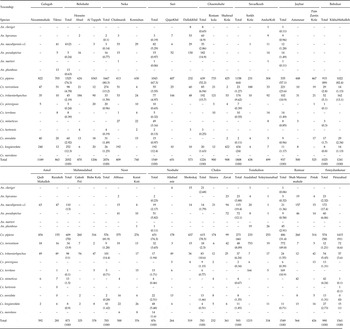
The highest number and percentage of Anopheles were collected in Sari (n = 285, 22.49% of total Anopheles) followed by Ramsar (n = 255, 20.12% of total Anopheles), while the lowest was in Noshahr County (n = 35, 2.18% of total Anopheles). Surprisingly, no Anopheles mosquitoes were caught in the Counties of Ghaemshahr, Juybar, Babolsar, Fereydunkenar and Mahmudabad.
Anopheles maculipennis s.l. was the dominant species of anopheline larvae in the province. The lowest and highest densities of this species were found in the counties of Behshahr (n = 3, 0.14% of total larvae in this county) and Ramsar (n = 172, 17.4% of total larvae in this county) (table 1).
Numbers and percentage of the distribution of larvae species caught from larval habitats in different counties of Mazandaran Province, May–December 2014.

The maximum number of culicine larvae were collected from Behshahr (n = 2055, 11.06% of total Culicinae) followed by Galugah (n = 1993, 10.73% of total Culicinae) and the minimum from Chalus (n = 383, 2.06% of total Culicinae) and Mahmudabad (n = 703, 3.79% of total Culicinae) Counties.
Culex pipiens was the dominant species, its least number occurred in Chalus (n = 273, 46% of total larvae in this County) while Sari recorded the highest number (n = 1667, 80.3% of total larvae in this County) respectively. Culex hortensis and Culiseta morsitans were observed with the lowest distribution in Counties of Fereydunkenar, Behshahr, Neka, Sari and Noor (table 1).
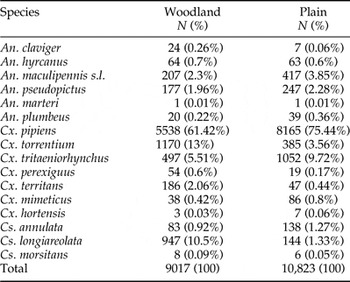
Density of larvae collected in the woodland and plain regions were 45.5 and 54.5%, respectively. An. maculipennis s.l. and Cx. pipiens were collected with the highest density of 417 (3.85%) and 8165 (75.44%), in plain areas, respectively. Data on other species in woodland and plain areas are presented in table 2.
Frequency of larvae collected in woodland and plain areas of Mazandaran Province, May–December 2014.

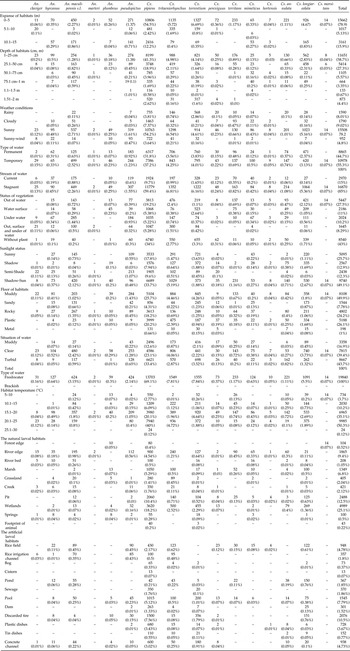
As summarized in table 3, most larvae were collected from natural habitats (n = 11972, 60.34%), including river edge (n = 1865, 9.4%), wetlands (n = 4989, 25.1%), pit (n = 2488, 12.5%) and marsh (n = 1349, 6.8%). The same was true with temporary habitats (n = 10978, 55.3%), stagnant (n = 16870, 85%), expanse of 0–5 m (n = 15662, 78.9%), depth of 1–25 cm (n = 11651, 58.7%), without plant (n = 8540, 43%), shadow-sun (n = 9740, 49.1%), muddy floor (n = 8108, 49.9%), turbid water (n = 8667, 43.7%), temperature 20–25°C (n = 9985, 50.3%) and in sunny conditions (n = 15508, 78.2%). The highest number and percentage of species in natural and artificial habitats with different characteristics are listed in table 3.
Number and percentage of larvae density in habitats with different ecological characteristics, Mazandaran Province, Iran.

All of the different types of habitats were occupied with more than one species mosquito larvae that it is deducible from table 3.
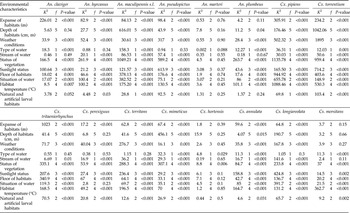
Chi-square analysis indicated that each of the environmental variables is significantly associated with occurrence of An. maculipennis s.l., Cx. pipiens, Cx. torrentium, Cx. mimeticus and Cs. annulata (P < 0.001). Anopheles plumbeus, Cx. pipiens, Cx. tritaeniorhynchus, Cx. territans, Cx. mimeticus, Cs. annulata and Cs. morsitans showed the highest interest to occur in natural habitats compared with other species in the province (table 4).
Association between environmental variables and occurrences of larva in Mazandaran Province.

The rainfall and temperatures fluctuations in study area are shown in fig. 1.
The status of climate fluctuations in the study area of Mazandaran Province during April–March, 2014.

Discussion
This is the first comprehensive study on the density of species in different habitats of Mazandaran Province, north of Iran, during which three genera and 16 species of mosquitoes were recorded. In contrast, five species of mosquito larvae were collected by Azari-Hamidian (Reference Azari-Hamidian2011) from Guilan Province, 14 species by Saghafipour et al. (Reference Saghafipour, Abai, Farzinnia, Nafar, Ladonni and Azari-Hamidian2012) from Qom Province, 11 species by Banafshi et al. (Reference Banafshi, Abai, Ladonni, Bakhshi, Karami and Azari-Hamidian2013) from Kurdistan Province and by Vatandoost et al. (Reference Vatandoost, Shahi, Abai, Hanafi-Bojd, Oshaghi and Zamani2004) from Hormozgan Province.
In agreement with other studies, An. maculipennis s.l. and An. pseudopictus showed the highest geographical distribution in almost all sectors of the study area and the highest density especially in the plain. In contrast, An. marteri showed the lowest distribution and density in woodland and plain regions (Dow, Reference Dow1953; Nicolescu et al., Reference Nicolescu, Vladimirescu and Ciolpan2002; Azari-Hamidian et al., Reference Azari-Hamidian, Jouafshani, Rassaei, Moslem and Mousavi Eyvanaki2003; Azari-Hamidian et al., Reference Azari-Hamidian, Yaghobi-Ershadi, Javadian, Abai, Mobedi, Linton and Harbach2009b ; Amani et al., Reference Amani, Yaghoobi-Ershadi and Kassiri2014). To our surprise, despite the through sampling effort, no Anopheles were found in the counties of Ghaemshahr, Juybar, Babolsar, Fereydunkenar and Mahmudabad, an important finding that should be revisited in future studies. Increasing urbanization may be at least part of the fact justifying the finding.
Culex pipiens, Cx. torrentium and Cx. tritaeniorhynchushad the highest distribution and dominance among culicine species in the province, especially in the plain and woodland areas. This is consistent with other studies in Iran (Azari-Hamidian, Reference Azari-Hamidian2007; Khoshdel-Nezamiha et al., Reference Khoshdel-Nezamiha, Vatandoost, Azari-Hamidian, Mohammadi-Bavani, Dabiri, Entezar-Mahdi and Chavshin2014; Nikookar et al., Reference Nikookar, Moosa-Kazemi, Yaghoobi-Ershadi, Vatandoost, Oshaghi, Ataei and Anjamrooz2015; Nikookar et al., Reference Nikookar, Azari-Hamidian, Fazeli-Dinan, Nasab, Aarabi, Ziapour and Enayati2016) and the world (Kim et al., Reference Kim, Klein, Lee, Collier, Chong, Sames, Lee, Lee and Lee2007; Gunduz et al., Reference Gunduz, Aldemir and Alten2009). It could be because of their compatibility with and very high diversity of habitats in the province.
Undoubtedly An. maculipennis s.l. is the main vector of malaria in the Caspian Sea shore area of Iran (Manouchehri et al., Reference Manouchehri, Zaim and Emadi1992). This coupled with the malaria historical records and West Nile Virus cases in the Caspian Sea coast (Naficy & Saidi, Reference Naficy and Saidi1970) plus the high density and distribution of this species recorded in the present study, poses a potential risk for re-emergence of autochthonous transmission of malaria in the Mazandaran Province.
Cx. pipiens is a prevalent mosquito species in Europe, Asia, Africa, Australia, and North and South America (Harbach, Reference Harbach2012) as well as most parts of Iran (Zaim, Reference Zaim1987). It has been known mainly as the ornithophilic species and vector of West Nile Virus in different parts of the world (Zeller & Schuffenecker, Reference Zeller and Schuffenecker2004; Orshan et al., Reference Orshan, Bin, Schnur, Kaufman, Valinsky, Shulman, Weiss, Mendelson and Pener2008; Weitzel et al., Reference Weitzel, Jawień, Rydzanicz, Lonc and Becker2015). Blood meal analysis showed that this species bites both humans and animals; therefore, it can be as bridge vector between birds and humans (Fonseca et al., Reference Fonseca, Keyghobadi, Malcolm, Mehmet, Schaffner, Mogi, Fleischer and Wilkerson2004). Given the history of West Nile virus in the North of Iran (Naficy & Saidi, Reference Naficy and Saidi1970) and availability of wetlands for migratory birds, there are great concerns about entry and spread of the virus in the province.
In the present study, 22 types of the habitats were visited in Mazandaran Province ten types of which were natural and 12 types were artificial habitats. The highest density of larvae were observed in wetlands with characteristics such as temporary and stagnant, expanse of 0–5 m, depth of 1–25 cm, without plant, shadow-sun, muddy floor, turbid water, temperature 20–25°C and in sunny days. Azari-Hamidian (Reference Azari-Hamidian2007, Reference Azari-Hamidian2011) collected the highest number of larvae from natural habitats, including river bed pool, rain pool and artificial habitats like rice filed with clean waters, and temporary and stagnant water, out of water plants, muddy bed and exposure to sunlight in Guilan Province.
An. maculipennis s.l., An. pseudopictus and An. hyrcanus prefer more river edge and rice fields. These observations are consistent with the results of other investigations (Dow, Reference Dow1953; Azari-Hamidian, Reference Azari-Hamidian2011; Amani, et al., Reference Amani, Yaghoobi-Ershadi and Kassiri2014; Nikookar et al., Reference Nikookar, Moosa-Kazemi, Yaghoobi-Ershadi, Vatandoost, Oshaghi, Ataei and Anjamrooz2015).
An. maculipennis prefers river bed pool and rice field with the gravel bed, submerged plant, transient and stagnant water (Azari-Hamidian, Reference Azari-Hamidian2011), which is consistent with the findings of our research. It was reported that this species lays eggs in habitats that are exposed to sunlight (Azari-Hamidian, Reference Azari-Hamidian2011; Amani et al., Reference Amani, Yaghoobi-Ershadi and Kassiri2014), whereas, in the present study it prefers habitats with shadow–sun conditions.
Dow (Reference Dow1953) reported that An. maculipennis tends to occupy shady habitats with plant on water surface, whereas our study and another research in the study area (Nikookar et al., Reference Nikookar, Moosa-Kazemi, Yaghoobi-Ershadi, Vatandoost, Oshaghi, Ataei and Anjamrooz2015) showed that this species lays eggs in habitats with characteristics such as shadow–sun with underwater plants.
An. maculipennis were collected in temporary wetlands on the edge of rice fields and plot of rice field by Azari-Hamidian et al., in Rasht County, Guilan Province (Azari Hamidian et al., Reference Azari Hamidian, Yaghoubi and Javadian2002), river edge and plot of rice field by Amani et al., in Aligudarz County, western Iran (Amani et al., Reference Amani, Yaghoobi-Ershadi and Kassiri2014). Mousakazemi et al. (Reference Mousakazemi, Zaim and Zahraee2000) found this species from rice fields in Zarrin-Shahr and Mobarakeh Counties, Isfahan Province (Mousakazemi et al., Reference Mousakazemi, Zaim and Zahraee2000), which confirms the findings of this investigation.
An. maculipennis was observed in habitats with muddy bed in Counties of Rasht and Aligudarz, northern and western Iran (Azari Hamidian et al., Reference Azari Hamidian, Yaghoubi and Javadian2002; Amani et al., Reference Amani, Yaghoobi-Ershadi and Kassiri2014), whereas this species was collected from habitats with gravel and rocky bed by Azari-Hamidian in Guilan Province (Azari-Hamidian, Reference Azari-Hamidian2011) and in the present study. The differences between the results of the present study with other studies could be due to the preference of this species to habitats such as rice fields and river edge.
Based on our observations, An. pseudopictus and An. hyrcanus prefer habitats with muddy bed unlike An. maculipennis. These Anopheles species lay eggs in temporary and stagnant waters with temperature of 15–20°C and are heliophilous, a finding that is consistent with the results of other studies (Azari-Hamidian Reference Azari-Hamidian2011). Information is lacking on the larval habitat characteristics of An. pseudopictus in details due to difficulties in separating An. pseudopictus and An. hyrcanus in the larval stage. Anopheles pseudopictus (as An. hyrcanus var. pseudopictus) was collected from ‘fairly deep channels in river bed with emergent vegetation and surface debris’, ‘rice fields’, ‘quiet river channel’, ‘canal with emergent grass along banks’, ‘small brook below spring with mats of glove-like alga’ by Dow in northern Iran (Dow, Reference Dow1953) which is consistent with the findings of this research.
An. maculipennis s.l., An. pseudopictus and An. hyrcanus were seen more in depth of 1–25 cm and expanse of 0–5 cm. There was no report associated with this feature in Iranian literature. These species of Anopheles show more habitats diversity than An. claviger, An. plumbeus and An. marteri, this could justify why the first three species have the highest density in the studied area where natural and artificial habitats including river edge and rice fields are widespread and various.
It should be noted that no Anopheles mosquitoes have been observed in natural (footprints of animal) and artificial habitats such as bog, cistern, sewage, dam, plastic dishes and tin can, with depth more than 1 m, temperatures higher than 25°C and metal bed in the present study. Only one Anopheles was collected from footprints of animals by Amani et al. (Reference Amani, Yaghoobi-Ershadi and Kassiri2014) in Aligudarz County, which is almost in accordance with the findings of our research.
Among Culicinae, Cx. pipiens and Cx. torrentium prefer natural and artificial habitats, including wetlands and discarded tire, respectively. These Culex species lay eggs in temporary and stagnant waters, with depth of 1–25 cm, expanse of 0–5 cm, without plant and shadow–sun conditions. These two species were found further in turbid waters with temperature of 20–25°C and muddy floor and similar to Anopheles, they are heliophilous. This genus was reported as the largest, most common, and most important genus of the tribe Culicinae (Service, Reference Service, Lane and Crosskey1993) and is the most densely populated species with vast distribution in the province.
Cx. pipiens was collected more in natural and artificial habitats such as stream bed pools and rice field, respectively, with vegetation that are exposed to sunlight by Zaim (Reference Zaim1987) in 24 provinces, rain pool and discarded concrete tubes with presence of plant outside water, clear water and shadow by Azari-Hamidian (Reference Azari-Hamidian2007) in Guilan Province. Banafshi et al. (Reference Banafshi, Abai, Ladonni, Bakhshi, Karami and Azari-Hamidian2013) found this species from river edge with vegetation that also is under sunlight in Kurdistan Province, northwestern Iran. Moosa-Kazemi et al. (Reference Moosa-Kazemi, Vatandoost, Nikookar and Fathian2009) also collected this species from swamps, seepages, streams, river banks, drying river beds, pools and grasslands in Chabahar County, southeastern Iran. This observation is different with findings of our investigation. This species often chooses transient and standing water with muddy bottom (Zaim, Reference Zaim1987; Azari-Hamidian, Reference Azari-Hamidian2007; Banafshi et al., Reference Banafshi, Abai, Ladonni, Bakhshi, Karami and Azari-Hamidian2013; Nikookar et al., Reference Nikookar, Moosa-Kazemi, Yaghoobi-Ershadi, Vatandoost, Oshaghi, Ataei and Anjamrooz2015), which is in agreement with our study.
High abundance of Cx. pipiens was reported in natural habitats of tree holes (Nikookar et al., Reference Nikookar, Moosa-Kazemi, Oshaghi, Yaghoobi-Ershadi, Vatandoost and Kianinasab2010), but it should be noted that the tree holes are not the main habitat of this species (Horsfall, Reference Horsfall1955; Zaim, Reference Zaim1987; Service, Reference Service, Lane and Crosskey1993; Azari-Hamidian, Reference Azari-Hamidian, Jouafshani, Rassaei, Moslem and Mousavi Eyvanaki2003, Reference Azari-Hamidian2007; Moosa-Kazemi et al., Reference Moosa-Kazemi, Vatandoost, Nikookar and Fathian2009; Banafshi et al., Reference Banafshi, Abai, Ladonni, Bakhshi, Karami and Azari-Hamidian2013).
Cx. pipiens was collected from different habitats, including pool with semi-permanent and stagnant water by Ibrahim et al. (Reference Ibrahim, El-Monairy, El-Sayed and Baz2011) in Qalyubiya Governorate, Egypt, artificial container, ground pool, marsh, rice field, stream margin, tire and well/cistern by Kim et al. (Reference Kim, Klein, Lee, Collier, Chong, Sames, Lee, Lee and Lee2007) in northern Gyeonggi Province, Korea. These investigations, along with the present study demonstrate high compatibility of this species in selection of different habitats, which can be a reason for their high density and vast distribution in Mazandaran Province.
In the present study, all environmental variables were statistically associated with the occurrence of An. maculipennis s.l., Cx. pipiens, Cx. torrentium, Cx. mimeticus and Cs. morsitans. It is interesting that despite significant relationship, Cx. mimeticus and Cs. morsitans were collected with low density; this requires more studies in future. Tall and out of water plants can reduce the abundance of larvae by acting as barrier to spawning female and assist high diversity of predators in nests (Muturi et al., Reference Muturi, Mwangangi, Shililu, Jacob, Mbogo, Githure and Novak2008). Therefore, larval abundance decreases with increasing tall and out of the water vegetation (Mwangangi et al., Reference Mwangangi, Muturi, Shililu, Muriu, Jacob, Kabiru, Mbogo, Githure and Novak2007; Fillinger et al., Reference Fillinger, Sombroek, Majambere, van Loon, Takken and Lindsay2009). Consequently, it can be suggested that density of An. maculipennis, Cx. pipiens and Cx. torrentium in the province, could be related with habitats without plant and mostly with underwater vegetation.
Study on the physicochemical factors, pathogens, predators and nutritional factors which can play important role in distribution, density and the presence of mosquito larvae could have improved the soundness of the results.
Conclusion
This study provided comprehensive data on larval habitats of mosquitoes for the first time in Mazandaran Province. There are high densities of An. maculipennis s.l. and Cx. pipiens in river edge and wetlands with characteristics, including underwater plants or without plants which can be important factors in determining the abundance of these species in the area. As An. maculipennis and Cx. pipiens are potential vectors of malaria and West Nile Virus, changes in the features of their habitats in line with other control programs could be operational strategies to reduce the abundance of these species in the province as well as in other parts of the world with similar ecological conditions.
Acknowledgements
The authors are grateful to 100 members of staff of Mazandaran Provincial Health Deputy for their direct involvement in field sampling. We wish to express our gratitude to the health technicians of the villages for their kind cooperation with sampling teams during the study. The results presented here is part of the Ph D thesis of Seyyed Hassan Nikookar. Funding for this research was received from the Centers for Diseases Control and Prevention of Iran and Deputy for Research and Technology of Mazandaran University of Medical Sciences by Grant no. 93-1017.