‘Abcud al-baida min al-hajar …’
Keep the egg well away from the stone …
(Sudanese proverbial admonition)This article engages with road to roadside relations along the so-called Forty Days Road, which connects the Sudanese capital with Darfur and the countries beyond.Footnote 1 Besides being an important axis of transit, the Forty Days Road constitutes the main channel of supply for export to a large rural hinterland, and provides this region's major outlet. This article is about traffic and flows, more specifically about the temporary mooring of flows to the roadside and the safe transfer of goods and travellers between road and roadside. It is argued that truck stops constitute major institutions for regulating roadside exchange and sociality; they can be explored, like other road corner societies, as microcosms of social life.
Truck stops provide the social infrastructure for the commercial flow of goods and passengers. On the one hand, they are gateways to small towns and to rural Sudan; on the other hand, they cater for the needs of transit travellers and vehicles. They provide the space for secure relationships between travelling and roadside folk, mediating between residents and strangers. And it is at truck stops that the passengers and crews of the motor lorries – who may be on the road for a number of days or, depending on their destination and progress, even for weeks – can count on the offer of food, shelter and repose.
Roadside to road sociality thus works through an infrastructure of hospitality. But this hospitality is not unconditional. It serves both integrative and segregative purposes. I see truck stops as institutions through which the roadside society opens up a welcoming space for travelling strangers from the road – and, at the same time, serves to shield both road and roadside from each other. This idea resonates well with recent reformulations in the social sciences that conceive of hospitality not only as the provision of food and shelter by a host to a guest, but also as the simultaneous extension of dimensions of social control, belonging and the management of difference (Brotherton and Wood Reference Brotherton, Wood, Brotherton and Wood2007; Molz and Gibson Reference Molz and Gibson2007; Lynch et al. Reference Lynch, Molz, McIntosh, Lugosi and Lashley2011; Candea and Da Col Reference Candea and Da Col2012). Hospitality may be about social exchange, sharing and establishing common ground, while it is also about controlling boundaries, allocation of difference, and affirmation of ownership. Guests are served with food, but they are kept away from the kitchen; they are invited to an honourable place in the diwân (guest house or guest room), but they are also confined to this space, and can be treated with legitimate indifference by those not concerned with the diwân. Practices of hospitality may familiarize strangers – and, by means of hospitality, those who begin as strangers may in time and through social metamorphosis find entrance into local society (Selwyn Reference Selwyn, Lashley and Morrison2000: 19). But they also draw boundaries between residents and strangers. From the perspective of the ‘mobility turn’ in the social sciences (Hannam et al. Reference Hannam, Sheller and Urry2006), truck stops with their hospitality are among those instances of a mobile world that slow down mobility; they serve ‘to moor the traveller’ (Molz and Gibson Reference Molz and Gibson2007: 14), though only temporarily. ‘Hospitality is premised on the mobility of the visitor,’ Lynch et al. remark (2011: 7). Undoubtedly, practices of hospitality open opportunities for domesticating difference in the sense of coexistence with alterity, but at the same time alterity is immanent in the status of the guest as long as he is treated as a guest. Practices of hospitality thus disambiguate between foreignness and belonging.
THE FORTY DAYS ROAD
These rural truck stops are dotted along the Forty Days Road from Omdurman on the Nile to El Fasher in Darfur. The Forty Days Road,Footnote 2 or simply al-khatt, the line, as it is called by people living along it, is one of the most important roads in western Sudan. It constitutes a branch of the great east–west transversal road which connects Port Sudan on the Red Sea and the agricultural areas around Kassala, al-Qadarif and the river with Darfur, and from there with Libya, Chad and the countries further west. Although there exists a second, more southerly, branch of the transversal that makes a large detour from the Nile near Kosti through El Obeid and El Nahud to El Fasher, the northern Forty Days Road is historically more important, owing to its shorter distance (800 km compared to 1,200 km), less government control, and a stretch of rather formidable sand dunes between El Nahud and El Fasher (SWECO 2003: 142–7). But it lost much of its traffic to the south when the tarmac road through El Obeid finally reached El Nahud in 2008, thus making the southerly road in parts practicable for large trailer trucks and comfortable long-distance coaches.
On its way from the river to El Fasher, the Forty Days Road leads through northern Kordofan and northern Darfur, sparsely populated agrarian hinterlands inhabited mainly by the large Arab tribes of Kababish, Hawawir and Kawahla as well as communities of Zaghawa, Northern Nuba and Kaja, on the Kordofan side, and Berti, Zayadiyya and Midob in Darfur. Its semi-desert acacia environment is perfectly suited for practising nomadic or transhumant pastoralism with camels and sheep, combined with cultivation of millet and gardening of vegetables in suitable places. Settlements have emerged near some watering places, and these have in turn developed into market towns since the 1920s when they were selected as administrative posts. Although administrative control has always been extremely light, the presence of an administrative structure and the eventual pacification of the region provided security for markets that became attractive for the settlement of freed slaves and Jallâba traders. Originally mobile traders from the river, the Jallâba had constituted a mobile diaspora on the expanding western trading frontier since the nineteenth century (Bjorkelo Reference Bjorkelo1989: 117–34). Jallâba had accompanied the nomads on their migrations, partly to have a ready market outlet for their imported commodities, but mainly to benefit from their protection. With pacification and the establishment of an administrative structure, these mobile traders could settle in the developing rural markets. With the establishment of schools after the Second World War, and of hospitals from the 1970s onwards, these market towns expanded their services to a huge nomadic hinterland and became centres of sedentarization for nomads. In the 1980s, market-town society was neatly stratified according to identity and occupation: on top were the descendants of the Jallâba, who defended their trade monopoly as well as their diasporic identity from the Nile, often in alliance with administrative officials and teachers, who tended to share the same origins as well as tastes and convictions; at the lower end were the impoverished settled nomads and the descendants of freed slaves (Beck Reference Beck1984, 1998; Hesse Reference Hesse2002: 136–61). Although the countryside and the deep rural settlements are clearly dominated by the Shaykhs of the nomadic tribes, market-town politics exhibits a delicate balance of power and influence between tribal Shaykhs and the market-town elite of Jallâba origins.
In the last instance, all these small market towns exist today because they are connected by the Forty Days Road to the river, either directly or through its feeder roads, and are thus part of a greater Sudanese societal configuration. In this societal machinery, the Forty Days Road with its roadside regime provides the technology of transmission, mutually feeding the capital on the river and the hinterland in the west, and holding them together. Since the caravan trade has declined with the appearance of motor lorries, the economic fortunes of market towns in the west are inextricably tied to motor transport. Attracting traffic therefore is one of the most fundamental functions of local government. And given the fact that there always exist alternative roads for lorries on their way west, becoming attractive for lorry drivers depends to no small degree on the attractiveness of the local truck stop.
The Forty Days Road is really an unpaved track through semi-desert country, covering alternating stretches of sand, gravel and mud. And it is not literally one road but rather a bundle of tracks that connect the small market towns, branching off and merging again according to travellers' wayside destinations in their general westward direction. There are tracks for heavily loaded and for unloaded lorries, for small four-wheel drive cars as well as for the large 40-ton lorries. The fact that the Forty Days Road crosses three major and a number of minor wâdî systems with their loamy catchments explains why there are both dry season and rainy season tracks, which sometimes diverge widely from each other. During the rainy season, flooded wâdîs may obstruct passage for several weeks, and it is in no way uncommon to find ten or twenty lorries gathered at the bank of a wâdî, stuck in the mud and besieged by a cloud of mosquitoes for weeks because their passage has been blocked by flowing water. Thus, travelling on the Forty Days Road is a seasonal affair and may be interrupted for several weeks after heavy rains.
There are also tracks for those who wish to stay clear of government control. They avoid administrative centres and were in high demand during the era of rationing in the 1980s and 1990s, for instance, when high profits could be secured by smuggling sugar, petrol products and flour along what was then generally known as the Sugar Road.Footnote 3 After the rebellion in Darfur in 2003, occasional highway robbery made the western stretches of the Forty Days Road unsafe. The Sudanese security organs responded by setting up a system of armed escorts along the less secure stretches. The escorts are usually drawn from the so-called border guards (haras al-hidûd), recruited from the government-friendly nomadic tribes along the Forty Days Road and commanded by officers from their ruling Shaykhs' families. Lorry drivers are well advised to wait at the established gathering places and attach themselves to the escorted convoys when attempting to cross the insecure areas.
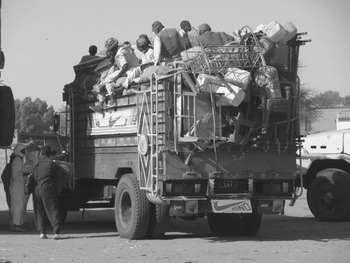
Travelling has always been accompanied by minor as well as major hazards and hardships, especially in places like the Sudan and on tracks like the Forty Days Road. Apart from the usual hazards of travelling in a hostile and menacing environment, especially in the dry season, the nature of the tracks itself poses many dangers ranging from mechanical breakdown or getting stuck in the sand to highway robbery, overturning of vehicles, and death. Before an imported lorry is commissioned for service on routes like the Forty Days Road, it is therefore converted into a Sudanese lorry: its chassis is strengthened and other modifications are carried out to make it fully operational for off-road purposes (Hänsch Reference Hänsch2009; Beck Reference Beck, Gewald, Luning and van Walraven2009). Lorries usually carry an assortment of spare parts and tools, and, before setting out, lorry drivers make sure that they have adequate provisions of food and water on board. In fact, lorries on the Forty Days Road rather resemble ships at sea, whose crew and passengers are largely self-contained. When a lorry begins its 800 km journey from the river (see Figure 1), lasting a week or longer, there is no guarantee whatsoever that passengers and crew will arrive safely at the other end. Moreover, travelling on a lorry usually means being wedged close to other travellers, while luggage is piled on top of the freight and exposed to whatever the climate may offer. If the freight consists of sacks of flour or sugar, squatting on these may even provide some comfort if other passengers leave one enough space to stretch one's limbs from time to time. But if the freight consists of sheep, or of sacks full of smelly tobacco from Darfur, or sharp-edged containers, bouncing along the track on the back of a lorry is anything but a pleasure. It is this context that makes people speak of travel as nauc min an-nâr, a kind of hellfire. Travellers are clearly in need of all the roadside assistance, hospitality and protection they can get.
Boarding the truck for Darfur in Abu Hadid, northern Kordofan

If travelling on a truck on the Forty Days Road is like navigating rather rough seas, then the truck stop is the harbour where passengers and crew recover from the arduous voyage. It is the roadside institution where travellers can expect hospitality. In local parlance, the truck stop offers shade (dull), or shelter in the most comprehensive sense of the word – from the sun, from hunger and thirst, and generally from the deprivations of the road.
THE TRUCK STOP
Sudanese people refer to a truck stop as al-mauqif, the station, or simply al-qahâwî, coffee houses – the latter term pointing to the most important feature of the truck stop, the coffee house, al-qahwa, where meals, tea and coffee are served. To arrive at a closer description of the truck stop as a roadside institution, it might be compared to other types of rest stops. A typology of rest stops would comprise four or possibly five different types:
1. The large lorry park in the capital, like Omdurman and El Fasher, the starting and final destinations of the Forty Days Road, situated adjacent to a market area or simply occupying empty spaces in the wholesale market.
2. The isolated rest stop in the desert.
3. The service station along the paved highway.
4. The small-town or village truck stop along the unpaved long-distance road.
A fifth, though distantly related, type could be added, namely the gated overland port (al-mîna al-barrî). Overland ports have recently been constructed at a number of major destinations in an effort to modernize bus travel on the new highways. They exclusively serve large long-distance passenger coaches and resemble airports in that they are highly guarded, formalized and controlled structures.
These types differ from each other in significant ways. The large lorry park, as in Omdurman's Suq Libia or in Suq ash-Shacabi near the Hilal football stadium, may not even be visible to the uninitiated observer, as it tends to melt into the background of the market. Loading, unloading, waiting and servicing of lined-up lorries takes place in the midst of confusing traffic and marketing activities. There will be agents who act as brokers between passengers and lorry drivers, but otherwise there are no institutions related exclusively to long-distance transport. Instead, passengers, as well as drivers and their assistants, use the ordinary facilities of the market – shops, coffee-stalls, restaurants, laundries or mosques – just as other market goers do. They may take a nap in the shade of a shop, but they will not sleep in the market, nor will they depend on the hospitality of other market people.
The isolated rest stop in the desert provides another extreme. It is an institution that exists solely because of the road; there is no other reason for its existence. It typically consists of a single hut near the desert track, usually at junctions or at places where other roads branch off. A corner of the hut or a second hut may serve as a shop with a small assortment of commodities like biscuits and cigarettes for sale. Usually there is a well at some distance, which is used by nomads. The keeper will prepare tea and coffee for his occasional guests, but if they are hungry they should bring their own food, which the assistants then prepare at the fireplace. At isolated places it is quite common for the keeper of the place to charge only passengers for tea and coffee and to refuse payment from lorry drivers. He treats them not as customers but as his guests, and they in turn make sure to leave a jerrycan of sweet water from the river.
Once long-distance roads are paved and thereby turned into high-speed highways, they attract different travellers. And if not different travellers, high-speed highways produce at least a different road regime in which travellers find themselves facing different behavioural expectations. They literally open the way for a different style of travel. Paving entails changes in the mix of vehicles on the road. On the unpaved road, slow-moving two- and three-axle lorries are the rule and small cars – virtually all four-wheel drives – the exception; on the new highways, by contrast, the majority of vehicles are small passenger cars. If not the highway regulations enforced by the traffic police, then the pressure of speed in itself tends to clear the road of ‘undesirables’ – donkey carts, camel riders, flocks of sheep or any other slow-moving travellers. The highway regime tends to inspire different expectations concerning ownership of the road and services as well as different concepts of time and sociability. Transport on the unpaved road is rather undifferentiated; open buses locally converted from Bedford or Nissan lorries travel the unpaved road but the majority of passengers sit on the backs of the lorries together with transported goods. On the paved highway, air-conditioned overland coaches replace the slow lorries. Large trailer trucks appear, together with a fleet of high-speed mini-buses and small cars. The small private cars and the comfortable overland coaches bring a new middle-class clientele with Sudanese middle-class concepts of hygiene, modernity and public order. Therefore, service stations on the highways always provide separate family sections to cater for the needs of female passengers. The numerous truck stops make way for large service stations with a petrol filling station, a shop, a restaurant with plastic tables and chairs, fast food, a self-service coffee-shop, toilets and a mosque, all built in concrete and nicely painted. It seems that the service stations are modelled after Gulf country patterns; they are obviously devised to cater efficiently for the large number of anonymous passengers of private cars and overland coaches, as well as for their tight time schedules. Although lorry drivers would prefer the old-style truck stops where they feel more welcome, these seem unable to compete. Within a couple of years after the paving of a highway, they have disappeared, leaving large empty distances between the new service stations, as has happened over the last twenty years on the highways from Khartoum to El Obeid, Khartoum to Port Sudan via Atbara, and Omdurman to Dongola. This leaves not exactly non-places – as Marc Augé (Reference Augé1992) has called spaces devoid of sociability – but certainly places where sociability is much reduced.
In the following sections, I concentrate on the small-town or village truck stop along the unpaved road. This is a social space of a distinct type. In contrast to the lorry park in the market area of the city, it has its own roadside institutions. It differs also from the desert rest stop and the highway service station, in design as well as in function. Whereas the highway service station serves the highway and nothing else, and whereas its sociability is of a rather limited and fleeting kind, the small-town truck stop caters for the needs of travellers in a much more sociable way. Moreover, it also serves as a gateway to small-town Sudan and its hinterland.
THE EMERGENCE OF TRUCK STOPS ON THE FORTY DAYS ROAD
The development of truck stops is obviously connected to the appearance of commercial motor lorries in larger numbers. Although the arrival of the automobile in the area dates back to the early twentieth century, when a motorized unit took part in the Anglo-Egyptian invasion of the Sultanate of Darfur in 1916,Footnote 4 until the end of the Second World War automobiles travelling in the northern parts of Darfur or Kordofan were rare exceptions and served mainly administrative purposes.Footnote 5 But in the late 1950s and the 1960s, when the transport industry flourished all over the Sudan (Abu-Manga Reference Abu-Manga, Schlee and E. Watson2009: 143; Duffield Reference Duffield1981: 116), privately owned commercial motor lorries began to displace the camel caravans in the long-distance haulage of commodities (Hesse Reference Hesse2002: 150).
Truck stops started to appear in the 1970s. Before this, lorry drivers had either set up camp for the night near the road, fending for themselves, or called on the hospitality of a shopkeeper along the road. To facilitate the first of these options, Sudanese long-distance trucks are equipped with a wooden box for cooking utensils and another one for provisions, both attached side by side to the roof of the driver's cabin. This is one of the basic modifications carried out on Sudanese lorries, mentioned earlier. It is on these boxes that the driver's assistants sit when the truck is moving, a sort of automobile crow's nest. From their look-out station the assistants learn to navigate, to recognize landmarks and to assess the properties of the road. From there they bring utensils and provisions when it is time to prepare meals and tea. In the earlier days of the road regime, camps along the road were sited at convenient places, usually after difficult passages through wâdîs or sand dunes, wherever shade and with luck a fresh breeze could be found to cool the truck's engine, to pass the hottest time of the day, or to spend the night. When herds were nearby, migrant Arabs would occasionally come to offer milk and share tea and conversation. But camping out in the deep desert was always surrounded by a certain unease, and encounters with strangers were never free of suspicion. In those days, travelling the Forty Days Road had the character of an expedition, even more so than today when traffic has become denser. Truck drivers were therefore happy to join other trucks at convenient places.
In the 1950s and 1960s, drivers with their assistants also used to depend on the hospitality of the shopkeepers along the road, even if they did not deliver at the shop, and so did the passengers. It was also common practice for the shop's customers to stay for tea or partake in meals prepared when they happened to be around. These isolated shops at watering places continue to provide a local meeting place where news and goods are exchanged. Some of the shopkeepers became legendary for their hospitality, like Muhammad al-Hassan, one of the Jallâba merchants in Hamrat al-Wizz, near Jabal Haraza, who used to feed the whole market with a local-style breakfast of asîda (millet porridge) every Thursday.
This hospitality was not a one-way trade. Apart from acquiring a reputation along the road and being preferentially served with goods, news and gossip, shopkeepers who extended their hospitality to travellers became roadside intermediaries, brokers and patrons. Those who enjoyed their hospitality reciprocated with favours like bringing newspapers (in the 1960s and 1970s a much-valued present), carrying out orders, taking passengers aboard or delivering messages (before the mobile phone). At the same time, those in need of transport for goods or wishing to travel were expected to go through the intermediaries of the roadside regime to gain access to the road. Certainly more was being exchanged at these roadside shops than commodities; reciprocal arrangements clearly extended into the spheres of the social and the micro-political. For the Jallâba merchants hospitality provided opportunities to cultivate their status and networks. But, above all, by providing hospitality to the travelling folk the shopkeeper also provided a service to his community that might be described as the domestication of the foreign. By sheltering travellers, he transformed them from being unconnected, and thus potentially harmful, strangers into guests who would in turn feel committed by obligation to their host and his community.
Today, at peak times, as many as twenty, thirty or even more lorries may pull in and park up at larger truck stops. Exchanges between road and roadside have become much more anonymous. The early hospitality regime worked well for the time when there was maybe a lorry per week. But as traffic increased, local shopkeepers became overburdened, especially when they were of the bachelor type and could not depend on female domestic labour, as was often the case on the western trading frontier. Increasing traffic outgrew the capacity of private hospitality, Muhammad al-Hassan's legendary example notwithstanding – and this should be regarded as one of the reasons for the emergence of truck stops. They became particular spaces created especially for the reception of strangers, and thus had the effect of unburdening local society of the potential and actual claims made by a growing number of strangers travelling along the road.
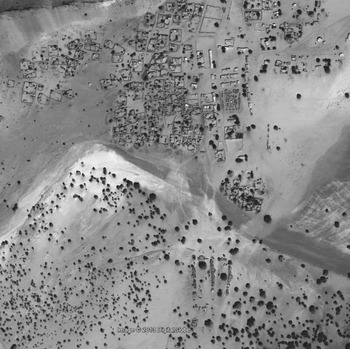
Today's truck stops are usually located at some distance from the markets and especially the residential quarters (see Figure 2) – but not all the stops on the Forty Days Road are like this, and other arrangements used to be more common. In the early days of the truck stops, it was especially small-town merchants who lobbied for the road to lead right into their markets. However, inhabitants' pressure and local government intervention have in most cases succeeded in keeping the road and the travelling folk at a safe distance from residential areas. In places where this is not the case there are clear tensions around the truck stops and the road more generally – materializing, for instance, in stones or other obstacles placed in the way of the lorries. This seems mainly because the settlements' inhabitants feel uneasy about the transit through their midst of strangers whom they do not know and certainly do not control. Lorry drivers are also notorious for damaging cultivation and evading compensation. Moreover, people detest the noise near their homes and fear for the safety of their children and domestic animals. They also feel embarrassed and upset when lorries, with passengers perched on top of their towering loads, pass by their homesteads – inevitably exposing the intimacy of domestic life behind their fences to the strangers' gaze from above.
Location at a distance in Umm Badir, northern Kordofan. The three rows of coffee houses comprising the truck stop in the lower half of the picture are set at a distance from the rectangular market area and the adjoining residential areas in the upper half of the picture, and separated by the U-shaped course of the wadi, which is seasonally flooded. © 2013 Google

Location at a distance is obviously compatible with the interests of drivers. They generally tend to regard crowded places like markets as unsafe, and some of the more complex truck stops have acquired a bad reputation for harbouring thieves and all kinds of crooks, simply because there are too many strangers around and the effort to watch their lorries and freight keeps the drivers and their assistants on edge. Besides hospitality, security is one of drivers' most important criteria in selecting truck stops and choosing between alternative routes. In many places so-called barryas, outlying truck stops at a distance from small towns and villages, have developed. It can already be inferred from the roadside's built environment – as the current end product of social action and decision making – that it is in the interests of neither the travelling nor the resident populations to mingle in an uncontrolled, direct way. Instead, a well-defined and circumscribed interaction is sought, which in turn has led to the emergence of the truck stop as a mediating roadside institution.
SMALL-TOWN TRUCK STOPS I: MEDIATING INSTITUTIONS
Small-town truck stops cater for the needs of travellers in a much more sociable way than the service stations along the highway, and they also serve as gateways to small-town Sudan and its hinterland. I see them as providing the social infrastructure for the secure commercial channelling of persons and commodities. Some of their services derive from their function as gateways to their respective towns and, seen from the towns and their hinterlands, to the capital and the world at large. The truck stops thus provide the space for institutionalized roadside practices of connection and transfer between the mobile and the sedentary, the transient and the local; they thus emerge as border spaces that also keep both sides safely apart from each other.
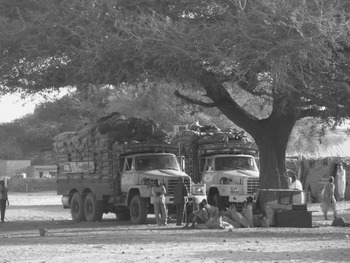
Resting at the truck stop, Umm Badir, northern Kordofan

Truck stops are places of arrival or departure for travellers, who sometimes are seen off or greeted by family and friends, and they are places for the handling of incoming and outgoing goods. They are places where news arrives, but also places where news and social commentary is produced. All important comings and goings are registered here: the governor's arrival; the passing of army vehicles, food aid trucks, or the well-boring rig; the latest movements of the veterinary team, various missionaries, merchants and notables – but also of less conspicuous travellers. In fact, one of the thrills of the sometimes rather boring life at the truck stop is finding out who exactly the newly arrived travellers are, and what their purpose for coming is. Nobody can hope to go undetected; the truck stop thus emerges as an instance in the unobtrusive scanning of the road's flows. Those who populate the truck stop can offer the most interesting news, advice and gossip available in the surrounding district.
Apart from this more privately gathered and disseminated interest in the road's flows, there is a dimension of state control, especially pronounced in times of crisis – as in the early 1980s towards the end of Nimairy's government (1985); in the early years when the present government (after 1989) tried to extend its power over the Sudan; as well as during the revolt in Darfur (after 2003). In the truck stops of larger towns, drivers have to show their freight declaration (al-manifistû) and pay local government fees; in smaller places, there may be simply al-khaima, the tent, where an isolated policeman tries to make a modest living from the passing trucks. Standing beside the flagged-down lorry, he might open his negotiation by asking: ‘What is on that lorry?’ and the driver might respond: ‘Just goods for El Fasher’, upon which the policeman might continue: ‘A loaded lorry like this one, surely there is something on it?’ leaving open what that something could be. The driver might give in at that point and covertly hand over a small bill or he might resist and say: ‘We come from afar, our pockets are empty, by God!’ The discussion might then go on, and in the end the driver will hand over a small banknote. But most drivers voluntarily step down from their seat to enter the tent and hand over something amidst handshakes and laughter, just to avoid embarrassing talk of this kind.
Like the European railway station in the era when the railway was still the main means of transport (Richards and MacKenzie Reference Richards and MacKenzie1986), the truck stop, like the market, is one of the main hubs in a small town, the only one in which travellers take part. The truck stop provides the opportunity to buy food, meat, vegetables and fresh bread, even when the main market is closed in the evening and on Fridays, because business in the station is not geared to the cycles of small-town life, but to the flow of traffic. And, like the railway station, the truck stop tends to be perceived as attracting all kinds of vagabonds and youth with a desire for the outside world, at least as seen from the perspective of reputable small-town Sudan. Lately, television clubs have become fashionable; before the age of satellite television and videos, playing cards attracted young men to the coffee houses in the evenings. But except for persons who earn their living there, the truck stop is generally considered to be appropriate only for strangers who have no home and for those who flee home; neither nomads nor villagers nor the citizens of the market would spend their time at a truck stop without a well-defined purpose – though they might spend such unscheduled time in the market. In fact, as seen from the perspectives of the mosque and the family, the truck stop is surrounded by vague fears of contagion, although the risk of actual infection with diseases for which lorry drivers and truck stop personnel are usually held responsible – namely sexually transmitted diseases, especially HIV – seems extremely low, as compared with other African countries (Chen et al. Reference Chen, Jha, Stirling, Sgaier and Daid2007).
Although spatially and socially at a distance from the market and the residential areas, the truck stop, providing the main channel for the flow of goods, has an inherent institutional link to the market. The link is personified in the licensed forwarding agent, al-kumusanjî. Usually, there are two or even more forwarding agents for passengers and freight at a truck stop. Goods which enter the small-town market from the road or leave the market are forwarded through the truck stop. Even if they do not pass through the truck stop physically – as in the case of live animals, for example – they are handled by a forwarding agent. Those who intend to travel or have freight transported contact the forwarding agent, who looks for a driver from the arriving trucks willing to take them. He is usually also the one to suggest the fare. Before the mobile phone era, it was consistently through him that orders for commodities in Omdurman or in the small-town market were placed. Traders in the market who had run out of goods would contact him and it was he who collected the orders and sent them via a driver to a trader in Omdurman with whom he had an understanding. When, on the other hand, an Omdurman-based trader sent money with an order for livestock or melon seed, the main export commodities of the region, the forwarding agent would act as a middleman with the local traders. Transaction models differed according to the mode of payment: the money was sent with the order or only after the purchase of the commodities had been concluded at the other end. Sometimes, when small-town market traders signalled that there was a scarcity of goods, the forwarding agent independently placed an order with a driver to bring back the desired commodity, for instance a load of grain, from Omdurman. In other cases, the forwarding agent just ordered a so-called ‘mixed lorry’ (carabiyya mushakkila) without detailing the order, and his business partner at the other end sent a lorry loaded with grain, sugar, soap and oil plus whatever he deemed appropriate.
After a lorry with market goods has arrived, the driver and his assistants, as well as the passengers, will relax in the truck stop; the forwarding agent will then board the lorry and steer it to the market, where the ordered goods are delivered and unloaded. If goods have not been ordered for a previously fixed price, the driver will indicate his minimum price and the forwarding agent will negotiate on his behalf. At the end of the day, he will collect the payments from the shopkeepers and deliver them to the driver. If the lorry has unused transport capacity he will also assemble freight for the driver. For his services, he will take a fee from the party which has commissioned the deal.
Knowledge of the road regime and information are quintessential for the forwarding agent to maintain a smooth flow. Usually, a forwarding agent has worked as a lorry driver himself or has been involved in the transport business in other capacities before becoming eligible for this office. He should be acquainted with the drivers who usually travel the line and their professional backgrounds, and he should know their whereabouts and their plans. Though this sort of knowledge is essential, the forwarding agent's most important asset is trust. Large amounts of cash and even larger amounts of credit pass through his hands. He mediates between traders and drivers who are not linked by a contractual obligation and, in most cases, do not even know each other; the only guarantee that they will get what they have ordered, or their money, is the forwarding agent's professional integrity to both parties.
The function of the truck stop, namely to mediate and to connect, but also to keep apart, thus crystallizes clearly in the role and practice of the forwarding agent: he takes goods which pass from road to town under his custody, and he shields the mobile and the resident links in the transport chain from each other.
SMALL-TOWN TRUCK STOPS II: MOORING TRANSIENT MOBILITY
As Muhammad Bashir, a forwarding agent in a small town called Umm Badir for more than thirty years related:
I remember that I came back from Omdurman in 1974 and I found a couple of lorries, all Bedfords, under the acacia tree over there. They intended to travel the recently opened al-Kharta road west. It was during the rains. The Wadi Hayy Mut was flooded. So they had to wait. They stayed for several days under the acacia, sleeping under their lorries and spending the hot hours of the day in their shade, and the assistants cooked their food. So I talked to some people in the market. We had a real problem with drinking then, you know, and if we could convince the liquor-producing women to stop their trade and instead open coffee houses for the people of the lorries we would solve two problems at once. You see? We would serve public order and the travellers – the drivers would tell their colleagues who would in turn be attracted to take the road via Umm Badir. Well, that was the beginning.
In this conversation in early spring of 2011, Muhammad drew attention to the truck stops' function as nodal points in the network of trans-regional, regional and smaller feeder roads. As junctions, they are places of interchange, where other roads branch off from the main road; as relay stations they provide for the needs of transit travellers and for the basic maintenance requirements of vehicles. They supply the travellers with food in restaurants and with tea and coffee in coffee houses, as well as with an assortment of soft drinks, biscuits, batteries, and other travel-related goods in their shops. Shops sell credit for mobile phones and charge them – if connected to a diesel generator or a solar panel, as has become fashionable lately in the better-organized truck stops. Coffee houses offer local beds, so called anqaraib, simple wooden frames plaited with cowhide strings, for spending the night and resting during the hot hours of the day. Larger truck stops provide simple showers and a laundry where lorry drivers can leave their clothes for washing and ironing, picking them up on their way back. The better-equipped truck stops have a store where fuel, lubricants and a small assortment of spare parts are on sale. Contrary to the service stations on the highway, there are no filling stations at the truck stops. Petrol is sold directly from the usual 44-gallon barrels; it is mostly for local use. Lorry drivers make sure that they carry enough fuel on board to reach and return from their destinations, which again points to the expedition-like nature of travelling the unpaved road. Drivers and their assistants might make some extra money by selling empty, and sometimes not so empty, barrels along their route. It has also become quite common to find a tyre repair shop at a truck stop, and a workshop with welding equipment where, with the help of the driver and his assistants, a local craftsman is able to carry out basic vehicle repairs. But this picture reflects the situation in 2012, forty years after the emergence of the first truck stop in Umm Badir. Muhammad has already drawn attention to the circumstances of its emergence. Engineers and construction lorries had opened a new track to a settlement project for nomads 50 kilometres west of Umm Badir, which was started in 1969. The road's name, al-Kharta (the map), was derived from the observation that the engineers used maps for travelling. Once opened and found practicable, al-Kharta became an important section of the Forty Days Road.
Muhammad has also drawn attention to the main institutions of the truck stop, the coffee houses. It is the coffee houses which provide shade and rest, water, tea, coffee and food. In the east, near the Nile, they are operated by men with the help of boys; in the west, they are operated exclusively by women, usually widowed or divorced local women, sometimes with the help of their daughters, for whom the coffee houses provide an income to support their families. In fact, the growth of the truck stops should be regarded as related to the banning of local beer and alcohol production, and the home entertainment offered to drinking customers. As Muhammad has already suggested, the truck stops provided a niche for otherwise destitute females at a historical moment when other niches started to be persecuted and later outlawed as harâm by state legislation (Beck Reference Beck, Stiansen and Kevane1998: 269–71).
Apart from the coffee house keepers, the truck stop is an all-male world. ‘Respectable ladies’ should not be seen there. If they have to travel, the forwarding agent usually negotiates for them to be picked up at their homes or a convenient private home near the road; on the road they tend to stay in the lorry's cabin; if they have to alight at a truck stop, they attempt to disappear into the background of some coffee house, and try to attract as little attention as possible.
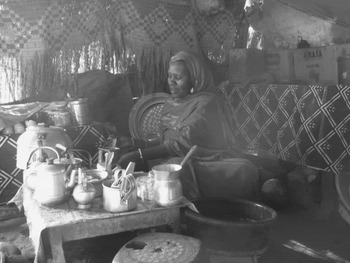
The coffee houses are the main performance spaces for truck stop hospitality. The keeper usually sits at the entrance, the open area of the truck stop well in sight, amidst an arrangement of charcoal stoves and kitchen utensils (see Figure 4). After nightfall, whenever the sound of an approaching lorry engine is heard from afar, the coffee house keepers will light a lamp, or simply a can of waste oil, whose flare promises hospitality to the lorry driver at a distance. When arriving, the driver will stop in front of the coffee house of his choice, open bonnet directed into the wind for the heated engine to cool, and while relaxing inside he will have his resting lorry under visual control. The passengers on the back of the lorry might choose a neighbouring coffee house; those occupying a cabin seat will accompany the driver. Greetings and inquiries about the whereabouts of common friends are exchanged. Having spent long hours on the lorry, the visitors quickly make themselves at home. The lorry's crew will commandeer the place, ordering tea, coffee and food. Should they wish to prepare their own meal, the driver's assistants will serve themselves liberally with whatever kitchenware they need; they will occupy the cooking place and even send the keeper to buy cooking oil, onions, meat, bread and whatever they need for preparing the meal.
Providing hospitality. Coffee house keeper on the Forty Days Road

Drivers approach truck stops as welcome social spaces in which to build their reputation among the trucking community. Apart from acting as hosts for their passengers, at least those occupying a front seat, they will inevitably meet friends and colleagues whom they invite to share their meal or tea; alternatively they may try to settle the bills of other parties before they can do so themselves. Usually, these gestures of generosity play out in an atmosphere enlivened by much joking and laughter, but at times they reach the level of virtual contests of generosity. If the usual offer of ‘Itfaddal, tastarîh!’ (sit down and share), is declined (‘By God, I have already eaten!’) one may hear: ‘Well, then drink tea! Wa calay at-talâk! (Otherwise I will divorce my wife!)’ The threat may be a jest but, nevertheless, it would be considered extremely impolite or even rude to continue to refuse. Locals, who happen to be nearby, stand aloof or even flee such showdowns of generosity. Leftovers of the meal may go to the coffee house keeper or, more properly, to her children, but for adult men to accept hospitality from strangers in their own country would turn the social order upside down.
Travellers waiting for transport sometimes stay for several days. They will sleep in a coffee house and spend their days waiting and socializing with the coffee house keepers. Lorries may be on the road for several weeks, and it is especially the drivers' young assistants in their early teens who become very familiar with the coffee house keepers. Lorry crews and drivers, in particular, are treated like guests who own the place as their home and are provided with every comfort the truck stop can offer. In fact, the whole arrangement is one of close familiarity with a clear undertone of ownership. Practices of this kind of hospitality come close to what could be called a temporary household.
Indeed, arriving from the midst of the desert to the coffee house is like the experience of coming home, especially for those living on the road by profession. It regularly occurs that lorry drivers have spent all their money in trade goods at the outset of their journey west, and arrive at the truck stop without means to pay. Still, they and their assistants do not have to go hungry, as the keeper of their coffee house will usually extend credit until they come back eastwards on their return journey and settle their debts. And to accept credit means to accept a bond beyond the settling of debts, for the creditor has made the personal offer of a relationship built on trust. Lorry drivers who have accepted credit once are willing, and obliged, to come back again, and will also feel a strong obligation to provide favours and small services to the keeper, and vice versa. Repeated visits, gifts and return gifts, and the experience of receiving a warm welcome after long hours on the road tend to foster long-lasting ties of familiarity and closeness. Seen from the perspective of drivers and crew who have travelled the road for years, they can rely on a number of these temporary domestic arrangements along the road to the west, like a series of comforting havens.
In spite of this blatant familiarity, guests are still clients who are obliged to pay. The hospitality of the coffee house is commercial hospitality. The coffee house is not home but it emulates ‘the comforts of home’, an opportune expression coined by Luise White (Reference White1990) for the comprehensive domestic services of prostitutes in colonial Nairobi. The contrast it offers to the anonymous hospitality industry of service stations along the paved highways is due to its domestic character, and it also differs significantly from the practices of domestic hospitality beyond the truck stop in its commercial nature.
According to northern Sudanese customs, however, for a female coffee house keeper to provide this comprehensive sort of hospitality to strangers is morally marginal, to say the least. In contrast to domestic hospitality outside the truck stop, this kind of hospitality – ‘keeping the stones close to the eggs’ or allowing close familiarity between otherwise unrelated females and transient males – changes ambiguously into a temporary domestic arrangement blurring the boundaries between the status of host and ownership.
Although people strictly avoid talking about it, truck stops provide the space for all sorts of little tragedies that are inevitable in road to roadside relations, like illegitimate romantic affairs, children without fathers, abandoned mothers whose travelling friends are matrimonially anchored somewhere else, all of which point to the truck stop's role as a boundary-maintaining institution. One day in early March 2011, I travelled west on the Forty Days Road with a driver from the Nile Valley who had worked the Forty Days Road intermittently for many years, and whom I will call Yasin. We shared the spacious cabin of his 40-ton Hino with a middle-aged woman and her young daughter, who had paid an extended visit to relatives in Omdurman. Apparently, she had been exposed to high doses of Nile Valley Islamic moral teaching, which she used the opportunity to impart to us. After trying to establish common acquaintances in the west with Yasin and me, she steered the conversation into stories with a moral conclusion. Yasin listened reluctantly and became rather silent, until he finally decided to bring her back to reality by casually remarking: ‘I have a son in Hamra.’ She interrupted her sermon and he continued with unusual frankness: ‘But I'm not married to his mother.’ As she was silent now, he explained: ‘I used to know her and, when travelling the line, I made it a point to arrange for a break in Hamra. But you know how it is. I eventually married – from my own people, of course, and I'm settled with my house and family, as you have seen when we took our provisions.’ Catching my questioning glimpse, he said: ‘Yes, these children are all mine and those of my brothers, except the one who serves as an assistant on the lorry.’ Turning back to the woman, he continued: ‘You see, I have a good wife, and then I worked the road to Port Sudan and Egypt and forgot about the whole affair. But some months ago, I took the road via Hamra again and met her there. And it was then that she presented my son to me. He is twelve years old now. Do you want to know what I said to her?’ The woman, taking it for granted that Yasin's former girlfriend had pressed for support, and eager to take Yasin's side in the anticipated quarrel over money, replied: ‘Surely, you said “Work and earn your living yourself!’” ‘No,’ Yasin said, ‘nothing of that kind. She is a good woman. She still works her coffee house. I told the boy that I would support him, whether he chooses to continue school or learn a trade, I would support him until he has finished. I even told my wife. She is a good wife, she understands.’
It should come as no surprise, then, that truck stops and especially coffee houses have been subjected to a moral discourse about respectability and propriety time and again, and that these debates have also inevitably turned into a legal discourse that is resonant with the Sudanese Islamic public order laws. At certain truck stops, a local government order is in force according to which female coffee house keepers should leave the truck stop by 10 p.m. and only return in the morning after 6 a.m. For all those travellers who arrive late in the night, it is considered entirely natural simply to take possession of a coffee house, and even to remove obstacles positioned to deter intruders. What leads to heated discussions, however, is the regular complaint of night-time guests that they find the place deserted and have to wait until the keeper arrives at daybreak to prepare their tea. This reminds us of another salient point often noted in hospitality studies. Hospitality may be about establishing common ground and a space of welcome for the stranger, but it is also about the host who establishes the rules, and the space, for welcoming and sociability, and who guards the boundaries.
KEEPING EGGS AND STONES APART
Roadside sociability is thus contained within the truck stop. This becomes obvious from the built environment as well as from the forwarding agents' quarantine-like practices around their relations of trust and the coffee house keepers' practices of hospitality. In fact, the truck stop itself emerges as the institution to channel sociability between the road and the town. It is another instance of keeping ‘the egg well away from the stone’. Seen from the town and its hinterland, the truck stop is the mediating institution that confines passing strangers and their possible claims on hospitality and contact within a circumscribed domain – one staffed by the marginals and professional go-betweens of small-town Sudan. Seen from the road, the truck stop is the accommodating haven, providing travellers with ‘the comforts of home’ while preventing access to the society beyond.
‘Hospitality is produced through the negotiation of movement and mooring. Even a world of constant mobility must sometimes stop,’ Molz and Gibson remark in their book Mobilizing Hospitality (2007: 14; cf. Hannam et al. Reference Hannam, Sheller and Urry2006). Indeed, somewhere down the road the engine has to cool down, the travellers need to stretch their limbs and find some rest, the cargo has to be unloaded and reloaded. If we have come to think about the world as in perpetual flow, which is certainly an appropriate metaphor for imagining exchange, transport, travelling and the road in general, then we also have to think about the spaces where these flows meet and interchange and where they are absorbed by, merely anchored temporarily in, or repelled by more solid structures. Without wishing to overstretch the metaphor, we can think of these spaces – like customs departments, departure halls, toll stations, free port zones, road blocks, quarantine stations, detention camps for migrants and all sorts of waiting rooms – as membranes the properties of which regulate permeability, and the associated practices as their properties. Some of these membranes are clearly governed by hostility, while others are regulated by hospitality as their dominant mode of sociability, and among the latter we can clearly count the truck stops with their promises of roadside comfort.
In a nutshell, truck stops as spaces for the enactment of hospitality thus emerge as the social infrastructure for the secure managing of incoming and passing travellers and goods. Having created a welcoming, though restricted, space of transfer and transit for all the strangers that the road inevitably brings with it, society beyond the truck stop can afford an attitude of indifference towards these strangers and their potential claims.
ACKNOWLEDGEMENTS
I owe a debt of gratitude to several institutions for their generosity in funding and supporting field research, among them the University of Khartoum's Department of Social Anthropology and Sociology, the University of El Fasher, Deutscher Akademischer Austauschdienst, Deutsche Morgenländische Gesellschaft, Stiftung Volkswagenwerk and Deutsche Forschungsgemeinschaft. I am also indebted for criticism and comments provided by colleagues at the universities of Bayreuth, Göttingen, München and Khartoum, at the London School of Economics, at the conference of German-speaking Anthropologists in Vienna (2011), as well as by the participants of the workshop ‘The Makings and Uses of Motor Roads’ in Thurnau castle and, finally, by this journal's anonymous reviewers.