INTRODUCTION
The Mediterranean Sea, with some 1800 native species of Mollusca, is currently inhabited by 216 alien Mollusca (Zenetos, Reference Zenetos2009). The majority of the introduced species are of Indo-Pacific origin found mainly in the eastern basin of the Mediterranean (Gofas & Zenetos, Reference Gofas and Zenetos2003).
The alien Mollusca of Cyprus have been reported by Demetropoulos (Reference Demetropoulos1971); Demetropoulos & Hadjichristophorou (Reference Demetropoulos and Hadjichristophorou1976); Tornaritis (Reference Tornaritis1987); Cecalupo & Quadri (Reference Cecalupo and Quadri1994, Reference Cecalupo and Quadri1995, Reference Cecalupo and Quadri1996); Buzzurro & Greppi (Reference Buzzurro and Greppi1997) and summarized in Ozturk et al. (Reference Ozturk, Buzzurro and Avni Benli2004). Later records include Cooke (Reference Cooke2005); Sanchez Villarejo (Reference Sanchez Villarejo2007); Delongueville & Scaillet (Reference Delongueville and Scaillet2007, Reference Delongueville and Scaillet2008). Thirty-five out of 645 (5%) of the species of molluscs cited from Cyprus (Cecalupo & Quadri, Reference Cecalupo and Quadri1996; Buzzurro & Greppi, Reference Buzzurro and Greppi1997; Ozturk et al., Reference Ozturk, Buzzurro and Avni Benli2004) are alien. This work reports on additional sightings of alien Mollusca reported in literature after the CIESM Atlas (Zenetos et al., Reference Zenetos, Gofas, Russo and Templado2004) and the publication of Ozturk et al. (Reference Ozturk, Buzzurro and Avni Benli2004) and adds significant information on the spread of reported alien species and on the occurrence of new ones.
MATERIALS AND METHODS
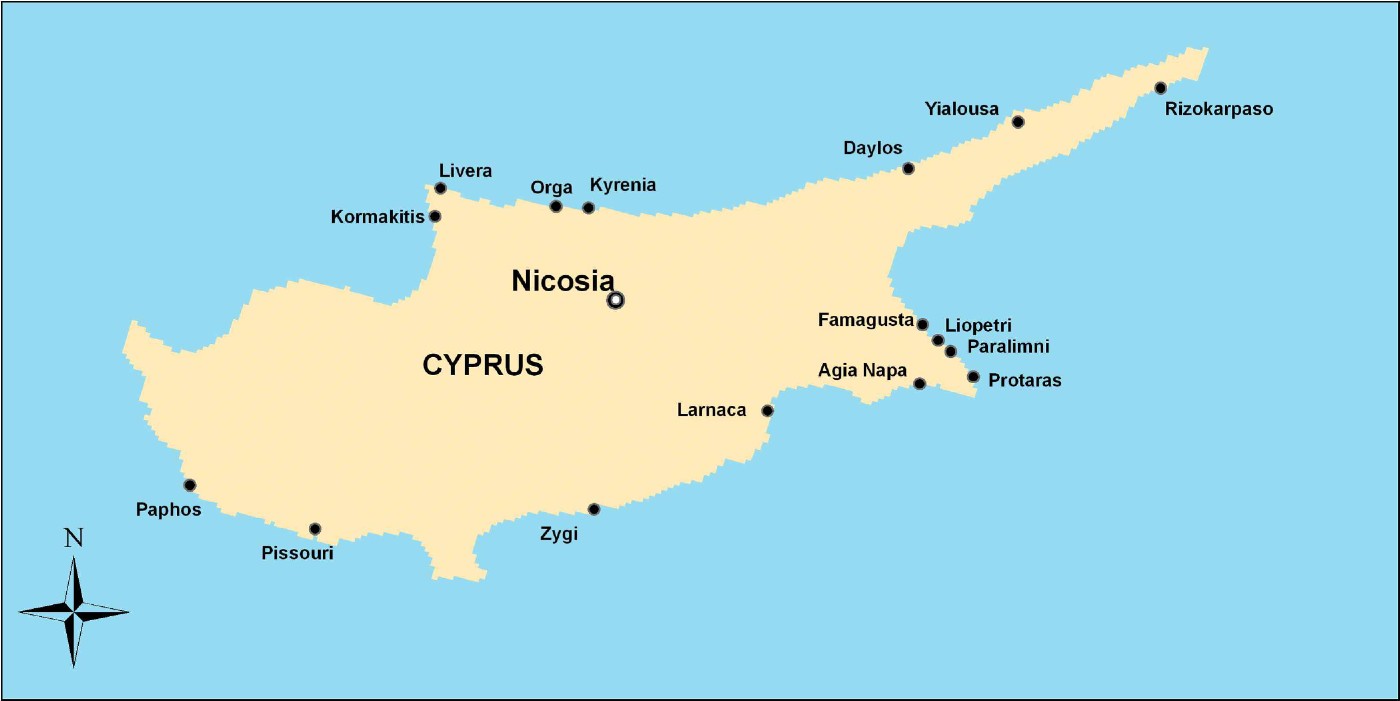
The material was collected and photographed at 13 shallow water sites (0–5 m) located along the coast of Cyprus (Figure 1) in the period from 1980 to 2009. Some species were caught alive and others found in beached material. The first record date is only indicative. Some species may have been introduced in the 1980s when they were also recorded in South Turkey. However, they were not sought after and the authors (F. & G. Konstantinou) could only visit the north coast after July 2004. Furthermore, recent literature (after 2004) on the occurrence of alien species in Cyprus was reviewed.
Sites of molluscan collections.

RESULTS
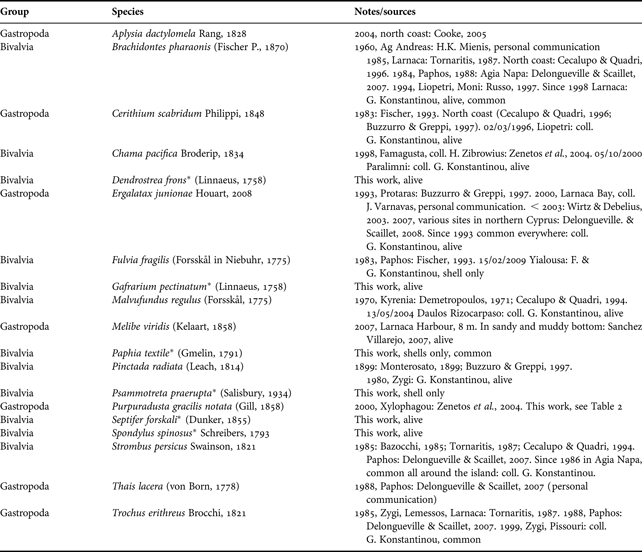
The literature review revealed three species Aplysia dactylomela (Cooke, Reference Cooke2005), Melibe viridis (Sanchez Villarejo, Reference Sanchez Villarejo2007) and Thais lacera (Delongueville & Scaillet, Reference Delongueville and Scaillet2007). Sixteen alien species were collected alive and/or as shells. Details on their distribution are provided in Table 1. With the exception of Psammotreta praerupta they are all well established species in the Levantine basin. The majority of them have been recorded from Cyprus. Dendrostrea frons, Gafrarium pectinatum, P. praerupta, Paphia textile, Septifer forskali and Spondylus spinosus constitute first records for the country. Outstanding is also the finding of Fulvia fragilis, a well established Indo-Pacific species whose occurrence in Cyprus has been controversial (Fischer, Reference Fischer1993, Reference Fischer1994).
List of alien mollusca (in alphabetical order) collected in Cyprus and/or reported since 2004.

*, denotes new species.
Notes on selected species
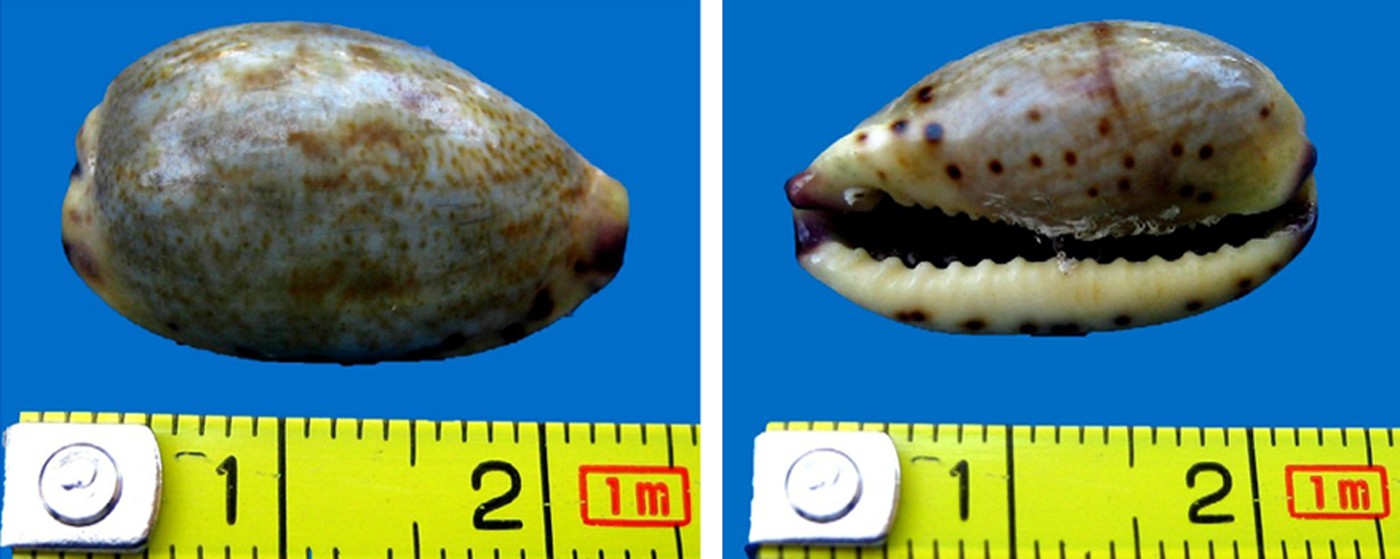
PURPURADUSTA GRACILIS NOTATA
Purpuradusta gracilis notata originates from the eastern Indian Ocean and tropical western Pacific (Lorenz & Hubert, Reference Lorenz and Hubert1993). The species was initially reported in 1981 from Israel (Mienis & Singer, Reference Mienis and Singer1983; Barash & Danin, Reference Barash and Danin1986). Later it was reported from southern Turkey (Bloecher, Reference Bloecher1983 (as Palmadusta gracilis); Engl, Reference Engl1995; Buzzurro & Greppi, 1996) and from Lebanon (Bitar & Kouli-Bitar, Reference Bitar and Kouli-Bitar1999).
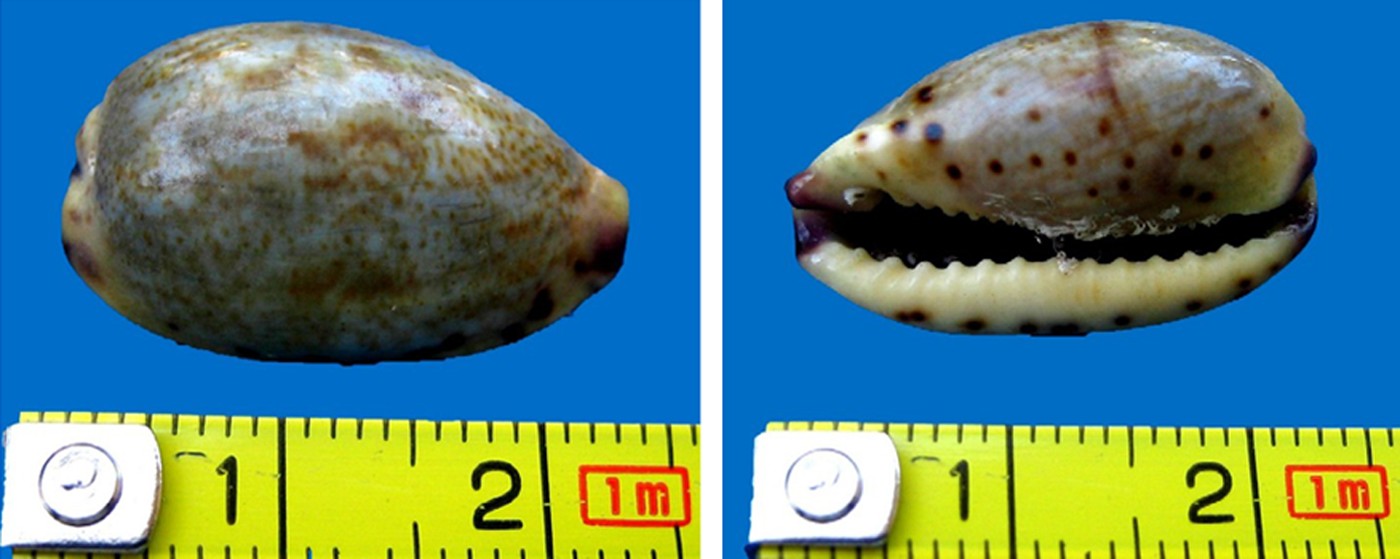
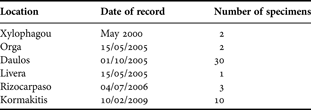
In Cyprus two live specimens were collected on rocks at the low water mark from the Xylophagou area in May 2000 (Zenetos et al., Reference Zenetos, Gofas, Russo and Templado2004). Since then Purpuradusta gracilis notata has been collected on shallow sublittoral rocky bottoms, from various sites around the island of Cyprus (Figure 2). The species has been all the more abundant after 2005 (Table 2).
Purpuradusta gracilis notata. Photograph: G. Konstantinou.
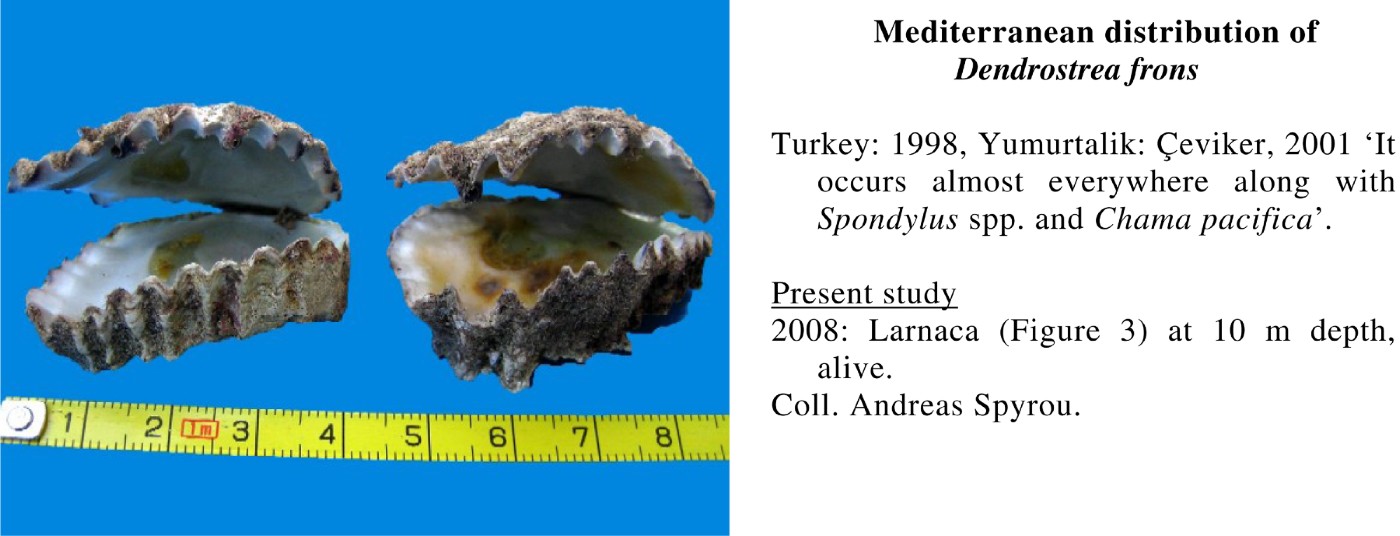
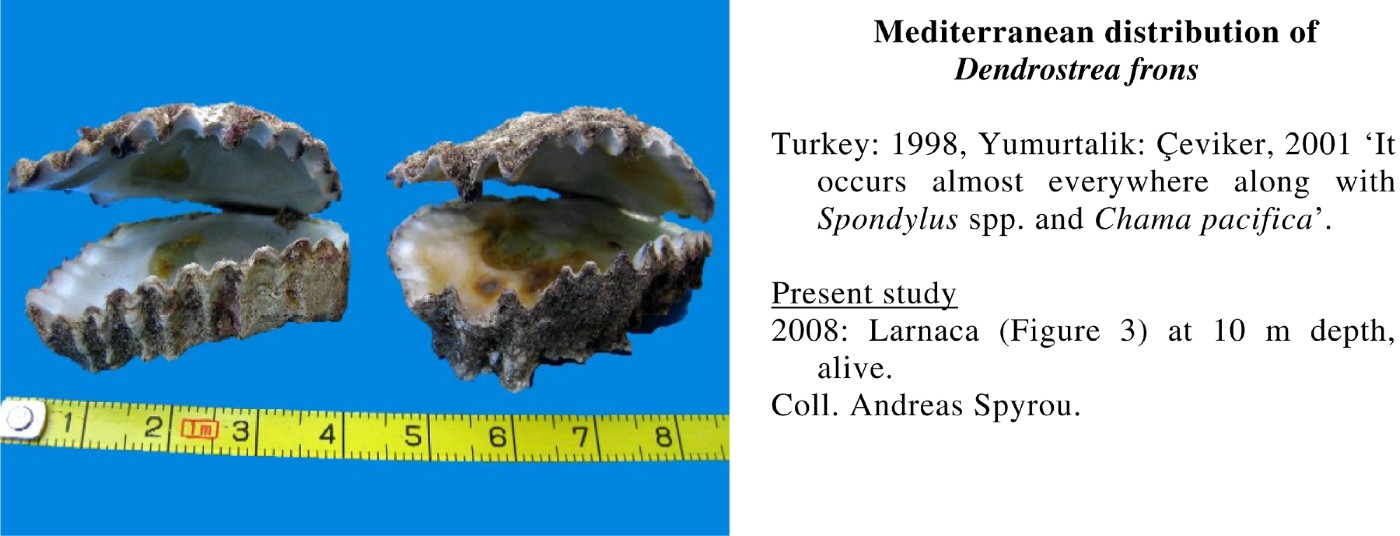
Dendrostrea frons. Photograph: G. Konstantinou.
Sites at which Purpuradusta gracilis notata has been collected.

Dendrostrea frons
GAFRARIUM PECTINATUM
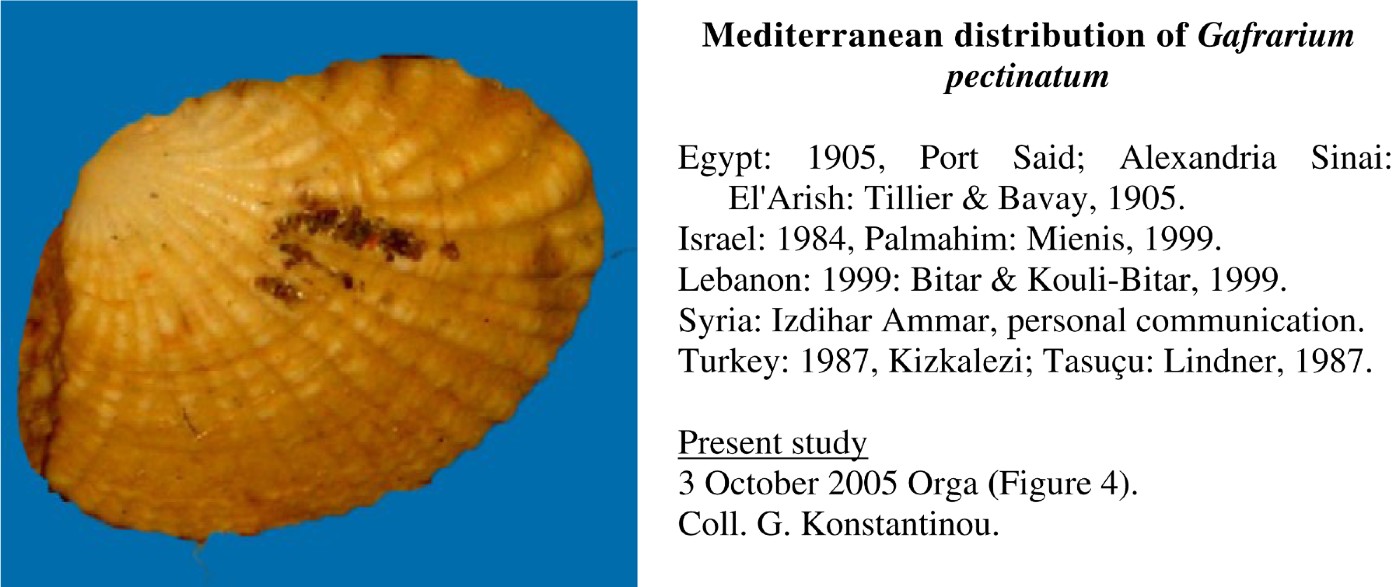
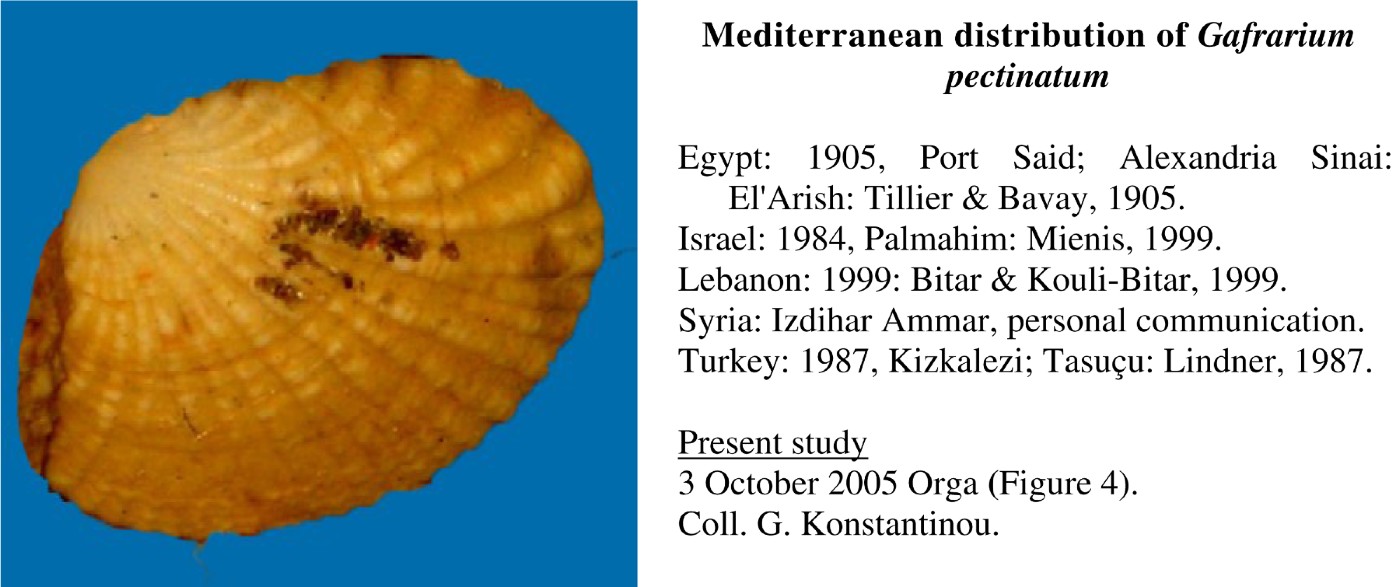
This species has worldwide distribution: and has been found in the Indo-Pacific, including the Red Sea and Gulf of Suez (Oliver, Reference Oliver1992). It is sold in the market at Alexandria. In the last ten years, along the Mediterranean coast of Israel, its status has changed from an occasional Indo-Pacific immigrant to a successful lessepsian colonizer (Mienis, Reference Mienis1999).
Gafrarium pectinatum. Photograph: G. Konstantinou.
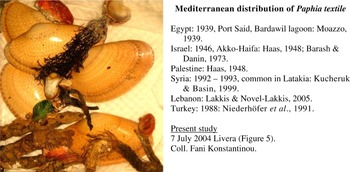
Paphia textile. Photograph: G. Konstantinou.

PAPHIA TEXTILE
Paphia textile also has worldwide distribution. It is present in the Indo-Pacific, including the Red Sea and Gulf of Suez (Oliver, Reference Oliver1992). The species is common in deep waters along the coasts of Israel and south-east Turkey.
PSAMMOTRETA PRAERUPTA
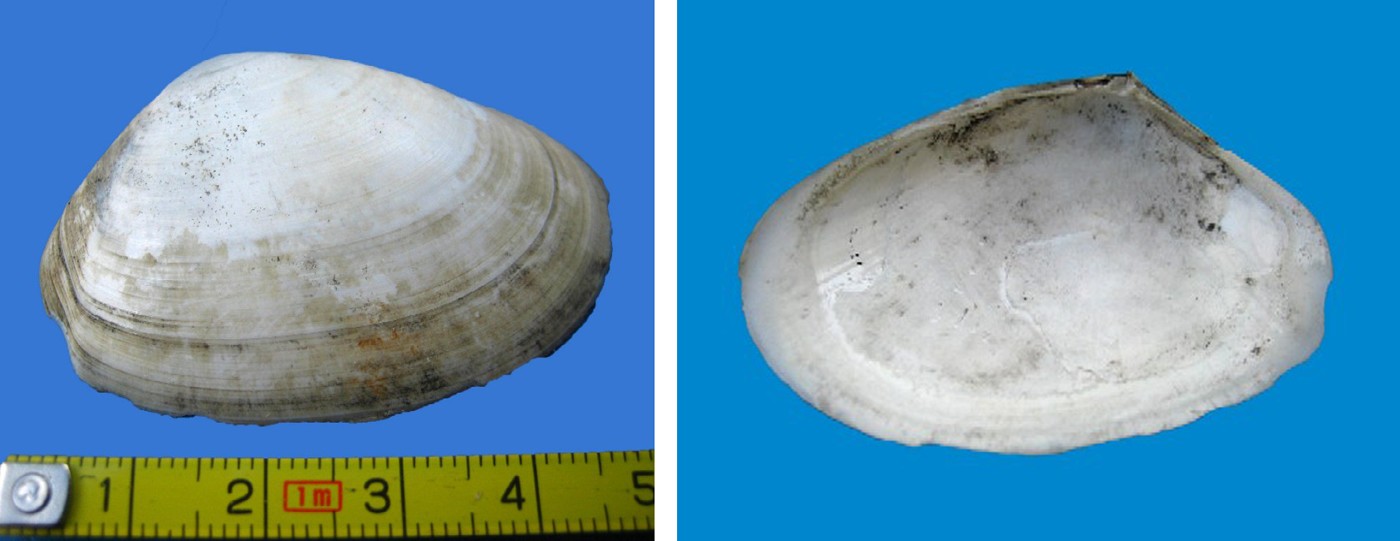
There is some controversy concerning the identity of Psammotreta praerupta reported (Salisbury, 1934). Although it is mentioned by Oliver (Reference Oliver1992) found in the Red Sea, the real P. praerupta is a species from the Philippines. In fact, two closely related but separate species seem to occur in the Red Sea; however, no species have been identified with certainty (H.K. Mienis, personal communication). In the Mediterranean P. praerupta has been found in Turkey (Engl & Çeviker, Reference Engl and Çeviker1999) where four valves were dredged from 120–180 m of muddy substrata in 1992 off the coast of Adana. A later finding is from Lebanon (Lakkis & Novel-Lakkis, Reference Lakkis and Novel-Lakkis2005). One valve was found in the present study, beached in Larnaca Bay in March 2009 (Figure 6).
Psammotreta praerupta. Left, inside; right, outside. Photograph: G. Konstantinou.

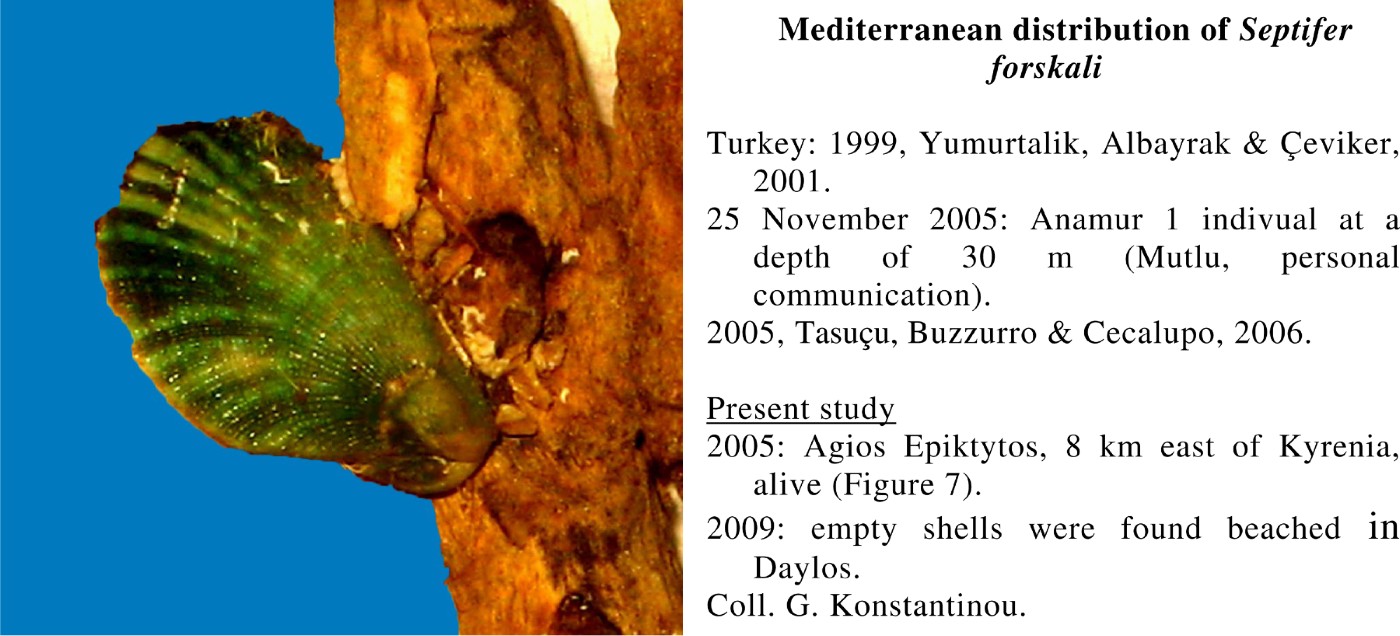
SEPTIFER FORSKALI
This species is present in the Suez Canal (Moazzo, Reference Moazzo1939 as Septifer bilocularis var. forskali). Septifer forskali is a small species of less than 1 cm in length, from the Red Sea and Persian Gulf. The real Septifer bilocularis does not occur in the Red Sea or the Persian Gulf (it is found in the eastern Indian Ocean), it does not have the coloured rays in the pattern and grows to at least 2.5 cm in length.
Septifer forskali. Photograph: G. Konstantinou.

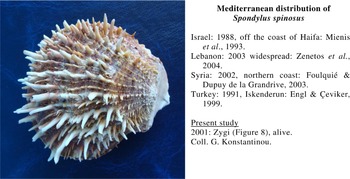
Spondylus spinosus. Photograph: N.J. Xentidis.

SPONDYLUS SPINOSUS
This species is distributed worldwide. Found in the Indo-Pacific, the Red Sea and is a well established species in the Mediterranean. Off the northern coast of Israel it occurs in dense populations of up to 15 specimens per m2 (Mienis et al., Reference Mienis, Galili and Rapoport1993). Along the Turkish coasts there are also stable and reproducing populations as demonstrated by the many upper valves of juveniles found in shell grit at Iskenderun (Engl & Çeviker, Reference Engl and Çeviker1999).
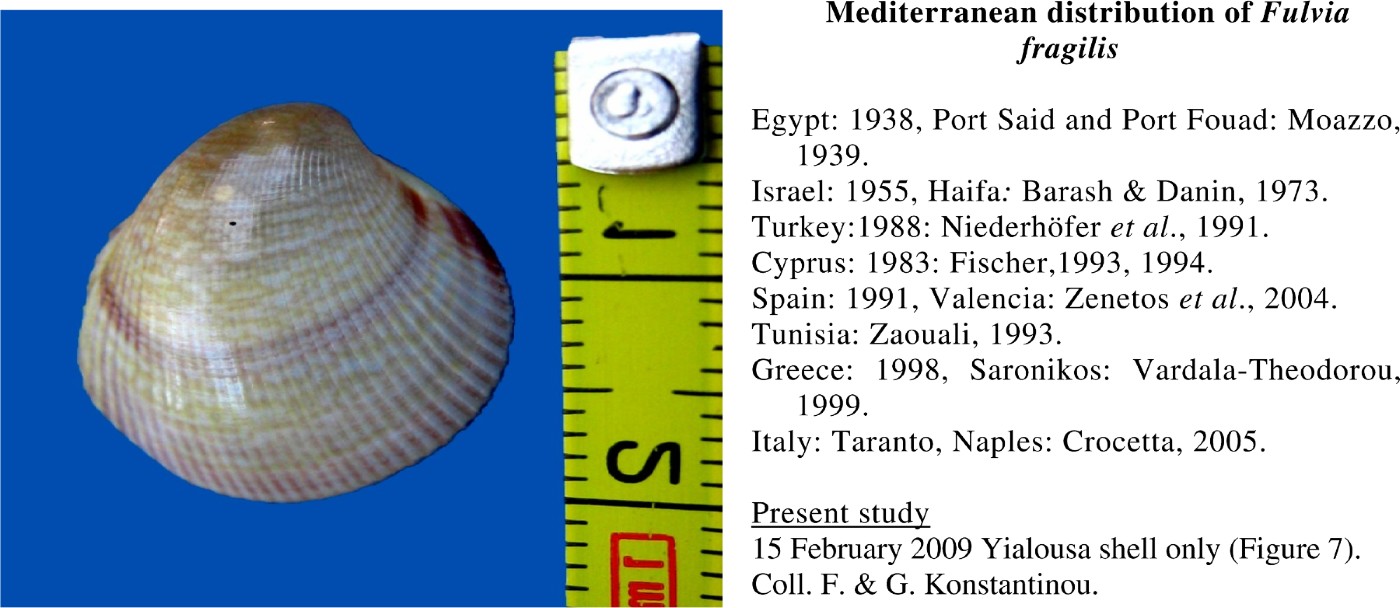
FULVIA FRAGILIS
Fulvia fragilis (Figure 9) originates in the western Indian Ocean, Persian Gulf and Red Sea (Vidal, Reference Vidal1994). In the Mediterranean it was presumably introduced via the Suez Canal. According to Passamonti (Reference Passamonti1996), the species must have expanded its distribution to Tunisia through Egypt and Libya; introduction into Tunisia is attributed to anthropogenic intervention and must be excluded due to the fact that the area in which it was found is only visited by small local boats. Recently Fulvia fragilis was recorded from the Italian seas, found at Calambrone (Livorno), at Castellaneta Marina (Taranto) and at several stations in the Gulf of Naples (Crocetta, Reference Crocetta2005; Crocetta et al., Reference Crocetta, Renda and Colamonaco2008).
Fulvia fragilis. Photograph: G. Konstantinou.

Fischer (Reference Fischer1993) mentioned the species as a fossil, under the name Papyridea papyracea. However, in his more recent work (Fischer, Reference Fischer1994), he amends the occurrence of F. fragilis as a fossil, and reinstates it as a contemporary species. The species has been repeatedly collected from the Paphos area since 1983.
DISCUSSION
In addition to six new species reported in this work, the literature review has revealed another three new alien species, namely Aplysia dactylomela (Cooke, Reference Cooke2005), Melibe viridis (Sanchez Villarejo, Reference Sanchez Villarejo2007) and Thais lacera (Delongueville & Scaillet, Reference Delongueville and Scaillet2007). The finding of Fulvia fragilis among our species is outstanding, as it was an Indian Ocean species widespread throughout the Mediterranean whose presence in Cyprus was debatable (first reported as fossil, then revised to be a contemporary species).
All the reported alien Mollusca around the Cypriot coast have an Indo-Pacific origin. They are widely distributed in the Levantine basin and have presumably been introduced via the Suez Canal, either as lessepsian immigrants (Cerithium scabridum, Trochus erithreus, Malvufundus regulus, Pinctada radiata and Brachidontes pharaonis) or their settlement has been assisted by shipping (e.g. Ergalatax junionae, Fulvia fragilis, Strombus persicus, Chama pacifica and Spondylus spinosus).
The new reported species, excepting Psammotreta praerupta, are also among the successful colonizers presenting the typical distribution pattern of lessepsian immigrants. Purpuradusta gracilis notata, an Indo-Pacific cowry known from the Levantine basin, is currently well established on the Cypriot coast. More than 50 adult specimens were collected between 2002 and 2009 from seven sites in both northern and southern Cyprus.
Considering the 35 species reported in the CIESM Atlas (Zenetos et al., Reference Zenetos, Gofas, Russo and Templado2004) and Ozturk et al. (Reference Ozturk, Buzzurro and Avni Benli2004), as a standpoint, nine aliens are added. This brings the total of alien mollusca to 44, which is 7% of the total molluscan fauna of Cyprus. This number lacks behind the 128 alien Mollusca reported by Galil (Reference Galil2007) off the Israeli coast. Similarly, along the Turkish Levantine coast Cinar et al. (2006) calculated that alien mollusca reach 16.1% of the total fauna (79 species). In a sample from Kyrenia, in northern Cyprus, six species out of 76 (7.9%) were lessepsian but they represented only 13 specimens of a total of 527 (2.5%) (Gofas & Zenetos, Reference Gofas and Zenetos2003).
Our results indicate that the major expansion of tropical and subtropical alien arrivals which started after the opening of the Suez Canal is continuing onwards. It is assumed that temperature is a major factor influencing the settlement of tropical alien species.
Considering the molluscan species diversity of the Mediterranean, it is clear that alien species represent more than 10% of the total species of the area, reaching up to 20% in the Levantine basin (HCMR database; Zenetos & Fraggos, Reference Zenetos and Fraggos2008).
It should be highlighted, however, that the process of data collection is inadequately and unequally monitored in Cyprus as it is in most Mediterranean countries and many taxa merely go uninvestigated. Notwithstanding the low number of alien species reported to date in Cyprus, it is a safe assumption that the number of alien species is higher. We are facing an homogenization of the Levantine Sea biota where the fauna is, and will continue to be, a mixture of the old and the newly settled species.
ACKNOWLEDGEMENTS
The authors are grateful to Dr E. Vardala-Theodorou (Goulandris Museum of Natural History, Kifissia, Greece), Mr H. Mienis (Mollusc Collection, Tel Aviv University and Hebrew University of Jerusalem) and Dr H. Dekker (Zoological Museum, University of Amsterdam) for confirming identifications and also Ms Christiane Delongueville and Mr Roland Scaillet for communicating details on the finding of Thais lacera and Brachidontes pharaonis and Mr J. Varnavas for providing details on Ergalatax junionae and Purpuradusta gracilis notata.