What is the effect of international law on foreign policy preferences? The number of treaties has grown dramatically in recent years as many states are increasingly placing their faith in international agreements to improve outcomes across a variety of issue areas.Footnote 1 On matters ranging from the environment to war, actors often turn to international treaties in the hopes of facilitating compliance and solving common problems.
Despite this rising prominence, debates over international law's effectiveness remain far from settled. In response to proponents of international law, skeptics counter that international agreements are simply a function of existing power and interests, having no genuine autonomous effect.Footnote 2 Resolving diverging views regarding international law's effects is frustrated by several empirical and methodological challenges.Footnote 3 Of foremost concern, joining an agreement is voluntary, meaning countries ratifying a treaty may differ in crucial ways from those refusing to do so. These selection effects make it difficult to determine whether any changes in preferences or behavior are due to the treaty itself, or rather baseline differences between ratifying and nonratifying countries. Apparently strong findings for international law remain vulnerable to charges that they simply reflect what states would have done anyway in the absence of an agreement.Footnote 4
Even when there is consensus regarding the promise of international law, the exact sources of treaties' impact continue to be contested. Many approaches focus on states as the most relevant actors for uncovering the potential benefits of international agreements.Footnote 5 The extent to which research in this vein considers nonstate actors can be seen when assessing the role of domestic elites.Footnote 6 By contrast, a number of recent scholars offer a “bottom-up” alternative emphasizing the importance of domestic politics and the public.Footnote 7 Far from sitting on the global sidelines, domestic groups are key players explaining patterns of enforcement and compliance with international commitments. International law may provide new information to citizens, legitimate demands, and empower groups to mobilize and pressure their governments to abide by treaty provisions. Alongside the challenges involved in testing the general impact of international law, evaluating these domestic mechanisms is further complicated by the limits of available data and resulting reliance on indirect supporting evidence. Recent research has had to employ rough proxies, such as regime type or interest group size, to test domestic arguments even though these measures may also capture unrelated processes.Footnote 8
In this study, I seek to fill both of these gaps in the international law literature by providing systematic evidence of the causal consequences of international agreements on domestic mass politics. I complement existing observational studies by leveraging the use of experiments embedded in a pair of U.S. national surveys. Using an experimental design minimizes problems posed by selection effects that characterize much of the existing research on international law. Querying mass publics also allows me to examine more directly one of the core claims underlying domestic approaches to international law—that treaties transform public preferences.Footnote 9 By offering evidence of public preferences toward treaty commitments, the findings strengthen the microfoundations of existing domestic theories of international law.Footnote 10
I create a hard test for international law by investigating public attitudes toward torture. When dealing with matters of national security, laws constraining the use of force are often the first to be breached.Footnote 11 Examining an issue that epitomizes concerns over “high politics” provides a tougher trial for international law. If public preferences over an issue as controversial as torture can be influenced by international law, then treaty effects are likely to be pronounced across other issues as well.
I find that international law does indeed exert a significant effect on public preferences toward torture, which challenges the doubts of many skeptics. Respondents exposed to international law are less likely to condone the use of torture even in situations that heighten support for such practices. The public does not appear to be equally affected by all elements of an agreement. Going against presumptions in the legalization literature,Footnote 12 the findings suggest that the level of obligation has little effect on public attitudes, while the extent of precision and delegation figure more prominently. Not all members of the public, however, view international law in a similar manner. Liberals and conservatives respond in systematically different ways to legal appeals, while conservatives actually turn out to be more sensitive to the level of legalization in an agreement. Taken together, the findings shed light on the general effects of international law on public preferences, the design of international agreements, and the role of domestic groups for compliance.
The article is organized as follows. The first section provides a brief overview of the nature of international laws governing torture. The second section presents the main argument linking international law and legalization to changes in public attitudes. The third section describes the experimental design and reports the results from the analysis. The final section discusses the findings' implications.
Torture and International Law
In many respects rules against torture possess a privileged status in the corpus of international law across several issue areas.Footnote 13 Because torture is considered a “grave breach” of the 1949 Geneva Conventions, it qualifies as a war crime.Footnote 14 Prohibitions are equally widespread in the related area of human rights, which offers protections during times of both war and peace. While only an informal pledge, the 1948 Universal Declaration of Human Rights (UDHR) outlawed the use of torture against any individual under any circumstances.Footnote 15 This was followed by a binding agreement with the 1966 International Covenant on Civil and Political Rights (ICCPR). Unlike many other rights covered by the ICCPR, the ban on torture could not be derogated from, even in times of public emergency.Footnote 16 Prohibitions on torture were reaffirmed and expanded in the 1984 Convention against Torture (CAT), where parties took the additional step of delegating away a significant amount of national sovereignty through the principle of universal jurisdiction.Footnote 17 Universal jurisdiction allows any state to arrest and try an individual suspected of committing a violation, regardless of the nationality of the accused and victim, or of the country where the offense took place.Footnote 18 The prohibition on torture thus occupies a pride of place in international law, where the extensive use of such practices has been further codified as a “crime against humanity.”Footnote 19 Some proponents even argue that torture has obtained the status of ius cogens, or a peremptory norm of international law from which no derogation is ever permitted, though this claim remains contested.Footnote 20
Despite the prominence of international rules outlawing torture, a large gap is evident between legal principles and the actual rhetoric and practices of many states.Footnote 21 Higher levels of repression are especially common when governments face war or other severe military threats.Footnote 22 Research confirms that compliance with human rights treaties declines when states are confronted with challenges to their security.Footnote 23 During wartime when pressures over security are often at their maximum, the laws of war also appear to provide few constraints against violations.Footnote 24
Debates over the merits of torture are closely tied to threats to national security.Footnote 25 The tension between law and security was summed up succinctly by former U.S. Vice President Richard Cheney shortly after the 11 September 2001 attacks, when he declared the U.S. government would need to work on the “dark side” to defeat terrorists.Footnote 26 In a confidential memo justifying the inapplicability of the Geneva Conventions, former Attorney General Albert Gonzales further argued that the war on terror “renders obsolete Geneva's strict limitations on questioning enemy prisoners and renders quaint some of its provisions.”Footnote 27 Yet justifications for torture are not owned by one end of the political spectrum—liberal political philosophers including Bentham accepted that conditions existed under which “torture might be made use of with advantage.”Footnote 28 While still stressing the moral issues involved, just war theorist Walzer similarly acknowledged there could be circumstances where political leaders were warranted to use torture on utilitarian grounds.Footnote 29
The willingness to contravene international rules governing torture seems to apply not only to governments but equally their citizens. Across several countries publics are more likely to support aggressive foreign policies and restrictions on civil liberties when feeling increased threats to their security.Footnote 30 Despite revelations of U.S. abuses at its base at Guantanamo Bay in Cuba and the Abu Ghraib prison in Iraq, public attitudes toward torture did not shift significantly in response; if anything, support has risen in recent years.Footnote 31 These trends appear to echo Lasswell's warning during the Cold War that fears over security lead the public to accept limits on laws and liberties, allowing their government to become a “garrison state.”Footnote 32
Even many proponents of international law might readily admit that for matters of national security skeptics may have a point.Footnote 33 When facing extreme threats, torture thus represents a relatively hard test for international law's effectiveness in shaping the public's attitudes. On the other hand, if international law reduces support for torture, then legal commitments may also have the potential to shape public preferences across other issues.
Theory: International Law and the Public
Recent studies of international law increasingly look inward to investigate the domestic sources of compliance and enforcement. Domestic accounts have been developed across a wide range of issue areasFootnote 34 but are especially prominent in the realm of human rights. Unlike many other issues, human rights agreements address the conduct of governments within their own borders rather than interactions among states.Footnote 35 As a result, states are generally reluctant to enforce human rights norms in repressive foreign countries, despite some notable exceptions.Footnote 36 Conventional mechanisms explaining compliance, such as mutual gains, reciprocity, or reputational concerns, are also less relevant for human rights.Footnote 37 Examining domestic groups and the public at large thus offers an attractive alternative for explaining the limits and potential of international laws dealing with torture or other human rights issues.
Even in the laws of war, where the authority of states is traditionally paramount, attention to domestic mechanisms proves useful for understanding patterns of compliance. Morrow finds noncompliance during wartime is most pervasive in those issues exhibiting greater potential for violations by individuals or small groups of soldiers.Footnote 38 Chemical and biological weapons, which are often tightly controlled by higher authorities, display a fairly decent track record of nonuse. By comparison, civilians and prisoners are more vulnerable to depredations by troops on the ground. Although violence against noncombatants is often directed by the leadership,Footnote 39 a long line of research explains wartime violations in terms of small group or individual-level factors.Footnote 40
Alongside wartime contexts, other empirical research shows the importance of domestic groups for upholding human rights norms. Findings that human rights practices tend to improve only in democratic ratifiers, and can even be counterproductive under autocratic regimes, may be partly driven by the relative potential for domestic constituencies to press their governments for change.Footnote 41 Other research indicates human rights treaties are most effective in countries with strong civil societies, where nongovernmental organizations (NGOs) and public activism are more prevalent.Footnote 42 New democracies may join human rights agreements to “lock in” democratic rule in the hopes that ratification will embolden the public to blunt any lingering authoritarian elements.Footnote 43 In general, human rights regimes are expected to function most effectively in circumstances where there is a lively civil society and robust public engagement.Footnote 44 The question that follows, and largely remains untested, is whether international treaties can independently shape public preferences in the first place.
One of the core claims of “bottom-up” approaches is that international law has a distinct impact on the mass public's beliefs and preferences. Legal theorists point to particular attributes of law, including generality, nonretroactivity, and consistency, that differentiate legal norms from other forms of social organization.Footnote 45 These characteristics create a sense of “fidelity” among citizens who subject themselves to legal rules. While law has a deterrent function through threats of material punishments, individual obedience is more frequently driven by beliefs about the law's legitimacy.Footnote 46 This normative function of legitimacy is especially relevant in the international sphere where the deterrent effects of international law are usually weaker.Footnote 47 International law exhibits a similar “compliance pull” based on its unique pedigree, equality, and coherence compared to nonlegal international norms.Footnote 48 Even those skeptical of legal principles' preeminence acknowledge some of these distinct attributes of international law compared to other types of norms.Footnote 49
Possessing a particular authority, law also frequently serves an educational role by transforming the very beliefs of citizens.Footnote 50 Legal norms communicate “messages” to individuals regarding potential penalties for violations, but they also strongly signal the legitimacy of the rules contained in the law.Footnote 51 International law functions as a device for transmitting information to domestic actors. At its most basic level, treaties may supply details on the compliance behavior of states, which makes it easier for citizens to hold their leaders accountable. Treaties also serve as focal points for coordination among domestic groups and legitimate their demands.Footnote 52 More broadly, international law can instill new ideas regarding human rights.Footnote 53 International law thus offers the potential to alter or heighten public preferences concerning human rights abuses, including torture.
The domestic promise of international law needs to be balanced against more skeptical views regarding the public. Earlier public opinion scholarship largely questioned the degree to which the masses hold stable and meaningful preferences, especially for foreign policy.Footnote 54 In this view, the information and ideas purportedly transmitted by international treaties would have little impact because of the inchoate nature of domestic audiences. However, a large body of more recent work suggests a much greater level of stability and coherence in mass publics' foreign policy preferences.Footnote 55
Coherent preferences do not necessarily imply the public is sensitive to legal appeals. Although many realists assume the American populace is averse to their worldview,Footnote 56 recent research suggests the public is fairly comfortable with realpolitik thinking. Far from being captive to “simple moralistic and legalistic terms of absolute good and absolute evil,”Footnote 57 public support for international law and institutions is more nuanced and far from automatic. In a recent comprehensive study of American support for the use of force, the most significant determining factor was expectations for victory rather than concerns over the war's rightness.Footnote 58 The public is also more likely to reject cooperation through international institutions in favor of unilateral action when core national security interests are at stake.Footnote 59 Even instances involving stronger support for international institutions may be driven more by realist motives. Favoring multilateral solutions during military interventions is often a function of instrumental desires to improve burden sharing rather than concern over international legitimacy.Footnote 60 Furthermore, during times of extreme threat, national publics have sometimes been quite supportive of actions contrary to international norms.Footnote 61 Instead of becoming a force for the spread of international law, the public may actually represent a formidable obstacle.
The Level of Legalization
Recognizing the potential for international law despite some of these concerns, a growing number of studies have investigated the effects of different types of agreements.Footnote 62 One of the most prominent classification systems involves an agreement's level of legalization based on three dimensions—obligation, precision, and delegation.Footnote 63 Empirical efforts to assess the effects of legalization are unfortunately even more problematic than for international law in general, since the prior stage of treaty design also needs to be taken into account.Footnote 64 There has also been little attempt to examine the impact of legalization on public opinion. The existing literature nevertheless points to several expectations regarding the role of each legalization component on foreign policy attitudes.
First, obligation refers to the degree to which rules are legally binding as opposed to noncompulsory principles of intent. For instance, the 1975 UN Declaration against Torture offered some general guidelines, but many of these rules became formally binding only under the 1984 CAT. Obligation is frequently believed to exert the most influence among the three legalization components.Footnote 65 As Guzman notes, “A formal treaty represents the most serious form of commitment … because it is understood to be a maximal pledge of reputation.”Footnote 66 Publics are consequently presumed to be more likely to punish their leaders for breaking formal international commitments.Footnote 67 Because of greater public accountability, audience costs are thought to make the promises, as well as threats, of democracies more credible.Footnote 68 Recent experimental work on coercive bargaining suggests the size of audience costs increases with the escalation level of threats from which a leader subsequently backs down.Footnote 69 Translated to international law, citizens should be expected to attach greater value to more “serious” treaties involving higher levels of obligation.
There are several reasons to remain cautious regarding the role of obligation. Levels of state compliance often remain impressive even for softer nonbinding norms.Footnote 70 For instance, international agreements of varying obligation levels have had largely similar impacts on human rights practices in Latin America.Footnote 71 Furthermore, a study of minority rights in Europe found that most actors “simply are unaware of the differences in hardness among the norms” in terms of the degree of obligation.Footnote 72 This does not necessarily imply European actors were not influenced by international law. Rather, both political elites and the wider public tended to view binding and nonbinding rules as an undifferentiated “monolith.”Footnote 73 This suggests public attitudes may not be significantly affected by the degree to which an agreement is legally binding.
Second, precision concerns how unambiguously an agreement defines key terms and specifies appropriate conduct. For instance, the laws of war vary greatly in the clarity with which certain acts are considered violations.Footnote 74 Precision can set clearer standards for behavior and limit confusion over the terms of the agreement.Footnote 75 Prioritizing precision is consistent with the managerial school, which argues that ambiguity in rules is one of the most common sources of noncompliance.Footnote 76
The informational role of international law in several domestic accounts similarly suggests more precise agreements should transmit clearer signals, which consequently should have a greater ability to shape the preferences of domestic actors.Footnote 77 Rationalist approaches stressing the importance of precision are in many ways complemented by constructivist scholars, who point to how international law creates shared understandings around norms such as torture—a process facilitated by a clearer sense of the terms of international rules.Footnote 78 Even though precision is frequently relegated to the least consequential component of legalization,Footnote 79 existing work suggests the public is more likely to be influenced by highly precise agreements.
Third, delegation concerns how much authority is granted to third parties to interpret and enforce an agreement. In contrast to claims regarding international law's weak enforcement capabilities, recent treaties have delegated increasing amounts of authority to international organizations.Footnote 80 Third parties, such as the World Trade Organization (WTO) or the International Criminal Court (ICC), now wield far greater influence in monitoring, adjudicating, and enforcing their respective bodies of international law.Footnote 81 The enthusiastic willingness of many citizens to directly petition the European Court of Human Rights, resulting in a backlog of tens of thousands of cases, suggests the behavior of mass publics can also be significantly affected by heightened powers of delegation.Footnote 82
Greater levels of delegation can also affect compliance by functioning as a deterrent. The social control approach in domestic legal studies emphasizes the role of promised rewards, or threats of punishment, to secure the compliance of individual citizens.Footnote 83 The logic of this view parallels the enforcement school of international law, which stresses the need for the threat and imposition of negative sanctions to ensure actors abide by commitments.Footnote 84 If the public is similarly concerned over the potential negative consequences for their country or officials resulting from violations, then agreements exhibiting higher levels of delegations should have a greater effect on support for torture.
Variation in Individual Preferences toward International Law
Although international law and legalization can shape public preferences, their effects are unlikely to be the same across all groups. A number of sociodemographic characteristics, such as gender or education, explain many differences in foreign policy preferences, though rarely with reference to both international law and the use of violence.Footnote 85
Of the wide range of possible traits or political orientations influencing policy preferences, one receiving some of the most theoretical and empirical attention concerns political ideology—usually measured on a liberal or left versus conservative or right continuum.Footnote 86 Several studies find leftist governments are more likely to support international agreements, especially for human rights.Footnote 87 Presuming such governments reflect in part the interests of left-leaning societal coalitions, their leftist supporters may be similarly predisposed toward legal appeals. The greater emphasis of liberals on principles of equality and community is thought to translate into stronger preferences for multilateralism and international institutions, while the hierarchical ideals of conservatives lead to more intense skepticism of such institutions and inclinations toward greater self-reliance.Footnote 88 In turn, it might be expected that liberal respondents should be more influenced by appeals to international legal principles compared to their conservative counterparts.
Differences in views rooted in political ideology may not be constant, but rather a function of other contextual factors. In particular, security threats might either heighten or suppress the gap in policy attitudes across different political orientations. Recent research indicates American citizens across the ideological spectrum demonstrated heightened levels of support for torture when reporting greater fears of future terrorist attacks.Footnote 89 Other work further suggests that higher levels of threat reduce the impact of individual attributes on opinions toward restrictions on civil liberties or the use of force.Footnote 90 Differences between ideological groups toward international law might thus be expected to become less salient when national security is involved.Footnote 91
An alternative line of research counters that the American public has become increasingly polarized across foreign policy issues with political ideology playing a crucial role.Footnote 92 In the immediate aftermath of the 2001 terrorist attacks, several polls indeed showed that liberals reflected more conservative positions on civil and political liberties.Footnote 93 Looking over a longer period, however, other research finds this initial consensus to be fleeting; the ideological gap has actually increased over time.Footnote 94 There is thus good reason to believe ideological differences might be similarly pronounced when examining attitudes toward international law and torture.
Possible differences in the effects of treaties across certain individual attributes are especially relevant for understanding the conditions under which international law is most likely to influence government policy. The impact of domestic politics on compliance depends in part on the relative political leverage and information that different domestic groups possess.Footnote 95 To the extent that legal appeals can mobilize opponents, or moderate the views of likely “pro-violation constituencies,”Footnote 96 international law may consequently have a constraining impact on governments.
In sum, existing theoretical approaches provide several arguments for why international law and the level of legalization should affect public attitudes toward foreign policy. Whether or not international commitments shape support for practices like torture ultimately remains an empirical question.Footnote 97 What follows is a research design that offers a more direct test of the effects of international law on mass attitudes toward torture.
Research Design and Method
To more directly study the domestic effects of international law while mitigating problems of selection effects, I designed and fielded a pair of survey experiments for the U.S. public. Random assignment increases the likelihood that treatment and control groups are similar to each other on average across all observed and unobserved factors.Footnote 98 By comparing differences in responses between groups, an experimental design can estimate with greater certainty the effect of international law on foreign policy preferences.
Experimental methods, of course, are not without weaknesses. Of particular note are concerns over external validity—the degree to which results are generalizable to broader phenomena of interest.Footnote 99 Subjects may act differently in laboratory settings than in more commonplace conditions. Experiments also reduce scenarios to a few key variables, often implemented over a short time period, compared to the complex and fluid nature of everyday relations. I tried to alleviate these issues by conducting surveys at different points in time, using nationally representative samples, and providing vignettes that closely reflect possible real-world situations.Footnote 100 Keeping these concerns in mind, Druckman and colleagues believe experimental methods are most valuable, “where theory, observational studies, or policy concerns generate contested causal claims and when potential problems such as two-way causation and omitted variable bias plague the statistical analysis of observational data.”Footnote 101 These characteristics exemplify much current research on international law.Footnote 102 The experimental evidence that follows should thus be viewed as complementing previous empirical studies on the effects of international law by providing a basis for further inquiry.
The International Law Experiment
The first survey was conducted through Time-sharing Experiments for the Social Sciences (TESS).Footnote 103 The TESS survey was administered by the research firm Knowledge Networks (KN) and fielded between October and November 2008 to a random sample of 4,665 American adults drawn from the KN panel.Footnote 104 Of those invited to participate, 2,817 agreed to do so, producing a final completion rate of 60.4 percent. KN offers a probability-based panel that covers the entire online and offline U.S. population aged eighteen years or older. The panel thus provides the opportunity to field online surveys to a national random sample of the U.S. population.Footnote 105
All subjects were first presented with the following hypothetical scenario:
• In conflicts ranging from World War I to the present, the United States has often captured combatants from the opposing side. These combatants may have information of interest for the conflict, such as plans for future attacks. Some U.S. officials believe interrogating these combatants through a variety of methods is a useful way to obtain information.
• The interrogation methods would involve torture, meaning they would cause severe pain or suffering.
• The information may, or may not, be accurate or relevant.
Care was taken to ensure the scenario was as realistic as possible, but also that it would not bias support for torture in any one direction. In light of often-heated debates over what constitutes torture, the scenario offers a clear sense of the consequences of interrogating prisoners, while avoiding overly inflammatory language.Footnote 106 I also present a neutral stance on the effectiveness of torture for obtaining intelligence given similar controversy over this issue.Footnote 107
The experimental component of the survey involves randomly providing respondents with additional pieces of information regarding the scenario. For international law, the treatment group was given the following statement: “The interrogation methods would violate international law. The United States has signed international treaties that do not allow the use of these methods under any circumstances.” Those receiving no international law prompt, in turn, make up the control group.Footnote 108 I also included two additional contextual treatments, which past studies show to influence wartime conduct. First, for the nature of the prisoner, the treatment group involved prisoners who were insurgents, while the control group concerned regular combatants.Footnote 109 Second, to assess possible retaliatory motives, the treatment group was told the adversary is abusing U.S. prisoners, while the control group was given no such prompt.Footnote 110 Including three separate binary treatments implies a three-way (2 × 2 × 2) factorial design with eight experimental groups. The full texts for this and the subsequent survey instrument are provided in supplementary online appendices.
After reading the scenario and additional prompts, respondents were then asked to consider the following question: “To what extent do you agree or disagree with the following statement: The United States should use interrogation methods involving torture on captured combatants.” They then provided an answer based on a seven-point scale ranging from strongly agree to strongly disagree. The rate of nonresponse remained extremely low at less than 1 percent.
By design, random assignment improves the chances experimental groups differ only with respect to the treatment. As expected, tests indicate groups assigned to the treatment and control groups were comparable across all observed characteristics.Footnote 111 The sequence of the additional pieces of information was also randomized to guard against possible order effects.
The Effect of International Law on Support for Torture
If, as proponents claim, treaty commitments shape public preferences, then respondents exposed to the international law treatment should be less supportive of the use of torture compared to the control group. On the other hand, if skeptics are correct that legal rules have little impact, or public attitudes are too inconsistent or unstable, no significant difference should be evident.
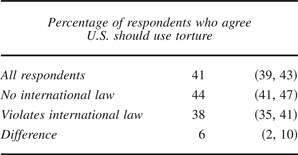
Because of randomization, complex statistical models involving a battery of control variables are unnecessary for obtaining valid inferences regarding the effect of international law. For respondents who indicated some preference for or against torture, Table 1 reports the percentage for those supporting torture across the international law treatment and control groups; 95 percent confidence intervals are included in parentheses.Footnote 112 Support for the use of torture across the entire sample was at little more than 41 percent, which is consistent with many past polls on this topic. This suggests the sample was not unusual, but fairly representative of the wider U.S. public.Footnote 113
Effect of international law on support for torture
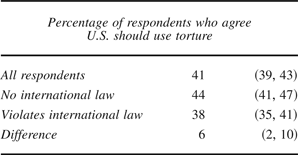
Note: 95% confidence intervals in parentheses.
Turning to the experimental manipulations, the results provide support for the role of international law. Exposure to international law reduces approval for torture by 6 percentage points, which represents a systematic but substantively modest effect. The effect is nonetheless impressive given the wartime scenario and the potential value of intelligence that could be gained. If anything, the result may reflect an underestimate of treaty effects, since the control group likely included individuals who knew about, and may have been influenced by, legal principles despite not directly receiving the treatment. Even a relatively moderate effect might have distinct consequences given the recent closing gap between supporters and detractors of torture.Footnote 114 A change of just 5 or 6 percent could tip the balance and lead to an overall shift in public support over such a tightly contested issue. Far from relegated to the realm of “low politics,” international law appears to influence public preferences even in an area of paramount interest to national security.
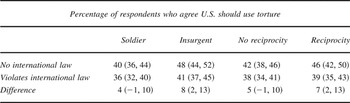
International law also seems to have the most marked impact when incentives for violations are higher. Table 2 reports international law's effect in light of the two contextual treatments concerning the type of soldier captured and whether the adversary is already committing torture. Looking at the first column for a scenario involving prisoners from the regular armed forces, one sees that international law had a modest impact on support for torture, though failed to achieve statistical significance. By comparison, the insurgent situation had a more pronounced and statistically significant effect. In absolute terms, respondents remained more willing to approve of torture against insurgents compared to regular soldiers, perhaps because of the former's perceived illegitimacy, or greater intelligence value. Nevertheless, it is instructive that international law had a greater impact in the more threatening insurgent context.
Effect of international law on support for torture, by conflict context

Note: 95% confidence intervals in parentheses. Size of effect between relevant treatment and control groups may differ slightly from reported values due to rounding.
A similar pattern is evident for reciprocity where respondents for this treatment were told the other side was torturing U.S. soldiers. Theories of cooperation might expect a “tit for tat” strategy of retaliation for any violations by the adversary.Footnote 115 There is some support for this pattern; under the “no international law condition,” support rose somewhat when the other side was already committing torture. However, even in the case of reciprocity, international law reduced support for torture and was statistically significant, which suggests legal appeals may act as a brake on retaliatory desires. In fact, respondents exposed to both the international law and reciprocity conditions were slightly less likely to support the use of torture than those receiving neither the international law nor reciprocity prompts (39 versus 42 percent in Table 2), though the difference is not statistically significant. Rather than simply operating when there are few incentives for violations, international law appears to have the greatest impact in those circumstances where it is needed most.
Political Ideology and Individual Sensitivity to International Law
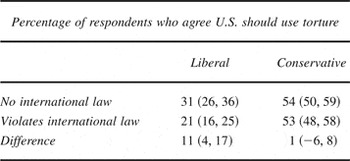
The analysis thus far assumes that the effect of international law is uniform across all individuals. There are good theoretical reasons to believe segments of the public may differ in their sensitivity to international law, especially due to political ideology. Table 3 illustrates the relationship between political ideology and international law by differentiating between respondents who identified themselves in some way as either liberal or conservative.Footnote 116
Effect of international law on support for torture, by political ideology

Note: 95% confidence intervals in parentheses. Size of effect between relevant treatment and control groups may differ slightly from reported values due to rounding.
Liberals and conservatives differ significantly both in terms of overall support for torture and the effect of international law. Given the wartime scenario, the results suggest that higher levels of threat do not inevitably lead to similar views across ideological groups. Liberals are less supportive of torture than conservatives, which is consistent with the view that liberals generally place a greater emphasis on humanitarian ideals.Footnote 117 The size of the international law treatment effect is also related to a respondent's political ideology. Liberal support for torture declines markedly compared to the small and statistically insignificant change for conservatives. Conservative respondents thus appear less influenced by appeals to international legal principles compared to their liberal counterparts, which widens the gap between each group's support for torture. Despite its overall promise, international law may thus act as a further source of polarization within the U.S. public.Footnote 118
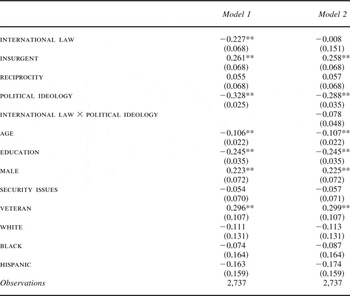
To assess the effect of international law more precisely, I estimated a series of regression models using the full seven-point measure for attitudes toward torture as the dependent variable, where higher values indicate greater levels of support. Table 4 reports the results from an ordered logit analysis, which includes the international law treatment, both contextual treatments, political ideology, as well as a number of standard explanatory variables for foreign policy preferences.Footnote 119 These other covariates are included to provide some comparison to earlier studies on public support for the use of force.Footnote 120 It bears emphasizing that randomization ensures other covariates are orthogonal to the treatment variables, meaning the exact choice of covariates should have little impact on the main coefficients of interest.
International law and individual support for torture, ordered logit analysis

Notes: Cutpoints for ordered logit models not shown. Standard errors in parentheses.
** p < .01;
* p < .05;
+ p < .1.
Model 1 shows that, as expected, international law has a dampening effect on support for torture. Consistent with findings from the earlier cross-tabulations, the nature of the prisoner also matters a great deal—respondents are more willing to favor using torture against insurgents compared to regular soldiers. On the other hand, the coefficient for reciprocity is in the expected positive direction, but fails to achieve statistical significance. The nonfinding is intriguing in light of attention devoted to reciprocal dynamics in much of the literature on wartime conduct.Footnote 121 The weak results, however, are consistent with several studies that find publics are not necessarily predisposed toward reciprocity-driven motives.Footnote 122
Turning to the other covariates, political ideology continues to have a statistically significant impact, where those who are more liberal are less likely to support torture. Age also has a negative effect on support for torture, as do higher levels of education. In contrast, men are more likely to support torture than women, which is consistent with past studies showing a gender gap over the use of force, especially when dealing with humanitarian concerns.Footnote 123 The greater willingness of those with a military background to sanction the use of torture is also consistent with prior studies showing the preference of the military to oppose limits on the use of force during wartime.Footnote 124 Those placing a greater emphasis on security concerns, however, appear no more likely to favor the use of torture. Similarly, racial or ethnic identity has little effect on attitudes toward torture.
Model 2 provides a more formal test of the conditional relationship between political ideology and international law on support for torture. The international law coefficient stays negative but its size and significance is dramatically reduced, while the interaction term is also negative and not significant. The insignificance for the lower-order law term does not necessarily disconfirm an interactive relationship because the coefficient measures the effect of international law when ideology equals 0 only, or for extreme conservatives. Since the earlier cross-tabulations suggest conservatives are less affected by international law, it follows that the significance of the lower-order law coefficient should be fairly weak.
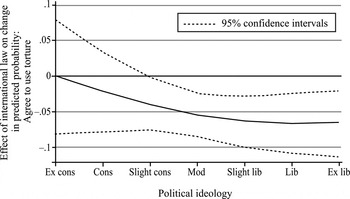
When looking at the interaction term, the lack of statistical significance for the coefficient might be viewed as problematic, though the p-value is not far off from conventional levels of statistical significance (p = .11). Even if the interaction coefficient is insignificant, conditional effects may still exist for relevant values of the variables of interest.Footnote 125 Because looking solely at regression coefficients may miss potentially important interactive effects, Figure 1 plots the impact of international law on support for torture across levels of political ideology. The figure shows the change in the probability of a respondent reporting any level of support for torture when comparing the international law treatment and control groups, where the lines indicate 95 percent confidence intervals.Footnote 126 To provide a better sense of the substantive effects, values are estimated for the median respondent across all other sociodemographic traits, facing a scenario involving insurgent prisoners and no reciprocity.Footnote 127
Effect of international law on support for torture, by level of political ideology
Note: Results are generated using Model 2 from Table 4. Y-axis measures the first difference between the international law treatment and control groups on the probability of reporting any level of support for torture. First difference assumes a scenario involving insurgents and no reciprocity; all other independent variables are set to their median values. Cons = conservative; Ex = extreme; Lib = liberal; Mod = moderate.

Figure 1 indicates that the impact of international law is far from constant and exists for only a subset of ideological groupings. The finding that conservatives are largely unaffected by appeals to international law cannot be rejected, while moderates and liberals demonstrate greater sensitivity to legal appeals. There is a discernible shift in the impact of international law among conservatives even if the treatment effect fails to achieve statistical significance, except in the case of slight conservatives where it is barely distinguishable from 0.Footnote 128 In contrast, international law appears to have a greater effect on the attitudes of moderates and liberals. The shift from moderates to slight liberals is small, and there is little difference in the effect of international law among liberals of varying ideological convictions. The results thus point to a difference between liberals and moderates on the one hand, and conservatives (especially those with more extreme beliefs) on the other, in their susceptibility to international law.Footnote 129 Taken as a whole, the results from the first experiment suggest international law has a discernible impact even for a highly controversial issue like torture, but the effects are conditional on individual political ideology.
The International Legalization Experiment
The evidence discussed so far offers a general picture of international law's effectiveness on mass preferences, but provides little indication of the relative importance of different dimensions of institutional design. In order to address these concerns, I conducted a second experiment isolating the impact of each component of legalization—obligation, precision, and delegation. Similar to the first experiment, the survey was conducted through TESS in conjunction with KN.Footnote 130 The survey was fielded between June and July 2010 to a random sample of 9,213 American adults. Of those who received the invitation, 6,101 agreed to participate, producing a final completion rate of 66.2 percent.
The instrument involved a similar scenario, where subjects were told the United States had captured enemy prisoners and needed to decide whether to use torture. All respondents were then randomly assigned to an additional prompt introducing an international agreement prohibiting torture. The agreements varied, however, in exhibiting different combinations of either high or low levels of obligation, precision, and delegation. For each legalization component, the “high” version is considered the treatment, and the “low” the control.
Three separate binary treatments normally suggest a similar three-way factorial design to the first experiment. However, legalization scholars note that agreements with high levels of delegation combined with low levels of obligation almost never exist, since it is unusual to transfer authority to a third party to interpret and enforce rules that are not actually binding.Footnote 131 As a consequence, I excluded the two combinations involving high delegation and low obligation, leaving six total experimental groups.
In practice, legalization operates on a continuum between higher and lower levels. Unfortunately, including trichotomous or more finely grained differentiations greatly increases the number of experimental groups and would quickly become unwieldy. A binary treatment thus offers a reasonable first test of the effects of each legalization component. In order to concentrate on the impact of legalization, I chose not to include additional contextual treatments. Because reciprocity did not figure prominently in the first experiment, this prompt was excluded. On the other hand, given the prominence of concerns over irregular combatants, all respondents received the insurgent prompt.
Turning to the treatments, I sought to use language capturing the essential characteristics of each legalization component, while avoiding extraneous information that could bias responses. First, legalization scholars argue that committing to a legally binding treaty entails high levels of obligation. Respondents receiving the obligation treatment were thus told the United States had signed “international treaties” prohibiting the use of torture. By contrast, the control group receiving the low-obligation prompt were simply told torture was against “general international values,” which do not necessarily involve any formal legal commitment.Footnote 132 According to expectations from existing research, the high-level obligation treatment should have a greater impact on support for torture compared to the low-level control. Furthermore, the obligation treatment should also demonstrate the most pronounced impact among the three legalization components.Footnote 133
Second, precision measures the extent to which provisions narrowly proscribe the use of torture, irrespective of the degree to which an agreement is binding. The high-level precision treatment mentions that the terms of the agreement “do not allow the use of torture under any circumstances against any prisoners.” On the other hand, the low-level control introduces a degree of uncertainty, by qualifying that the terms “might, or might not, allow for the use of torture against prisoners.” The expectation is that respondents faced with the more precisely worded treatment will be less likely to support torture compared to the control group receiving the more ambiguous prompt.
Finally, delegation involves the degree to which a third party has the authority to punish officials for authorizing torture. I decided to focus on international judicial bodies in light of continued debates over the effectiveness of the ICC and other tribunals.Footnote 134 The high-level delegation treatment states, “If U.S. officials used torture, then an international court could prosecute them for war crimes.” By contrast, the low-level control notes that “Even if U.S. officials used torture, no international court could prosecute them for war crimes.” High-level delegation is expected to reduce support for torture compared to the low delegation prompt.
After receiving one of the six combinations of the legalization components, respondents were then asked to answer a similar question on support for torture ranging along the same seven-point scale from “strongly agree” to “strongly disagree.”Footnote 135 As in the first experiment, the rate of nonresponse remained extremely low at less than 1 percent.
The Effect of International Legalization on Support for Torture
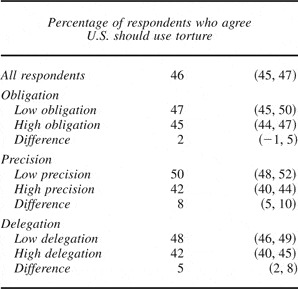
Table 5 indicates the relative impact of each legalization element on public attitudes toward torture. The overall level of support is slightly higher but the scenario involved insurgents for all groups, which the first experiment shows increases support for torture. The general levels of support across both experiments continue to fall within the range of other surveys on torture, and suggest any results are unlikely to be driven by the particular samples used.
Effect of international legalization on support for torture

Note: 95% confidence intervals in parentheses. Size of effect between relevant treatment and control groups may differ slightly from reported values due to rounding.
The first and somewhat surprising finding suggests obligation has little effect on mass attitudes. Respondents who were told the United States had committed to formal international treaties were slightly less likely to support torture compared to those told the prohibition was simply part of international values, but the effect is not statistically significant. To be fair, there may be some concerns the language used for the treatment and control groups does not completely capture the high-low distinction for obligation.Footnote 136 The results should thus be treated as tentative. Even if far from settled, the nonfinding is consistent with arguments that the public does not make subtle distinctions across different levels of obligation.Footnote 137 The similarity in public attitudes toward agreements exhibiting either high or low levels of obligation also provides some support for research emphasizing the influence of nonbinding rules.Footnote 138 Far from playing the dominant role in explaining the effectiveness of international treaties as often assumed, obligation does not appear to figure prominently in public attitudes, based on the initial results presented here. The result for obligation is particularly intriguing in light of the emphasis much of the international law literature places on formal binding legal obligations.Footnote 139
The preliminary findings for obligation do not mean the public is completely unmoved by differences in the level of legalization. Looking at precision, this legalization component exerts a more substantial impact on public preferences. Respondents exposed to the high-precision treatment were less likely to condone torture than those receiving the more indeterminate control prompt, and the effect is statistically significant. The results for precision provide some support for informational approaches emphasizing the domestic effects of international law.Footnote 140 By communicating clearer information to respondents, more precise agreements appear to be more effective in altering the preferences of domestic actors. The findings are also consistent with the managerial school, which focuses on ambiguity in rules as one of the key sources of noncompliance.Footnote 141 This perhaps also helps explain why for some issues areas, such as the laws of war, much greater attention has been devoted to increasing the level of precision rather than necessarily attempting to create more binding agreements.Footnote 142 Although often relegated to the least consequential component of legalization, the findings for precision shed some light on how certain norms can generate wide-ranging consequences despite the absence of formal treaties.
Turning to the third element of legalization, delegation also significantly reduces support for torture, though the size of the effect is not quite as large as for precision. In line with the enforcement school of compliance, the risk of external punishment appears to act as a deterrent compared to low delegation situations that lack third-party threats. Given the gradual trend toward delegating greater authority to international organizations, international law might also become increasingly consequential in the public's eye. Of course, opposition to delegation remains apparent in many areas, in particular the ICC and war crimes tribunals more generally.Footnote 143 The findings suggest, however, that if negotiators succeed in delegating power to external agencies, the public appears more willing to support the terms of the agreement. Taken together, the results for precision and delegation suggest multiple pathways exist through which an agreement's design shapes public attitudes. While managerial and enforcement approaches are frequently framed as being at odds with one another, the findings point to several areas of complementarity.
Political Ideology and Individual Sensitivity to International Legalization
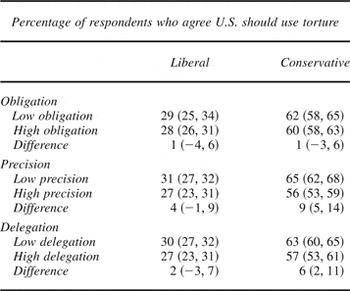
The first experiment suggested liberals were more sensitive to international law, while conservatives appeared relatively immune to legal appeals. Table 6 reports whether a similar conditional effect exists between political ideology and each legalization component.
Effect of international legalization on support for torture, by political ideology

Note: 95% confidence intervals in parentheses. Size of effect between relevant treatment and control groups may differ slightly from reported values due to rounding.
Not surprisingly, in absolute terms liberals remain less willing than conservatives to support the use of torture. When turning to the relative influence of international legalization, however, the pattern is startling. The effect of political ideology for precision and delegation is in the opposite direction from that found in the first experiment. On the other hand, similar to the overall finding for obligation, neither conservatives nor liberals are significantly influenced by binding treaties compared to softer commitments.
Liberals are still less likely to support torture when moving from low to high levels of precision or delegation, but neither effect is statistically significant. Liberals thus seem less sensitive to varying levels of legalization. By contrast, conservatives are more substantially shaped by higher levels of precision and delegation. While conservatives demonstrated little receptiveness to general appeals of international law, they seem to react more strongly to highly legalized commitments.
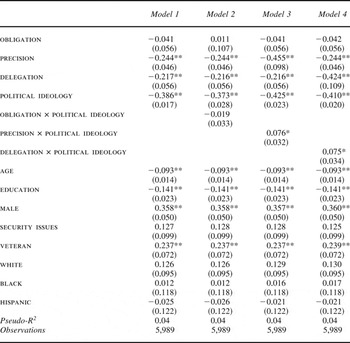
Table 7 investigates these findings further by estimating the impact of legalization and political ideology on support for torture using a similar set of covariates to those reported in the first experiment. Across all ordered logit models, the findings for the other sociodemographic covariates are similar to those from the first experiment. Looking more closely at each legalization component, Model 1 confirms that obligation has little impact on support for torture, while precision and delegation both have statistically significant negative effects.
International legalization and individual support for torture, ordered logit analysis

Notes: Cutpoints for ordered logit models not shown. Standard errors in parentheses.
** p < .01;
* p < .05;
+ p < .1.
The next three models test the conditional effect between political ideology and each legalization component. Model 2 reports a slightly negative coefficient for the interaction between political ideology and obligation, but the coefficient is far from meeting standard levels of statistical significance (p = 0.57). Tests further indicate no conditional effect exists for obligation at any level of political ideology. By comparison, the interaction terms for precision and delegation are positive and statistically significant in Models 3 and 4 respectively, which suggest both components exert greater effects for more conservative individuals.
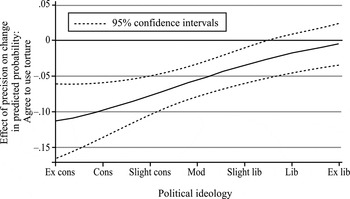
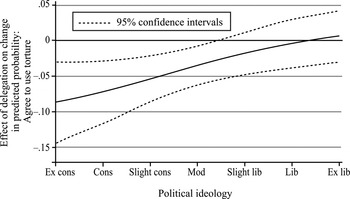
In order to assess the substantive effects more fully, Figures 2 and 3 plot the expected change in the probability of supporting torture for each category of political ideology when moving from low to high levels of precision and delegation respectively. In a similar manner to the first experiment, results are estimated with all remaining sociodemographic covariates set to the values of the median respondent. Obligation is set to high, since by design the instrument did not include the low obligation/high delegation combination. Delegation is set to low for the precision figure, and vice versa for the delegation figure, though the conditional effects of political ideology remain substantially the same at alternative values for either legalization component.
Effect of precision on support for torture, by level of political ideology
Note: Results are generated using Model 3 from Table 7. Y-axis measures the first difference between the high-precision treatment and the low-precision control groups on the probability of reporting any level of support for torture. First differnce assumes a scenario involving high obligation and low delegation; all other independent variables are set to their median values. Cons = conservative; Ex = extreme; Lib = liberal; Mod = moderate.

Effect of delegation on support for torture, by level of political ideology
Note: Results are generated using Model 4 from Table 7. Y-axis measures the first difference between the high-delegation treatment and the low-delegation control groups on the probability of reporting any level of support for torture. First differnce assumes a scenario involving high obligation and low precision; all other independent variables are set to their median values. Cons = conservative; Ex = extreme; Lib = liberal; Mod = moderate.

The figures confirm that political ideology heightens sensitivity to greater levels of precision and delegation, but in the opposite direction from that found in the first international law experiment. Moderates and conservatives of all levels of ideological conviction are less likely to support torture when exposed to higher levels of both precision and delegation. The effect of legalization appears most pronounced for extreme conservatives—the group least swayed by the original appeals to international law. By contrast, it cannot be rejected that liberals appear relatively unaffected by legalization, except in the case of a modest effect from precision for slight liberals.
What accounts for the seemingly contradictory findings for political ideology between the two experiments? Regarding liberals, the results suggest a possible plateau effect when moving along the international law spectrum. Faced with an international agreement prohibiting torture compared to the absence of any legal commitment, the first experiment indicates liberals' values toward international society lead them to respond more keenly to international law. This same communitarian commitment, however, might paradoxically make liberals less susceptible to differences in legalization. Indeed, in the second experiment the presence of international rules against the use of torture was taken as a given. Faced with differing degrees of obligation, precision, and delegation in the context of an existing international agreement, liberals showed little sensitivity to varying levels of legalization. The nonfinding for liberals and legalization does not necessarily nullify their attachment to international law. Incorporating results across the two experiments reveals that liberals appear to be influenced by any form of international agreement. What appears to matter most for liberals is simply the existence of some type of legal commitment; differences in the actual design of the agreement become far less consequential.
Turning to conservatives, the findings suggest a corresponding threshold effect when moving from weaker to stronger forms of agreements. Conservatives generally appear more skeptical of international commitments—a pattern supported by the nonfinding for international law among conservatives in the first experiment. Only once exposed to higher levels of legalization does it appear that they overcome some of their inhibitions.
The findings for both liberals and conservatives are in many ways consistent with the phenomenon of motivated reasoning in political psychology, which posits that individuals are prone to interpret weak or ambiguous information in ways supporting their preexisting beliefs.Footnote 144 Research shows that motivated reasoning is evident when individuals judge domestic legal cases in terms consistent with their prior preferencesFootnote 145 and may operate in a similar manner for international law. Because liberals are generally more inclined toward both international law and limits on torture, even a modest level of legalization may be sufficient to activate support for international legal prohibitions. By contrast, conservatives appear less willing to alter their beliefs toward both international law and torture in response to relatively weak legal appeals. When facing more precise agreements, or looming external punishment by third parties, their discretion in reasoning is greatly reduced and conservatives are consequently more likely to be affected by international law.
The contrasting findings also mirror U.S. debates over judicial interpretation, which are arrayed largely along similar liberal and conservative lines. More conservative legal philosophies, such as textualism, mandate a narrower interpretation of legal texts as they were initially written. Consistent with this view, conservatives surveyed are influenced by international law only once it becomes more precisely specified. By contrast, liberals appear more willing to accept ideals contained in broader and less-precise agreements in a similar manner to the philosophy espoused by proponents of the living Constitution.Footnote 146 Political ideology thus conditions the impact of international law on public preferences in various ways, but the extent and direction of this effect depends on the particular design of the agreement.
Conclusion
Can international law shape foreign policy preferences, especially when national security is at stake? This study offers direct evidence of international agreements' effect on mass attitudes toward torture. Using a pair of experiments embedded in public opinion surveys, the design lessens common concerns over selection effects in observational studies to show that international law does have an impact on public support for torture even under difficult circumstances. Not all elements of international law, however, are treated equal in the eyes of the public; precision and delegation appear to figure more prominently relative to the level of obligation. Furthermore, political ideology conditions the impact of international law, though this in turn depends upon the type and level of legalization.
The results have a number of implications. First, the findings offer firm microfoundations for domestic theories of international law.Footnote 147 Many domestic explanations stress the role of international rules for generating new interests, mobilizing domestic groups, and holding leaders accountable to their international commitments.Footnote 148 The results provide strong evidence for the first step in domestic accounts by demonstrating the impact of international law on public preferences. Future work might examine the degree and limits to which international law functions in a similar manner across other issue areas, or contexts where the role and preferences of the public may vary.Footnote 149
Second, legalization also exerts a significant impact, though not in the ways most commonly thought. The nonfinding for obligation is especially intriguing in light of the attention often devoted to binding treaties. Further work should investigate the robustness of this result to different treatment wordings and more fine-grained specifications. Nonetheless, the impressive impact of other legalization elements like precision reinforces the need to consider alternative avenues through which international law operates. Future research in this vein could add to studies seeking to explain patterns of compliance with nonbinding norms, as well as more systematic empirical research on customary international law.Footnote 150
Third, the contrasting effects for political ideology are relevant for understanding the role of domestic groups on foreign policy. Given each group often forms a key constituency for governments of the right and left respectively, the conditional impact of political ideology provides further support for more general theories about the effect of domestic coalitions and government ideology on international cooperation and compliance.Footnote 151
Last, the political ideology findings also stress the need to further investigate possible trade-offs between the depth of commitments and the subsequent effectiveness of international agreements by incorporating domestic politics.Footnote 152 Modest agreements exhibiting low levels of legalization are often easier to negotiate and would probably influence liberal contingents among the public, but would likely have little effect on conservatives. Only highly legalized treaties appear capable of shifting conservative preferences, yet these are exactly the sorts of agreements oftentimes facing the greatest obstacles to being concluded in the first place. In a similar manner to arguments regarding the motivations of newer democracies to join human rights agreements,Footnote 153 leftist governments might thus have incentives to “lock in” more highly legalized agreements as a way to bind future conservative governments and their constituents. The findings thus point to numerous ways in which political ideology might affect not only the consequences of international agreements, but also earlier stages involving negotiation and commitment to international laws. By investigating the varying effects of international law on foreign policy preferences, this article highlights the need to more systematically study the design and functioning of international agreements.