Artisanal cheeses are defined as cheeses manufactured according to traditional methods using small-scale equipment and milk which comes from livestock kept by local producers and/or farmers (European Union, 2016). To benefit both producers and consumers, artisanal cheeses must be produced according to legal requirements. Currently, there are only two Brazilian cheeses recognized by a protected designation of origin in accordance to the National Institute of Industrial Property. Recently, however, 11 different types of artisanal cheeses have been described in Brazil (Kamimura et al., Reference Kamimura, De Filippis, Sant'Ana and Ercolini2019). In this context, our study is the first work to cover the physicochemical characteristics of Porungo cheese. Porungo is a traditional pasta filata cheese produced using raw milk from small farmers throughout the southwest region of the state of São Paulo, Brazil. The name Porungo comes from the cheese shape, which is similar to a gourd, popularly known as ‘porunga’ (Lagenaria siceraria). The objectives of the present study were to evaluate the quality of raw milk used to make Porungo cheese, to characterize its production process and to determine the chemical composition of the final product.
Materials and methods
Sampling
Eighteen Porungo cheese manufacturers were identified in the rural area around the cities of Angatuba, Buri and Campina do Monte Alegre, state of São Paulo, Brazil. Milk samples from each farm were collected in sterile tubes immediately after milking. The samples were cooled in an ice bath until they could be analysed for milk composition, somatic cell count, total bacterial count, and antibiotic residues.
One-day-old cheeses of approximately 500 g were also collected from 16 of the 18 initially identified (two producers were not producing or selling Porungo cheese at the time of collection). The cheeses were cooled to 4°C and analysed for pH, fat, protein, moisture and salt contents (% m/m).
Milk quality
The chemical compositions of milk samples were measured by infrared spectroscopy according to IDF 141:2013 (International Dairy Federation, 2013a). Somatic cell and total bacterial counts were determined in conformity with IDF 148-2:2006 and 161:2013 standards, respectively (International Dairy Federation, 2006a, 2013b). Antibiotic residues were analysed using the Delvo Test T (DSM, Cascavel, Brazil), which can identify most of the antibiotic drugs and sulphonamides used to treat mastitis.
Description of the production process
Three of the 18 farms where Porungo cheese is made were visited to observe and describe the production process.
Cheese characteristics
Moisture content was measured gravimetrically by drying 5 g of each cheese sample at 105°C until a constant mass was obtained. The moisture content (%) was calculated as the difference between the mass before and after drying. The Van Gulik method (IDF 221:2008) was used to analyse fat content (International Dairy Federation, 2008). Salt content (total chloride) was determined by titration according to IDF 88:2006 standard (International Dairy Federation, 2006b). Nitrogen content was evaluated using the Kjeldahl method according to the IDF 020-1:2014 standard (International Dairy Federation, 2014). This was converted into proteins by multiplying the nitrogen content by 6.38. To determine cheese pH, 10 g of grated cheese were diluted in 90 mL of distilled water, and then agitated at 25°C for 1 h.
Statistical analysis
The chemical and microbiological parameters of both the milk and the cheeses were analysed by descriptive statistics, violin charts, and data summary measurements. Confidence intervals were estimated by non-parametric bootstrap (2000 resampling). The t-test was applied to paired samples to determine if the cheeses had similar protein and fat contents. All hypothesis tests were carried out with a level of significance α = 0.05. The statistical analyses were conducted in R software (R Core Team, 2018).
Results and discussion
Milk quality
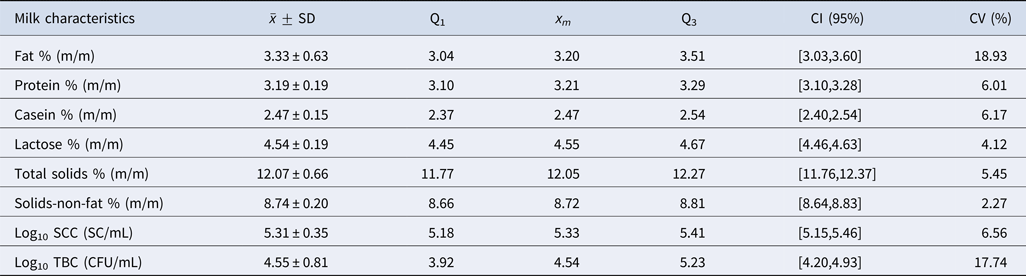
The primary raw milk data recorded at each dairy producer are available as Supplementary File (S1). Table 1 summarizes the microbiological and chemical characteristics of the raw milk while the violin plots of these characteristics are presented as Supplementary File (S2). It should be noted that no antibiotic residues were found in any of the samples.
Summary of the microbiologic and chemical characteristics of raw milk: mean and standard deviation  $\lpar \bar{x} \pm {\rm SD}\semicolon \;n = 18\rpar $; 1st and 3rd quartiles (Q1 and Q2); median ((x m)); 95% confidence interval (CI) for the mean via bootstrapping; coefficient of variation (CV).

Raw milk quality can be evaluated by bacterial contamination, often expressed as total bacterial count (TBC) and somatic cell count (SCC). SCC is used as an indicator for mastitis in dairy cattle worldwide. As a general rule, the higher the SCC level, the more intense the inflammation (Hand et al., Reference Hand K, Godkin and Kelton2012). TBC directly reflects the hygiene conditions of milking systems and the temperature at which the milk was stocked (Bava et al., Reference Bava, Zucali, Sandrucci, Brasca, Vanoni, Zanini and Tamburini2011). The federal government of Brazil has established maximum TBC and SCC counts for raw milk as 5.48 log10 CFU/ml and 5.7 log10 SC/ml, respectively (Brazil, 2018). As can be seen in Table 1, the mean values of SCC and TBC were in line with legal limits for Brazilian regulation. The 95% CI for log10 SCC (SC/ml) was [5.15, 5.46], while log10 TBC varied in the range of [4.20, 4.93]. However, three out of the 18 milk samples analysed exceeded Brazilian SCC regulatory limits. These outliers can be seen in the violin charts in Supplementary File S2. The TBC counts of raw milk samples were more heterogeneous than the SCC counts. They presented an approximately 18% CV (Table 1). This result indicates that the milk hygiene conditions for Porungo cheese production still have room for improvement.
The milk samples were homogenous with respect to total protein, casein, lactose, total solids and solids-non-fat contents, demonstrated by low CV values (Table 1). Nevertheless, the samples showed heterogeneous fat contents, which varied from 3.03 to 3.60% (95% CI), and a CV of 19% (Table 1). The dairy cattle herds in Brazil are primarily made up of the Gyr breed, and the results found in this work are aligned with Machado et al. (Reference Machado, Pereira and Sarríes2000). Despite the observed variations, the samples met milk composition standards established by the Federal Government of Brazil (Table 1 and Supplementary File S1).
Description of the production process
The production process is presented in details in the Supplementary File S3. In general, the process is similar to that used to produce Caciocavalo cheeses in southern Italy (Albenzio et al., Reference Albenzio, Santillo, Russo, Caroprese, Marino and Sevi2010), and comprises the following steps: (i) fresh raw milk, approximately at 35°C, is placed in aluminium or plastic recipients; (ii) a natural starter culture, which consists of the drained whey from the cheese production of the day before, is added to the milk along with commercial liquid rennet; (iii) the milk is allowed to rest for 40 to 60 min to coagulate; (iv) the curd is cut into pieces of around 1.0 cm; (v) the curd grains and whey are gently stirred for 5–10 min, at intervals of 10–15 min. The stirring is repeated two or three times; (vi) when the stirring ceases, the grains descend and are left on the bottom of the recipient; (vii) the excess of whey is removed, but enough whey is left to cover the curd in order to slow down the natural cooling process. A small part of the whey removed is kept at room temperature to be used as starter culture the next day; (viii) the curd is allowed to rest, and the stretching test begins by putting small pieces of curd in a hot water bath (80–90°C); (ix) the curd is then cut into strips and manually stretched in water at 80–90°C; (x) the curd is moulded into gourd shapes similar to gourds (Lagenaria siceraria); (xi) 250 g to 1000 g cheeses are salted in brine at room temperature for 3–10 h depending on the cheese mass.
Cheese characterization
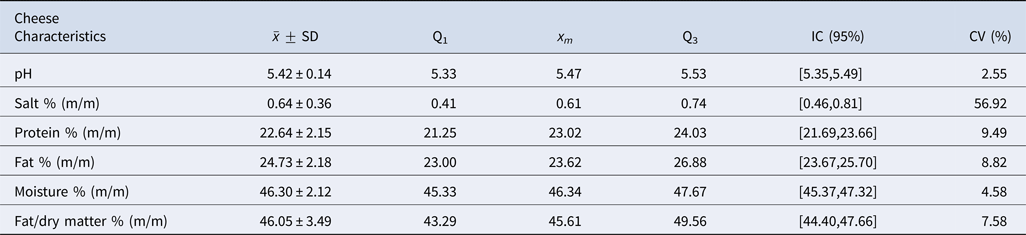
The chemical composition of Porungo cheese is presented in Table 2, and the violin plots of the data are shown in Supplementary File S5. The primary data of the cheese characteristics are available as Supplementary File S4. On the one hand, the Porungo cheeses have strongly consistent pH and moisture contents. The average pH was 5.42, and the CV was only 2.55%. For moisture content, the average was 46.3% with a CV of 4.58%. There was only one sample that was far below the moisture content average (40.5%). On the other hand, salt contents were heterogeneous and therefore cannot be used as a suitable parameter for characterizing the Porungo cheeses. This can be inferred from the asymmetrical distribution in Supplementary File S5, and the high CV value in Table 2. The average salt content was 0.64%, but its CV was 56.9% (Table 2).
Summary of the chemical characteristics of Porungo cheeses: mean and standard deviation  $\lpar \bar{x} \pm {\rm SD}\rpar $, 1° and 3° quartiles (Q1 and Q3), medians (xm), 95% confidence interval (CI) via bootstrapping and coefficient of variation (CV).

On average, 47% of the Porungo cheese mass was composed of proteins and fat (Table 2). However, fat content was significantly higher than protein content (paired t-test = 2.344; degrees of freedom = 15; P = 0.033). The fat content distribution was bimodal, i.e., there were two distinct cheese groups in terms of fat (Supplementary File S5). The group composed by the five cheese samples with the highest fat contents (27% or more) exhibited low protein contents (23% or less) (Supplementary File S4). Nevertheless, this was not a general rule, as we also identified cheese samples with low fat and protein contents (Supplementary File S4). Regarding fat/dry matter relationship, which is employed as a parameter for classifying cheeses, the 95% CI ranged from 44.40 to 47.66% (Table 2). When the overall characteristics of Porungo cheese are evaluated according to the Codex General Standard for Cheese Definition (Codex, Reference Codex1978), Porungo cheese can be defined as: fresh, as there is no ripening; semi-hard, based on its moisture content; and medium to full fat cheese, for its fat/dry matter ratio.
In conclusion, we have demonstrated that the raw milk used to produce Porungo cheeses meets Brazilian quality standards for microbiological and chemical criteria, and does not present inhibitory substances (antibiotics). Additionally, it should be noted the data collected and analysed in this study was used as a guide to establish the first technical regulation of Porungo cheese in the city of Angatuba, Brazil which is available as Supplementary File S6.
Supplementary material
The supplementary material for this article can be found at https://doi.org/10.1017/S0022029920001016
Acknowledgments
We acknowledge the National Council for Scientific and Technological Development (CNPq) for the scholarship provided to Aguiar, K. S., Professor Paulo F. Machado for the milk analysis at Clinica do Leite (University of São Paulo-USP), and Tiago Santi, from the Coordination of Social Communication (UFSCar), for the help with taking pictures of the Porungo's production process.