INTRODUCTION
Near the opening of Liber de musica (The Book on Music) the fourteenth-century Italian music theorist Johannes Vetulus de Anagnia introduces solmisation as follows:
In plainchant there are six notes: ut, re, mi, fa, sol and la. All music is known through these six notes. According to the philosophers this is because this science [music] holds the sixth degree among the Liberal Arts and because, as the Apostle James says, ‘Every perfect gift’ et cetera, this science represents the sixth gift of the Holy Spirit, which is the gift of piety. … But by the reduction of the ars nova these six notes can be reduced to four notes which are ut, re, mi and fa. Why is this? Because just as the whole world and the things that are in the world are made of the four elements so too is all song composed and dealt with through the four aforesaid notes.Footnote 1
In the first part of this passage, Vetulus remarks uncontroversially that plainsong is composed from the six solmisation syllables of the hexachord: ut, re, mi, fa, sol and la. The sixfold hexachord is analogous to the position of music both as sixth among the seven Liberal Arts of the medieval university and as the sixth gift of the Holy Spirit, piety. Vetulus then states that the music of the ars nova is composed not from the hexachord, but from the tetrachord of ut, re, mi and fa, and that these notes symbolise the four elements – earth, air, fire and water.
For a reader familiar with the music-theoretical practices of the later Middle Ages Vetulus’s claim is surprising, since it is widely accepted that the compositions of the ars nova are hexachordal, not tetrachordal. If this represents a gap in Vetulus’s knowledge of music theory, this would number among others, since Vetulus appears to have misunderstood a handful of elementary music-theoretical rules.Footnote 2 Apparent inconsistencies of this kind can perhaps explain in part the paucity of interest that has been shown in Vetulus’s work in musicological scholarship. To date, the only substantial published study on Vetulus’s theory is Frederick Hammond’s edition of the treatise, which was completed in 1977. His introduction to the edition focuses primarily on the material context of Liber de musica and Vetulus’s theory of time. Hammond pays little attention to Vetulus’s attempts to compare the parts of music to theological and philosophical symbols, such as the elements, the Trinity, hierarchies of angels and parts of the world, amusingly characterising such digressions as ‘rambling fantasies’.Footnote 3
Vetulus’s poor reputation in modern scholarship is at odds with the prominence his work is accorded in the only known manuscript to transmit the complete text of the treatise. Liber de musica is copied at the very opening of Vatican, Biblioteca Apostolica Vaticana, Barb. lat. 307 (Vbar307), a miscellany containing some of the most prestigious music treatises of the fourteenth century. Dated most recently to no later than c. 1365,Footnote 4 this source has been the subject of much musicological interest because it contains the most textually detailed witness to a central music treatise of the fourteenth century: the Vitriacan Ars nova et vetus.Footnote 5
The prominence of Liber de musica in Vbar307 indicates that the value of Vetulus’s work was perceived differently by the compilers of this manuscript than it is in modern musicological scholarship, an observation that provides a starting point for the present investigation. Following several excellent recent studies of the intellectual history of medieval music,Footnote 6 the present article argues for a methodological approach that examines historical music treatises as far as possible on their own terms by treating the perceived extra-musical, ‘silent’ or speculative elements and the practical elements of music theory with equal weight.Footnote 7 Adopting this approach illustrates that Vetulus theorised a unique system of mensural divisions that develop and exhaust some of the central precepts of contemporaneous practical music, and that he integrated this into a Platonist Christian framework that reimagines theological concepts in a musical context. The mutually constitutive roles of music and philosophy in Vetulus’s work allow a system to emerge that is in some respects unique and innovative, but that is in others intellectually conservative. Vetulus forged a project that adjusts the theoretical norms of music and philosophy to one another to emphasise the patterns of similitude inherent within the various parts of reality as he envisaged them. The ability of the science of music to imitate nature and elevate the human mind in contemplation lies at the heart of this system of thought.
Following a brief outline of the scanty information that is known about Vetulus, this article proceeds through five sections that examine musical and/or philosophical concepts that are encountered in Vetulus’s Liber de musica. The first of these sections discusses Vetulus’s use of an indivisible atom of time derived from calendrical computation (computus) to quantify the duration of every musical sound. Vetulus’s approach to mathematics is characterised by a combination of innovation and conservatism, a pattern that is mirrored in his theory of musical time and notation. Following this, I set out a new reading of Vetulus’s hierarchies of musical time. Acknowledging the all-encompassing nature of Vetulus’s divisions invites a shift of scholarly emphasis away from discussions of whether his work is predominantly stylistically French or Italian, since the conceptual precepts of both systems are inherent within his work. In the next section, I provide further details about the relationship between Vetulus’s theory of time and contemporaneous performance concerns and, specifically, his tripartite model of musical tempo (the pace at which music is performed). I argue that while Vetulus’s work appears to have been written in response to practice, reading his theory of tempo in a literal sense obscures its underlying conceptual framework, and with this the speculative nature of his work. Examining further the reciprocity of musical and philosophical ideas in the theory of musical time presented in Liber de musica, the proceeding section illustrates that the threefold patterns of Vetulus’s musical hierarchies can also be interpreted in relation to the Platonist formula in which a triad is composed of a mean between two extremes. The final section examines the concept of ‘reduction’ that Vetulus introduces in Liber de musica through an analysis of his tree diagrams. Reduction refers to three concepts: the grouping together of musical notes, the reduction of the most specific to the most general in logical reasoning, and reduction as a spiritual ascent (or in a Platonic sense, a return to the One). This analysis shows that Vetulus’s tree diagrams present a definitive example of the intermingling of practical musical concepts – the division and grouping of musical notes – with Platonist Christian symbolism – creative emanation and contemplative return.
The following reveals that Vetulus’s complex work is extraordinarily rich but also difficult to parse. To better understand the motivations behind Vetulus’s project, it is important to bear in mind that Liber de musica presents an epistemological as opposed to an ontological theory of music. The impracticality of Vetulus’s system from the perspective of performance and the trouble to which Vetulus went to emphasise the primacy of ascent (that is the experiential act of contemplative return, analogous to the division of spans of musical time) over descent (the physical act of emanative creation, analogous to the grouping of spans of musical time) in his theory of reduction indicates that Vetulus was interested primarily in exploring how humans think about and engage with music. For Vetulus the foremost purpose of music, in all its complexity and nuance, is to facilitate contemplative devotion. To this extent, music’s role as an intermediary between the material and immaterial worlds is by necessity symbolic.
WHO WAS JOHANNES VETULUS DE ANAGNIA?
Vetulus is, like many of his contemporaries, extraordinarily difficult to pin down. Besides Vbar307 the only remaining extant late-medieval copy of Liber de musica is transmitted in Catania, Biblioteche Riunite Civica e A. Ursino Recupero, D 39, fol. 122r, which contains an excerpt of the treatise that provides general information about the attributes of musical sounds, including the names of the musical notes, the perfections and imperfections, syncopation and the difference between notated sounds and sounds that are sung by a cantor.Footnote 8 No biographical information about Vetulus is known to have survived. Primary sources from Anagni and its surroundings record several individuals named Vetulus de Anagnia in the thirteenth and fourteenth centuries, indicating that a family with the same surname was active in and around the time and place that Vetulus might have spent part of his life. F. Alberto Gallo observed that a notary named Johannes Vetulus de Anagnia is named in a document of 16 August 1374 in Frosinone, leading him to speculate that this may have been a relation of Vetulus.Footnote 9 In the absence of further evidence it is impossible to establish whether this man was related to Vetulus or indeed whether this was even Vetulus himself, although Manzari and Stoessel have suggested that this man would have been too young to have written Liber de musica.Footnote 10 Beyond musicological literature a Jordanus Vetulus de Anagnia (1238–1302) is recorded as having been a chaplain of Pope Boniface VIII between 1295 and 1302. He was the brother of Andreas Vetulus de Anagnia, who was in the service of the prominent Colonna family c. 1291–3.Footnote 11 These men may have been younger relatives of the better-known Andreas Vetulus (or Veclus), a doctor of canon law (doctor decretorum) who was a chaplain to Pope Gregory IX.Footnote 12 A document dated 16 April 1299 that details the itinerary of Cardinal Petrus de Piperno also mentions a Johannes Vetulus de Anagnia. Petrus recalls that he had visited the home of a man named Johannes Veclus de Canpania or Anagnia sixteen years previously.Footnote 13 This reference is tenuous because it relies upon the distant memory of Petrus, leading Tilmann Schmidt to suggest that in reality Petrus stayed in the home of Jordanus.Footnote 14 Even if this man was called Johannes Vetulus de Anagnia, he would have been considerably older than the author of Liber de musica. These references may present clues to locate documents that could provide further details about Vetulus’s life, but more archival work would be required to establish Vetulus’s identity, if indeed any further records of him have survived.
The manuscript record of Liber de musica can provide some glimpses into Vetulus’s life. Since Vetulus’s text is granted such a prominent position in Vbar307, Manzari and Stoessel have hypothesised that Vetulus may have been associated with the patron of the manuscript. They suggest that the anonymous author of Omnis ars sive doctrina, another treatise copied in Vbar307, may have patronised this manuscript, and that he could have been a student of Vetulus.Footnote 15 The author of Omnis ars sive doctrina seems to have held Vetulus in high regard, since he lauds him in his treatise as the ‘Reverend Magister Johannes Vetulus de Anagnia, learned in music’.Footnote 16 Manzari and Stoessel note that the location of Omnis ars sive doctrina near the end of the manuscript reflects an appropriate level of humility if the anonymous author of this text commissioned Vbar307. The prominent position of Liber de musica, on the other hand, probably discounts Vetulus from this role.
In the absence of further clues beyond Liber de musica’s main text, the contents of this treatise can also reveal information about Vetulus.Footnote 17 As a magister, Vetulus would have been a privileged man who attended university and studied the Liberal Arts, including the trivium of logic, grammar and rhetoric, and the quadrivium of arithmetic, geometry, music and astronomy. Vetulus’s references to scripture have also led to some speculation that he was connected with religious orders.Footnote 18
In sum, little concrete information can be ascertained about Vetulus’s life. He appears to have been a mature thinker in the middle decades of the fourteenth century (or later), an educated man and probably a cleric.Footnote 19 Aside from his name, which implies an association with the hilltop town of Anagni near Rome, remaining pointers towards cultural connections beyond Italy can be inferred from his theoretical views. Peter Lefferts has noted that some of the language Vetulus employed is characteristically English: for instance, he calls the longest note in his system the larga rather than the maxima, which would have been a more conventional choice for an Italian theorist.Footnote 20 Vetulus’s work also draws on ideas from the French and Italian notational systems of the fourteenth century. Because Vetulus synthesises ideas that are associated with both of these systems, there is disagreement in scholarship over whether Vetulus’s system is characteristically ‘French’ or ‘Italian’.Footnote 21 The following illustrates that Vetulus’s system presents a means to think beyond this perceived dichotomy, since he synthesises ideas that are inherent within both of these systems.Footnote 22
THE ATOM
For Vetulus, musical time is composed of durational atoms, which he describes as follows:
Time is divided by the year, months, weeks, days, quadrants, hours, points, moments, ounces and atoms. The atom is indivisible. Having set out the division of all times, we must consider how the natural day is divided, by which the measure of time according to the musician is discerned.
It must be said that the day is divided into four principal quadrants. A quadrant contains six hours. Four points proceed from the hour. Points contain ten moments. A moment contains twelve ounces. An ounce contains fifty-four atoms.Footnote 23
Vetulus divides the ‘natural day’Footnote 24 into progressively smaller parts: the quadrant, the hour (equal to a present-day hour), the point (1/4 of an hour), the moment (1/10 of a point = 1.5 minutes), the ounce (1/12 of a point = 7.5 seconds) and the atom (1/54 of an ounce = 5/36 of a second).
Vetulus is the first music theorist known to have precisely measured the spans of time represented by musical notes using a durational atom.Footnote 25 Jacobus, author of the Speculum musice (c. 1330s–50s) also divided the hour into points, moments, ounces and atoms, but did not specify their durations.Footnote 26 In keeping with his theory as a whole, Vetulus’s use of atoms is from one perspective old-fashioned and conventional, and from another idiosyncratic and innovative.Footnote 27 This is because Vetulus used a value for the atom that is remarkably similar to the standard value of previous centuries, altering this slightly to fit his unique system for the hierarchical organisation of musical time.
Durational temporal atoms similar to those of Vetulus were used throughout the Middle Ages in computus, a mathematical discipline concerned with the calculation of dates from the observation of the motions of astronomical objects.Footnote 28 Computus was a subject of intense controversy, since it determined the trajectory of the liturgical calendar, a matter of spiritual and cultural significance. By the thirteenth century, two forms of computus were taught in universities. Computus vulgaris, ‘common’ or ‘ecclesiastical’ computus, was concerned with establishing the traditional rules of the calendar, while computus naturalis or ‘natural’ computus was a philosophical discipline that aimed to establish an accurate method for the measurement of the temporal spans occupied by the movements of astronomical bodies.Footnote 29 In technical terms, the primary distinction between these two forms of computus is that computus vulgaris measured temporal spans in days, whereas computus naturalis subdivided the day into smaller parts to calculate temporal spans precisely. By measuring temporal spans using minute units of measurement – such as the atom – proponents of computus naturalis attempted to calculate the precise durations of celestial motions that were observable in nature. Although these two systems were initially separate, attempts were made in the fourteenth century to unite ecclesiastical and philosophical computus to counteract the by then obvious discrepancies between the liturgical calendar and the natural lunar month. Pope Clement VI (r. 1342–1352) commissioned scientists such as the astronomer and music theorist Jean des Murs and the Jewish philosopher Levi Ben Gerson to tackle this problem at the papal court of Avignon between 1344 and 1345.Footnote 30 While the project was ultimately unsuccessful, a consequence of Clement’s actions was that philosophical computus entered into mainstream ecclesiastical debate.
Vetulus does not provide a comprehensive account of computus in Liber de musica, nor does he seem to have concerned himself with the calculation of dates, yet his decision to divide the natural day into atoms positions his work among the philosophical computists. The division of time into points, moments, ounces and atoms was devised to account for the saltus lunae, the day added to the Metonic (19-year) cycle to allow the lunar and solar months to align.Footnote 31 His units of time align closely with the standard practice of thirteenth-century computus teaching in which the hour is divided into the point (1/4 of an hour), the moment (1/10 of a point), the ounce (1/12 of a point) and the atom (1/47 of an ounce).Footnote 32 This system is encountered in widely-transmitted texts such as the popular encyclopaedia De proprietatibus rerum by the English Franciscan Bartholomaeus Anglicus (d. 1272).Footnote 33 The only difference between Vetulus’s method of dividing up the natural day and that of authors such as Bartholomaeus is that Vetulus’s ounce contains fifty-four atoms rather than the standard forty-seven. Giuseppe Conti has suggested that the standard division of time (in which the ounce contains 47 atoms) from which Vetulus adapted his theory originated in a text such as the De divisionibus temporum, an anonymous treatise written by an Irish author in the early eighth century that would be transmitted in at least eighty manuscripts.Footnote 34 Marielle Popin and Armand Machabey suggest that Vetulus’s division of the day originated in the work of the Benedictine monk Hrabanus Maurus (d. 856), who divided the hour into four points and forty moments, each containing 564 atoms. Because Maurus postdates the anonymous author of De divisionibus temporum, this was probably (directly or indirectly) the source of his own division.Footnote 35
In employing a system for the division of the day that is the same as the standard system in thirteenth-century computus teaching – with the exception of the relationship of the ounce to the atom – Vetulus eschewed the latest innovations in computus theory. By the mid fourteenth century, theorists commonly employed the sexagesimal system, whereby the hour is divided into sixty minutes, each worth sixty seconds. Originating in the Arab system for dividing time, the sexagesimal system is believed to have been established in Europe through the Computus of Johannes Sacrobosco (d. c. 1256),Footnote 36 and is encountered in fourteenth-century texts such as the Autores Kalendarii (1317) attributed to Jean des Murs.Footnote 37 That this was the standard division by this period is established by a report given to Pope Clement VI on the subject of calendar reform in 1345.Footnote 38 A similar pattern of innovation and conservatism to that of Vetulus’s use of computus is encountered in his musical divisions. Vetulus’s musical divisions are innovative because they provide a means of precisely determining the durations of a huge range of different rhythms, but they are also conservative because Vetulus eschews some of the latest notational innovations, such as the addition of extra stems and flags to distinguish between notes representing complex rhythms. Vetulus exhibits knowledge of complex notations but does not condone their use.Footnote 39
Without discussing computus in detail, Vetulus tacitly links his music-theoretical system with contemporaneous astronomy while adding a musical twist to the standard system by altering the number of atoms within the ounce from the conventional forty-seven to fifty-four to accommodate his theory of musical time.Footnote 40 Divisible by two, three and nine, Vetulus’s ounce of fifty-four atoms is assigned to the most important division within this system: the so-called ‘lesser perfect tempus of the greater extension’ (to be discussed further below). The tempus (pl. tempora), a Latin term that means ‘time’, is a central precept of mensural notational systems, including that of Vetulus. Music theorists of the fourteenth century used the word tempus as a technical term to refer to the span of the breve and its division into parts. The tempus or span of the breve can be perfect or imperfect. Where the tempus is perfect, breves contain three equal parts. Where the tempus is imperfect, breves contain two equal parts. That the structures of the musical tempus could determine the duration of the atom aligns with Vetulus’s project more broadly, in which music wields the symbolic potential to describe the different parts of reality. As I will illustrate in the following section, the pattern of influence between Vetulus’s musical and philosophical projects (if indeed they can be viewed separately) was mutual. While music exercises a world-forming agency within Liber de musica, the philosophical framework presented in Vetulus’s treatise also determines the structures of Vetulus’s music-theoretical project, so much so that the system as a whole becomes unwieldy and impractical from the perspective of music performance.
HIERARCHIES OF MUSICAL TIME
Vetulus uses the atom as a minimal unit of measurement for a system of musical divisions.Footnote 41 His system borrows ideas from several central music-theoretical systems of the fourteenth century, but he rarely cites the sources of his ideas, making it impossible to determine whether he had direct access to the texts with which these ideas are associated. Vetulus constantly alters and adapts the textual traditions that he cites. The incomplete and altered quotation of authoritative sources is a recurrent pattern in Liber de musica and applies to both music-theoretical and broader intellectual ideas. It is possible that this reflects the fact that university students typically encountered authoritative texts when they were read aloud in lectures. There was no fixed correlation between the difficulty of a text and the number of times that it was revisited. As a result, students would often hear dense philosophical texts, such as those of Aristotle, only once.Footnote 42 Another explanation for the seemingly haphazard application of both music theory and intellectual ideas in Liber de musica is that Vetulus did not regard textual fidelity to the sources with which he engaged to be important. In order to synthesise a coherent system in which reciprocity can be established between music, the well-being of the soul and the structure of the world, Vetulus adapted conventional ideas to align with his own intellectual priorities.
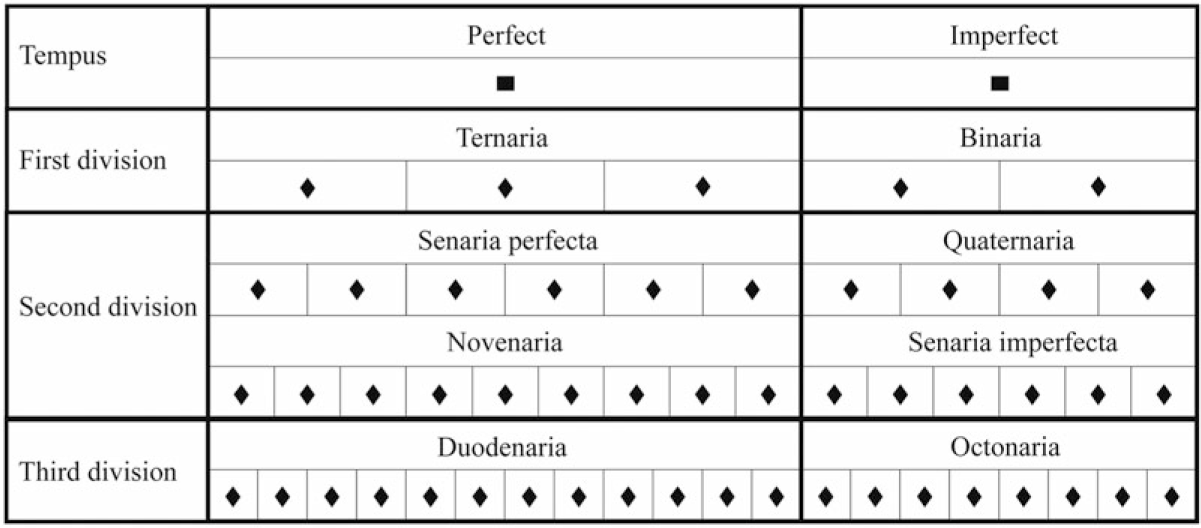
Vetulus’s hierarchies of musical time adapt the Italian Trecento divisions, best known from the Pomerium (c. 1319) by Marchetto of Padua. Like Vetulus, Marchetto theorises the perfect (triple) and the imperfect (duple) tempus. The imperfect tempus is two-thirds as long as the perfect tempus. Perfect and imperfect tempora are classified into divisions and are divided into up to twelve semibreves (see Figure 1). The name of each division corresponds to the number of semibreves within it. The tempus in which the breve is divided into nine parts is called the novenaria or ‘novenary’ division. The tempus in which the breve is divided into twelve parts is called the duodenaria or ‘duodenary’ division and so on. The semibreves into which breves are divided vary in duration to accommodate the fixed durations of the breves. The practice of varying the durations of shorter notes to accommodate a fixed span for the breve is termed breve equivalence and is regarded as a characteristic marker of Italian mensural notation.
Marchetto’s Divisions (adapted from M. de Padua, Pomerium, ed. J. Vecchi, Corpus scriptorum de musica, 6 (Rome: American Institute of Musicology, 1961), p. 72)

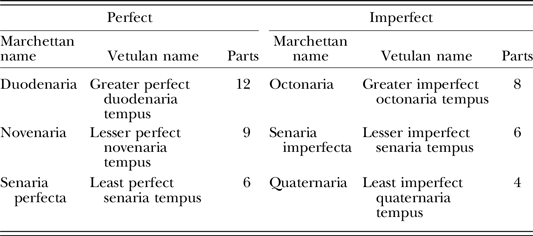
Vetulus borrows from Marchetto the idea that the tempus can be divided into up to twelve parts, he adopts Marchetto’s naming system for his own divisions, and he transmits the general concept that imperfect breves are two-thirds as long as perfect breves. There are also a number of notable differences between these theorists’ divisions. First, following the conventions of later fourteenth-century theory, Vetulus writes an ascending stem on his shortest semibreves, calling them semibreves minime, ‘least semibreves’ or ‘minims’. Second, Vetulus employs an idiosyncratic naming system for the divisions in conjunction with Marchetto’s (see Table 1) in which each perfect and imperfect tempus can be maius ‘greater’, minus ‘lesser’ or minimum ‘least’. In this context, the terms greater, lesser and least refer to the number of minims within the tempus. The duodenaria division is also called the greater perfect duodenaria tempus (12 minims). The novenaria division is also called the lesser perfect novenaria tempus (9 minims). The senaria perfecta division is also called the least perfect senaria tempus (6 minims).Footnote 43 Table 1 compares Marchetto’s and Vetulus’s naming systems.
Vetulus’s naming system compared to Marchetto’s

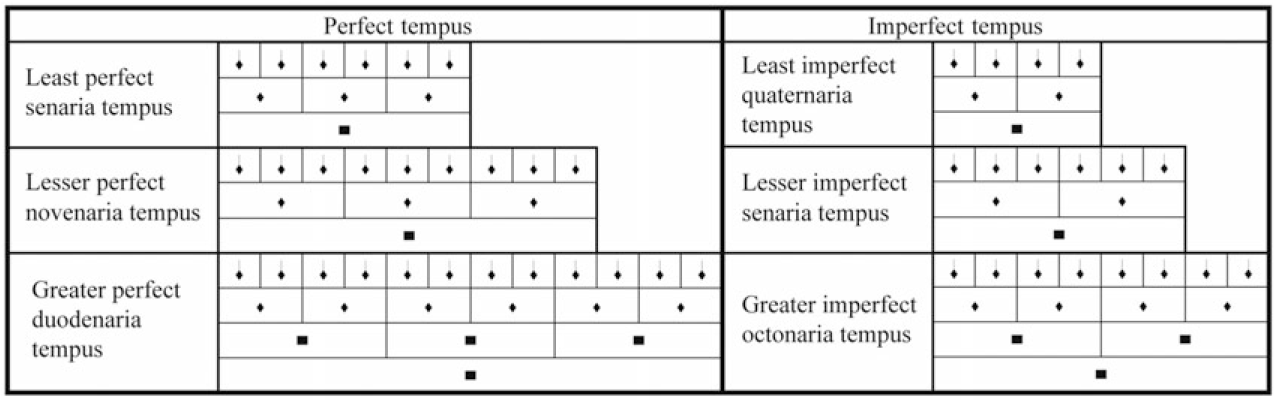
Figure 2 sets out Vetulus’s basic divisions. Unlike the divisions of Marchetto, the principle of breve equivalence is not universal within Vetulus’s system, since the durations of breves can vary to accommodate a fixed duration of the minim. Reflecting the fixed duration for the minim, the greater perfect duodenaria tempus (12 minims, bottom left of Figure 2) is longer than the lesser perfect novenaria tempus (9 minims, middle left of Figure 2). The opposite is true in Marchetto’s system, where the duodenaria and novenaria divisions share the same tempus span. The practice of using a fixed minim seen in Vetulus’s work, termed minim equivalence, is associated primarily with the fourteenth-century French notational system.Footnote 44
Vetulus’s basic divisions

Vetulus subcategorises each of the divisions in Figure 2 into tripartite groups called prolationes (pl.). Vetulus’s use of the term prolatio (sg.) is idiosyncratic. Musicologists typically employ the term prolatio or ‘prolation’ in relation to medieval theory to refer to the level of division that applies to semibreves. Where prolation is major, semibreves span three minims. Where prolation is minor, semibreves span two minims. In its general sense, the term prolatio was used in a wide variety of contexts, and is translatable as a ‘bringing forward’, ‘putting forth’, ‘pronouncing’ or ‘utterance’.Footnote 45 The general sense of prolatio aligns more closely with Vetulus’s use of the term, which refers to the duration of a note in atoms. I therefore translate prolatio as ‘extension’. Vetulus states that an extension can be maior ‘greater’, minor ‘lesser’ or minima ‘least’.Footnote 46
Vetulus’s theorisation of prolatio represents one among many examples of the difficulty of language encountered in Liber de musica. The confusion in this instance lies in Vetulus’s use of the terms greater, lesser and least to refer to two different levels of temporal organisation. Where the terms greater, lesser and least refer to the divisions (Figure 2), they describe the number of minims within a note. The greater perfect duodenaria tempus contains twelve minims; the lesser perfect novenaria tempus contains nine minims, and so on. Where the terms greater, lesser and least refer to the prolationes or extensions, they describe the number of atoms within a note. Thus, there are three different kinds of greater perfect duodenaria tempus (12 minims): the greater perfect duodenaria tempus of the greater extension (72 atoms), the greater perfect duodenaria tempus of the lesser extension (48 atoms) and the greater perfect duodenaria tempus of the least extension (36 atoms). There are also three different kinds of lesser perfect novenaria tempus (9 minims): the lesser perfect novenaria tempus of the greater extension (54 atoms), the lesser perfect novenaria tempus of the lesser extension (36 atoms) and the lesser perfect novenaria tempus of the least extension (27 atoms), and so on.
Figure 3 provides a visual representation of Vetulus’s divisions and extensions. The figure depicts the perfect tempora on the left and the imperfect on the right. The perfect and imperfect categories are organised into greater, lesser and least divisions (as seen in Figure 2). Figure 3 visualises the subcategories of each of the divisions seen in Figure 2 to incorporate their greater, lesser and least extensions and provides numerals to indicate the duration of every note in atoms. Reading from the top left of the figure the three types of least perfect senaria tempus (6 minims) are as follows: the least perfect senaria tempus of the least extension (18 atoms), the least perfect senaria tempus of the lesser extension (24 atoms) and the least perfect senaria tempus of the greater extension (36 atoms). The underlying principle of this system is that tripartite layers of divisions are subcategorised into tripartite extensions.
Vetulus’s ‘proper’ divisions. The numerals indicate how many atoms are contained within the time span of each note.Footnote 47

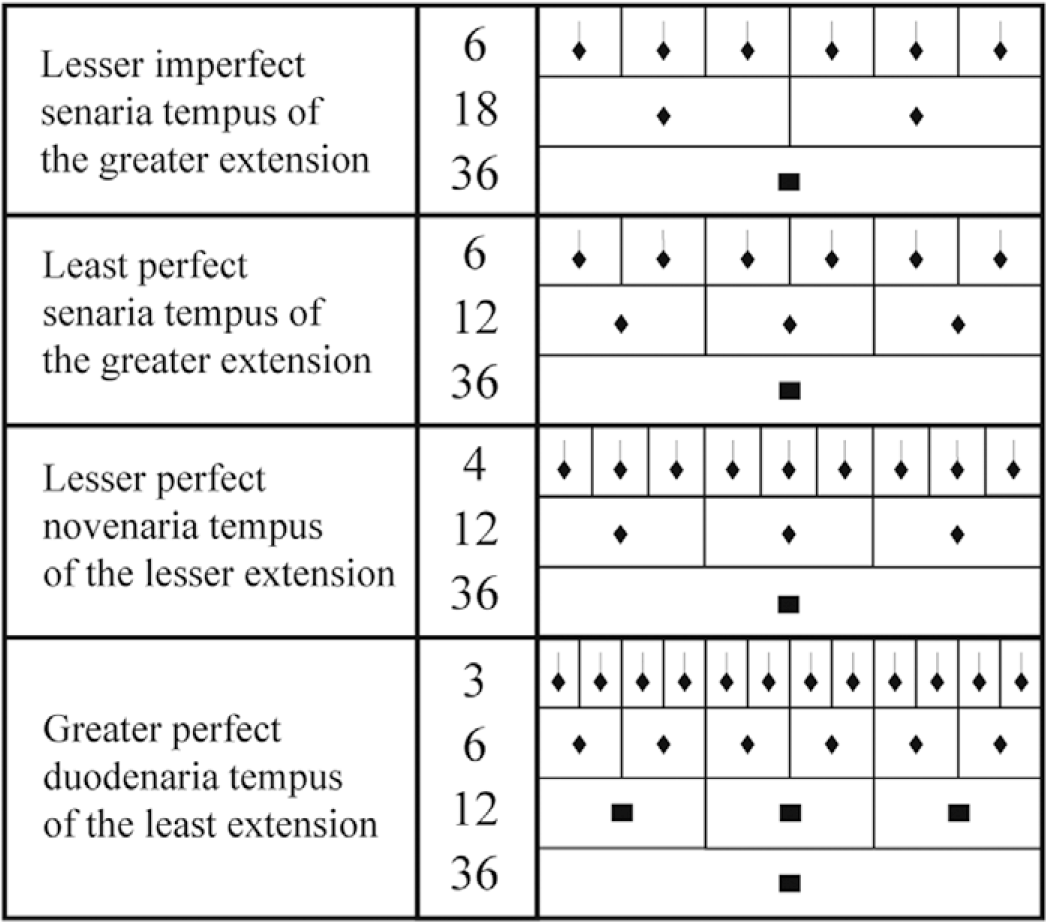
From one perspective, Vetulus’s system broadly relies on minim equivalence: all the divisions feature minim equivalence within the same extension. Consider, for instance, the least perfect senaria tempus of the greater extension (36 atoms), which shares a minim (6 atoms) with the lesser perfect novenaria tempus of the greater extension (54 atoms) and the greater perfect duodenaria tempus of the greater extension (72 atoms). As a result of this, each of the breves in Figure 3 is represented in such a way as to illustrate that it varies in duration to accommodate the spans of time occupied by the minims that it contains. From another perspective breve equivalence is predictably maintained among different divisions. Figure 4 provides an example of four types of tempus that share the same duration (36 atoms), but that contain different numbers of minims: the lesser imperfect senaria tempus of the greater extension (6 minims), the least perfect senaria tempus of the greater extension (6 minims), the lesser perfect novenaria tempus of the lesser extension (9 minims) and the greater perfect duodenaria tempus of the least extension (12 minims). Each of these tempora are equal in span, but they are divided into minims that vary in duration. A comparison of Figures 3 and 4 confirms that Vetulus’s system combines the concepts of breve and minim equivalence through the use of the durational atom and three different types of fixed-duration minim (worth three, four or six atoms). Maintaining equivalence between the two types of senaria divisions (perfect and imperfect), this system exhausts the possibilities that are presented by organising time from the perspectives of both breve and minim equivalence.
Breve equivalence in Vetulus’s system

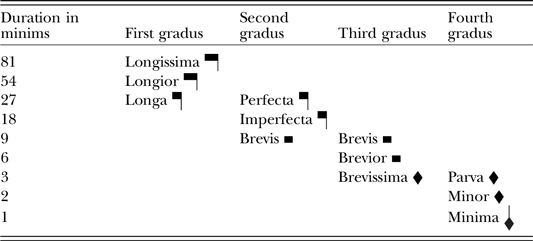
Peter Lefferts has proposed that in theorising tripartite layers of notes within an overarching framework of minim equivalence, Vetulus expanded the fourteenth-century gradus system.Footnote 48 This system was popularised by the French astronomer, mathematician and music theorist Jean des Murs. In Jean des Murs’s version of the gradus system (see Table 2), the temporal continuum, range or ‘latitude’ of musical sounds is organised into gradus or ‘degrees’ for which the minim serves as a minimal counting unit.Footnote 49 Each gradus contains three notes, which are named using absolutes, comparatives and superlatives. Consider, for instance, the first gradus. The shortest note is the longa or ‘long’, which is doubled to make a longior or ‘longer’ and tripled to form a longissima or ‘longest’.Footnote 50
Jean des Murs’s gradus system1

1 Adapted from: Jean des Murs, ‘Notitia artis musicae’, ed. in J. de Muris, Notitia artis musicae et Compendium musicae practicae; P. de Sancto Dionysio, Tractatus de musica, ed. U. Michels, Corpus Scriptorum de Musica, 17 (Dallas, 1972), p. 79.
Vetulus’s system is similar to that of Jean des Murs because it incorporates threefold gradus that are named using the comparatives ‘greater’ and ‘lesser’ and the superlative ‘least’. Vetulus’s system differs from that of Jean des Murs because each gradus of the divisions (Figure 2) contains notes of the same kind, whereas Jean des Murs’s gradus contain different kinds of notes. Compare, for instance, Vetulus’s greater, lesser and least perfect breves with Jean des Murs’s third gradus, which contains the brevis and brevior – both shaped like the breve – and the brevissima, which is shaped like a semibreve. Vetulus’s system is also far more substantial than that of Jean des Murs. There are only four gradus in Jean des Murs’s theory, whereas in Vetulus’s system the proper breves alone have six gradus, each of which contains greater, lesser and least extensions. Thus, each note in Vetulus’s basic divisions (Figure 2) itself becomes a gradus within which there are three parts.
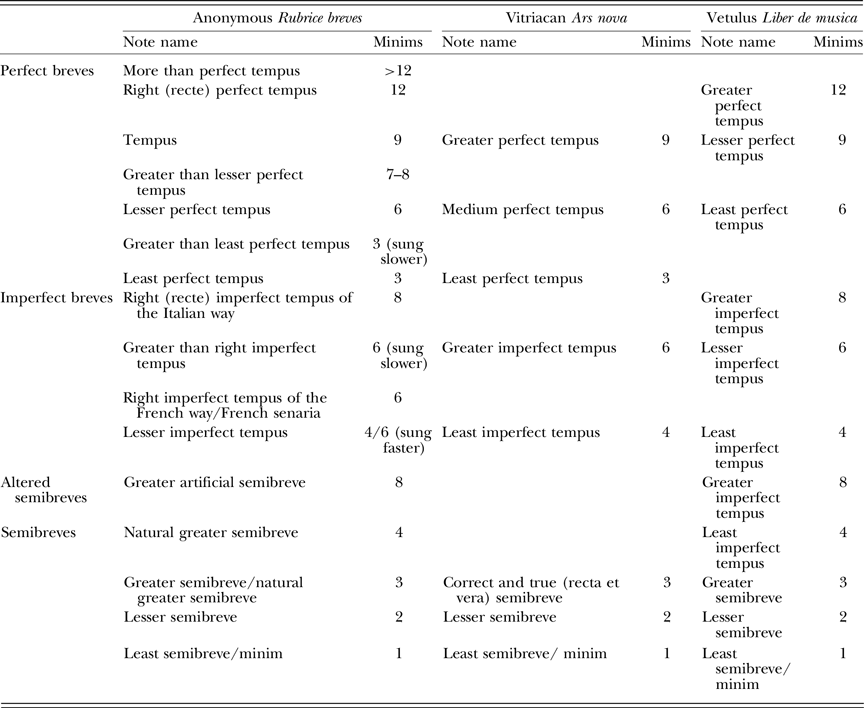
Gallo has observed that Vetulus’s application of the gradus system bears greater similarity to expanded gradus systems other than that of Jean des Murs, and most closely to the hierarchies of musical time set out in the Rubrice breves, a treatise written by an anonymous fourteenth-century Italian theorist.Footnote 51 Following Marchetto, the anonymous author synthesises a system in which the breve can be divided into between three and twelve (or more) minims. In both Vetulus’s and the anonymous author’s systems, notes can be ‘greater’, ‘lesser’ or ‘least’ and can have ‘greater’ (or lesser) extensions. Semibreves can also be greater, lesser or least (see Table 3). A comparison of these two systems reveals that Vetulus’s divisions are much more expansive, and in certain regards more systematic, than those of the anonymous author. For instance, the Rubrice breves omits the least imperfect tempus, whereas each of the threefold levels of Vetulus’s system is complete. The differences between Liber de musica and the Rubrice breves reflect the contrasting purposes of these two treatises. While the Rubrice breves constitutes an attempt to represent practice, which is amorphous and lacks standardisation, the systematised comprehensiveness of Vetulus’s theory indicates that it was devised principally as a theoretical and philosophical system, albeit one that responded to a practical tradition that was codified in treatises such as the Rubrice breves.Footnote 52
Comparisons of tempo relations in the Rubrice breves, Ars nova and Liber de musica 1

1 Vecchi, ‘Anonimi Rubrice breves’, pp. 128–34; Vbar307, fol. 20v, ed. J. D. Gray, ‘Ars Nova Treatises Attributed to Philippe de Vitry’ (PhD diss., Colorado University, 1996), pp. 41, 47–50. For simplicity I include only Vetulus’s basic divisions in this table.
TEMPO
A practical application of the theory of both Liber de musica and the Rubrice breves is the systematisation of musical tempo.Footnote 53 Vetulus’s work is in synchrony with contemporaneous theory, which typically codified musical tempo into threefold hierarchies.Footnote 54 In the Speculum musice, Jacobus describes a threefold hierarchy of tempi – the mensura cita (the fast measure), the mensura media (the medium measure) and the mensura morosa (the slow measure).Footnote 55 He also describes a minimum (least), medium (medium) and maius (greater) perfect tempus, but does not elaborate further the relationships between these three kinds of tempora. The English theorist Robertus de Handlo wrote in his Regule (Paris, 1326) of three tempi, the mos longus (slow way), mos mediocris (moderate way) and mos lascivus (lively or ‘lascivious’ way).Footnote 56 Threefold hierarchies of tempi are also found in the Vitriacan Ars nova witnesses, including the copy contained within Vbar307.Footnote 57 Here, there are three perfect tempi – minimum (least), medium (medium) et maius (greater) perfect tempora – and two imperfect tempi – minimum (least) and maius (greater) (see Table 3).
Although Vetulus ascribes a precise duration to every note, his system presents significant problems as a means of precisely calculating tempo because his tempi are absurdly slow.Footnote 58 The impracticality of Vetulus’s tempi indicates that they should not be taken literally, especially since Vetulus would have had no means of measuring the duration of his atom, nor the spans of any of the notes that he described.Footnote 59 The longest note in Liber de musica – the greater perfect larga – spans two minutes. The lesser perfect breve of the greater extension (9 minims, 54 atoms) spans 7.5 seconds, an extraordinarily long period of time for a note of this kind.
Solutions to this problem have sought to justify the premise that Vetulus’s system could have provided a means of precisely measuring musical time by tweaking his system.Footnote 60 Salvatore Gullo suggested that Vetulus’s tempus, as a primary unit of measurement, could be a longa rather than a breve;Footnote 61 Ephraim Segerman argued conversely that Vetulus’s tempi represent fourteenth-century practice and that tempi became faster over time.Footnote 62 Attempting to make sense of the durations of notes discussed in Liber de musica as literal descriptions of tempo places too much importance on the technical details of his system to the detriment of its foundational conceptual framework. While Vetulus’s divisions may bear witness to the range of tempi that were available in practice, or even reflect a prevailing tendency to group tempi into tripartite structures, his priorities extended beyond this aim. Vetulus’s work harnesses the tripartite structures of the gradus system, transforming them in order to allow music to take on symbolic significance. Synthesising the conceptual precepts of practice, Vetulus’s work presents a system that is impractical and speculative.
A MEAN BETWEEN TWO EXTREMES
Throughout Liber de musica, Vetulus compares the various components of music to theological symbols. Examining the symbols that occur in Liber de musica reveals that Vetulus integrated his music-theoretical work into a Platonist Christian intellectual framework. In Vetulus’s treatise, music and theology are mutually constitutive components of a project that describes and determines the structures of a world in which everything is linked in a chain of causes composed of tripartite patterns embedded within one another.Footnote 63 The tripartite structures of music performance thus find their analogues in the threefold patterns inherent within Platonist Trinitarian theology.
Two symbols occur repeatedly in this treatise. Vetulus associates his tripartite organisation of musical notes with the Trinity and the novenaria division with the ‘nine choirs of angels’:
each of these [notes] can be divided into three equal parts like the names of the Trinity – into the Father, the Son and the Holy Spirit. It is not with respect to the division of their persons that they are considered to be different, since ‘such as the Father is, the Son is and the Holy Spirit is’, but rather because the Father, to the extent that he is the Father, differs from his Son because he is greater, the Son differs from his Father because he is lesser, which was testified to by Christ in the Gospel, ‘the Father is greater than I’. The Holy Spirit differs from the Father and his Son because it holds the mean between Father and Son. And that which holds the mean partakes of the nature of the greater and lesser extremity. This is why the Holy Spirit, which is the mean, partakes of the nature of the Father and Son, because they are the same in perfection. In likeness of the Holy Spirit, the lesser larga holds the mean between the greater and the least larga with respect to the measure of musical time, and it contains nine tempora, just like the nine choirs of angels each singing nine Kyrie eleison between God and the people.Footnote 64
In this passage, Vetulus presents an analogy between the hierarchy of the Trinity and his theory of music, claiming that the position of the lesser larga between the greater larga and the least larga symbolises the position of the Holy Spirit between the Father and Son. In a similar manner to the tempora, the greater, lesser and least largae contain twelve, nine and six breves, respectively. Thus, the lesser larga or novenaria division of largae (9 tempora or breves) represents the Holy Spirit, which ‘partakes of’ the greater and lesser extremity and symbolises the nine choirs in heaven.
Vetulus’s claim that the Holy Spirit is the mean between the Father and the Son resonates with the doctrinal position of Augustine of Hippo (354–430), who stated that the Holy Spirit was the mutual love between the Father and the Son.Footnote 65 This position was shared by the majority of Christians in the Latin West either directly through the teachings of Augustine or through the teachings of others who developed Augustine’s ideas.Footnote 66 Later in the same passage, Vetulus discusses the role of the Holy Spirit in relation to humanity, here stating that of the three things in human nature (flesh or matter, soul or form and good will or the Holy Spirit) it is the Holy Spirit – Vetulus’s ‘good will’ – that binds together the parts of the human body, and ‘goes forth from the body and soul for the resounding praise of God’.Footnote 67 Curiously, it appears that a reader of the text objected to some of the views expressed in these passages, since they were crossed out by a later hand.Footnote 68 Manzari and Stoessel attribute these emendations to their Text Hand Z, the so-called ‘Spanish Annotator’, a speaker of Spanish whose cursive hand they date tentatively to the seventeenth century.Footnote 69 Without further information about the date and provenance of these annotations, it is difficult to gauge why this scribe may have objected to these passages in particular. A music-theoretical explanation appears improbable, given that the views espoused here are in keeping with the theory set out throughout Liber de musica in its entirety.
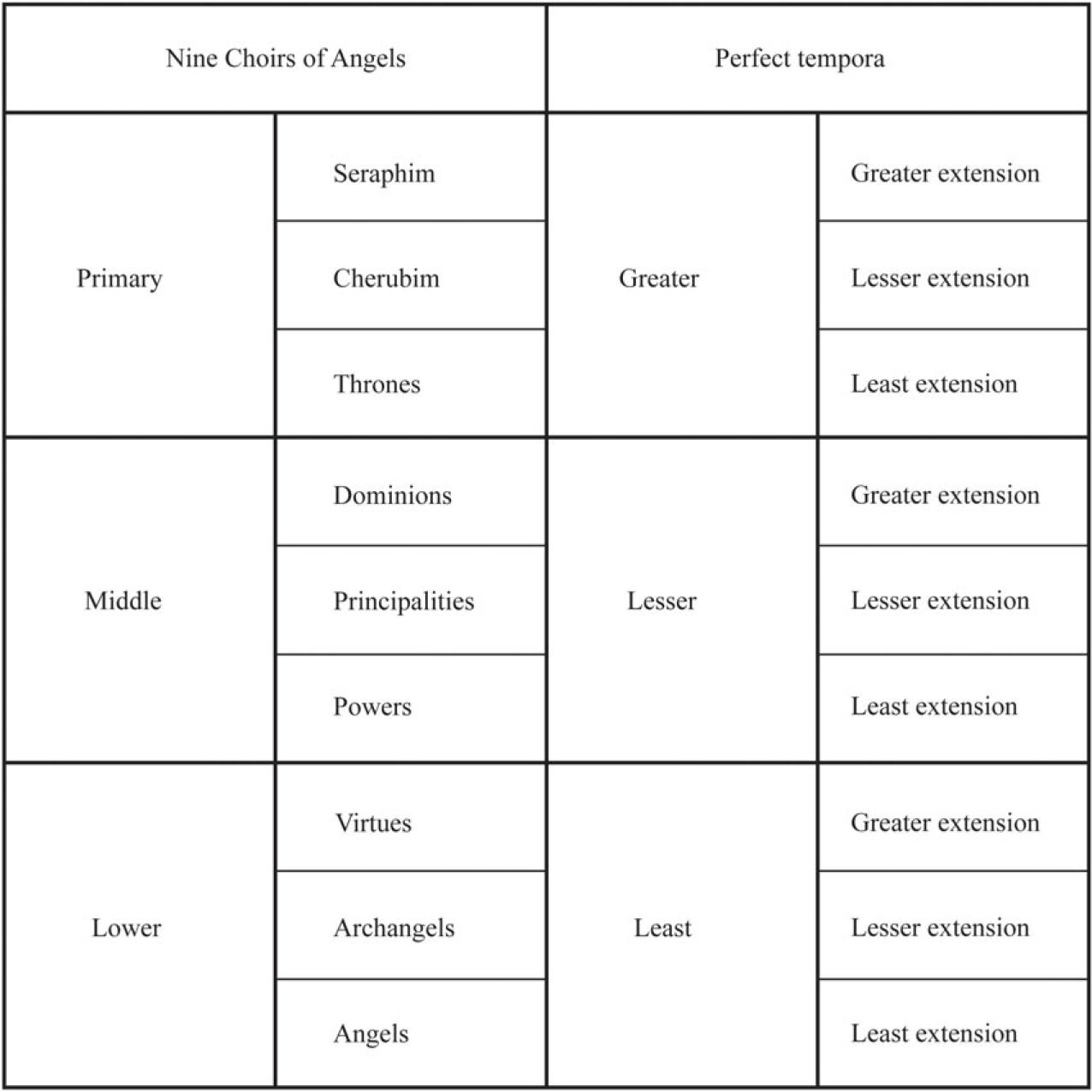
The second symbol in this section – that the novenaria is analogous to the nine choirs of angels – merits consideration because it exemplifies the reciprocity of Vetulus’s theological and music-theoretical project(s). For a medieval reader educated in theology, the nine choirs of angels would have been associated with pseudo-Dionysius (5th–6th century), who codified a ninefold hierarchy of angels in his De coelesti hierarchia.Footnote 70 A writer of possible Syrian origins, pseudo-Dionysius exercised immense influence in the Middle Ages because it was widely believed that he was the real Dionysius the Areopagite.Footnote 71 As a result of Dionysius’s association with Paul the Apostle, pseudo-Dionysius’s authority in the Middle Ages was second only to Augustine’s. One among many authors to discuss the nine choirs of angels, pseudo-Dionysius would ultimately replace Gregory the Great (c. 540–604) as the standard authority on this subject in the later Middle Ages.Footnote 72 By the late thirteenth century, De coelesti hierarchia was being studied through the filter of a seven-hundred-year-old tradition of Latin commentary composed of the translations of John Scotus Eriugena (c. 800–877) and John Sarrazin (fl. c. 1167) as well as the commentaries and glosses of Sarrazin, Hugh of St Victor (c. 1096–1141) and Thomas Gallus (c. 1200−1246).Footnote 73 Other notable commentators include Robert Grosseteste (c. 1175–1253), Albertus Magnus (c. 1200–1280) and Thomas Aquinas (1225–1274). By the fourteenth century, the most prevalent conduit for the kind of basic angelology that is encountered in Liber de musica was the Sentences of Peter Lombard (c. 1100–1160), which was the standard textbook of Scholastic theology in universities of the later Middle Ages.Footnote 74 Lombard orders the angels into threefold strata, each of which contains three kinds of angels. In the first stratum of Lombard’s angelic hierarchies sit the highest angels – the seraphim, cherubim and thrones. In the middle are the dominions, principalities and powers. In the third are the virtues, archangels and angels. Lombard cites Dionysius as an authority on the nine choirs, even though he follows the ordering of Gregory the Great.Footnote 75 The ninefold structure of the angels encountered in texts such as these originates in Platonic thought, reflecting a predilection for an intermediary or middle term to form a triad between two extremes.Footnote 76
The triadic ordering of angels of basic late-medieval angelology can be mapped directly onto the musical structures that are set out in Liber de musica. Figure 5 compares the structure of the nine choirs to the overall template of Vetulus’s perfect tempora. In this diagram I follow the ordering of the angels cited by Lombard, since this is a text through which any fourteenth-century author who attended university would have encountered basic angelology, although it is likely that Vetulus would have associated this symbol with Dionysius.Footnote 77 A comparison between the mathematical framework of the nine choirs of angels and that of Vetulus’s music-theoretical project reveals that Vetulus’s threefold hierarchies of greater, lesser and least divisions and extensions share the same basic pattern as the angelic hierarchies, which are formed of triads nested within triads. The concept of nested tripartite structures within tripartite structures inherent within Platonist philosophy is symbolically propagated across Vetulus’s theory of musical time. Whether Vetulus directly intended his hierarchies of musical time to follow the same basic pattern as the nine choirs of angels that he cites cannot be confirmed without doubt, since he does not state explicitly that this was his intention. Nevertheless, the Platonist language of ascent and descent that Vetulus employed – to be discussed again further below – adds weight to the hypothesis that Vetulus wished to link the threefold patterns of music performance – the tripartite structures of the gradus system and the three levels of tempo – with the Platonist formula embedded within symbolic structures such as the angelic hierarchies in which a mean sits between two extremes of a triad.
Angelic hierarchies transmitted in Peter Lombard’s Sentences (attributed to Dionysius) compared with the structures of Vetulus’s perfect tempora

REDUCTION
A further example drawn from the end of the second section of Liber de musica highlights the potential for a reciprocal relationship to arise between music-theoretical concepts and theological and philosophical symbolism in Vetulus’s epistemology. In this part of Liber de musica, Vetulus presents six tree diagrams, three to represent the divisions of the greater, lesser and least perfect largae, and another three to represent the divisions of the greater, lesser and least perfect tempora. Vetulus describes the passage of ascent and descent through these trees using the term ‘reduction’. Like many terms encountered in Liber de musica, Vetulus’s reduction is multivalent, embodying three distinct meanings. Reduction can refer to the reduction of the specific to the general in natural philosophy, the reduction of shorter time spans to longer time spans in mathematics, or reduction as a return to God (or the One) in its Christian theological (or Platonic) sense. As a whole, the tripartite model of reduction implied by Vetulus maps onto the basic threefold division of the sciences into natural philosophy, mathematics and theology that was set out by Aristotle and transmitted to the Middle Ages by authors such as Boethius.Footnote 78 If Vetulus consciously adopted the tripartite division of the sciences, this would yet again represent a conservative approach to medieval philosophy that adopts a long-established model but rethinks it in a novel manner. With the possible exception of the ideas of Bonaventure (c. 1217–1274, to be discussed below), Vetulus eschews engagement with the most prominent earlier theories that had nuanced the division of the sciences.Footnote 79 He exhibits no knowledge of recent trends towards Aristotelianism that would emphasise the primacy of sense perception.Footnote 80
Figure 6 provides the trees of the greater and lesser perfect tempora. At the base of the trees are positioned the four solmisation syllables of Vetulus’s ars nova – ut, re, mi and fa. As I noted previously, Vetulus states that the solmisation syllables represent the four elements – earth, air, fire and water.Footnote 81 At the root of the tree of the greater perfect tempus (12 minims) on the left of Figure 6, three of the four solmisation syllables are accompanied by the Hindu-Arabic numeral 12, each of which represents twelve minims of the greater extension (6 atoms). These twelve minims group to form the greater perfect tempus of the greater extension (72 atoms). At the foot of the tree on the right, two of the four solmisation syllables are accompanied by the numeral 9, each of which represents nine minims of the greater extension (6 atoms). These minims group to form the lesser perfect tempus of the greater extension (54 atoms). As one looks upwards through the branches of this tree, the numerals represent spans of time in minims of Vetulus’s greater, lesser and least extensions. As a general rule, these time spans become progressively shorter, up until the very shortest spans at the canopies of the trees.
Vetulus’s trees of the greater and lesser perfect breves with transcriptions (Vbar307, fol. 8v; image © 2023 Biblioteca Apostolica Vaticana)

Vetulus provides commentary on these tree diagrams, describing the passage through the trees as follows:
For all music, both plain and measured, there is an ascent through the trees all the way to the atom, and similarly a reduction. If someone asks why ascent through these trees is prior to descent, seeing as the Philosopher [Aristotle] does the contrary when he demonstrates through dialectic the division and construction of nature, the response is that nature differs greatly from this science [music]. For in all nature every superior [entity] constitutes its inferior and is greater than it. But in this science, which was invented to praise God, as has been said many times, no one who praises is greater than God; rather he is lesser. [A person who praises] does not constitute God; rather he ascends to the praise of God and is constituted by him.Footnote 82
The passage indicates that these diagrams represent the ascent from plainsong (as reflected in the positioning of the solmisation syllables at the base of the diagrams) to mensural music (represented by the numerals in the roots and branches of the trees). Vetulus states that the trees ascend ‘all the way to the atom’ and that this occurs concurrently with a reduction. Vetulus’s model of ‘reduction’ is threefold.
In its first sense, Vetulus’s reduction describes the dialectical progression from the most specific to the most general. This motif was commonly represented in the later Middle Ages using a visual schema called a tree of Porphyry, a diagram that was theorised long after the original composition of the Isagoge or Introduction to Aristotle’s Categories by the Platonist Porphyry (c. 234–c. 305).Footnote 83 The orientation of a ‘canonical’ tree of Porphyry – the tree of Peter of Spain (13th century) – was compared to the human body.Footnote 84 Following the process of logical reasoning attributed by Vetulus to Aristotle and as set out in the Isagoge, a canonical tree of Porphyry descends from general concepts that are predicated of many (the head) incrementally towards the specific concepts that are predicated upon few (the foot), and vice versa.
Figure 7 provides examples of two fourteenth-century music-theoretical trees of Porphyry from Marchetto’s Pomerium and the anonymous Ars cantus mensurabilis mensurata per modos iuris (c. 1375/6).Footnote 85 To the left, Marchetto’s tree represents the perfect and imperfect divisions. To the right, the tree of the anonymous author illustrates imperfection by remote parts – a process whereby parts of longer notes are removed by shorter notes.Footnote 87 Both authors follow the orientation of a canonical tree of Porphyry by depicting the division of musical time as a descent from longer time spans to shorter ones. The general concepts – genera – are positioned at the centre of each diagram with species on either side. For Marchetto, the genus is the tempus, and the species are the perfect and imperfect tempora. For the anonymous author, the genera are longer notes. The species are the imagined notes that result from the removal of parts from the genus notes situated at the centre of the diagram during imperfection.
Trees of Porphyry in Marchetto’s Pomerium (Milan, Biblioteca Ambrosiana, MS D 5 inf., fol. 100r; image © Veneranda Biblioteca Ambrosiana) and the Ars cantus mensurabilis mensurata per modos iuris (Brussels, Bibliothèque Royal Albert Premier, MS II 785, fol. 12v; image copyright KBR)Footnote 86

Vetulus draws an analogy between his model and logical reasoning but also emphasises that his own trees represent a different kind of reduction. Vetulus explains this by stating that nature (the natural philosophy of Aristotle represented by a tree of Porphyry) ‘differs greatly from this science [music]’. Music and natural philosophy are dissimilar because in nature ‘every superior [entity] constitutes its inferior and is greater than it’. A chain of causes exists within nature wherein the parts of the natural world that are ontologically prior create those that are lesser.Footnote 88 Vetulus provides the textbook example of God, who is ‘greater’ than a person who praises God, who is ‘lesser’. The creative force of God is the cause of the person, who is a part of nature.
Vetulus states that music cannot represent the descent from the general to the specific in nature. As a mathematical science and an imitation of nature that provides a conduit for the praise of God, music instead portrays this process in reverse. In its second sense, reduction thus entails a descent through the trees, by which shorter time spans group to form longer ones. The following is a representative example that illustrates how Vetulus applies the term reduction to describe the grouping of notes:
The aforementioned tempus of the octonaria of the greater extension can be divided into a binary rhythmic unit. Each part is called a … quaternaria of the greater extension, which is divided and grouped imperfectly.Footnote 89
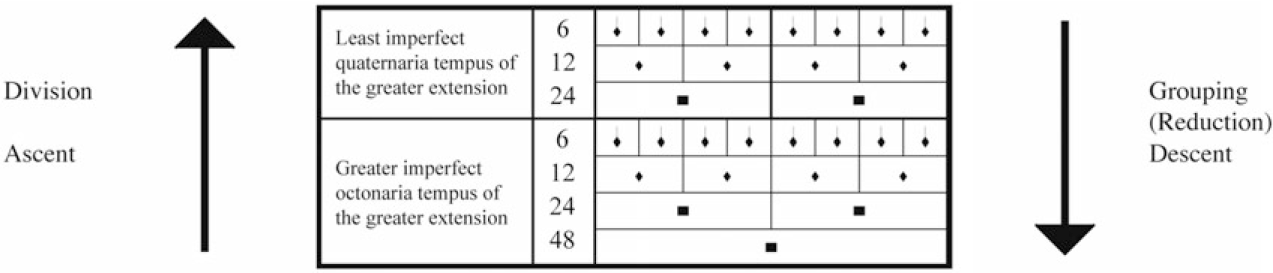
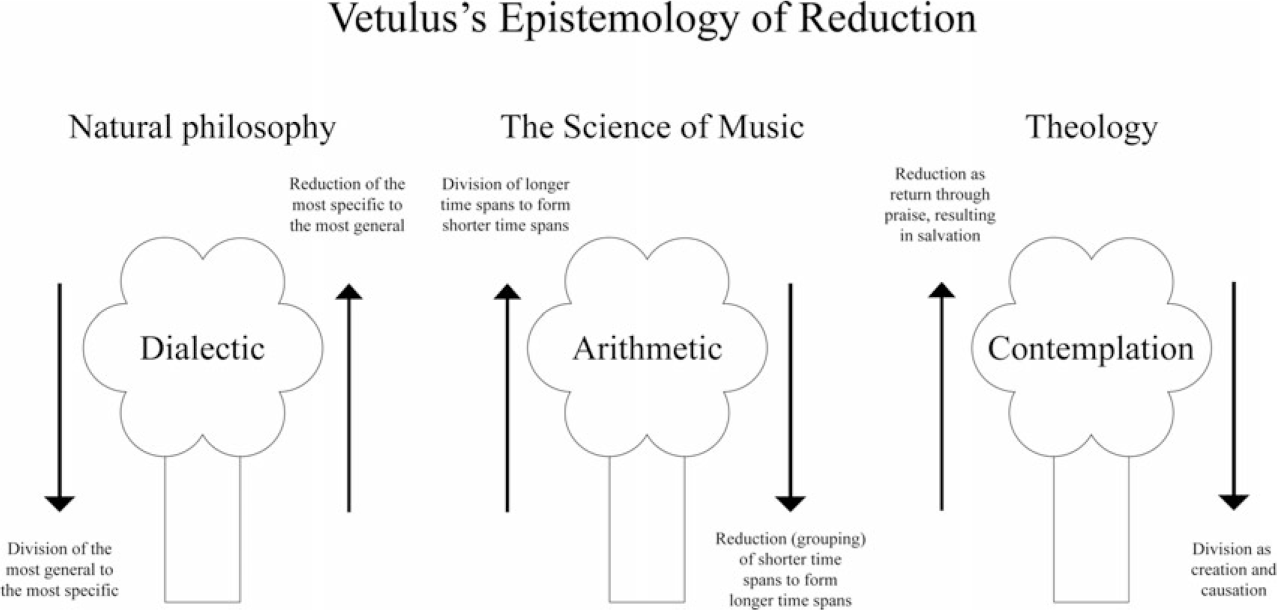
In this passage, Vetulus describes the division of the greater imperfect octonaria tempus of the greater extension (8 minims, 48 atoms) into two least imperfect quaternaria tempora of the greater extension (4 minims, 24 atoms). In other words, the octonaria is divided in half. The resulting quaternaria divisions are divided (dividitur) and grouped or ‘reduced’ (reducitur) imperfectly (into duple units). The division of notes is realised in the trees through the ascent from root to crown; the grouping (reduction) of notes is realised through the descent from crown to root. Throughout Liber de musica the term ‘ascent’ is employed synonymously with ‘division’ to describe the division of time spans. The term ‘descent’ is employed synonymously with ‘reduction’ to describe the grouping of time spans. Figure 8 clarifies this terminology through a visual representation of the division (ascent) and grouping (reduction, through descent) described in the above passage. The example illustrates that in the science of music, Vetulus’s reduction is an inversion from the model presented in a canonical tree of Porphyry. Whereas a tree of Porphyry descends from the general (that which is predicated of many) to the specific (that which is predicated of few), Vetulus’s trees, understood mathematically, ascend from the general (longer time spans) to the specific (atoms, shorter time spans).
Division of the greater imperfect octonaria tempus of the greater extension into two least imperfect quaternaria tempora of the greater extension through ascent. Grouping (reduction) of the same quaternaria divisions into an octonaria division through descent.

With this in mind, it is now possible to consider the final overall shade of meaning imbued within Vetulus’s reduction: the theological. The position of music as an imitation of nature that is opposed to dialectical reduction resonates with late-medieval models of reduction as a ‘leading back’ or ‘return’.Footnote 90 The concept of reduction as a return was explored in a body of late-medieval Platonist Christian theory that theorised the world in terms of a procession (descent) through revelation and a return through interpretation (ascent), whereby descent is analogous to creation and ascent is analogous to salvation.Footnote 91 Vetulus indicates that this is how a reader should engage with his trees by emphasising that ascent is prior to descent, reflecting music’s role as a discipline whose final cause is the praise of God.Footnote 92 The idea that reduction is a return maps onto the concept of ascent from the most general to the most specific encountered in Porphyry’s Isagoge, but repositions this model within a Platonist Christian epistemology that replaces Aristotelian dialectic with a return through contemplation.
The primary conduit for the transmission of the procession–return formula to the Latin Middle Ages was Proclus (412–485), whose Elements of Theology exercised considerable influence on pseudo-Dionysius.Footnote 93 In Proclus’s text, a chain of causes leads from the One, whose descent ultimately compels the lower causes to return to the One in ascent.Footnote 94 This structure entails the tripartite pattern of the ‘immanence in the cause, procession from the cause and reversion to the cause’,Footnote 95 a threefold division that developed the concept of procession and return already encountered in Plotinus (204/5–270).Footnote 96 Among the best known conduits for these ideas to the Latin Middle Ages are the Dionysian corpus (including the body of translations and commentaries mentioned previously) and the anonymous Liber de causis, a short treatise on Platonist metaphysics believed to have been composed in Baghdad in the ninth century.Footnote 97
The concept of procession and return is ubiquitous in late-medieval theological texts and is present as an idea in all the major commentaries of the Dionysian corpus.Footnote 98 An examination of the procession–return motif that resonates closely with the model encountered in Vetulus’s Liber de musica occurs in De reductione artium ad theologiam by Bonaventure.Footnote 99 Numbered among Bonaventure’s devotional texts, De reductione artium ad theologiam presents an application of the concept of procession and return to the arts and theology and a theory of reduction as a return or ascent.Footnote 100 Bonaventure’s reduction, like that of Vetulus, is derived from dialectical reduction but adapts this principle to a Christian theological context by describing reduction as an ascent from the reducible (everything in the world) to the irreducible (God-as-unity).Footnote 101 As Guy-H. Allard has illustrated, this pattern of reduction was theorised to convey the similitude present in creation in its entirety. It is a technique or ‘mode of thought’ that allows a reader to acquire virtue through contemplation.Footnote 102
In De reductione artium ad theologiam, Bonaventure describes the two major processes that entail reduction.Footnote 103 As a metaphysical process, reduction refers to the cyclic pattern of creation by which everything in the world emanates from God before eventually returning, a process that is realised through the reduction of all the arts to theology.Footnote 104 As a cognitive construct, reduction describes anagogy – the exegetical process of ascent.Footnote 105 This reading of reduction is already encountered in Eriugena, who translated pseudo-Dionysius’s ‘anago’ into Latin as ‘reducere’ (to reduce).Footnote 106 Bonaventure’s reduction reworks Augustine’s concept of contemplative ascent as encountered in the Confessions and filtered through the works of Hugh of St Victor.Footnote 107 It develops the Platonic-Augustinian model of paideia (education) through a structure in which the Liberal Arts serve as a conduit for educational (and spiritual) ascent to theology, and with this a more profound knowledge of God.Footnote 108
The anagogical process of ascent is also worked out systematically in Bonaventure’s influential Itinerarium mentis in Deum, which describes the ascent of the soul in contemplation of the divine. Anagogical ascent is codified in the structure of this text as a whole, which begins with (ascends from) the material and concludes with the immaterial by arriving at the darkness of the inability to know God (the Dionysian apophatic theology). The elements are situated at the bottom of this paradigm, as they are in Vetulus’s trees. Citing the sixth book of Augustine’s De musica, Bonaventure in this text claims that music is a conduit for anagogical ascent through the division of number.Footnote 109 The sciences in general result from the descent of the eternal light, and constitute an immanence of God that does not entail a reduction to the One but can help to facilitate this through the mediating influence of Christ.Footnote 110 Vetulus’s work resonates with this model, whereby the descent through the hierarchies of music – a process that entails a reduction from the atom (the specific) to longer spans of time (the general) – imitates in reverse the reduction of the contemplative mind in ascent and the reduction of all nature to God. The science of music is ‘reduced’ in descent to the contemplative, and reductive, ascent.
In sum, three general forms of reduction manifest in Liber de musica, each of whose meanings is interlaced with the others. The first describes reduction as the dialectical process by which one proceeds from the most specific to the most general. This occurs in natural philosophy and is encountered in the Isagoge and visualised in the subsequent trees of Porphyry. The following two definitions are developed from the procession from the specific to the general encountered in logical reasoning but are adapted to convey Vetulus’s music-theoretical and theological agenda. First, Vetulus inverts the concept of reduction as codified visually in a canonical tree of Porphyry by representing reduction as a descent. He rethinks the concept and applies it to music as a mathematical science and liberal art. The numerical properties of notes are reduced (grouped in a music-theoretical sense) from the numerically specific (the atom, shorter time spans) to the numerically general (longer time spans). The final form of reduction follows the trajectory of the dialectical process of ascent, but applies this to a Platonic Christian context by reading reduction as a return. Reduction occurs when the mind ascends in contemplation of music and through this praises God. As a mathematical science, music facilitates this form of reduction.Footnote 111 These processes are represented in Figure 9.
Visual representation of the various shades of meaning of the terms ‘reduction’, ‘ascent’ and ‘descent’ in Liber de musica Footnote 112

CONCLUSIONS
The threefold model of reduction set out by Vetulus represents an epistemological as opposed to an ontological approach to music, otherwise it could not be the case that ascent in praise of God could be prior to the descent of causation. While music appears to mediate between natural philosophy and theology in this model, music does not exercise a passive role, nor is it entirely mathematical. As a performative art and a facilitator of devotion, music participates in all three of the components of knowledge implied in Vetulus’s model of reduction. Music imitates the threefold hierarchies of nature, which in turn symbolise and imitate the Trinity, a process that results in contemplation of the divine. The tripartite patterns of the Trinity and angels are similarly encountered in music performance, illustrating that the speculative and the practical are mutually constitutive, both within the discipline of music and the wider world.
The readings set out above do not emerge through a surface-level examination of Vetulus’s treatise. Liber de musica is ambiguous and abstruse; Vetulus’s extensive use of symbolism and multivalent vocabulary allow multiple shades of meaning to emerge from and to be hidden within Liber de musica. While it would be impossible to comprehend Vetulus’s treatise in the same way as a medieval author, or to revive Vetulus’s own views on his work, there is value in attempting to understand this text on its own terms.Footnote 113 The theological elements of Liber de musica, when taken seriously, reveal a rich array of textual allusions and philosophical ideas that are in some respects novel, and in others old fashioned. Vetulus is neither philosophically nor music-theoretically rigorous in a present-day sense. The musical examples in the latter part of his treatise are filled with inconsistencies; in many respects his engagement with Platonist and Aristotelian philosophy does not extend beyond the surface level. Nonetheless, placing equal emphasis upon the musical and extra-musical components of Liber de musica reveals that Vetulus’s priorities lay beyond the kind of technical exactitude that is prioritised in modern musicological literature. His treatise conversely sets out an extraordinary and idiosyncratic epistemological model in which a mutual, world-forming reciprocity can emerge between human knowledge of music and philosophy.