Introduction
Sex pheromones have been identified in several hundred lepidopteran species (Arn et al., Reference Arn, Tóth and Priesner1992; El-Sayed, Reference El-Sayed2009). Pheromones are known from a wide range of taxa; but, typically, the emphasis has been on particular species which are of importance in agriculture and forestry, while there are only few comprehensive studies of species belonging to the same or closely related genera (Chisholm et al., Reference Chisholm, Reed, Underhill, Palaniswamy and Wong1985; Löfstedt & Van der Pers, Reference Löfstedt and Van der Pers1985; Priesner, Reference Priesner, Payne, Birch and Kennedy1986).
Pheromone mate recognition systems are normally highly specific and play an important role in premating isolation. Most lepidopteran pheromones consist of blends of chemicals that define channels in olfactory space along which communication occurs (Greenfield & Karandinos, Reference Greenfield and Karandinos1979). One important current question is how these communication channels change over time (Phelan, Reference Phelan, Roitberg and Isman1992; Löfstedt, Reference Löfstedt1993; Linn & Roelofs, Reference Linn, Roelofs, Lambert and Spencer1995; Cardé & Haynes, Reference Cardé, Haynes, Cardé and Millar2004; Bengtsson & Löfstedt, Reference Bengtsson and Löfstedt2007). Data on pheromones of closely related species can make an important contribution to this question (Baker, Reference Baker2002; Roelofs et al., Reference Roelofs, Liu, Hao, Jiao, Rooney and Linn2002; Karpati et al., Reference Karpati, Dekker and Hansson2008). A comparative analysis of sex pheromones across related genera will also provide valuable background knowledge for the investigation of pheromone biosynthetic pathways (Roelofs & Rooney, Reference Roelofs and Rooney2003; Xue et al., Reference Xue, Rooney, Kajikawa, Okada and Roelofs2007) and the male behavioural response to the female signal for the development of environmentally safe control techniques (Cardé, Reference Cardé, Kogan and Jepson2007; Witzgall et al., Reference Witzgall, Stelinski, Gut and Thomson2008).
A field-screening test with the four geometric isomers of (▵,▵)-8,10-dodecadienyl acetate (8,10–12Ac) has shown that males of a number of lepidopteran species belonging to the tortricid tribes Eucosmini and Grapholitini are attracted to single compounds or to binary blends of the E,E-, E,Z-, Z,E- and Z,Z-isomers. These compounds were also identified from female sex pheromone glands in several species. Each one of the four isomers elicits a behavioural response, either as main pheromone compound, attraction synergist or attraction inhibitor; their reciprocal attractive/antagonistic activity provides species-specific communication channels for a number of species (Witzgall et al., Reference Witzgall, Chambon, Bengtsson, Unelius, Appelgren, Makranczy, Muraleedharan, Reed, Hellrigl, Buser, Hallberg, Bergström, Tóth, Löfstedt and Löfqvist1996).
Two of the analogous alcohols, (E,E)- and (Z,E)-8,10-dodecadienol (E8,E10-12OH, codlemone; Z8,E10-12OH) have been identified as pheromone components in the Grapholitini species, Cydia pomonella, C. fagiglandana and Pammene rhediella (Arn et al., Reference Arn, Tóth and Priesner1992). This suggested that other Eucosmini and Grapholitini species may use (▵,▵)-8,10-dodecadienols (8,10-12OH) as pheromone components. We have field-screened these alcohols and their binary blends for their attractiveness in tortricid moths.
Methods and materials
Codlemone (E,E)-8,10-dodecadienol (E8,E10-12OH) was purchased from Pherobank (Wageningen, The Netherlands). The isomers of codlemone, E,Z-, Z,E- and Z8,Z10-12OH were synthesized as earlier described for the acetate analogs (Witzgall et al., Reference Witzgall, Bengtsson, Unelius and Löfqvist1993). They were purified by medium-pressure liquid chromatography (MPLC) on silica gel (Merck 60, 0.040–0.063 mm) coated with 15% AgNO3 in 15 mm×12 cm glass columns. Gradient elution with hexane and increasing amounts of ethyl acetate was done as described by Baeckström et al. (Reference Baeckström, Stridh, Li and Norin1987). Compounds were detected by thin layer chromatography (TLC) on silica gel (Merck 60, HF precoated aluminium foil) using 20% ethyl acetate in hexane as the eluent, visualizing the compounds with vanillin and H2SO4 in ethanol. The collected fractions were analyzed by gas chromatography (GC) and solvents were removed on a Rotavapor at reduced pressure.
Analysis of chemical and isomeric purity was done on a Hewlett Packard 5890 GC with flame ionization detection on a DB-Wax column (30 m×0.25 mm ID, J&W Scientific, Folsom, CA 96830) programmed from 60°C (hold 2 min) at 10°C min−1 to 100°C, 1.5°C min−1 to 150°C and 20°C min−1 to 230°C. Pheromone test solutions were prepared in HPLC grade ethanol and were stored at −18°C. Chemical purity of the test compounds was >99.5% and their isomeric purity was >98.9%, according to GC.
Compounds in heptane solution were formulated at 10 μg on red rubber septa (Merck ABS, Dietikon, Switzerland). Tetra traps (Phero.Net, Lund, Sweden) were hung at eye level from green branches, and were ca. 5 m apart within one replicate. Traps and septa were renewed every three to four weeks.
The geometric isomers of 8,10-12OH and their binary blends (ten treatments), blends of 8,10-12OH and their analogous acetates, 8,10-12Ac (four treatments), as well as the isomers of 8,10-12Ac and their binary blends (ten treatments) were screened in a deciduous forest in Touraine and Yvelines (France, N=12, June to September), in coniferous and deciduous forests in South Tyrol (Italy, N=4, May to August) and in various habitats in Skåne (Sweden, N=30, May to August). Trap captures were transformed to log(x+1) and submitted to an analysis of variance, followed by Tukey's test (P<0.05). Trapped males were in part identified by their wing pattern. Males of uncertain taxonomic status were identified by their genital morphology. The preparations are conserved at SLU Alnarp.
Results
Attraction to 8,10-dodecadienols
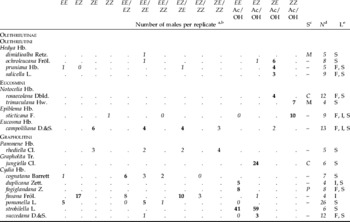
Five tortricid species were attracted to single compounds and two-component blends of 8,10-12OH (table 1). Trap catch of codling moth, C. pomonella, with E8,E10-12OH (codlemone) was significantly reduced by the E,Z and Z,Z isomers, while the Z,E isomer had no effect. This is in accordance with earlier wind tunnel and field studies (El-Sayed et al., Reference El-Sayed, Unelius, Liblikas, Löfqvist, Bengtsson and Witzgall1998). C. cognatana responded also to codlemone, but most males were captured with an E,E/E,Z-blend. C. fissana was attracted by the E,Z isomer and, of the other alcohol isomers, only Z,Z had a significant antagonistic effect. Two species with entirely different host plants responded to all blends containing the Z,E alcohol isomer: Pammene rhediella, feeding on apple; and Eucosma campoliliana, feeding on ragwort, Senecio jacobaea. The other isomers did not have a pronounced effect on trap capture of these two species (table 1).
Field attraction of tortricid males to geometric isomers of ▵8,▵10-12OH and ▵8,▵10-12Ac.


a Rounded average number of males per replicate; mean captures of <0.5 males per trap shown as ‘0’; empty traps shown as ‘.’
b Bold-faced numbers show treatments that were significantly different from others at P<0.05 (Tukey test). Blank traps did not capture any moths; captures that were not significantly different from blank are shown in italics.
c Characterization status, according to literature (Arn et al., Reference Arn, Tóth and Priesner1992, 1995) or to separate tests: (P) Pheromone, (B) off-blend, (C) compound missing, (M) non-pheromonal compound or mimic.
d Number of trap replicates, in which the respective species was trapped.
e Trap location: (F) France, (I) Italy, (S) Sweden.
Attraction to blends of 8,10-dodecadienols and 8,10-dodecadienyl acetates
In the species responding to a blend of acetate and alcohol, such as Cydia fagiglandana or C. duplicana, the acetate was the main compound and attractive by itself, while the alcohol was not attractive alone and only an attraction synergist (table 1). In C. nigricana or C. pyrivora, addition of alcohols reduced attraction to the acetates (table 2). Epiblema sticticana (=farfarae Fletch.) and three Hedya were also attracted to acetate/alcohol blends. Hedya salicella was found to be a widely distributed species. H. ochroleucana and H. pruniana were trapped in small numbers with the alcohols, larger numbers were trapped with acetates and the acetate/alcohol blends (table 1; Witzgall et al., Reference Witzgall, Chambon, Bengtsson, Unelius, Appelgren, Makranczy, Muraleedharan, Reed, Hellrigl, Buser, Hallberg, Bergström, Tóth, Löfstedt and Löfqvist1996).
Attraction of four Cydia speciesFootnote a to blends of E8,E10-12OH and E8,E10-12Ac.

a Percent trap capture.
b Total number of males captured.
c Number of trap replicates, in which the respective species was trapped.
C. strobilella feeds on seeds of spruce (Picea). The pheromone of this widely distributed and important species has not yet been identified, but the large number of males attracted to two acetate/alcohol blends (table 1) strongly suggests that the pheromone of C. strobilella includes E,E- and/or E8,Z10-12OH and the corresponding acetates. In a previous field screening study with 8,10-dodecadienyl acetates, males of C. strobilella were attracted in smaller numbers to a blend of E,E- and E8,Z10-12Ac and to the single isomers (Witzgall et al., Reference Witzgall, Chambon, Bengtsson, Unelius, Appelgren, Makranczy, Muraleedharan, Reed, Hellrigl, Buser, Hallberg, Bergström, Tóth, Löfstedt and Löfqvist1996).
C. succedana showed the same attraction pattern. Here, association of pheromone types and different host plants is possible. C. succedana was trapped in habitats where the main larval hosts, gorse, broom or greenweeds (Ulex, Genista) were not present. The larvae of these insects must have been feeding on other, herbaceous Leguminosae present at trapping sites, such as Lotus (Bradley et al., Reference Bradley, Tremewan and Smith1979). C. succedana that were introduced to New Zealand for biological control of gorse, originating from gorse seeds collected in England and Portugal, responded to the E,Z isomer only (Suckling et al., Reference Suckling, Hill, Gourlay and Witzgall1999). Pheromone races, responding to different blends, were also shown to occur in C. splendana and Epiblema foenella (Witzgall et al., Reference Witzgall, Chambon, Bengtsson, Unelius, Appelgren, Makranczy, Muraleedharan, Reed, Hellrigl, Buser, Hallberg, Bergström, Tóth, Löfstedt and Löfqvist1996).
Attraction to 8,10-dodecadienyl acetates
In addition to the species reported by Witzgall et al. (Reference Witzgall, Chambon, Bengtsson, Unelius, Appelgren, Makranczy, Muraleedharan, Reed, Hellrigl, Buser, Hallberg, Bergström, Tóth, Löfstedt and Löfqvist1996), Epiblema costipunctana Hw. (=trigeminana Stph.) responded best to a blend of Z,E- and Z8,Z10-12Ac, and E. grandaevana Z. to Z8,E10-12Ac. This test confirmed results that single specimens of C. ilipulana Wlsm. and C. oxytropidis Mart. were attracted to E8,E10-12Ac (data not shown).
Table 1 lists two species responding to compounds that are probably not part of their sex pheromones. Notocelia trimaculana is best attracted to Z10,Z12-14Ac; females of two other Notocelia species have been shown to produce ▵10,▵12-14Ac (Witzgall et al., Reference Witzgall, Chambon, Bengtsson, Unelius, Appelgren, Makranczy, Muraleedharan, Reed, Hellrigl, Buser, Hallberg, Bergström, Tóth, Löfstedt and Löfqvist1996). The reponse of N. trimaculana to a blend of Z8,Z10-12Ac and OH (table 1) may reflect the close relationship of Notocelia to Epiblema, which all use 8,10-12 compounds. One species, N. rosaecolana, uses ▵8,▵10-12Ac (table 1; Witzgall et al. Reference Witzgall, Chambon, Bengtsson, Unelius, Appelgren, Makranczy, Muraleedharan, Reed, Hellrigl, Buser, Hallberg, Bergström, Tóth, Löfstedt and Löfqvist1996). Another example is Hedya dimidioalba, an economically important species feeding on apple. Its pheromone is a blend of E8,E10-12Ac and Z8-12Ac (Frérot et al., Reference Frérot, Priesner and Gallois1979). However, H. dimidioalba is known to be attracted also to E8,E10-12OH (Arn et al., Reference Arn, Tóth and Priesner1992).
Discussion
Fewer tortricid species are attracted to the isomers of 8,10-dodecadienol, and their binary blends, than to the analogous acetates (table 3). Most species responding to the alcohols are attracted to one isomer, while the other alcohol isomers have little or no effect on male attraction (table 1). In contrast, in most species using 8,10-dodecadienyl acetates for pheromonal communication, several or all isomers have a behavioural effect. Besides the main compound, the other isomers normally are pheromone synergists or pheromone antagonists, but they are rarely inactive (Witzgall et al., Reference Witzgall, Chambon, Bengtsson, Unelius, Appelgren, Makranczy, Muraleedharan, Reed, Hellrigl, Buser, Hallberg, Bergström, Tóth, Löfstedt and Löfqvist1996). Intra- and interspecific modulation of the males' response through attraction synergists and antagonists is a strong indication that avoidance of attraction to non-conspecific females is an essential part of premating olfactory communication (Phelan, Reference Phelan, Roitberg and Isman1992; Löfstedt, Reference Löfstedt1993; Linn & Roelofs, Reference Linn, Roelofs, Lambert and Spencer1995; Cardé & Haynes, Reference Cardé, Haynes, Cardé and Millar2004).
Number of tortricid species attracted to ▵8,▵10-12 acetates and alcohols.

a Data from Witzgall et al. (Reference Witzgall, Chambon, Bengtsson, Unelius, Appelgren, Makranczy, Muraleedharan, Reed, Hellrigl, Buser, Hallberg, Bergström, Tóth, Löfstedt and Löfqvist1996) and this study.
b Data from this study.
c Total number of species using ▵8,▵10-12Ac or ▵8,▵10-12OH, including those where a preference for single compounds or blends is not determined.
Lack of a synergistic or antagonistic, i.e. intra- or inter-specific behavioural effect of the other isomers, when added to the main attractant isomer of 8,10-dodecadienol, reduces the number of species-specific communication channels based on these compounds. Only one species, C. cognatana, shows strong attraction to an alcohol blend (tables 1 and 3). In contrast, due to male sensitivity to each one of the 8,10-dodecadienyl acetates, four single isomers plus four different acetate isomer blends have been shown to function as specific male sex attractants (table 3; Witzgall et al., Reference Witzgall, Chambon, Bengtsson, Unelius, Appelgren, Makranczy, Muraleedharan, Reed, Hellrigl, Buser, Hallberg, Bergström, Tóth, Löfstedt and Löfqvist1996). In addition, the acetates were often either pronounced synergists or antagonists of male attraction to the analogous 8,10-12 alcohols (tables 1 and 3).
The female-produced sex pheromone blends of some tortricid moths also include ▵8-, ▵9- or ▵10-monounsaturated compounds in addition to ▵8,▵10-12Ac and ▵8,▵10-12OH. However, there is no indication of an interspecific behavioural role of the minor monoenic alcohols. On the other hand, specific pheromone blends of dienic and monoenic acetates, not alcohols, are known from a few Olethreutini, such as H. nubiferana and Lobesia botrana (Arn et al., Reference Arn, Tóth and Priesner1992; El-Sayed, Reference El-Sayed2009).
Many lepidopteran sex pheromones are blends of geometric isomers of straight-chain acetates that are optimally attractive over a narrow range of isomer ratios. Blends of, for example, (E)- and (Z)-11-tetradecenyl acetates are the backbone of many leafroller pheromones, and pheromone strains of the European corn borer Ostrinia nubilalis are attracted to opposite blend ratios of these compounds (Domingue et al., Reference Domingue, Musto, Linn, Roelofs and Baker2007; Karpati et al., Reference Karpati, Dekker and Hansson2008). Grapholita species communicate with blends of (Z)- and (E)-8-dodecenyl acetate; the females produce and the males respond to a rather precise, species-specific ratio of both isomers. A detailed wind tunnel study in, for example, Grapholita molesta has shown that males are quite sensitive to the E/Z-acetate ratio, while the proportion of the alcohol synergist, (Z)-8-dodecenol, in the blend is not quite as critical (Linn & Roelofs, Reference Linn and Roelofs1983). Although alcohols are frequently found to be pheromone synergists, there are no examples of tightly controlled, species-specific pheromone blends consisting of alcohol isomers, not even of analogous acetates and alcohols (Arn et al., Reference Arn, Tóth and Priesner1992; El-Sayed, Reference El-Sayed2009).
Structure-activity studies on a receptor for (Z)-5-decenyl acetate, a pheromone component of the turnip moth, Agrotis segetum, have shown that the acetate group is of great importance for the recognition of this compound, due to its polarity and hydrogen-bonding capability. Both oxygens of the acetate group contribute to the interaction between pheromone compound and its receptor (Gustavsson et al., Reference Gustavsson, Tuvesson, Larsson, Wenqi, Hansson and Liljefors1997; Norinder et al., Reference Norinder, Gustavsson and Liljefors1997). The lack of a strong behavioural effect of the 8,10-dodecadienol isomers, compared to the analogous acetates, may thus result from a lack of discrimination between single isomers at the antennal receptor level (Bäckman et al., Reference Bäckman, Anderson, Bengtsson, Löfqvist, Unelius and Witzgall2000). A tentative explanation is that the shape of a dienic acetate molecule, with a large functional group opposite the rigid double bond system, is more characteristic than that of an alcohol. Therefore, male moths may distinguish between geometric isomers of acetates more precisely than between the alcohol isomers.
Acknowledgements
Supported by the Linnaeus Grant IC-E3 (FORMAS, SLU), the University of Kalmar and the Royal Institute of Technology. We thank Jean-Pierre Chambon, Versailles and Peter Huemer, Innsbruck for help with taxonomical identification.