INTRODUCTION
In one of the earliest Spanish descriptions of cacao—based on personal observations made in Nicaragua in 1528—the royal chronicler Gonzalo Fernández de Oviedo despised the custom of combining it with achiote (Bixa orellana). He explained, “because those people are fond of drinking human blood, to make this beverage seem like blood, they add a little achiote, so that it then turns red.” A few paragraphs later he added, “and part of that foam is left on the lips and around the mouth, and when it is red for having achiote, it seems a horrific thing, because it seems like blood itself” (Fernández de Oviedo Reference Fernández de Oviedo and de los Ríos1851:318; all translations from Spanish by the author). The comments might be taken to reflect the chronicler's prejudice and misjudgment of native customs, but the documentary, iconographic, and ethnographic evidence suggests otherwise. Mesoamerican peoples associated cacao with human sacrifice, and cacao drinks with sacrificial blood, in ritual and symbolic contexts. The frequent addition of red-colored achiote to cacao drinks probably accentuated the underlying metaphor. This article explores the artistic, literary, and ritual expressions of this metaphor in the Pacific coast of Guatemala, from a diachronic perspective that highlights the crop's shifting symbolic connotations, and the permanence of core meanings that linked cacao with human sacrifice.
The Pacific coastal districts of Soconusco in modern Chiapas, Zapotitlan and Suchitepequez, Escuintla and Guazacapan in modern Guatemala, and the Izalcos in modern El Salvador, were major cacao producers in the sixteenth century (Bergman Reference Bergmann1969; Millon Reference Millon1955). While the importance of the crop is best documented in the early Colonial period, archaeological evidence suggests that it was no less important in earlier times. The abundance and quality of cacao is generally considered as a stimulus for the cultural development of the region's inhabitants, and their participation in extensive networks of trade and exchange (Bove et al. Reference Bove, Medrano, Lou and Arroyo1993; Lowe et al.Reference Lowe, Lee and Espinosa1982). Cacao production also made the Pacific coast a target for the ambitions of expansive powers. Sites in the coastal plain of Escuintla have yielded indications of an Early Classic influx from Teotihuacan, which may have involved military expansion (Berlo Reference Berlo1984; Bove and Medrano Reference Bove, Medrano and Braswell2003; Hellmuth Reference Hellmuth1975). During the Late Postclassic period, the Mexica made Soconusco a tributary province, while the highland Guatemalan K'iche’ and Kaqchikel expanded into the rich cacao-producing lands of the coastal piedmont (Chinchilla Mazariegos Reference Chinchilla Mazariegos1998; Voorhies Reference Voorhies1989; Zamora Acosta Reference Zamora Acosta and Franch1979). Ceramic artifacts and stone sculptures from the Pacific coast are rich in representations of cacao related to images of warriors, captives, and sacrificial victims. Despite their significance, these objects remain largely unstudied and partly unpublished. Janet Berlo's work on Teotihuacan-style art in Escuintla (Reference Berlo and Berlo1983, Reference Berlo1984) is an exception that provides an important precedent for this article.
In a pioneering essay on the uses of cacao in Mesoamerica, Thompson (Reference Thompson1956:101) brought the sacrificial connotations of the crop and its derivates to the attention of modern scholars. His observations were based on the iconography of the Cotzumalhuapa sculptures, complemented with passages from three colonial texts: (a) García de Palacio's 1576 letter (Reference García de Palacio and Acuña1982), describing the custom among the Pipil of El Salvador of hanging cacao around the neck of captives destined for sacrifice, (b) a Maya riddle from the Book of Chilam Balam of Chumayel, which equated a severed head with a gourd full of chocolate (de la Garza Reference de la Garza and Bolio1985:131); and (c) the Nahuatl verse cuauhinochitla, cacahuatla, from the Song to Otontecuhtli, recorded in the sixteenth century by Sahagún, which equated a cacao pod with the heart of a sacrificial victim. According to Seler (Reference Seler and Comparato1992:267–70), the couplet alluded to the god Otontecuhtli himself, who personified a dead warrior. Building on Thompson's insights, Coe and Coe (Reference Coe and Coe1986:101) noted a Nahuatl metaphor, the couplet yollotli, eztli—literally “heart, blood”—that, according to Sahagún's (Reference Sahagún, Dibble and Anderson1969:256) informants, stood for cacao. Smith (Reference Smith1973:58) noted an intriguing parallel in the Mixtec codices of occasional representations of bleeding cacao pods inside or on the roof of temples.
Recent scholarship has greatly improved our understanding of the agricultural, economic, and cultural significance of cacao in Mesoamerica, as reflected in a substantive volume edited by McNeil (Reference McNeil and McNeil2006:15), who reviewed the crop's sacrificial symbolism in the introductory chapter. Yet beyond Thompson's (Reference Thompson1956:101) initial observations, there are few attempts to probe the iconographic or archaeological correlates of the crop's sacrificial symbolism, or relate them with other aspects of Mesoamerican religion and sacrificial practices. This article traces the iconography of cacao on the Pacific coast of Guatemala, from probable representations on Early Preclassic figurines to Late Classic stone sculptures and ceramic objects. The final sections analyze colonial textual sources and contemporary ethnographic data from the southern Guatemalan highlands, which preserve elements of the sacrificial symbolism of cacao, and may be relevant for the interpretation of pre-Columbian imagery.
Observing an apparent similarity in the shape of cacao pods and human hearts, Thompson (Reference Thompson1956) suggested that they were both conceived of as repositories of precious liquids—chocolate and blood. While he offered no further comment, his insight merits elaboration. In coastal art, cacao pods often acquired bodily manifestations, although, instead of hearts, they generally substituted for human heads. Cacao pods were also depicted growing from human bodies that personified cacao trees. Thompson's analogy suggests that cacao and sacrificial victims belonged to the same conceptual category, and substituted for each other in the art and religion of Pacific coastal peoples. Both were likely conceived as sources of nourishment, suitable for the gods. From this perspective, the iconography of cacao is relevant for discussions about human sacrifice and divine sustenance in Mesoamerican religion (Carrasco Reference Carrasco1995; Graulich and Olivier Reference Graulich and Olivier2004).
Early Preclassic Representations Of Cacao?
Powis et al. (Reference Powis, Hurst, Rodríguez, Ortíz C., Blake, Cheetham, Coe and Hodgson2007) found chemical traces of cacao in pottery sherds from Cantón Corralito, a site in the Soconusco region of Pacific coastal Chiapas. Dating to 1900–1500 b.c., these sherds currently provide the earliest evidence of cacao consumption in Mesoamerica. The earliest representations of cacao appeared in the same region somewhat later, during the Ocós phase (1250–1100 b.c.), in ceramic figurines of the Paqui Group that represent fat individuals with animal heads or masks. Examples published by Lesure (Reference Lesure, Claassen and Joyce1997) and Rosenswig (Reference Rosenswig and Lesure2011) have elongated, striated protuberances growing from the torso or hanging from the neck (Figure 1). While Lesure (Reference Lesure, Claassen and Joyce1997:236) described them as tassels that formed part of their apparel, these protuberances may represent cacao pods. Their shape and position are similar to the cacao pods that grow from the body or hang from the neck of Classic period ceramic effigies, as described later in this article.
Paqui Group figurine fragment from the Mazatán Region, Chiapas, dating to the Ocós phase (1250–1100 b.c.), which represents a standing character with cacao pods growing from the torso. Drawing by the author after Lesure Reference Lesure, Claassen and Joyce1997:236.

Clark (Reference Clark and Fowler1991:21) identified these characters as shamans or chiefs, while Lesure (Reference Lesure, Claassen and Joyce1997:235–241) saw them as male elders whose masked visages suggest their participation in the reenactment of mythical events. These interpretations are compatible with the proposed identification of cacao pods as a salient attribute of these characters. In later Mesoamerican societies, cacao was broadly conceptualized as a symbol of wealth and abundance that would fit well in portraits of community leaders and elders who claimed control over incipient cacao orchards. The human embodiment of cacao trees, suggested by the Paqui figurines, provides an indication about the early onset and long duration of iconographic conventions that prevailed many centuries later in the Pacific coast. However, the figurines show no signs of the sacrificial symbolism that became strongly attached to the iconography of cacao during the Classic period.
Cacao And Warrior Imagery In Coastal Censers
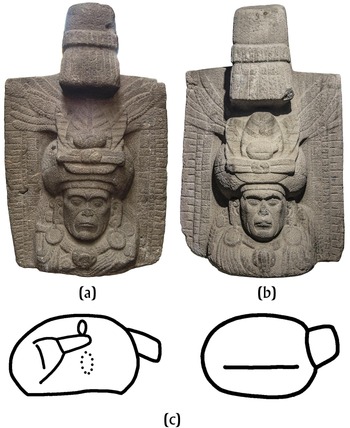
Representations of cacao are conspicuously absent from the Late Preclassic sculptures of Izapa, Tak'alik Ab'aj, and other coastal sites. They reappeared in Early Classic Teotihuacan-style censers and ceramic vessels from the coastal plain of Escuintla, initially described by Hellmuth (Reference Hellmuth1975, Reference Hellmuth and Pasztory1978), and documented in archaeological contexts by Shook (Reference Shook1975) and Bove and Medrano (Reference Bove, Medrano and Braswell2003).
Berlo (Reference Berlo1984:105) interpreted the censers as mortuary representations related to Postclassic Aztec beliefs in the transformation of the spirits of dead warriors into butterflies: “the icons in these censers are dead warriors, papalotl [butterfly] warriors, and the incense is offered to their memory.” Building on her insights, Taube (Reference Taube, Carrasco, Jones and Sessions2000:306–309, Reference Taube, Mazariegos and Arroyo2005) identified the censers as representations of warriors’ mortuary bundles. When lit, they would have recreated the cremation rituals that liberated the warriors’ souls, transformed as butterflies. Moreover, Berlo proposed that the metamorphosis of butterflies served as a natural model for the transformation of dead warriors. Taube (Reference Taube, Carrasco, Jones and Sessions2000:309) also elaborated on this idea, highlighting the representation of mortuary bundles as chrysalises and pupae in Postclassic codices from highland Mexico, which implied the eventual metamorphosis of the warriors’ souls as butterflies.
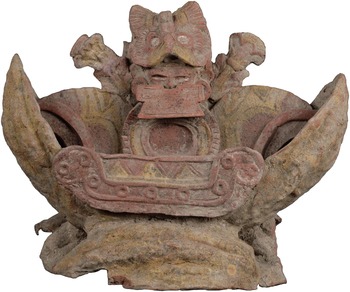
Hellmuth (Reference Hellmuth and Pasztory1978) first published an extraordinary censer lid that preserves its original yellow, red, black and white colors (Figure 2). The liquid receptacle in the frontal plane is common in Teotihuacan-style censer lids from Escuintla. However, the lid is uniquely shaped as a split cacao pod resting on two others, all molded from natural cacao pods. Following Thompson's (Reference Thompson1956) insights on the sacrificial symbolism of cacao, Berlo (Reference Berlo and Berlo1983:96; Reference Berlo1984:108) interpreted this object as “a ritual metaphor for human hearts and blood.”
Censer lid that shows a split cacao pod. The emerging character has a human face, butterfly wings, and a headdress that combines butterfly and avian attributes. Photograph by Eduardo Sacayón, courtesy of Museo Popol Vuh, Universidad Francisco Marroquín.

The character that emerges from the split cacao pod has a human face, a circular chest ornament (probably a mirror), a butterfly nosepiece, and butterfly wings. The headdress combines a butterfly's proboscis and antennae with the feathered eyes and beak of a raptorial bird. The beak on this lid is broken, but it may be reconstructed by comparison with a separate adorno that has a complete, curved beak with triple drops of blood flowing down (Figure 3). A close parallel is found in the raptorial birds depicted on the mural paintings of Tetitla, Teotihuacan. Pasztory (Reference Pasztory and Berrin1988:164) identified them as owls, although they may be harpy eagles, and they are often associated with weapons and military imagery. For want of a secure identification, they will be designated as “raptors” in the following paragraphs.
Adorno combining butterfly and raptorial bird features, with dripping blood emphasized. Photograph by the author.

The attributes of this character evoke both his status as a warrior and his afterlife destiny, themes that are commonplace in the Escuintla censers. Why does he emerge from a split cacao pod in this unique example? Following Taube's mortuary interpretation of the censers, it appears that the cacao pod represented either the warrior's body or his mortuary bundle. Like a butterfly emerging from the inert chrysalis, the warrior's soul was freed from the empty rind. Conceivably, the flowers that flank his head evoked the flowering places associated with the destiny of dead warriors in sixteenth-century Nahuatl sources. The belief is ancient, as suggested by representations of flowering mountains in Lowland Maya and Teotihuacan art, identified by Taube (Reference Taube2004, Reference Taube, Mazariegos and Arroyo2005), who noted their prominent presence in censer lids from the Pacific coast.
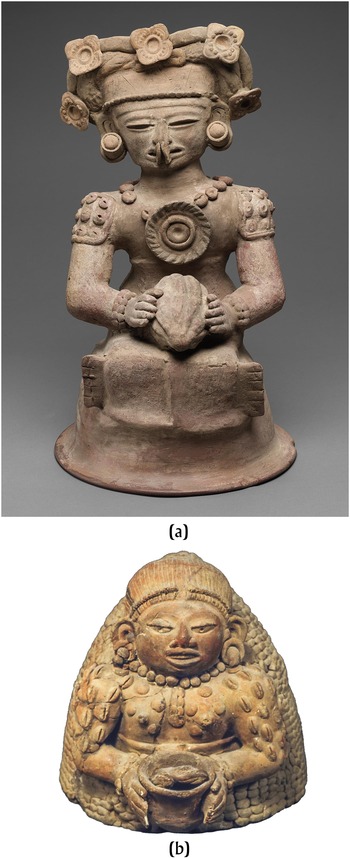
A substitution between cacao pods and Teotihuacan-style butterfly-raptors is noticeable in another group of Early Classic censer lids that represent seated females with elaborate headdresses, large nosepieces, and multiple ornaments or scarifications in the shoulders, holding cacao pods in their hands (Figure 4a). Berlo (Reference Berlo1984:Plate 127) published one example, while others are known from photographs by Kerr (Reference Kerr2013:K6048, K6050) and from the Boston Museum of Fine Arts online catalog (Accession No. 1988.1227a).Footnote 1 Other similar effigy lids show females holding empty bowls. The distinction is blurred in a fine lid from the collection of Guatemala's National Museum of Archaeology and Ethnology that depicts two small cacao pods inside a bowl (Figure 4b). The entire lid is covered with oval-shaped applications that give it the appearance of a large pile of cacao beans.
Censer lids with female characters holding cacao pods. (a) Woman or goddess holding cacao pod. Photograph ©2015 Museum of Fine Arts, Boston. (b) Woman or goddess holding a bowl with two cacao pods. Photograph by the author.

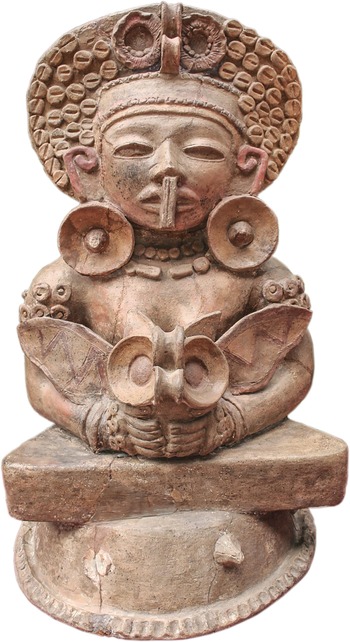
A similar lid, in the collection of the Museo de Arqueología y Vidrio Moderno, Antigua Guatemala, shows the same character holding a butterfly-raptor instead of a cacao pod (Figure 5). The substitution suggests that the cacao pod and the butterfly-raptor conveyed related meanings. In accordance with the previous arguments, the cacao pods corresponded to dead warriors or their mortuary bundles, while the butterfly-raptors likely represented a dead warrior's transformed souls.
Censer lid with female character holding a butterfly-raptor. Photograph by the author, courtesy of the Museo de Arqueología y Vidrio Moderno, Antigua Guatemala.

The consistent iconographic attributes of these lids—especially the nosepieces and shoulder ornaments—suggest a well-defined female character, perhaps a specific goddess, or her ritual impersonators. It appears that this character played a role in the eventual transformation of dead warriors into butterflies or butterfly-raptors, perhaps achieved through appropriate mortuary rituals that involved the actual use of the censers.
Strings Of Cacao Around The Neck
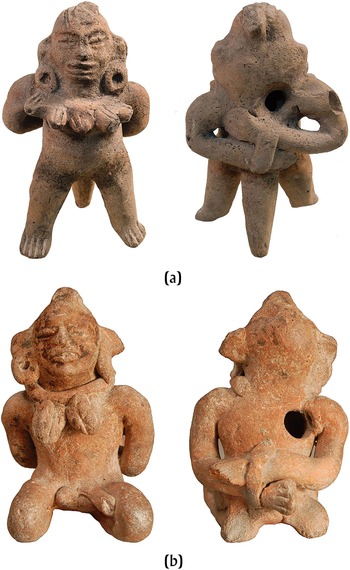
Butterflies and other motifs of Teotihuacan origin waned at the end of the Early Classic, but the association of cacao with warfare and human sacrifice persisted. A group of simply made ceramic whistles provide tantalizing evidence of continuity in sacrificial rituals involving cacao from the Classic period to the sixteenth century. They represent naked captives with the arms tied behind the back. The known examples (Figure 6; Chinchilla Mazariegos Reference Chinchilla Mazariegos2005:17) share crest-like protuberances on the head and some have prominent male genitals. The penis may or may not be erect. They wear necklaces with two or more pointed, striated cacao pods.
Whistles showing captives with cacao pods around the neck. (a) Standing captive, front and back views. (b) Seated captive, front and back views. Photographs by the author.

Many centuries separate these whistles from García de Palacio's (Reference García de Palacio and Acuña1982) description of war captives among the sixteenth-century Pipil of the Izalcos region, in modern El Salvador. Yet they may pass as portraits of the victims that were sacrificed during feasts that, according to the Spanish oidor, were dedicated to Quetzalcoatl or to the goddess Itzqueye: “all of those who were in the war came orderly singing and dancing, and they brought those who were to be sacrificed, with many feathers and jewels in their feet and hands, with strings of cacao around the neck, and these were brought by the captains in their midst” (García de Palacio Reference García de Palacio and Acuña1982:279). They gave the captives to the priests, who received them with dance and music. The captives were kept for the duration of the feast, and were finally killed by heart extraction.
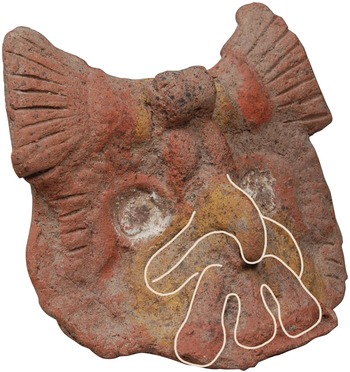
Heart sacrifice is the apparent destiny of the character represented in a Tiquisate ceramic effigy—not a whistle—that reiterates the theme of a back tied captive with a cacao pod hanging from the neck (Figure 7). The luxurious cream-orange slip is characteristic of Tiquisate, a fine ceramic ware from Escuintla that was broadly distributed along the Pacific coast during the Late Classic period (Thompson Reference Thompson1948:45–47; Parsons Reference Parsons1969:130–134; Gómez Gonzáles Reference Gómez Gonzáles2006). In a detailed study of Tiquisate figurines, Castillo Aguilar (Reference Castillo Aguilar2008:60) identified the character represented in this effigy as an “androgynous old man” that combines an old man's visage and beard with pointed, feminine breasts. The androgynous old man is featured with some frequency in Tiquisate figurines but this effigy is the only known example that shows him as a captive. His death by heart sacrifice is suggested by an oddly-shaped design, incised on the left side of his chest, which likely represents a bleeding wound.
Effigy portrait of a captive with a cacao pod hanging from the neck. (a) Front, (b) back, and (c) side views, and (d) tracing of the incised design on the left side of the chest. Photographs and drawing by the author.

The parallel with García de Palacio's (Reference García de Palacio and Acuña1982) description of the Pipil captives is patent, but the oidor offered no explanation about the role of cacao in these rituals. Elsewhere in the Maya area, collars of cacao pods appear mostly in portraits of animals, including jaguars and monkeys that have no evident sacrificial connotations (Ichon and Grignon Cheesman Reference Ichon and Cheesman1983:121–124; Miller and Martin Reference Miller and Martin2004:87; Kerr Reference Kerr2013:K1789, K9103). Conceivably, the cacao pods hanging from their necks gave the captives some resemblance to cacao trees ripe with fruits. They may have underscored the victims’ sameness to cacao pods, both conceived as rich victuals suitable for the gods.
Their captives sometimes display prominent genitals—not always ithyphallic—that bring them close to Lowland Maya representations of male captives with eroticized, naked bodies, whose sexuality has been variously interpreted. Joyce (Reference Joyce, Schmidt and Voss2000:270) suggested that they were mainly addressed to male viewers, highlighting their apparent “celebration of male sexuality and male beauty for apparently exclusive male audiences.” Houston et al. (Reference Houston, Stuart and Taube2006:207–219) interpreted them as denoting degradation and vulnerability to sexual abuse. Urcid (Reference Urcid, Garcia and Guzman2011:221) saw them as victims that fulfilled sacred covenants with the gods, alluding to the divine granting of human procreative powers.
The cacao pods hanging from their necks may also have given the coastal captives an effeminate aspect, as if provided with women's breasts. Their feminization may have implied an alimentary metaphor. Graulich and Olivier (Reference Graulich and Olivier2004) noted that Mesoamerican gods were sometimes likened with babies that had to be nurtured from their mothers’ breasts. In the Popol Vuh, the god Tohil requested, in exchange for fire, that the nations had to “give their breast, beneath the shoulders and armpits.” Tedlock (Reference Tedlock1996:155–156, 299). Christenson (Reference Christenson2003:216) noted the wordplay based on the verb tu'nik, “to give the breast, to suckle, to nurture,” which, in this context, implied that humans submitted themselves to sacrifice by heart extraction. The metaphor seems applicable to the androgynous old man in the Tiquisate effigy, whose pointed breasts may allude to the qualities of cacao and human victims as sources of divine nurturance.
The continuity poses important culture-historical questions about the relationship of Classic coastal populations with Postclassic Nahua speaking peoples of southern Guatemala and El Salvador, generally considered a result of Postclassic waves of migration. Fowler (Reference Fowler1989:38–41) discussed possible Nahua influxes during the Early and Late Classic period, while noting that the archaeological evidence is not incontrovertible. Be that as it may, the captive figurines with cacao pods around the neck provide one indication of cultural continuity, despite the waves of migration that transformed the linguistic composition of the area through the Classic and Postclassic periods. Such continuity was likely related to the sustained importance of cacao cultivation, which implies the transfer of agricultural technology and associated cultural patterns from the Classic people of Escuintla, Guazacapan, and the Izalcos, to the Postclassic Pipil of El Salvador.
The Sacrifice Of Cacao In Cotzumalhuapa Art
Thompson's (Reference Thompson1956:101) seminal discussion of cacao and human sacrifice began from his iconographic observations on the sculptures of Cotzumalhuapa. Representations of cacao pods in Cotzumalhuapa sculptures suggest that the crop was an important component of the city's agricultural economy and played an important role in religious beliefs and rituals.
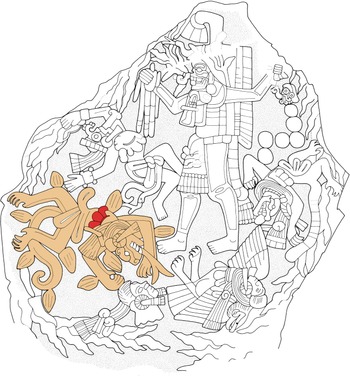
Specifically, Thompson (Reference Thompson1956:101) commented on the sacrificial scene depicted on Monument 4 from El Baúl, one of the three architectural complexes that dominated the city's urban landscape together with Bilbao and El Castillo (Chinchilla Mazariegos Reference Chinchilla Mazariegos, Stuardo and Rock2011a, Reference Chinchilla Mazariegos2012a). This great rock carving (Figure 8) shows four victims falling backwards, around a skeletal executioner that utters a fiery speech scroll while raising up a bleeding heart (Chinchilla Mazariegos Reference Chinchilla Mazariegos, Boone and Urton2011b:61–62). As suggested by Javier Urcid (personal communication 2014), the calendrical name 6 Rain appears to designate the executioner, who may be a historical individual, while the spatial arrangement of the victims may have directional significance.
Monument 4 from El Baúl, Cotzumalhuapa with the composite animal sprouting cacao pods highlighted. Note split chest with gushing blood. Drawing by the author.

Thick gushes of blood flow from open wounds in the victims’ chests, while the loops in their abdominal region may represent their extruded bowels. One of the victims is a quadruped that seems to embody a sacrificed cacao tree with nine cacao pods growing from its body. Thompson (Reference Thompson1956:101) identified it as a jaguar and Kufer and McNeil (Reference Kufer, McNeil and McNeil2006:97) suggested that it might represent pataxte (Theobroma bicolor), a cacao species that is known in Yucatec Maya as balamte, “jaguar tree.” Yet the animal is a composite that combines the head and body of a feline with the long split tongue of a reptile. While dissimilar in some respects, it may relate with the Jaguar Iguana, a mythical animal that combines a jaguar head with the body of an iguana (Chinchilla Mazariegos Reference Chinchilla Mazariegos2006).
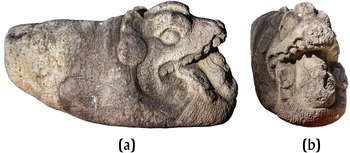
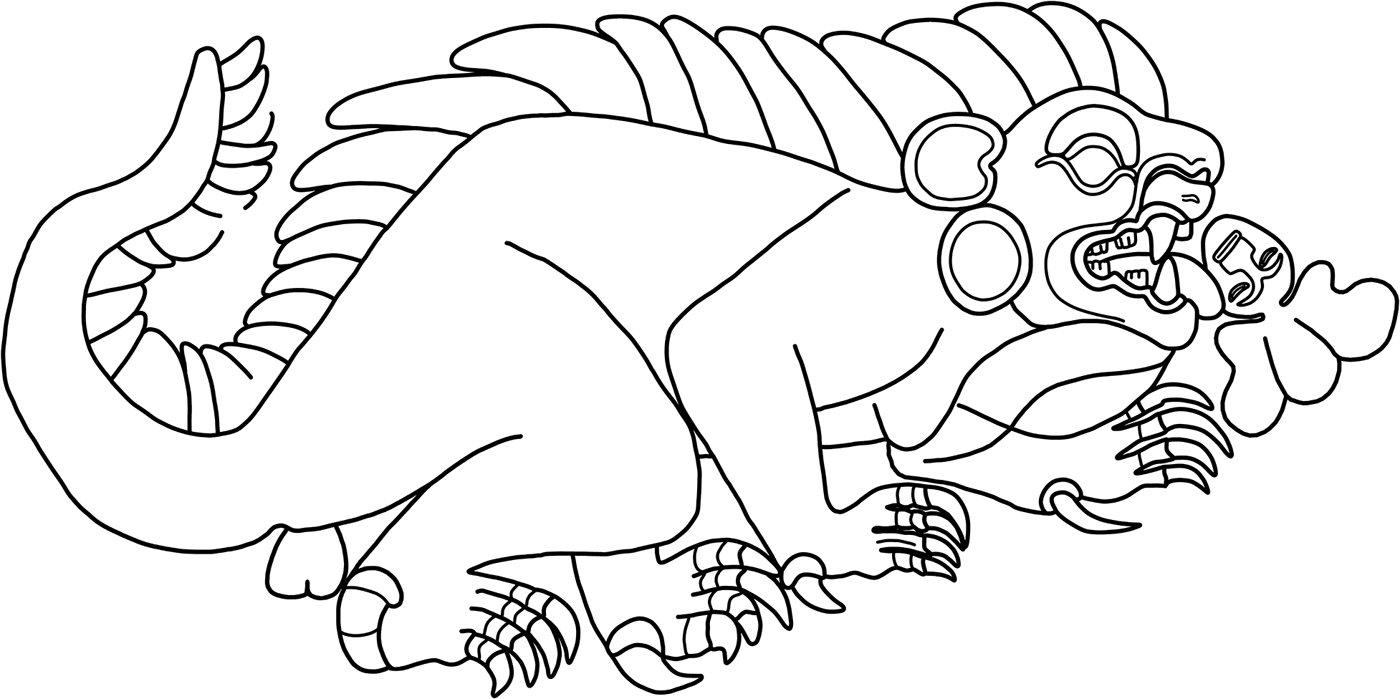
A horizontally tenoned sculpture in Guatemala's National Museum of Archaeology and Ethnology shows a creature with jaguar nose and ears and the short crest of an iguana. The monster devours a victim, whose head hangs down from the animal's mouth (Figure 9). The Jaguar Iguana's victims adopt a similar stance elsewhere in Lowland Maya and Cotzumalhuapa art. The composite animal reappears in El Baúl Monument 69, where its victim is a human-faced fruit that hangs head down from the animal's tongue (Figure 10). The comparison of both sculptures highlights the common substitution of human-faced fruits for human heads in Cotzumalhuapa art.
Horizontally tenoned sculpture showing the Jaguar Iguana with a human head hanging in the mouth. (a) Side view; (b) front view. Photographs by the author.

Depiction of the Jaguar Iguana biting a human-faced fruit on El Baúl Monument 69. Drawing by the author.

The Jaguar Iguana's role as a killer in these sculptures contrasts with its apparent role as a victim on El Baúl Monument 4. Urcid (personal communication 2014) suggested that this dual role reflects the paradoxical roles of Mesoamerican warriors as aggressors and potential victims of sacrifice. As an active aggressor, the Jaguar Iguana consumes human heads like ripe fruits; as a victim of sacrifice, the animal sprouts cacao pods, perhaps denoting a passive role, as a fruit about to be consumed.
In Maya languages, the words for “face” and “fruit” are generally interchangeable. Relevant roots include ich in Yucatec languages, ut or wut in Ch'olan languages, sat or sit in Tzotzil and Tzeltal, witz in Mam, and wach in K'ichean languages (Kaufman and Justeson Reference Kaufman and Justeson2003:325–326; Martin Reference Martin and McNeil2006:165). The lexical correspondence may partially explain the substitution between human-faced fruits and severed human heads. However, the representation of human heads as fruits in Cotzumalhuapa art goes beyond the common use of terms derived from human bodily parts to designate plant parts. The fruits are human heads and their harvest amounts to human sacrifice. This quality was not restricted to cacao but also applied to other fruits of oblong shape that were not marked with the striations that characterize cacao and pataxte. Other local fruits of appropriate size and shape include zapote (Pouteria sp.) and a cucurbit locally known as melocotón (Sicana odorifera).
A revealing substitution appears in the imposing portraits known as El Baúl Monument 12 and Pantaleón Monument 1 (Figure 11), originally found together at the great precinct of El Baúl (Chinchilla Mazariegos Reference Chinchilla Mazariegos1996, Reference Chinchilla Mazariegos2012a:55–56). The facial features are so similar that both sculptures seem to represent the same individual, perhaps a lord who ruled during the heyday of Cotzumalhuapa. Each portrait has a fruit resting on the headdress. The fruit on El Baúl Monument 12 is striated, suggesting a cacao pod. Pantaleón Monument 1 has a human-faced fruit, complete with the stem. The presence of these fruits on the lord's headdress may highlight the economic importance of cacao, which was probably an important source of his wealth. At the same time, the fruits are human heads, carried as lordly trophies, in a way that suggests links between the bounty of cacao and the performance of human sacrifice.
Horizontally tenoned portraits of a probable ruler from the El Baúl acropolis, with details showing the fruits on the respective headdresses. (a) Pantaleón Monument 1; (b) El Baúl Monument 12; (c) detail showing the fruits on the respective headdresses. Photographs and drawings by the author.

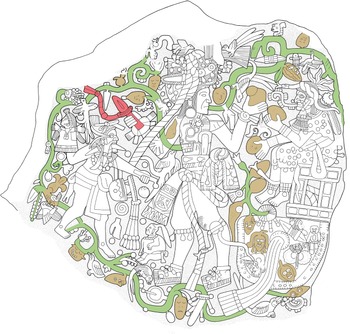
Human sacrifice is also metaphorically represented as a harvest of fruits on Bilbao Monument 21 (Figure 12). Thomas Gann (Reference Gann1939:217) first noted the sacrificial theme of this great relief—the largest and most complex at Cotzumalhuapa. Briefly, the scene shows a sacrificial dance with three participants. At center stage, the main character is dancing and singing to the rhythm of an instrument played by another performer, at the observer's left. The latter handles a puppet while beating a sound instrument with a human femur. The central character's twisted stance—with feet and face turned in opposite directions—is a widespread Mesoamerican convention for dancing (Chinchilla Mazariegos Reference Chinchilla Mazariegos, Stöckli and Both2012b, Reference Chinchilla Mazariegos2015). His utterance is represented as a scrolling vine ripe with flowers, human-faced fruits, and even objects that hang like fruits from the vine. Considering the scene's musical qualities, his utterance is best understood as an elaborate song, echoed by the song of a death god that occupies the dancer's torso. More than an ornament or decoration, the death god appears to be part of his body and sings together with him—perhaps highlighting the dancer's dual role as executioner and potential victim. Their songs grow to create a veritable landscape around the scene, blooming with fruits and flowers, inhabited by birds that suck the nectar and bite the fruits. This landscape of beauty and abundance also features a number of precious or ritually significant objects such as knives, shells, earspools, and other jewels that sprout like flowers from the flourishing vines.
Bilbao Monument 21 with shaded areas highlighting the knife held by the central character, the vines/sound scrolls, and the human-faced fruits growing from them. Drawing by the author.

While dancing and singing, the central character wields a large knife, with which he cuts the fruits that grow from his own utterances. Thompson (Reference Thompson1956) noted the sacrificial connotations of this harvest. The fruits are human heads, and the act of gleaning them with a knife stands for human sacrifice. The harvested fruits appear in the hands of both the dancer and an old woman that sits on a bench in front of him, who seems to receive them while responding to the dancer's song with a song or speech marked by a spiraling sound scroll in her mouth.
As noted in previous work, the flowery songs of Cotzumalhuapa art recall widespread mythical beliefs in primeval places of beauty and abundance, as documented in ethnographic and literary sources from various places in Mesoamerica and the southwestern United States (Chinchilla Mazariegos Reference Chinchilla Mazariegos, Laporte, Arroyo and Mejía2008, Reference Chinchilla Mazariegos, Boone and Urton2011b, Reference Chinchilla Mazariegos, Stöckli and Both2012b, Reference Chinchilla Mazariegos2015). In a study of Uto-Aztecan songs, Jane Hill coined the term “flower world” to designate prodigious places characterized by an abundance of flowers, birds of bright plumage, and bright objects such as shells and precious stones. These are primeval locations associated with creation and the gods, and they also correspond with the destiny of human souls (Hill Reference Hill1992; Laughlin Reference Laughlin1962; López Austin Reference López Austin1994). Taube (Reference Taube2004, Reference Taube, Mazariegos and Arroyo2005) identified representations of flowering mountains in Lowland Maya and Teotihuacan art—including examples on Pacific coastal censers—and traced the origin of flower world iconography back to Middle Formative Olmec-style examples.
Thompson (Reference Thompson1948:19) identified the flowering places represented on the Bilbao stelae with Xochitlicacan, the mythical “place of flowers” of the sixteenth-century Mexica (López Austin Reference López Austin1994). A closer comparison can be found in southern Guatemala, among the Tz'utujil of Santiago Atitlán. Carlsen and Prechtel (Reference Carlsen and Prechtel1991) documented the belief in Kotz'eej Juyu Ruchulew, “Flowering Mountain Earth,” a primeval place where all animated beings, objects, and even natural phenomena originated. In the beginning, they grew from the branches of a tree that eventually broke under their weight, causing all things to spread across the earth.
On Bilbao Monument 21, the main character is able to evoke and also partake in the flower world through his performance. His role compares well with that of modern ritualists who are able to interact with the spirits invoked in their songs. Hill (Reference Hill1992:129) noted, “in Piman, as in Yaqui, the mere mention of flowers can transform the world evoked by the singer or orator into the immanent realm of the spirit and of creation.” At Santiago Atitlán, O'Brien (Reference O'Brien1975, personal communication 2012) documented songs that bring to reality the Santo Mundo, summoning the spirits of the dead to dance.
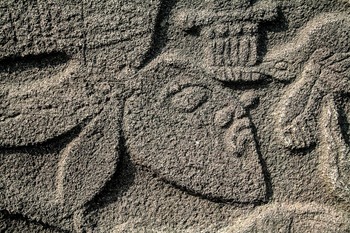
Thompson (Reference Thompson1956:101) and Parsons (Reference Parsons1969:102–103) identified the fruits in Monument 21 as cacao pods, although only one has recognizable striations that confirm this identification (Figure 13). It appears that the sculptors were not especially concerned with marking cacao pods as such. Yet cacao fits well in this landscape of wealth and abundance. As a precious object, it belonged in the same category with earspools and other jewels that grew in the same place. By the same logic, the sacrificial victims personified as cacao pods were equally precious. Their identity is unknown, but they probably stood for warriors killed in battle or war captives destined for ritual sacrifice. Monument 21 alluded to their death while also evoking their destiny as denizens of the flower world. They shared that destiny with gods or ancestors, portrayed on the Bilbao stelae as personified flowers or fruits growing from the lush vegetation of the flower world (Chinchilla Mazariegos Reference Chinchilla Mazariegos, Arnauld and Breton2013).
Detail of Bilbao Monument 21, showing a human-faced cacao pod. Photograph by the author.

The old woman that presides over the entire scene from her throne most likely corresponded to a goddess or goddess impersonator. The serpent that winds through her legs and the ropes between the legs of her seat bring her close to representations of Xochiquetzal, Chantico, and other goddesses in sixteenth-century codices from highland Mexico (Chinchilla Mazariegos Reference Chinchilla Mazariegos, Stöckli and Both2012b, Reference Chinchilla Mazariegos2015). Like them, she is likely a member of a broad complex of Mesoamerican goddesses related to the earth, the moon, sexuality, and procreation (Nicholson Reference Nicholson, Ekhholm and Bernal1971:421–422). Despite her old age, her stance is consistent with the female characters portrayed on Early Classic censer lids who are shown holding cacao pods in their hands and acted as mediators in the transition of the dead warriors to the afterlife.
The final destiny of the harvest seems to be a large container below the old goddess's bench. The objects therein—a bivalve shell, a double-bladed knife, a snail shell, a human-faced fruit with leaves, and a doll-like character—are animated with human hands and heads. Taube (Reference Taube and Prem1994:228) and Houston (Reference Houston, Finamore and Houston2010:68) speculated that this container might be a water deposit, alive with marine creatures. While Houston's identifications of some of these creatures are erroneous, his general assessment may be correct. In the Postclassic codices, water bodies are normally encased within rectangular borders, and populated not only by a variety of aquatic creatures, but also by birds, jewels, and other objects, in much the same way as the animated objects in Monument 21 (Boone Reference Boone2007:55). This container may indeed be a water body where the sacrificial victims embodied by fruits and other precious objects regain new life. From this perspective, it may be understood as a symbolic womb, the domain of the old goddess who seems to partake in the rebirth of these creatures, like a midwife propitiating childbirth.
Taube (Reference Taube and Prem1994:227) noted a parallel between the long tassel hanging from the center of the container and a similar tassel in a pillar from the Temple of the Owls at Chichen Itza. The pillar is shaped as a humanized tree, with the torso on the ground, and the lower body turned sharply upward to form the trunk. The tree is ripe with cacao pods and earspools, precious objects that are thus portrayed as like in kind to each other. While the meaning of the tassel remains unclear, it may signifiy the capacity of the container in Bilbao Monument 21 to generate abundance and wealth, just like the humanized tree of the Temple of the Owls.
In consonance with widespread Mesoamerican religious beliefs, the sacrificial dance portrayed on Monument 21 was likely related to the generation of abundance as a consequence of the proper fulfillment of primeval covenants between human beings and the gods (Monaghan Reference Monaghan and Monaghan2000:38). However, the harvest of Monument 21 is not about maize and other staples, which are conspicuously absent. Instead, it is about cacao, other fruits, and precious objects that are likened to fruits and flowers. This harvest is not that of humble peasants. It is the glorious harvest of the warriors who gleaned sacrificial victims to feed the gods and who potentially became such victims themselves. Their plight held the key for the generation of earthly abundance, while preluding their afterlife destiny in places of abundance and beauty. The carving condensed multiple, related actions and meanings that included: the sacrifice of human victims by decapitation; their ultimate destiny in a flowering landscape of beauty; the ritual evocation of this landscape through song, dance, and human sacrifice; and the generation of earthly abundance.
The Cacao Tree Goddess Effigies
A recurrent theme in coastal art is the association of cacao with female characters. As noted, even male captives appear to be somewhat feminized, with breast-like cacao pods hanging from their necks. Kufer and Heinrich (Reference Kufer, Heinrich and McNeil2006:404) summarized ethnographic data from Maya communities that suggests a broad association of cacao with the female gender. They warned that the pattern is neither rigid nor absolute and explained that cacao is naturally associated with humidity, shade, darkness, and the wet half of the year, all of which have feminine connotations in Mesoamerican thought.
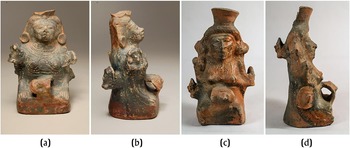
While the gender of cacao pods is not clear in coastal art, there are indications that cacao trees were conceived as feminine. This is especially clear in a group of molded ceramic effigies that portray personified cacao trees (Figure 14). It should be noted that the gender is not always evident, and there are examples of male characters that sprout cacao pods (Chinchilla Mazariegos 2005). However, there is a consistent group that belongs in the tradition of coastal female effigies described by Castillo Aguilar (Reference Castillo Aguilar2008), who classified them in a subgroup with distinctive attributes. In addition to the cacao pods growing from their body, they share a characteristic set of three curved marks on both sides of the jaw and commonly carry a small jar on the head or back. They wear feminine dresses and some examples show minuscule breasts. Several examples have two stubs in the back that approximate the shape of small human bodies. There is no information on their provenance, but examples are known from collections in Guatemala and El Salvador (Paul Amaroli, personal communication 2011).
Personified cacao tree effigies. (a) Female effigy with multiple pods and jar in the head; (b) female effigy with multiple pods and broken jar in the head; and (c) front and side views of female effigy with broken pods and jar in the back. Photographs by Eduardo Sacayón and Mauricio Acevedo, courtesy of Museo Popol Vuh, Universidad Francisco Marroquín.

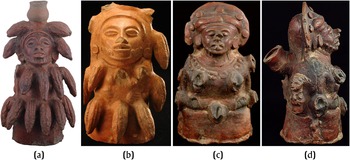
The reiteration of constant attributes suggests that these effigies portray a well-characterized mythical character with distinctive iconographic features. Importantly, her attributes differ from those of the probable goddesses represented on Early Classic censer lids. As noted, the latter seem to be mediators in mortuary rituals involving cacao. The tree effigies are better understood as mothers that generate abundant cacao pods. Their maternal role becomes evident in a group of Plumbate effigies that form an Early Postclassic variant of the genre. Shepard (Reference Shepard1948:Figure 21k) published an example from the Quetzaltenango region. Others belong to the Museo Popol Vuh and to a private collection in Guatemala City (Figure 15). The Plumbate effigies share the characteristic jaw marks, and all known examples carry small jars or bowls on their heads. However, instead of cacao pods, the Plumbate effigies have human heads sprouting from their body.
Plumbate female effigies with multiple heads sprouting from the body. (a) Effigy with broken jar on the head, front view, and (b) side view; (c) effigy with broken bowl on the head, holding an animal in the right hand, and touching her breast with the left, front view, and (d) side view. Photographs by the author.

These effigies exemplify the continuity of shapes and subjects from Late Classic Tiquisate to Early Postclassic Tohil Plumbate ceramics, noted by Hector Neff (Reference Neff, Mazariegos and Arroyo2005). In two of the three known examples, the goddess carries a small animal in the right arm while holding her own breast with the left. Both attributes appear with some frequency in Tiquisate woman or goddess effigies (Castillo Aguilar Reference Castillo Aguilar2008). The substitution between cacao pods and human heads in these effigies echoes the pattern noted in the Cotzumalhuapa sculptures. The heads that sprout from the body of the Plumbate effigies are fruits, ripe for harvest. Conversely, the harvest of cacao pods that grow like heads from these personified trees was akin to a harvest of human victims offered in sacrifice.
Time To Behead
The cacao harvest was still paired with human sacrifice in southern Guatemala as late as 1685, according to a Kaqchikel calendar compiled by an anonymous Franciscan friar. The friar wrote short annotations for each month and noted that the Kaqchikel named their months according to their sources of sustenance (“en orden a sus mantenimientos”; Rodríguez and Crespo Reference Rodríguez and Crespo1957:18). The cacao harvest occupied two twenty-day months, named Nabeitoεiε and Rucactoεiε. The gloss for Nabeitoεiε is “cosecha primera de cacao ó tiempo de degollar” (Rodríguez and Crespo Reference Rodríguez and Crespo1957:24). In his seventeenth-century dictionary, Covarrubias Orozco (Reference Covarrubias Orozco1674:203) glossed the Spanish word degollar as “to separate the head from the body, cutting it by the neck” (“apartar la cabeza del cuerpo, cortándola por el cuello”). Therefore, the gloss of Nabeitoεiε can be translated as “first harvest of cacao or time to behead.” Rucactoεiε was the “second harvest, or companion to the preceding” (“cosecha segunda ó compañero del antecedente”; Rodríguez and Crespo Reference Rodríguez and Crespo1957:24).
Both month names derive from to ε, “flint,” a root that appears in a variety of terms related to cutting instruments, weapons, and the actions performed with them. In this context, the names refer to the instrument used to harvest cacao. In his Kaqchikel Thesaurus, compiled in the mid-seventeenth century, friar Coto (Reference Coto and Acuña1983:116) noted that there were different names for different types of harvests: “they are named according to the verb that means the mode of picking up the fruit; e.g., those of cacao tan ti toε, tan ti εip cacao.” The word εip, “to cut,” also referred to the procedure used to harvest cacao. Coto made it clear that different words were used to designate the harvest of maize, beans, cotton, and other crops.
The rationale behind the friar's annotation to the month Nabeito εiε was likely related to ancient notions that linked cacao pods with human heads and the harvest of cacao with the sacrifice of human victims. The “time to behead” of the Kaqchikel calendar may be a reminiscence of pre-Columbian rituals that put in practice the metaphor. The cacao harvest was likely a time of rejoicing that brought abundance and wealth and, in ancient times, it may have been celebrated with a corresponding harvest of human victims for the gods.
Cacao In Flowering Mountain Earth
Located on the southern rim of Lake Atitlán, Santiago Atitlán once controlled an extensive territory in the adjacent coastal piedmont, which made it one of the major cacao-producing towns in sixteenth-century Guatemala (Bergman Reference Bergmann1969). As documented by ethnographers since the mid-twentieth century, cacao and other fruits from the piedmont still play an important role in traditional Atiteco religion (Mendelson Reference Mendelson1965; Carlsen and Prechtel Reference Carlsen and Prechtel1991; Tarn and Prechtel Reference Tarn and Prechtel1990, Reference Tarn and Prechtel1997; Christenson Reference Christenson2001; Stanzione Reference Stanzione2003). Considering the town's proximity to, and close economic ties with, the piedmont there is a probability that aspects of Atiteco religion share deep common roots with coastal religious beliefs and practices. Indeed, traditional Easter Week rituals involve the use of cacao and other fruits in ways that reflect notions of sacrifice and divine nourishment.
According to Carlsen and Prechtel (Reference Carlsen and Prechtel1991) a major focus of Atiteco religion is Flowering Mountain Earth—the place where once stood the flowering tree that gave fruit to everything in existence. The main altar in the church of Santiago Atitlán represents this primordial place, whose preservation and renewal are crucial for the well-being of the world (Carlsen and Prechtel Reference Carlsen and Prechtel1991:27; Christenson Reference Christenson2001:102–107). During Easter Week, an abundance of fruits, bromeliad flowers, and cypress boughs are hung from a great scaffold built to cover the entire altar, known as the monumento. The verdant edifice of the monumento recreates the landscape of Flowering Mountain Earth, restoring the altar to its original strength (Christenson Reference Christenson2001:93–101). According to Stanzione (Reference Stanzione2003:245), it also replicates the mountain where the sun is newly born during Easter Week.
Traditionally, the fruits that hang from the monumento are brought to Santiago Atitlán on the back of the alguaciles, a group of young, newly married men whose journey marks their initiation in the civil-religious hierarchy of the cofradía system. While the system is now in decline (Carlsen Reference Carlsen2011), detailed descriptions were made by Tarn and Prechtel (Reference Tarn and Prechtel1990, Reference Tarn and Prechtel1997) in the 1970s and Stanzione in the early 1990s (Reference Stanzione2003:166–227). According to their accounts, the alguaciles undertook a brisk incursion to the piedmont and came back two days later bringing loads of fruit that included plantains, cacao, pataxte, and melocotón. Another group brought corozo palm flowers.
Tarn and Prechtel (Reference Tarn and Prechtel1990) noted the sexual and warlike aspects of the expedition. While the fruits were harvested at previously arranged locations, the actions of the alguaciles were conceived as those of thieves that stole them like vanquished slaves or women taken by force (Tarn and Prechtel Reference Tarn and Prechtel1990:80, Reference Tarn and Prechtel1997:284; Stanzione Reference Stanzione2003:200). They returned triumphantly, and were hailed as warriors (achijab). Before hanging them in the monumento, the fruits were ripened and presented to Mam, a deity that plays a major role in Atiteco Easter rituals. Mam was said to “eat the fruit” a metaphor that carried the double sense of feeding and copulating. The ritual had multiple meanings related to sexual initiation, the propitiation of childbirth, and agricultural fertility. The fruits were finally hung on the monumento, where they served as a backdrop for the sacrifice of Jesus Christ, who was previously captured much like the fruits themselves (Christenson Reference Christenson2001:185; Stanzione Reference Stanzione2003:296–312).
Stanzione (Reference Stanzione2003:200) speculated whether the capture of fruits by the alguaciles might be a reminiscence of pre-Hispanic expeditions in which the Atiteco warriors brought human captives from the coast. This suggestion is difficult to test in historical terms, although early colonial texts show that Late Postclassic highland peoples did undertake multiple incursions into the piedmont with the purpose of securing a supply of cacao, which involved warlike actions and the imposition of highland rule over coastal piedmont communities (Chinchilla Mazariegos Reference Chinchilla Mazariegos1998; Polo Sifontes Reference Polo Sifontes and Carcache2009; Zamora Acosta Reference Zamora Acosta and Franch1979). Loads of the coveted fruit brought up to the highlands during these incursions were plausibly accompanied by strings of war captives. As discussed in the following section, early colonial terminology suggests links between captives and fruits that were once widespread in the Maya area.
Cacao And Captives As Excess Food
According to Tarn and Prechtel (Reference Tarn and Prechtel1990:79–80), the fruits brought to Santiago Atitlán by the alguaciles were qualified as feminine and as munil, “a category of comestibles that does not mean ‘real food’ (as in the word waya: maize and water) but ‘additional’ food, food to be enjoyed, desserts, that is, abundance, excess.” They also noted that in colonial Yucatec dictionaries the term also meant “slave.” In other Maya languages, the term encompassed a complex of ideas referring to gluttony and excess food but also tribute and slavery. Coto's (Reference Coto and Acuña1983) Kaqchikel Thesaurus includes the following entries:
Captivity and slavery like that of negroes: munil, alabitz, q,ijl (Coto Reference Coto and Acuña1983:94)
Male or female slave: Mun, alabijtz (Coto Reference Coto and Acuña1983:206).
To capture: tin munih, ti u'alabih (Coto Reference Coto and Acuña1983:206).
To show gluttony [Glotonear]: qui munin, or hupalic munil tin ban, xaki munil benak (Coto Reference Coto and Acuña1983:250).
Hungry: mun, which is taken for the slave (Coto Reference Coto and Acuña1983:265).
Similar glosses appear in the Tzotzil dictionary of Santo Domingo Zinacantán:
mu'nat: bought captive, slave
mu'natij: eat in secret
mu'natil: captivity, gluttony (Laughlin Reference Laughlin1988:261).
The term refers to slavery, captivity, and serfdom in colonial dictionaries of Pokom (Feldman Reference Feldman1998), and Ch'olti’ (Boot Reference Boot2004). Allusions to slavery have disappeared in contemporary Ch'orti’, while those that refer to gluttony and excess remain (Wisdom Reference Wisdom1950). In Yucatec dictionaries, the word refers to immature or tender fruit and perhaps, by extension, to young people but also to slavery and captives (Barrera Vásquez Reference Barrera Vásquez1991:540–541).
The categorization of fruits as munil at Santiago Atitlán and elsewhere relates to broader distinctions between different kinds of food. Among the K'iche’ of Chichicastenango, Henne (Reference Henne, Neuenswander and Arnold1977) reported that the term wa designates “real food” that fills the stomach and provides strength for work. Strictly, it refers to solid maize food such as tortillas or tamales, but it may include a variety of foods that are eaten as their companions, including chili, vegetables, beans, rice, and meat. Fruits belong in a separate category, šaq ketihowik, “it is just eaten,” which also includes items such as sweets and peanuts, which are not believed to provide nourishment, and are eaten just for pleasure. López García (Reference López García2002:vol. 2, p. 39) reported that the Ch'orti’ distinguish fruits and sweets as things that pass through the mouth but are not eaten in the full sense of the word. Food properly is considered to include maize tortillas and beans. Meats and soups are only included in this category if they accompany tortillas.
While not classified as real food for humans, munil fruits are “eaten” by Mam in the course of the Atiteco Easter rituals. The god does not seem to require real nourishment but, instead, he eats fruit, that is, “excess food.” This raises the question of whether the human victims that were equated with cacao and other fruits in coastal iconography belonged to a similar category in the classification of food. No maize grows from the prodigious vegetation of the Cotzumalhuapa flower world, which yields only fruits, flowers and objects that evoke images of beauty, wealth and abundance, but not of human sustenance. Sacrificial victims represented as mature fruits, ripe for harvest, overlap with the range meanings of munil in the Maya languages. From an alimentary perspective, they were luscious, excess food that did not provide real sustenance for human beings but were craved by the gods.
FINAL COMMENTS
The wealth of cacao imagery in Pacific coastal art provides a basis to trace the evolution of the metaphors that linked cacao pods with dead warriors, captives, and sacrificial victims. The lack of contextual information for the majority of representations imposes limitations on our capacity to understand the geographic and temporal variability present in the sacrificial symbolism of cacao. Nevertheless, the stylistic dating of the unprovenanced artifacts allows a rough appreciation of changing religious beliefs and ritual practices related to cacao. These changes appear to correlate with shifts in the cultural and political landscape of the coast. No sacrificial symbolism is apparent in the Early Preclassic Paqui figurines, and cacao is conspicuously absent from Late Preclassic coastal sculptures. The Early Classic Teotihuacan-style censer lids focused on the transformation of dead warriors as butterfly-raptors that related in various ways to cacao pods. In the Late Classic period, the main focus of attention shifted to the harvest of cacao pods and other fruits as a metaphor for human sacrifice.
Despite these variations, there is surprising stability from Classic period representations to textual passages in colonial sources, extending to modern beliefs in traditional Atiteco religion. Most striking is the likeness of the captives with cacao pods around the neck to the Pipil war captives described by García de Palacio (Reference García de Palacio and Acuña1982) in the late sixteenth century. Equally pervasive are the feminine associations of cacao, present in the iconography of Classic censers and sculptures and still prevailing in modern Maya communities.
As interpreted in this article, the equation of cacao pods with captives and sacrificial victims seems to involve an alimentary metaphor, in which both were conceived as sources of precious food for the gods. Human sacrifice in Mesoamerica was commonly believed to provide nourishment for the gods (Graulich and Olivier Reference Graulich and Olivier2004; Monaghan Reference Monaghan and Monaghan2000:36; Thompson Reference Thompson1970:181). However, from the perspective of food classification, the sacrificial victims that were harvested and offered to the gods like fruits fall in the category of excess food, eaten only for pleasure. It appears that the provision of human victims for the gods on the Pacific coast was not intended as sustenance but as a satisfaction for their cravings. The belief is still echoed in modern Atiteco rituals that involve offerings of fruit to be eaten by Mam. It seems probable that in ancient times this kind of food was offered to specific deities, although our limited knowledge of coastal religion precludes their identification.
The widespread distribution of sacrificial references associated to cacao in sixteenth-century textual sources suggests that the associated beliefs were not limited to the Pacific coast. The range of meanings found in this area may provide models to examine beliefs about cacao and its artistic representations elsewhere in Mesoamerica.
RESUMEN
En este artículo se explora el simbolismo sacrificial del cacao en la Costa Pacífica de Guatemala, que se encuentra plasmado en una serie de objetos de cerámica y esculturas prehispánicas de piedra, reaparece en las fuentes escritas del periodo colonial, y aún se manifiesta en las creencias y rituales religiosos contemporáneas del pueblo Tz'utujil de Santiago Atitlán. Se exploran las metáforas iconográficas y textuales que equiparan las mazorcas de cacao con los guerreros muertos, los cautivos, y las víctimas de sacrificio. A partir de estas representaciones, se puede colegir que la cosecha de cacao era equiparada con la adquisición de víctimas de sacrificio. Ambos se concebían como fuentes de sustento para los dioses.
El artículo se organiza en forma cronológica, y se explora la evolución de las representaciones desde los incensarios de estilo teotihuacano, del periodo clásico temprano, pasando por las esculturas de Cotzumalguapa, hasta llegar a las efigies de cerámica plomiza que marcan el inicio del periodo posclásico, pero que mantienen gran continuidad con el simbolismo presente en el periodo clásico. El artículo empieza con una propuesta de identificación de representaciones de cacao en las figurillas Paqui del formativo temprano de la región de Mazatán, Chiapas. A continuación se analizan las tapaderas de incensario de estilo teotihuacano, que muestran una relación entre las mazorcas de cacao y los espíritus de los guerreros muertos, representados con atributos de mariposas y búhos. A continuación se analiza un conjunto de silbatos y efigies de cerámica que representan cautivos con mazorcas de cacao colgando del cuello. Estas representaciones son muy cercanas a la descripción de los cautivos pipiles, que desfilaban “con sartas de cacao al pescuezo”, según una descripción escrita por Diego García de Palacio en 1576.
En las esculturas de Cotzumalguapa, destacan la representaciones de frutas con rostro humano, entre ellas el cacao. La cosecha de cacao y otras frutas se corresponde con el sacrificio humano por decapitación. Se analiza la iconografía el Monumento 21 de Bilbao, que representa un baile sacrificial, en el que las víctimas están representadas como frutas listas para cosechar. La sustitución entre mazorcas de cacao y cabezas humanas también se manifiesta en efigies de cerámica, y se percibe en un calendario kakchikel de 1635, donde la cosecha de cacao se caracteriza como el “tiempo de degollar”.
El cacao y otras frutas del piedemonte aún se relacionan con el simbolismo de los cautivos de guerra y el sacrificio en la religión tradicional de Santiago Atitlán. En varias comunidades mayas, las frutas se clasifican como comidas que se comen en exceso, designadas como munil, término que se refieren a los cautivos y esclavos en los diccionarios del periodo colonial. El cacao y los cautivos de guerra parecen haber sido considerados como pertenecientes a la misma clase de alimentos preciosos que se ofrecían a los dioses. Estas interpretaciones pueden ser relevantes para entender el simbolismo sacrificial del cacao presente en toda Mesoamérica.
ACKNOWLEDGEMENTS
This article had a long gestation, beginning with research carried out for a special exhibition at the Museo Popol Vuh, Universidad Francisco Marroquín, in 2005. The late Mrs. Barbara de Nottebohm deserves a special recognition for her enthusiastic help that allowed me to identify some of the objects described and illustrated here. For similar reasons I thank Guillermo Mata Amado, Coralia de Rodríguez, Susana Campins, the Museo Nacional de Arqueología y Etnología de Guatemala, and the Museo de Arqueología y Vidrio Moderno, Antigua Guatemala. Through the years, many colleagues and students have shared with me their thoughts and opinions about cacao. Among them, I especially wish to thank Cameron McNeil, Javier Urcid, William Fowler, Paul Amaroli, Víctor Castillo, Vincent Stanzione, and Linda O'Brien-Rothe. Research for this article was partly conducted with support from a John Simon Guggenheim Fellowship awarded to the author in 2011.