The impact of professionalization on the internal power balance of parties lies at the heart of influential party models (Hopkin and Paolucci Reference Hopkin and Paolucci1999; Katz and Mair Reference Katz and Mair1995; Panebianco Reference Panebianco1988). The growing presence of professional staffers is often seen as an organizational game changer, empowering elected elites at the expense of extra-parliamentary party organizations (Katz and Mair Reference Katz, Mair, Gunther, Montero and Linz2002). This article aims to contribute to this debate by comparing the staff resources of parliamentary and ministerial offices to those of central offices. If the human resources of central offices are indeed inferior, the staffing advantage of parliamentary and ministerial offices undermines the capacity of extra-parliamentary party organizations to control their elected elites. This matters because central offices have a crucial role as a mouthpieces of party members and activists: they safeguard parties' ideological principles and long-term policy goals while elected elites are immersed in day-to-day politics (Gibson and Harmel Reference Gibson and Harmel1998).
Existing empirical studies have analysed quantitative evolutions, showing how the staff size of parliamentary offices has surpassed central offices in Western Europe (Bardi et al. Reference Bardi, Calossi, Pizzimenti, Scarrow, Webb and Poguntke2017; Krouwel Reference Krouwel2012). However, two elements are currently missing from the discussion. First, the actual qualifications of staffers merit closer examination. Building on the seminal work of Angelo Panebianco (Reference Panebianco1988), I argue that staffers' individual qualifications can amplify or reduce the staffing advantage of parliamentary and ministerial offices. While a larger staff indicates a quantitative staffing advantage, a more qualified staff signals a qualitative staffing advantage. Second, the party in public office should not be reduced to the party in parliament as ministerial offices can strongly affect the distribution of staff resources. Ministerial staffers are an integral part of parties' human resources since they are most often recruited through the party network (Moens Reference Moens2021). Although Richard Katz and Peter Mair (Reference Katz and Mair1993: 606) explicitly acknowledged that the resources of the party in public office can include both a parliamentary and a governing face, previous studies have not included ministerial offices in their empirical analyses of ‘the ascendancy of the party in public office’ (Bardi et al. Reference Bardi, Calossi, Pizzimenti, Scarrow, Webb and Poguntke2017; Katz and Mair Reference Katz, Mair, Gunther, Montero and Linz2002; Krouwel Reference Krouwel2012). Therefore, this study introduces a more fine-grained approach by comparing the staff resources of three separate party offices: the party in central office, the party in parliament and the party in the executive.
This article addresses two research questions. I first examine which party office has both the largest (quantitative advantage) and most qualified staff (qualitative advantage). Hence, the first research question: ‘Which party office benefits from a double staffing advantage: the party in central office, the party in parliament or the party in the executive?’ (RQ1). Based on earlier research on parties' internal distribution of resources, I expect parties' central office staffs to be smaller and less qualified than those working in parliamentary and ministerial offices. However, I suggest that institutional factors determine whether the party in parliament or the party in the executive reaps the benefits of this double staffing advantage. Based on recent studies of ministerial advisers (Gouglas and Brans Reference Gouglas and Brans2017; Shaw and Eichbaum Reference Shaw and Eichbaum2018), I expect that the impact of ministerial offices strongly depends on the institutional context. For this reason, this article examines staffing patterns in two similar countries that nonetheless belong to different administrative traditions: Belgium and the Netherlands. The Belgian politico-administrative system is heavily influenced by the Napoleonic tradition, where politically appointed ministerial advisers have been a historical feature of government since the 19th century (Brans et al. Reference Brans, Pelgrims, Hoet, Peters, Verheijen and Vass2005). Government ministers preside over formally institutionalized ‘ministerial cabinets’ containing dozens of political staffers. In contrast, the Dutch politico-administrative system is part of the European continental tradition, where ministerial advisers only recently appeared as an informal position (van den Berg Reference van den Berg, Shaw and Eichbaum2018). As a result, current Dutch ministers rely on only a handful of partisan advisers (van den Berg Reference van den Berg, Shaw and Eichbaum2018). While it is evident that Belgian ministers recruit more political staffers than their Dutch counterparts, the impact of ministerial cabinet systems such as Belgium's on the internal organization of political parties remains an open question. Whether or not these extensive ministerial cabinets benefit from a staffing advantage depends on how their staffs compare to those of other party offices. Hence the second research question: ‘How does the size of ministerial offices affect the quantitative and qualitative staff distribution within political parties?’ (RQ2).
Political staffers are under-researched, and gaining access to this notoriously elusive population is challenging (Webb and Kolodny Reference Webb, Kolodny, Katz and Crotty2006). As a result, only a few studies have focused on their individual characteristics (Karlsen and Saglie Reference Karlsen and Saglie2017; Webb and Fisher Reference Webb and Fisher2003) and longitudinal analyses on the micro-level are beyond our reach. Instead, this article focuses on the current state of affairs in Belgium and the Netherlands based on original survey data collected among the staff of 14 parties (N = 1,009). It offers an in-depth, cross-sectional analysis of staffing by analysing both its quantitative dimension (staff size) and qualitative dimension (staffers' qualifications). The quantitative dimension is studied by comparing the relative staff sizes of central, parliamentary and ministerial offices. The qualitative dimension is studied by analysing the individual expertise of staffers from different party offices, including their education, professional experience and tasks.
This study makes two innovative contributions to existing literature. First, the full scope of parties' national human capital has rarely been studied in depth. Whereas most existing studies focus on a specific subgroup of staffers within a specific party office such as ministerial advisers (Shaw and Eichbaum Reference Shaw and Eichbaum2018) or parliamentary staff (Hertel-Fernandez et al. Reference Hertel-Fernandez, Mildenberger and Stokes2018), I approach political staffers as a single group spread across several entities (central office, parliament, the executive). Second, the article demonstrates how institutional factors can affect the internal working of political parties. The differences between Belgium and the Netherlands suggest that staffing might affect party organizations similarly in other political systems. Moreover, the impact of ministerial cabinets has broader relevance as ministerial advisers are becoming increasingly prominent in several political systems (Gouglas and Brans Reference Gouglas and Brans2017).
This article proceeds as follows. First, I discuss the power relation between party offices and how it is linked to the distribution of human resources. After theorizing the quantitative and qualitative staffing advantage of parliamentary and ministerial offices, the systemic differences between Belgium and the Netherlands are addressed. The methods section specifies data collection, the operationalization of key variables and the empirical analysis. After that, I analyse the combined effect of staff size and staffers' qualifications (education, professional experience and tasks) to assess the uneven distribution of staff. Lastly, the implications of this staffing advantage and its variation across political systems are discussed.
Professionalization and power
In their seminal conceptualization of political parties, Katz and Mair (Reference Katz and Mair1993) distinguish between three faces of party organization: the party on the ground (members and activists), the party in central office (national party organization) and the party in public office (parliament and the executive). Moreover, they argued that this distinction was essential to understanding an internal power shift within parties because the party in public office had become the dominant force within contemporary parties (Katz and Mair Reference Katz and Mair1993, Reference Katz, Mair, Gunther, Montero and Linz2002). Katz and Mair's claims continue to inspire research on the growing importance of the party in public office, including debates on presidentialization (Poguntke and Webb Reference Poguntke and Webb2007) and personalization (Rahat and Kenig Reference Rahat and Kenig2018). Similarly, the impact of cartelization on the party on the ground is subject to ongoing debate among scholars (Heidar and Wauters Reference Heidar and Wauters2019; Loxbo Reference Loxbo2013). However, this article only aims to shed light on the relationship between two of the three party faces described by Katz and Mair (Reference Katz and Mair1993): the party in central office and the party in public office (Gibson and Harmel Reference Gibson and Harmel1998).
Vesa Koskimaa (Reference Koskimaa2020) identifies three dimensions that shape the power balance between parties' central and public offices: control of resources, leadership positions and statutory prerogatives. Instead of examining all of these power dimensions, this article takes a closer look at one particular resource: staff. Evidently, this focus implies that the complete staff of parties' central and public offices should be taken into account. Hence, I define this population of political staffers as ‘individuals with remunerated, unelected positions that have been on a partisan basis to work in a party office, parliamentary party group or ministerial office’ (Moens Reference Moens2021: 2). This approach to political staff is quite innovative as staffers from different party offices have barely been analysed as a single population. Existing research is scattered across disciplines interested in specific subgroups of staffers. Legislative scholars have focused on parliamentary staffers' impact on political representation, most notably the US Congress (DeGregorio Reference DeGregorio1988; Hertel-Fernandez et al. Reference Hertel-Fernandez, Mildenberger and Stokes2018) and the European Parliament (Busby and Belkacem Reference Busby and Belkacem2013; Pegan Reference Pegan2017). Public administration scholars have focused on the policy advice of ministerial staffers (Askim et al. Reference Askim, Karlsen and Kolltveit2017; Maley Reference Maley2000) and the (dys)functions of ministerial offices, particularly in relation to civil servants (Connaughton Reference Connaughton2015).
While party politics scholars have rarely studied political staff, the few existing studies neglect ministerial staffers and limit their scope to staffers in central and parliamentary offices. This observation applies to in-depth studies focusing on staffers as individuals (Karlsen and Saglie Reference Karlsen and Saglie2017; Webb and Fisher Reference Webb and Fisher2003) as well as large-N analyses of their increasing presence in parties (Bardi et al. Reference Bardi, Calossi, Pizzimenti, Scarrow, Webb and Poguntke2017; Katz and Mair Reference Katz and Mair1993; Krouwel Reference Krouwel2012). However, I argue that ministerial staffers should not be overlooked as they are an integral part of a party's human resources. Admittedly, parties often only directly pay central office staffers (Webb and Kolodny Reference Webb, Kolodny, Katz and Crotty2006), yet the mere concept of the party in public office clearly implies that a party's human capital extends beyond its own payroll. While the salaries of elites in parliament and the executive originate from the state, parties are nonetheless indirectly responsible for their compensation because they are the principal recruitment channel for such positions (Schlesinger Reference Schlesinger1984). As pointed out by Katz and Mair (Reference Katz and Mair1993: 606), ‘the resources of the party in public office may not be visible in pure party terms, especially when the party in question includes a governing as well as a parliamentary face, and when key staff are appointed to positions in the public, as opposed to the party, bureaucracy’. To allow for a more fine-grained assessment of parties' internal distribution of staff, this article distinguishes between the three party offices described above: the party in central office, the party in parliament and the party in the executive.
The conventional wisdom among party scholars is that professionalization has strengthened the dominance of elected elites within parties' internal power balance. Indeed, several empirical studies of Western European parties show that the influx of paid staffers has disproportionally benefited the party in parliament (Bardi et al. Reference Bardi, Calossi, Pizzimenti, Scarrow, Webb and Poguntke2017; Katz and Mair Reference Katz and Mair1993; Krouwel Reference Krouwel2012). More specifically, staff growth within parliamentary offices has simply outpaced central offices. Whereas central offices originally had larger staffs than parliamentary offices in most parties during the 1970s, the opposite had become the case by the 2010s (Bardi et al. Reference Bardi, Calossi, Pizzimenti, Scarrow, Webb and Poguntke2017). Although both party offices have ostensibly professionalized, these analyses suggest that professionalization has put the party in parliament in control of the majority of parties' human resources. However, I argue that a full assessment of a party's human resources should: (1) consider the actual qualifications of staffers; and (2) include ministerial offices in the analysis.
Two dimensions of staffing
The relationship between parties' central, parliamentary and ministerial offices is shaped by both the quantity – and quality – of staffers. Including this qualitative dimension of staffing is important because professionalization goes well beyond staff size. Panebianco's (Reference Panebianco1988) original argument focused strongly on staffers' individual qualifications as it described the gradual replacement of traditional party bureaucrats by more qualified professionals. Building on the seminal works of Panebianco (Reference Panebianco1988) and Katz and Mair (Reference Katz, Mair, Gunther, Montero and Linz2002), I expect that the influx of these political professionals puts the party in central office at a double disadvantage. Public offices not only have larger staffs, but the individual qualifications of their staffers also reinforce their dominance over the party in central office.
The principal difference between these professionals and traditional party bureaucrats is their role within politics. Panebianco (Reference Panebianco1988) drew from private sector terminology by referring to the different assignments of employees with line and staff roles. Whereas traditional party bureaucrats exemplified the line role in politics by supporting the party machine as administrative clerks, political professionals take on advice-oriented roles towards elected elites. More recently, Rune Karlsen and Jo Saglie (Reference Karlsen and Saglie2017) have applied Panebianco's work to the current context by distinguishing between staffers with technical tasks and those with strategic tasks. ‘Strategy assistance refers to involvement in essentially political decisions, such as the development and implementation of policy and campaign strategy. Technical assistance includes administrative functions and services, such as website design or maintaining membership files’ (Karlsen and Saglie Reference Karlsen and Saglie2017: 1334). Hence, the overrepresentation of political-strategic staffers within the party in public office signals a qualitative advantage.
The dominance of political-strategic staffers within parties' public offices reduces the capacity of central offices to control the party in public office. Following Panebianco (Reference Panebianco1988), who described how power dynamics within electoral-professional parties were shifting because professionals are less susceptible to control, I expect that staffers' professional expertise plays a central role in this process. Knowledge is power: staffers with extensive expertise have an informational advantage over political competitors, colleagues and elected elites. First, such expertise can be accrued through education. Second, the most valuable expertise is accumulated through professional experience, as ‘professional knowledge is obtained by practice, by an apprenticeship process or “enculturation process”; an unwritten know-how or “tacit knowledge” that cannot be standardized and formalized to a university course’ (Brante Reference Brante, Burrage and Torstendahl1990: 83–84). Experience both inside and outside politics can translate into an informational advantage. Those with extensive experience in politics excel at ‘knowing the game’ (Svallfors Reference Svallfors2017), remaining one step ahead of others who are less familiar with political dynamics. Those with extensive experience outside politics (civil service, academia, private sector) specialize within specific policy domains or communication practices – including details that elude political generalists.
Why does all this expertise disproportionally benefit public offices? While the quantitative advantage of the party in public office is caused by its privileged access to state resources, I suggest that the qualitative advantage of parties' public offices is the result of environmental pressures. The party in public office has been at the forefront of professionalization because elected elites (representatives and ministers) experience several environmental challenges more acutely. In the electoral arena, elected elites faced increased competition and volatility due to centripetal competition (Kircheimer Reference Kircheimer, LaPalombara and Weiner1966) and the success of challenger parties (De Vries and Hobolt Reference De Vries and Hobolt2020). At the same time, the emergence of mass media (and, later, social media) provided new opportunities to connect with voters. As a result, communication experts were recruited to navigate new technological developments and strengthen their position towards media outlets in this permanent campaign environment (Blumenthal Reference Blumenthal1980). In the policy arena, elected elites faced the emergence of ‘wicked problems’ (Rittel and Webber Reference Rittel and Webber1973) fuelled by the expansion of the welfare state and the increasing complexity of multilevel governance (Marks et al. Reference Marks, Hooghe and Blank1996). When parties participate in government, ministers increasingly rely on policy experts to monitor the policy output of other ministers (Askim et al. Reference Askim, Karlsen and Kolltveit2018; Maley Reference Maley2011). At the same time, interest groups (Allern and Bale Reference Allern and Bale2012), lobbyists (McCrain Reference McCrain2018) and think-tanks (Stone et al. Reference Stone, Denham and Garnett1998) increasingly sought access to elites in order to shape policies. As a result, policy experts were hired to navigate the increasingly complex and technical nature of policymaking. Admittedly, central offices are not immune to environmental challenges. However, I argue that the fate of the party in public office is connected more directly to its performance within the electoral and policy arena. As a result, elected elites in parliament and the executive have a higher need for in-house expertise.
Hypothesis 1: The staff of parliamentary and ministerial offices is both larger and more qualified than the staff of central offices.
Although earlier studies show that parties' parliamentary offices have a quantitative staffing advantage over central offices, this supposed qualitative advantage remains untested. Moreover, parties' internal distribution of staff is actually more complicated because the party in public office often includes both parliamentary and ministerial offices. Therefore, a complete assessment of staffing requires that central offices, parliamentary offices and ministerial offices are situated on two separate, independent dimensions of staffing. To situate party offices on both dimensions, I distinguish between four types of party offices: professional machines, back offices, expert cells and bureaucracies (Figure 1). While the quantitative dimension distinguishes between party offices with larger and smaller staffs, the qualitative dimensions distinguishes between party offices with highly qualified and less qualified staff (based on education, professional experience and tasks).
Quantitative and Qualitative Dimensions of Staffing

Based on the quantitative and qualitative dimension of staffing, party offices can hold four ideal typical positions within their party (Figure 1). Professional machines are able to set the general course of a party because they benefit from a double staffing advantage. They dominate other party offices as they not only have more staff but also rely on more qualified staffers. Cartelization theory suggests that parliamentary offices fit into this category as they have become the gravitational centre of contemporary parties (Katz and Mair Reference Katz, Mair, Gunther, Montero and Linz2002). In contrast, back offices take on a subordinate role within the party structure because they experience a double staffing disadvantage (small, less qualified staff). Conventional wisdom says that central offices have moved towards this ideal type because their staff resources have become inferior to those of the party in public office (Katz and Mair Reference Katz, Mair, Gunther, Montero and Linz2002). As the quantitative and qualitative dimensions of staffing are independent, however, the relationship between party offices might be more ambiguous. On the one hand, expert cells might have a decisive impact on party policy or strategy thanks to their small but highly qualified staffs. Indeed, this could well be the case in political systems where the party in the executive can only recruit a handful of senior ministerial advisers. On the other hand, the organizational capacity of bureaucracies with large, less qualified staffs might provide parties with vital human resources during campaigns (e.g. canvassing). In fact, this ideal type might illustrate how large central offices can continue to be relevant in contemporary parties.
The institutional setting
The institutional setting in which parties operate determines which particular public office reaps the benefits of this staffing advantage. In most Western European parliamentary democracies, staffing puts parties' central offices at a double disadvantage. However, the party in public office is not monolithic and its institutional structure varies considerably between political systems. I argue that the institutional setting determines whether the party in parliament or the party in the executive benefits from a staffing advantage. Depending on the structure of the core executive within a political system, ministerial staffers can tilt the staffing advantage of the party in public office in favour of the party in the executive. In nations within the Napoleonic administrative tradition,Footnote 1 members of the executive are supported by an extensive cabinet containing dozens of partisan staffers serving a single minister (Gouglas et al. Reference Gouglas, Brans and Jaspers2015; Peters Reference Peters2008).
In ministerial cabinet systems, I expect that the sheer size of these ministerial offices translates into a temporary staffing advantage within the party in the executive. As a consequence, a party's internal distribution of human resources hinges on its governing status. Whereas majority parties control the government resources needed to recruit numerous ministerial staffers, they lose this privilege when leaving the executive, and the party in parliament becomes the main foothold for staffers. Regardless of whether parties enter the executive or drop out, the transition of power automatically triggers a restructuring of parties' human resources. These recurring cycles of organizational expansion and contraction align with Nicole Bolleyer's (Reference Bolleyer2009) description of the cartel party's inherent vulnerabilities, as parties' reliance on controlling government resources leads to organizational instability. In non-cabinet systems, ministerial advisers are not numerous enough to fundamentally shift a party's internal balance of human resources towards its ministerial offices (Shaw and Eichbaum Reference Shaw and Eichbaum2018). In such political systems, the staffing advantage of the party in public office remains permanently concentrated within the party in parliament (Wilson Reference Wilson2020).
Hypothesis 2a: In ministerial cabinet systems, ministerial offices benefit from a staffing advantage when a party participates in government.
Hypothesis 2b: In ministerial cabinet systems, parliamentary offices benefit from a staffing advantage when a party does not participate in government.
Hypothesis 2c: In non-cabinet systems, parliamentary offices benefit from a permanent staffing advantage.
Case selection and method
This study examines staffers from Belgium and the Netherlands. From an international perspective, the two countries share many similarities. Both are historically divided societies that have overcome societal cleavages through consociationalism and power-sharing (Andeweg and Irwin Reference Andeweg and Irwin2009; Deschouwer Reference Deschouwer2009). Their highly proportional electoral systems have produced extensive, complex party systems that require cooperation through coalition government. In both countries, this institutional context has created collective staff infrastructures centred around parties who predominantly recruit staffers within their own network (Moens Reference Moens2021). As such, this comparative study controls for the potential impact of consociationalism and a multiparty context. However, the systemic differences between the two nations concern a key argument of this article: the impact of ministerial cabinets. As Belgium and the Netherlands adhere to different administrative traditions (Painter and Peters Reference Painter, Peters, Painter and Peters2010), the institutional support structures for executives are fundamentally different (Brans et al. Reference Brans, Pelgrims and Hoet2006). As a member of the European continental tradition, impartial civil servants provide the most important policy advice to Dutch ministers as they are only assisted by a handful of political staffers. As a member of the Napoleonic tradition, an extensive team of partisan ‘cabinet advisers’ provide the most important policy advice to Belgian ministers, and distrust fuels the marginalization of a politicized civil service (De Winter and Brans Reference De Winter, Brans, Borchert and Zeiss2003).
Data collection
Original survey data were collected among the paid staff of 14 parties (Online Appendix A). Since the support of party leadership was indispensable for contacting the target population, face-to-face interviews with senior party management were set up to gain an official endorsement. Although parties are often reluctant to provide access to their personnel (Webb and Keith Reference Webb, Keith, Scarrow, Webb and Poguntke2017), this approach resulted in the participation of 14 out of 25 parties represented in the Belgian and Dutch parliaments. Apart from the radical right family (which refused to participate), these cases mirror the diversity of the party landscape in electoral size, organizational resources and ideological outlook. Before launching the online survey, a carefully developed questionnaire was tested among party staffers during 33 face-to-face interviews.
Designed to be completed in under 15 minutes, the questionnaire contained general background questions on staffers' sociodemographic characteristics, day-to-day professional activities and previous professional experiences, but also gauged their political attitudes, future ambitions and their interactions with peers and elected elites. Between December 2018 and January 2020, the complete population of staffers from the participating parties received a digital invitation to answer this online questionnaire, followed up by two reminders. Out of a population of 2,936 individuals, the survey obtained a response rate of 34% (N = 1,009). To calculate response rates and check the representativeness of our findings, participating parties provided population data. Based on the weighted cases approach (Parke Reference Parke2012), χ2-tests were run to test under- or overrepresentation among specific subgroups within the sample. Post-stratification weights were calculated based on population data on the number of staffers within each party, party office and age category (weighting factors range from 0.63 to 1.37).
Variables and analysis
The analysis examines staffers' qualifications based on three indicators: their education, professional experience and tasks. First, their formal education gives us an impression of their expertise. Staffers were categorized into three groups based on the highest degree they have obtained: no higher education, higher non-university and university degree. Second, professional experience was measured using six-point Likert scales surveying their prior experience in a given field (e.g. the public sector).Footnote 2 Consequently, these scales were recoded into dichotomous variables to identify staffers with substantial experience (at least 10 years of experience). In effect, only staffers who have experienced at least two political cycles are considered as ‘experienced in party politics’. The same operationalization was applied to experience outside party politics. Third, I analyse what staffers actually do by considering their individual tasks. Based on their principal activities, staffers were grouped into six mutually exclusive categories: managers, policy experts, communication experts, political assistants, party organizers and administration and support (see Online Appendix B for details). While a high prevalence of political-strategic staffers (policy and communication experts) contributes to a qualitative advantage, a high prevalence of staffers with traditional bureaucratic tasks (party organizers and administration and support) contributes to a qualitative disadvantage.
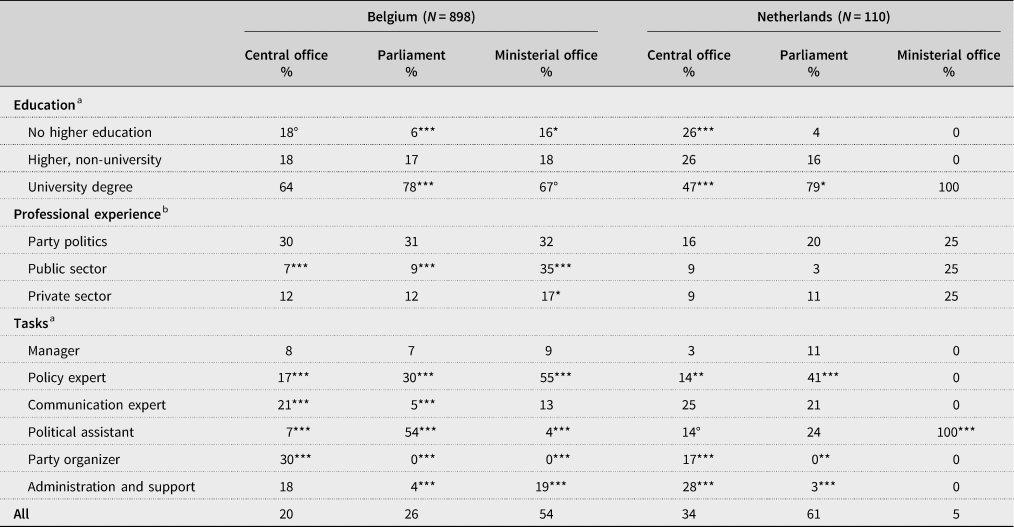
These indicators show interesting commonalities and differences between Belgium and the Netherlands (Table 1). First, staffers from both countries are highly educated. University graduates make up the lion's share of all staffers: only a small minority did not receive a higher education. Second, staffers' professional experiences are mostly centred on party politics. In both countries, the most common occupational track is political and only a minority of staffers have extensive professional experience in the public or private sector. Nonetheless, Belgium and the Netherlands diverge significantly as Belgian staffers have distinctly more experience in both party politics and the public sector. This is likely driven by differences in age, as Dutch political staffers are often younger than their Belgian counterparts. Whereas staffers' median age is 32.5 in the Netherlands, it is 40 in Belgium (Online Appendix C). Third, around half of all staffers have political-strategic tasks (as policy or communication experts) and some 20% have classic bureaucratic tasks (as party organizer, administration). Strikingly, the balance between policy and communication experts is significantly different: communication experts are more prevalent in the Netherlands; Belgian parties include more policy experts. In both cases, however, political-strategic staffers do not make up an overwhelming majority.
Staffers' Individual Qualifications

Notes: Column totals. aCategories mutually exclusive, bCategories not mutually exclusive.
Adjusted standardized residuals: °p ⩽ 0.1, *p ⩽ 0.05, **p ⩽ 0.01, ***p ⩽ 0.001. Values represent percentages that occasionally add up to 99 or 101 due to rounding.
The results section makes several analytical steps. First, the quantitative dimension of staffing is examined by comparing the relative staff size of central, parliamentary and ministerial offices in Belgium and the Netherlands. This categorization between party offices is based on a survey question in which respondents were asked to indicate the principal location of their professional activities. Second, a bivariate analysis addresses the qualitative dimension of staffing by describing the prevalence of three indicators (education, experience and tasks) across the different party offices. Significance levels were determined based on adjusted standardized residuals (° p ⩽ 0.1, * p ⩽ 0.05, ** p ⩽ 0.01, *** p ⩽ 0.001). To complement this bivariate analysis of staffers' individual qualifications, two additional regression analyses were run to: (1) identify which types of staffers are most likely to work within specific party offices; and (2) identify which types of individual tasks are linked to higher levels of education and professional experience (see Online Appendices D and E). These models control for age and sex as education and professional experience are expected to be influenced by age and existing studies have shown that staffers' relationships with parties are gendered (Calcagno and Montgomery Reference Calcagno and Montgomery2021; Erikson and Verge Reference Erikson and Verge2021; Snagovsky and Kerby Reference Snagovsky and Kerby2018; Taflaga and Kerby Reference Taflaga and Kerby2019). Third, the sample is split into opposition and government parties to analyse the impact of parties' governing status on staffing. Tables 3 and 4 examine the staffing advantage by comparing the staff sizes and staffers' qualifications of the three party offices separately for opposition and government parties. By taking the staff size of party offices as a benchmark, chi-square tests with adjusted standardized residuals were runFootnote 3 to examine whether the qualitative dimension amplifies or reduces the quantitative dimension.
Results
To examine which party office benefits from a double staffing advantage (RQ1), two steps will be undertaken. First, I analyse the relative staff size of parties' central, parliamentary and ministerial offices (quantitative dimension). Second, I examine which party offices have the most qualified staff by analysing their level of education, professional experience and their individual tasks (qualitative dimension).
The quantitative dimension
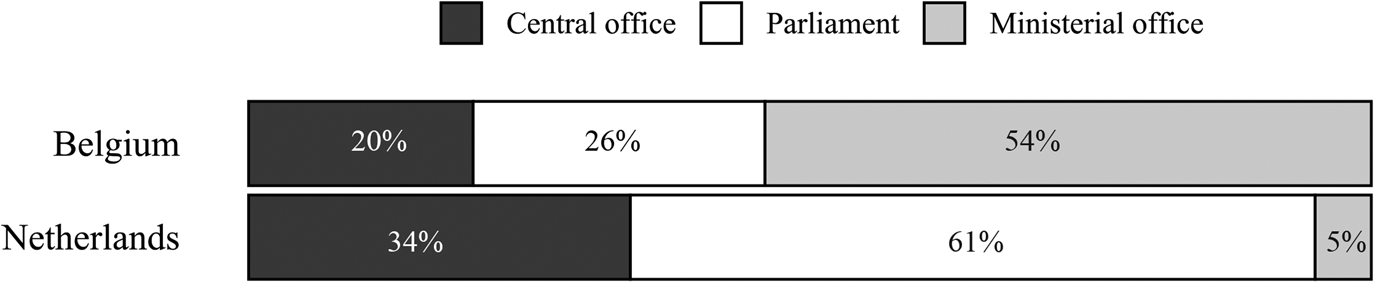
The quantitative staff distribution shows that Belgian and Dutch political staffers are not distributed evenly across all party offices. However, different party offices reap the benefits from this unequal distribution in Belgium and the Netherlands (Figure 2). The Dutch case reflects conventional wisdom on contemporary parties: a clear majority of all Dutch staffers are concentrated within parliament. In contrast, the Belgian case demonstrates how the party in the executive can be the main beneficiary of a quantitative staffing advantage: the majority of Belgian staffers work in ministerial offices. The sheer size of these extensive ministerial ‘cabinets’ pushes back the relative weight of central and parliamentary offices. As a result, Dutch central offices house a larger share of their party's human resources than their Belgian counterparts. However, this does not mean that Dutch central offices have larger staffs in absolute terms. In general, the human resources of Belgian parties far exceed the staff of their Dutch counterparts (Table 1; Online Appendix A).
Quantitative Staff Distribution

The qualitative dimension
The individual qualifications of staffers demonstrate that highly qualified staffers are indeed more prevalent within the party in parliament and the party in the executive. In Belgium, ministerial offices especially benefit from a qualitative staffing advantage (Table 2). Belgian ministerial staffers stand out for their professional experience and their tasks. While all party offices include a similar portion of staffers with experience in party politics, ministerial staffers bring in significantly more extra-political experience. The difference is especially striking for experience within the public sector, which shows that ministerial offices are an important gateway between politics and the civil service in Belgium. The qualitative staffing advantage of Belgian ministerial offices is also illustrated by the many policy experts among their ranks. Although not unique to the party in the executive, policy experts make up the majority of ministerial staffers. Their presence is significantly lower in other party offices.
Qualitative Dimension of Staffing

Note: Column totals. aCategories mutually exclusive, bCategories not mutually exclusive. Adjusted standardized residuals: °p ⩽ 0.1, *p ⩽ 0.05, ** p ⩽ 0.01, ***p ⩽ 0.001. Values represent percentages that occasionally add up to 99 or 101 due to rounding.
However, the qualitative advantage of Belgian ministerial offices is not absolute. First, the qualitative advantage of the party in the executive is tempered by the lack of an educational advantage. Although staffers are well educated in general (Table 1), parliamentary staffers are actually more likely to hold a university degree than their colleagues in ministerial offices. This comparatively low level of education among ministerial staffers is linked to the presence of staffers in administrative and supportive roles, as staffers within this category are significantly less likely to be higher-educated (Online Appendix E). In contrast, this group is virtually absent from parliamentary offices. Unsurprisingly, both the level of education and the prevalence of administration and support staffers at central and ministerial offices are highly similar. Second, the qualitative advantage of the party in the executive is tempered by the low presence of communication experts. In fact, communication experts are most numerous at parties' central offices. However, these nuances do not fundamentally challenge the staffing advantage of ministerial offices. The regression analysis in Online Appendix D demonstrates that ministerial staffers are robustly more experienced within the public sector and more likely to be policy experts.
In the Netherlands, the party in parliament benefits from a qualitative staffing advantage. Dutch parliamentary staffers stand out for their education and their tasks. Although staffers are generally highly educated, the proportion of parliamentary staffers with a university degree is significantly higher than in other party offices. The qualitative advantage of the party in parliament is also illustrated by the large presence of policy experts. Although Dutch central offices also include staffers working on policy, they are significantly more prevalent in parliamentary offices. Moreover, only a small number of Dutch parliamentary staffers are involved in traditional bureaucratic tasks. Although it is not surprising that party organizers are concentrated within parties' central offices, very few parliamentary staffers offer administrative and logistical support.
However, the qualitative advantage of Dutch parliamentary offices is not absolute either. First, the qualitative advantage of the party in parliament is tempered by the staff's limited professional experience. Although this relative lack of professional experience is similar to other party offices, only a small minority of parliamentary staffers have substantial experience outside politics. Compared to central and ministerial offices, Dutch parliamentary offices especially include few staffers with experience in the public sector. However, these differences between party offices are not statistically significant. Second, the qualitative advantage of the party in the executive is tempered by the lack of a communication advantage. Although insignificant, communication experts are nonetheless more numerous in parties' central offices. However, these nuances do not neutralize the staffing advantage of parliamentary offices. The regression analysis in Online Appendix D demonstrates that the low presence of administration and support staffers is a robust finding. However, the educational advantage of parliamentary staffers dissipates when controlling for the low presence of lower-educated administration and support staffers. Lastly, the estimate indicating the stronger presence of policy experts is positive but insignificant. Compared to Belgium, the contrasts between staffers' qualifications appear relatively limited in the Netherlands. However, the lack of significant results is linked to a substantially lower number of observations from the Netherlands (Table 2).
The institutional setting
To examine how staffing is shaped by the institutional structure of the party in the executive (RQ2), I examine the impact of ministerial offices on parties' internal distribution of staff. Of course, ministerial offices can only affect parties when they participate in government. Figures 3 and 4 illustrate how government participation can strongly impact staffing in parties. While ministerial offices only have a marginal impact on Dutch party organizations, Belgian ministerial offices strongly reduce the relative weight of central and parliamentary offices. For this reason, government and opposition parties are analysed separately in this section. The combined effect of the quantitative (staff size) and qualitative distribution (education, professional experience and tasks) of staff are discussed in detail for each party office (e.g. central offices of Belgian opposition parties) to situate them on each dimension (Figure 5).
Distribution of Staffers' Tasks by Country and Government Status in Belgium
Note: Significance levels refer to adjusted standardized residuals: ° p ⩽ 0.1, * p ⩽ 0.05, ** p ⩽ 0.01, *** p ⩽ 0.001.

Distribution of Staffers' Tasks by Government Status in the Netherlands
Note: Significance levels refer to adjusted standardized residuals: ° p ⩽ 0.1, * p ⩽ 0.05, ** p ⩽ 0.01, *** p ⩽ 0.001.

Party Offices on Quantitative and Qualitative Dimension
Note: CPO, central party office; PPG, parliamentary party group; MO, ministerial office; BE, Belgium; NL, the Netherlands; Gov, government parties; Opp, opposition parties.

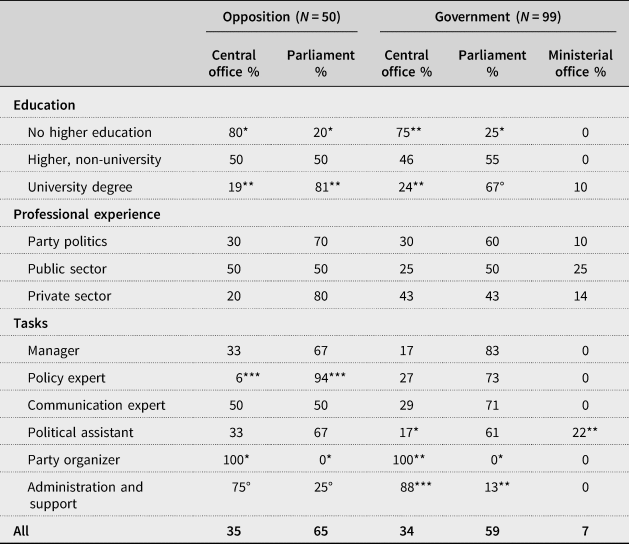
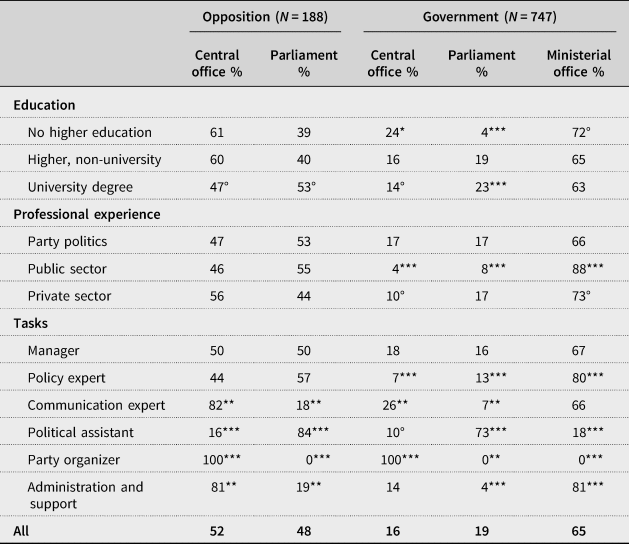
The bivariate analyses listed in Tables 3 and 4 show that the combined effect of staff size and staffers' qualifications often leads to a double advantage. At the bottom of the tables, the quantitative distribution of staffers is shown. For example, 65% of all staffers from Dutch opposition parties work within parliamentary offices. The tables also show how staffers with certain qualifications are distributed across party offices. More specifically, Figures 3 and 4 visualize how staffers with certain tasks are distributed within parties. In Dutch opposition parties, for example, 94% of all policy experts work within parliamentary offices – leaving only 6% of this important group to central offices. The significance test signals a double staffing advantage: parliamentary offices include even more policy experts (94%) than expected based on their relative staff size (65%). Hence, the quantitative advantage of the party in parliament is amplified by an advantage in policy expertise. In the following paragraphs, the combined effect of staff size and staffers' qualifications is discussed in more detail.
Staffing Advantage in the Netherlands

Note: Row totals; significance levels of adjusted standardized residuals: °p ⩽ 0.1, *p ⩽ 0.05, **p ⩽ 0.01, ***p ⩽ 0.001. Values represent percentages that occasionally add up to 99 or 101 due to rounding.
Staffing Advantage in Belgium

Note: Row totals; significance levels of adjusted standardized residuals: °p ⩽ 0.1, *p ⩽ 0.05, **p ⩽ 0.01, ***p ⩽ 0.001. Values represent percentages that occasionally add up to 99 or 101 due to rounding.
The results demonstrate that the balance between party offices is strongly affected by the political system and a party's governing status. In Dutch opposition parties, the party in parliament benefits from a double staffing advantage. First, its relative staff size substantially exceeds that of the party in central office. Second, this quantitative advantage is amplified by the qualifications of parliamentary staffers. Both party offices are each other's mirror image. In parliament, staffers without higher education are underrepresented and university-educated staffers are even more prevalent than expected based on staff size. The level of education among central office staffers shows the opposite effect. While parliamentary offices include the majority of staffers with extensive experience in party politics and the private sector, this unequal distribution reflects their relative staff size. Where staffers' tasks are concerned, however, the quantitative staffing advantage of the party in parliament is amplified by a qualitative advantage. While the distribution of policy experts strongly benefits parliamentary offices, party organizers and supporting staff are heavily concentrated within central offices.
In Dutch government parties, the party in parliament again benefits from a double staffing advantage. First, the party in parliament clearly remains the party office with the largest staff – in spite of losing some of its relative weight to ministerial offices. Second, its staffers remain the most highly qualified of all party offices. For starters, parliamentary staffers are significantly more qualified than their colleagues at central offices. Parliamentary offices include even more highly educated staffers than suggested by their staff size. The opposite applies to their colleagues at central offices, where the number of lower-educated staffers is disproportionally high. Most experienced staffers are concentrated within parliament, which aligns with the quantitative advantage of the parliamentary party. Furthermore, parliamentary offices include significantly fewer staffers involved in party organization and administration and support – staff types that are strongly concentrated within central offices. Although the group of Dutch ministerial staffers appears too small to challenge fundamentally the staffing advantage of the party in parliament, the results show that they are rather highly qualified. All ministerial staffers have a university degree and they appear to punch above their weight when it comes to experience outside party politics – albeit not significantly.
In Belgian opposition parties, no single party office clearly benefits from a staffing advantage. First, central offices have a tiny quantitative advantage. Second, the qualifications of both central and parliamentary offices are ambiguous as they point to both advantages and disadvantages. On the one hand, parliamentary staffers are slightly more highly educated and they include significantly fewer staffers in supporting roles. On the other hand, the group of communication experts are strongly concentrated within the party in central office. However, this particular qualitative advantage for central offices does not apply to policy experts, who are equally split between central and parliamentary offices. The professional experience of staffers does not offer clarity, as the most experienced staffers appear to be distributed relatively evenly between the party in central office and the party in parliament.
In Belgian government parties, the party in the executive benefits from a double staffing advantage. First, the infamous ministerial cabinets undoubtedly have the largest staff. In fact, a clear majority of all staffers from Belgian government parties work in ministerial offices. Second, this quantitative advantage is amplified by the superior qualifications of their staff. Ministerial offices attract even more staffers with experience in the public and private sectors than suggested by their relative staff size. This adds even more weight to the fact that the majority of staffers with extensive professional experience work in ministerial offices. Moreover, the largest and most important group of policy experts are strongly concentrated within ministerial offices. Although they do not fundamentally challenge the staffing advantage of ministerial offices, there are some nuances to be made. Parliamentary staffers are slightly more highly educated than suggested by their relative staff size. Nonetheless, a clear majority of highly educated staffers are concentrated within ministerial cabinets. A similar pattern can be observed concerning communication experts. Although the share of communication experts at central offices is disproportionally high, most of these communication experts work in ministerial offices. Finally, a significantly large share of administration and support staffers work in ministerial offices.
These findings largely align with the hypotheses presented in the first section of this article. Figure 5 illustrates the position of central party offices, parliamentary offices and ministerial offices on both dimensions, split up by country and governing status. Central office staffers are overshadowed by their colleagues in parliamentary and ministerial offices – except in Belgian opposition parties. This partially supports the first hypothesis, which stated that the staff of parties' public offices is both larger and more qualified than the staff of central offices (H1). Indeed, Dutch parliamentary offices are dominant professional machines with an extensive, highly qualified staff. In contrast, Dutch central offices neatly fit into the back office category as their staffs are both relatively small and less qualified. This image hardly changes when parties participate in government.
Staffing patterns in Belgium substantially diverge from the Dutch situation. This finding suggests that parties' internal distribution of staff is indeed shaped by institutional factors. In the Netherlands, the party in parliament permanently dominates and a party's governing status has little effect on staffing (H2c). Ministerial offices do not fundamentally affect parties' internal balance: the party in parliament does not lose its quantitative nor its qualitative staffing advantage. The comparatively high degree of experience and education among Dutch ministerial staffers suggests that ministerial offices are tiny expert cells – but the number of observations is too small to yield significant results. In Belgium, however, government participation dramatically alters staffing patterns because ministerial offices are professional machines with large, highly qualified staffs (H2a). These dominant ministerial offices overshadow central and parliamentary offices alike. Central offices in Belgian government parties act as back offices with smaller, less qualified staffs. The position of parliamentary offices is somewhere between back office and expert cell because their staff is smaller but only slightly more qualified. Staffing in Belgian opposition parties is even more ambiguous as the staffs of central and parliamentary offices are nearly equal and qualitative indicators yield mixed results.
Conclusion
This article examined the internal power balance of parties by studying the distribution of their human resources. While earlier research suggests that parties' parliamentary offices have a quantitative staffing advantage (Bardi et al. Reference Bardi, Calossi, Pizzimenti, Scarrow, Webb and Poguntke2017; Krouwel Reference Krouwel2012), I have argued that elected elites in parliament and the executive also benefit from a qualitative staffing advantage. Based on Panebianco's (Reference Panebianco1988) seminal work, I have argued that the demand for highly qualified staff is higher in parliamentary and ministerial offices because elected elites are more vulnerable to challenges in the electoral and policy arena. As a result, both the party in parliament and the party in the executive were expected to benefit from a qualitative staffing advantage as their staffs are more qualified. The results confirm that the individual qualifications of staffers in parliamentary and ministerial offices are often superior to those of central office staffers.
The differences between Belgium and the Netherlands demonstrate how institutional arrangements can shape parties' internal distribution of resources. Although both political systems share many similarities, the support structure of executives is substantially different because both nations belong to different administrative traditions. As a member of the European continental tradition, Dutch executives only have a handful of political advisers at their disposal. This stands in stark contrast to Belgium's adherence to the Napoleonic tradition, where executives rely on extensive ‘ministerial cabinets’ containing dozens of politically recruited staffers. The findings illustrate that such institutional factors influence which party office is the main beneficiary of the double staffing advantage – combining both the largest and most qualified staff. The Dutch case neatly reflects the conventional view on the power balance between party offices: the party in parliament clearly benefits from a double staffing advantage. Moreover, government participation does not substantially alter parties' internal distribution of resources because ministerial offices include few political staffers. The Belgian case challenges this dominant image as the party in the executive benefits from a double staffing advantage. Although ministerial offices can become semi-permanent power centres within parties that frequently participate in government, party organizations are in constant flux as their human resources are strongly dependent on government participation.
This unequal distribution of human resources affects parties' internal power balance. As staffing patterns favour the elected elites in parliament and the executive, they undermine the capacity of extra-parliamentary parties to keep track of their elected representatives. In both Belgium and the Netherlands, controlling the actions of elected elites in parliament and the executive is an uphill battle for extra-parliamentary party organizations. As parliamentary and ministerial staffers are more qualified, their expertise puts them one step ahead of their peers at central offices. However, it remains unclear whether shifts in resources (including staff) are responsible for the dominance of elected elites or vice versa. As longitudinal data are lacking, it is just as plausible that the dominance of elected elites actually preceded staff growth, enabling public offices to divert important resources towards themselves. Moreover, intra-party power dynamics should not be reduced to distribution of resources. They are just one piece of the puzzle that makes up parties' internal power balance. In fact, research shows that central party organizations can remain dominant by controlling leadership positions and statutory prerogatives despite the growth of resources in parliamentary and ministerial offices (Koskimaa Reference Koskimaa2020). Similarly, the Belgian case demonstrates that the dominance of the party in public office is not inevitable – even in a political system where parties are highly dependent on public funding (van Biezen and Kopecký Reference van Biezen and Kopecký2014). Despite the lack of a staffing advantage, central offices are nonetheless considered to be the main political power houses within the Belgian ‘partitocracy’ (Deschouwer et al. Reference Deschouwer, De Winter and Della Porta1996) and parliamentary party groups remain subordinate to both central and ministerial offices (De Winter and Dumont Reference De Winter, Dumont, Strøm, Müller and Bergman2003, Reference De Winter and Dumont2006).
The contrasts between Belgium and the Netherlands are relevant for other countries where ministerial advisers are prominent actors (Shaw and Eichbaum Reference Shaw and Eichbaum2018). Despite the idiosyncrasies of the Belgian case, the staffing advantage of the party in the executive is unlikely to be an international aberration. Parties' internal staff distribution can be expected to favour the party in the executive more than the party in parliament in other European ministerial cabinet systems as well. As this study only focused on two cases, however, future comparative studies can test whether the diverging staffing patterns of Belgium and the Netherlands do indeed reflect general differences between ministerial cabinet systems and non-cabinet systems. If so, the staffing advantage of Belgian ministerial offices suggests that ongoing experiments with ‘cabinetization’ in Australia, Canada and Sweden (Gouglas and Brans Reference Gouglas and Brans2017) might affect political parties internally. The findings even suggest that the existence of ministerial cabinets influences the careers of those who work in politics (Svallfors Reference Svallfors2020). Compared to the Netherlands, Belgian parties include more older and experienced staffers and rely more on policy experts. The extensive ministerial offices are likely responsible for these contrasts. Belgian ministerial staffers often pursue careers at the crossroads between politics and administration (Brans et al. Reference Brans, Pelgrims, Hoet, Peters, Verheijen and Vass2005), resulting in higher levels of experience in the public sector and the availability of policy experts. Moreover, the extensive size of ministerial offices creates many career opportunities, which enables more staffers to pursue a career in party politics as a ‘separate occupational track’ (Katz and Mair Reference Katz and Mair2009).
Supplementary material
The supplementary material for this article can be found at https://doi.org/10.1017/gov.2022.2.
Acknowledgements
I thank Bram Wauters, Nicolas Bouteca, Jessica Cuthbert-Smith, the participants of the panel on Political Parties at the Belgian ‘State of the Federation’ conference (Ghent, 2020) and the anonymous reviewers for their helpful comments. All remaining errors are my own.