Management Implications
The management of Rhamnus cathartica (common buckthorn) often includes the use of foliar herbicides. Fosamine ammonium (Krenite®) is a bud inhibitor that is thought to primarily target woody plant species and may be an effective tool in controlling R. cathartica and other invasive understory shrubs. At six sites in Minnesota, USA, we found foliar treatments using fosamine ammonium caused almost complete mortality of R. cathartica stems (>40-cm tall). However, the use of fosamine ammonium was also associated with severe reductions in forb cover in some sites, particularly those treated using high-volume pistol grip sprayers. Graminoid cover was low across all sites, but tended toward similar negative responses to fosamine ammonium. Our findings suggest that fosamine ammonium can exert strong control over R. cathartica, but that land managers should carefully consider potential non-target impacts when using fosamine ammonium. Delaying restoration seeding until after fosamine ammonium applications have concluded or timing fosamine ammonium application to occur after the senescence of understory herbs may mitigate non-target impacts of fosamine ammonium while maintaining comparable levels of R. cathartica control.
Introduction
The control of invasive woody plants is a common management goal in temperate forests, and many herbicides can be employed to remove undesired species from the understory (Delanoy and Archibold Reference Delanoy and Archibold2007; Ghassemi et al. Reference Ghassemi, Quinlivan and Dellarco1982). Foliar spraying is commonly the application method of choice for managing large areas of invasive woody species at relatively low cost (Power et al. Reference Power, Kelly and Stout2013), because foliar spraying is not reliant on mechanical removal or on targeted application, unlike cut-stump or basal bark methods. Foliar spraying is also often used as a follow-up treatment after mechanical removal operations to control resprouts or plants missed by the initial removal. Non-target impacts of foliar spraying can be reduced by spraying late in the season when many native species are less vulnerable to herbicide (Caplan et al. Reference Caplan, Whitehead, Gover and Grabosky2018), and non-target impacts can be further reduced by using herbicides with higher target specificity (Luken et al. Reference Luken, Beiting, Kareth, Kumler, Liu and Seither1994). One such herbicide is fosamine ammonium (Krenite®, Albaugh, Ankeny, IA), which targets woody plant species (Marrs Reference Marrs1984). Fosamine ammonium can be used at similar cost to land mangers as other foliar sprays (e.g., tricylopyr; P Bockenstedt, personal observation), but the efficacy and non-target impacts of fosamine ammonium are rarely reported in research literature, and the value of fosamine ammonium for management of invasive woody plants is not well understood.
The mechanism by which fosamine ammonium affects perennial plant growth is poorly described (Beste Reference Beste1983; Marrs Reference Marrs1985; Naylor and British Crop Protection Council Reference Naylor2002), but plants sprayed with fosamine ammonium exhibit inhibited apical and vascular meristem growth (Morey and Dahl Reference Morey and Dahl1980). Similarly, bud formation in deciduous species is prevented if leaves received full coverage the previous season. Thus, fosamine ammonium is an effective “bud inhibitor” that can starve plants of carbon if they are unable to develop enough leaves. Most of what is publicly known about fosamine ammonium is based on the manufacturer’s label, which states that when mixed with water and applied to the leaves of plants up to 2 mo before senescence, fosamine ammonium offers effective control of more than 45 woody species or genera, many of which are invasive in at least some regions. There is a limited set of scientific studies published evaluating the use of fosamine ammonium. These studies have been primarily conducted in open environments (Knezevic et al. Reference Knezevic, Osipitan, Oliveira and Scott2018; Marrs Reference Marrs1985; Milbauer et al. Reference Milbauer, Leach and Glass2003), but also in some woodlands (Nature Conservancy et al. Reference Tu, Hurd and Randall2001; Stein Reference Stein1999). They report mixed results, with studies targeting woody species more frequently reporting high efficacy of fosamine ammonium (Derr Reference Derr2008; Luken et al. Reference Luken, Beiting, Kareth, Kumler, Liu and Seither1994; Marrs Reference Marrs1984, Reference Marrs1985), and those targeting herbaceous perennial species reporting low to no impact of fosamine ammonium (Knezevic et al. Reference Knezevic, Osipitan, Oliveira and Scott2018; Laufenberg et al. Reference Laufenberg, Sheley, Jacobs and Borkowski2005; Shaw and Mack Reference Shaw and Mack1991). This disparity is consistent with theorized modes of action (Coupland and Peabody Reference Coupland and Peabody1981; Morey and Dahl Reference Morey and Dahl1980), such that woody plants that maintain tissues sprayed with fosamine ammonium should be more sensitive to the chemical than perennial herbs that undergo complete aboveground senescence and lose affected tissues. Despite this, there are still qualitative reports of significant non-target effects of fosamine ammonium on herbaceous species and bracken ferns [Pteridium aquilinium (L.) Kuhn] (Marrs Reference Marrs1984, Reference Marrs1985; Nature Conservancy et al. Reference Tu, Hurd and Randall2001). Thus, impacts of fosamine ammonium are highly variable in the literature. In addition to differences between species’ physiology, it is likely that the timing of fosamine ammonium application influences its efficacy on both target and non-target species, and that differences in the timing of application between studies at least partially explains some of this variability (Derr Reference Derr2008; Luken et al. Reference Luken, Beiting, Kareth, Kumler, Liu and Seither1994). Notably, to the best of our knowledge, the utility of fosamine ammonium for managing invasive understory shrubs is untested.
Common buckthorn (also called European buckthorn; Rhamnus cathartica L.) is a common invader of temperate forests of eastern North America (Kurylo et al. Reference Kurylo, Knight, Stewart and Endress2007), with extensive impacts on ecosystem structure and function (Knight et al. Reference Knight, Kurylo, Endress, Stewart and Reich2007). These impacts—including reduced plant and animal diversity, reduced habitat quality, accelerated decomposition and nutrient cycling, arrested forest regeneration, and stimulated agricultural pests and pathogens (Heimpel et al. Reference Heimpel, Frelich, Landis, Hopper, Hoelmer, Sezen, Asplen and Wu2010; Knight et al. Reference Knight, Kurylo, Endress, Stewart and Reich2007)—are largely the result of R. cathartica forming dense, monospecific stands that outcompete native understory plants for light (Archibold et al. Reference Archibold, Brooks and Delanoy1997). Thus, native plants that are able to persist under R. cathartica invasion are essential to maintaining and restoring understory biodiversity (Roth Reference Roth2015), and non-target effects of R. cathartica management should be avoided as much as possible when forest restoration is a goal of management. Rhamnus cathartica may be a particularly good candidate for control with fosamine ammonium due to its extended phenology, wherein R. cathartica retains its leaves into late autumn or early winter (Fridley Reference Fridley2012; Harrington et al. Reference Harrington, Brown and Reich1989; Knight Reference Knight2006), allowing R. cathartica to potentially be treated at a time when other understory plants are inactive (Caplan et al. Reference Caplan, Whitehead, Gover and Grabosky2018). Yet, to what extent fosamine ammonium controls R. cathartica and how much it affects non-target species is unknown.
Here, we evaluate the efficacy of fosamine ammonium on R. cathartica and the potential for non-target effects in a forest restoration experiment replicated across six sites. Specifically, we hypothesized that foliar application of fosamine ammonium to R. cathartica resprouts would result in high mortality of R. cathartica in treated areas and that herbaceous cover would remain unaffected.
Methods
We evaluated the efficacy of fosamine ammonium (41.5% fosamine ammonium) for R. cathartica control and impacts on non-target species using an ongoing restoration experiment in Minnesota, USA. We selected six sites where mature R. cathartica had been chemically (cut-stump or basal bark application of Garlon® 4 [Dow Agrosciences, Indianapolis, IN, USA] mixed with oil) or mechanically (forestry mower) removed in the past year and were in need of follow-up management to prevent reestablishment of R. cathartica from seed and resprout (Table 1). All sites were temperate deciduous forests characterized by canopies composed primarily of Quercus, Acer, and Populus. Rhamnus cathartica was the most abundant understory species, but creeping charlie (Glechoma hederacea L.), wood nettle [Laportea canadensis (L.) Weddell], enchanter’s nightshade (Circaea lutetiana L.), bedstraw (Galium spp.), woodbine [Parthenocissus quinquefolia (L.) Planch.], and white snakeroot [Ageratina altissima (L.) R.M. King & H. Rob.] were also common.
Characteristics of the six experimental sites in Minnesota, USA.

a GPS coordinates of each site.
b n, number of replicate blocks at each site.
c Method used to remove Rhamnus cathartica initially, before the start of the experimental period.
d Dominant tree canopy at the site.
e Method by which fosamine ammonium was applied to the site.
Experimental Design
As part of a larger restoration experiment, we established three to six replicate blocks in each site in February 2017. Each block contained a pair of plots, one assigned to receive foliar fosamine ammonium and another to serve as a control. Most plots were 12 by 30 m, but plots at Circle Pines and Chaska sites were half as wide (6 by 30 m) to accommodate space constraints and areas containing large stacks of cut stems (i.e., slash piles). We also identified four 1 by 1 m2 subplots within each plot (spaced 5 m apart along a 20-m transect) for use in sampling. If subplots could not be feasibly placed along the transect (e.g., due to intervening tree trunks), they were shifted the minimum distance required to allow representative sampling.
All sites were in need of follow-up herbicide treatments to remove residual R. cathartica resulting from stump resprouts and seed germination. On July 25–27, 2017, plots assigned to the fosamine ammonium treatment were sprayed using a combination of application techniques. Because sites varied in removal method and initial conditions (Table 1), R. cathartica abundance was variable between sites. Following common management practices, we varied the application method between sites based on the amount of R. cathartica to be sprayed. Sites with dense R. cathartica regeneration were treated at 300 L ha−1 using pistol grip sprayers fed from a vehicle-mounted tank containing 3.5% fosamine ammonium mixed with water (4.2 L ha−1 fosamine ammonium). Sites with sparse R. cathartica regeneration were treated at 100 L ha−1 using backpack sprayers containing 7% fosamine ammonium mixed with water (2.9 L ha−1 fosamine ammonium). These application rates are below the manufacturer’s recommended minimum for fosamine ammonium (5.8 L ha−1 fosamine ammonium), but we have observed effective control of R. cathartica with these application rates in the past (P Bockenstedt, personal observation). Thus, our treatments provide a conservative metric of fosamine ammonium efficacy. Using foliar sprays, especially a bud inhibitor like fosamine ammonium, is dependent on complete coverage of a target plant’s leaves. Leaves that are not sprayed are prone to return the following spring and allow for continued growth, severely limiting the efficacy of the treatment overall and requiring additional treatments at added cost. For this reason, it is common to use foliar sprays subsequent to mechanical removal. Once R. cathartica stems have been cut, they resprout, and these resprouts are sufficiently small to allow for complete coverage by foliar sprays. Use of either mechanical removal or fosamine ammonium in isolation is only likely to be effective in very young stands that are short and lack stored carbohydrate reserves. Therefore, we performed our study within the context of stands that had already undergone some R. cathartica management.
Efficacy of fosamine ammonium against R. cathartica was measured by assessing the health of all standing R. cathartica stems >40-cm tall in May 2018. Stems were identified by any remnant leaves and by bark characteristics. Stems with green leaves or active buds were determined to be alive, while those that lacked leaves or active buds and were brittle to the touch were determined to be dead. The total number of live and dead R. cathartica was recorded for each subplot.
Effects on community composition were measured by visually estimating cover in July 2018. Within each subplot, we visually estimated total woody cover (including R. cathartica), total graminoid cover, and total forb cover.
Statistical Analyses
First, we characterized inherent differences between sites by analyzing the total number of R. cathartica surveyed and graminoid and forb cover as functions of site, using data only from control plots. We then tested our hypothesis using a series of generalized mixed models. We evaluated R. cathartica mortality as the proportion of total R. cathartica stems that were dead and evaluated community composition by considering the cover of woody species, graminoids, and forbs. Mean R. cathartica mortality within a plot and mean woody cover, mean graminoid cover, and mean forb cover within a plot were analyzed based on site, whether the plot had received fosamine ammonium, and the interaction between site and fosamine ammonium. Rhamnus cathartica mortality was modeled in a general linear mixed model using PROC MIXED in SAS v. 9.4 (SAS Institute, Cary, NC) using the Satterthwaite approximation for degrees of freedom and with block as a random factor nested within site. All other models were performed using PROC GLIMMIX, assuming a Poisson distribution and with block as a random factor nested within site. We also tested post hoc whether sites with different fosamine ammonium application techniques differed in impacts on target and non-target species.
Results and Discussion
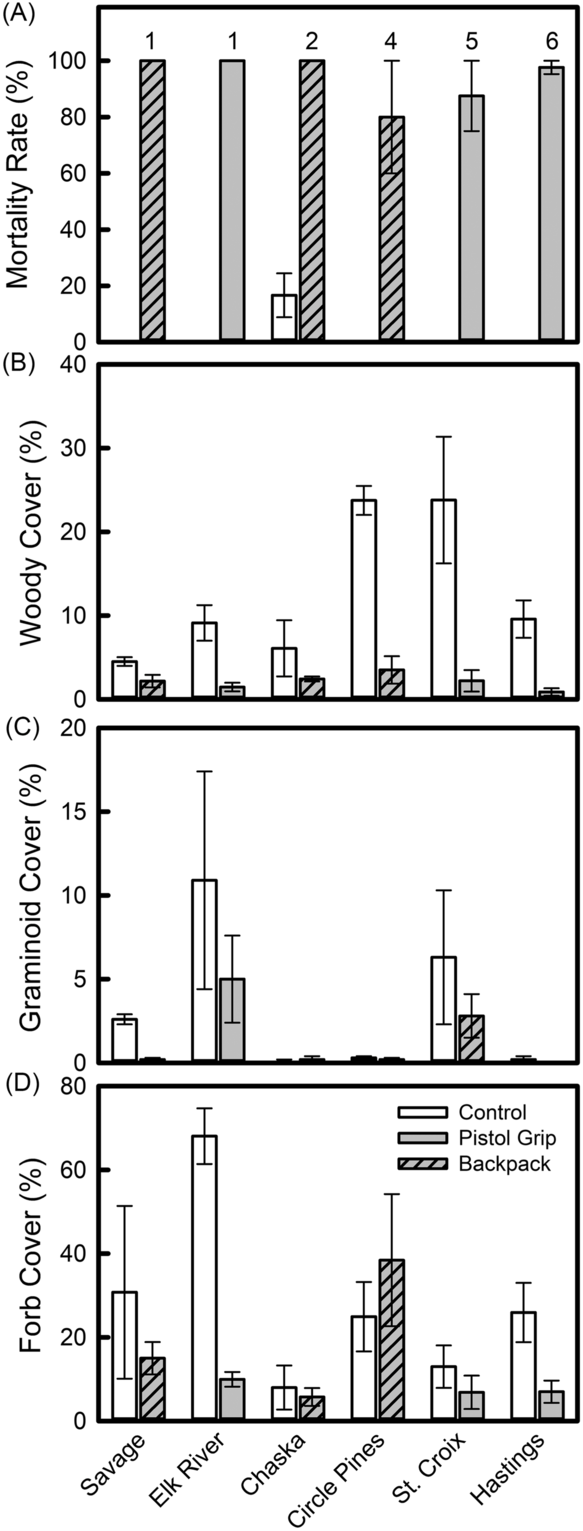
Experimental sites differed greatly in their baseline conditions as indicated by control plots (Figure 1). The St Croix site had the greatest baseline abundance of R. cathartica stems (numbers in Figure 1A; Table 2), and the Circle Pines and St Croix sites had similarly high woody cover (Figure 1B). The Elk River site had the lowest R. cathartica abundance but also had the greatest baseline forb cover (Table 2). In contrast, the Chaska site had the lowest forb cover. Baseline graminoid cover was consistently low across all sites (Table 2).
Mean (±SE) Rhamnus cathartica mortality as a proportion of all R. cathartica stems located in May 2018 (A). Also presented are mean woody (B), graminoid (C), and forb (D) cover in July 2018 in control plots (white) and those treated with fosamine ammonium (gray). Sites were treated using either pistol grip sprayers (open bars) or backpack sprayers (hashed bars). Numbers in A indicate the mean density of R. cathartica >40-cm tall (m−2) at each site. Sites are organized in order of increasing R. cathartica abundance.

Statistical results for analyses of Rhamnus cathartica mortality, woody cover, graminoid cover, and forb cover.

Mortality of R. cathartica greater than 40-cm tall was highly elevated following fosamine ammonium application (Table 2). Across sites, 95% of all R. cathartica that had been sprayed were considered dead at the time of survey. Mortality rates in sprayed plots were near 100% at four sites, but were 80% and 88% at the Circle Pines and St Croix sites, respectively (Figure 1A). In comparison, ambient mortality rates in the absence of fosamine ammonium (i.e., in control plots) were 0% at all sites except Chaska, where mortality that may have occurred in prior years due to basal bark herbicide application might have been included in our survey. Rhamnus cathartica mortality did not vary significantly by site, and there was no interaction between site and fosamine ammonium (Table 2). In accordance with the high mortality rate we observed during the spring, cover of woody species (including R. cathartica) in summer was 74% lower in plots treated with fosamine ammonium (Figure 1B). Post hoc tests of woody cover showed a trend toward high-volume pistol grip sprayers resulting in lower woody cover compared with backpack sprayers, but this was not statistically significant (Tukey HSD, P = 0.06). Although species aside from R. cathartica (e.g., pin cherry, Prunus pensylvanica L.) contributed to woody cover estimates, R. cathartica remained the most common woody species across the experiment, even after fosamine ammonium treatment. The disparity between our observations of high mortality and some residual woody cover following fosamine ammonium treatment is most likely due to individuals that did not receive full fosamine ammonium coverage or otherwise avoided being sprayed. It may be that increasing the application rate would result in more complete control of woody species, but the reality of imperfect coverage likely requires managers to repeat treatments for several seasons, despite the high chemical efficacy of fosamine ammonium.
Non-target effects of fosamine ammonium varied by site and by growth form. Graminoid cover was not consistently affected by fosamine ammonium, and varied between sites (Table 2). The Elk River site had the greatest graminoid cover overall compared with other sites (Figure 1C). Two of three sites with detectable graminoid cover (the two with most cover) did show marked reductions in fosamine ammonium–treated plots, but with high variability in responses. Forb cover also varied by site and was adversely affected by fosamine ammonium application (Table 2); forb cover in fosamine ammonium–treated plots was only 37% of what it was in control plots on average across all sites. However, there were also strong differences in the impact of fosamine ammonium on forbs between sites (Table 2). For example, forb cover was reduced by 85%, 73%, and 50% at the Elk River, Hastings, and Savage sites, respectively, whereas there was no consistent different in forb cover between control and fosamine ammonium–treated plots in the other sites (Figure 1D). The sites with the greatest reductions in forb cover (Elk River and Hastings) were also those that were treated with high-volume pistol grip sprayers instead of backpack sprayers (Tukey HSD, P < 0.01). Similar differences between pistol grip sprayers and backpack sprayers were not apparent in graminoid cover.
Reductions in forb cover with fosamine ammonium were associated with shifts in species composition as well. In the Elk River site, control plots were characterized by large components of L. canadensis, A. altissima, and G. hederacea. In contrast, fosamine ammonium–treated plots at Elk River were characterized by different forbs: exotic garlic mustard [Alliaria petiolata (M. Bieb) Cavara & Grande], native clearweed [Pilea pumila (L.) A. Gray], and native wood-sorrels (Oxalis spp.). These shifts in forb composition were not observed in sites like Chaska, where there were no discernable differences in forb cover (Figure 1D). The variability in forb responses may also be tied to resident community composition in a way that sites comprising species other than what were found in our study would respond differently to fosamine ammonium treatment. For example, species with earlier phenology (e.g., spring ephemerals) would likely be less affected by fosamine ammonium spraying during dormancy.
Following intensive fosamine ammonium application across six forest sites, we found consistent evidence of high efficacy of fosamine ammonium against R. cathartica. However, we also observed markedly reduced forb cover as an unintended consequence of fosamine ammonium, particularly in sites treated with high-volume pistol grip sprayers. Our findings indicate that fosamine ammonium can be used to effectively control R. cathartica, but also highlight the need for careful planning and evaluation of non-target risk by land managers.
To the best of our knowledge, this is the most comprehensive test to date of fosamine ammonium efficacy and non-target impacts in forest understories. However, it is important to interpret our findings only within the context of our experiment. We likely overestimate efficacy by only considering stems taller than 40 cm. Stems shorter than this could have been obscured by taller vegetation or gone undetected during spraying, and therefore survived the treatment by avoiding contact with fosamine ammonium. Even in plots where we detected 100% mortality of stems taller than 40 cm, some smaller R. cathartica persisted to contribute to woody cover in the following summer (Figure 1B; M Schuster and P Wragg, personal observation). These remaining R. cathartica warrant continued monitoring over the next growing season to evaluate whether additional management is necessary. In terms of biological response, our estimate of high efficacy is likely accurate—R. cathartica that were exposed to fosamine ammonium had much lower survival rates—but in terms of practical management, effective mortality rate would be lower, as some R. cathartica escaped treatment.
The non-target effects we observed may have been brought on by the timing of our fosamine ammonium application in late July. It is recommended by the manufacturer that fosamine ammonium be applied within 2 mo of plant senescence. This is a challenging criterion to follow, given that woody plant phenology is highly variable across species and years (Fan et al. Reference Fan, Li, Huang, Wu, Yu, Wei, Zhang, Wang, Hu and D’Odorico2019; Fridley Reference Fridley2012; Zettlemoyer et al. Reference Zettlemoyer, Schultheis and Lau2019). Therefore, it is not always possible to discern the optimal time for fosamine ammonium application, and land managers may apply fosamine ammonium earlier than necessary to ensure sufficient coverage of target species. Because fosamine ammonium must be applied to green leaf tissues, delaying application later into autumn risks reduced efficacy as leaves are lost throughout the season. However, many herbaceous species are also still active during these earlier application windows compared with later ones. Therefore, the leaves of these non-target herbaceous species can still be affected by fosamine ammonium, especially when it is applied with nondiscriminate, high-volume pistol grip sprayers. Therefore, applying fosamine ammonium in late summer, as we did here, likely leads to high efficacy against R. cathartica, but also exposes herbaceous species to considerable risk. Moreover, for species like R. cathartica that do not undergo distinct autumn senescence in nonnative North American territory, the optimal application date might be in autumn. That is because R. cathartica will commonly hold a large portion of their leaves fully or remain nearly fully green well past first frost and only become fully defoliated as leaves are lost to necrosis (Harrington et al. Reference Harrington, Brown and Reich1989; Knight et al. Reference Knight, Kurylo, Endress, Stewart and Reich2007; Pretorius Reference Pretorius2015) when low temperatures reach approximately −12 C (personal observation).
We speculate that a later application date would have reduced non-target impacts with only minor differences in target efficacy. Further research is needed on how the timing of fosamine ammonium applications affects both target and non-target species.
Rhamnus cathartica treatment utilizing fosamine ammonium herbicide can be effective. However, potential non-target impacts must be considered when planning and executing treatment and an overall restoration approach. Observations in the field at multiple sites, including the plots that are part of this study, indicate that the application tools, timing, and methods can all influence the type and level of non-target impacts. Our observations indicate that particular types of vegetation can be negatively impacted by bud-inhibitor application, including herbaceous seedlings and juvenile plants, as well as mature plants with woody or semi-woody roots.
There are likely several strategies that would minimize non-target damage in restoration areas, including carefully choosing application tools and timing to conduct foliar applications, as well as delay of native seeding for restoration. We have observed that a treatment approach that minimizes non-target impacts is to focus on foliar treatment of brush under 1-m tall, allowing the applicator to hold a spray wand tip over the plant rather than needing to spray upward to reach the uppermost stems and leaves of taller brush, which often results in overspray (P Bockenstedt, personal observation). As would be expected, high-volume applications by boom and pistol resulted in the most frequently observed non-target impacts, while spot treatment using backpacks typically resulted in the least non-target impacts.
Our results also have relevance when establishing timelines for R. cathartica management. Although avoiding non-target impacts is a common goal of management, control of invasive or weedy herbaceous species in addition to R. cathartica may be an advantageous—if unintended—consequence of using fosamine ammonium. Lower cover of highly competitive species like A. petiolata can allow for the reestablishment of desired native species and facilitate more diverse understory communities (Stinson et al. Reference Stinson, Campbell, Powell, Wolfe, Callaway, Thelen, Hallett, Prati and Klironomos2006, Reference Stinson, Kaufman, Durbin and Lowenstein2007). Additionally, it may be that mature perennial plants are less sensitive to herbicide than first-year seedlings due to differences in stored reserves (Marrs et al. Reference Marrs, Frost and Plant1991), suggesting that non-target impacts may be particularly harmful to plants establishing from seed as part of revegetation efforts (Wagner and Nelson Reference Wagner and Nelson2014). Thus, for sites where a significant portion of an area is expected to be foliar sprayed to treat abundant R. cathartica resprouts and/or seedlings in the first growing season after initial invasive brush management, delaying restoration seeding for one growing season can be an effective approach for developing long-term native ground cover and mitigating non-target impacts (Luken et al. Reference Luken, Beiting, Kareth, Kumler, Liu and Seither1994).
Acknowledgments
Partial funding was provided by the Minnesota Invasive Terrestrial Plants and Pests Center through the Minnesota Environment and Natural Resources Trust Fund. Carl Anfang and Gabriele Menomin contributed significantly to fieldwork. No conflicts of interest have been declared.