Antimicrobial resistance is a significant threat to public health. It results in decreased effectiveness of antimicrobial therapy leading to prolonged illness, increased mortality, and increased social and economic costs. 1 Antimicrobial utilization, the key driver of resistance, is highest in acute-care settings. However, up to 50% of this use is considered inappropriate.Reference Dellit, Owens and McGowan 2 Implementing an antimicrobial stewardship program (ASP) is a vital intervention to address inappropriate use and prevent the negative consequences of therapy in this setting.Reference Barlam, Cosgrove and Abbo 3
Guidelines have promoted the importance of both structural (eg, funding, staffing, leadership support) and strategic (eg, interventions to improve antimicrobial utilization) ASP components.Reference Barlam, Cosgrove and Abbo 3 , 4 Despite recommendations to include these components in a hospital ASP, their relative impact remains to be determined. Additionally, identifying which elements may influence antibiotic use is an important consideration in the context of finite hospital resources where prioritizing ASP activities is needed.
Recent studies indicate that antimicrobial utilization varies widely between hospital facilities even after accounting for nonmodifiable factors (eg, hospital type, patient population characteristics).Reference Tan, Vermeulen, Wang, Zvonar, Garber and Daneman 5 , Reference MacDougall and Polk 6 Current knowledge about the drivers of such variability is limited, particularly as it relates to the impact of an ASP on antimicrobial use.
The primary objective of this study was to determine whether the following hospital ASP structural elements are associated with reduced antibiotic use: program maturity, designated funding/resources, recognition as an organizational priority, and reporting of ASP metrics to senior administration. A secondary objective was to determine which specific strategies strongly recommended by the 2016 Infectious Diseases Society of America (IDSA)/Society for Healthcare Epidemiology of America (SHEA) guidelines are associated with reduced antibiotic use: formulary restriction with preauthorization, prospective audit and feedback, therapeutic drug monitoring with feedback, and intravenous-to-oral conversion.Reference Barlam, Cosgrove and Abbo 3
Methods
Study design and setting
We conducted an observational study of acute-care hospitals in Ontario, Canada, to evaluate the association between self-reported ASP characteristics in place as of 2013 and risk-adjusted antibiotic utilization for the 2014 calendar year.
Antimicrobial stewardship program survey
The Ontario ASP Landscape survey, developed by Public Health Ontario, asked clinicians about the structural and strategic elements of their organization’s ASP (Table 1). The survey was pilot tested by selected individuals involved in hospital ASPs (eg, pharmacists, program leads) and was refined based on their feedback prior to dissemination. The voluntary survey, administered online and open for 5 weeks (September–October, 2016), was distributed to all hospitals and was addressed to the individual most responsible for antimicrobial stewardship in their organization (eg, ASP pharmacist or physician). Respondents were asked the year of ASP element implementation. Only elements implemented in 2013 or prior were considered present for the purposes of this analysis. The ASP elements implemented in 2014 and later or with year unknown were considered absent (due to respondent uncertainty of whether these elements were present prior to 2014).
Structural and Strategic Antimicrobial Stewardship Program (ASP) Elements

Antibiotic use
Monthly antibiotic purchasing from January 1 to December 31, 2014, for acute-care hospitals in Ontario was included in this dataset in grams for each antibiotic and was converted to defined daily doses, a standard metric defined by the World Health Organization for benchmarking drug utilization. 7 All systemic antibacterials administered by the enteral or parenteral route were included. Purchasing data were obtained from the IMS Health Canadian Drug Store and Hospital Purchases Audit, which includes direct and indirect drug sales to hospitals and pharmacies across Canada. These data have been validated, showing a strong correlation with internal hospital records of antibiotic dispensing (correlation coefficient, 0.88–0.91).Reference Tan, Ritchie, Alldred and Daneman 8
Data on acute-care hospitals and hospitalizations
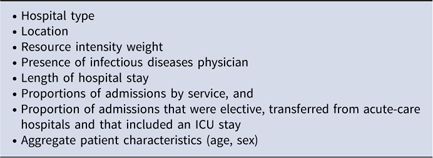
Eligible hospitals included acute-care facilities in Ontario. Hospitals that specialized only in psychiatric, surgical, pediatric, outpatient, rehabilitation or long-term geriatric care were excluded given the anticipated low rates of antibiotic use and the paucity of antibiotic stewardship efforts. Two hospitals that purchased antibiotics for nursing station outposts in their area were excluded because their inpatient antibiotic use would be overestimated. Hospitals with shared purchasing or pooled administrative data were combined (eg, multiple hospital sites within a hospital corporation). Hospital-level variables collected for this study were based on a previous work of risk-adjusted variability in hospital antibiotic use in Ontario.Reference Tan, Vermeulen, Wang, Zvonar, Garber and Daneman 5 The number of patient days from inpatient admissions and same-day surgeries in 2014 at each hospital were obtained from Canadian Institutes of Health Information Discharge Abstracts Database and Same-Day Surgery databases, respectively. Hospital characteristics collected are shown in Table 2.
Hospital Characteristics

Note. ICU, intensive care unit.
Privacy and ethics
The Privacy Office and Ethics Review Board at Public Health Ontario approved this study.
Primary outcome
Antibiotic use was expressed in defined daily doses per 1,000 patient days at each hospital.
Statistical analysis
A multivariable generalized estimating equations (GEE) Poisson regression model, using defined daily doses as the outcome and the log of hospital patient days as the offset, was developed. The model included the hospital and patient covariates from the administrative databases (Table 2) using an exchangeable correlation structure. The best-fitting model was generated by backward selection, with prespecified, forced inclusion of hospital type, proportion of admissions by service, proportion of admissions that included an ICU stay, and proportion of admissions by patient age.Reference Tan, Vermeulen, Wang, Zvonar, Garber and Daneman 5 The observed (O) antibiotic use at each hospital was compared to the model-based expected (E) antibiotic use, and hospitals were ranked from lowest to highest according to the O:E ratio. Analyses were performed with SAS Enterprise Guide version 7·12 software (SAS Institute, Cary, NC).
Results
Hospital characteristics and antibiotic use
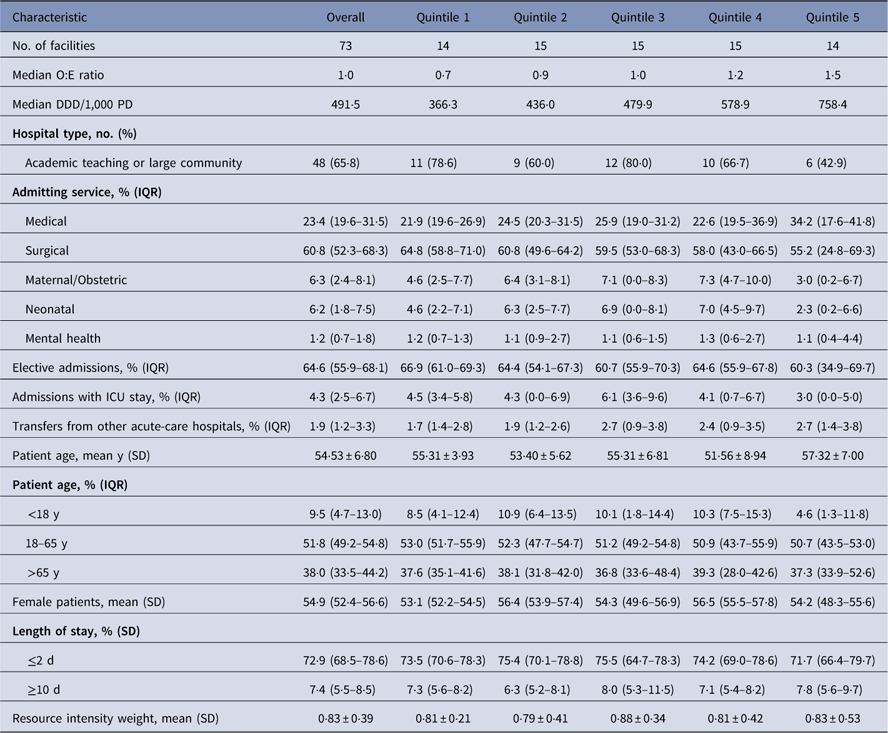
Of 127 eligible hospitals, 73 (57%) participated in this study. Among these 73 facilities were 12 academic teaching hospitals (16%), 36 large community hospitals (49%), 17 medium community hospitals, (23%) and 8 small community hospitals (11%). Wide variability (7-fold) in antibiotic usage was observed, ranging from 253 to 1,872 defined daily doses per 1,000 patient days. Table 3 displays hospital and aggregate patient characteristics of the hospitals, subdivided into quintiles of O:E ratio of antibiotic use.
Hospital Characteristics Ranked by Observed to Expected Antibiotic Use Ratio (Lowest to Highest)

Note. O:E observed to expected; DDD, defined daily dose; PD, patient days; IQR, interquartile ratio; SD, standard deviation.
Antimicrobial stewardship program characteristics
Structural elements
Of the 73 hospitals participating, 24 hospitals (33%) implemented 0–2 structural elements, 22 hospitals (30%) implemented 3–5 structural elements, and 27 hospitals (37%) implemented 6–8 structural elements. 49 hospitals (67%) reported implementation of a formal ASP. Among these programs, 23 hospitals (47%) were mature ASPs (ie, in place for at least 3 years). With respect to other structural characteristics, 33 hospitals (45%) had dedicated ASP funding and/or resources; 19 hospitals (26%) had ASP recognized as an organizational priority; 31 hospitals (42%) reported ASP metrics to senior administration.
Strategic elements
Of the 32 ASP strategies, 15 hospitals (21%) implemented 0–7 ASP strategies, 22 hospitals (30%) implemented 8–15 ASP strategies, and 36 hospitals (49%) implemented 16 or more ASP strategies. Regarding strategies strongly recommended by IDSA/SHEA, formulary restriction with preauthorization was implemented by 15 hospitals (21%), prospective audit and feedback was implemented by 42 hospitals (58%), therapeutic drug monitoring with feedback was implemented by 53 hospitals (73%), and intravenous-to-oral conversion was implemented by 47 hospitals (64%).
Impact of ASP elements on outcome
Structural elements
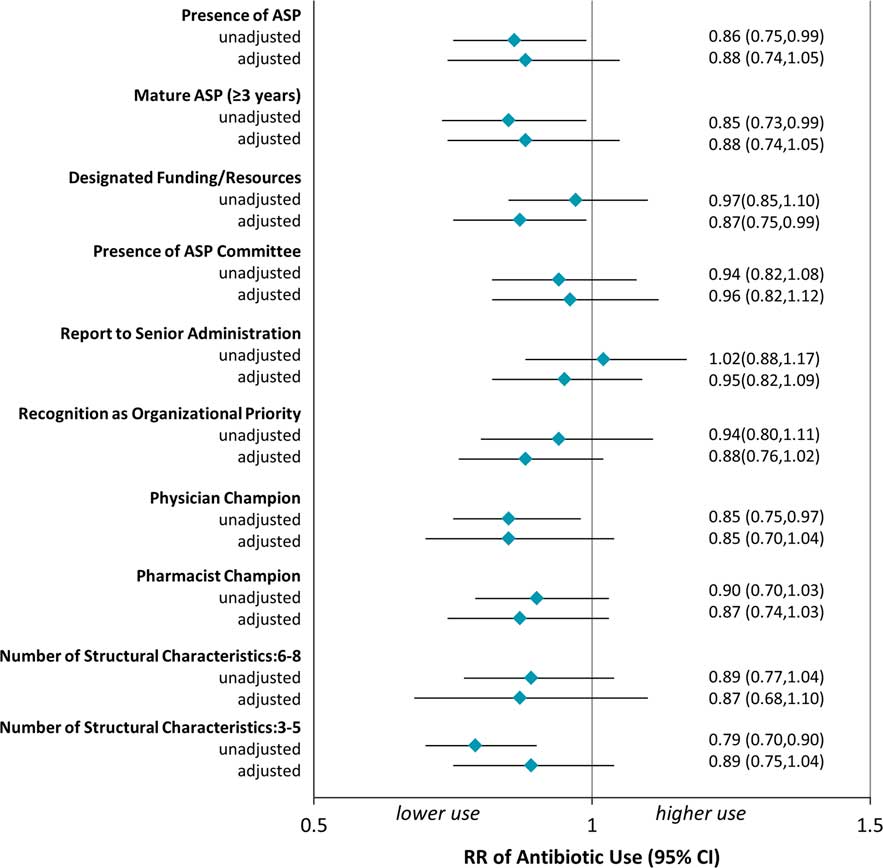
After adjustment for hospital and patient characteristics, the only structural element associated with lower risk-adjusted antibiotic use was the presence of designated ASP funding or resources (Fig. 1). This element was associated with modestly lower antibiotic use (rate ratio [RR], 0·87; 95% CI, 0·75–0·99). The overall number of structural characteristics implemented was not statistically significantly associated with lower antibiotic use.
Impact of antibiotic stewardship program (ASP) structural elements on antibiotic use. Forest plot of the rate ratio (RR) of unadjusted and adjusted antibiotic use measured in defined daily doses (DDD) per 1,000 patient days (PD) for hospitals with specified ASP characteristics. The reference is the absence of the characteristic, and for the number of structural characteristics it is 0–2 elements.

Strategic elements
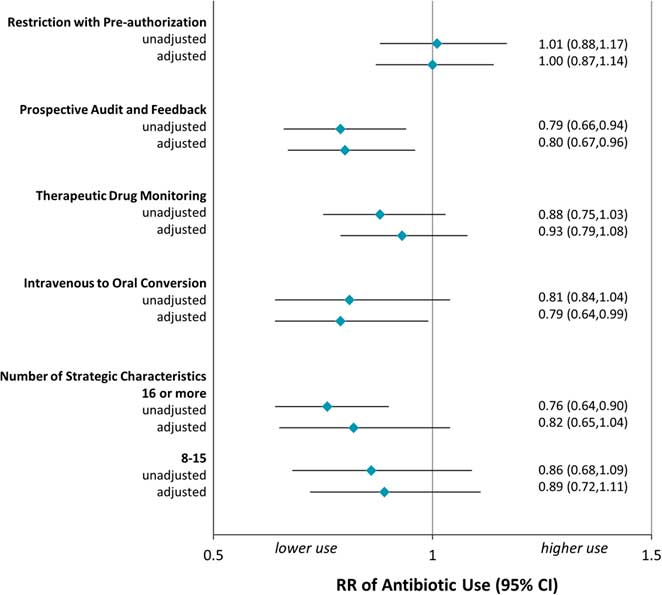
The IDSA/SHEA-recommended strategies of prospective audit and feedback (RR, 0·80; 95% CI, 0·67–0·96) and intravenous-to-oral conversion (RR, 0·79; 95% CI, 0·64–0·99) were associated with lower risk-adjusted antibiotic use (Fig. 2). Hospitals with 16 or more strategies were associated with lower antibiotic use (RR, 0·76; 95% CI, 0·64–0·90), but statistical significance was lost (RR, 0·82; 95% CI, 0·65–1·04) after adjustment for hospital and patient characteristics.
Impact of antibiotic stewardship program (ASP) strategic elements on antibiotic use. Forest plot of the rate ratio (RR) of unadjusted and adjusted antibiotic use measured in defined daily doses (DDD) per 1000 patient days (PD) for hospitals with specified ASP characteristics. The reference is the absence of the characteristic, and for the number of strategic characteristics it is 0–7 elements.

Discussion
This analysis of 73 Ontario hospitals revealed that key structural and strategic ASP elements are significantly associated with decreased hospital antibiotic utilization. These elements were the presence of designated funding or resources, prospective audit and feedback, and intravenous-to-oral conversion.
These results echo previous findings that ASP characteristics contribute to variability in antibiotic use between hospitals. Pakyz et al. Reference Pakyz, Moczygemba, Wang, Stevens and Edmond 9 found that an antimicrobial stewardship strategy score was associated with lower antibiotic use across 44 academic medical centers in the United States.Reference Pakyz, Moczygemba, Wang, Stevens and Edmond 9 Although our study did not find an association between the overall number of strategies and antimicrobial use, both studies found that prospective audit and feedback was a predictor of reduced antibiotic use. In contrast, a study of 977 acute-care hospitals in France found no association between their “action score,” a measure of strategies implemented, and antibiotic usage. However, they found an association between the hospital’s “resource score,” an indicator of personnel and technological support, and antibiotic consumption.Reference Amadeo, Dumartin, Parneix, Fourrier-Réglat and Rogues 10 Predictors of antibiotic use variability differ across studies, which may reflect differences in definitions of ASP components, scoring systems used, risk-adjustment, and geography. Nevertheless, the literature to date supports the recommendations by the IDSA/SHEA and CDC that both structural and strategic characteristics must be considered when building an ASP.
Presence of ASP funding and/or resources was associated with modestly lower antibiotic use. The independent impact of this structural element is difficult to assess given that ASP resources allow for more robust implementation of strategies, the latter of which are expected to drive changes in antibiotic prescribing. However, evidence shows that ASPs without funding and/or resources may be less able to impact antibiotic prescribing through strategies such as prospective audit and feedback.Reference Cosgrove, Seo and Bolon 11 Although we detected a trend toward reduced antibiotic use in programs with pharmacist and physician champions, these elements were not associated with reduced antibiotic use in the adjusted analysis. Pharmacist and physician leadership of ASPs is certainly important, but they are most likely to be effective when having protected time to perform ASP duties, further underscoring the need for dedicated ASP personnel.
A recent Cochrane review examining interventions to improve antibiotic prescribing in hospital settings found that both restrictive and enabling (advice or feedback to guide prescribing) were effective at improving antibiotic use and reducing length of stay without increasing mortality.Reference Davey, Marwick and Scott 12 Furthermore, enabling approaches tended to amplify the impact of other interventions, including antimicrobial restrictions. We did not find an association between restrictions and antibiotic use, but we did find that the enabling intervention of prospective audit and feedback was a predictor of lower antibiotic use.
Importantly, 2 interventions strongly recommended by the IDSA/SHEA were associated with low antibiotic utilization: prospective audit and feedback and intravenous-to-oral conversion. Although prospective audit and feedback has a proven impact on antimicrobial utilization,Reference Elligsen, Walker and Pinto 13 , Reference Newland, Stach and De Lurgio 14 the mechanism by which intravenous-to-oral conversion can reduce antibiotic consumption is less certain. One reason for this finding could be reduced length of stayReference Carratalà, Garcia-Vidal and Ortega 15 for patients receiving antimicrobial agents, allowing for earlier discharge and shifting use to the outpatient setting. Alternatively, intravenous-to-oral strategies may be indirect markers of more robust ASPs.
Our study does have some limitations. There may be selection bias given that only 57% of eligible hospitals participated. Our model risk-adjusted antibiotic use at the facility level, but given the observational nature of the study, unmeasured confounding may have occurred. Factors that may influence antibiotic use patterns, such as percentage of cystic fibrosis, oncology, and organ transplantation patients, were not considered. On the other hand, in this study, antibiotic use tended to be higher in community hospitals where these populations are less likely to be found. Due to the self-reported nature of the survey, the fidelity and degree of implementation of each ASP element was not assessed, which although challenging to quantify, could be an important factor impacting antibiotic use. Validating the survey responses with measures of actual implementation would be ideal for future studies. Finally, our study did not assess the appropriateness of antibiotic therapy. This is a labor-intensive activity and presents challenges in cases where appropriateness is uncertain. However, given that an estimated 50% of antibiotic use is inappropriate, a downward trajectory in antibiotic use is likely reflective of reductions in inappropriate use.
Despite these limitations, this study offers important considerations for ASPs in hospital settings, including key structural and strategic elements that may reduce inappropriate antimicrobial exposure for patients.
In conclusion, wide variability in antibiotic use across hospitals may be partially explained by ASP characteristics. Both structural elements (ie, designated funding/resources) and strategic elements (ie, prospective audit and feedback, intravenous-to-oral conversion) are associated with reduced risk-adjusted antibiotic use.
Financial support
This study was supported by a grant from the Canadian Society of Hospital Pharmacists (CSHP) Foundation.
Conflicts of interest
All authors report no conflicts of interest relevant to this article.