Introduction
Schizophrenia is a heritable (Sullivan et al. Reference Sullivan, Kendler and Neale2003) but aetiologically complex disorder, associated with a range of abnormalities of brain structure and function. The neurodevelopmental model (Weinberger, Reference Weinberger1987; Murray et al. Reference Murray, O'Callaghan, Castle and Lewis1992) suggests that the origins of the illness lie in early life and that patients manifest signs of abnormal neural function well before overt psychotic symptoms. This theory is based in part on the observation of pre-morbid abnormalities in a wide variety of domains including schizotypal personality and social competency (Gupta et al. Reference Gupta, Rajaprabhakaran, Arndt, Flaum and Andreasen1995; Bailer et al. Reference Bailer, Brauer and Rey1996; Davidson et al. Reference Davidson, Reichenberg, Rabinowitz, Weiser, Kaplan and Mark1999; Vourdas et al. Reference Vourdas, Pipe, Corrigall and Frangou2003; Addington & Addington, Reference Addington and Addington2005; Johnstone et al. Reference Johnstone, Ebmeier, Miller, Owens and Lawrie2005). These deficits predict those who go on to develop schizophrenia (Johnstone et al. Reference Johnstone, Ebmeier, Miller, Owens and Lawrie2005), acting as markers of future illness severity (Gupta et al. Reference Gupta, Rajaprabhakaran, Arndt, Flaum and Andreasen1995; Vourdas et al. Reference Vourdas, Pipe, Corrigall and Frangou2003; Addington & Addington, Reference Addington and Addington2005) and prognosis (Bailer et al. Reference Bailer, Brauer and Rey1996; Addington & Addington, Reference Addington and Addington2005). These deficits could represent early facets of the illness, or alternatively risk factors for it. Similar abnormalities accumulate in patients' non-psychotic relatives (Cannon-Spoor et al. Reference Cannon-Spoor, Potkin and Wyatt1982; Foerster et al. Reference Foerster, Lewis, Owen and Murray1991; Maxwell, Reference Maxwell1992; Walshe et al. Reference Walshe, Taylor, Schulze, Bramon, Frangou, Stahl, Kravariti, Daly, Fearon, Murray and McDonald2007; Shapiro et al. Reference Shapiro, Marcenco, Spoor, Egan, Weinberger and Gold2009), suggesting but not proving that they are genetic in origin. This question, however, remains unanswered because the familial aggregation could also result from shared familial environmental factors; because of their design, the earlier studies could not discriminate between these two competing influences.
Combined twin and family studies offer the optimal study design to both explore and quantify the extent to which genetic and environmental factors influence variation in, and covariation between, traits. Developmental data in a schizophrenia twin and family sample can both establish the genetic and environmental influences on such traits and quantify the genetic relationship between these facets and schizophrenia. A combined twin and family study design offers the additional advantages of increasing experimental sample size, reducing sample variance and offering a better approximation of the true population than a twin sample alone, while also increasing the study's power to discriminate between additive and dominant genetic effects. Sibling pairs can model for dizygotic (DZ) twin pairs on the basis that they share the same degree of genetic similarity.
We hypothesized first that childhood and adolescent social adjustment and personality would be more abnormal in patients with schizophrenia compared to both their non-psychotic relatives and healthy controls whereas their non-psychotic relatives would also be more abnormal than controls. Second, we hypothesized that model fitting would show that shared genetic factors underlie abnormal early social development and personality, and also schizophrenia.
Method
Recruitment
The subjects had participated in the Maudsley Twin (Picchioni et al. Reference Picchioni, Toulopoulou, Landau, Davies, Ribchester and Murray2006; Toulopoulou et al. Reference Toulopoulou, Picchioni, Rijsdijk, Hua-Hall, Ettinger, Sham and Murray2007) and Family (McDonald et al. Reference McDonald, Marshall, Sham, Bullmore, Schulze, Chapple, Bramon, Filbey, Quraishi, Walshe and Murray2006) Studies of Schizophrenia. A total of 531 individuals contributed to this study after Research Ethics Committee approval had been granted. Twin and singleton probands with schizophrenia, and their relatives, were recruited nationally through referral by treating National Health Service (NHS) psychiatrists and voluntary support groups. Control twins and families were recruited nationally from the Institute of Psychiatry Volunteer Twin Register and by advertisement in the national media. Exclusion criteria applied to all groups were: age <18 years, lack of a suitable parent informant, systemic illness with known neurological complications, a history of head injury with loss of consciousness of >1 min, and current (past 12 months) or aetiologically relevant substance misuse or dependence. All probands gave written informed consent for their parents to contribute after a detailed description of the study aims and method.
Clinical assessment
Structured clinical interviews were performed by trained psychiatrists using the Schedule for Affective Disorders and Schizophrenia – Lifetime Version (SADS-L; Endicott & Spitzer, Reference Endicott and Spitzer1978), augmented with further clinical information from which DSM-IV (APA, 1994) diagnoses were made. For sibling relatives not directly assessed, information regarding clinical status was obtained from the most reliable informant using the Family Interview for Genetic Studies (FIGS; Maxwell, Reference Maxwell1992) with additional information from medical notes where available. Twin zygosity was determined from 12 highly polymorphic microsatellite markers (95%) or a twin likeness questionnaire (5%).
Developmental assessment
Early social function and adjustment were assessed by parental interview (40%) and parental self-report questionnaire (60%) using a modified version of the Premorbid Social Adjustment (PSA) scale (Cannon-Spoor et al. Reference Cannon-Spoor, Potkin and Wyatt1982; Foerster et al. Reference Foerster, Lewis, Owen and Murray1991). This assesses pre-morbid function on an eight-point scale (0–7) of increasing deviance over two developmental phases: childhood to the age of 11 and adolescence from 12 to 16 years. It assesses function in four developmental areas (social interactions, peer relationships, school performance and adaptation, and general interests) and psychosexual function in the adolescent period only. It produces a sum score for each developmental age phase. Pre-morbid schizoid/schizotypal personality traits were assessed by the Pre-morbid Assessment of Schizoid and Schizotypal Traits (PSST; Foerster et al. Reference Foerster, Lewis, Owen and Murray1991). This is a seven-item questionnaire, on which each item is rated on a four-point scale (0–3) of increasing deviance using explicit anchor points, to produce a sum score. The items cover sociability, affect, suspiciousness and sensitivity, beliefs and behaviour, speech and isolated or peer group anti-social behaviour.
Participants
The final study group consisted of 98 twin pairs [21 monozygotic (MZ) concordant for schizophrenia, 18 MZ discordant for schizophrenia in which the co-twin was free of any psychotic illness, 10 DZ discordant for schizophrenia and 29 MZ and 20 DZ healthy control twin pairs (with no personal or family history of a psychotic or schizophrenia spectrum disorder)] and 156 sibling family clusters (Walshe et al. Reference Walshe, Taylor, Schulze, Bramon, Frangou, Stahl, Kravariti, Daly, Fearon, Murray and McDonald2007) [128 schizophrenia patients, 21 of their concordant ill siblings, 122 of their discordant (i.e. free of any psychotic illness) siblings, and 85 healthy control siblings from unaffected families], the largest family contained eight siblings. The probability that any of the discordant twin pairs would become concordant for schizophrenia was low because an average of 8.9 (s.d.=5.9) years in the MZ pairs and 16.5 (s.d.=11.2) years in the DZ pairs had elapsed since the onset of the probands' illness (Belmaker et al. Reference Belmaker, Pollin, Wyatt and Cohen1974). Sixteen of the non-schizophrenic co-twins from discordant pairs, 13 of the unaffected siblings and 21 of the healthy controls met DSM-IV criteria for a lifetime Axis I disorder, mainly major depressive disorder, although none were unwell at the time of testing.
Data analyses
Regression analysis
The PSA and PSST scales generated three dependent variables: (i) total childhood social adjustment (CSA), (ii) total adolescent social adjustment (ASA) and (iii) total pre-morbid schizoid/schizotypal personality traits (PSST). The main objective of this part of the statistical analysis was to compare values on these three dependent variables between the groups (MZ concordant ill, MZ discordant ill, MZ discordant well, siblings concordant ill, DZ twins and siblings discordant ill, DZ twins and siblings discordant well), with all the healthy control subjects.
The genetic relatedness of twin and siblings and the likely within-family correlations violate the ANOVA assumption of independence; in addition, we hypothesized that familial correlations would be stronger within MZ than DZ/sibling pairs and clusters. Furthermore, there were outlying points in the PSA distributions, whereas the PSST variables in some groups suffered from floor effects. Consequently, group differences were analysed using a regression model with standard errors that is robust against correlations within families, departures from normality, and heterogeneity of covariance matrices (Binder, Reference Binder1983). The model uses dummy variables for group as independent variables. We carried out overall group comparisons followed by post-hoc pair-wise comparisons. To control for multiple testing, pair-wise comparisons were carried out only when there was a significant overall difference and Bonferroni correction was used to judge statistical significance throughout. Regression and logistic regression with robust standard errors were used to compare demographic and clinical variables between groups while taking account of family clusters. Age and gender were considered potential confounders of the later group effects on the dependant variables. All analyses were carried out in Stata version 10 (StataCorp LP, USA).
Model fitting analysis
The twin model
Data from identical (MZ) and non-identical (DZ) twins and siblings allow the decomposition of variation in, and covariation between, traits into latent genetic and environmental factors based on their hypothetical contributions to the correlation between different types of family relationships.
MZ twins correlate 1 for additive genetic effects A (also known as narrow-sense heritability, h2), representing the combined effect of alleles at, and across, loci that ‘add up’ to affect a behaviour, whereas DZ twins and siblings correlate half (i.e. 0.5). Conversely, twins and siblings correlate equally (i.e. 1.0) for shared environmental effects (C or c2), whereas unique environmental effects (E or e2) are modelled as 0. Instead of C, a non-additive genetic or dominance component (D or d2) can be modelled, which correlates 1 for MZ twins and 0.25 for DZ twins and sibs and is consistent with DZ/sibling correlations that are less than half the MZ correlation. As a consequence of these different degrees of genetic correlations between MZ and DZ twins/siblings, but the same degree of correlation in environmental influences, a higher trait correlation in MZ than DZ twins/siblings is assumed to represent the effects of genetic factors (Rijsdijk et al. Reference Rijsdijk, van Haren, Picchioni, McDonald, Toulopoulou, Hulshoff Pol, Kahn, Murray and Sham2005). In addition, twin-specific environmental effects (S) were modelled, to account for the potential excess in correlation in twin pairs compared to sibling pairs.
Bivariate modeling
Bivariate models estimate A, C or D, S and E of the individual variables through the MZ:DZ/sibling cross-member within-trait (trait A or B in subject 1 with that of their co-twin/sibling) correlations, partitioning the covariance between the two traits into A, C or D, S and E through the cross-member cross-trait (trait A in subject 1 with trait B of their co-twin/sibling) MZ:DZ/sibling correlation ratios. Significant cross-member within/cross traits covariance implies that common aetiological factors between two traits are familial. These familial effects are genetic in nature if the cross-member cross-trait correlation is greater for MZ twins than for DZ/siblings and of the order 2 to 1, whereas a 1 to 1 ratio suggests that shared-environmental effects (C) induce the correlation between the two traits. Non-significant cross-member cross-trait correlations suggest that the shared aetiological influences on the two traits are non-familial, that is due to unique environmental effects, E.
The partitioning of the covariation between schizophrenia and each developmental measure into genetic, shared and unique environmental sources of covariation yields genetic (r g), common environmental (r c) and individual-specific environmental (r e) correlations. r g indicates the extent to which the same genetic effects impact on both schizophrenia and development and personality, whereas r c reflects the degree to which the environmental effects inducing a shared environmental correlation for one trait (e.g. abnormal childhood social development) are the same as those in the second trait (e.g. schizophrenia). The level to which the unique environmental influences are common in both traits is given by r e.
As the r g, r c and r e correlations do not take into account the heritability of either trait, it is possible for a large genetic correlation to explain very little of the observed covariation between two traits. Combining the information from r g, r c and r e with the heritabilities, c 2 and e 2 of each trait allow us to establish the genetic (r ph-a), common environmental (r ph-c) and unique environmental (r ph-e) contribution to the total phenotypic correlation (r ph) between two traits.
The fixed bivariate liability threshold model
To simultaneously analyse dichotomous diagnostic and continuous developmental data, the latter were ordinalized into five equal classes, after potential sources of variation and noise, age and gender were partitioned out. The bivariate liability threshold model assumes a continuum of genetic risk that is normally distributed, the disorder occurring when it exceeds the liability threshold. All correlations between schizophrenia and social development and personality, both within and across individuals, were derived from the combined sample. In other words, both affected and unaffected individuals were assumed to be part of the same distribution of liability, with each individual below or above that threshold. As data were from twin pairs and siblings selected for schizophrenia rather than randomly, the sources of variance of the developmental/personality variables and their covariance with schizophrenia were estimated after ascertainment correction. This involved fixing the model parameters of the selection variable (schizophrenia) to values estimated by an earlier meta-analysis (Sullivan et al. Reference Sullivan, Kendler and Neale2003) (h2=0.81, c2=0.11, e2=0.08) and set the threshold to the population life-time prevalence (1%).
A goodness-of-fit index (χ2) was obtained by computing the difference in likelihoods and the degrees of freedom between the genetic AC/DSE model and a constrained correlational model in which the observed twin and sibling correlations are explained with a limited number of parameters given the complexity of the family data (Rijsdijk et al. Reference Rijsdijk, van Haren, Picchioni, McDonald, Toulopoulou, Hulshoff Pol, Kahn, Murray and Sham2005).
Polychoric correlations
To estimate the MZ and DZ/sibling correlations within and across each developmental and personality rating and schizophrenia, we fitted a constrained correlational model to the data to get: one within-member cross-trait correlation (e.g. childhood social development with liability to schizophrenia) equal across all individuals in the sample regardless of their zygosity; one MZ, DZ and sibling cross-member within-developmental-trait correlation; and one MZ, DZ and sibling cross-member cross-trait correlation.
In line with the correction for selection described above, in each correlational model for schizophrenia the MZ and DZ/sibling cross-member correlations were fixed according to the point estimates of the meta-analysis: r MZ=0.92 and r DZ=0.515.
Results
Group differences: comparison of means
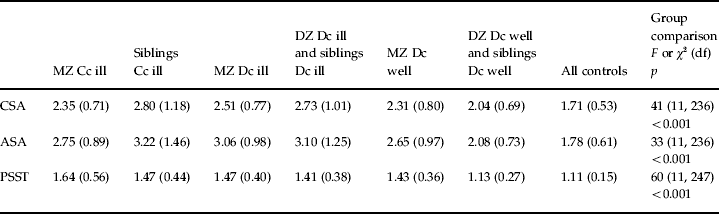
The groups differed significantly in age, gender, years in full-time education and social class (Table 1). Summary statistics for the developmental and personality scores are shown in Table 2.
Demographics of twins and siblings

Cc, Concordant; Dc, discordant; MZ, monozygotic; DZ, dizygotic; s.d., standard deviation.
Summary statistics of means and standard deviations for twins and siblings

Cc, Concordant; Dc, discordant; MZ, monozygotic; DZ, dizygotic; CSA, childhood social adjustment; ASA, adolescent social adjustment; PSST, pre-morbid schizoid/schizotypal traits.
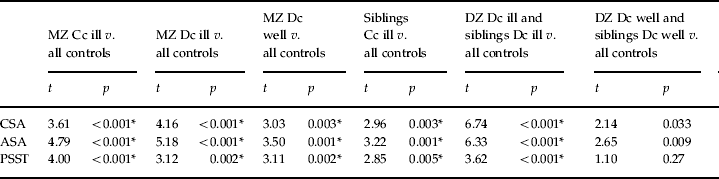
The subsequent group comparisons for the developmental and personality scores were adjusted for age and gender to control for potential confounding effects. There was an overall effect of group (Table 2) on both childhood and adolescent social development and pre-morbid schizoid/schizotypal ratings. The post-hoc group tests are shown in Table 3. There were no significant differences in the means between DZ twins and siblings for any of the developmental and personality variables. As DZ twin pairs and sibling pairs share the same genetic relationship, we felt justified in collapsing them into single groups on the basis of concordance and diagnostic status. Irrespective of zygosity or concordance, patients with schizophrenia were rated to have had more abnormal childhood and adolescent social development and more abnormal childhood personality than healthy controls. The well co-twins from MZ discordant pairs, those in which their co-twin had schizophrenia, were also more abnormal on all three developmental ratings compared to the healthy controls. By contrast, the well DZ co-twins and siblings from discordant pairs did not differ from controls for childhood social development and schizoid/schizotypal ratings and only approached significance for adolescent social development.
Post-hoc adjusted mean comparisons in twins and siblings

Cc, Concordant; Dc, discordant; MZ, monozygotic; DZ, dizygotic; CSA, childhood social adjustment; ASA, adolescent social adjustment; PSST, pre-morbid schizoid/schizotypal traits.
* Significant difference at p<0.0083 Bonferroni corrected.
Genetic model fitting
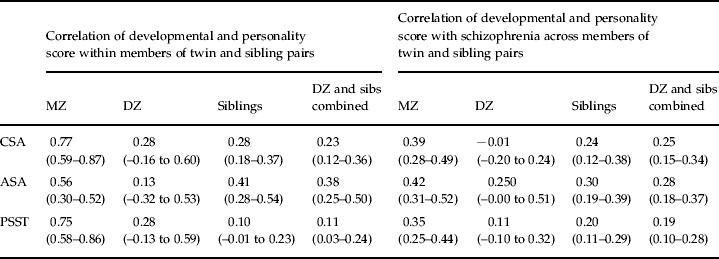
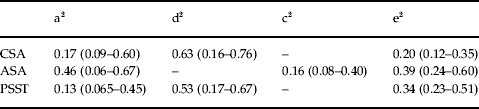
Table 4 shows the maximum likelihood polychoric correlations for the MZ and DZ twin pairs and siblings. A submodel of the constrained correlational model showed no significant difference in DZ twins and siblings for any of the variables [Δχ(df=2)=4.99, 1.83 and 1.75, p=0.08, 0.40 and 0.42 for CSA, ASA and PSST respectively]. For CSA and PSST the pattern of MZ and DZ/sibling correlations suggested non-additive genetic effects (consequently an ADE model was fitted), whereas for ASA an ACE model was indicated, both including twin-specific environmental effects (S). As these twin-specific effects were non-significant for all three variables [Δχ(df=1)=0.66, 0 and 3.8. p=0.41, 1 and 0.05 for CSA, ASA and PSST respectively], we evaluated the estimates of the full AD/CE models. Table 5 shows that significant additive genetic heritability (a 2) effects were found for all three variables. There was further evidence of dominant genetic (d2) effects for childhood social development and schizoid/schizotypal personality and shared environmental effects for adolescent social development. The remainder of the variance was explained by unique environmental influences (e2), including measurement error.
Cross-twin/sibling within trait and cross-twin/sibling cross-trait correlations (r and 95% CI)

MZ, Monozygotic; DZ, dizygotic; CSA, childhood social adjustment; ASA, adolescent social adjustment; PSST, pre-morbid schizoid/schizotypal traits.
The schizophrenia cross-twin correlation (SZtw1–SZtw2) is constrained to be 0.92 in MZ twins and 0.515 in DZ twins based on the point estimates of meta-analysis results, and the thresholds on the liabilities are fixed to a prevalence of 1%. Intervals including zero indicate non-significance.
Additive genetic, dominant genetic, shared and specific environmental estimates (with 95% CI) of the AD/CE genetic model for CSA, ASA and PSST

CI, confidence interval; CSA, childhood social adjustment; ASA, adolescent social adjustment; PSST, pre-morbid schizoid/schizotypal traits.
a2, d2, c2 and e2: broad heritability, dominant genetic, shared and non-shared environmental. CIs including zero indicate non-significance.
Parameters for schizophrenia are fixed based on a prevalence of 1% and the following genetic model: h2=0.81, c2=0.11, e2=0.08.
Table 6 shows that an increased liability for schizophrenia was associated with greater abnormalities in each of the developmental variables (r ph). All three abnormal developmental markers had significant additive genetic correlations with schizophrenia (r a), whereas specific environmental correlations (r e) and the shared environmental correlation in ASA (r c) were not significant. Therefore, additive genetic factors were the main source of the phenotypic correlation between all three of the developmental variables and schizophrenia (r ph-a).
The phenotypic correlations between schizophrenia and the developmental and personality scores (rph), the decomposed sources of the correlations (rph-a, rph-c, rph-e) predicted by the AC/DE models and correlation estimates (with 95% CI)

CI, Confidence interval; CSA, childhood social adjustment; ASA, adolescent social adjustment; PSST, pre-morbid schizoid/schizotypal traits.
r ph, total phenotypic correlation; r ph-a, r ph-c and r ph-e, phenotypic correlation due to additive genetic, shared and unique environmental influences; r a, r c and r e, correlation between additive genetic, shared and specific environmental factors.
CIs including zero indicate non-significance. Fixed genetic model for schizophrenia used: h2=0.81, c2=0.11, e2=0.08.
Discussion
We have confirmed that both social development and personality traits are abnormal in children and adolescents who subsequently develop schizophrenia, whereas unaffected relatives demonstrate qualitatively similar abnormalities suggesting a familial effect. Our model-fitting analyses allowed us to extend this interpretation, supporting the notion that abnormal early social development and schizoid/schizotypal personality traits are related to schizophrenia through common genetic influences.
Pre-morbid social behaviour abnormalities are well replicated in schizophrenia (Done et al. Reference Done, Crow, Johnstone and Sacker1994; Malmberg et al. Reference Malmberg, Lewis, David and Allebeck1998; Cannon et al. Reference Cannon, Caspi, Moffitt, Harrington, Taylor, Murray and Poulton2002; Addington & Addington, Reference Addington and Addington2005), with little effect of gender (Olin & Mednick, Reference Olin and Mednick1996; Cannon et al. Reference Cannon, Jones, Gilvarry, Rifkin, McKenzie, Foerster and Murray1997; Addington & Addington, Reference Addington and Addington2005). They deteriorate from childhood through adolescence (Davidson et al. Reference Davidson, Reichenberg, Rabinowitz, Weiser, Kaplan and Mark1999; Tarbox & Pogue-Geile, Reference Tarbox and Pogue-Geile2008). The aetiology of these deficits has in the past been unclear, with both genetic and environmental origins proposed (Sobel, Reference Sobel1961; Ragins et al. Reference Ragins, Schachter, Elmer, Preisman, Bowes and Harway1975; Hans et al. Reference Hans, Auerbach, Asarnow, Styr and Marcus2000, Reference Hans, Auerbach, Auerbach and Marcus2005; Shim et al. Reference Shim, Kang, Chung, Yoo, Shin and Kwon2008). The core of these pre-schizophrenia social deficits centre on the quality of peer relationships (Lewine et al. Reference Lewine, Watt, Prentky and Fryer1980), especially with people of the opposite sex (Dworkin et al. Reference Dworkin, Lewis, Cornblatt and Erlenmeyerkimling1994; Malmberg et al. Reference Malmberg, Lewis, David and Allebeck1998), through social immaturity and peer rejection (Hans et al. Reference Hans, Auerbach, Asarnow, Styr and Marcus2000). The more extreme the difficulties in establishing and maintaining peer relationships, the greater the future risk for schizophrenia (Malmberg et al. Reference Malmberg, Lewis, David and Allebeck1998).
Social adjustment abnormalities in both childhood (a2=0.17) and adolescence (a2=0.46) were found to be heritable. The additive genetic correlations for childhood (r a=1.0) and adolescent (r a=0.55) social development with schizophrenia indicate that the same genetic effects contribute to variance in abnormal social development at both ages and to the liability for schizophrenia. For both childhood and adolescent social development much of this phenotypic correlation was attributable to shared additive genetic effects, and environmental effects were insignificant. Correlations do not prove causality and we were unable to determine whether the liability to schizophrenia impairs early social development or whether impaired early social development causes schizophrenia; nor if they are linked by another common pathophysiological process.
Broad heritability of schizotypal traits in twin studies range between 27% and 60%, depending on the measures used, with considerable confidence interval overlap (Kendler & Hewitt, Reference Kendler and Hewitt1992; Hay et al. Reference Hay, Martin, Foley, Treloar, Kirk and Heath2001; MacDonald et al. Reference MacDonald, Pogue-Geile, Debski and Manuck2001). Schizotypal personality traits are, phenomenologically at least, intricately linked to schizophrenia (Liddle, Reference Liddle1987; Bentall et al. Reference Bentall, Claridge and Slade1988; Liddle & Barnes, Reference Liddle and Barnes1990; Bergman et al. Reference Bergman, Silverman, Harvey, Smith and Siever2000), more prominent in men (Kremen et al. Reference Kremen, Faraone, Toomey, Seidman and Tsuang1998), linked with minor psychotic symptoms in childhood (Poulton et al. Reference Poulton, Caspi, Moffitt, Cannon, Murray and Harrington2000), and are associated with an increased future risk of schizophrenia (Vourdas et al. Reference Vourdas, Pipe, Corrigall and Frangou2003). They hypothetically lie on a population-based continuum of psychosis (van Os et al. Reference van Os, Verdoux, Maurice-Tison, Gay, Liraud, Salamon and Bourgeois1999); indeed, the modest phenotypic correlation with schizophrenia (r ph=0.33) in this study was perhaps surprising. Despite some inconsistencies, studies in relatives and twins (Baron et al. Reference Baron, Gruen, Rainer, Kane, Asnis and Lord1985; Grove et al. Reference Grove, Lebow, Clementz, Cerri, Medus and Iacono1991; Kendler et al. Reference Kendler, McGuire, Gruenberg, O'Hare, Spellman and Walsh1993; Maier et al. Reference Maier, Lichtermann, Minges and Heun1994; Battaglia et al. Reference Battaglia, Bernardeschi, Franchini, Bellodi and Smeraldi1995; Bergman et al. Reference Bergman, Silverman, Harvey, Smith and Siever2000) generally support familial aggregation with schizophrenia, particularly for the affective and interpersonal components (Kremen et al. Reference Kremen, Faraone, Toomey, Seidman and Tsuang1998). However, whether schizotypy is a unitary (Jang et al. Reference Jang, Woodward, Lang, Honer and Livesley2005) or, like schizophrenia, a multidimensional construct (Kendler et al. Reference Kendler, McGuire, Gruenberg and Walsh1995; Vollema & van den Bosch, Reference Vollema and van den Bosch1995; Suhr & Spitnagel, Reference Suhr and Spitnagel2001; Linney et al. Reference Linney, Murray, Peters, MacDonald, Rijsdijk and Sham2003), with attendant aetiologically heterogeneity, remains unclear.
Additive genetic effects accounted for 13% and dominant genetic effects for 53% of the variance in personality ratings, our results being broadly in line with studies that have found evidence of both additive and non-additive (dominant) genetic influences across a variety of personality domains (Keller et al. Reference Keller, Coventry, Heath and Martin2005; Rebollo & Boomsma, Reference Rebollo and Boomsma2006; Rettew et al. Reference Rettew, Rebollo-Mesa, Hudziak, Willemsen and Boomsma2008). Although the phenotypic correlation for schizoid/schizotypal personality with schizophrenia was only modest (0.33), this nonetheless represented a strong additive genetic correlation (r a) with schizophrenia of 0.99, emphasizing the genetically linked variance between these two ‘schizophrenia spectrum’ disorders, and the lack of any significant unique environmental effects linking the two.
The influence of unique environmental factors on the pre-morbid markers was also apparent in our sample, and contributed to developmental divergence. The majority of discordant MZ twin studies have reported that the future probands were distinguishable pre-morbidly from their genetically identical co-twins by their abnormal personality (Arieti, Reference Arieti1949; Kringlen, Reference Kringlen1967; Mosher et al. Reference Mosher, Pollin and Stabenau1971; Fischer, Reference Fischer1973), social development (Pollin et al. Reference Pollin, Stabenau, Mosher and Tupin1966), academic ability (Stabenau & Pollin, Reference Stabenau and Pollin1967) and subclinical non-psychotic symptoms (Stabenau & Pollin, Reference Stabenau and Pollin1967). Torrey et al. (Reference Torrey, Taylor, Bracha, Bowler, McNeil, Rawlings, Quinn, Bigelow, Rickler, Sjostrom, Higgins and Gottesman1994) have suggested that within ‘future’ MZ discordant twins, a small early developmentally divergent group can be recognized by the age of 5, whereas the majority remain on parallel developmental tracks until mid-adolescence and the time of clinical discordance. van Oel et al. (Reference van Oel, Sitskoorn, Cremer and Kahn2002) examined the age of developmental divergence in MZ and DZ twins discordant for schizophrenia and control twins. They reported that the future discordant twins diverged earlier than the control twins, and in the majority well before any clinical suggestion of the illness, with the discordant group segregating into subgroups on the basis of their age of divergence. By contrast, Reichenberg et al. (Reference Reichenberg, Rabinowitz, Weiser, Mark, Kaplan and Davidson2000) used data from two national registers but could not robustly determine zygosity or diagnoses; they reported pre-morbid behavioural deficits in both the patients and their non-psychotic co-twins, with no differences between the members of the future discordant pairs. Studies in unaffected first-degree relatives of patients with schizophrenia (Cannon-Spoor et al. Reference Cannon-Spoor, Potkin and Wyatt1982; Foerster et al. Reference Foerster, Lewis, Owen and Murray1991; MacDonald et al. Reference MacDonald, Pogue-Geile, Debski and Manuck2001) strongly suggest that similar, if less marked, early developmental deficits are present in the unaffected relatives, supporting a familial effect.
Our data suggest that genetically influenced abnormalities in social development and personality are linked to the genetic risk for schizophrenia, although unique environmental influences drive up to a third of the variance in the developmental and personality data in the twins and siblings, in their social abilities and personality and later in schizophrenia. Candidate environmental factors for schizophrenia include obstetric complications (McNeil et al. Reference McNeil, Cantorgraae, Torrey, Sjostrom, Bowler, Taylor, Rawlings and Higgins1994), childhood trauma (Morgan & Fisher, Reference Morgan and Fisher2007; McEwen, Reference McEwen2008), drug exposure (Arseneault et al. Reference Arseneault, Cannon, Poulton, Murray, Caspi and Moffitt2002; O'Daly et al. Reference O'Daly, Guillin, Tsapakis, Martinez, Shergill, Murray and Buckley2005), immigration status (Veiling et al. Reference Veiling, Susser, van Os, Mackenbach, Selten and Hoek2008) and social inequality (Boydell et al. Reference Boydell, van Os, McKenzie and Murray2004), each factor's influence varying with the developmental stage and with a possible cumulative effect (Cougnard et al. Reference Cougnard, Marcelis, Myin-Germeys, De Graaf, Vollebergh, Krabbendam, Lieb, Wittchen, Henquet, Spauwen and Van Os2007). Models suggesting how these processes operate, through affective (Myin-Germeys et al. Reference Myin-Germeys, Krabbendam, Delespaul and van Os2003), cognitive, stress sensitization (Collip et al. Reference Collip, Myin-Germeys and Van Os2008), dopamine sensitization (Laruelle, Reference Laruelle1998, Reference Laruelle2000; Featherstone et al. Reference Featherstone, Kapur and Fletcher2007) or hypothalamic–pituitary–adrenal axis dysfunction (Walker & Diforio, Reference Walker and Diforio1997; Tarbox & Pogue-Geile, Reference Tarbox and Pogue-Geile2008; Walker et al. Reference Walker, Mittal and Tessner2008), however, remain speculative.
Twin modelling is in part dependent on the validity of the equal environments assumption (Joseph, Reference Joseph1998), a finding called into question in our study by the low DZ correlations, although other explanations include sibling interaction and contrast effects and genetic dominance and epistasis (Loehlin, Reference Loehlin1986). It is likely that the environmental experiences of MZ twins are more similar than those of DZ twins and siblings. Parents report that their MZ twins are more alike than DZ twins (Jones, Reference Jones1955; Scarr, Reference Scarr1968), thus their environment perceives them as more similar. However, this distinction is maintained when parents are mistaken in their assessment of their own twins' zygosity, and is consistent with the twins' true zygosity. Subjective and objective ratings of social characteristics and experiences are more similar for MZ than DZ adolescent twins (Horwitz et al. Reference Horwitz, Videon, Schmitz and Davis2003). Nevertheless, although parents treat MZ twins more alike than DZ twins (Lytton, Reference Lytton1977; Kendler et al. Reference Kendler, Neale, Kessler, Heath and Eaves1994), this is limited to behaviour initiated by the twins rather than the parents, suggesting that the environmental response may be an expression of the twins' phenotype, so although MZ twins' social environment is more similar than DZs', this is driven by their shared genotype (Plomin & Bergeman, Reference Plomin and Bergeman1991).
Although the non-psychotic co-twins and siblings in this study were at high genetic risk, they were in fact at very low risk of ever developing schizophrenia, as all the non-psychotic co-twins from discordant pairs had remained free of schizophrenia for long enough after their co-twin had become ill (Belmaker et al. Reference Belmaker, Pollin, Wyatt and Cohen1974). Thus, we are confident that these findings are not driven by non-psychotic relatives, with an excess in the MZ twins, who will later develop schizophrenia. This study was hampered by its retrospective design, in particular that mothers were asked to recall aspects of their children's development and personality from years earlier and, in some cases, after one or more of the children had developed schizophrenia. The mothers' reports are subjective and prone to rater error and contrast bias. However, the mothers of the discordant twins and siblings did not seem to have elevated their ‘threshold’ for normality by having an ‘abnormal’ child who later developed schizophrenia, leading to under-reporting of abnormalities in the non-psychotic co-twins. In fact, we detected the opposite, with more abnormalities reported in the unaffected co-twins and siblings than controls. The subjects were not drawn from an epidemiological sample and, although this could introduce a selection bias and inflate the genetic estimates with schizophrenia, this effect was minimized as the subjects were referred nationally by NHS psychiatrists. The NHS is comprehensive, free at the point of delivery service, socially inclusive and cares for the majority of patients with schizophrenia in the UK, making it a highly representative recruitment source. Both our control sample and well co-twins and siblings from discordant pairs contained subjects with other lifetime axis I disorders. To maintain diagnostic consistency between all the non-schizophrenic subjects (discordant MZ and DZ/siblings and control MZ and DZ/siblings), we applied the same psychiatric exclusion criteria to all. Consequently, these groups contained subjects with lifetime histories of other Axis I disorders although none were symptomatic at the time of testing. We considered that to introduce additional exclusion criteria for the controls, specifically that of any Axis I pathology, would artificially inflate differences with the controls.
The strengths of this study include the fact that this sample represents the largest national examination of pre-morbid developmental traits in twins and siblings with schizophrenia, and it is the only study to include both MZ and DZ discordant pairs with known zygosity and clinically assessed. Genetic model fitting in a combined twin and family sample increased the power to detect genetic and environmental effects (Posthuma et al. Reference Posthuma, de Geus, Neale, Hulschoff Pol, Baare, Kahn and Boomsma2000; Boomsma et al. Reference Boomsma, Busjahn and Peltonen2002), rigorous structured assessment criteria were used and improved statistical methods capitalized on the strengths of the twin/sibling model avoiding issues of independence.
This study supports the view that genetically determined pre-morbid abnormalities of social adjustment and personality are found in schizophrenia. These deficits are detectable in those who will later develop schizophrenia and their non-psychotic relatives, reflecting shared genetic risk.
Acknowledgements
We acknowledge the financial support of the Wellcome Trust, Research Training Fellowship (064971) to M. M. P., the NARSAD Young Investigator Award to T. T., and the Stanley Medical Research Institute.
Declaration of Interest
None.