Antimicrobial stewardship programs (ASPs) are an essential part of reducing inappropriate antibiotic use. In inpatient hospital settings, monitoring of antimicrobial use by ASPs is most often performed using prospective-audit-with-feedback (PAF) stewardship, which consists of review of currently prescribed antimicrobial therapy by a clinician with ASP expertise. Feedback is then provided to the prescriber when opportunities exist for optimizing antimicrobial use. Reference Barlam, Cosgrove and Abbo1 Overall, the PAF stewardship approach has resulted in a significant decrease in inappropriate antibiotic use and overall prescribing and is a large component of the CDC Core Elements of Hospital Antibiotic Stewardship Programs. Reference Barlam, Cosgrove and Abbo1,2 Depending on the institution, the number and scope of antimicrobials monitored by an ASP varies. For instance, one ASP program may monitor only a select number of costly or broad-spectrum antibiotics, and another program may monitor all antimicrobials including antifungal and antivirals. Programs that monitor all antibiotics have demonstrated a larger impact on antibiotic utilization and appropriateness; however, factors including resource availability and antimicrobial utilization influence ASP structure. Reference Langford, Brown, Chan and Downing3,Reference Ohashi, Matsuoka and Shinoda4
ASP efforts continue to develop beyond PAF stewardship with the expansion of ASP services into the outpatient setting as well as the development of policies and procedures to curb inappropriate prescribing and meet regulatory requirements. 2,5,6 Resource allocation and increases in full-time equivalent (FTE) support have been directly associated with increasing the effectiveness of inpatient ASPs. Reference Doernberg, Abbo and Burdette7 In addition to increasing resources, ASPs must focus on methods to optimize efficiency and must determine feasibility when expanding program reach.
We report our experience with expansion of an existing targeted PAF stewardship program to include monitoring all systemic and inhaled antibiotics while focusing on improving program efficiency. The primary objective was to evaluate the efficiency of a novel, daily ASP PAF review process. The secondary objective was to assess the impact of program expansion on antibiotic utilization and ASP intervention type.
Methods
Study setting
Children’s Mercy Kansas City (CMKC) is a 367-bed free-standing, pediatric academic medical center that provides comprehensive primary and tertiary care for a 5-state, 100-county region. Cerner Millennium software (Cerner, Kansas City, MO) is used for the electronic health record (EHR) with computerized physician order entry (CPOE) prescribing.
Original program
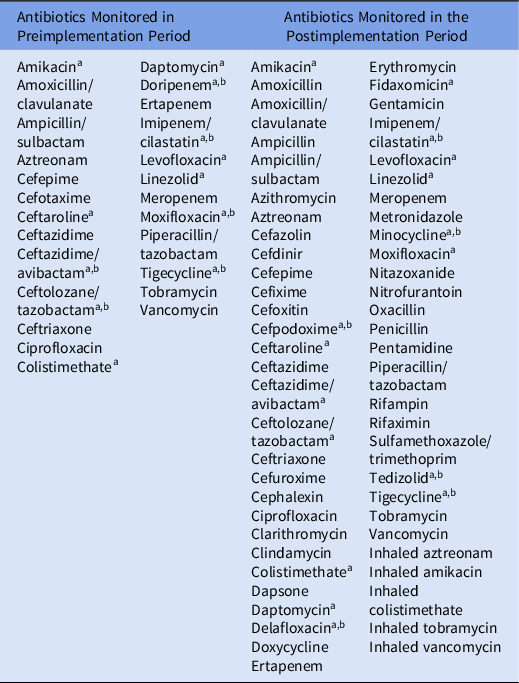
On March 3, 2008, a hospital-wide, PAF ASP was implemented with a primary focus of reducing inappropriate broad-spectrum antibiotic use in hospitalized children. Reference Newland, Stach and De Lurgio8 Overall, 25 select, broad-spectrum and/or costly antibiotics were routinely monitored by the program (Table 1). Narrow-spectrum antibiotics were not monitored unless a patient was concurrently receiving an ASP-monitored antibiotic. The ASP team, which consisted of 2 infectious disease (ID) clinical pharmacy specialists, an advanced practice provider, and ID physicians, performed a daily review of inpatients receiving an ASP-monitored antibiotic for 2 consecutive calendar days. The ASP team provided interventions to the primary medical team when indicated. Initial implementation of the program resulted in a significant decrease in antibiotic use as previously described. Reference Newland, Stach and De Lurgio8
Antibiotics Monitored by the Antimicrobial Stewardship Program in the Preimplementation Period and the Postimplementation Period

a Restricted to certain populations or requires approval from antimicrobial stewardship program or infectious diseases staff.
b Not on formulary.
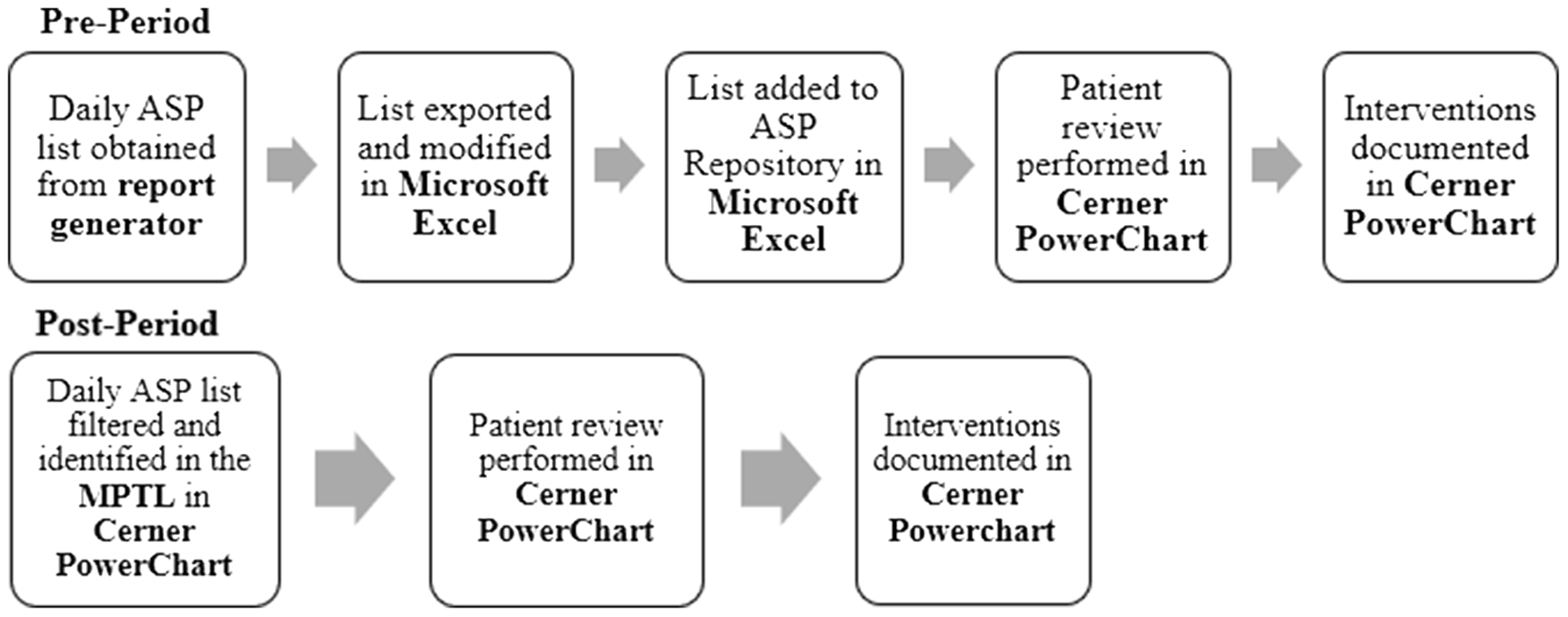
Prior to the study intervention, the ASP team utilized 3 separate programs to perform daily ASP PAF stewardship (Fig. 1). First, a report generator provided a daily ASP patient list that was filtered by date of antibiotic prescribing. Once completed, the ASP team member exported the report into Microsoft Excel (Microsoft, Redmond, WA) and reformatted the data prior to adding it to a pre-existing ASP repository database also within Microsoft Excel. The ASP repository contained patient and antibiotic information. Each patient was assigned a review number by the ASP team member in Excel, allowing for tracking of interventions and data analysis. Next, the ASP team member utilized Cerner PowerChart software to review the patient’s EHR. Interventions were documented in the patient’s EHR using a standard ASP form that tracked the following: all the antibiotics the patient was receiving, the indication, bacterial culture and antibiotic dosing assessment, the type of ASP intervention provided, and agreement and compliance with interventions.
ASP review process. Note. ASP, antimicrobial stewardship program; MPTL, Cerner Multi-Patient Task List.

Program expansion
In preparation for the program to expand monitoring to include all systemic and inhaled antibiotics, ASP met with members of medical informatics to identify opportunities to improve program efficiency. Goals were to streamline daily ASP review processes and modify the ASP documentation form to better capture intervention data. The team created a novel, daily review and documentation process utilizing the Cerner PowerChart Multi-Patient Task List (MPTL). Pharmacists primarily utilize the MPTL to identify tasks for resulted medication levels, planned teachings, and to document antibiotic 48-hour timeout reviews, as previously described. Reference Wirtz, Burns and Lee9 To our knowledge, this system has not previously been used to directly conduct ASP reviews. A new task was set to fire in the MPTL for each systemic and inhaled antibiotic ordered for >48 hours. Each antibiotic order generated its own task at the point of CPOE by DISCERN rule. The tasks were viewable to the ASP team members who could filter by date and remove tasks triggered from antibiotic orders recently discontinued to provide the daily ASP list (Supplementary Fig. 1 online). The patient chart could be readily accessed from the MPTL. Each task was linked to an ASP documentation form, and completion of the form automatically removed the task from the MPTL. Tasks were automatically removed for discharged patients. ASP pharmacists, APP, and ID physicians were still responsible for performing daily reviews and interventions as described previously following program expansion.
The ASP documentation form was updated to capture additional details related to ASP interventions, including method of communication for ASP interventions (Supplementary Fig. 2 online). The form included an area for documenting “nonantibiotic interventions”: recommending immunizations, diagnostic testing, penicillin allergy testing referral, further culture and/or susceptibility testing, and an additional subspecialty consultation, which were not previously recorded.
On July 23, 2020, ASP PAF stewardship expanded to include monitoring of all systemic and inhaled antibiotics prescribed for 2 calendar days in the inpatient setting. This amounted to 57 antibiotics which had order sentences built within the EHR, including formulary and nonformulary medications.
Study design and end points
The primary objective of evaluating the efficiency of our novel, daily ASP review process was assessed by comparing the average number of daily ASP reviews, absolute number of monthly interventions, intervention acceptance rate, and time required to conduct ASP reviews between the preimplementation period (January 1, 2019–June 30, 2020) and postimplementation period (August 1, 2020–January 31, 2022). To collect the time required to conduct ASP reviews, a single steward recorded time required beginning at list generation and ending at documentation for 1 week in each period.
To assess program impact on utilization and interventions, overall antibiotic days of therapy (DOT) per 1,000 patient days were compared between the preimplementation and postimplementation periods. Additionally, DOT per 1,000 patient days were compared between periods for ampicillin, clindamycin, and cefazolin, which are commonly prescribed antibiotics but were not routinely monitored by ASP prior to expansion. ASP intervention characteristics including frequency of intervention by type and antibiotic were collected for each period. The number of “nonantibiotic” interventions was quantified in the postimplementation period.
Statistical analysis
A 2-sample t test was utilized to compare the average number of ASP reviews between the preimplementation and postimplementation periods. The Pearson χ2 test was used to compare the frequency of interventions, average number of interventions per month, and intervention acceptance rate between periods. Unadjusted Poisson models were used to compare DOT rates per 1,000 patient days. All analyses were completed using R version 2.4.3 software (R Foundation for Statistical Computing, Vienna, Austria). Descriptive statistics were used to quantify intervention characteristics and “nonantibiotic interventions.” The institutional review board reviewed and approved this study.
Results
Assessment of program efficiency
During the study period, the ASP completed 4,108 and 6,704 reviews during the preimplementation and postimplementation periods, respectively (Fig. 2). The average number of daily ASP reviews significantly increased following program expansion from 9 (SD, 4) to 14 reviews (SD, 6) (P < .0001). The proportion of reviews requiring ASP interventions was similar between periods (14.8% vs 13.9%; P = .1968); however, the absolute number of ASP interventions provided each month significantly increased, with an average of 34 (SD, 34.5) and 52 (SD, 10) monthly interventions in the preimplementation and postimplementation periods, respectively (P ≤ .001). On average, 78.3% of interventions in the preimplementation period and 70.1% in the postimplementation period were accepted. The time required to conduct daily ASP reviews increased following program expansion: 1.03 vs 1.32 hours in the preimplementation and postimplementation periods, respectively.
ASP reviews and interventions in the preimplementation and postimplementation periods. Note. The black solid line indicates intervention rate; red vertical dashed line indicates date of program expansion.

Impact on antibiotic utilization and interventions
Overall antibiotic DOT per 1,000 patient days significantly decreased between the preimplementation and postimplementation periods (457.9 vs 427.9; P < .0001). When examining utilization of antibiotics not routinely monitored by ASP in the preimplementation period, a significant decrease in DOT per 1,000 patient days was observed for ampicillin (33.6 vs 29.3; P < .0001) and clindamycin (25.6 vs 15.6; P < .0001). Cefazolin DOT per 1,000 patient days significantly increased in the postimplementation period (38.5 vs 52.1; P < .0001).
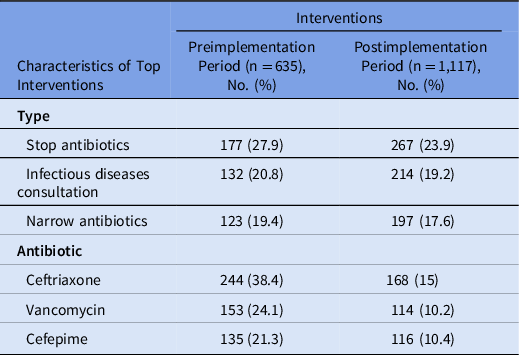
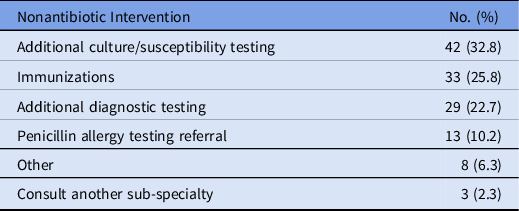
Interventions related to stopping antibiotics, recommending an ID consult, or narrowing antibiotics occurred most frequently both in the preimplementation and postimplementation periods (Table 2). The most common antibiotics associated with interventions in both periods included ceftriaxone, vancomycin, and cefepime. ASP documented 128 “nonantibiotic interventions” in the postimplementation period. Additional culture and/or susceptibility testing (32.8%), immunizations (25.8%), and additional diagnostic testing (22.7%) were the most common (Table 3).
Top Intervention Characteristics

“Non-antibiotic interventions” provided by ASP team

Discussion
We report the successful development of a novel, daily ASP review process using a preexisting MPTL to improve efficiency and expand program function during PAF stewardship. Our data reflect the importance of monitoring all systemic and inhaled antibiotics, narrow-spectrum agents. With the expansion of an existing program, it is important to consider opportunities to increase efficiency given competing priorities. Leveraging existing technology within the EHR is an effective way to efficiently expand ASPs.
ASPs are effective in reducing antibiotic utilization in free-standing pediatric hospitals. Reference Newland, Stach and De Lurgio8,Reference Hersh, De Lurgio and Thurm10 Specifically, evidence suggests that PAF stewardship, often coupled with a “handshake stewardship” approach, is effective in reducing inappropriate antibiotic prescribing. 2 There are limited data to determine whether monitoring all antibiotics versus a specific list of high-use or broad-spectrum antibiotics are comparative in outcomes. Shifting from performing a “low-intensity” approach for PAF stewardship including monitoring of only targeted antibiotic classes to a “high-intensity” approach including “handshake stewardship” and monitoring of all antimicrobials significantly reduced antimicrobial utilization at a community hospital. Reference Langford, Brown, Chan and Downing3 A recent point-prevalence study examining inpatient antibiotic prescribing in 32 pediatric institutions suggests opportunity for expanded monitoring of antibiotics by ASP. Within this study ∼25% of patients received suboptimal antibiotic therapy, and of the patients with suboptimal antibiotic therapy, ASPs would have reviewed only 46.1% with current program structure. Reference Tribble, Lee and Flett11 Recent data describe opportunities for optimization in antibiotic duration by ASP for community acquired pneumonia, acute otitis media, or surgical prophylaxis, all of which commonly utilize narrow-spectrum antibiotics. Reference MacBrayne, Williams, Poole, Pearce, Cotter and Parker12–Reference Lee, Tribble, Gerber, Hersh, Kronman and Newland14 Additionally, adverse drug reactions due to antibiotics occur commonly in hospitalized children, further highlighting the importance of judicious use of antibiotics. Reference Same, Hsu and Cosgrove15 Overall, the clearly defined benefits of PAF stewardship coupled with remaining opportunities for antibiotic optimization justified the expansion of our established ASP to include monitoring of all systemic and inhaled antibiotics.
With this expansion, we were able to ensure that all patients with an antibiotic ordered for 2 consecutive calendar days were reviewed by ASP. We significantly reduced overall antibiotic use within the hospital and identified increased opportunities for optimization, which was demonstrated by an increase in ASP interventions. Intervention acceptance rates were lower in the postimplementation period; however, the sheer volume of interventions increased significantly. It is possible that providers were more inclined to accept interventions for broad-spectrum antibiotics rather than narrow-spectrum antibiotics. Additionally with this expansion, ASP also began interacting more frequently with other medical services who utilize primarily narrow-spectrum antibiotics (eg, surgery) and were not as familiar with ASP processes.
Broad-spectrum antibiotics were associated with most interventions in both periods, indicating the importance of continuing to monitor these antibiotics; however, opportunities existed for interventions relating to narrow-spectrum antibiotics at our institution. For example, we observed an increase in cefazolin use and decrease in clindamycin use in the post implementation period. At our institution, infections due to methicillin-susceptible Staphylococcus aureus (MSSA) occur more frequently than infections due to methicillin-resistant S. aureus (MRSA). Cefazolin is a more narrow and appropriate choice for MSSA infections than clindamycin; therefore, the increase in cefazolin use and decrease in clindamycin use demonstrates optimization of antibiotics at our institution.
In addition to a need for increased monitoring through PAF stewardship, ASPs are being tasked with integrating multiple processes to meet regulatory requirements produced by the Centers for Disease Control and Prevention, Joint Commission and Centers for Medicare and Medicaid Services. 2,5,6 Additionally, ASPs are heavily involved in development of policies and procedures related to antibiotics, tracking and reporting of antibiotic utilization data, implementation of therapies for COVID-19, as well as many other nonclinical tasks. Despite limited resources, many programs are also expanding ASPs to the outpatient setting. Reference El Feghaly, Monsees and Burns16 Physician and pharmacist support for ASP overall has increased, but the majority of ASPs still report lack of time as a barrier to implementation of a successful ASP. Reference Doernberg, Abbo and Burdette7 Our ASP consists of a large multidisciplinary team with organized efforts for project sharing and time management, yet team members still report challenges due to time constraints and competing priorities. Reference Wirtz, Monsees and Gibbs17 Improving efficiency and addressing challenges with our current PAF stewardship program was vital with program expansion.
Leverage of the EHR is a useful strategy to improve efficiency within ASPs. A recent survey of ASP leadership at 4 institutions reported that interventions including software alerts for positive blood cultures or ineffective therapy and improved access to antibiotic prescribing resources in the EHR were beneficial strategies to augment ASPs. Reference Kapadia, Abramson and Carter18 As previously described, our institution implemented EHR-driven mandatory indications and/or durations and a pharmacist-driven 48-hour timeout that resulted in a significant decrease in antibiotic use. Reference Wirtz, Burns and Lee9 A common barrier faced by institutions is lack of integration of the EHR and ASP software, which was experienced by our ASP. Reference Kapadia, Abramson and Carter18 To perform daily PAF stewardship prior to expansion, we utilized 3 separate programs. The MPTL was a pre-existing tool within the EHR effectively utilized by pharmacists to perform daily tasks, and its structure was similar to the tool needed for daily PAF stewardship. Integration of the MPTL allowed use of only 1 program to perform PAF stewardship, which greatly improved program efficiency.
Finally, it was important for our ASP group to fully track of all ASP interventions by integrating a “nonantibiotic” intervention section into our ASP documentation. Although these interventions were likely occurring prior to program expansion, we were able to identify 128 interventions in the postimplementation period within this category, which enhanced documentation of our ASP’s impact on patient care. The literature identifies opportunities for positive collaboration between ASPs and microbiology. Incorporation of an ASP pharmacist into daily microbiology rounds resulted in ∼4.5 interventions per day, which included requesting additional susceptibilities or microbiological tests and often avoided delays in time to optimal therapy. Reference MacVane, Hurst and Steed19 Approximately one-fourth of the “nonantibiotic” interventions involved additional culture and/or susceptibility tests from the microbiology laboratory. Our ASP has a partnership with the microbiology laboratory and tracking microbiology-related “nonantibiotic” interventions may serve to quantify collaborative efforts. The “nonantibiotic” interventions can also inform future program efforts, such as increasing penicillin allergy testing referrals and improving immunization efforts in high-risk patients (eg, asplenia).
This study had several limitations. The preimplementation period and the postimplementation period included different seasons, which may have affected the patient census, antibiotic use, and number of ASP reviews. Additionally, the number of ASP reviews in the postimplementation period may have been reduced due to a low patient census during this portion of the COVID-19 pandemic, which may have caused us to underestimate the impact of program expansion. Reduction of antibiotic utilization may have occurred due to additional efforts being conducted in the hospital (eg, order sentence modification, etc). Multiple team members conduct daily PAF stewardship, but time to conduct daily ASP reviews was only measured by the steward who conducted reviews most frequently during a limited period. Finally, in the postimplementation period, the number of “nonantibiotic” interventions may have been less than the true frequency because stewards became accustomed to tracking these interventions throughout the postimplementation period.
We report the implementation of a novel, daily ASP PAF review process aimed at improving efficiency with expansion to include monitoring of all systemic and inhaled antibiotics. The number of daily antibiotic reviews and interventions increased with program expansion, but the time required to conduct daily PAF stewardship did not significantly increase. Antibiotic utilization decreased, and our ASP was able to enhance documentation of interventions (ie, “nonantibiotic” interventions) to fully track the impact of the program.
Supplementary material
To view supplementary material for this article, please visit https://doi.org/10.1017/ice.2022.197
Acknowledgments
Financial support
No financial support was provided relevant to this article.
Conflicts of interest
All authors report no conflicts of interest related to this article.