1. INTRODUCTION
The continued and often escalating violence and conflicts that are religious-based pose immediate questions to scholars of political economy on the role of religion and related issues, including how religious freedom and state regulations on religion affect social, political, and economic development (Grier Reference Grier1997; McCleary Reference McCleary2008; Toft, Philpott, and Shah Reference Toft, Philpott and Shah2011; Saiya Reference Saiya2015). While the role of religion on economic development has been studied as early as 1905 by Max Weber, and a rich literature over the next century is full of controversial and opposing views (Barro and McCleary Reference Barro and McCleary2003; Gill Reference Gill2013), the role of religious freedom on economic development is rarely examined. In the few studies that discuss the topic, the views on religious freedom are overwhelmingly positive (Alon and Chase Reference Alon and Chase2005; Dolansky and Alon Reference Dolansky and Alon2008; Gill Reference Gill2013; Wang and Lin Reference Wang and Lin2014). Any phrase that includes the word “freedom” tends to convey a positive meaning, whether it refers to political, economic, or religious freedom. The term “religious freedom,” commonly defined as the freedom to believe, practice, and act in accordance with one's faith, is regarded as a desirable goal for all societies and a positive force in social development. For example, Stepan (Reference Stepan2000) argues for the reciprocal needs of religious freedom and democracy, which he calls the “twin tolerations.” As such, freedom of religion requires political freedom, which in turn requires freedom of religion in order for vibrant, multi-voice democracies to thrive.
A common and yet paradoxical phenomenon that motivated us to examine the role of religious freedom on economic development is that when scholars and policy makers advocate religious freedom, few mention the need for government restrictions on certain religious activities that may have negative consequences. For example, potential clashes among people of different faiths may result in violence, human dislocations, and negative economic impacts. In this study, we examine how different dimensions of religious freedom and/or their lack affect economic performance across countries. We take the institutional perspective (North Reference North1990) and decompose religious freedom into informal (soft) institutional constraints such as culture (attitude toward religion) and formal (hard) institutional constraints such as state policies and laws regulating religion. We then examine how these constraints affect economic growth and argue that certain state limitations on religious freedom are necessary and conducive to economic growth. We use newly available data on religious freedom and interference with religious activities from 2007 to 2013 for 198 countries to test our theoretical framework and obtain robust and consistent results supporting our hypotheses. Our results show that the normative stance on religious freedom and government interference on religion should be reevaluated.
2. REVIEWING THE EFFECTS OF RELIGIOUS FREEDOM ON THE ECONOMY
Despite a long history that dates back to Weber's seminal work, contemporary economic theory has largely ignored the role of religion and religious freedom, with a few notable exceptions (Barro Reference Barro1996; Barro and McCleary Reference Barro and McCleary2003; Alon and Chase Reference Alon and Chase2005). Given the paucity of research linking religious freedom to economic growth, the Berkley Center for Religion, Peace and World Affairs of Georgetown University, established a research team to advance the field.
The scarce research already done on the economic impact of religious freedom shows strong positive support of religious freedom on economic growth (Grim, Clark, and Snyder Reference Grim, Clark and Snyder2014). Alon and Chase examine the possible relationships that exist among economic, political and religious freedom, and individual prosperity, measured by purchasing power parity per capita gross domestic product (GDP) (Alon and Chase Reference Alon and Chase2005). They find that religious freedom positively contributes to prosperity above and beyond its contribution to political and economic freedom in a large cross-section of countries. These findings prompt the question: why and how does religious freedom affect economic prosperity?
Several researchers have suggested linking religious freedom to economic growth (Shah Reference Shah2013; Gill Reference Gill2013). A major argument from the institutional perspective says that religious freedom correlates closely with civic, political, and economic freedom, making it an integral building block of what we consider a liberal democracy (Alon and Chase Reference Alon and Chase2005; Grim Reference Grim2008; Grim and Finke Reference Grim and Finke2010; Gill Reference Gill2013). Gill (Reference Gill2013) suggests the contingent liberty model where religious freedom does not exist in a vacuum. Civil, economic, and religious freedoms are bundled together to form a modern liberal economy with private property rights, the rule of law, and high-functioning markets.
Another institutional argument suggests that countries invest in other countries with similar institutional environments because investors like to minimize the institutional distances (Ghemawat Reference Ghemawat2007). Dolanski and Alon (Reference Dolansky and Alon2008) show how religious freedom and religious diversity affect foreign direct investment. The authors find that American investors are more sensitive to religious freedom violations. Through gravity models, economists have been able to show that countries that are institutionally similar are more likely to trade with and invest in one another (Li and Samsell Reference Li and Samsell2009). Religion is an important element of the cultural and institutional environment (North Reference North1989). Hergueux (Reference Hergueux2011) suggests that religious institutions advance interpersonal trust and lower free-riding. He empirically shows that bilateral religious similarities and difference promote bilateral country pair investment. Religious similarity may work as an efficient substitute for the quality of formal institutions in developing countries where the quality of these institutions is not sufficiently high, thus promoting foreign direct investment. Religious diversity, in comparison, fosters Foreign Direct Investment in countries where the quality of formal institutions is good enough. Guiso, Sapienza, and Zingales (Reference Guiso, Sapienza and Zingales2003) empirically show that religious proximity strengthens trade between country pairs. Both Hergueux (Reference Hergueux2011) and Guiso, Sapienza, and Zingales (Reference Guiso, Sapienza and Zingales2003) suggest that the level of formal institutions moderates the impact of religious similarities.
The United States (US) is a major advocate for religious freedom through trade and investment. The Congress passed the International Religious Freedom Act in 1998 to promote religious freedom in US foreign policy. The act, which invokes international and constitutional law as a justification, allows the US to apply sanctions on countries that engage in religious persecution. Religious freedom promotes religious diversity, because competition among religious associations increases the market for religious services (Gill Reference Gill2013). The marketization of religion means that more segments of a society are provided with a larger set of options to express their religious consciousness. Diversity fosters creativity, innovation, entrepreneurship, and, in turn, economic development. Societies that welcome people of diverse backgrounds tend to attract more talent. Religious groups entering the workforce can bring their professional backgrounds and preferred occupations to the performance at national level. Hergueux (Reference Hergueux2011) warns, however, that while religious diversity promotes open-mindedness, innovation, and risk taking, in countries with weak institutions it can lead to community tension and conflict.
Examples of the lack of religious freedom hurting economic development abound. More than 400 years ago, when the Puritans left England due to religious persecution, they took with them gifts, arts, and products of the Commonwealth to the detriment of the Commonwealth and to the benefit of the new colony, according to Henry Robinson, a prominent writer on religious tolerance of the time noted in his well-known work, Liberty of Conscience. Robinson equates religious freedom with private property or private enterprises. In this way, spiritual capital is as important an institutional predictor of economic wealth as financial, natural, and human capital. He concludes that economic ruin will come to those nations that seize property or exile citizens due to their religious beliefs, proclaiming: let history be a lesson and let us choose freedom and toleration in all areas of social life, including liberty of consciousness, so that the “invisible hand” and prosperity can co-exist (Robinson Reference Robinson1643).
The former Soviet Union provides another case in which a country experienced a brain drain as a result of hostility toward religious minorities. There was a quota on the number of Jews allowed to enter elite universities and government organizations, and religious minorities suffered repression. Although not an official policy, discrimination against Jews was socially acceptable and made them feel unwelcome and not fully integrated into the society. As a result, when the Soviet Union changed its emigration policies under Mikhail Gorbachev, more than 500,000 of educated Jews fled to Western Europe, America, and Israel (Schodolski Reference Schodolski1991). This massive emigration represented a brain drain for the Soviet Union and a brain gain for the receiving countries. The success story of Israel's “start-up nation” was partly due to the influx of educated immigrants with technical and engineering degrees from the Soviet Union (Senor and Singer Reference Senor and Singer2011). In short, existing research seems to concur that religious freedom promotes economic activity, both directly through institutions and indirectly through religious diversity and religiosity. A lack of religious freedom can reduce the entrepreneurial and economic activities that result from the traits nurtured by religious beliefs (Alon and Spitzer Reference Alon and Spitzer2003; Barro and McCleary, Reference Barro and McCleary2003).
Despite the optimism regarding the positive impact of religious freedom on economic growth and the positive connotations of “freedom” in public policy, the real impact of religious freedom is more nuanced. The main weakness of existing studies on religious freedom and economic growth lies in their failure to recognize that religious freedom has various dimensions and that an absence of government regulation of religious freedom may have a detrimental effect on economic activities.
3. RELIGIOUS FREEDOM: A DOUBLE-EDGED SWORD ON ECONOMIC GROWTH
Unlike existing studies on religious freedom and economic development, we propose that religious freedom exerts both positive and negative effects on economic growth. Before delving into our argument, we take a closer look at religious freedom, which most scholars define as the right to believe in and practice one's religion. Shah and Gill (Reference Shah and Gill2013) define religious freedom as “the freedom to engage in public life (as well as private life) on the basis of one's religious convictions and identity.” The authors go on to further define religious freedom in terms of cost and efficiency: “Any increase in the cost of believing, practicing, and acting on one's faith decreases religious freedom. Conversely, anything that decreases those costs increases religious freedom.” Religious freedom facilitates religious activities and enhances the efficiency of practicing and disseminating religion. This definition implies that religious freedom should be free of interference, which may increase the cost of practicing and disseminating religion and thus hinder religious freedom. What this definition misses is the flip side of religious freedom. The International Covenant on Civil and Political Rights of the United Nations states: “No one shall be subject to coercion which would impair his freedom to have or to adopt a religion or belief of his choice” (United Nations Human Rights 1966). Like any freedom, religious freedom, if unchecked, may encroach upon the religious freedom of others. When this occurs, without the intervention of a third party such as the government, clashes may turn violent and harm the economy. The implication here is that government regulations on religion, commonly viewed as restrictions on religious freedom, may be necessary for social (or religious) order and economic efficiency.
To gain further theoretical insights, we use the lens of institutional theory to examine the effects of religious freedoms on economic growth (North Reference North1989; Reference North1990). According to Douglass North, institutions can be divided into formal (hard) and informal (soft) governing mechanisms (constraints). Religious freedoms, for example, can be divided into formal government regulations and informal mechanisms, such as social attitudes toward religious minorities. This distinction is important with respect to religious freedom because the formal mechanisms (government policies and laws) can be shaped by informal institutions, such as culture and social acceptance, and vice versa. Furthermore, the two mechanisms may clash, causing social frictions and violence detrimental to economic growth. This implies an interaction between the formal and informal elements of religious freedom, and between religious freedom and religion. Henne (Reference Henne2013), for example, argues that non-democratic states support the ban on the defamation of religion in order to protect the integrity of religious communities and minimize inter-religious conflict and also to gain support from religious groups, lessen religious opposition and legitimize the regime.
Fortunately, a relatively new and comprehensive quantitative dataset on religious freedom and religion developed by the Pew Research Center (2016) allows direct testing of both the formal and informal institutions of religious freedom. Based on annual International Religious Freedom Reports of the US government, Grim and Finke (Reference Grim and Finke2006) describe the data collection, coding and classification in great detail and show these data to be reliable and valid, and a major improvement on previously available measures. Included in the data are government regulations, government favoritism, and social regulation of religion. We need to point out that the Pew data on religious freedom include the lack of religious freedom, or interference in religion because most freedoms can only be measured by the degree to which they are restricted. The first variable is an index of “social hostilities involving religion” (SHI). “Social regulation moves past the formal regulations to measure institutional and cultural restraints that go beyond the restrictions of government agencies” (Grim and Finke Reference Grim and Finke2006, 3). We use this variable to measure the informal, cultural aspects of interference on religion or religious freedom. The second variable is an index of “government restrictions on religion” (GRI), which measures governmental laws, policies, and regulations regarding religion and can be used to represent the formal dimension of interference in religion or religious freedom.
SHI, which measures people's negative attitudes and behavior toward the religions of others, is the opposite of religious tolerance, and an important dimension of religious freedom. While social regulation does not have the formal power of state regulations, it is nevertheless as powerful and can originate from the religions themselves (Grim and Finke Reference Grim and Finke2006). Strong social hostilities involving religion encourage religious and social segregation and fuel religious conflicts. They increase the costs of religious activities and decrease religious freedom. Costs incurred by segregation, hatred, and conflicts are also economic costs for a society. We argue that societies with strong social hostilities involving religion tend to have slower economic growth. Thus, religious social toleration is a precondition for economic stability and growth.
Hypothesis 1:
Social hostilities involving religion have a negative effect on economic growth. The greater the social hostilities involving religion, the lower the economic growth rate.
GRI (government restrictions on religion) measures the limitations imposed on or support for certain religious activities by governments in terms of laws, policies, and regulations. The role of GRI on economic growth is more complicated than that of SHI. As we showed earlier, prevalent view and existing studies on religious freedom tend to emphasize the right to practice and proselytize one's religion, and thus overlook the need to protect the rights of someone not to believe or not to be converted. Thus, government restrictions on religion tend to be viewed as exerting a negative force that reduces religious freedoms. However, in an environment where different religions compete for followers and social and economic resources, unregulated and unrestrained freedom by all religions may eventually lead to what Thomas Hobbes (Reference Hobbes1651), the author of The Leviathan feared a “war of all against all.” Huntington also warns of the potential for violent conflict along religious fault lines (Huntington Reference Huntington1993). In this sense, certain governmental restrictions on religious freedoms are justified as “necessary to protect public safety, order, health, or morals or the fundamental rights and freedoms of others” (United Nations Human Rights 1966).
Based on the above analysis, we can group government interference into two types: (1) those that provide equal legal protections to all believers, including the right not to believe, and (2) those that favor certain religion(s) over others, which are discriminatory. Type 1 implies that if a dominant religion uses its power to force non-believers to convert, the government must interfere to stop the action and protect the rights of the minorities. Such interference will reduce religious conflicts and preserve religious diversity in a free and peaceful society for religions. We label type 1 as necessary government limitations (GL) and believe that it exerts a positive effect on economic performance.
Hypothesis 2:
It is necessary for governments to limit religious freedom to safeguard economic activities. Countries with more impartial limitations on religious freedom (equally applied to all) tend to outperform countries without such limitations in terms of economic growth.
Type 2 government interference or government discrimination (GD) reduces religious diversity and distorts the marketplace for religions. Grim and Finke (Reference Grim and Finke2006) suggest that this type of government favoritism underlines the relationship between church and state through providing subsidies and privileges to selected religions. Such policies will not only reduce competition but also deprive the discriminated minority religions and non-believers of social resources and thus hurt economic performance.
Hypothesis 3:
Government discrimination against certain religions is detrimental to economic growth. Countries with discriminatory religious policies tend to underperform countries without such policies in terms of economic growth.
Government limitations aimed at protecting all religions may help to reduce social hostilities involving religion. Thus we posit:
Hypothesis 4:
Government limitations on religious freedom interact with social hostilities involving religion and reduce the negative effect of social hostilities on economic growth.
We briefly alluded to the idea that there may be interactions between different dimensions of religious freedom and religious diversity in affecting economic performance. To further elaborate, we focus on the effect of state policy on religious freedom, especially those policies on the concentration or fragmentation of religious population in a country. If the state protects the equal rights of all religious groups and protects religious minorities from being forced to convert to the dominant religion (a GL policy), then such policies will preserve religious diversity in a society. Government limitations tend to exist with a religiously diverse society and are conducive to economic growth.
Hypotheses 5:
There is an interactive relationship between necessary government limitations on religious freedom and religious diversity which positively affects economic growth.
Conversely, a discriminatory government policy toward religion (GD) usually favors the dominant religion (or the official state religion), which may encourage the dominant religion to impose its religion on others. Logically, in countries with strong GD policies, a dominant religion usually exists, and the combination is not conducive to economic performance.
Hypotheses 6:
There is an interactive relationship between discriminatory religious policy and a dominant religion and the interaction negatively affects economic growth.
4. METHODOLOGY
4.1. Data
We collected data on 198 countries over seven years from 2007 to 2013. The dependent variables tested are Gross Domestic Product Growth Rate (GD_growth) and Per Capita Gross Domestic Product Growth Rate (GDP_PC_growth). We used market prices based on a constant local currency and took the five-year average for each of the variables, starting from two years before to two years after the relevant year. These two variables are derived from the World Development Indicators (World Bank 2013).
The main independent variables of interests, Social Hostilities Involving Religion Index (SHI), Government Restrictions on Religion Index (GRI), and its individual items were collected from the Rising Tide of Restrictions on Religion Survey (Pew Research Center 2016). We took the values from 2007 to 2013, the most recent available data. Social Hostilities Involving Religion Index (SHI) is between 0 (the fewest social hostilities) and 10 (the most social hostilities). Government Restrictions on Religion Index (GRI) also ranged from 0 (fewest government restrictions) to 10 (most government restrictions). More detailed descriptions on SHI and GRI follow.
We controlled for the following variables in our multiple regression analysis: religious makeup of each country, income level, economic freedom as a measure of the quality of economic institutions, and education level as an indicator of human capital.
The individual religious makeup of each country (Christian%, Muslim%, Buddhist%, Hindu% etc.), and Religious Diversity Index (RDI) were taken from the Global Religious Diversity Research (Pew Research Center 2014), which examines the percentage of the population that belonged to eight major religions in year 2010, including Christian, Muslim, Buddhism, Hindu, unaffiliated, folk religion, Judaism, and other religions. The RDI is calculated from the percentages of eight religious groups, ranging from 0 (least diversified) to 10 (most diversified). In this study, we created several variables to better measure the influence of a single dominant religion (Christian50, Muslim50, Buddhism50, Hindu50, etc.) and overall religious dominance (Dominant). A single dominant religion is a dummy variable. If 50% or more of the population of a country believes in a single religion, then the value of the dummy is 1, otherwise 0. For example, Christian50 equals 1 if the population of a country is over 50% Christian. Given this definition, we are able to test the impact of the dominance of a single religion for all major religions. Several countries were excluded from the sample because they had no single religion higher than 50%. Only one country has Jewish50 at 1, which is Israel. Only in Macau does FolkReligion50 equal 1. Thus, Dominant is a dummy variable, equal to 1 if Christian50 = 1 or Muslim50 = 1 or Hindu50 = 1 or Buddhist50 = 1 or Jewish50 = 1, and 0 otherwise. All individual religion makeup variables, RDI and all derived dominant-religion variables are treated as invariant from 2007 to 2013 as they should change little over this time period.
The income level (GNI_PC_PPP) is computed as the average gross national income (GNI) per capita based on purchasing power parity (PPP) (unit: thousand dollars). This variable was collected from the World Development Indicator database. We used a five-year average of the variable to control for single year spikes in growth due to exogenous variables. For the level of education, we use the Education Index from International Human Development Reports developed by the United Nations. It is a normalized value ranging from 0 (least educated) to 1 (most educated). The Economic Freedom Index, published by The Wall Street Journal and The Heritage Foundation, uses a scale of 0 (least free) to 100 (most free). Accordingly, both the education index and economic freedom index were collected from 2007 to 2013. More detailed variable definitions, sources and descriptions are listed in Appendix 1.
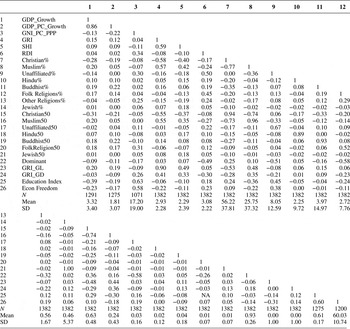
The basic data statistics such as means, standard deviation, and correlations among the variables are listed in Table 1. Some of the correlations are high, such as 0.96 between Muslim% and Muslim50, 0.94 between Christian% and Christian50, 0.93 between Buddhist% and Buddhist50, 0.89 between Hindu% and Hindu50. In addition, GRI and GRI_GL (one of the factors that emerged from factor analysis of GRI, see session 5.1 for more details) are closely related (0.9). Also, the two measure of economic growth, GDP_Growth and GDP_PC_Growth are highly associated (0.86). But all of these closely correlated variables will not show up in the same regression, so there is no concern about multi-collinearity. We ran variance inflation factor (VIF) tests for each regression model. For every model, all VIFs remained under the suggested value of 2.0, indicating no issues with multi-collinearity.
Data description and correlations

Correlations ≥ 0.08 are significant at the 0.01 level (2-tailed); Correlations ≥0.06 are significant at the 0.05 level.
4.2. Statistical Modeling
The time period for data collection, 2007–2013, covers the global economic recession, which makes the economic growth data bumpy. In order to smooth the economic growth data to obtain more stable results, we use a five-year moving average of annual GDP data to calculate the growth rate (e.g., Shin, Kim, and Park Reference Shin, Kim and Park2016). As a result, we pool the data in our regression estimates, controlling six year dummies to check the fixed effect of years.
We estimate the following model:
 $$\eqalign{& \hbox{Economic Growth Rate} = \cr & \quad {\rm b}_{0} + {\rm b}_{1} \times {\rm SHI} + {\rm b}_{2} \times {\rm GRI + B}_{3} \times \left[ {\hbox{Control Variables}} \right] \cr & \quad \left( { + {\rm B}_{4} \times {\rm Interactions}} \right) + {\rm B}_{5} \times \left[ {\hbox{year dummies}} \right]{\rm.}} $$
5. RESULTS
5.1. Developing Factors Representing Government Restrictions on Religion (GRI)
GRI, an index based on 26 survey questions about the role of government in facilitating or constraining religion, is comprehensive and cover three aspects of government restrictions: (1) whether the constitution or governing laws specify “freedom of religion”; (2) whether any level of government imposes limitations on religious activities; (3) whether any level of government funds any religions or exhibits favoritism toward any religions.
To reduce the 26 questions to a manageable number, we decided to summarize them and group them quantitatively using factor analysis. Based on several runs and an examination of both the eigenvalues and the questions, we decided to limit the number of factors to two. The first factor has high loadings mostly concentrating on GRI-3 to GRI-19 (except GRI-7, GRI-13, and GRI-18). All these questions, except GRI-3, focused on whether any level of government imposes limitations on religious activities, which corresponds to the type 1 group we discussed earlier. We thus labeled this factor “government limitations” (GRI_GL). Two types of questions have high loadings on the second factor: (a), whether the constitution or basic laws clearly specify “freedom of religion” (GRI-1 to GRI-3), and (b) whether any level of government favors or funds certain religion(s) (GRI-20-1 to GRI20-5). The absence of “freedom of religion” in the constitution or in the basic laws (type [a] above) and government favoritism toward certain religions are both discriminatory governmental policies toward religion, or type 2 group in our earlier discussion. We thus called Factor 2 “government discrimination” (GRI_GD). (See Appendix 2 for the factor analysis of GRI).
5.2. The Effects of SHI and GRI (GRI_GL and GRI_GD)
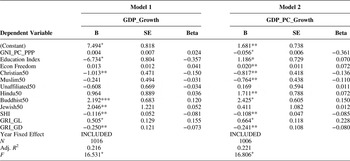
The effects of social hostilities involving religion (SHI) are measured by an index based on 13 survey questions on social hostilities involving religion, covering subjects ranging from crimes, malicious acts, and violence motivated by religious hatred or biases, frictions and tensions among religious groups, and religion-related wars or terrorist activities. All of these increase the costs of practicing religion for those religious groups adversely affected and thus should be viewed as reducing religious freedom. Throughout our analyses, it is clear that SHI is negatively correlated with economic growth. The negative effect of SHI is statistically significant in regression Model 1 (b = −0.116, p < 0.05) and Model 2 (b = −0.108, p < 0.05) in Table 2, supporting Hypothesis 1 (Please also refer to Online Appendix Tables A1, A2, A3, A4, A6, and A7). The lack of socially-based religious freedom breeds hatred and conflicts and hinders cooperative behavior among people. Social intolerance for other religions is also an economic liability that affects a country's consistent economic growth.
Regressions of religious freedom on economic growth

Note: *p < 0.1; **p < 0.05; ***p < 0.01; + p < 0.001 (all 1-tailed); B = Unstandardized Coefficients; Beta = Standardized Coefficients.
Using the two GRI factors provides insight into the role of government in promoting and restricting religious freedom and economic development. Factor 1, government limitations on religious freedom, exerts a positive effect on economic growth with a high level of statistical significance (see Table 2, b = 0.505, p < 0.001 in Model 1; b = 0.664, p < 0.001 in Model 2). Hypothesis 2 is strongly supported (Please refer to Online Appendix Tables A2, A3, A4, A6, and A7). Government guarantees of equal civil rights across all religious groups, including religious freedom, generally play a positive role in economic growth.
The regression also shows that Factor 2, government discrimination (GD) against certain religions, exerts a statistically significant negative effect on economic growth (see Table 2, b = −0.250, p < 0.05 in Model 1 and b = −0.241, p < 0.05 in Model 2). Hypothesis 3 is also supported (Please refer to Online Appendix Tables A2, A3, A4, A6, and A7). Government discrimination in religious policy increases the costs of practicing a discriminated religion and reduces the freedom for religious affiliation: the greater the GD, the lower the economic growth. Countries with a low GD protect freedom of religion either through the constitution or the basic laws and tend to have higher economic growth rates.
In sum, GL and GD have opposite effects in promoting economic growth. Reasonable government limitations on some religious activities may be necessary and conducive for economic growth. In the market of religions, some religious regulation is necessary, but it should come in the form of setting limitations that are equally applied to all religious activities, especially to those that encourage hatred and conflicts in the general society, while lowering discrimination among groups.
5.3. The Interaction Effects
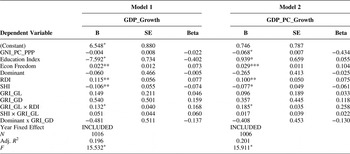
To examine the relationships among the independent variables postulated in Hypotheses 4 to 6, we ran regressions interacting the religious freedom variables with the religious diversity index (RDI), single dominant religion variables (Christain50, etc.), and overall religious dominance (Dominant). Table 3 shows the regression results.
Regressions of religious freedom on economic growth with interaction terms and religious diversity added

Note: *p < 0.1; **p < 0.05; ***p < 0.01; + p < 0.001 (all 1-tailed); B = Unstandardized Coefficients; Beta = Standardized Coefficients.
5.3.1. The Interaction between SHI and GRI_GL
Statistically, an interaction term of two variables is the product of the two variables. The coefficient estimate of the interaction term, along with the coefficients of the two variables, reveals whether they have a joint effect on the dependent variable that otherwise cannot be captured from the effects of the two variables independently. Our analyses show that the interaction between GRI_GL and SHI is positive, as we predicted in Hypothesis 4. However, the coefficient do not have a high significant level (see Table 3, b = 0.051, p > 0.1 in Model 1; b = 0.017, p > 0.1 in Model 2). Thus Hypothesis 4 is not supported.
5.3.2. The Interaction between GRI_GL and Religious Diversity (RD)
If a country has few religions, each with a large number of followers, it is low in religious diversity; conversely, if a country has many religions and each has a small number of followers, then religious beliefs are fragmented and highly diverse. We use the Religious Diversity Index (RDI) to measure the diversity of religions in a society. The value of the RDI ranges from close to zero (highly diversified) to 10 (no diversity with only one religion). Religious diversity is sometimes seen as an imperfect proxy of religious freedom (Grim and Finke Reference Grim and Finke2006).
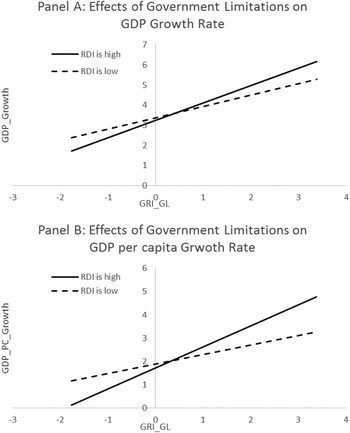
We found that a highly significant positive effect from the interaction term between religious diversity and government limitation on religious freedom on economic growth (b = 0.132, p < 0.001 in Model 1; b = 0.185, p < 0.001 in Model 2), strongly supporting Hypothesis 5 (please refer to Online Appendix Table A7). The result seems to suggest that when religious diversity is broad, government policies that provide equal protection of religious freedom will have a greater positive impact on economic growth. We estimate regression slope coefficients at high (greater than average) and low (lower than average) levels of religious diversity. When the economic growth rate is measured by the GDP growth rate, at a high level of religious diversity, the effect of government limitations on GDP growth rate (b = 0.867, p < 0.001) is larger than when the religious diversity is at a low level (b = 0.568, p < 0.001). Similarly, when the economic growth rate is changed to the GDP per capita growth rate, the slope for high level religious diversity (b = 0.907, p < 0.001) is still higher than the slope for a low level of religious diversity (b = 0.409, p < 0.001). Figure 1 displays these interaction effects.
The interaction effects of government limitations and religious diversity on economic growth rate.

We find that religious diversity in a country is positively associated with high economic growth (see Table 3, b = 0.115, p < 0.05 in Model 1; b = 0.100, p < 0.05 in Model 2; please refer to Online Appendix Tables A5 and A6). Religious diversity can be viewed as a proxy of religious pluralism and a relatively free religious market in a society. Its positive relationship with economic growth probably stems from the presence of more competition for ideas and beliefs, which in turn promote divergent thinking and a greater capacity for innovation. Religious and ethnic diversity as well as an attitude of openness for the cultural other are often cited as among the key drivers of creativity in the Silicon Valley region of California. According to the Silicon Valley Interreligious Council, the region contains 50 Buddhist centers, the largest Sikh Gurdwara in North America, Hindu centers, Zoroastrian temples, Baha'i cultural assemblies, and synagogues as well as churches. The percentage of non-Christians is about double the rate of the US average, at around 10%, and non-affiliated people constitute around 17% of the population (Silicon Valley Interreligious Council 2014).
5.3.3. The Interaction of GRI_GD and Dominant Religion
The interaction term between a discriminatory religious policy of the government and religious dominance is negative in the regression, as we conjectured in Hypothesis 6. However the term is not statistically significant and Hypothesis 6 is not supported (b = −0.481, p > 0.1 in Model 1; b = −0.408, p > 0.1 in Model 2). Nevertheless, we note that religious dominance exerts a negative effect on economic growth (see Table 2). In some countries, including Muslim-majority countries with strict Sharia law, alliances between the majority religion and the state can have a debilitating impact on the religious freedom of others (Finke and Martin Reference Finke and Martin2014).
Summarizing our analysis of the interaction terms involving religious diversity and religious dominance, we find that religious diversity is beneficial in terms of economic growth across countries while religious dominance curtails economic growth.
Which countries have the highest religious diversity? The answer may surprise many seasoned observers: according to the Pew Research Center, half of the most religiously diverse countries are in the Asia-Pacific region: Singapore, Taiwan, Vietnam, South Korea, China, and Hong Kong (Pew Research Center 2014). Perhaps religious diversity partially explains the Asian economic miracle following its economic liberalization.
6. CONCLUSIONS AND DISCUSSION
Religion, which is fundamental to human behavior and understanding of the world, is still under-researched, as is religious freedom, which is an etic value that crosses national borders. In this study, we have attempted to provide a more granular understanding of religious tolerance and the impact of regulation on economic growth. We presented an economic growth model that is partially based in religious freedoms, from both a social and government point of view. While we agree with the general proposition that religious freedom is beneficial for economic growth, our main contribution is to show, theoretically and empirically, that there are both positive and negative effects on economic growth relating to government restrictions on religious freedom. Government limitations on religious freedom that protect all religions equally are necessary and conducive for economic development, while government discrimination is debilitating. Social intolerance for the religious other is unequivocally negative for economic growth. These findings suggest that religious groups cannot act completely freely without regard to the welfare of religious others. A system to control religious extremism that endangers the general welfare of society is justified on economic grounds. Just as a free economy has to be regulated by anti-trust authorities to prevent misuse of market power, so should the marketplace of religions be regulated by government to ensure balanced, fair and peaceful economic development.
We show that government restrictions that interfere with religious freedom can be deconstructed into two factors: government limitations on religious freedom (GL) and government discrimination against certain religions (GD). The first factor, GL, helps economic growth, possibly through its mitigation of religious conflicts. From the economic growth perspective, it is necessary to have a well-regulated free religious market.
The second factor measures whether a government legally protects religious freedom and whether it treats all religions equally in terms of providing resources or imposing restrictions. This factor exerts a negative effect on economic growth: the lack of legal protection for religious freedom and discriminatory religious policies lead to low economic growth. Policies that strengthen freedom of religion and lower discrimination against religious minorities may, indeed, promote economic growth and should be pursued by governments that seek to sustain economic development and control social tensions.
Our study also lends support to the proposition that religious diversity helps to reduce the negative effects of religion-related social hatreds and conflicts, and to increase the positive effects of government religious limitations on economic growth. In general, religious diversity is a good thing not only socially, but also economically. Governments should formulate policies that encourage peaceful competition among various religions.
Overall, our statistical analyses paint the following picture of the optimal combination of religion- and religious freedom–related variables in a society to contribute to high economic performance: the constitution or the basic laws should explicitly protect freedom of religion and the government should treat all religions equally in terms of the distribution of resources. At the same time, the government should effectively regulate religious freedom impartially so that no one religion has unrestrained freedom to promote its faith and endanger the safety and freedom of other religions. As a result, a country should have a free market in which diverse religions compete peacefully under effective government regulation as well as a high level of religious tolerance (as opposed to social hostilities involving religion). Tolerance, including toward religion, is a cultural value with an economic advantage. The absence of social hostility toward religion is a valuable social (and economic) asset.
Although freedom is desirable, if it is unrestrained and unregulated, it can lead to economic, social, and political turmoil. This is true with respect to the economic market as well as the religious market. In the religious market, diversity and competition should be preserved along with fair rules of conduct that treat the various religions equally under the law.
7. LIMITATIONS AND FUTURE RESEARCH
This article highlighted the importance of the state in the formation of religious freedom and its impact on economic growth, which needs to be further verified by using different data sources to check for robustness. For example, recent measures developed by Fox (Reference Fox2011) that provides an opportunity to directly test the role of government policy in religious freedom on economic activity can serve this purpose.
While this paper introduces the idea that some regulation of religious freedom may be beneficial to society and the economy, a question remains on what the right level of regulation is and when is regulation too much or too little. For example, the use of headscarves and burkas in Islamic wear has sparked debates in Western countries and has tested the limits of liberalism (Helbling Reference Helbling2014). In Western Europe, while a minority of citizens has negative social attitudes towards Muslims, a large majority would advocate for a policy prohibiting headscarves in schools (Helbling Reference Helbling2014). The interplay between social and government restrictions on religious freedom in liberal societies is a particularly perplexing dilemma: how can democratic societies integrate and accommodate religious rules of subcultures whose values they may not share and what impacts will that have on political stability and economic efficiency?
Further studies should be conducted to identify the determinants of governmental and social hostilities involving religion and to distinguish which ones can be actively changed through societal efforts, such as social movements or public policies. Finke and Martin (Reference Finke and Martin2014) identify certain causes of religious freedom and have proposed that free elections, an independent judiciary, and constitutional religious freedoms advance religious freedoms, while alliances of state agents with religious groups, social and cultural pressures against select religions, and the state ideology as a competing ideology with religion restrict religious freedoms. Fox and Flores (Reference Fox and Flores2009) suggest, however, that constitutional clauses protecting religious freedom have a limited impact on government religious discrimination, and separation of religion and state clauses tends to lead to less religion-related legislation. Fox (Reference Fox2014) proposes that economic development is correlated with increased religious discrimination. Future research should build on these studies and our research to differentiate between the determinants of social hostilities and governmental discrimination, and government limitations, and their interactions, and link those to economic growth and prosperity using different methodological and data sources.
In sum, the increased evidence on the role of religion and religious freedom on economic activity suggests the need for additional research in this neglected area of economics. We hope that this research provides additional impetus for such development.
Supplementary materials and methods
To view supplementary material for this article, please visit https://doi.org/10.1017/S1755048317000098.
APPENDIX 1. DATA SOURCES AND VARIABLE DESCRIPTIONS

APPENDIX 2. FACTOR ANALYSIS OF GRI