As international elections monitors have grown active worldwide, their announcements have gained considerable influence.Footnote 1 Sometimes, however, their assessments are puzzling. For example, the Organization for Security and Cooperation in Europe (OSCE) and the United Nations (UN) accepted the outcome of Bosnia's 1996 election, although others called it fraudulent and accused the OSCE of spin.Footnote 2 Cambodia's 1998 election was fraught with problemsFootnote 3 but the Joint International Observer Group approved it even before counting was complete.Footnote 4 Furthermore, according to the Data on International Election Monitoring (DIEM), which codes information on nearly 600 observation missions to 385 elections,Footnote 5 observer assessments contradict each other in 22 percent of elections. Many scholars have also criticized international monitors for endorsing flawed elections and failing to condemn flagrant fraud such as in Kenya's 1997 election,Footnote 6 and Cambodia's 1993 UN-supervised postconflict election.Footnote 7
What factors influence election monitors' assessments and why do they sometimes endorse highly flawed elections? Scholars rightly note that the moral authority and influence of transnational actors rests partly on their veracity.Footnote 8 If their objective is to report on the quality of elections and if this is what gives them influence, why would monitors ever compromise? Doing so may harm the effectiveness of future election monitoring, legitimize undemocratic regimes, enable government manipulation,Footnote 9 and stifle viable opposition movements.Footnote 10 These unintended effects only compound the broader criticisms of the international community's narrow focus on elections.Footnote 11 Nonetheless, the factors influencing monitors' assessments have received little attention.
This study argues that election monitors sometimes endorse elections to protect the interests of their member states or donors or to accommodate other compelling but tangential organizational norms. At times, these other factors align with the monitors' core objective to assess the election quality; at other times, however, monitors face a dilemma between accommodating these factors and assessing the election honestly. Organizations may avoid some of these dilemmas by refusing to monitor certain elections.Footnote 12 Given their mission, however, monitors attend many problematic elections. Because of their various norms and politics, different organizations may assess these elections differently, and even the same organization may assess elections of similar quality differently depending on their contexts. This study of international election monitoring thus exemplifies that understanding the behavior of international organizations and transnational actors requires attention to their politics and preferences beyond their formal mandates.
The Politics and Norms of International Election Observers
Scholars have long argued that transnational actors are both normative and strategic.Footnote 13 Although some studies still treat transnational actors as neutral and trustworthy,Footnote 14 scholars have recently begun to study how the politics and preferences of international nongovernmental organizations (INGOs) and intergovernmental organizations (IGOs) influence their behavior.Footnote 15 Given the great variety of international organizations and the growing role of transnational actors in world politics, however, much remains unknown.
This study uses original data to examine the role of organizational interests and norms in monitors' assessments of elections. Because international election monitors help the international community to assess the legitimacy of governments, their politics and preferences are important to study in their own right. Furthermore, international election monitors are also interesting because the variety of both IGOs and INGOs that observe elections makes it possible to compare them across many countries and political contexts. This section first discusses monitors' core electoral norms. It then presents hypotheses about how organizational structures, preferences, and politics, as well as norms of democracy promotion and violence prevention, can sometimes lead monitors' assessments to deviate from their core electoral norms.
Upholding Electoral Norms
Monitoring organizations exist first and foremost to report on the quality of elections. Their core mission is to uphold a shared set of electoral norms enshrined in a vast collection of international laws and organizational documents.Footnote 16 Although organizations may differ on the finer details of restrictions on the media or unfair use of government resources, declarations signed by the major monitoring organizationsFootnote 17 suggest that they largely agree on the characteristics of acceptable elections and that they are aware of the “menu of manipulation.”Footnote 18 Even the legal documents of less-critical organizations, such as the Commonwealth of Independent States or the African Union, align with the norms of other observer groups. In their election reports, the organizations also discuss similar issues such as media use, electoral laws, voter registration, and the like. Most organizations thus describe their tasks and organize their findings around a core set of electoral norms.
Because monitoring organizations exist to uphold these electoral norms, the most basic expectation is that their assessments should reflect the level of election irregularities. Not reporting irregularities fully or truthfully demotes the very standards monitors seek to uphold and weakens their moral authority. Furthermore, organizations that are widely perceived as biased forfeit serious recognition.Footnote 19 Their election-monitoring activities may be jeopardized; indeed, their entire spectrum of democracy promotion activities and funding may suffer.Footnote 20 To avoid such a fate, monitors should be especially keen to report obvious types of fraud such as legal shortcomings, media restrictions, unfair use of state resources, campaigning bans, tabulation irregularities, ballot stuffing, and intimidation. Although administrative irregularities, such as problems in voter lists, are critical to legitimacy,Footnote 21 these are less publicized and monitors may perceive them as unintentional. Research and case studies of elections in Kenya, Russia, Cambodia, Bosnia Herzegovina, and elsewhere also suggest that monitors pay greater attention to the events on the polling day than to pre-election irregularities.Footnote 22 In sum, monitors' core mission of upholding electoral norms leads to the first set of hypotheses:
H1. Irregularities hypotheses:
(1) Monitors are less likely to endorse an election the greater the level of irregularities in general, and (2) they are especially unlikely to endorse very obvious forms of cheating.
Weighing Other Norms and Interests
Although monitors seek to base their reports on election irregularities, these irregularities alone do not account fully for their assessment; several tangential factors, such as organizational politics and norms, also influence the monitors' conclusions. Indeed, these factors may make monitors more likely to endorse elections despite the fact that most of them in and of themselves should not be expected to produce cleaner elections.
First, donors or member states may constrain election monitors. Research on International Monetary Fund (IMF) lending suggests that IGO member states sometimes prevent consistent application of standards.Footnote 23 Although some IGO staff have flexibility to implement their agendas,Footnote 24 most monitoring mission staff have little flexibility in drafting official assessments. Indeed, organizational documents and discussions with officials reveal that to ensure institutional approval, most IGOs have strict procedures for finalizing official statements. Both European Union (EU) and Organization of American States (OAS) observer missions, for example, have strict supervisory mechanisms for the drafting of statements.Footnote 25 Although INGOs must also worry about their sponsors' or donors' preferences, they face fewer constraints.Footnote 26 Many INGOs also have multiple and diverse stakeholders, which counters the dominance of donor preferences.Footnote 27 Furthermore, because INGOs do not speak directly for any governments or donors, they have greater freedom; certainly they do not face formal institutional procedures that allow governments to veto the wording of the election assessments.
Because international monitors seek to uphold electoral norms, the degree of constraint imposed by donors and member states should depend on the level of democracy in the member states or in the organization's environment. Less-democratic IGO members may constrain monitors to protect their regime from future criticisms or to prevent democratic transitions in their neighborhood. Indeed, after the OSCE's active role in the color revolutions in Georgia and Ukraine, Russia has sought institutional reforms to curtail the independence of OSCE observers.Footnote 28 Furthermore, by restricting OSCE operations within Russia, Russia's government has shown other countries how to circumvent their organizational obligation to invite OSCE monitors.Footnote 29 INGOs and nonprofit institutes may also be influenced by the level of democracy in the countries that host their headquarters. Because Western countries have played a strong leadership role in cultivating the norms of international election monitoring,Footnote 30 Western organizations, which conduct about 80 percent of all INGO monitoring missions, may be more vested in upholding electoral norms. In sum, this leads to the second set of hypotheses:
H2. Organizational hypotheses:
(1) IGOs are more likely than INGOs to endorse elections, but this tendency decreases for IGO's with more democratic member states. Furthermore, (2) INGOs are less likely to endorse elections when their national context is more democratic.
Donor states and member states may also impose other political constraints on monitors' assessments. Reflecting this reality, Human Rights Watch, for example, has accused established democracies of accepting flawed elections for political expediency.Footnote 31 If monitors are concerned about upsetting trade patterns or destabilizing large populous countries, they may also be less apt to criticize large countries or trading partners. Research also suggests that foreign aid recipient countries tend to be strategically and politically favored.Footnote 32 For example, United States aid recipients have fewer conditions on their IMF aid programs.Footnote 33 Case studies suggest that these findings also are true in election monitoring. The pressures on monitoring organizations stood out strongly in Cambodia's 1998 election, for example, when powerful countries and donors wanted to resume aid and normal relations. As noted above, IGOs were much less critical than Western INGOs, and the political pressures were apparent.Footnote 34 Therefore, the third set of hypotheses is:
H3. Political hypotheses:
Monitoring organizations are more likely to endorse elections in countries that are (1) significant global trading partners, (2) populous, or (3) receive foreign aid.
Both these and the organizational hypotheses thus suggest that monitors may have to temper their criticism of violations of election norms to protect the interests of their donors or member states.
Monitoring organizations may also limit their criticism to accommodate a broader set of compelling organizational norms. Specifically, although promoting democracy and upholding election standards are complementary norms and often go hand in hand, a conflict may arise when countries have progressed, but the election still falls short of absolute standards. Research on political conditionality, for example, shows that international organizations sometimes face a dilemma between rewarding relative progress and criticizing performances that are still inadequate based on an absolute standard.Footnote 35 Studies of elections in Russia, Kenya, Cambodia, and elsewhere in the 1990s suggest that international monitors may be similarly torn between praising progress—a step in the right direction toward democracy—and denouncing election flaws and possibly causing democratic gains to unravel. Thus, in spite of shortcomings, the OSCE prematurely hailed the 1999 elections in Russia as “the conclusion of a transitional period forged by President Boris Yeltsin since 1991.”Footnote 36 Monitoring organizations may thus be particularly inclined to temper their criticism of an election in countries where they fear disrupting their own long-standing programs and where they seek to build positive long-term momentum toward democracy. Subsequently, monitors may endorse an election if it showed progress, although they would have denounced an election of similar quality in a country that had not displayed progress or was expected to do better. The fourth set of hypotheses therefore is:
H4. Progress hypotheses:
Monitoring organizations are more likely to endorse (1) transitional or first multiparty elections or (2) elections showing improvement relative to the prior election.
Fear of violent instability may also temper monitors' criticism. Historically, concerns about stability have motivated monitoring effortsFootnote 37 and monitors have sometimes offered mediation or sought to minimize violence.Footnote 38 Occasionally, however, fear of violence has entirely paralyzed the truth.Footnote 39 This can happen if monitors worry that their statements may fuel conflict. In the most common fraud scenario,Footnote 40 when an incumbent wins through fraud or simply invalidates returns showing an opposition victory, monitors therefore want to know whether denouncing the official version of events will fuel opposition outrage and postelection conflict. Will the cheating incumbent—as in Zimbabwe's 2008 general election—be unwilling to leave office and resort to violence to squash opposition supporters? Or, if monitors endorse the flawed elections, will the opposition revolt against what it believes is a “rubber stamp” by election monitors?
The presence of pre-election violence may help monitors assess whether denouncing or endorsing the fraud is more likely to fuel postelection violence. Most commonly, as in the 2000 Zimbabwean election, or the 1992 and 1997 elections in Kenya,Footnote 41 the incumbent dominates the pre-election violence. Monitors may therefore infer that the incumbent is stronger than the opposition and that the risk of postelection conflict may increase if they denounce the incumbent, whereas if they endorse the election or are ambiguous, the incumbent may be able to maintain calm because the opposition cannot use the observer criticism as a rallying cry. Thus, incumbent-dominated pre-election violence may dissuade monitors from denouncing the elections. The effects of violence on the polling day itself are less clear, however. If violence spirals out of control on the polling day, monitors may abandon hope of dampening violence. In the 2007 elections in Kenya, for example, EU monitors initially made positive statements, but denounced the elections after violence escalated.Footnote 42 Thus, the final hypothesis is that monitors treat pre-election violence as a signal of increased risk of postelection violence:
H5. Pre-election violence hypothesis:
Monitoring organizations are more likely to endorse an election the greater the level of pre-election violence.
Because higher levels of violence are associated with more irregularities, support for this hypothesis would be an interesting illustration of how election monitors may sometimes experience a conflict between upholding electoral norms and violence-prevention norms.
Data
To examine the above propositions, this study relies on the DIEM, which codes election monitoring reports and related documents for 591 election monitoring missions from 1984 and 2004 by eighteen common election-monitoring organizations as listed in Table 1. The organizations were included based on their prevalence and visibility. Detailed information about the coding procedures, intercoder reliability scores, and sources can be found on the DIEM Web site.Footnote 43
Monitoring organizations

Note: The DIEM also includes the African Union (AU) and the Economic Community of West African States (ECOWAS), but because no reports could be obtained from these organizations, they are excluded from the present analysis.
The dependent variable is the overall summary assessment of an election by an individual monitoring organization. This variable captures an individual monitoring organization's summary assessment of whether a given election represented the will of the voters. Monitors most often issue immediate postelection statements or press releases followed by a longer report, which may come out months later. The latter reports are quite detailed and their contents often differ from their own executive summary or conclusion. However, by the time the longer report comes out, the media and world attention has moved on. The world primarily hears the statements made shortly after the polling. Indeed, the EU stresses that in the early statements, “considerable care should be taken to drafting [the “headline conclusion”] so that it clearly describes the overall view of the Mission. This is the phrase likely to be used by the media when reporting the findings of the Preliminary Statement.”Footnote 44 Therefore, the dependent variable is based on press statements, preliminary statements or immediate postelection statements, the introduction/executive summary or conclusion of the report only, and not on the content of the body of the report.Footnote 45 The variable is ordered. It is “1” if the organization states that the election represents the will of the voters, is free and fair, or in other ways frankly endorses the outcome. It is “0.5” if the organization is entirely ambiguous, outright states that it has no opinion, or is simply silent. It is “0” if the organization explicitly states that the election does not represent the will of the voters, is not free or fair, or otherwise delegitimizes the outcome of the election.
As discussed above, several factors may influence the monitors' overall summary assessment, but the baseline expectation is that it reflects the level of election irregularities, especially obvious cheating and fundamental legal shortcomings. To examine this hypothesis, it is useful to consider the spectrum of irregularities observed during an election, rather than a broad measure that may distort through excessive oversimplification. Furthermore, because organizations seeking to render a mild overall assessment may downplay details inside the report, the analysis took advantage of the fact that more than one organization was present in 80 percent of the elections and that the documentation per election averaged seventy-four pages. Thus, for each election, new variables were generated that used the maximum level of each type of irregularity reported in the body of the report by any organization present.Footnote 46 Based on this information, the following variables were created on a scale from 0–3, with “0” indicating the absence of problems and “3” indicating the highest level of problems. A variable called structural problems captures the degree of problems in the legal framework for elections. This includes restrictions on the scope of the elected office, restrictions on who can vote and stand for office, and rules and regulations guiding the supervision, funding, and conduct of the election. pre-election capacity problems includes assessment of four administrative areas: problems in voter lists or registration, complaints about electoral commission conduct, voter information problems and procedural problems, and technical difficulties. pre-election cheating includes assessment of four categories: intimidation, media, freedom to campaign, and improper use of public funds. election-day capacity problems captures the degree of irregularities in four categories: informational insufficiencies, administrative insufficiencies, problems in voter lists, and complaints about electoral commission conduct. Finally, election-day cheating assesses three categories: vote processing, voter fraud, and intimidation. More coding details are on the data Web site.Footnote 47 If indeed the monitors were guided only by observed irregularities during the election, then the contents of the monitoring reports, as captured in the variables above, should account for their overall assessments. Thus if other factors are statistically significant even when considering these variables, this suggests that the monitors are not guided solely by the quality of the elections.
The organizational hypotheses are tested with an indicator variable for IGOs and by creating a democracy score for each intergovernmental organization, based on the Polity2 variable from the Polity IV dataset.Footnote 48 The score is the average level of democracy in all the member states of the organization in the year before the election. The score is zero for INGOs, and an indicator variable is created for western ingos.
The political hypotheses are tested with several measures. Political importance naturally varies depending on which countries are affiliated with the observer group, and more specific measures could be developed to capture these dyadic relationships. This study, however, simplifies by using standard log transformation of the each country's population,Footnote 49total trade,Footnote 50 and foreign aid.Footnote 51
The progress hypotheses are tested by creating variables that measure the overall level of problems of the previous election and the overall level of problems of the current election. The variable election quality ranges from 0 to 3, with three being the worst, such that when the measure for the current election was subtracted from the measure of the previous election, the resulting variable, improvement, is positive for improvements and negative for deteriorations. To have consistent measures of past elections, which may not have been formally monitored by international groups, the variables are drawn from a new election quality dataset based on the U.S. State Department's Country Reports on Human Rights Practices.Footnote 52 This dataset was created using the same scales and types of irregularities and coding guidelines used in the DIEM dataset.Footnote 53 Next, an indicator variable captures whether the organization itself described the election as transitional in its report. A final indicator, based on a combination of DIEM and multiple LexisNexis news report sources, captures whether the election was a first multiparty election.
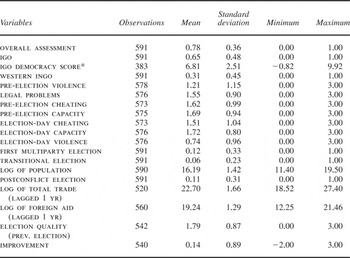
Finally, to examine the pre-election violence hypothesis this study coded preelection violence and election-day violence separately. Scores range from 0 to 3 and are based on the levels of violence reported by election monitors in their reports. If the election took place in a general condition of war, the variable is coded as level “3.” If a subpart of the country was at war, the variable may receive a lower score depending on the effect the organization reported the conflict had on the election. It was not possible for this study to differentiate between who perpetrates the violence, although that may be desirable for a study focused more specifically on the dynamics of violence in elections. Note that violence is different from political intimidation, which is coded as a type of election irregularity above. Examples of behaviors that would qualify as violence and unrest are: grenades and other weapons use, murders, physical assaults, and protests that turned violent. The score for this variable is based on the maximum level of violence reported by any organization present.Footnote 54 An indicator variable, postconflict, was also created to capture whether an election followed a conflict. It is based either on the content of the election monitoring report or on the election description in the Country Reports on Human Rights Practices.Footnote 55Table 2 summarizes all the variables.
Summary of variables

Note: *Calculated for IGOs only, set to zero for INGOs.
Empirical Results
Because the monitors' summary assessment is an ordered three-level variable, the models are standard-ordered logistic regressions, which estimate the probability of observing the different levels of assessments. The models are clustered on countries to control for lack of within-country independence of observations.Footnote 56 The coefficients are rendered as odds ratios, such that numbers above one indicate increased odds of an endorsement of the election.
The hypotheses generally find strong support. Model 1 in Table 3 examines the significance of the various irregularity measures alone. As expected, the odds that an organization will endorse an election decrease as regularities increase and the odds decrease most when the bulk of the problems take obvious forms. Structural legal problems, cheating in the pre-election period, and cheating on the election day are highly statistically significant and robust. Capacity-related problems are not statistically significant, although they do have the expected direction of effect. These findings are robust across all the models. As expected, monitors clearly do consider the irregularities that they observe on the ground.
Ordered logit of monitors' overall election assessment

Notes: Odds ratio. Robust standard errors, clustered on countries, are in parentheses. *p ≤ .1; **p ≤ .05; ***p ≤ .01.
However, Models 2 to 5 reveal that even when considering the election irregularities, other factors are also associated with election endorsements. All the model specifications corroborate the hypotheses about IGOs and their member states. For example, Model 2 shows that IGOs are more likely to endorse elections, but that this tendency is lower for IGOs with more democratic member states. The difference between Western INGOs and other INGOs (the omitted category) is not statistically significant, but the IGO finding is very robust.Footnote 57 This finding also has descriptive support. Figure 1 shows how different organizations assessed all the elections they observed. This comparison is biased because organizations monitor elections of different quality, but that said, INGOs and nonprofit institutes clearly criticize elections more often and the most critical organizations are Western. In contrast, the least critical organizations are IGOs with less-democratic member states such as the Commonwealth Secretariat, the Commonwealth of Independent States (CIS), and the South African Development Community (SADC). Furthermore, as noted below Table 1, two of the least critical IGOs, the Economic Community of West African States and the African Union, were excluded from the analysis due to missing data. Had they been included, however, given their less-democratic membership profile and quite uncritical track record, the findings about IGOs and their member states would likely have been even stronger.
Distribution of types of overall election assessments by organization

The political hypotheses find mixed support. Population, trade, and foreign aid were examined in separate models to avoid multicolinearity problems. Neither trade nor population size was statistically significant. However, Model 4 indicates that monitors were statistically more likely to endorse elections in countries that receive more total foreign aid. The fact that the coefficient is not significant in Model 5 may be because of the smaller sample size, or because foreign aid is correlated with electoral improvements. However, the significance in Model 4 holds up when including other variables as discussed under robustness checks later. That said, if population size is included as a control, the significance of the coefficient on the log of foreign aid only has a probability value of 0.105, thus just losing statistical significance at the 0.1 level. The log of foreign aid per capita is also not significant. Thus, the finding on foreign aid may be tenuous, but its significance in Model 4 and the fact that it is robust to several other checks does corroborate existing research,Footnote 58 and supports the argument that IGO member states and INGO donors and sponsors may attach particular importance to countries that receive more foreign aid and treat these more leniently.
The progress hypotheses also find some support. The odds of an election being endorsed more than doubles for elections that monitoring organizations described as transitional. Furthermore, Model 5 shows that the improvement in election quality is highly statistically significant and increases the odds of endorsement. However, this variable is difficult to interpret because it assumes that different stages of improvements are equivalent, but this may not be true. Lastly, although monitors appear more likely to endorse first multiparty elections, this effect is not statistically robust, likely due to correlation with the other measures.
Finally, the measures of postconflict elections and election-day violence are not significant. Consistent with expectations of the pre-election violence hypothesis, however, violence in the pre-election period is statistically associated with greater odds of endorsement. This relationship is highly robust across all the models. This is remarkable, because pre-election violence and irregularities are also highly positively correlated and it would therefore be logical if pre-election violence was associated with lower—not greater—odds of endorsement.
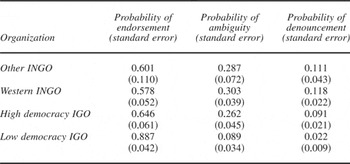
The magnitude of the statistically significant coefficients of Model 4 is illustrated through Clarify simulations.Footnote 59Table 4 shows that, holding all other variables at their means, an increase from no legal problems to the maximum level decreases the probability of an endorsement by 19.8 percent. Similar increases in pre-election cheating and election-day cheating are associated with even greater decreases of 36.8 and 45.8, respectively. Furthermore, a change from minimum to maximum in foreign aid is associated with a 27.7 percent increase in the probability of an endorsement. On average, an organization is 15.3 percent more likely to endorse elections it perceives as transitional. Finally, when the level of pre-election violence rises from minimum to maximum, the average organization is 16.7 percent more likely to endorse an election. Table 5 shows that on average INGOs are about 30 percent less likely to endorse elections than IGOs with low democracy scores, but that this difference decreases to only about 5 percent compared to IGOs with high democracy scores.
Changes in probabilities of overall election assessments

Note: Table uses Clarify simulations based on Model 4.
Probabilities of overall election assessments

Note: Table uses Clarify simulations based on Model 4.
Robustness Checks
The findings in this study are robust to several checks such as including the level of democracy in the previous year, a year variable to control for trends, or an indicator for the presence of domestic monitors. None were significant or changed the results much. The study also considered whether monitors were more likely to endorse the election if the incumbent party left power. An indicator variable was created to capture whether, for effective presidential systems, the president or the president's party stayed in power after the election, and for effective parliamentary systems, whether the prime minister or the prime minister's party stayed in power after the election.Footnote 60 This indicator was indeed significant: monitors were more likely to endorse elections if the incumbent party left power. Importantly, however, with the exception of the variable capturing whether monitors perceived an election as transitional, all the other results remained robust.
Another consideration was whether monitors endorse elections due to lack of capacity to cover the election fully.Footnote 61 The budgets of missions are not available, but neither measures of the length of stay of the longest staying delegation from an organization nor the numbers of observers from an organization present on election day were significantly associated with endorsements, even if these measures were weighted by the population size.
Finally, the study also applied a drastically different analytical approach by using several criteria to isolate a sample of elections that were highly problematic and then analyzing only these elections. This design would allow each factor to be interpreted not simply as correlates of endorsements, but of false endorsements. This approach is weak, however, because the criteria used to isolate the sample cannot be objective. Nonetheless, it is noteworthy that the central findings were quite similar to the present approach.
Conclusion
International election monitors are essentially in the business of policing norms. Because their influence rests on their veracity, the fact that they sometimes endorse flawed elections presents a puzzle. This study shows that the explanation lies in the previously recognized but seldom explored fact that transnational actors act both normatively and strategically. Election monitors do seek to uphold electoral norms; their assessments are informed greatly by the irregularities that they observe on the ground and particularly so by the more obvious types of fraud. Nevertheless, several other less quality-related factors also correlate significantly with whether monitors will endorse a given election.
Specifically, monitors consider the political interests of member states or donors. The analysis shows that IGOs are more likely than NIGOs to endorse elections and that this is particularly true for IGOs with less democratic member states. Thus IGOs may temper their criticism of election violations to appease member states, which fear that future criticism could be directed at them, or states that want to prevent democratic transitions in their region.Footnote 62 The analysis also suggests that foreign aid receipts are associated with greater odds of endorsement. This is likely because member states or INGO funders discourage denunciations of elections in foreign aid recipients such as Cambodia or Kenya, whose aid status may signify the interests their donors take in them.Footnote 63 This finding aligns well with research that has found the IMF to be lenient toward United States foreign aid recipients.Footnote 64 Dealing with these political interests may thus constrain monitors from basing their assessments exclusively on electoral norms. Monitors may want to denounce an election to uphold the electoral norms and to retain their own credibility, but they may also realize that this could undermine member state and donor support for their activities.
Monitors also face compelling normative pressures. Statistically, they are more likely to endorse elections when the electoral process improved from the previous election or when they perceive the election to be transitional. This could, of course, be because improvements are associated with cleaner elections. However, because this is significant even when accounting for the nature and level of irregularities in the observed election, it suggests that monitors sometimes praise improvements in election quality and endorse the outcome—even if still substandard—to support a country's trajectory toward more democratic elections in the long term. Monitors may decide that the election was of the best quality possible given the circumstances and that further progress can be encouraged by supporting the election result. This interpretation also concurs with careful readings of many election monitoring reports that chronicle serious irregularities, but then praise the progress and endorse the outcome. Russia in the mid- to late-1990s is a prime example.
The analysis also finds that pre-election violence is associated with greater likelihood of endorsements. Pre-election violence signals a greater risk of postelection violence, which monitors do not want to fuel. Thus, when pre-election violence has been particularly high, monitors may dampen their criticisms of incumbent fraud in the hope that even if the incumbent did not run a clean election, the incumbent will at least be able to maintain calm and therefore lessen the chances of serious postelection conflict. This was the case in the Kenyan elections of the 1990s. In Zimbabwe's 2000 election, monitors also stopped short of questioning the final results and praised the well-organized and calm voting day;Footnote 65 as one scholar noted, it had become clear to all foreigners that “changing the government in Zimbabwe would not necessarily have been easy or peaceful.”Footnote 66 Because higher levels of violence are associated with more irregularities, monitors may therefore experience a conflict between upholding electoral norms and endorsing an election as a means to quell potential violence after a violent election campaign.
That these factors above are significantly associated with endorsements is remarkable, because at least three of them should not be expected to correlate with cleaner elections. As noted, transitional elections or elections with greater improvements could by their nature be cleaner than others. However, no reasons exist to believe that monitors from less democratic IGOs, which mostly operate exclusively in their own member states, observe cleaner elections, or that foreign aid recipients hold cleaner elections. Certainly no logic would suggest that elections with more violence are cleaner.
This analysis has thus made considerable progress in explaining the behaviors of international election monitors, an understanding that is essential to interpret their pronouncements. Of course the findings do not themselves reveal how often observer missions are too lenient or grossly mischaracterize elections. However, about 21 percent of elections scored very high on a cumulative index of irregularities,Footnote 67 yet only 39 percent of missions to these problem-ridden elections stated forthrightly that results did not represent the will of the people. A conservative but of course greatly uncertain estimate may therefore be that monitors mischaracterize elections about 10 percent of the time. Thus caution is necessary when interpreting the assessments of monitors and this analysis suggests when such caution is most warranted.
This study of international election monitoring exemplifies that understanding the behavior of many international organizations and transnational actors requires attention to their politics and preferences beyond their formal missions. In addition to broadening the understanding of INGOs and IGOs behavior, the findings have implications for comparative and international relations scholarship, because election monitors' assessments often inform the data used in macro analysis. For example, nearly 30 percent of monitored elections are followed by positive changes in democracy scores in the Polity IV dataset. If factors other than the quality of the election influence the monitors' assessments, they might therefore misinform common democracy measures. To the extent that the biases introduced correlate with other variables of popular research questions, this can produce biased results. For example, if monitors assess elections in foreign aid recipients more leniently, correlations between foreign aid and democratic progress could be spurious.
The reasons monitors endorse elections are likely more complex than shown herein. Future research could advance this analysis by, for example, differentiating further between organizations and their dyadic relationships to the monitored state. The discussion of pre-election violence could also benefit from greater attention to who perpetrates the violence and why. Nevertheless, this article has illuminated monitors' choices considerably. The factors that influence the behavior of other INGOs and IGOs may be specific to their context. However, the general insight from this study is that multiple norms and interests likely prevent these actors from pursuing their objectives single-mindedly. This is not inherently bad; their choices may be justifiable on grounds of morality or efficiency. As these governmental and nongovernmental international organizations grow more active and influential, however, understanding the factors that guide their behavior is useful for practitioners and analysts alike.