Acute coronary syndrome secondary to mast cell activation from hypersensitivity or anaphylaxis was first noted in 1938. Reference Clark1 The pathophysiologic mechanism was later described by Kounis and Zavras as the concurrence of acute coronary syndrome or coronary vasospasm with conditions associated with the release of inflammatory cytokines through mast cell activation and platelet activation in the setting of allergic or anaphylactic reactions, termed Kounis syndrome. Reference Kounis2,Reference Kounis3 Kounis syndrome has been described as secondary to exposures, immunisations, and drugs; however, this has predominantly been noted in the adult population with only three case reports noted in patients 10 years of age or younger. Reference Abdelghany, Subedi, Shah and Kozman4 In this case report, we describe a paediatric patient who had the uncommon complication of Kounis syndrome.
A 9-year-old female presented to an urgent care facility with chest tightness, palpitations, flushing, dyspnoea, and pallor within 9 minutes after receiving her weekly allergy injection with serum to her previously noted allergies (dust mites, grass, etc.). The patient had been receiving weekly allergy injections without complications previously. She was taken from the allergist’s office to an urgent care facility where she was found to be tachycardic. At this time, emergency services were contacted for transfer to our emergency department. In route, she received epinephrine due to concern for anaphylaxis.
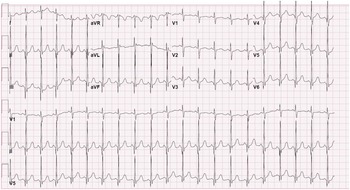
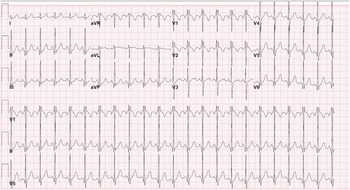
On arrival to the emergency department approximately 1 hour after injection, the patient was noted to a have heart rate of 122 beats per minute with a blood pressure on the lower end of normal for age, 86/53 mmHg. Given the patient’s presentation, she was treated with methylprednisolone, diphenhydramine, and a normal saline bolus. Further evaluation in the emergency department showed evidence of acute cardiac ischaemia including deep Q waves in leads III and V6 as well as ST depression in V5/V6 on EKG (Fig 1). Troponin was elevated to 0.599 ng/ml (ref 0–0.399 ng/ml) and B-Natriuretic peptide was 19 pg/ml. Histamine and tryptase levels were not obtained and no significant eosinophilia noted on presentation; however, blood was drawn more than 5 hours after the event which may have been outside of the window of detection. An echocardiogram demonstrated dyskinesis of the basal mid/posterior septum in the region of the right coronary artery and posterior descending artery distribution. The patient was transferred to the PICU for monitoring overnight where she remained stable with gradual improvement in symptoms. She was discharged home the following day on 81 mg ASA with close cardiology follow-up. Serial echocardiograms demonstrated improvement in regional wall abnormalities as well as improvement in ECG findings (Fig 2). The patient later developed supraventricular tachycardia which is thought to be unrelated to the prior coronary vasospasm.
Deep Q waves in leads III and V6 as well as ST depression in V5/V6 on initial EKG.

Improvement in Q waves depth in lead III and V6 as well as normalization of ST segment in V5/V6.

On initial presentation, this case appeared to be typical anaphylaxis from allergy immunotherapy with co-existent chest pain. However, ECG and echocardiogram findings as well as an elevated troponin suggest acute ischaemia which is consistent with Kounis syndrome. Kounis syndrome in children is exceedingly uncommon with the first reported case being in 2009. Reference Biteker, Duran and Biteker5 The primary inciting factors reported being drugs (particularly antibiotics), foods (fish, shellfish, fruits, and canned food) and environmental exposures (insect stings, grass cutting, or other animal bites). Reference Kounis6 To our knowledge, this is the first paediatric case of Kounis syndrome triggered by immunotherapy. Reference Giovannini, Alletto and Koniari7 Though clearly rare, given the nature of the patient population and disease spectrum treated by allergists (i.e. atopic patients receiving intervention), Kounis syndrome should be considered in cases of allergic response to immunotherapy, especially when involving chest pain. Given that histamine and IgE are commonly elevated in Kounis syndrome, being mindful of this reaction in patient’s undergoing immunotherapy is paramount for diagnosis and expedited treatment. Reference Ebo, Leysen, Mayorga, Rozieres, Knol and Terreehorst8 Histamine’s action on cardiac pathophysiology during anaphylactic reactions or Kounis syndrome include coronary vasoconstriction, intimal thickening, inflammatory cell modulation, and platelet aggregation.
An accurate diagnosis of Kounis syndrome not only allows for timely and appropriate treatment, but also for valuable prognostic information. Common symptoms include acute chest pain, dyspnoea, difficulty breathing, pruritis, and even syncope. Cardiac findings range from conduction delay abnormalities, ST elevation or depression, repolarisation abnormalities, ventricular ectopy, elevated cardiac enzymes, and regional wall abnormalities on echocardiogram. There are three reported variants in Kounis syndrome with type 1 representing normal coronary artery structure without predisposing factors for coronary artery disease, with type 1 being the most commonly reported in adults and paediatrics. Our patient was diagnosed with type 1 Kounis syndrome by clinical symptoms, history, lab data, ECG, and echocardiogram given the low incidence of coronary artery disease in the absence of proximal abnormalities. Most cases of Kounis syndrome in paediatric patients are self-limited with only rare cases requiring continued management. One case of Kounis syndrome in a young patient reported the diagnosis of “congenital hypoplasia of the coronary arteries” which was subsequently evaluated for heart transplant as her coronary arteries were found to be small and unresponsive to nitroglycerin. While the diagnosis of hypoplastic coronary arteries is bleak, it is an outlier for this condition with appropriate treatment for Kounis syndrome often resulting in far better outcomes. Reference Parent, Wearden, Kounis and Chrysostomou9
The treatment of Kounis Syndrome primarily involves treating the allergic reaction responsible for mast cell degranulation and vasospasm. Mainstay treatments for allergic reactions include H1 and H2 blockers, steroids, vasodilatiors, and epinephrine. Care must be taken; however, as both epinephrine and corticosteroids have been identified in the literature to paradoxically induce Kounis syndrome. Reference Abdelghany, Subedi, Shah and Kozman4 As such, it is reasonable to question the contribution of epinephrine to coronary artery vasospasm in our case. The diagnosis of Kounis syndrome should be considered in patients presenting with anaphylaxis and chest pain as use of common treatments (i.e. epinephrine, steroids) may worsen morbidity. Reference Yanagawa, Kondo and Ishikawa10
Conclusions
Kounis syndrome is a rare occurrence in paediatric patients but may have an underreported incidence. A high index of suspicion is needed in patients who develop systemic signs of anaphylaxis with clinical, laboratory, electrocardiographic, and echocardiographic findings of acute coronary syndrome of having the diagnosis of Kounis syndrome. To our knowledge, this is the first reported case of Kounis syndrome in a paediatric patient thought to be secondary to an allergy injection.
Financial support
This research received no specific grant from any funding agency, commercial, or not-for-profit sections.
Conflicts of interest
None.