Introduction
Age is the greatest single risk factor for developing dementia, and an estimated 34 million people suffer from this condition, which impairs an individual's ability to live independently (Barnes and Yaffe, Reference Barnes and Yaffe2011). About 10% of individuals age 65 years or older have dementia, but by age 85 years and older more than 45% suffer from the condition (Alzheimer's Association, 2012). The annual caregiving and healthcare costs are estimated to exceed $400 billion in the USA (Alzheimer's Association, 2012). Dementia symptoms usually begin gradually and are preceded by years of steadily increasing cognitive declines – initially mild age-related memory complaints, followed by mild cognitive impairment, a condition that increases the risk for developing dementia (Petersen, Reference Petersen2004).
The most common cause of dementia is Alzheimer's disease (AD), defined by abnormal protein fibers – amyloid plaques and tau tangles – that accumulate in brain areas controlling memory, language, judgment, thinking, and behavior (Knopman et al., Reference Knopman2001). Although definitive AD is diagnosed at brain autopsy by high concentrations of plaques and tangles, positron emission tomography (PET) scans using molecular probes that bind to these protein deposits can indicate patterns consistent with AD years before people develop dementia symptoms (Small et al., Reference Small2012).
Available medications can temporarily benefit cognitive and behavioral symptoms of AD, but no cure yet exists. Because genetics account for only part of the risk for AD and related dementias, investigators have searched for nongenetic factors that contribute to risk and earlier symptom onset. Clinical trials and epidemiological studies have linked smoking (Cataldo et al, Reference Cataldo2010) and midlife overweight and obesity (Fitzpatrick et al., Reference Fitzpatrick2009) to increasing dementia risk in late life, while adherence to the Mediterranean diet (Sofi et al., Reference Sofi2010), eating fruits and vegetables (Hughes et al., Reference Hughes2010), and regular physical exercise (Hamer and Chida, Reference Hamer and Chida2009) are associated with lower risk.
Lifestyle behaviors also may impact the extent of cognitive symptoms that people without dementia experience. These milder cognitive impairments are common and may represent a stage of decline that precedes mild cognitive impairment, which increases an individual's risk for dementia (Reisberg and Guathier, Reference Reisberg and Guathier2008). Moreover, in most normal individuals objective evidence of age-related cognitive decline can be measured by age 45 years (Singh-Manoux et al., Reference Singh-Manoux2011). Previous studies support the role of physical exercise, nutrition, and not smoking in protecting brain health and memory ability (Joseph et al., Reference Joseph2009; Etgen et al., Reference Etgen2010; Heffernan et al., Reference Heffernan2010). A better understanding and recognition of mild memory symptoms has the potential to impact medical practice. A recent four-year longitudinal study showed that subjective memory complaints in an older general practice population predicted subsequent hospital-based dementia diagnosis, suggesting that general practitioners might identify vulnerable older patients by asking about memory complaints (Waldorff et al., Reference Waldorff2012).
Despite the prior research linking healthy behaviors to a lower probability of developing AD and related dementias, studies of associations between healthy behavior and memory in people from different age groups are limited. To address this knowledge gap, we assessed memory symptoms in Gallup Poll telephone surveys of a random sample of adults aged 18–99 years to determine relationships between healthy behaviors and self-reported memory abilities.
Methods
Survey procedures
Gallup Poll Daily tracking interviews of 18,552 US adults, aged 18 years and older, for the period between December 19, 2011, and January 31, 2012, provided the data set for this analysis. The Gallup daily survey methods rely on live telephone interviews in all 50 US states and use dual-frame sampling, which includes listed landline interviewing and wireless phone sampling to reach those in “wireless-only” and “wireless-mostly” households, as well as unlisted, landline-only households. A random selection method (by asking for the person 18 years or older with the most recent or last birthday) chooses respondents within the household. The survey includes Spanish language interviews for respondents who speak only Spanish and a three-call design to reach respondents not contacted on the initial attempt. Nightly quotas ensure that the unweighted samples are proportionate by region and gender. The data are weighted daily based on the 2011 Current Population Survey Annual Social and Economic Supplement to match targets by age, sex, region, education, ethnicity, and race. Sampling weights correct for unequal selection probability and compensate for disproportionalities in selection probabilities and nonresponse. With the inclusion of the cell phone-only households and Spanish language interviews, over 90% of the US adult population is represented. Response rates refer to the response fraction or the number of respondents providing a given response divided by the total number that responded to the particular question. The response rates for the survey, using standard definitions from the American Association for Public Opinion Research (2008) were as follows: contact rate (number of households reached divided by the number of working, nonbusiness telephone numbers dialed), 51%; refusal rate (number of respondents that refused to be interviewed divided by the number of all potentially eligible cases), 23%; cooperation rate (the number of eligible respondents who gave initial consent to be interviewed, divided by the total number of households reached), 29%; and completion rate (the proportion of initially cooperating and eligible households where someone completed the interview), 93%. Gallup uses professionally trained interviewers, who have the leeway to terminate calls if the respondent seems unable to understand or respond to the questions. Because this analysis did not pose risk to respondents and was an analysis of data collected by the Gallup Organization, it received a waiver from the UCLA Human Subjects Protection Committee.
Questionnaire items
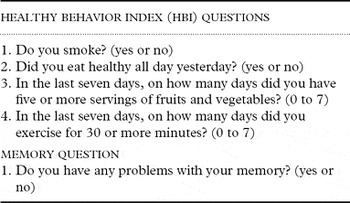
The questionnaire included items providing demographic information and measuring lifestyle habits with established relationships to health outcomes. The Healthy Behavior Index (HBI) is one of six subcomponents of the Gallup-Healthways Well-Being Index, and includes four items: smoking, eating healthy, weekly consumption of fruits and vegetables, and weekly exercise frequency (Table 1). Yes or no responses to the “Do you smoke?” and “Did you eat healthy all day yesterday?” questions were recoded to reflect the positive response only (i.e. “1” if nonsmoker/ate healthy; “0” if smoker/did not eat healthy). If the participant's response indicated ≥4 times/week for eating fruits and vegetables (question 3) or 3–7 times/week for exercise (question 4), then that item was given a positive value of 1 for that respondent; if not, that item was scored as 0. The HBI was then calculated as the mean of these 4 items multiplied by 100, and rounded to 1 decimal place. The mean score for HBI requires all 4 items to be present in order for the mean to be calculated. The cut-offs used in the scoring for the HBI were empirically derived based on how the scale (days) differentiated on several well-being outcomes (life evaluation, emotional health, and physical health). In addition, memory symptoms were assessed using a single question about the presence of memory problems with yes or no as possible responses (Table 1). This question was adapted from a meta-memory questionnaire item, and responses to this question are associated with objective memory performance scores (Schofield et al., Reference Schofield1997).
Gallup poll questions on healthy behavior and memory

Note: Possible responses are indicated in parentheses.
The Gallup HBI (Gallup-Healthways Well-Being Index, further information is available at http://www.well-beingindex.com) has been compared with external sources of health and well-being data to study construct validity. The HBI displays strong associations with external indicators, such as the percentage of adults who: participate in moderate or vigorous physical activities (r = 0.66, p < 0.001), are obese (r = –0.85, p < 0.0001), have diabetes (r = –0.59, p < 0.001), have ever been told by a doctor that they have diabetes (r = –0.59, p < 0.001), smoke (r = –0.74, p < 0.001), and consume tobacco (r = –0.68, p < 0.001). These correlations with external metrics of health risk factors underscore the construct validity of the index.
Statistical analyses
Analyses were performed using SAS 9.2, which allows estimation of parameters and hypothesis testing weighted by sample weights to ensure correct computation of standard errors. Respondents were divided into three age groups: younger (18–39 years), middle-aged (40–59 years), and older (60 years and older) adults.
Mean HBI scores were calculated for subjects in the three age groups, and effect sizes for group differences (Cohen's d) were calculated for each pairwise comparison. The individual HBI components and the proportion of participants with memory problems were also examined for each age group. We then calculated the mean HBI for participants with and without memory problems and the effect size for the mean difference both for the full sample and within each age group. Educational and income levels were used as covariates in the model.
The relationship between memory symptoms and HBI was also studied using logistic regression, with memory group as the dependent variable and HBI as the independent variable. In addition, we examined the contribution of individual HBI components to memory symptoms by estimating a logistic regression model with the individual items as independent variables. Since obesity can be considered a surrogate marker of healthy behavior, we included obesity (as a yes or no variable and defined as a body mass index (BMI) > 30) as an additional predictor in the logistic regression and computed the two models within each age group to determine how the age groups differed in their association between memory symptoms and healthy behaviors.
Because of the large sample size, results can be statistically significant even when actual effect sizes are small. In this analysis, we thus emphasized effect sizes and odds ratios over p-values. Effect size is a simple way of quantifying the differences between groups by emphasizing the size of the difference without confounding this difference with sample size.
Results
Subjects
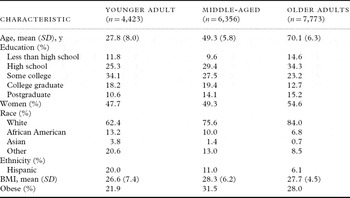
Older age was associated with a higher proportion of women, Caucasian respondents, and individuals with postgraduate education, while obesity rates were higher in middle-aged and older adults compared with younger adults (Table 2). As noted, the data were weighted to match targets from the U.S. Census Bureau by age, sex, region, education, ethnicity, and race.
Characteristics of subjects according to age group

Notes: Weighted numbers and percentages are presented. Younger adults: age 18–39 years; middle-aged: 40–59 years; older adults: 60–99 years. Obese defined as BMI > 30.
Healthy behavior and age
Reports of healthy behaviors were more common in older than in middle-aged and younger adults. The mean (SD) HBI for older subjects was 69.8 (19.8) compared to 60.7 (28.0) for middle-aged and 57.9 (34.4) for younger subjects (ES = 0.38 for older vs. middle-aged; ES = 0.42 for older vs. younger; ES = 0.09 for middle-aged vs. younger). Controlling for educational and income levels, the effect size was 0.39 for older versus middle-aged, 0.42 for older versus younger, and 0.07 for middle-aged versus younger adults.
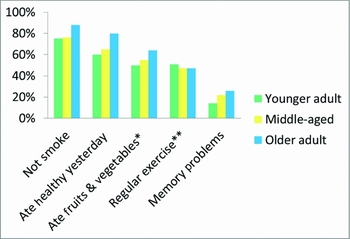
Several HBI subcomponents differed significantly according to age (Figure 1). Only 12.4% of older adults smoked, while 24.8% of young adults and 23.7% of middle-aged adults smoked. A higher proportion of older adults reported eating healthy yesterday (80.4%) and eating five or more daily servings of fruits and vegetables during the previous week (64.0%) compared with middle-aged adults (65.8% and 53.9%, respectively) and younger adults (56.2% and 49.1%). Comparable proportions of adults participated in regular exercise in the different age groups (younger: 50.9%; middle-aged: 46.6%; older: 46.7%).
The histograms indicate the percentage of respondents engaging in each of the behaviors comprising the subcomponents of the Healthy Behavior Index and reporting memory problems, according to age group. Note: Healthy behavior subcomponents and memory problems according to age group. *Ate five or more servings of fruits and vegetables at least 4 times/week. **Exercised for 30 or more minutes at least 3 times/week.

Healthy behavior, memory, and age
Only 14.4% of younger adults reported memory problems compared with 22.0% of middle-aged and 26.4% of older adults (Figure 1). Respondents with memory problems had significantly lower mean (SD) HBI scores of 60.9 (26.5) compared to 66.2 (26.4) for those without problems. The effect sizes for this relationship were comparable among the three age groups (younger: ES = 0.26; middle-aged: ES = 0.30; and older: ES = 0.25) and controlling for educational and income levels of the survey respondents did not change the magnitude of these effect sizes. For a 25-unit decrease in HBI (equivalent to not participating in any one of the four healthy behavior activities: not smoking, eating healthy yesterday, eating five servings of fruits and vegetables, or exercising three or more time a week), the odds of reporting memory problems was 1.21 (95% confidence interval (CI) [1.17, 1.25]). For respondents not participating in two of the four healthy activities, the odds of reporting memory problems increased to 1.45 (95% CI [1.36, 1.55]). For those not participating in three of the four healthy activities, the odds of reporting memory problems increased to 1.75 (95% CI [1.59, 1.93]). For those not involved in any of the four healthy activities, the odds of reporting memory problems was 2.11 (95% CI [1.85, 2.41]).
Reports of healthy eating were associated with better memory regardless of age. Controlling for the other factors (smoking, regular exercise, obesity, educational, and income levels), a person who did not report healthy eating had an odds ratio of 1.26 (95% CI [1.14, 1.39]) for reporting memory problems compared to a person who reported eating healthy. This effect was most pronounced in older individuals: while younger adults who reported healthy eating had a 1.48 (95% CI [1.26, 1.74]) increase in odds compared to younger adults who did not report healthy eating and middle-aged adults had a 1.28 (95% CI [1.10, 1.50]) increase in odds, older adults who did not report healthy eating habits had a 1.86 (95% CI [1.49, 2.31]) increase in the odds of reporting memory problems compared to those who reported healthy eating habits.
Smoking was associated with memory symptoms in younger and middle-aged but not in older adults. A younger smoker had a 1.88 (95% CI [1.60, 2.20]) increase in the odds of reporting memory problems compared to a younger nonsmoker, and a middle-aged smoker had a 1.28 (95% CI [1.10, 1.48]) increase in the odds of reporting memory problems compared to a middle-aged nonsmoker.
Reports of physical exercise were associated with better memory in the middle-aged and older groups, but not in the younger group. A middle-aged person who did not report exercising regularly had a 1.38 (95% CI [1.21, 1.58]) increase and an older adult had a 1.51 (95% CI [1.30, 1.76]) increase in the odds of reporting memory problems compared to a person in the same age group who reported exercising regularly (controlling for the other factors). Obesity also was a significant predictor of memory problems in the middle-aged and older groups, but not in the younger group. Controlling for the other factors, a middle-aged obese adult had a 1.21 (95% CI [1.06, 1.39]) increase and an older obese adult had an 1.16 (95% CI [1.00, 1.35]) increase in the odds of reporting memory problems compared to a non-obese person in the same age group.
Comment
To our knowledge, this is the first large-scale study of a representative community sample demonstrating associations between reports of healthy behaviors and fewer memory symptoms across different age groups. Reports of healthy eating, regular physical exercise, and not smoking were all associated with self-ratings of better memory.
Other research suggests that individuals who engage in one healthy behavior are likely to engage in others. For example, cigarette smokers are less likely to consume fruits and vegetables than nonsmokers, while those who attempt to quit smoking are more likely to succeed if they eat higher quantities of fruits and vegetables (Haibach et al., Reference Haibach2013). In our study, respondents engaging in just one healthy behavior (e.g., not smoking or eating healthy yesterday) were 21% less likely to report memory symptoms than those who did not. Moreover, the higher the number of healthy behaviors reported, the less like were respondents to report memory problem. Those reporting two healthy behaviors were 45% less likely to report memory problems, while respondents reporting three or four healthy behaviors were 75% and 111% less likely to report memory problems. These findings suggest a dose response effect in engaging in more than one healthy behavior in reducing memory symptoms.
Although information linking very mild memory symptoms to healthy behaviors is limited, previous research has focused on healthy behaviors and more advanced cognitive declines, such as mild cognitive impairment, a risk state for dementia. A diet high in processed foods has been associated with more severe cognitive deficits in patients with mild cognitive impairment (Torres et al., Reference Torres2012). Exercise interventions also have been associated with positive changes in vascular risk factors related to cognitive decline and vascular disease in older adults with mild cognitive impairment (Uemura et al., Reference Uemura2012). Other studies have shown evidence that physical activity and cognitive exercise may improve memory and executive functions in older people with mild cognitive impairment (Teixeira et al., Reference Teixeira2012).
It is noteworthy that older age was associated with healthier behaviors, which counters the stereotype of aging as a time of life characterized by immobility, dependence, and both physical and mental decline (Kotter-Grühn et al., Reference Kotter-Grühn and Hess2012). Young adults often engage in unhealthy behaviors because of their sense of invincibility (El Ansari et al., Reference El Ansari2011): many are able to smoke, overeat, and engage in other unhealthy behaviors without experiencing immediate health consequences, whereas middle-aged and older adults are more likely to suffer the consequences of unhealthy behaviors. As they develop such age-related illnesses as cardiac disease, hypertension, and diabetes, their doctors may advise them to eat a healthy diet, lose weight, stop smoking, and begin exercising. Also, health information through television, newspapers, magazines, and other media may influence older adults more than younger adults. Another possible explanation for the healthier behaviors reported in middle-aged and older adults is that people with unhealthy behavior habits have short life expectancies and do not survive to older age groups or are more likely to be institutionalized and not accessible to surveyors (Shavelle et al., Reference Shavelle2008; Wen et al., Reference Wen2011).
Older adults were more likely to report memory problems, but 14% of younger adult respondents reported memory symptoms. Other studies have shown that young adults do experience memory symptoms, but such symptoms are qualitatively different from those of older adults and not likely to indicate neurodegeneration (Ginó et al., Reference Ginó2010).
Regardless of age, respondents who did not report healthy eating habits had a 26% increase in the odds of reporting memory problems compared with those reporting healthier eating habits. This finding is consistent with previous studies suggesting cognitive benefits from intake of antioxidant fruits and vegetables (Hughes et al., Reference Hughes2010), omega-3 fatty acids (Mazereeuw et al., Reference Mazereeuw2012), and the Mediterranean diet (Gu et al., Reference Gu2010). In our analysis, obesity, a surrogate of unhealthy eating, was a significant predictor of memory symptoms in the middle-aged and older groups. We defined obesity as a BMI > 30, and BMI has been found to correlate with levels of cognitive decline (Coin, Reference Coin2012). Other studies indicate a link between midlife obesity and later risk for developing dementia (Fitzpatrick et al., Reference Fitzpatrick2009); however, adiposity rather than BMI may be a better measure of vascular, metabolic, and neurodegenerative risks (De Lorenzo et al., Reference De Lorenzo2011).
Consistent with previous research, we found that nonsmokers had fewer memory symptoms (Heffernan et al., Reference Heffernan2010). Why this association was present in younger and middle-aged and not older adults is not clear, but could reflect the influence of alcohol abuse and other unhealthy behaviors associated with smoking, which was not considered in this analysis (De Leon et al., Reference De Leon2007). Differential survival rates due to unhealthy behaviors may contribute to such age-related differences (Shavelle et al., Reference Shavelle2008; Wen et al., Reference Wen2011). Smoking in middle-aged respondents had a relatively modest association with memory symptoms, which is consistent with a previous study showing a statistically significant but weak association between smoking and the presence of memory symptoms in people aged 45–64 years (Paradise et al., Reference Paradise2011).
Our findings that reports of physical inactivity increased the probability of memory symptoms in middle-aged and older adults agree with other work indicating associations between cardiovascular conditioning and cognitive health (Etgen et al., Reference Etgen2010). Regular aerobic conditioning results in physiological effects that benefit cognitive function, such as increased cerebral blood flow, neuronal growth, and brain-derived neurotrophic factor expression, which enhances brain plasticity (Merrill and Small, Reference Merrill and Small2011). Cardiovascular conditioning also increases hippocampal volume (Erickson et al., Reference Erickson2011) and is associated with lower levels of brain amyloid in people without dementia at genetic risk for AD (Head et al., Reference Head2012).
We found that 26% of respondents age 65 years and older reported memory problems, which is lower than rates reported from other studies. For example, Schofield et al. (Reference Schofield1997) found that 31% of normal community-dwelling elderly had memory complaints. It is possible that in the present survey older subjects minimized their memory symptoms or else avoided the survey because of such symptoms. However, other recent studies have found comparable frequencies of memory complaints in older populations ranging from 21% (Minett et al., Reference Minett2008) to 25.5% (Dik et al., Reference Dik2001). Gallup's interviewers are professionally trained to terminate calls if the respondent seems unable to understand or respond to questions so that potential respondents with apparent memory difficulties could have been weeded out, which also may have explained the relatively low rates of memory problems in the older respondent group. Despite the relatively low rate of complaints in older subjects, complaints of memory problems still increased with age as expected from previous research.
Although psychometric data from respondents were not available, previous studies have demonstrated correlations between subjective reports of memory and objective neuropsychological performance scores. For example, Zelinski et al. (Reference Zelinski1990) found moderate concurrent validity for self-reports of memory and objective memory measures in a study of 287 adults aged 50 years and older. Eckerström et al. (Reference Eckerström2013) found that a self-reported cognitive impairment questionnaire effectively discriminated between older controls and patients seeking care at a memory clinic, and showed medium to high correlations between questionnaire scores and a single question on memory functioning.
Other factors could have influenced these results. For example, subjective memory complaints have been associated with symptoms of depression and anxiety in healthy cognitively normal older adults (Balash et al., Reference Balash2012). It is also possible that respondents without memory complaints were less inclined to report healthy behaviors. In addition, even though the HBI is associated with external metrics of health risk factors (further information is available at http://www.well-beingindex.com), such questions as “eat healthy all day yesterday” could have varied meanings to respondents, which could influence survey results. Another potential weakness of this study is that these relationships between behavioral habits, memory symptoms, and other variables are associations and do not prove causation. Moreover, the variables were self-reports, which may be influenced by subjective factors that distort true objective measures. Previous studies, however, have demonstrated that subjective memory measures are not only correlated with objective neuropsychological test results (Troyer and Rich, Reference Troyer and Rich2002), but are also associated with subsequent cognitive decline (Schofield et al., Reference Schofield1997), AD genetic risk (Small et al., Reference Small1999), and lower cerebral metabolic rates measured by PET scanning (Ercoli et al., Reference Ercoli2006). Recent research also indicates an association between subjective memory symptoms and PET scan measures of brain amyloid plaques and tangles in persons without dementia (Merrill et al., Reference Merrill2012). Thus, the memory symptoms reported in the present analysis could reflect accumulation of brain pathology in middle-aged and older adults without dementia, suggesting the presence of a prodromal stage of AD in some respondents.
Strengths of the present study are that the sample is representative of the US population, includes respondents from a range of age groups, and is large enough to provide meaningful results in different age groups. It thus provides insights into relationships between healthy behaviors and memory symptoms that could stimulate future investigations designed to elucidate hypothesized causal relationships, stimulate clinical interventions for people at risk for memory symptoms and neurodegeneration, and eventually drive public policy. Our findings have implications for how we influence personal behavior, its attendant impact on healthcare costs and expenditures, and the importance of health wellness and prevention, components of the Affordable Care Act. To the extent that we can promote healthy lifestyle behaviors, we can reinforce the central tenets of healthcare reform: namely, improving individual and societal health and reducing medical expenditures.
These findings also reinforce the importance of educating young and middle-age individuals to take greater responsibility in preserving their memory and mitigating potential future symptoms of dementia by practicing positive lifestyle behaviors prior to becoming older adults. Ultimately, if we are to prepare for the aging of society and a doubling of the older population by 2040 (Kinsella and He, Reference Kinsella and He2009), it will behoove government and individuals to draw lessons from the results of this study. A recent analysis concluded that the projected effect of a 25% risk factor reduction would result in three million fewer dementia cases in the US and 17 million fewer cases worldwide (Barnes and Yaffe, Reference Barnes and Yaffe2011). Thus, encouragement of healthy behaviors in all age groups has the potential for significant public health impact in limiting and forestalling morbidities associated with age-related cognitive decline and neurodegeneration.
Conflict of interest
The University of California, Los Angeles, owns a US patent (6274119) entitled “Methods for Labeling β-Amyloid Plaques and Neurofibrillary Tangles.” Dr. Small is among the inventors, has received royalties, and may receive royalties on future sales. Dr. Small reports having served as a consultant and/or having received lecture fees from Pfizer, Janssen, Novartis, and Lilly. Dr. Small also reports having received grant funds from POM Wonderful. Drs. Siddarth, Ercoli, Chen, Merrill, and Torres-Gil have no financial conflicts of interest.
Description of authors’ roles
All authors designed the study, revised internal versions of the paper, and approved the final draft. G. W. Small and P. Siddarth wrote the initial draft of the paper and P. Siddarth performed the statistical analyses.
Acknowledgments
We thank Dan Witters and Mark Bartels of the Gallup Organization, Jim Pope of Healthways Corporation, and Beverly Cosand for their assistance in study design, execution, and analysis. We also thank the Gallup Organization and Healthways Corporation for access to the survey results. This work was supported by the Gallup Organization, the Parlow-Solomon Professorship on Aging, the Ahmanson Foundation, the Fran and Ray Stark Foundation Fund for Alzheimer's Disease Research, the Semel Institute, and the UCLA Longevity Center. Dr. Siddarth had full access to all of the data in the study and takes responsibility for the integrity of the data and the accuracy of the data analysis.