Introduction
Recent studies have confirmed the original findings of Imshenetsky et al. (Reference Imshenetsky, Lysenko and Kazakov1978), that microorganisms (bacteria and fungi) exist in the stratosphere (Wainwright et al. Reference Wainwright, Wickramasinghe, Narlikar and Rajaratnam2003; 2004; Shivaji et al. Reference Shivaji, Chaturvedi, Suresh, Reddy, Dutt, Wainwright, Narlikar and Bhargava2006; Griffin Reference Griffin2008; Yang et al. Reference Yang, Itahashi, Yokobori and Yamagishi2008; Shivaji et al. Reference Shivaji2009; Smith et al. Reference Smith, Griffin and Schuerger2010). Since a variety of environmental-sampling techniques and approaches to microbiological sample processing have been used in these various studies we can be confident that the Earth's biosphere does indeed extend into the stratosphere (Wainwright Reference Wainwright2008). While a diverse range of bacteria have been isolated from the stratosphere, spore-forming members of the genus Bacillus appear to be particularly common (or else are selectively isolated from this region by the chosen isolation techniques).
Now that that the existence of a stratospheric bacterial has been established, the next obvious question is – from where do these organisms originate: from Earth or from space? The application of Occam's razor suggests that since these are microbes are commonly found on Earth, they must have an Earth origin. There exists, however, the possibility that some, at least, originate from space and that a mixed population of bacteria exists in the stratosphere, some outgoing from Earth and some incoming from space (Wainwright Reference Wainwright2003; Wainwright et al. Reference Wainwright, Alharbi and Wickramasinghe2006). How then might the microorganisms, which originate on Earth, reach heights of 60 km above Earth's surface? One possibility is that they are ejected into the stratosphere by volcanoes. However, at least two of the above cited studies (Wainwright et al. Reference Wainwright, Wickramasinghe, Narlikar and Rajaratnam2003; Shivaji et al. Reference Shivaji, Chaturvedi, Suresh, Reddy, Dutt, Wainwright, Narlikar and Bhargava2006) were conducted some two years after the last major volcanic eruption on Earth; since bacteria and fungi deposit under gravity, any stratosphere isolations of organisms derived from these studies are unlikely to have originated from volcanoes. A number of other mechanisms have been suggested by which bacteria might be carried into the stratosphere, including blue lightening, gravitophotophoresis and electrostatic action (Wainwright et al. Reference Wainwright, Alharbi and Wickramasinghe2006; Dehel et al. Reference Dehel, Lorge and Dickinson2008). However, it appears unlikely that any of these mechanisms would be capable of carrying a particle of a diameter exceeding 1 μm, i.e. the usual size of bacteria when grown on nutrient-rich laboratory media (Dehel et al. Reference Dehel, Lorge and Dickinson2008). The likelihood of particles, such as bacteria, being elevated from Earth to the stratosphere is, however, likely to increase with decreasing cell size. Very small bacteria do occur in nature (Hahn Reference Hahn2004) and it is likely that these so-called ‘ultrabacteria’, or ‘ultrasmall bacteria’ (i.e. filterable bacteria) would be more easily carried to the stratosphere than bacteria of a larger size. As a result, most of the bacteria that are readily isolated from the stratosphere should be ultrasmall forms. As this is not the case, then either some mechanism must exist by which larger bacteria are carried to the stratosphere or else, the non-ultrasmall bacteria found in this region must have originated from space.
The aim of this study was to determine if ultrasmall bacteria occur in Earth environments, such as soils, seawater and rainwater, and attempt to explain the paradox of why they have not been isolated from the stratosphere.
Material and methods
Sampling of soils and seawater
Seawater samples were obtained from the North Sea, the English Channel, the East Pacific Ocean, the Mediterranean Sea, the Atlantic Ocean, the Red Sea and the Black Sea and the Indian Ocean. The following soil samples were obtained from the UK (Sheffield region): deciduous woodland (under Acer psuedoplatanus and Fagus silvaticus); coniferous woodland soil (Pinus species) agricultural; loam (last crop wheat); and an agricultural grassland soil.
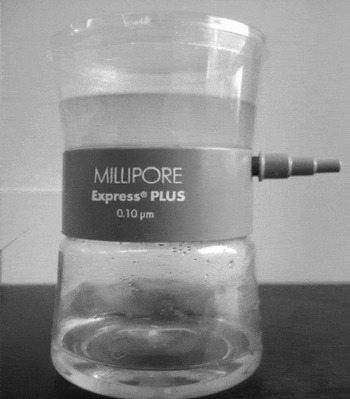
Seawater samples and soil suspension (1 g soil:100 ml of sterile, distilled water) were filtered through a micropore filter apparatus (Fig. 1), having either a 0.2 or 0.1 μm micropore filter apparatus (Millipore Express Plus); the apparatus consists of two chambers with a membrane filter between; the seawater sample (100 ml) or soil suspension (1 g soil:100 ml of sterile, deionized water) was transferred to the top chamber and allowed to pass, under gravity (i.e. without suction), into the lower chamber containing the liquid bacterial isolation medium. The filter apparatus was then incubated at 25°C for 2 weeks and checked at intervals for signs of clouding of the medium, i.e. bacterial growth. The following media were used: (1) liquid broth (LB); (2) nutrient broth; (3) LB and nutrient broth made up in autoclaved (120°C for 20 min) seawater (for use with seawater samples only); and (4) LB and nutrient broth diluted 100 fold with distilled water (oligotrophic, i.e. low nutrient, media). All media were autoclaved at 120°C for 20 min.
The filter apparatus. The seawater sample, or soil suspension, is transferred to the top chamber and is allowed to pass, under gravity, through the micropore membrane between the two chambers into the lower chamber, which contains the liquid bacteria-isolation medium.

Checks for integrity of the filter membrane
The integrity of the micropore filter was checked as follows. When a bacterium passed through one of the micropore filter membranes (with the result that the medium turned cloudy) the top part of the filter apparatus was removed and a new one containing fresh medium (nutrient broth) was screwed into the upper chamber, which contains the filter. A culture of Staphylococcus aureus, grown on nutrient agar, was then allowed to pass through the filter, under gravity into the medium (nutrient broth) below. If no growth of this bacterium occurred (which was always the case), it was taken that the membrane did not allow through ‘normal’ sized bacteria (i.e. exceeding 1 μm) and that, as a result, only ultrasmall species (i.e. filterable forms) had been isolated.
Selective isolation of Bacillus species
For the selective of members of the genus Bacillus, the seawater and soil suspensions were heated to 80°C for 5 min, a temperature which kills non-spore formers and thereby selectively isolates spore-forming bacteria, i.e. mainly Bacillus species (Travers et al. Reference Travers, Martin and Reichelderfer1987).
Sampling of rainwater
Samples of rainwater were collected in open, sterilized containers from the roof of Firth Court, University of Sheffield, during December 2009. Cell masses present in this rainwater were studied using light microscopy, as well as environmental scanning electron microscopy (the latter at the University of Manchester). Symplasm was also stained with the deoxyribonucleic acid (DNA) stain SYBR Green (which stains fluorescent green in the presence of DNA) and examined using a fluorescent microscope. Rainwater samples were also was passed through 0.2 μm filters as described above for seawater.
Results and discussion
Evidence for the occurrence of ultrasmall bacteria in seawater
Bacteria capable of passing through 0.2 μm filters were isolated from all of the seawater samples. No such filterable bacteria were, however, isolated from the wide range of soil samples tested. These findings agree with previous reports on the widespread occurrence of 0.2 μm filterable bacteria in seawater from around the world. Other workers have, however, reported the isolation of 0.2 μm filterable bacteria from freshwaters and soils, a finding which we have been unable to replicate. Only one of these seawater isolates was identified in this laboratory (using 16srRNA analysis); this was a species of Rheinheimera isolated from the North Sea sample.
Attempts to selectively isolate Bacillus spp. and oligotrophic members of this genus
Since Bacillus sp. are the most frequently reported bacteria found in the stratosphere, attempts were made to selectively isolate ultrasmall forms of members of this genus from the environmental samples used. It has been reported that the size of laboratory grown bacterial isolates decreases when grown in a nutrient-poor (oligotrophic) medium; thus, it may be possible to make ‘normal-sized’ bacteria filterable merely by growing them in an oligotrophic medium (such as the 100 fold diluted medium used here). No filterable Bacilli were, however, isolated from any of the environmental samples used here, and the laboratory strains of Bacillus species (B. sphaericus, B. simplex and B. Pumilus) were not converted to filterable forms when grown on a low-nutrient medium.
Evidence for the presence of ultrasmall bacteria in rainwater
Ultrasmall bacteria were seen using the light microscope (×100 oil immersion) in samples of Sheffield rainwater, occurring in small masses comprising a variety of different morphologies and sizes; these masses are referred to here as ‘symplasm’. This term was used in the early microbiology literature to refer to amorphous mass of bacteria observed in soils; here, the term is re-introduced to refer to cell masses seen in rainwater. Figure 2 shows a typical rainwater-derived symplasm mass as seen under the light microscope (×100, oil). A mass of cells of different sizes is seen held together in an amorphous mass – the symplasm.
(a) Light microscope image of symplasm from rainwater; (b) fluorescent (green) microscope image of symplasm as observed after SYBR Green II staining.

The obvious question that next arises is – are these symplasm masses biological in nature, or just inorganic particles? To answer this question, the symplasm was stained using SYBR Green II stain. This is a fluorescent nucleic acid stain that fluoresces green in the presence of DNA and ribonucleic acid (RNA), thereby showing that the particle mass is made of biological entities. This was further confirmed when the environmental scanning electron microscope (SEM) (at Manchester University) was next used to view the symplasm. The environmental SEM allows biological material to be viewed without pre-coating the sample with metals, such as gold.
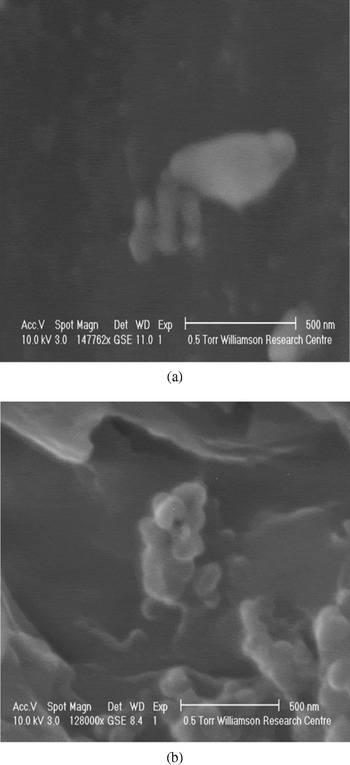
As can be seen in Fig. 3(a), submicrometre particles were seen, some of which are in the region of about 0.1 μm (note that, compared to the light microscope, a better size determination can be achieved by the use of this microscope).
(a) Symplasm viewed under the environmental SEM; (b) a hole in one of the symplasm components created by long-term exposure to the electron beam of the SEM, thereby showing that the structures seen are not inorganic particles.

Next, a technique was developed to demonstrate that the individual symplasm features observed in rain are biological in nature and not merely inorganic particles (i.e. dust). In order to achieved this differentiation, samples of rainwater containing symplasm were exposed to a longer than normal period of exposure to the electron beam. Biological particles, unlike inorganic forms, are likely to be affected by such exposure. Figure 3(b) shows that this is the case, and that the symplasm cells are holed by long-term exposure to the electron beam. This method backs up the SYBR Green II nucleic acid staining approach used here, confirming the fact that symplasm cells are biological. It is also included here in order to highlight a technique that can be used when studies are restricted to the use of the environmental SEM for differentiating between biological and inorganic samples in any environmental sample collected on Earth, or elsewhere.
A wide range of bacteria were isolated from the symplasm masses (using LB and nutrient media), showing that they are not made up of single species, but are a complex mixture of different bacteria and possibly other microorganisms. No ultrasmall bacteria were, however, isolated when rainwater containing symplasm masses were passed (without suction) through 0.2 μm membranes, showing that the individual ultrasmall bacterial seen using microscope techniques are firmly bound within the symplasm masses, which are too large to pass through the filters.
Discussion of these findings in relation to the microbiology of the stratosphere
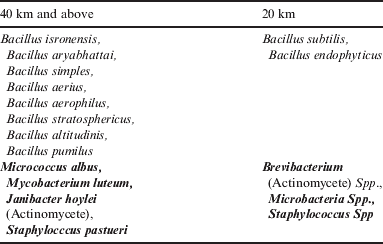
As was mentioned in the Introduction, a number of recent studies have confirmed that microorganisms, both bacteria and fungi, can be isolated from the stratosphere at heights of up to 60 km, with the majority of studies being conducted at 41 km. The range of environmental- and laboratory-based sampling techniques used in these studies would appear to exclude the possibility that these stratosphere isolates are all contaminants; we can safely conclude therefore that both bacteria and fungi do occur in the stratosphere. Assuming that some, at least, of these stratosphere organisms originate from Earth, we need to explain how they can reach these extreme heights. Although the exact mechanisms of such transfer are unknown, it is likely that the smaller the viable microbial unit involved, the greater chance it would have of being carried to the stratosphere. The fact that ultrasmall bacteria exist on Earth, therefore, obviously increases the chances of microorganisms being elevated from the surface of the planet to the stratosphere. There is, however, one paradox that needs to be addressed in relation to this possibility – namely that the ultrasmall bacteria have been isolated and characterized as belonging to the Bacteriodes, Alphaproteobacteria, Betaproteobacteria, Actinobacteria and Spirochaetes (Hahn Reference Hahn2004), Spirillum, Leucothrix, Flavobacterium, Cytophaga, Vibrio (Anderson & Heffernan Reference Anderson and Heffernan1965) and, to date, none of these bacteria have been isolated from the stratosphere; the isolated bacterial population of this region being dominated by species of Bacillus. As a result, if the bacterial flora of the stratosphere results from ultrasmall bacteria is transferred from Earth's oceans to the stratosphere one would expect that the stratosphere microflora would contain, if not be dominated by, species of ultrasmall bacteria that are commonly found on Earth. This finding might suggest that ultrasmall bacteria are not carried up into the stratosphere and that the bacteria, such as species of Bacillus commonly isolated from this region, are in fact incoming from space. Alternatively, the presence of Bacillus species in the stratosphere could follow from a reduction in cell size following starvation in Earth environments, which would reduce their size and make them amenable to the mechanisms (known or unknown) that might be capable of transferring bacteria from Earth to heights of 41 km and above (our results show, however, that this is unlikely in the case of Bacillus species). Differential survival, and or, isolation of Bacillus sp. and the other bacteria found in the stratosphere, may offer an alternative explanation. A mixed population of ultrasmall bacteria may be lifted into the stratosphere but only a few (mainly spore-forming Bacilli) might survive in this region, or be readily cultured when stratosphere-derived samples are returned to the laboratory. However, non-spore-forming bacteria, such as species of Staphylococcus, Micrococcus and Mycobacterium, have been isolated from the stratosphere (Imshenetsky et al. Reference Imshenetsky, Lysenko and Kazakov1978; Wainwright et al. Reference Wainwright, Wickramasinghe, Narlikar and Rajaratnam2003), so bacteria other than spore formers can clearly survive in this region, as can be seen from the list of bacteria that have been isolated from the stratosphere to date (Table 1).
Bacteria isolated from the stratosphere
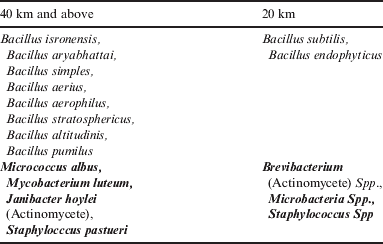
Non-spore-forming species are given in bold.
We were unable to (a) selectively isolate filterable (0.2 μm) Bacillus species from any of our environmental samples and (b) convert Bacillus species from normal laboratory-sized bacteria to filterable bacteria by the imposition of a period of growth on an oligotrophic medium. However, Miteva & Brenchley (Reference Miteva and Brenchley2005) reported the isolation (from a 120 000-year-old Greenland Glacier ice core) of several species of Bacillus isolates (described as being distinctly related to Bacillus mucilaginosus) possessing small, filterable cells and spores.
The symplasm masses observed here could have been formed (a) on Earth, or at low altitude, or (b) at high altitude in the stratosphere. In the first case, the relatively large masses formed are unlikely to be carried into the stratosphere. In the latter case, however, individual, ultrasmall bacteria might be more readily transferred from Earth to the stratosphere, where they coalesce to form symplasm masses, which then deposit readily to Earth. In this way one can envisage a cycle whereby individual ultrasmall bacteria are carried from Earth into the stratosphere and subsequently deposited to Earth after forming into high-density symplasm masses. These masses could then break up (and reproduce) in Earth environments and then be returned to the stratosphere. Such a cycle could provide a mechanism for exposing bacteria to the mutagenic effects of the high levels of ultraviolet (UV) radiation found in the stratosphere and thereby enhance the rate of bacterial evolution of Earth bacteria. It could also provide a means by which bacteria are carried across the globe, a likelihood that would be particularly important should any of these symplasm-related ultrasmall bacteria be plant, animal or human pathogens.
The absence in the stratosphere of ultrasmall bacteria commonly found in the oceans of the world suggests that such environments do not provide the main source of bacteria to the stratosphere. It should be borne in mind that Wainwright et al. (Reference Wainwright, Alharbi and Wickramasinghe2006) provided evidence in support of the view that the stratosphere contains a mixed population of bacteria comprised of those coming in from space (panspermia) and those exiting from Earth (negative panspermia).
The following points summarize our discussion.
(1) By the known mechanisms, it is likely that the smaller the particle is, the more likely it is to be transferred from Earth to the stratosphere.
(2) This suggests that stratospheric microorganisms should be predominantly species of ultrasmall bacteria that occur on Earth.
(3) However, the bacteria that have, to date, been isolated from the stratosphere are members of bacterial genera not typically isolated from Earth environments after filtration, i.e. notably species of Bacillus.
(4) The bacterial growth media used in this study was capable of isolating ultrasmall bacteria from stratospheric samples, if they are present in the stratosphere – the fact that they are not, suggests that stable, ultrasmall bacteria are not present in the stratosphere, even though such small bacteria should be more readily carried from Earth to the stratosphere than are bacteria of size larger than 1 μm.
(5) The most likely explanation for the occurrence of non-filterable, ‘large’ bacteria, identical to those found on Earth, is that small, starvation forms are carried, by some mechanism, to the stratosphere.
(6) Why representatives of the stable, ultrasmall bacteria, found in Earth's oceans are not over-represented amongst stratosphere isolates remains an enigma. It could be argued that such bacteria cannot withstand the extreme environmental conditions found in the stratosphere, as can, for example resilient, spore-forming Bacilli. However, non-spore-forming ‘large’ bacteria have also been isolated from this region. Ultrasmall Bacilli have been found in 1200-year-old ice cores in Greenland, so ancient ice may provide a source of those Bacilli that have been isolated from the stratosphere.
Acknowledgement
The study was supported in part by the Centre for Excellence and Diversity, King Saud University; we also thank the College of Science Research Center, King Saud University, Saudi Arabia, for support.