1 Introduction
The minimal faithful permutation degree
 $\mu (G)$
of a finite group G is the least integer n such that G is isomorphic to a subgroup of the symmetric group
 $S_n$
. This invariant has attracted significant attention (see, for example, [Reference Easdown and Hendriksen7–Reference Elias, Silberman and Takloo-Bighash9, Reference Johnson14, Reference Karpilovsky15, Reference Wong27]). Cannon et al. [Reference Cannon, Holt and Unger5] exploit such representations to assist with structural investigations of large-degree matrix groups.
Clearly,
 $\mu (H) \leq \mu (G)$
for every subgroup H of G, but this need not hold for quotients of G. If G has a normal subgroup N such that
 $\mu (G/N)> \mu (G)$
, then N is a distinguished subgroup,
 $G/N$
is a distinguished quotient and G is exceptional. Easdown and Praeger [Reference Easdown and Praeger8] introduced this terminology, believing that such groups are rare, and they showed that the smallest exceptional group has order 32. Kovács and Praeger [Reference Kovács and Praeger16] proved that
 $\mu (G/N) \leq \mu (G)$
if
 $G/N$
has no nontrivial abelian normal subgroup. Holt and Walton [Reference Holt and Walton12] proved that there exists a constant c such that
 $\mu (G/N) \leq c^{\mu (G) - 1}$
for every
 $N \lhd G$
. Franchi [Reference Franchi10] proved that if G is a finite nonabelian p-group with abelian maximal subgroup, then
 $\mu (G/G') \leq \mu (G)$
.
Lemieux [Reference Lemieux17] (and later Chamberlain [Reference Chamberlain6]) constructed an exceptional group of order
 $p^5$
for every odd prime p and proved that there are no exceptional groups of order dividing
 $p^4$
. Britnell et al. [Reference Britnell, Saunders and Skyner4] determined the
 $p + 6$
exceptional groups of order
 $p^5$
for
 $p \geq 5$
; since the number of groups of order
 $p^5$
is at most
 $2p + 71$
, the proportion of exceptional groups of order
 $p^5$
is asymptotically
 $1/2$
. Hence, they questioned whether ‘exceptional’ is an apposite descriptor for such groups. By contrast, we prove the following theorem.
Theorem 1.1. The proportion of exceptional groups of order
 $p^6$
for primes
 $p \geq 5$
is asymptotically zero.
We prove this theorem by obtaining in Theorem 3.11 an upper bound to the number of such groups, and so we establish that the proportion of exceptional groups is
 $O(1/p)$
. We identify
 $(11p+107)/2$
exceptional groups of order
 $p^6$
and conjecture that there are no others.
For completeness, we report that 32 of the 267 groups of order
 $2^6$
are exceptional, as are 67 of the 504 groups of order
 $3^6$
. This computation takes about ten minutes of CPU time using the SmallGroups library [Reference Besche, Eick and O’Brien2] and Magma 2.28-13 [Reference Bosma, Cannon and Playoust3] on a 2.6 GHz machine. The identifiers of these groups are recorded at [Reference O’Brien, Prajapati and Udeep23].
2 Background and notation
Let
 $p\geq 5$
be prime. Let
 $\omega $
be the smallest positive integer that is a primitive root modulo p, and let
 $\nu $
be the smallest positive integer that is a quadratic nonresidue modulo p.
Let
 $Z(G)$
,
 $G'$
and
 $d(G)$
denote, respectively, the centre, commutator subgroup and minimal number of generators of a p-group G. Let
 $\mathrm {cd}(G)$
and
 $\exp (G)$
denote, respectively, the set of irreducible character degrees and exponent of G.
A quasi-permutation matrix is a square matrix over the complex field with nonnegative integral trace. Wong [Reference Wong27] defined a quasi-permutation representation of G as one consisting of quasi-permutation matrices. Let
 $c(G)$
denote the minimal degree of a faithful quasi-permutation representation of G. It is easy to deduce that
 $c(G)\leq \mu (G)$
; Behravesh and Ghaffarzadeh [Reference Behravesh and Ghaffarzadeh1, Theorem 3.2] proved that
 $c(G) = \mu (G)$
for a p-group G of odd order.
Newman et al. [Reference Newman, O’Brien and Vaughan-Lee20] established that there are
 $$ \begin{align} 3p^2 + 39 p + 344 + 24\gcd(p-1,3) + 11 \gcd(p-1,4) + 2 \gcd(p-1,5) \end{align} $$
groups of order
 $p^{6}$
where
 $p \geq 5$
. The groups are classified into 43 isoclinism families labelled
 $\Phi _{i}$
for
 $1 \leq i \leq 43$
; the first ten also contain groups of order dividing
 $p^5$
. Invariants for these families are tabulated in [Reference James13]; these include the structures of the derived group and the central quotient, and the character degrees. Parametrised presentations are listed in [Reference Newman, O’Brien and Vaughan-Lee21] for the groups of order
 $p^6$
and in [Reference James13] for orders dividing
 $p^5$
. (See [Reference O’Brien, Prajapati and Udeep22, Remark 3.3] for those few presentations of 5-groups not covered by [Reference Newman, O’Brien and Vaughan-Lee21].) We use the identifiers of [Reference Newman, O’Brien and Vaughan-Lee21] for groups of order
 $p^6$
and those of [Reference James13] for quotients. The values of
 $c(G)$
and
 $\mu (G)$
for the groups G of order
 $p^5$
and
 $p^6$
are available in [Reference O’Brien, Prajapati and Udeep22, Reference Prajapati and Udeep26], respectively.
As is well known (see, for example, [Reference Johnson14, Theorem 2]), if
 $G \cong C_{p^{n_1}} \times \cdots \times C_{p^{n_k}}$
, then
 $\mu (G) = \sum _{i=1}^k p^{n_i}$
. Clearly, no abelian group is exceptional. All 11 abelian groups of order
 $p^6$
are in
 $\Phi _1$
.
3 An upper bound to the number of exceptional groups of order
 $p^6$

We obtain an upper bound to the number of exceptional groups of order
 $p^6$
and so prove Theorem 1.1.
As in [Reference Lewis, Bianchi, Longobardi, Maj and Scoppola18], a group G is VZ if
 $\chi (g)=0$
for all
 $g\in G\setminus Z(G)$
and all nonlinear characters
 $\chi $
of G.
Lemma 3.1. Let G be a VZ group of order
 $p^6$
. If
 $d(Z(G)) = d(G')$
and
 $|Z(G)| = p^2$
, then G is not exceptional.
Proof. From [Reference Prajapati and Udeep25, Corollary 4], we deduce that
 $$ \begin{align*} c(G) = \begin{cases} 2p^3 &\text{ if } Z(G) \cong C_p \times C_p,\\ p^4 &\text{ if } Z(G) \cong C_{p^2}. \end{cases} \end{align*} $$
If G has a quotient Q of order
 $p^4$
, then Q is not distinguished. Let
 $Q = G/N$
, where
 $|N| = p$
. Since
 $N \leq Z(G)$
,
 $$ \begin{align*} \frac{G}{Z(G)} \cong \frac{G/N}{Z(G)/N}. \end{align*} $$
From [Reference Lewis19, Lemma 2.4],
 $G/Z(G)$
is elementary abelian. Since
 $Z(G)/N \cong C_{p}$
, we conclude that
 $\exp (G/N) \leq p^2$
. If
 $\mathrm {cd}(Q) = \{ 1, p \}$
, then
 $c(Q) \leq 2p^3$
(see [Reference Prajapati and Udeep24, Theorem 3]). If
 $\mathrm {cd}(Q) = \{ 1, p^2 \}$
, then
 $Q\in \Phi _{5}$
(see [Reference James13, Section 4.1]). Hence, Q is a VZ group with centre of order p and
 $c(Q) = p^3$
(see [Reference Prajapati and Udeep25, Corollary 4]). If
 $\mathrm {cd}(Q) = \{ 1, p, p^2 \}$
, then
 $Q\in \Phi _{i}$
, where
 $i \in \{ 7, 8, 10 \}$
and
 $c(Q) = p^3$
(see [Reference James13, Section 4.1]).
Corollary 3.2. No group in
 $\Phi _{15}$
is exceptional.
Proof. If
 $G \in \Phi _{15}$
, then
 $d(Z(G)) = d(G')$
and
 $|Z(G)| = p^2$
(see [Reference Newman, O’Brien and Vaughan-Lee21]). Lemma 3.1 shows that G is not exceptional.
Lemma 3.3. No group in
 $\Phi _{21}$
is exceptional.
Proof. If
 $G \in \Phi _{21}$
, then
 $\exp (G) \leq p^2$
(see [Reference Newman, O’Brien and Vaughan-Lee21, Table 1]). By [Reference Behravesh and Ghaffarzadeh1, Theorem 3.2] and [Reference O’Brien, Prajapati and Udeep22, Lemma 4.28], we deduce that
 $\mu (G) = 2p^3$
. Let
 $1\neq N \lhd G$
and let
 $Q = G/N$
. If Q is cyclic, then it is not distinguished (see [Reference Britnell, Saunders and Skyner4, Lemma 1.2]). Suppose that Q is not cyclic. If
 $|Q| = p^4$
, then
 $\mu (Q) \leq 2p^3$
(see [Reference Lemieux17, Table 1]. Suppose that
 $|Q| = p^5$
. If Q is abelian, then
 $\mu (Q) < 2p^3$
since
 $\exp (Q) \leq p^2$
. If Q is nonabelian, then
 $\mathrm {cd}(Q) \in \{ \{ 1, p \}, \{ 1, p^2 \}, \{ 1, p, p^2 \} \}$
. If
 $\mathrm {cd}(Q) = \{ 1, p \}$
, then
 $\mu (G) \leq 2p^3$
(see [Reference Behravesh and Ghaffarzadeh1, Theorem 3.2] and [Reference Prajapati and Udeep24, Theorem 3]). If
 $\mathrm {cd}(Q) \in \{ \{ 1, p^2 \}, \{ 1, p, p^2 \} \}$
, then
 $Q \in \Phi _{i}$
, where
 $i\in \{ 5,7,8,10 \}$
(see [Reference James13, Section 4.1]). Hence,
 $\mu (Q) \in \{ p^2, p^3 \}$
(see [Reference O’Brien, Prajapati and Udeep22, Tables 1 and 2]).
Lemma 3.4. No group in
 $\Phi _{i}$
for
 $$ \begin{align*} i \in \{ 22,24,27,30, 31, 32,33,35,36, 37, 38, 39, 40,41 \} \end{align*} $$
is exceptional.
Proof. We consider the families in turn. Let G be a group of order
 $p^6$
.
-
•
$\Phi _{22}$
,
$\Phi _{27}$
and
$\Phi _{30}$
: If G is in one of these families, then
$\mu (G) \in \{ p^3, p^4\}$
(see [Reference O’Brien, Prajapati and Udeep22, Tables 3 and 7]) and
$\exp (G) \leq p^2$
(see [Reference Newman, O’Brien and Vaughan-Lee21]). Let Q be a quotient of G. If
$|Q| = p^4$
, then
$\mu (Q) \leq p^3$
. Suppose that
$|Q| = p^5$
. If
$G\in \Phi _{22}$
, then
$Q = G/Z(G) \cong \phi _{2}(1^5)$
; if
$G\in \Phi _{27}$
, then
$Q = G/Z(G) \cong \phi _{3}(1^5)$
; if
$G\in \Phi _{30}$
, then
$Q = G/Z(G) \cong \phi _{7}(1^5)$
(see [Reference James13, Section 4.1]). So
$\mu (Q) \leq p^3$
. Hence,
$\mu (Q) \leq \mu (G)$
and G has no distinguished quotients. -
•
$\Phi _{24}$
: If G is in this family, then
$\mu (G) = p^3$
(see [Reference O’Brien, Prajapati and Udeep22, Table 3]) and
$\exp (G) \leq p^2$
(see [Reference Newman, O’Brien and Vaughan-Lee21]). Let Q be a quotient of G. If
$|Q| = p^4$
, then
$\mu (Q) \leq p^3$
. Suppose that
$|Q| = p^5$
. Now,
$Q = G/Z(G) \cong \phi _{3}(1^5)$
(see [Reference James13, Section 4.1]), so
$\mu (Q) = p^2 + p$
. Hence,
$\mu (Q) \leq \mu (G)$
and G has no distinguished quotients. -
•
$\Phi _{31}$
,
$\Phi _{32}$
and
$\Phi _{33}$
: If G is in one of these families, then
$\mu (G) \in \{ p^3, p^4 \}$
(see [Reference O’Brien, Prajapati and Udeep22, Tables 3 and 7]) and
$\exp (G) \leq p^2$
(see [Reference Newman, O’Brien and Vaughan-Lee21]). Let Q be a quotient of G. If
$|Q| = p^4$
, then
$\mu (Q) \leq p^3$
. Suppose that
$|Q| = p^5$
. Now,
$Q = G/Z(G) \cong \phi _{4}(1^5)$
(see [Reference James13, Section 4.1]), so
$\mu (Q) = 2p^2$
. Hence,
$\mu (Q) \leq \mu (G)$
and G has no distinguished quotients. -
•
$\Phi _{36}$
and
$\Phi _{38}$
: If G is in one of these families, then
$\mu (G) = p^3$
(see [Reference O’Brien, Prajapati and Udeep22, Table 3]) and
$\exp (G) \leq p^2$
(see [Reference Newman, O’Brien and Vaughan-Lee21]). Let Q be a quotient of G. If
$|Q| = p^4$
, then
$\mu (Q) \leq p^3$
. Suppose that
$|Q| = p^5$
. If
$G\in \Phi _{36}$
, then
${Q = G/Z(G) \cong \phi _{9}(1^5)}$
; if
$G\in \Phi _{38}$
, then
${Q = G/Z(G) \cong \phi _{10}(1^5)}$
(see [Reference James13, Section 4.1]). So
$\mu (Q) \leq p^3$
. Hence,
$\mu (Q) \leq \mu (G)$
and G has no distinguished quotients. -
•
$\Phi _{37}$
and
$\Phi _{39}$
: If G is in one of these families, then
$\mu (G) \in \{ p^3, p^4\}$
(see [Reference O’Brien, Prajapati and Udeep22, Tables 3 and 7]) and
$\exp (G) \leq p^2$
(see [Reference Newman, O’Brien and Vaughan-Lee21]). Let Q be a quotient of G. If
$|Q| = p^4$
, then
${\mu (Q) \leq p^3}$
. Suppose that
$|Q| = p^5$
. If
$G\in \Phi _{37}$
, then
$Q = G/Z(G) \cong \phi _{9}(1^5)$
; if
$G\in \Phi _{39}$
, then
$Q = G/Z(G) \cong \phi _{10}(1^5)$
(see [Reference James13, Section 4.1]). So
$\mu (Q) \leq p^3$
. Hence,
$\mu (Q) \leq \mu (G)$
and G has no distinguished quotients. -
•
$\Phi _{40}$
and
$\Phi _{41}$
: If G is in one of these families, then
$\mu (G) = p^3$
(see [Reference O’Brien, Prajapati and Udeep22, Table 3]) and
$\exp (G) \leq p^2$
(see [Reference Newman, O’Brien and Vaughan-Lee21]). Let Q be a quotient of G. If
$|Q| = p^4$
, then
$\mu (Q) \leq p^3$
. If
$|Q| = p^5$
, then
$Q = G/Z(G) \cong \phi _{9}(1^5)$
(see [Reference James13, Section 4.1]). So
$\mu (Q) = 2p^2$
. Hence,
$\mu (Q) \leq \mu (G)$
and G has no distinguished quotients.


Lemma 3.5. Let G be a nonabelian group of order
 $p^6$
. If
 $\exp (G) \leq p^3$
and
 $\mu (G) = p^4$
, then G is not exceptional.
Proof. If
 $|Q| = p^4$
, then it is not a distinguished quotient of G. Suppose that
 $|Q| = p^5$
. If Q is abelian, then
 $\mu (Q) < p^4$
since
 $\exp (G) \leq p^3$
. If Q is nonabelian, then
 $\mu (Q) \leq p^4$
(see [Reference O’Brien, Prajapati and Udeep22, Tables 1 and 2]).
Lemma 3.6. No group in
 $\Phi _{i}$
for
 $i \in \{ 25,26,42,43 \}$
is exceptional.
Proof. If G is in one of these families, then
 $\exp (G) \leq p^3$
(see [Reference Newman, O’Brien and Vaughan-Lee21]) and
 $\mu (G) = p^4$
(see [Reference O’Brien, Prajapati and Udeep22, Table 7]). Lemma 3.5 shows that G is not exceptional.
Lemma 3.7. The only exceptional group in
 $\Phi _{28}$
is
 $G_{(28, 2r)}$
, where
 $r=p-1$
.
Proof. If
 $G \in \Phi _{28}$
, then (see [Reference O’Brien, Prajapati and Udeep22, Tables 3 and 7])
 $$ \begin{align*} \mu(G) = \begin{cases} p^3 & \text{if } G = G_{(28,2r)} \text{ where } r = p-1,\\ p^4 & \text{otherwise}. \end{cases} \end{align*} $$
Let G have a quotient Q of order
 $p^5$
. Now,
 $Q = G/Z(G) \cong \phi _{3}(221)b_1$
(see [Reference James13, Section 4.1]), so
 $\mu (G/Z(G)) = p^3 + p^2$
. Therefore, if
 $G = G_{(28,2r)}$
where
 $r = p-1$
, then
 $\mu (G) < \mu (G/Z(G))$
. If G is any other group in
 $\Phi _{28}$
, then Q is not distinguished. But
 $\mu (G) = p^4$
, and thus G has no distinguished quotient of order
 $p^4$
, and so G is not exceptional.
We omit the proofs of the next two lemmas; both are similar to that of Lemma 3.7.
Lemma 3.8. The only exceptional group in
 $\Phi _{29}$
is
 $G_{(29, 2r)}$
, where
 $r=p-1$
.
Groups with minimal degree at least
 $p^4$
.

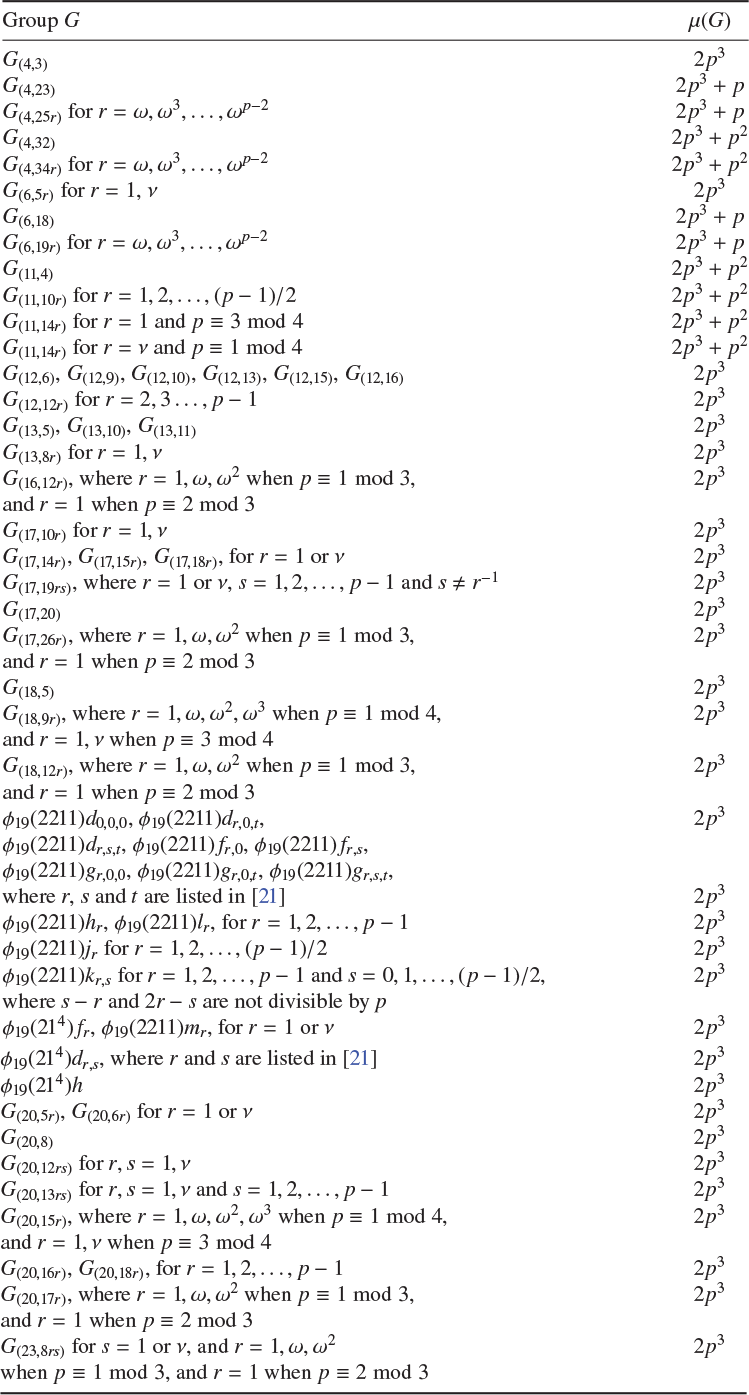
Groups with exponent at most
 $p^2$
and minimal degree at least
 $2p^3$
.

Lemma 3.9. The only exceptional group in
 $\Phi _{34}$
is
 $G_{(34, 1)}$
.
Lemma 3.10. Let G be a nonabelian group of order
 $p^6$
satisfying one the following:
-
(i)
$\mu (G) \geq p^4$
and
$\exp (G) \leq p^3$
; or -
(ii)
$\mu (G) = 2p^3$
and
$\exp (G) \leq p^2$
.


Then G is not exceptional.
Proof. Let
 $1\neq N \lhd G$
and let
 $Q= G/N$
. If Q is cyclic, then it is not distinguished. Suppose that Q is not cyclic. If
 $|Q| \leq p^4$
, then
 $\mu (Q) \leq p^3$
(see [Reference Lemieux17, Table 1]).
Suppose that
 $|Q| = p^5$
. We first prove part (i). If Q is abelian, then
 $\mu (Q) \leq p^3+p^2$
since
 $\exp (Q) \leq p^3$
. If Q is nonabelian, then
 $\mu (Q) \leq p^4$
(see [Reference Prajapati and Udeep26, Theorem 1.1]). Hence, if
 $\mu (G) \geq p^4$
, then G is not exceptional.
We now prove part (ii). Assume that
 $\mu (G) = 2p^3$
and
 $\exp (G) \leq p^2$
. From [Reference Behravesh and Ghaffarzadeh1, Theorem 3.2] and [Reference Prajapati and Udeep24, Theorem 3], we deduce that
 $\mu (Q) \leq d(Z(Q))p^3$
. Thus, if
 $d(Z(Q)) \leq 2$
, then
 $\mu (Q) \leq 2p^3 = \mu (G)$
. If
 $d(Z(Q)) = 3$
, then
 $Q \in \Phi _2$
(see [Reference James13, Section 4.1]). Tables 1 and 2 of [Reference Prajapati and Udeep26] show that
 $\mu (Q) \leq p^3+p^2$
. Hence, G is not exceptional.
Theorem 3.11. The number of exceptional groups of order
 $p^6$
is at most
 $$ \begin{align*} \frac{(33p +467)}{2} + 6\gcd(p-1, 3) + 3\gcd(p-1, 4). \end{align*} $$
Proof.
-
• By Corollary 3.2, the
$p+3$
groups in
$\Phi _{15}$
are not exceptional. -
• By Lemma 3.3, the
$(3p^2+4p+5)/2$
groups in
$\Phi _{21}$
are not exceptional. -
• By Lemma 3.6, the
$3p+4$
groups in
$\Phi _{i}$
, where
$i\in \{ 25,26,42,43 \}$
, are not exceptional. -
• By Lemma 3.4, the
$2p+45+10\gcd (p-1,3)+5\gcd (p-1,4)+2\gcd (p-1,5)$
groups in
$\Phi _{i}$
, where
$i \in \{ 22,24,27,30, 31, 32,33,35,36, 37, 38, 39, 40,41 \}$
, are not exceptional. -
• By Lemmas 3.7–3.9, the
$2p$
groups in
$\Phi _{i}$
, where
$i\in \{ 28,29,34 \}$
, are not exceptional. -
• By [Reference O’Brien, Prajapati and Udeep22, Tables 1–3, 5 and 6], there are
$p+28+2\gcd (p-1,3)+\gcd (p-1,4)$
groups of order
$p^6$
in
$\Phi _{i}$
, where
$i \in \{ 2,3,4,5,6,7,8,9,10,14 \}$
, that have minimal degree at least
$p^4$
. By Lemma 3.10, they are not exceptional. We list these groups in Table 1. -
• By [Reference O’Brien, Prajapati and Udeep22, Tables 4–6], there are
$(3p^2+23p+56)/2+6\gcd (p-1,3)+2\gcd (p-1,4)$
groups of order
$p^6$
in
$\Phi _{i}$
, where
$i \in \{ 4,6,11,12,13,16,17,18,19,20,23 \}$
, that have exponent at most
$p^2$
and minimal degree at least
$2p^3$
. By Lemma 3.10, they are not exceptional. We list these groups in Table 2.We deduce that at least groups of order
$$ \begin{align*} 3p^2 + \frac{45p+221}{2} + 18\gcd(p-1,3) + 8\gcd(p-1,4)+ 2\gcd(p-1,5) \end{align*} $$
$p^6$
are not exceptional. The claim follows from (2.1).


Theorem 1.1 is an immediate consequence.
4 A lower bound to the number of exceptional groups of order
$p^6$

In Table 3 we identify
 $(11p+107)/2$
exceptional groups of order
 $p^6$
. For each group G, we list a generating set for a distinguished subgroup N. Group identifiers for G and
 $G/N$
are those from [Reference James13, Reference Newman, O’Brien and Vaughan-Lee21], respectively; but we identify the distinguished quotient of
 $G_{(4, 38)}, G_{(4, 39)}$
and
 $G_{(11, 11)}$
as
 $G_{46}$
(see [Reference Girnat11, Section 6.5]). The values of
 $\mu (G)$
and
 $\mu (G/N)$
are extracted from [Reference O’Brien, Prajapati and Udeep22, Tables 2 and 3] and [Reference Prajapati and Udeep26, Tables 1–3], respectively.
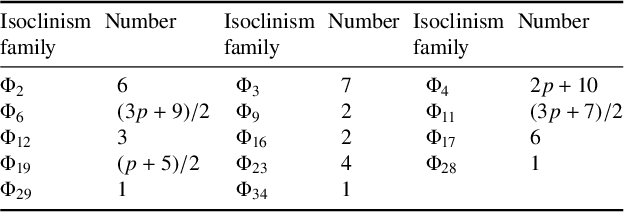
In Table 4 we record the number of exceptional groups in those isoclinism families listed in Table 3. By summing these values, we deduce that the number of exceptional groups of order
 $p^6$
is at least
 $(11p+107)/2$
. Using the machinery of [Reference O’Brien, Prajapati and Udeep22, Section 6] in Magma, we established that the number of exceptional groups of order
 $p^6$
for
 ${5 \leq p \leq 13}$
is precisely this value. This provides evidence to support the following conjecture.
Conjecture 4.1. The number of exceptional groups of order
 $p^6$
for primes
 $p \geq 5$
is
 $(11p+107)/2$
.
5 Access to results
The data recorded in Table 3 is publicly available in Magma via a GitHub repository [Reference O’Brien, Prajapati and Udeep23]. For each exceptional group in that table, we record a presentation and a generating set for a distinguished subgroup. The available code can be used to verify our claims for ‘small’ primes.
Exceptional groups of order
 $p^6$
.

Number of exceptional groups in some isoclinism families.