Background
In many countries around the world, generalist teachers are responsible for the delivery of music teaching. Twenty years ago, Mills (Reference MILLS1991) supported the notion of generalist teachers teaching music, suggesting that just as music should be for all children, it also should be for all teachers. Yet, numerous studies suggest that generalist teachers feel incapable of teaching music in the classroom (Temmerman, Reference TEMMERMAN1997; Oreck, Reference ORECK2001, Reference ORECK2004; Alter et al., Reference ALTER, HAYS and O'HARA2009).
A generalist teacher's ability to teach a particular subject is determined by their level of self-efficacy. Teacher self-efficacy is defined as ‘beliefs in one's capabilities to organise and execute the courses of action required to produce given attainments’ (Bandura, Reference BANDURA1997, p. 3). People use efficacy beliefs to guide their lives by being self-organising, pro-active, self-regulating and self-reflecting. This means that people may regulate their own behaviour through motivation, thought processes, affective states and actions or changing environmental conditions based around their efficacy beliefs (Bandura, Reference BANDURA, Pajares and Urdan2006).
Within Australia, literature has explored teacher preparation in music education from a variety of perspectives. Much of the literature has examined the minimal preparation that beginning teachers receive, the confidence of generalist teachers towards music (Alter et al., Reference ALTER, HAYS and O'HARA2009), beginning teacher's understandings of their musicality (Kane, Reference KANE2008), praxis-shock because of isolation and burn-out of early career music teachers (Ballantyne, Reference BALLANTYNE2007), and previous musical background (Russell-Bowie, Reference RUSSELL-BOWIE2002). Little research has been conducted on levels of teacher self-efficacy for music, measuring perceived capability as defined by Bandura's self-efficacy theory (1997). When drawing on self-efficacy theory, confidence alone is meaningless if it is not accompanied by competence (Bartel et al., Reference BARTEL, CAMERON, WIGGINS, WIGGINS and Shand2004) Greater research into this motivational construct is therefore necessary.
Teacher self-efficacy
Teacher self-efficacy beliefs determine the level to which the teacher will teach in the classroom. It has proven to be profoundly powerful in predicting outcomes for a variety of endeavours (Bandura, Reference BANDURA1997; McPherson & McCormick, Reference McPHERSON and McCORMICK2006). It has been related to student achievement (Armor et al., Reference ARMOR, CONROY-OSEGUERA, COX, KING, McDONNELL, PASCAL, PAULY and ZELLMAN1976; Ashton & Webb, Reference ASHTON and WEBB1986; Moore & Esselman, Reference MOORE and ESSELMAN1992; Ross, Reference ROSS1992); student motivation (Midgley et al., Reference MIDGLEY, FELDAUFER and ECCLES1989); student attitude towards school and teachers (Woolfolk et al., Reference WOOLFOLK, ROSOFF and HOY1990); and students’ own sense of efficacy (Anderson et al., Reference ANDERSON, GREENE and LOEWEN1988). Teacher efficacy beliefs have also been related to teacher behaviour with higher efficacy leading to decreased burnout (Brouwers & Tomic, 2003); increased job satisfaction (Caprara et al., Reference CAPRARA, BARBARANELLI, BORGOGNI and STECA2003); commitment to teaching (Coladarci, Reference COLADARCI1992); greater levels of planning and organisation (Allinder, Reference ALLINDER1994); being less critical of students when they make errors (Ashton & Webb, Reference ASHTON and WEBB1986); working longer with students who are struggling (Gibson & Dembo, Reference GIBSON and DEMBO1984); and using a wider variety of teaching material with the desire to search for a new teaching formulae and the use of innovating teaching methods (Ghaith & Yaghi, Reference GHAITH and YAGHI1997; Wertheim & Leyser, Reference WERTHEIM and LEYSER2002). Teachers with low levels of teacher self-efficacy put less effort into planning and teaching and give up more easily on students. It is for this reason Woolfolk (see interview with Shaughnessy, Reference SHAUGHNESSY2004) suggests that teachers who seek to help students increase their academic and self-regulatory self-efficacy should first attend to the sources underlying their beliefs. These beliefs therefore act as validation beliefs of capabilities with the teaching of arts education. Since teacher's efficacy beliefs affect teaching and teacher's professional lives, their origins, supports and ‘enemies’ of these beliefs are important to teacher educators, administrators and policy makers.
Teacher self-efficacy is developed through the interaction between an individual's judgement of their teaching ability to perform a task and their perception of the actions required to perform that task successfully. This type of interaction is the self-efficacy process defined by Bandura (Reference BANDURA1986). Teacher self-efficacy is responsible for the motivation and the actual amount of effort that an individual will bring to the task as they access their ability to perform the teaching task successfully.
There are four sources of efficacy that inform teacher self-efficacy beliefs. These are: mastery experience; verbal persuasion; vicarious experiences; and emotional arousal (Bandura, Reference BANDURA1997). Successful mastery experience of a task will strengthen teacher self-efficacy. Emotional arousal is the level of excitement or anxiety associated with the teaching task. Vicarious experience acknowledges the use of modelling of the task and observation. Finally, verbal persuasion is associated feedback from undertaking a teaching task. It includes words of praise from colleagues or assistance and advice for future actions of work.
Bandura (Reference BANDURA1997) postulated that the higher the sense of self-efficacy, the greater the perseverance and the higher the chance that the pursued activity will be performed successfully. Teachers with higher self-efficacy were likely to put more effort into planning and teaching, to have higher expectations of students and to find strategies that would help students learn (Bandura, Reference BANDURA1997). Beliefs appeared to be influenced by confidence (Tosun, Reference TOSUN2000), level of content knowledge for a subject (Borko & Putnam Reference BORKO, PUTNAM, Guskey and Huberman1995; Muijs & Reynolds, Reference MUIJS and REYNOLDS2001) and support structures available (Ashton & Webb, 1987).
Bandura (Reference BANDURA1997) theorises that teacher self-efficacy is still forming within the beginning phase of teaching. Once developed however, it can be resistant to change (Bandura, Reference BANDURA1997). During reflection on their beliefs, if beginning teachers perceive a task as difficult, they may simply lower the quality of their teaching, lowering their standards in an attempt to avoid self-assessment of failure (Tschannen-Moran & Woolfolk Hoy, Reference TSCHANNEN-MORAN and WOOLFOLK HOY2007).
Within music, there is a gap in teacher self-efficacy research. Studies that have been conducted suggest early childhood pre-service teachers can be supported in their teacher self-efficacy for music (Vannatta-Hall, Reference VANNATTA-HALL2010) and primary pre-service teachers can also have raised teacher self-efficacy if they have supportive teaching staff (Telemachou, Reference TELEMACHOU2007). Few studies have examined teacher self-efficacy for music during the beginning years of teaching after graduation from teacher education programmes.
Focus of research
In Australia, limited research exists on beginning generalist teachers’ perceived capability to teach music to students in years four to nine, based on the lens of Bandura's self-efficacy theory. This study forms part of the author's thesis work, exploring this research gap. The thesis explores beginning teacher self-efficacy for arts education (Garvis, 2010). This paper reports on a smaller section of that study that explores music teaching by generalist teachers. It examines beginning generalist teacher self-efficacy for music compared with English and maths over the first three years of teaching.
The beginning phase of teaching is considered an important period in teacher self-efficacy development (Bandura, Reference BANDURA1997). During this time teachers learn about their own perceived capability in teaching within a new context of their own classroom. As teachers gain mastery experience in teaching certain subject areas, their level of teacher self-efficacy for that subject will increase. Since it is hypothesised that teacher self-efficacy forms in the beginning phase of teaching, this study decided to focus on beginning generalist teachers still within the first three years since their graduation from teacher education. For this study, beginning generalist teachers are defined as those teachers still within the first three years of commencement of work as a teacher.
Teacher self-efficacy for music will also be compared with teacher self-efficacy for maths and English over the three years. Maths and English have been chosen for comparison as the key focuses in Queensland curriculum and teacher training. According to the Queensland College of Teachers who govern teacher education in Queensland, ‘universities must ensure primary teachers are well-prepared to teach English and mathematics key learning areas and able to teach across the key learning areas of Study of Society and Environment, Science, Technology and the Arts’ (Queensland College of Teachers, 2007, p. 20).
Two research questions guide this study. These are:
1. What are the current means for teacher self-efficacy for music, English and maths?
2. Does teacher self-efficacy for music compared with teacher self-efficacy for English and maths increase/decrease during the beginning phase of teaching?
Research method
In 2008, a total of 201 beginning generalist teachers (first three years of teaching since graduation) responded to a call to take part in teacher self-efficacy research. Respondents were recruited by advertising in professional teacher organisations, at schools and at beginning teacher conferences. An information letter was provided to potential participants. If a beginning teacher expressed an interest in participating, they were provided with contact details of the researcher. The questionnaire was then emailed to the participant. Participants were advised that on return of their questionnaire, all information would immediately be de-identified. Two hundred and one beginning generalist teachers responded, with an almost 100% response rate. Beginning teachers were located in state, independent and Catholic schools.
The questionnaire
The questionnaire was adapted from the Teachers’ Sense of Efficacy Scale (Tschannen-Moran & Woolfolk Hoy, Reference TSCHANNEN-MORAN and WOOLFOLK HOY2001) by providing a greater focus on the domain specificity of music. The main aim of the questionnaire was to measure beginning teacher self-efficacy for music teaching through personal ranking of their perceived capability.
Wording within the questionnaire was changed to be more specific to the content (music, English, maths) and context (students aged 9 to 14 years). In the questionnaire for example, question 4 which read:
4. How much can you do to help your students value learning? (Original questionnaire)
Was adapted to read:
4. How much can you do to help your students value learning in:
The questionnaire consisted of 24 items that were designed to measure the motivational construct of teacher self-efficacy (see Appendix 1 for the 24 items used). The scale consists of a 9-point Likert scale, based on Bandura's instructional scale for teacher self-efficacy (Bandura, Reference BANDURA1997, Reference BANDURA, Pajares and Urdan2006; Tschannen-Moran & Woolfolk Hoy, Reference TSCHANNEN-MORAN and WOOLFOLK HOY2001). The scale is unipolar with no negative numbers, based on the concept that there are no lower gradations beyond incapability (Bandura, Reference BANDURA, Pajares and Urdan2006). Anchors occurred at 1 – Nothing, 3 – Very Little, 5 – Some Influence, 7 – Quite A Bit and 9 – A Great Deal. The instructions direct the teacher to ‘Please respond to each of the questions by considering the combination of your current ability to do each of the following in your present position’.
The scale includes three 8-item subscales: efficacy for instructional strategies, efficacy for classroom management and efficacy for student engagement. In previous research, reliabilities for the full scale have ranged from 0.92 to 0.95, and for the subscales from 0.86 to 0.90 (Tschannen-Moran & Woolfolk Hoy, Reference TSCHANNEN-MORAN and WOOLFOLK HOY2007). The focus of this part of the study was only interested in the full scale for self-efficacy.
The preparation of the questionnaire included a review of instructions and procedures to minimise response bias. Safeguards were built into the instructions and the mode of administration of the questionnaire to minimise the effects of self-assessment. These included conducting the study without personal identification to reduce social evaluative concern, respondents being informed that their responses remain confidential and the scale being identified by code number, rather than name (Bandura, Reference BANDURA, Pajares and Urdan2006). Furthermore, Bandura (Reference BANDURA, Pajares and Urdan2006, p. 314) suggests that in order to encourage frank answers, ‘explain to the respondents the importance of their contribution to the research’. Accordingly, all correspondence with the participants emphasised the importance of their contribution.
Demographics
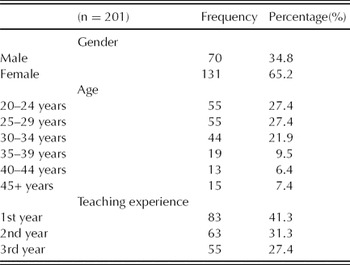
The respondents were 201 beginning generalist teachers of students aged 9–14 years throughout Queensland. Participants were aged between 21 and 52 years. The majority of beginning teachers were under 35 years of age (76.7%). Characteristics of the sample are presented in Table 1.
Characteristics of the sample

Results for the gender of teachers (65.2% female and 34.8% male) were similar to the reported ratio of 68.7% (female) and 31.3% (male) by the Australian Bureau of Statistics (2002) for the teaching profession.
Beginning teachers who participated were divided into three groups: first-year teachers (n = 83), second-year teachers (n = 63) and third-year teachers (n = 55). The data were analysed using descriptive statistics and analysis of variance (ANOVA) to test for significant difference between beginning teacher self-efficacy for each group and the perceived support within schools. ANOVA is a general technique that can be used to test the hypothesis that the means among two or more groups are equal, under the assumption that the sampled populations are normally distributed. A power test was also conducted to test the overall power of the significant differences. Results are presented below.
Results
The results in this section provide answers to the two research questions: (1) What are the current means for teacher self-efficacy for music, English and maths?; and (2) Does teacher self-efficacy for music compared with teacher self-efficacy for English and maths increase/decrease during the beginning phase of teaching? A factor analysis is conducted first to test reliability.
Factor analysis, reliability and means
Since it is a relatively new measure, the adapted version of the Teacher Sense of Efficacy scale was tested using factor analysis and reliability analysis. A mean for teacher self-efficacy for music, English and maths was produced (research question 1). Then the scores of beginning teachers were examined for differences between years of experience (research question 2). Each section is presented below.
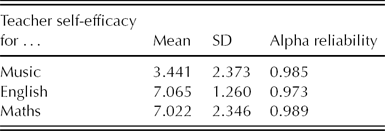
A second-order factor analysis was conducted to test the appropriateness of using an adapted version of the full TSES scale. All three factors within each subject area loaded on a single factor with eigenvalues of 2.026 for music (67% of variance explained), 2.599 for English (86% of variance explained) and 2.665 for maths (88% of variance explained). Consequently, the full scale was used in the analyses. The reliability of the full 24-item scales was 0.98 for music, 0.97 for English and 0.98 for maths. Means and standards deviations of music, English and maths are presented in Table 2. The mean for teacher self-efficacy for music was 3.44, compared with 7.06 for English and 7.02 for maths.
Teachers’ Sense of Efficacy Scales
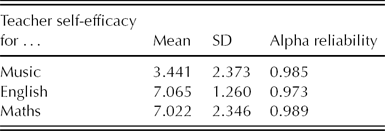
ANOVA tests were conducted between teaching experience and the individual subject levels of teacher self-efficacy to determine if teacher self-efficacy varied between years of experiences.
While the data appeared statistically significant, the variance needed to be tested to see if it was homogeneous. In the test of homogeneity of Variance using Levene's Statistic (Levene, Reference LEVENE, Olkin and Hotelling1960), only English appeared as homogeneous in variance. A robust test using Welch and Brown–Forsythe was therefore conducted with a significance level of 0.05. Under this test, all individual subscales were significant. Multiple comparisons were then made between the dependent variables using either Tukey HSD tests or Games–Howell tests, with SPSS showing levels of significance below 0.05. It appears that there was significant difference for teacher self-efficacy with years of experience for music, English and maths.
There was significant difference in teacher self-efficacy for music between one year experience and two and three years experience tested, F(2,198) = 10.539, p < 0.05. The mean for teacher self-efficacy for music decreased from 4.27 in the first year to 3.11 in the second year and 2.54 in the third year of teaching.
There was also significant difference in teacher self-efficacy for English between one years experience and three years experience tested, F(2, 198) = 6.786, p < 0.05. The mean for teacher self-efficacy for English increased in the first year from 6.70 to 7.47 in the third year of teaching. There was no significant difference between first and second years of teaching.
The mean for teacher self-efficacy for maths increased in the first year from 6.78 to 7.35 in the second year, to 7.71 in the third year of teaching. There was a significant difference in teacher self-efficacy for maths between one year of experience and two and three years of experience tested, F(2,198) = 7.104, p < 0.05.
Discussion and implications
It is of both theoretical and practical importance to understand the importance of teacher self-efficacy for music and the sources that inform teacher self-efficacy when teachers make assessment judgements about their own perceived capability to teach music. The above results bring to light levels of teacher self-efficacy for music (mean = 3.44) compared with English (7.06) and maths (7.02) for beginning generalist teachers in Queensland, Australia. While teacher self-efficacy for music decreases over the first three years of teaching, teacher self-efficacy for English and maths increases. Considering that teacher self-efficacy beliefs are considered to be the most pliable early in teaching experience, beginning teachers in this study had higher perceived capability for teaching English and maths compared with music. Some of the beginning teachers in the above study may have already had their beliefs confirmed about their own perceived capability for teaching maths, English and music. Once these beliefs are established, Bandura (Reference BANDURA1997) suggests beliefs are resistant to change unless there is a ‘shock’ of some kind to provoke a reassessment of capability. In this instance, it would take some kind of ‘shock’ about capability for participants to reassess the low levels of teacher self-efficacy in music. A ‘shock’ could include a curriculum mandate, a greater understanding of the importance of music or sustained professional development.
Low levels of teacher self-efficacy for music suggest teachers do not feel confident or capable to teach students. Previous research suggests that teachers with higher self-efficacy for a teaching area will put more effort into planning and teaching, to have higher expectations of students and to find strategies that would help students learn (Bandura, Reference BANDURA1997). With lower self-efficacy for teaching music, one would expect a beginning teacher to put less effort into planning, teaching and have lower expectations for students.
This study begins to show that teacher self-efficacy declines for music as beginning generalist teachers gain experience in the classroom between the first and third years of experience. Teacher self-efficacy for English and maths on the other hand, increases between the first and third year of teaching experience.
Since teacher self-efficacy beliefs are informed by the four sources of efficacy (mastery experience, vicarious experience, verbal persuasion and emotional arousal) (Bandura, Reference BANDURA1997), the beginning teachers must have had positive experience with one or a combination of these. For example, teachers may have gained greater mastery experience for teaching English and maths because they may have spent greater time teaching these areas compared with music. The beginning teachers may also have felt more comfortable teaching English and maths compared with music (reduced emotional arousal).
The decline in teacher self-efficacy for music could be explained by support structures given within universities. Previous research suggests teacher education can raise pre-service teacher self-efficacy for music (Vannatta-Hall, Reference VANNATTA-HALL2010). Once support had been removed, similar to Tschannen-Moran and Woolfolk Hoy's (2007) postulation, teacher self-efficacy may decline in the beginning years of teaching. When the generalist beginning teachers entered the classroom, they may have had a form of reality ‘shock’ as they assessed their perceived capability. Similar findings have been made with beginning music teachers and praxis shock (Ballantyne, Reference BALLANTYNE2007). In this study, beginning music teachers were unaware of what was expected as a music teacher in a school, creating a mismatch between what they expected and what was experienced.
Findings from this study help fill the current international research gap in generalist teacher self-efficacy for music. While studies have explored pre-service teacher self-efficacy for music, few studies have explored beginning teacher self-efficacy. This study helps build on the next phase of a teacher's life cycle. As Bandura (Reference BANDURA1997) suggests, the beginning phase of teaching is an important time for teacher self-efficacy development where teaching beliefs become established.
Findings also highlighted the importance of support structures for beginning teachers. Support structures appear important in helping sustain beginning teacher self-efficacy for music teaching in generalist classrooms.
The main limitation of this study was the fact that all of the data were collected via self-report measures. Actual observations of the beginning teachers, as well as qualitative data in the form of interviews and journal entries, would have enriched the study. The study would have also benefited from being replicated with larger samples and within other states of Australia. This study was based in the state of Queensland only with generalist beginning teachers.
Another limitation of this research was that it did not explore what the ‘shocks’ to beginning teacher self-efficacy were. Future research is necessary to explore what the ‘shocks’ to the teaching of music are to help support beginning generalist teachers in the classroom.
A suggestion for improvement could be to look at the support structures that are available within schools for music. Support structures include professional development, mentors and supportive colleagues. Previous research suggests support structures are important for the development of teacher self-efficacy for music during teacher education (Telemachou, Reference TELEMACHOU2007; Vannatta-Hall, Reference VANNATTA-HALL2010). These support structures however are unavailable to teachers once they graduate from teacher education. Similar structures could be trialled in sustained professional development at schools for beginning teachers once they graduate from teacher education. Universities could also provide continual support to beginning teachers beyond the point of graduation. Such supportive structures may help reduce the decline in teacher self-efficacy for music during the beginning phase of teaching.
There is also a need to investigate the different sources that contribute to teacher self-efficacy for music. These include mastery experience, vicarious experience, verbal persuasion and emotional arousal. Without support from other experienced colleagues and mentors to provide vicarious experiences and verbal persuasion for music, beginning teachers may have had to rely on their mastery experience to inform their teacher self-efficacy beliefs. Further study may also show that school structures and curriculum reform play a substantial role on the formation of beginning teacher self-efficacy for music. For some of the participants in this study, it may have been possible that schools had provided greater support for the teaching of maths and English in the classroom compared with music.
Because efficacy beliefs are shaped early, it would be useful to better understand what supports and undermines efficacy for music in the beginning phase of teaching. More research is needed to understand how beginning teachers’ successes and disappointments in the classroom interact with the supports available in their school to produce enduring efficacy beliefs (Hoy & Woolfolk, Reference HOY and WOOLFOLK1990). A challenge for future research is to identify characteristics of the schools that might affect the development of beginning teachers’ beliefs for music and to map relationships between specific school characteristics and teachers’ sense of efficacy. And what kind of support is most helpful in the beginning years of teaching music as a generalist teacher? What kind of mentoring provides the kind of support that would support and develop beginning teacher self-efficacy for music? What structural changes make a difference in the formation of efficacy beliefs for music teaching? These and many other questions on teacher self-efficacy for music await further investigation.
Acknowledgements
Findings in this paper are part of a 2010 PhD thesis from the School of Music, University of Queensland. Susanne Garvis would like to thank her primary supervisor, Professor Margaret Barrett and secondary supervisors, Professor Donna Pendergast and Nan Bahr, for supporting this thesis.
Appendix 1
Section 2a
Please respond to each of the questions by considering your current ability, resource and opportunity for Arts education to do each of the following in your present position. Please tick your response as per the scale below:
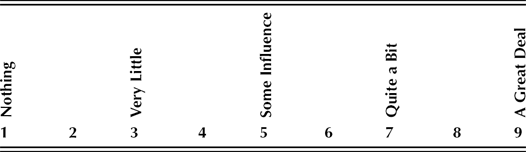
‘When teaching to students’:
1. How much can you do to get through to the most difficult students in:

2. How much can you do to help your students think critically in:

3. How much can you do to control disruptive behaviour in:

4. How much can you do to motivate students who show low interest in:

5. To what extent can you make your expectations clear about student behaviour in:

6. How much can you do to get students to believe they can do well in:

7. How well can you respond to difficult questions from your students in:

8. How well can you establish routines to keep activities running smoothly in:

Section 2b
Please respond to each of the questions by considering your current ability, resource and opportunity for Arts education to do each of the following in your present position. Please tick your response as per the scale below:
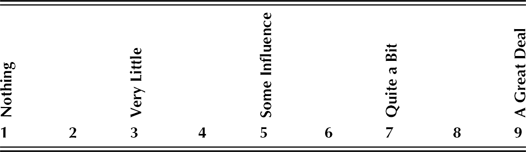
‘When teaching to students’:
9. How much can you do to help your students value learning in:

10. How much can you gauge student comprehension of what you have taught in:

11. To what extent can you craft good questions for your students in:

12. How much can you do to foster student creativity in:

13. How much can you do to get a student to follow classroom rules in:

14. How much can you do to improve the understanding of a student who is failing in:

15. How much can you do to calm a student who is disruptive or noisy in:

16. How well can you establish a classroom management system with each group of students in:

Section 2c
Please respond to each of the questions by considering your current ability, resource and opportunity for Arts education to do each of the following in your present position. Please tick your response as per the scale below:
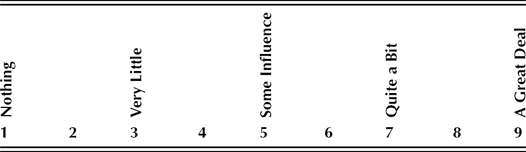
‘When teaching to students’:
17. How much can you do to adjust your lessons to the proper level for individual students:

18. How much can you use a variety of assessment strategies in:

19. How well can you keep a few problem students from ruining an entire lesson in:

20. To what extent can you provide an alternative explanation or example when students are confused in:

21. How well can you respond to defiant students in:

22. How much can you assist families in helping their children do well in:

23. How well can you implement alternative strategies in your classroom in:

24. How well can you provide appropriate challenges for very capable students in: