INTRODUCTION
The guidelines for palliative care (PC) provided by the World Health Organization recommends that it be implemented early on in the course of treatment. Many randomized studies involving patients with advanced cancer have shown that early integration of PC with standard curative oncological treatment can lead to significant improvements in quality of life as well as improved survival (Bakitas et al., Reference Bakitas, Lyons and Hegel2009; Temel et al., Reference Temel, Greer and Muzikansky2010; Zimmermann et al., Reference Zimmermann, Swami and Krzyzanowska2014; Bakitas et al., Reference Bakitas, Tosteson and Li2015). The American Society of Clinical Oncology recently recommends that patients with metastatic non-small-cell lung cancer should be offered concurrent palliative and oncological care from the time of diagnosis and that such combined treatment ought to be considered for any patients with metastatic cancer early on in the course of their disease (Smith et al., Reference Smith, Temin and Alesi2012).
Growing numbers of researches suggest that early PC has a positive effect on many clinical outcomes, including prolonging median survival length, improving quality of life, and ameliorating suffering. Hui and colleagues reported that earlier PC referral was associated with fewer emergency room visits, fewer hospitalizations, and fewer hospital deaths during the last 30 days of life (Hui et al., Reference Hui, Kim and Roquemore2014). On the other hand, late referral has been found to be an indicator of poor quality of care (Earle et al., Reference Earle, Neville and Landrum2005; Reference Earle, Park and Lai2003). Many authors have criticized the timing of PC and hospice referrals because of the limited time available to such patients (Christakis et al., Reference Christakis and Escarce1996). The perceptions of bereaved family members also indicate the untimely nature of many referrals for palliative care services (Schockett et al., Reference Schockett, Teno and Miller2005).
Nonetheless, many referrals to PC services still occur late in the disease process, especially for inpatients (Hui et al., Reference Hui, Elsayem and de la Cruz2010). Routine early integration of PC in the management of advanced cancer is not yet a part of standard practice in many countries (Baek et al., Reference Baek, Shin and Choi2011), including mainland China. As for most developing Asian countries, PC services are still in their early stages in China, where the medical referral system is different from that of Western countries. Considering the cultural differences and psychosocial background, mainland China may utilize different practices from those countries previously studied. Whether patients there suffering from advanced cancer are referred to inpatient PC services in a timely manner remains unclear. These factors make research about the time of referral of Chinese patients much more important. In the present study, we sought to (1) investigate the timing of referral to PC services for Chinese cancer patients from the time of enrollment into inpatient palliative care through until the time of death; (2) determine its predictors, and (3) evaluate the potential barriers within Chinese culture to early integration of palliative care.
METHODS
Palliative Care Services at the Fudan University Shanghai Cancer Center
The Fudan University Shanghai Cancer Center (FUSCC) is an 800-bed tertiary cancer center. The integrated therapy department (also known as the palliative care unit, or PCU) is a 12-bed inpatient ward and was established in 2006 to provide palliative care services for advanced cancer patients who could not undergo other anticancer therapies. It is staffed by seven palliative care physicians. Patients come to the outpatient palliative care service (OPCS) from other departments in the FUSCC and from other hospitals for symptom management and end-of-life care. If the patient is hospitalized due to exacerbation of symptoms, palliative therapy continues to be provided by the same PCU physicians. Daily multidisciplinary meetings are held with PCU physicians, medical oncologists, and nurses, and weekly meetings are conducted with an anesthesiologist, a psychiatrist, and social workers.
Patients
Patients referred to the PCU from January of 2007 to December of 2013 were included in our study. If a patient had multiple PCU admissions, data were evaluated according to their first admission. Patients who were still alive at the time of data collection or whose data were incomplete were excluded from our study. Patients younger than 18 years were also excluded. The information on a total of 759 patients was reviewed for the final analysis. We followed the ethical guidelines of the FUSCC review board. As all the data assessed in the study were obtained as part of routine clinical assessments from patients' medical records, written consent was not obtained, in accordance with the guidelines of the Chinese Ministry of Health.
Data Collection and Time Interval
An exploratory retrospective electronic chart review was conducted. The records of the 759 patients were reviewed through the Union Medical System of the FUSCC, which is an electronic medical records system that contains all the medical data (demographic and clinical) for all the patients at the FUSCC. The data retrieval process was conducted by four palliative care physicians, who collected baseline demographics and referral data. The following variables were extracted: (1) general baseline demographic characteristics—including age, sex, Shanghainese (indigenous) or not, medical insurance status, and area of residence (rural or urban); (2) disease-related characteristics—including cancer diagnosis, metastatic sites, previous treatment, and location of previous treatments; (3) time intervals—including date of cancer diagnosis, date of first OPCS visit, date of first enrollment in the PCU, the time interval between first OPCS visit and enrollment in the PCU (the O–I interval); and (4) overall survival, which was calculated as the time between the cancer diagnosis and the patient's death. The time interval from PCU enrollment to a patient's death (length of stay; LOS) was also calculated. A longer LOS indicated earlier referral to inpatient PC services. The date of death was confirmed in the chart-reviewing system or by follow-up information. Palliative care physicians followed up with patients weekly by telephone until their death. The time of the last follow-up was June of 2014.
Statistical Analysis
Descriptive statistics (proportions, means, standard deviations, medians, and mode) were utilized to describe patient characteristics, disease features, and different time intervals, while 95% confidence intervals (CI 95%) were calculated for median length. The survival analysis for patients who died in the PCU was computed using the Kaplan–Meier method. After univariate survival analysis, the significant factors were further subjected to multivariate analysis using the Cox proportional hazards model. SPSS software (v. 16.0) was employed for statistical analysis. We considered a p value of less than 0.05 significant.
RESULTS
General Characteristic of Included Patients
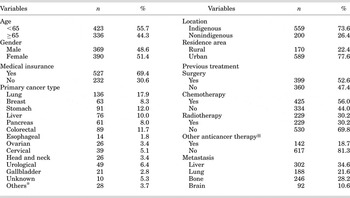
Table 1 summarizes the characteristics of the 759 patients who were referred to the PCU between 2007 and 2013. The mean age was 62.89 (61.95–63.82) years; 369 (48.6%) were male and 559 (73.6%) were Shanghainese (indigenous); 589 (77.6%) patients lived in urban areas and 170 (22.4%) in rural settings; 527 (69.4%) patients were covered by National Health Medical Insurance. The most common diagnoses were lung (17.9%), stomach (12.0%), colorectal (11.7%), and breast cancer (8.3%), and most had visceral metastases. The liver (34.6%) was the most prevalent metastatic site, and 228 patients (26.1%) had more than two sites of visceral metastasis. Some 399 patients (52.6%) had previously received surgery and 425 (56.0%) had received chemotherapy (with a median of three previous courses).
General characteristics of 759 patients

* Others included mediastinal tumors, cerebral tumors, bone tumors, hematological, and neoplasms, among others.
 Other anticancer therapy included interventional therapy, radiofrequency ablation, peritoneal perfusion, and clinical trials, among others.
Pathway of Patient Referral
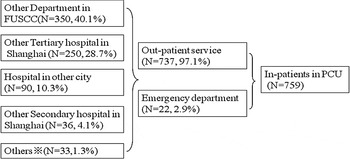
Before admission to the PCU, patients were admitted to the hospital an average of 1.8 (±1.4) times. Most patients (737, 97.1%) came to the PCU through the OPCS. The median O–I interval was 9 days (CI 95% = 7.54–11.21) for these 737 patients. Others came through emergency admissions (n = 22, 2.9%). Before patients came to the PCU, 350 (40.1%) had received anticancer treatment in other departments of the FUSCC, with the rest receiving treatment at other tertiary hospitals (250, 28.7%), The details of the referral pathway are depicted in Figure 1.
Patient referral pathway.  Others included primary hospitals and hospices.

Timing of Referral to the PCU and Its Predictors
Out of 759 patients, 406 died in the palliative care unit. Among them, 21 died within 24 hours of enrollment, while 121 (15.94%) died within a week of initiation of PC services. The median LOS for the 759 patients was 21 days (CI 95% = 19.79–22.21), and the median overall survival was 13.7 months (CI 95% = 12.49–14.91). The survival curves are depicted in Figure 2a,b.
Kaplan–Meier survival curves for 759 patients. (a) Survival measured from the day of first PCU admission to the day of death (in days). (b) Survival measured from the day of cancer diagnosis to the day of death (in months).

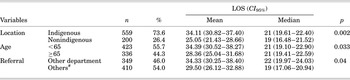
Patients who were indigenous to Shanghai (p = 0.002), younger than 65 (p = 0.033), and had been referred from other departments of the FUSCC (p = 0.04) experienced a significantly longer survival after receiving palliative care, which indicates that they received relatively early referral to inpatient PC services (see Table 2). Other characteristics such as gender and primary cancer type had no relationship with LOS (data not shown). After univariate survival analysis, the above significant factors were subjected to multivariate analysis using the Cox proportional hazards model. Whether the patient was indigenous or nonindigenous (p = 0.002) or younger than 65 (p = 0.031) were identified as independent factors for length of stay (see Table 3).
Factors related to length of stay according to univariate analysis

*Other department = other department of the FUSCC, including chemotherapy, radiotherapy, and surgery, among others.
# Others included other tertiary hospitals in Shanghai, hospitals in other cities, other secondary hospitals in Shanghai, primary hospitals, hospices, private hospitals, among others.
Independent predictive factors for length of stay according to Cox regression

Length of Stay According to Year of Treatment
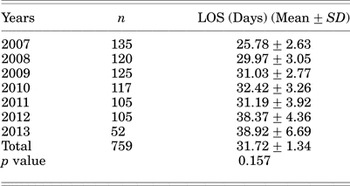
The LOS of patients from more recent years was longer, although the differences were not significant (p = 0.157). This indicates that during recent years patients have been referred to the PCU at an earlier time than previously (see Table 4).
Length of stay by date of treatment

The number of patients in 2013 included in the study was relatively small because of the June 2014 cutoff point.
DISCUSSION
To our knowledge, this is the first study to describe the timing of referral of Chinese cancer patients to palliative care services and its predictors. Our findings demonstrate that these cancer patients were referred relatively late in the course of their disease to inpatient palliative care services.
A number of publications have recommended early access to palliative care for cancer patients, but PC has been reported to be implemented late in the disease trajectory in previous studies (Iwashyna and Christakis, Reference Iwashyna and Christakis1998), where the length of stay ranged from 21 to 180 days. The median LOS in our study was 21 days, much shorter than the period reported in the United States (42 days) and Australia (54 days) (Osta et al., Reference Osta, Palmer and Paraskevopoulos2008). Our one-week death rate of 15.94% was similar to the 15% reported in previous research (Dudgeon et al., Reference Dudgeon, Raubertas and Doerner1995). The late referrals may have left inadequate time for the PCU to provide the kind of care that would achieve the goals of palliative care (Schockett et al., Reference Schockett, Teno and Miller2005; Christakis and Iwashyna, Reference Christakis and Iwashyna1998).
The timing of referral to palliative care is a complex and dynamic process involving a wide range of factors and dimensions (Greer et al., Reference Greer, Jackson and Meier2013; Sanders et al., Reference Sanders, Burkett and Dickinson2004). To examine the barriers to early access to PC, we explored the predictors of early PC integration. The factors contributing to referral time have been thought to be associated with patients, families, physicians, and healthcare systems (Weckmann, Reference Weckmann2008; Snyder et al., Reference Snyder, Hazelett and Allen2013; Schenker et al., Reference Schenker, Crowley-Matoka and Dohan2014). It is noteworthy that the patients in our study who were younger than 65 years, patients who were indigenous, and those who had previously received anticancer treatment in other departments of the FUSCC were found to be more likely to receive inpatient PC service at an earlier point in time. It is not difficult to understand why those patients tend to receive PC earlier. Palliative care is a relatively new area in China. The FUSCC is one of the most authoritative cancer centers in the nation, and its PCU is one of the pioneers in offering PC services. Shanghai is the first Chinese city to promote palliative care from the government level. Since 2012, more than a thousand beds have been made available for terminally ill patients at 18 facilities, including hospitals and nursing homes. Promotion of the concept of PC in recent years combined with the history of anticancer treatment at the FUSCC, a pioneering PC provider in China, offered patients indigenous to Shanghai a greater chance of knowing about and accepting palliative care. As found in other studies, patients younger than 65 years are more likely to accept the concept of PC (Osta et al., Reference Osta, Palmer and Paraskevopoulos2008; Corbett et al., Reference Corbett, Johnstone and Trauer2013; Kwon et al., Reference Kwon, Hui and Chisholm2013). Decreased tolerance of symptom burdens and the higher standard of quality of life offered to younger patients may also have some influence on the timing of PC integration.
Some studies have suggested a relationship between certain diagnoses and the timing of PC referral. In our study, patients with pancreatic and liver cancer had the shortest LOS, though the difference was not significant. Cancer type was shown to have a relationship with overall survival (details not shown). Insurance status has been considered to be one of the factors related to timing of referral in other studies (e.g., in Korea; Baek et al., Reference Baek, Shin and Choi2011). In our research, insurance status had no relationship with timing of referrals, which may be due to the different reimbursement systems in the two countries. China has moved from a system of universal insurance to a largely privatized healthcare system, with most (79%) rural residents remaining uninsured (Meng et al., Reference Meng, Xu and Zhang2012). Palliative care in hospitals is included in the list of the basic medical services for which patients receive reimbursement in mainland China. This may be the reason that medical insurance status did not influence the timing of referral.
Although most guidelines advise that palliative care be integrated early on in the cancer disease trajectory, the optimal timing of PC referral remains a difficult issue for physicians, patients, and family members. This is due to several factors. First, Chinese patients with cancer are free to choose their healthcare providers in most public Chinese hospitals, regardless of location. When patients can no longer undergo anticancer treatment, physicians can give patients advice to receive palliative care. Unlike in Western practice, Chinese physicians cannot directly refer patients to a palliative care unit. There are no standard procedures for PC referral at the FUSCC, as is the case in other hospitals in mainland China. There is no inpatient palliative care consult team working at the center either. Patients have to first go to the outpatient palliative care service before being admitted to a ward, even those who had been inpatients in other FUSCC departments. This means that Chinese palliative care physicians can do little when it comes to referral compared to physicians in Western countries (Brickner et al., Reference Brickner, Scannell and Marquet2004; Stillman & Syrjala, Reference Stillman and Syrjala1999; Halkett et al., Reference Halkett, Jiwa and Meng2014). In addition, the FUSCC palliative care unit does not have a PC consultation service to deal with patients after they leave the clinic, which may have led to a smaller chance of integrating palliative care earlier on.
Patients' understanding of their illness and prognosis have also been reported to strongly influence their decision-making process with regard to treatment (Friedman et al., Reference Friedman, Harwood and Shields2002; Cosgriff et al., Reference Cosgriff, Pisani and Bradley2007). Most Chinese patients do overestimate their prognosis because they may not see themselves as terminally ill, and they are thus less likely to prefer and receive symptom-directed care at the end of life (Mack et al., Reference Mack, Weeks and Wright2010).
The above characteristics of the medical referral system of mainland China makes it difficult to integrate palliative care earlier on in the course of treatment. In addition, patients' attitudes toward PC may have a greater influence on the time of PC integration in China than elsewhere. This indicates that further education regarding palliative care should focus not only on physicians but also on patients and their families. We strongly believe that renovation of the PC referral system is urgently required.
LIMITATIONS
Our study has several limitations. First, though patients enrolled in the palliative care unit came from different parts of China, individual patients may have had special circumstances that allowed them to come to the FUSCC. Future prospective studies with large patient populations at other centers in mainland China need to be conducted. Second, the variables included in our study were limited. Many excluded variables (e.g., personality, social status, and symptom burden) may have an effect on the timing of referrals. Finally, due to the cessation of follow-up in June of 2014, many patients who were admitted in recent years were still alive. Their LOS interval time could thus not be obtained, so it is hard to evaluate the timing of PC interventions for these patients. This may have biased the data.
CONCLUSIONS
This study showed that cancer patients are referred relatively late in the course of their disease to inpatient palliative care services. We also investigated the variables that affect the timing of referral of Chinese cancer patients to PC services. To overcome some of the barriers to early integration of PC into patients' treatment plans, accurate information about palliative care needs to be provided to both oncologists and patients via systematic educational programs.
ACKNOWLEDGMENTS
We express our gratitude to Sally Huang from Rice University for her assistance in revising our English writing.
CONFLICTS OF INTEREST
The authors state that they have no conflicts of interest to declare. The authors have no financial relationship with any organization that sponsored the research. The corresponding author has full control of all primary data and will allow review of the data if requested.