Introduction
Aortic valve disease in children can be divided into congenital and acquired aortic valve disease. According to the hemodynamic characteristics, it can be divided into aortic valve stenosis, aortic valve regurgitation, and aortic valve stenosis combined with aortic valve regurgitation. According to incomplete statistics, congenital aortic valve disease accounts for about 6% of all CHDs. Reference Kulshrestha, Greenberg and Kennedy1 Bicuspid aortic valve malformation is the most common cause of aortic valve stenosis in children. The prevalence of bicuspid aortic valve malformation in normal neonates and school-age children is about 0.5%, and it has a certain degree of family heredity. Reference Hao, Keming, Xinxin, Nianguo and Shoujun2 Fusion of left and right coronary valves is the most common type of bicuspid valve malformation, accounting for 70–80%, and is often associated with coarctation of the aorta. Aortic regurgitation in children is often detected by echocardiography, but it is rarely found alone and often combined with other malformations. About 20% of children with aortic valve regurgitation are complicated with a membranous or subpulmonary ventricular septal defect, of which 14–30% are complicated with aortic valve leaflet prolapse, leading to 20–30% of children with aortic insufficiency. Reference Saleeb, Solowiejczyk, Glickstein, Korsin, Gersony and Hsu3 The treatment concept of aortic valve disease in children is different from that in adults. The ideal treatment strategy must consider the needs of growth and development in children to achieve the best hemodynamic performance and reduce the incidence of valve-related complications. Due to the complexity of aortic valve disease in children, there is still no standard treatment. In the past decades, the surgical treatment of aortic valve disease in children has undergone constant changes and development, including the initial simple surgical repair to the application of the Ross procedure. The preferred treatment for aortic valve disease in children is currently controversial. In recent years, driven by the goal of providing the best survival rate, the least risk of reintervention and high quality of life, new surgical techniques for the treatment of aortic valve disease in children have been emerging. The optimal choice should be made carefully based on the characteristics of the disease, the patient’s family economic status, the level of medical institutions, and the will of the guardian. This article reviews the latest progress in the surgical treatment of aortic valve disease in children.
Aortic valve repair
Recently, the efficacy of aortic valve repair in children has been steadily improved, making its application in children with aortic valve disease more active and extensive. Johanna Schlein et al. Reference Schlein, Kaider and Gabriel4 reported 30 years of excellent experience at their institution in aortic valve repair in children. From May 1985 until April 2020, 126 patients underwent aortic valve repair at a median age of 1.8 years (interquartile range, 0.2–10). Early mortality was 5.6%. Kaplan-Meier estimated survival was 90.8% at 10 years, 86.9% at 20 years, and 83.5% at 30 years. The cumulative incidence of aortic valve replacement was 37% at 10 years, 62.2% at 20 years, and 67.4% at 30 years.
Compared with balloon aortic valve dilatation, aortic valve repair has the same safety and higher long-term freedom from aortic valve reoperation in infants and young children. In 2014, Prijic et al. Reference Prijic, Vukomanovic and Stajevic5 reported the long-term follow-up results of 39 cases of balloon aortic valve dilatation and 23 cases of aortic valve repair, and the 10-year free reintervention rates of aortic valve repair and balloon aortic valve dilatation were 71 and 61%, and the 20-year free reintervention rates of aortic valve repair and balloon aortic valve dilatation were 42 and 23%. Compared with balloon aortic valve dilatation, we believe that aortic valve repair is more accurate, which can effectively avoid the valve leaflet tear and regurgitation caused by iatrogenic injury during balloon aortic valve dilatation, thereby delaying the time of reintervention. There are also differences in the efficacy of aortic valve repair for patients of different ages. Vergna et al. Reference Vergnat, Asfour and Arenz6 reported excellent results for aortic valve repair in neonates between 1989 and 2015. Of these patients, 52 underwent surgical aortic valve repair and 51 underwent balloon aortic valve dilatation. Early mortality was similar in the two groups (7.8% with balloon aortic valve dilatation and 3.9% with aortic valve repair), as was survival at 10 years (88% with balloon aortic valve dilatation and 94% with aortic valve repair, P < 0.25). However, freedom from reoperation was higher among patients who underwent aortic valve repair (36% with balloon aortic valve dilatation and 66% with aortic valve repair, P < 0.01). In 2006, Miyamoto et al. Reference Miyamoto, Sinzobahamvya and Wetter7 followed up patients aged less than 3 months who received aortic valve repair due to severe aortic valve regurgitation from 1983 to 2003, and the free reintervention rates of 5, 10, and 15 years were 85.1%, 78.0%, and 53.5%, respectively. Among children older than 1 year, the operative mortality associated with aortic valve repair ranges from 0.4 to 1.8%, and freedom from reoperation at 10 years is approximately 70%. D’Udekem and colleagues Reference D’Udekem, Siddiqui and Seaman8 reported 142 children, with a median age of 9 years, who underwent aortic valve repair between 1996 and 2009. The early mortality rate was 1.8% in children older than 1 year. Freedom from reoperation at 7 years was 80%. We conclude that early survival and long-term freedom from reoperation after aortic valve repair are better in children older than 1 year than in neonates.
Ross procedure
Despite the rapid development of aortic valve repair technology in children, it is still inevitable for some patients to undergo aortic valve replacement. The ideal aortic valve replacement requires long-term durability, nonimmunogenicity, no need for anticoagulation, and growth potential. The Ross procedure, first reported in 1967, used the patient’s own pulmonary valve and root to replace the diseased aortic valve, and then reconstructed the right ventricular outflow tract by placing a conduit. It is the only surgical method that can provide a living valve, which has obvious advantages in avoiding long-term anticoagulation, growth potential, and reducing the risk of endocarditis. Reference Ross9 However, the Ross procedure is a complicated procedure, and reintervention of the right ventricular outflow tract may be necessary after Ross procedure.
In recent years, the excellent long-term outcomes of the Ross procedure in adult patients have led to its revival, and its application in children and even infants has become more widespread. Reference Mazine, David, Stoklosa, Chung, Lafreniere-Roula and Ouzounian10–Reference Donald, Wallace and Naimo13 However, it should be pointed out that young age is still an important risk factor for perioperative mortality of the Ross procedure. Compared with children over 1 year old, the perioperative mortality of infants undergoing Ross procedure is significantly higher. Donald JS et al. Reference Donald, Wallace and Naimo13 reported 140 children who underwent Ross procedures between 1995 and 2018. Operative mortality was 17% in neonates and infants and 0% in children older than 1 year. The 10-year survival rate for newborns and infants was 79%, compared with 96% for older children. Freedom from reoperation at 10 years was 62% in infants and 90% in older children. They believe that the Ross procedure should be postponed as far as possible beyond infancy to achieve the best results. Georgina Rowe et al. Reference Rowe, Gill and Zubair14 evaluated national variation in clinical outcomes using the Society of Thoracic Surgeons Congenital Heart Surgery Database. The database was used to identify 2805 children undergoing the Ross procedure from 2000 through 2018, comprising 163 neonates ( <30 days, 5.8%), 448 infants (30-365 days, 16.0%), 1444 children (1–12 years, 51.5%), and 750 teenagers (13–17 years, 26.7%). Operative mortality was 24.1% (n = 39) in neonates, 11.2% (n = 50) in infants, 1.5% (n = 21) in children, and 0.8% (n = 6) in teenagers (P < 0.01). Independent predictors of the composite outcome in children aged < 1 year included neonatal age, low-volume centre, and procedure year. In children aged > 1 year, no association was found between centre volume, procedure year, and outcome. So, they agreed that the Ross procedure is being performed with low mortality in children aged > 1 year throughout North America. High-volume centres have improved outcomes in children aged < 1 year, who have different anatomic characteristics and risk profiles.
However, the views of Jason W. Greenberg et al. Reference Greenberg, Argo and Ashfaq15 are contrary to the previous views. Last year, they reported outstanding long-term results of the Ross procedure in 133 patients from a multi-centre study with a median age of 96 days (interquartile range, 36 to 186) and a median weight of 4.4 kg (3.6 to 6.5). In-hospital death occurred in 13 (10%) (4/30[13%] neonates). Death after hospital discharge occurred in 10 of 120 patients (8%). New aortic dilatation occurred after the Ross procedure, peaked at 2 to 3 years, and was 4 to 5 standard deviations higher than normal, and returned to near baseline Z-score at a median follow-up of 11.5 (6.4–17.4) years. At a median of 10.3(4.1–12.8) years, 5 of 120 patients (4%) required autograft/left ventricular outflow tract reintervention. Freedom from moderate or greater new aortic valve regurgitation at 15 years was 86%. They concluded that newborns and infants survived well after discharge from the Ross procedure, with good long-term freedom from autograft reintervention and aortic regurgitation. New aortic dilatation in this population returned to normal in the long term. Ross should be considered in neonates and infants with concomitant aortic valve disease. We believe that there is a high mortality and technical difficulty in performing the Ross procedure in children younger than 3 months of age because of the large variation in the effect of the Ross procedure among different centres in children younger than 1 year of age. Therefore, it may be considered to perform aortic valve repair first to maintain left ventricular function and to perform a Ross procedure in the future if a secondary procedure is needed. This strategy helps to delay the time to valve replacement, thereby reducing the risk of reintervention. However, for experienced centres and surgeons, the Ross procedure can be attempted in children younger than 1 year of age.
Ozaki procedure
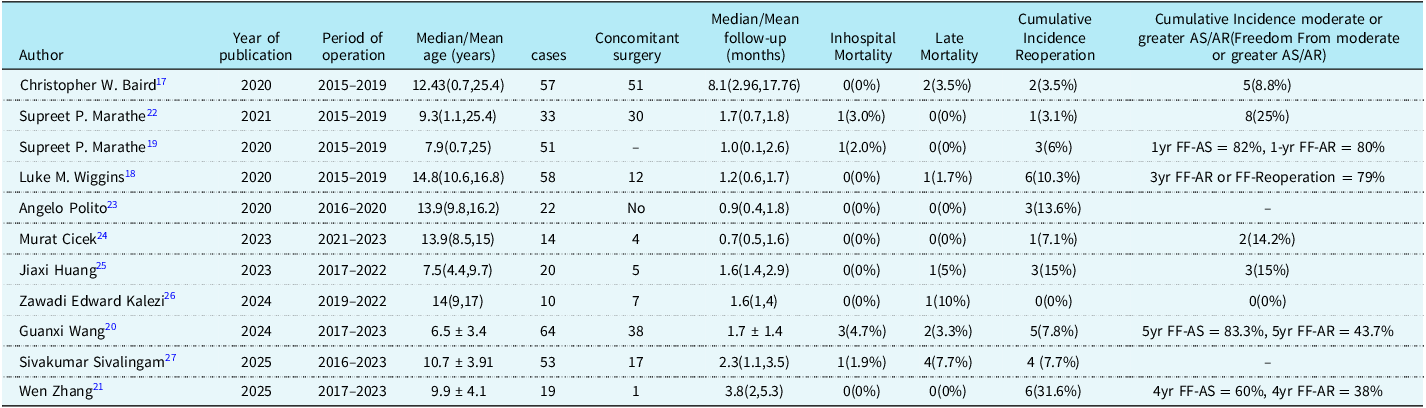
Ozaki procedure is an innovative surgical procedure in which the diseased valve leaflets are completely removed and reconstructed with autologous pericardium, which provides an alternative treatment method for aortic valve disease. In 2011, Professor Shigeyuki Ozaki initially described the aortic valve neo-cuspidization procedure in a series of adult patients. Reference Ozaki, Kawase and Yamashita16 They reported their initial experience of 88 patients with a mean age of 70.6 years with 65 patients having aortic valve stenosis. At 3 years of follow-up, freedom from reoperation was 100%. Most of the experience with Ozaki technique in the treatment of aortic valve disease in children has been concentrated in a few volume paediatric heart centres, with small patient sample sizes and short follow-up periods, and most of the reports are single-centre retrospective studies (Table 1). In paediatric populations, the Ozaki procedure has demonstrated promising short-term outcomes in several pioneering centres. Studies from the Boston group reported that 96 and 91% of patients had less than moderate aortic valve regurgitation and aortic valve stenosis, respectively, at the last follow-up, with a median follow-up of 8.1 months. Reference Baird, Cooney, Chavez, Sleeper, Marx and Del17 Another study from Great Ormond Street Hospital in London confirmed its acceptable short-term hemodynamic results, with freedom from reoperation or moderate or greater aortic valve regurgitation at 1, 2, and 3 years being 94, 85, and 79%, respectively, with a median follow-up of 14.1 months. Reference Wiggins, Mimic and Issitt18 The Boston Children’s Hospital team also reported encouraging results with 80 and 82% of patients had <moderate aortic valve regurgitation and aortic valve stenosis, at the last follow-up, with a median follow-up of 11.9 months, with the modified Ozaki procedure including annular enlargement for small aortic annuli in 51 patients. Reference Marathe, Chavez, Sleeper, Marx, Del and Baird19 In 2017, we introduced Ozaki technique to treat aortic valve disease in children and achieved promising short-term results. Sixty-four children underwent Ozaki operation from January 2017 to December 2023. During follow-up (20.4 ± 17.3 months), five patients (7.8%) in Ozaki group required reoperations. The incidence of moderate or severe aortic valve regurgitation and aortic valve stenosis was 28.1% and 31.3%, respectively. Reference Wang, Zhang and Ma20 Shanghai Children’s Medical Center Reference Zhang, Jiang and Liu21 reported similar short-term results, with freedom from neoaortic valve reoperation was 92% at 2 years and 71% at 4 years in the Ozaki group. Ozaki technique is less effective in paediatric aortic valve disease than in adult aortic valve disease. Considering the vigorous basal metabolism in children, the content of calcium and phosphorus in blood is higher than that in adults, so the occurrence rate of valvular degeneration in children is faster than that in adults. However, the early and mid-term results in children are acceptable, and the long-term results need to be confirmed by longer follow-up. Given these findings, we recommend Ozaki technique as an alternative to delay valve replacement, the Ross procedure, and reoperation in paediatric aortic valve disease. Current techniques use nonviable tissue making the Ozaki technique comparable to an aortic valve replacement. If this technique could be modified using bioengineered tissue with regeneration and growth potential, it may become valuable in the future.
Previous clinical studies of ozaki technique in children with AVD

Mechanical aortic valve replacement
After mechanical aortic valve replacement, children will face risks including long-term anticoagulation, prosthesis-patient mismatch, and long-term reoperation. Reference Myers, Mokashi and Horgan28 Myers et al. Reference Myers, Mokashi and Horgan28 reported 121 children who underwent mechanical aortic valve replacement from 2000 to 2014, with a median age of 16 years. They showed an early mortality rate of 5.5%, a 10-year survival rate of 82%, and a 10-year freedom from reoperation rate of 78%. Pannus ingrowth and valve thrombosis were the most common reasons for reoperation. They found that younger age and the use of a 16-mm prosthesis were risk factors for reoperation. In the meta-analysis conducted by Etnel et al., early mortality after mechanical aortic valve replacement in children was 7% per year, late mortality 1.2% per year, and reoperation 1% per year. Reference Etnel, Elmont and Ertekin29 Therefore, mechanical aortic valve replacement is not a good choice for children. Reference Buratto and Konstantinov30 Our centre tends not to recommend routine mechanical aortic valve replacement in children for several reasons. The main concern is the lack of a suitable mechanical valve for the small annulus and the need for long-term anticoagulation such as warfarin. In addition, management of anticoagulants in young children can be challenging, increasing the risk of complications. Most parents were hesitant to choose mechanical aortic valve replacement and wanted to wait until their children were older and able to self-administer anticoagulants. Mechanical valve replacement was considered only in patients with aortic valve disease associated with familial aortic disease, connective tissue disease, autoimmune disease, poor pulmonary valve function or structure, or aortic insufficiency, and aortic disease recurrence after aortic valve repair, Ozaki procedure, or Ross procedure.
Homograft aortic valve replacement
Homograft aortic valve has good hemodynamic performance, low thrombogenicity, and no need for long-term anticoagulation, but early calcification and lack of graft source limit its widespread use. Sharabiani et al. Reference Sharabiani, Dorobantu and Mahani31 described 53 patients who underwent homograft aortic valve replacement between 2000 and 2012, with a median age of 16 years, and reported an early mortality rate of 2.1% and a 60% freedom from reoperation at 12 years of follow-up. Etnel et al. Reference Etnel, Elmont and Ertekin29 conducted a systematic review that included 2409 patients (mean age, 9.4 years) undergoing Ross procedure, 696 patients (mean age, 12.8 years) undergoing mechanical aortic valve replacement, and 242 patients (mean age, 8.9 years) undergoing homograft aortic valve replacement, with a mean follow-up of 6.6 years. The mortality rates were 4.20%, 7.34%, and 12.82%, respectively. The annual mortality of the Ross procedure (0.46%) was lower than that of mechanical aortic valve replacement (1.23%) and homograft aortic valve replacement (1.59%). The annual reoperation rate of homograft aortic valve replacement (5.44%) was higher than that of Ross procedure (1.60%) and mechanical aortic valve replacement (1.07%). Fukushima S et al. Reference Fukushima, Tesar and Pearse32 reported 840 patients who underwent homograft aortic valve replacement from 1973 to 2008, of whom 61 (7.3%) were children. At 10 years, 85% of children were alive, and only 55% were free of structural valve degeneration. Younger age was independently associated with higher risk for structural valve degeneration. In a database clinical study of 3,446 children undergoing aortic valve replacement, Nelson et al. demonstrated that early mortality was highest among children undergoing HAV. Reference Nelson, Maul, Wearden, Pasquali and Romano33 The use of homografts in neonates and infants is limited to case reports and small series. The largest series described 15 neonates and infants, with an operative mortality of 40% (6/15), and no long-term outcomes were reported. Reference Woods, Pasquali and Jacobs34 We conclude that HAV is not recommended for neonates and infants with aortic valve disease. For older children, HAV can only be used as an emergency option for patients who are not suitable for aortic valve repair, mechanical aortic valve replacement, Ross procedure, and Ozaki procedure.
Comparison of different aortic valve surgical approaches
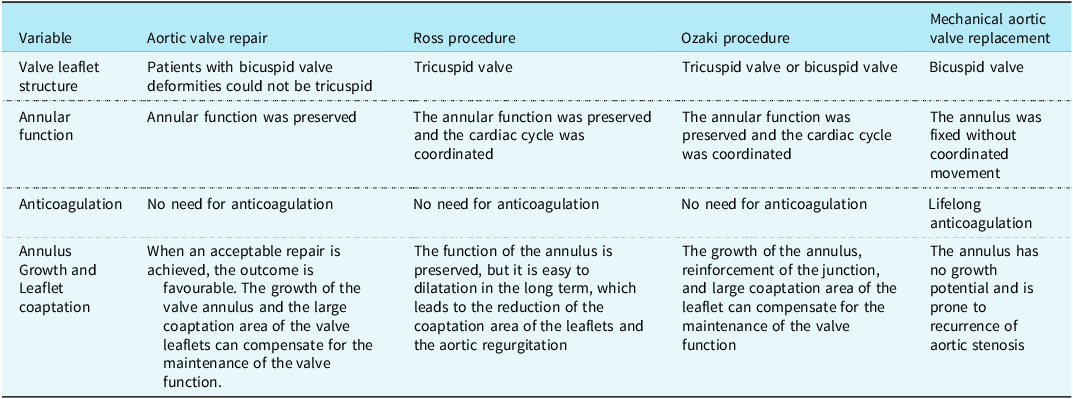
The advantages and disadvantages of various aortic valve surgical approaches remain controversial. We summarised the advantages and disadvantages of different surgical procedures in children roughly as shown in Table 2.
Advantages and disadvantages of different surgical procedures for AVD in children

Schelling et al. Reference Lin, Zhuheng, Jingyu and Ke35 retrospectively enrolled patients (age < 18 years) with severe aortic valve disease who underwent aortic valve repair or Ross procedure in West China Hospital of Sichuan University from January 2019 to September 2023. Patients (age < 18 years) with severe aortic valve disease who underwent aortic valve repair or Ross procedure at their institution from January 2019 to September 2023 were retrospectively enrolled. The median follow-up time was 16.0 (7.0, 30.0) months. During the follow-up period, the incidences of all-cause reoperation and aortic valve reoperation were similar between the aortic valve repair group and the Ross group (8.0% vs. 13.0%, P = 0.922; 8.0% vs. 0.0%, P = 0.266), but aortic valve disease recurrence rate was higher in aortic valve repair group (52.0% vs. 4.3%, P < 0.001). A study from the Royal Children’s Hospital in Melbourne Reference Zhu, Konstantinov, Wu, Wallace, Brizard and Buratto36 showed that children after aortic valve repair had better long-term survival (93.9% vs. 80.9%, P = 0.04), but there was no significant difference in freedom from reoperation between the two groups (45.7% vs. 48.5%, P = 0.29). Freedom from aortic valve reoperation was significantly lower in the aortic valve repair group than in the Ross group (45.7% vs. 70.7%, P < 0.01). When analysed by quality of repair, acceptable repair provided the highest survival (P = 0.01). Acceptable repair and the Ross procedure had similar freedom from reoperation at 15 years, whereas suboptimal repair performed worse (acceptable: 54.9%; Ross procedure: 48.5%; suboptimal: 27.0%, P < 0.001). Acceptable repair and the Ross procedure had similar freedom from aortic valve reoperation at 15 years, whereas suboptimal repair showed worse results (acceptable: 54.9; Ross procedure: 70.7%; suboptimal: 27.0%, P < 0.001). In infants, early death occurred in 2.9% (3/104) of the repair group compared with 30.8% (4/13) of the Ross procedure group (P = 0.003). Survival at 15 years was 87.7% in the repair group compared with 69.2% in the Ross procedure group (P = 0.02). Freedom from any cardiovascular reoperation at 10 years was 37.0% in the repair group compared with 26.3% in the Ross procedure group (P = 0.81). Freedom from aortic valve reoperation at 10 years was 37.0% in the repair group compared with 42.9% in the Ross procedure group (P = 0.06). In children aged 1 to 10 years, there were no early deaths in either group. Survival at 15 years was 97.3% in the repair group compared with 90.9% in the Ross procedure group(P = 0.97). Freedom from any cardiac reoperation at 15 years was 66.0% in the repair group compared with 31.4% in the Ross procedure group (P = 0.10). Freedom from aortic valve reoperation at 15 years was 66.0% in the repair group compared with 71.3% in the Ross procedure group (P = 0.25). Overall, aortic valve repair is associated with better survival in infants, according to previously published literature. In older children, overall outcomes were similar with repair and the Ross procedure. When an acceptable intraoperative result was achieved, outcomes of repair were favourable. However, when the intraoperative result of repair was suboptimal, the Ross procedure showed better results.
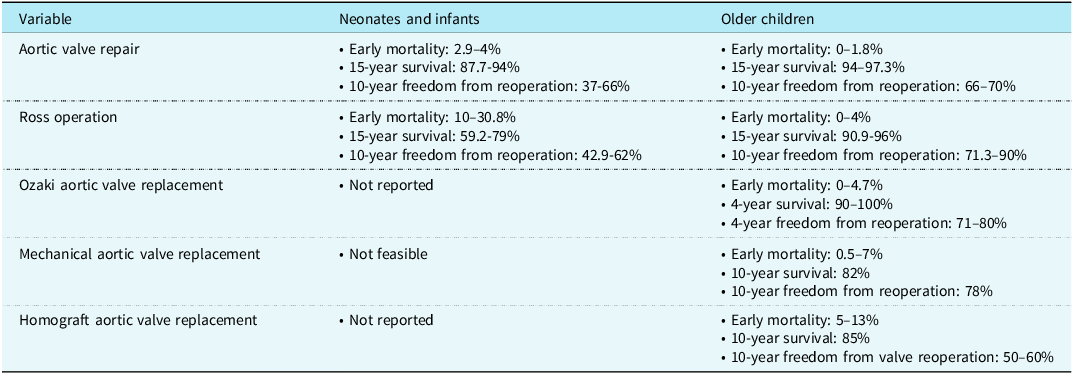
Studies comparing the Ozaki procedure and aortic valve repair in the surgical treatment of aortic valve disease in children have mainly focused on a few high-volume paediatric heart centres. Bambino Gesu` Children’s Hospital team directly first compared the mid-term efficacy of Ozaki with that of the Ross procedure for isolated aortic valve disease in children. Thirty-eight consecutive patients with congenital or acquired aortic valve disease underwent either Ozaki (n = 22) or Ross (n = 16) procedure. There was no significant difference in freedom from reoperation or death between the two groups. The medium-term outcome of Ozaki and Ross in paediatric patients is similar, despite an increased tendency of the former to develop aortic transvalvular gradient in the follow-up. Reference Polito, Albanese and Cetrano37 Guan-Xi Wang et al. Reference Wang, Zhang and Ma20 evaluated the mid-term results of Ozaki technique compared with Ross procedure for complex aortic valve disease in children at Fuwai Hospital. One hundred and seventeen children underwent either Ozaki (n = 64) or Ross (n = 53) operation from January 2017 to December 2023. During follow-up (20.4 ± 17.3 versus 22.7 ± 22.8 months, P = 0.526), five patients (7.8%) in Ozaki group but no patients in Ross group required reoperations. The incidence of moderate or severe aortic valve regurgitation (28.1% versus 3.1%) and aortic valve stenosis (31.3% versus 5.7%) was significantly higher than Ross group. Multivariate analysis identified lower age and extracorporeal membrane oxygenation installation to be risk factors for moderate or severe aortic valve regurgitation, and higher aortic transvalvular gradient before discharge was confirmed as the only risk factor for moderate or severe aortic valve stenosis ( ≥36 mmHg) at follow-up in Ozaki group. Wen Zhang et al. Reference Zhang, Jiang and Liu21 from Shanghai Children’s Medical Center evaluated the mid-term outcomes of the Ross and Ozaki procedures as alternatives to mechanical valve replacement in children with aortic valve disease. The cohort comprised 54 patients, with 35 patients (65%) undergoing the Ross procedure and 19 undergoing (35%) the Ozaki procedure. The mean age at surgery was 8.5 years (standard deviation: 4.0). Patients undergoing the Ozaki procedure had more cases of predominant aortic valve regurgitation and a large aortic valve annuli compared to the Ross group. The median follow-up time was 3.8 years. Freedom from moderate or greater aortic valve stenosis/aortic valve regurgitation was 92% at 2 years and 88% at 4 years in the Ross group, versus 59% at 2 years and 30% at 4 years in the Ozaki group (P < 0.001). Freedom from neoaortic valve reoperation was 100% at 2 years and 94% at 4 years in the Ross group, compared to 92% at 2 years and 71% at 4 years in the Ozaki group (P = 0.002). Overall freedom from any reoperation was similar between groups (P = 0.16). The Ross and Ozaki procedures have expanded our treatment options for paediatric aortic valve disease. The Ross procedure may provide a more durable new aortic valve, especially in patients with predominantly aortic valve stenosis or mixed lesions. In contrast, Ozaki procedure is mainly used in patients with significant aortic valve regurgitation and large annulus and may be associated with suboptimal mid-term prognosis. However, these results should be interpreted with caution because of the small sample size and retrospective nature of this study. Larger, multi-centre, prospective studies are needed to validate these results. We believe that the Ozaki procedure may also be an option to delay mechanical valve replacement for patients who have unsatisfactory aortic valve repair, cannot undergo the Ross procedure due to surgical contraindications, and are unwilling to take long-term anticoagulant drugs. Table 3 summarises the results of different surgical procedures in the treatment of aortic valve disease in children according to previous published studies.
Comparative outcomes of aortic valve surgery in children using different surgical procedures

Limitations
Of course, some limitations of this paper must be acknowledged. The sample size of previous studies was small, and the follow-up time was short. This view needs to be further clarified in multi-centre prospective studies with a larger sample size and longer follow-up time.
Conclusions
In conclusion, we concluded that there were differences in the effects of different surgical procedures according to the age of patients. In infants and young children, aortic valve repair has the same safety and higher long-term freedom from aortic valve reoperation than balloon aortic valve dilatation. For children younger than 1 year old, aortic valve repair is the first choice to avoid premature valve replacement. However, for experienced medical centres and surgeons, Ross procedure can be attempted to treat aortic valve disease in children younger than 1 year, and the long-term effect is comparable to aortic valve repair. The early mortality and long-term freedom from reoperation after aortic valve repair in children over 1 year old are better than those in neonates. In children older than 1 year, overall outcomes were similar with repair and the Ross procedure. When an acceptable intraoperative result is obtained with repair, results are favourable. However, when repair appears suboptimal, consideration should be given to the Ross procedure. For those patients with unsatisfactory aortic valve repair, contraindications to the Ross procedure, and unwillingness to take long-term anticoagulant drugs, Ozaki procedure can also be used as an alternative to delay mechanical aortic valve replacement. If Ozaki procedure could be modified using bioengineered tissue with regeneration and growth potential, it may become valuable in the future. Compared with the Ross procedure and aortic valve repair, mechanical or homograft aortic valve replacement has a poor prognosis and is the last option for surgical treatment of aortic valve disease in children.
Data availability statement
All data are incorporated into the article, and the data underlying this article are available in the article.
Acknowledgements
We acknowledge the roles of our colleagues, perfusionists, nurses, and others involved in the care of the study participants.
Author contributions
Zhangwei Wang: Conceptualisation; Data curation; Formal analysis; Investigation; Methodology; Software; Validation; Visualisation; Writing—original draft. Honghao Fu: Writing—review & editing. Shoujun Li: Writing—review & editing.
Financial support
No funding was received for this work.
Competing interests
None declared.