Introduction
Rapid development in high-technology sectors, such as the biopharmaceutical, urge firms to increasingly build strategic alliances and adopt open innovations (Beers & Zand, Reference Beers and Zand2014; Zhang, Baden-Fuller, & Mangematin, Reference Zhang, Baden-Fuller and Mangematin2007). Innovation alliances enable firms to have access to external knowledge, share innovation risks, and improve corporate performance (Li, Qiu, & Wang, Reference Li, Qiu and Wang2019; Sampson, Reference Sampson2007). While complementarity between firms and partners and competition among firms are critical predictors for alliance formation, communication and coordination costs pertinent to alliance structures largely affect the extent to which value is created by the alliance (Mindruta, Moeen, & Agarwal, Reference Mindruta, Moeen and Agarwal2016; Reuer, Arino, Poppo, & Zenger, Reference Reuer, Arino, Poppo and Zenger2016). The institutional arrangement for joint innovations has a substantial impact on knowledge transfer efficiency and the outcomes of product and process innovation (e.g., Coombs, Bierly, & Gallagher, Reference Coombs, Bierly and Gallagher2012; Lee & Cavusgil, Reference Lee and Cavusgil2006). As a result, the choice of alliance structure plays an important role in firm performance by determining trade-offs between benefits and costs of such cooperations (Choi & Contractor, Reference Choi and Contractor2016; Oxley & Wada, Reference Oxley and Wada2009). This thus leads to an essential question weinvestigate in this study: ‘How should firms choose the appropriate governance structure?’ (Jeppesen & Lakhani, Reference Jeppesen and Lakhani2010; Reuer et al., Reference Reuer, Arino, Poppo and Zenger2016).
Previous alliance research classified innovation alliance governance structures into two basic types: equity and non-equity alliances (e.g., Kale & Singh, Reference Kale and Singh2009; Yang, Wang, Lyu, & Yang, Reference Yang, Wang, Lyu and Yang2023). An equity alliance involves equity sharing or exchange between organizations, with lower transaction costs and higher knowledge transfer efficiency (Oxley & Wada, Reference Oxley and Wada2009), while a non-equity alliance refers to purely contractual cooperation, characterized by lower setup costs and greater flexibility (Bagherzadeh, Gurca, & Brunswicker, Reference Bagherzadeh, Gurca and Brunswicker2019; Colombo, Reference Colombo2003). Given the importance of appropriate governance structure, an extensive empirical work has examined a set of firm- and industry-level antecedents from the perspectives of external determinism or the resource-based view, including focal firm’s alliance experience, partner firm’s legitimacy, institutional distance, and coordination needs of alliance (Choi & Contractor, Reference Choi and Contractor2016; Coombs, Bierly, & Gallagher, Reference Coombs, Bierly and Gallagher2012; Lee, Hoetker, & Qualls, Reference Lee, Hoetker and Qualls2015; Phene & Tallman, Reference Phene and Tallman2012). Nevertheless, the behavioral lens of the firm is missing among prior studies, which thus provides little guidance on how crucial performance feedback influences the selection of alliance governance structure.
Performance feedback theory (PFT) posits that organizational performance relative to aspirations triggers responding actions and affects strategic decisions of firms (Cyert & March, Reference Cyert and March1963; Kotiloglu, Chen, & Lechler, Reference Kotiloglu, Chen and Lechler2021). Negative performance feedback, indicating organizational performance below aspirations, motivates firms to engage in problemistic search to access new knowledge and remedy the perceived challenge (Baum & Dahlin, Reference Baum and Dahlin2007; Chen & Miller, Reference Chen and Miller2007). Positive performance feedback, denoting organizational performance above aspirational levels, stimulates slack search to expand current businesses and sustain their superior positions (Jordan & Audia, Reference Jordan and Audia2012; Ref & Shapira, Reference Ref and Shapira2017). To pursue innovation search externally, one important decision of a firm is the engagement in the innovation alliances (Su, Yu, Chen, & Hou, Reference Su, Yu, Chen and Hou2023). Indeed, it is evident that performance feedback acts as a stimulus to firm’s alliance formation, partner selection, and alliance portfolio (e.g., Kavusan & Frankort, Reference Kavusan and Frankort2019; Lohrke, Kreiser, & Weaver, Reference Lohrke, Kreiser and Weaver2006; Martinez-Noya & Garcia-Canal, Reference Martinez-Noya and Garcia-Canal2021), while its role in the governance structure choice is yet underexplored.
To address this research gap, we propose that the search actions for organizational learning under different states of performance feedback may align with knowledge characteristics and costs of equity and non-equity alliances. Specifically, aspiration-based learning, as a central pillar in the PFT, postulates that firms react to performance feedback through organizational learning from others’ experience (Beckman & Lee, Reference Beckman, Lee, Argote and Levine2017; Levinthal & Rerup, Reference Levinthal and Rerup2021). The focus of organizational learning tends to change under various conditions of performance feedback, subsequently requiring an organizational choice between different innovation alliance structures. Besides, the PFT assumes that managers are boundedly rational, and their attributes affect firm’s behavioral responses to performance cues (Gavetti, Greve, Levinthal, & Ocasio, Reference Gavetti, Greve, Levinthal and Ocasio2012). The knowledge aspect of top management team (TMT) is fundamental as it influences the way in which TMT members interpret performance feedback and decide on corresponding actions (Jordan & Audia, Reference Jordan and Audia2012; Kolev & McNamara, Reference Kolev and McNamara2022). Hence, we additionally employed TMT average tenure and TMT educational-level diversity (Carpenter, Reference Carpenter2002), which reflect their levels of risk preference and knowledge heterogeneity. Specifically, we incorporate them into this model and examine their moderating effects on the relationship between performance feedback and the selection of alliance governance structure.
We test our theoretical hypotheses through a sample of 315 observations of 78 biopharmaceutical firms listed between 2007 and 2020 in China. Based on Tobit models, we confirm that firms with negative performance feedback are more likely to choose non-equity alliance and less inclined to choose equity alliance, while positive performance feedback increases firms’ likelihood to select equity alliance rather than non-equity alliance. Further, after receiving performance feedback information (whether positive or negative), firms with longer tenure of TMT are more likely to adopt equity alliance governance structure, while firms with higher diversity of TMT education level are prone to use non-equity alliance governance structure.
Our study makes several unique contributions. First, we enrich the literature of alliance governance structure choice by introducing the behavioral lens of the firm into addressing the overlooked but important role of performance feedback in such a choice (Bagherzadeh, Gurca, & Brunswicker, Reference Bagherzadeh, Gurca and Brunswicker2019). Our arguments confirm that different states of performance feedback can predict the selection between equity and non-equity alliance structures, which substantially expands the antecedent scope of alliance structure decisions. Second, we expand the research on the consequences of performance feedback and the mechanisms affecting firms’ responsive behavior. We elucidate that performance feedback may shape firms’ expectations regarding the balance between learning benefits and costs and, in turn, influences the choice of alliance governance structure. Finally, we assess the TMTs’ risk propensity and knowledge bases in terms of TMT’s average tenure and educational-level diversity, as a boundary condition, in the association between performance feedback and alliance structure. The expanded model highlights the critical role of these TMT characteristics, as cognitive bases, in the selection between different innovation alliance governance structures in response to performance feedback.
Theory and hypotheses
Innovation alliance governance structure
Innovation alliances represent formal agreements between organizations to systematically manage knowledge flows across organizational boundaries, establish commercial networks, and jointly create new value (Sampson, Reference Sampson2007). An innovation alliance is formed after parties involved consider expected benefits and potential costs, while different types of alliance governance structures influence their learning efficiency and cooperation costs (Kale & Singh, Reference Kale and Singh2009; Michelino, Cammarano, Lamberti, & Caputo, Reference Michelino, Cammarano, Lamberti and Caputo2015). The equity versus non-equity constitutes the prevalent classification of alliance structures (Choi & Contractor, Reference Choi and Contractor2016; Vrande, Vanhaverbeke, & Duysters, Reference Vrande, Vanhaverbeke and Duysters2009). An equity innovation alliance refers to a cooperative innovation mode that involves equity exchanges in the forms of joint ventures or mutual shareholding with external partners. A non-equity innovation alliance involves contractual agreements that cover different types of partnerships with no equity sharing (Niesten & Jolink, Reference Niesten and Jolink2017; Yang et al., Reference Yang, Wang, Lyu and Yang2023). As we detail subsequently, both governance structures differ in terms of knowledge transfer efficiency, transaction costs, and setup costs.
According to knowledge-based view, knowledge management is a key issue that addresses the implicit embeddedness of external knowledge and determines the effectiveness of the innovation alliance (Oxley & Wada, Reference Oxley and Wada2009). As an equity innovation alliance pushes participants to share their resources and risks, strengthen their mutual trust levels, and make decisions on a long-term basis (Michelino et al., Reference Michelino, Cammarano, Lamberti and Caputo2015). The equity alliance structure represents the most effective instrument to facilitate knowledge transfer and joint creation of new knowledge (Phene & Tallman, Reference Phene and Tallman2012; Williamson, Reference Williamson2008). By comparison, non-equity governance structure, constrained by detailed contractual agreements, tends to decrease the efficiency of knowledge transfer in the collaboration process (Bagherzadeh, Gurca, & Brunswicker, Reference Bagherzadeh, Gurca and Brunswicker2019).
Scholars drawing on transaction cost theory identify that the alliance failure may arise from opportunistic behavior of members, such as knowledge misappropriation, value exploitation, or distortion of information (Das & Rahman, Reference Das and Rahman2010; Majocchi, Mayrhofer, & Camps, Reference Majocchi, Mayrhofer and Camps2013). Equity alliance governance structure, equipped with formal monitor and control mechanisms to govern alliance partners, can curb opportunism and reduce transaction costs (Michelino et al., Reference Michelino, Cammarano, Lamberti and Caputo2015; Phene & Tallman, Reference Phene and Tallman2012; Reuer et al., Reference Reuer, Arino, Poppo and Zenger2016). Conversely, non-equity innovation alliances vulnerable to moral hazards and opportunistic behaviors are usually associated with greater degrees of transaction costs (Niesten & Jolink, Reference Niesten and Jolink2017). Further, equity innovation alliances require large amounts of commitment resources including capital, personnel, and time inputs, leading to higher levels of setup costs (Howell, Reference Howell2018; Phene & Tallman, Reference Phene and Tallman2012). By contrast, non-equity innovation alliances in which the duties and interests of each participant are clearly specified in the agreement demonstrate higher cooperative flexibility and lower setup costs (Bagherzadeh, Gurca, & Brunswicker, Reference Bagherzadeh, Gurca and Brunswicker2019; Colombo, Reference Colombo2003).
The governance structures of equity and non-equity innovation alliances manifest strengths and weaknesses in the process of cooperative innovation, as shown in the following Table 1.
The features of equity and non-equity innovation alliances

Performance feedback
The PFT explains why and how overperformance or underperformance messages guide firms’ strategic decisions (Baum, Rowley, Shipilov, & Chuang, Reference Baum, Rowley, Shipilov and Chuang2005; Yu, Minniti, & Nason, Reference Yu, Minniti and Nason2019). Ample empirical evidence shows that performance feedback engenders a wide range of organizational actions, such as strategic change or organizational reconfiguration (e.g., Baum & Dahlin, Reference Baum and Dahlin2007; Cheng, Xie, Fang, & Mei, Reference Cheng, Xie, Fang and Mei2022). Scholars suggested that firms rely on two different types of aspirations to calibrate performance feedback: social and historical aspirations (Kotiloglu, Chen, & Lechler, Reference Kotiloglu, Chen and Lechler2021). Social aspiration is an outcome of performance of peer firms, while historical aspiration arises from previous performance of the firm itself (Cyert & March, Reference Cyert and March1963). Both types of performance feedback reflect the changes in social status of firms and the variation in organizational development trajectory respectively (Kim, Finkelstein, & Haleblian, Reference Kim, Finkelstein and Haleblian2015). Although some previous studies revealed that they seemingly exert homogeneous effects on firm’s response behaviors (Kotiloglu, Chen, & Lechler, Reference Kotiloglu, Chen and Lechler2021), recent research suggests that their impacts are different or depend on other contingencies (e.g., Dong, Reference Dong2021; Kacperczyk, Beckman, & Moliterno, Reference Kacperczyk, Beckman and Moliterno2015). Particularly, the effects of social performance feedback may not be attenuated in a short period, which in turn will encourage firms to search for long-term solutions (e.g., innovation alliance) (Tyler & Caner, Reference Tyler and Caner2016; Ye, Yu, & Nason, Reference Ye, Yu and Nason2021). Thus, in this study, we focus on social performance feedback.
Negative performance feedback and innovation alliance governance structure
According to the PFT, performance below aspirations may motivate firms to initiate problemistic search to access new knowledge and practices to solve problems and improve current performance (Furlotti & Soda, Reference Furlotti and Soda2018; Lv et al., Reference Lv, Zhu, Chen and Lan2021; Sampson, Reference Sampson2004). As problemistic search often follows a search pattern from local to nonlocal sources, firms will turn to nonlocal search when local search of old experience and internal knowledge fails to address the performance gap (Baum & Dahlin, Reference Baum and Dahlin2007; Su et al., Reference Su, Yu, Chen and Hou2023). Alliance, serving as a bridge to distant contexts, enables firms to overcome constraints of local search and to acquire new knowledge (Rosenkopf & Almeida, Reference Rosenkopf and Almeida2003). Indeed, negative performance feedback is found to increase the alliance formation intention and the number of R&D alliances (Lohrke, Kreiser, & Weaver, Reference Lohrke, Kreiser and Weaver2006; Tyler & Caner, Reference Tyler and Caner2016). Literature in partner selection also shows that firms with similar levels of research capabilities are prone to establish partnership because those firms with superior research capabilities may be not available to them (Mindruta, Moeen, & Agarwal, Reference Mindruta, Moeen and Agarwal2016).
When choosing an appropriate governance structure for innovation alliances, underperforming firms usually take into account both two aspects: the knowledge to be obtained from alliance partners and the alliance costs to be borne during joint development activities (Niesten & Jolink, Reference Niesten and Jolink2017; Tyler & Caner, Reference Tyler and Caner2016). We propose that underperforming firms increase propensity toward selection of non-equity alliance for several reasons. First, performance pressure induced by negative performance feedback encourages firms to seek improvement as soon as possible (Baum & Dahlin, Reference Baum and Dahlin2007; Lv, Zhu, Chen, & Lan, Reference Lv, Zhu, Chen and Lan2021). Since a non-equity alliance displays lower setup costs and higher flexibility than an equity one, it becomes a preferable choice that helps underperforming firms engage in innovation alliances promptly (Colombo, Reference Colombo2003; Michelino et al., Reference Michelino, Cammarano, Lamberti and Caputo2015). Second, when firms cannot achieve target performance levels, they tend to undertake risky strategies to seek major improvements (Alexy, Bascavusoglu-Moreau, & Salter, Reference Alexy, Bascavusoglu-Moreau and Salter2016; Baum et al., Reference Baum, Rowley, Shipilov and Chuang2005; Jordan & Audia, Reference Jordan and Audia2012). Despite perceived high degrees of risk caused by knowledge leakage and transaction costs in non-equity alliances, firms with performance below aspirations may still be inclined to access new knowledge through non-equity alliances (Majchrzak, Jarvenpaa, & Bagherzadeh, Reference Majchrzak, Jarvenpaa and Bagherzadeh2015). Finally, underperforming firms intend to solve specific technical problems through building non-equity alliances. Although the knowledge transfer efficiency of non-equity alliance is lower, this limitation can be offset by articulating specific knowledge items in contractual agreements (Choi & Contractor, 2019). Building on these insights, we propose the hypothesis:
Hypothesis 1: Firms receiving negative performance feedback are more inclined to choose a non-equity innovation alliance structure than an equity one.
Positive performance feedback and innovation alliance governance structure
The PFT holds that overfulfillment of social aspirations makes firms released from pressure of solving immediate problems, they tend to implement slack search to attain utilization of existing resource as well as creation of new value (Argote & Greve, Reference Argote and Greve2007; Martinez-Noya & Garcia-Canal, Reference Martinez-Noya and Garcia-Canal2021). Decision-makers with satisfactory performance outcomes may note and learn from others’ failures to prevent future failing and keep their success (Kc, Staats, & Gino, Reference Kc, Staats and Gino2013; Kim & Rhee, Reference Kim and Rhee2017). Indeed, it is evident that high performing firms are willing to form alliances with diverse partners to explore new opportunities beyond their existing networks (Martinez-Noya & Garcia-Canal, Reference Martinez-Noya and Garcia-Canal2021). Therefore, performance exceeding social aspiration enhances the confidence of managers when exploiting firm capabilities and new projects to create a favorable bargaining power in the cooperations (Baum et al., Reference Baum, Rowley, Shipilov and Chuang2005; Xu, Zhou, & Du, Reference Xu, Zhou and Du2019).
We argue that performance above social aspirations will lead firms to engage in equity alliances for the following reasons. First, to keep superior performance in their industry, firms are willing to continue previous businesses and practices and explore additional similar projects in their knowledge domain (Alexy, Bascavusoglu-Moreau, & Salter, Reference Alexy, Bascavusoglu-Moreau and Salter2016). An equity innovation alliance with close relationships and high-levels of trust demonstrates great knowledge transfer efficiency between firms, which enables them to achieve value creation for joint innovations (Choi & Contractor, 2019; Sampson, Reference Sampson2004). Second, performance above the aspirations increases managerial confidence and resource slacks in taking projects that are costly but related to the long-run viability of the firm (Desai, Reference Desai2013; Xu, Zhou, & Du, Reference Xu, Zhou and Du2019). Although equity alliances have higher setup costs, the excess returns of overperforming firms reduce the cost consideration when they choose alliances governance structure. Finally, the better a firm performs above social aspirations, the more capable the firm will be to create higher bargaining powers in alliance negotiations (Bosse & Alvarez, Reference Bosse and Alvarez2010; Kim & Rhee, Reference Kim and Rhee2017). An equity innovation alliance imbued with lower transaction and opportunistic costs allows outperforming firms to better utilize their advantageous situations in building alliances through which they keep the competitive edge. Thus, we hypothesize that:
Hypothesis 2: Firms receiving positive performance feedback are more inclined to choose an equity innovation alliance structure than a non-equity one.
The moderating role of TMT tenure
The PFT predicts that decision-makers are boundedly rational agents and their background characteristics may influence their perception and interpretation of performance feedback cues and subsequent responses (Jordan & Audia, Reference Jordan and Audia2012). Indeed, the literature of organizational change has addressed how performance feedback and decision-makers’ characteristics jointly determine the strategic choices of firms (e.g., Choi, Rhee, & Kim, Reference Choi, Rhee and Kim2019; Díaz-Fernández, González-Rodríguez, & Simonetti, Reference Díaz-Fernández, González-Rodríguez and Simonetti2016). For instance, Kolev and McNamara (Reference Kolev and McNamara2022) identified that TMT’s structural attributes influence the way in which TMTs encode poor performance information and coordinate actions. Especially, the unique role of TMTs’ job-related attributes in strategic changes or open innovations is highlighted (e.g., Lu, Liu, Xu, Liao, & Fu, Reference Lu, Liu, Xu, Liao and Fu2022; Naranjo-Gil, Reference Naranjo-Gil2009). How these characteristics affect TMTs’ interpretation of performance feedback and determine a firm’s choice of innovation alliance governance remains unaddressed. TMT tenure, capturing the time team members spend in the firm, is related to TMTs’ adherence to the status quo, their risk preference and willingness of external search (Miller, Reference Miller1991).
We expect the contingent role of TMT tenure in the relationship between performance feedback and governance structure. Non-equity innovation alliance structure, imbued with greater opportunistic costs and higher risks of alliance-failure (Majchrzak, Jarvenpaa, & Bagherzadeh, Reference Majchrzak, Jarvenpaa and Bagherzadeh2015; Niesten & Jolink, Reference Niesten and Jolink2017), posits a potential threat to TMT’s reputation and status. Thus, longer-tenured TMTs are less likely to choose such an alliance structure (Simsek, Reference Simsek2007). Consequently, TMT tenure will magnify the negative effect of negative performance feedback on non-equity innovation alliance structure. By comparison, an equity innovation alliance structure involves greater degrees of stability and higher levels of trust (Phene & Tallman, Reference Phene and Tallman2012; Williamson, Reference Williamson2008), contributing little threats on TMT’s career. Thus, the promotive effect of positive performance feedback on the adoption of an equity alliance governance will be further enhance when longer-tenured TMTs are present (Carpenter, Reference Carpenter2002). By summarizing the above points, we posit the following hypothesis:
Hypothesis 3a: In the presence of long-tenured TMTs, firms’ propensity to choose a non-equity innovation alliance structure over an equity one will be attenuated after receiving negative performance feedback.
Hypothesis 3b: In the presence of long-tenured TMTs, firms’ propensity to choose an equity innovation alliance structure over a non-equity one will be enhanced after receiving positive performance feedback.
The moderating role of TMT educational-level diversity
TMT educational-level diversity is defined as the extent to which team members differ in their educational levels (Lv et al., Reference Lv, Zhu, Chen and Lan2021). It reflects the heterogeneity of managerial cognitive bases and the diversity of TMT knowledge, which largely determines a firm’s external search ability (Kolev & McNamara, Reference Kolev and McNamara2022). In response to negative performance feedback, TMT members with heterogeneous educational levels can analyze the feedback information from various perspectives, which spurs firms into an identification of problem causes and a search for effective solutions (Lo & Fu, Reference Lo and Fu2016). As TMTs diverse in knowledge assets possess strong capabilities to gather and integrate external knowledge, they are competent to scan and obtain sophisticated information from a variety of sources. Such heterogenous knowledge bases may improve TMTs’ ability of absorbing a broader range of knowledge, help tackle technological problems arising at different levels in the knowledge integration, and partially offsets the low efficiency of knowledge transfer associated with a non-equity alliance mode (Díaz-Fernández, González-Rodríguez, & Simonetti, Reference Díaz-Fernández, González-Rodríguez and Simonetti2016). Thus, TMTs with diverse cognitive bases are more prone to choose a non-equity innovation alliance. By comparison, for those firms with positive performance feedback, heterogeneous TMTs consisting of managers with various educational levels excel in transforming knowledge to outside of the organizations. Furthermore, the knowledge breadth of TMTs offers firms with a number of choices and ensures compatibility for their cooperations with external organizations (Naranjo-Gil, Reference Naranjo-Gil2009). This advantage leads to greater transfer efficiency of innovation knowledge, which reduces the necessity for firms with positive performance feedback to use an equity-based mode for innovation alliances. We therefore hypothesize that:
Hypothesis 4a: In the presence of higher TMT education level diversity, firms’ propensity to choose a non-equity innovation alliance structure over an equity one will be enhanced after receiving negative performance feedback.
Hypothesis 4b: In the presence of higher TMT education level diversity, firms’ propensity to choose an equity innovation alliance structure over a non-equity one will be attenuated after receiving positive performance feedback.
Research methods
Sample and data
We test our hypotheses in the context of Chinese biopharmaceutical industry where firms encounter higher levels of technological dynamism and market competition (Beers & Zand, Reference Beers and Zand2014). To address environmental challenges, the biopharmaceutical firms growingly engage in building R&D alliances with external partners to acquire complementary knowledge. Thus, innovation alliances are common in this sector (Michelino et al., Reference Michelino, Cammarano, Lamberti and Caputo2015). Our data was collected from two widely used databases: Chinese Stock Market & Accounting Research (CSMAR) database and China National Intellectual Property Administration (CNIPA) database.
As patent data has been intensively used to assess innovation, joint patents are usually considered as a measure of innovation alliances (Delerue, Reference Delerue2018). Hence, we gathered the data of joint patent to capture the selection of innovation alliance governances. The patent data of biopharmaceutical firms was primarily collected from CNIPA database, which generated an initial sample of 275 firms. We took several steps to purify the initial sample: (1) we eliminated those firms without patent data; (2) we kept the patents with two or more applicants, but omitted patents of which applicants include individuals as it was extremely difficult to identify whether those individuals were the employees of certain companies (Choi & Contractor, 2019); (3) we only retained invention patents while excluded utility and design patents because the former one sets a stricter requirement on resource inputs and innovativeness and involves greater chance of failure than the two latter ones, which thus fits our topic more appropriately. The refined sample consisted of 3,662 cooperative invention patents from 165 listed firms.
We estimated whether the alliance deals are equity or non-equity contracts through two online platforms of Qichacha and Tianyancha, which contain information of interorganizational business relationships. Specifically, we searched the relationship information via Qichacha website and then verified it by using Tianyancha website. In addition, the data of independent and control variables were collected through CSMAR database. By integrating these sources of data together, our final sample includes a total of 315 observations of 78 firms spanning the years from 2007 to 2020.
Dependent variables
Equity or non-equity innovation alliance
We classified the alliance partners based on the presence or absence of equity uses. In line with studies that calculated the percentage of some events to indicate the degree of cooperative action (Oxley & Wada, Reference Oxley and Wada2009; Schreiner, Kale, & Corsten, Reference Schreiner, Kale and Corsten2009), we measured the choice of alliance governance structure by assessing the percentage of co-patents with equity or non-equity partners. The denominator for each of these variables is the total number of co-patents in a given firm-year where focal firm and alliance partners are joint applicants. The numerators for the two variables are respectively the number of co-patents that the focal firm applied with equity or non-equity partners in a given firm-year. Specifically, there are three cases for the partners of each joint patent: the applicants of the patent are all equity partners, the applicants only consist of non-equity partners, the applicants include both equity and non-equity partners. Since the equity and non-equity partners all contribute to the patent in the third case, this type of joint patent can be considered as a component of both two alliance choices, which will be countered into both co-patents with equity partners and co-patents with non-equity partners.
There are usually no equity ties between the focal firm and nonprofit organizations such as social research institutes, public sectors, social organizations, etc. However, some firms have been supported by nonprofit organizations for long, and thus they formed a direct and long-term cooperation. We viewed such social or public organizations as equity partners because the stable relationship is consistent with the characteristics of equity innovation alliances.
Independent variables
Performance feedback
Following extant studies on performance feedback (Greve, Reference Greve2003; McConnell & Servaes, Reference McConnell and Servaes1990), we gauged this variable by capturing the gap between social aspirations and current performance. To seek performance improvement, they usually use the industry peers as the reference group to obtain accurate assessment and carry out improvement (Hu, Blettner, & Bettis, Reference Hu, Blettner and Bettis2011). Specifically, by measuring firm performance based on return on assets, we calculated social aspirational level from equation (1) and social aspirational gap from equation (2). In equation (1), median return on asset refers to the median performance of all firms within the biopharmaceutical industry in the t – 1 year, and the weight value  $ \propto \,$ is 0.4. The initial social performance aspiration was obtained by weighting of the median performance in the year before (weight = 0.6) and the median performance in the previous 2 years (weight = 0.4). As shown in equation (2), social aspiration gap is measured by the discrepancy between focal firm’s return on asset and the social aspirational level. In line with Chen and Miller (Reference Chen and Miller2007), we constructed two variables: Positive performance feedback was measured by the value of the social aspiration gap when it is positive, and 0 otherwise, to capture an overperforming performance of the focal firm; Negative performance feedback was scaled by the absolute value of the social aspiration gap when this is negative, and 0 otherwise, to reflect underperforming performance of the focal firm. We then multiply performance feedback by 100 simply to make discussing the resulting coefficients easier.
 \begin{equation}\begin{aligned}
Social\,aspirational\,leve{l_{i,t}} & =
\left( {1 - \propto \,} \right)\,MRO{A_{t - 1}} \\
& \quad + Social\,aspirational\,leve{l_{i,t - 1}} \\
\end{aligned} \end{equation}
 \begin{equation}Social\,aspirational\,ga{p_{i,t}}\,\, = RO{A_{i,\,t}} - Social\,aspirational\,leve{l_{i,t}}\end{equation}
Moderators
TMT tenure
As TMTs are defined as the CEO and top executives of the firm, we identified TMT members based on the CSMAR database (Chen, Hsu, & Huang, Reference Chen, Hsu and Huang2010). TMT tenure was assessed as the average number of years the TMT members had worked for the company (Liu et al., Reference Liu, Li, Hesterly and Cannella2012).
TMT educational-level diversity
We measured the educational level of an executive by using the revised scale of D’Aveni (Reference D’Aveni1990): 1 (middle school or below), 2 (high school), 3 (bachelor degree), 4 (academic qualifications in other forms), 5 (MBA and EMBA), 6 (master degree), and 7 (PhD/doctorate). The degree of heterogeneity of TMT educational level was calculated using Blau’s (Reference Blau1977) index, a widely used measure to capture the diversity of categories within a team (Barkema & Shvyrkov, Reference Barkema and Shvyrkov2007). This index is calculated as 1 − Σ(Pi)2, where Pi is the percentage of individuals in the ith category. The higher the resulting score, the greater the TMT’s educational level heterogeneity.
Control variables
In line with prior innovation alliance studies (Lohrke, Kreiser, & Weaver, Reference Lohrke, Kreiser and Weaver2006; Tyler & Caner, Reference Tyler and Caner2016), we controlled for two sets of variables that may affect the firms’ selection of alliance governance structure. At the firm level, as small or young enterprises are likely to form innovation alliance with incumbent partners to improve their legitimacy and reduce innovation risks (Lv et al., Reference Lv, Zhu, Chen and Lan2021; Majocchi, Mayrhofer, & Camps, Reference Majocchi, Mayrhofer and Camps2013), we controlled for firm size and firm age, measured by the logarithm of the number of employees and number of years since its establishment respectively. We also included return on equity measured by equity divided by revenue, and R&D intensity scaled by the ratio of R&D expenditures to total assets. Firm ownership was included as a binary variable, coded as 1 for state owned enterprises and 0 otherwise. As firms located in the different regions of China are expected to experience different levels of difficulty in finding an appropriate partner, we used a dummy variable to control the firm’s geographic location by coding ‘1’ for firms located in Chinese eastern part (Beijing, Shanghai, Hebei, Tianjin, Shandong, Jiangsu, Zhejiang, Fujian, Guangdong, and Hainan) and ‘0’ for firms located in other cities or provinces. Following Tyler and Caner (Reference Tyler and Caner2016), firm slack was controlled by calculating the sum of different categories of slacks, including available, absorbed, and potential slack. Available slack is calculated by current assets divided by current liabilities; absorbed slack is measured by the expenses-to-sales ratio; and potential slack is measured as the equity-to-debt ratio.
We also controlled for a number of executive characteristics that may affect the firm strategic choices and alliance formation. CEO duality is measured by creating a binary indicator regarding whether or not the CEO was also the chairman of the board (1 = yes, CEO is also a chairman of the board; 0 = otherwise). We additionally considered the composition of TMT by measuring TMT size and TMT’s average age (Liu et al., 2012). Further, board independence was calculated as the percentage of the independent directors in the total number of firm’s board members (Kolev & McNamara, Reference Kolev and McNamara2022). The year effect and firm-level effect were also controlled in this study.
Analysis
In our analysis, we assess the direct impact of social performance feedback on the selection of innovation alliance structure, and the moderating effects of TMT average tenure and TMT’s educational-level diversity on the association between performance feedback and alliance structure choice. First, as many firms in our sample have selected equity innovation alliance structure solely, their propensity to choose non-equity alliance structure will approach the value of 0; vice versa. Thus, we performed 0–1-double-censored panel Tobit model where the censored condition fits our situation that many values are at a specific level of 0 or 1 (McDonald & Moffitt, Reference McDonald and Moffitt1980). Second, the fixed-effects model is more appropriate since the sample of our study is small. To obtain an unbiased standard error, we used cluster adjustment for the standard errors at the firm level when conducting analyses.
We placed a time lag for all the explanatory variables in the Tobit regression analysis to reasonably establish hypothesized causal relationships. Social aspiration gaps were set by a 3-year lag because it allows the performance feedback of a biopharmaceutical firm in t − 3 year to be translated into the cooperative applications patents in t year (Fernald, Pennings, & Claassen, Reference Fernald, Pennings and Claassen2015). Control variables were also configured as 3-year prior variables. The regression model is illustrated as follows:
 \begin{equation}\begin{aligned}
{Y_{i,t}} & = {\beta _0} + {\beta _1}X{1_{i,t - 3}} + {\beta _2}X{2_{i,t - 3}} + {\beta _3}TMT\,tenur{e_{i,t - 3}} +
{\beta _4}TMT\,educational \\ & \quad - level\,diversit{y_{i,t - 3}} + {\beta _5}X{1_{i,t - 3}} \times \,TMT\,tenur{e_{i,t - 3}} + {\beta _6}X{2_{i,t - 3}} \times
TMT\,tenur{e_{i,t - 3}} \\ & \quad + {\beta _7}X{1_{i,t - 3}} \times \,TMT\,educational - level\,diversit{y_{i,t - 3}} + {\beta _8}X{2_{i,t - 3}} \times
TMT\,educational \\ & \quad - level\,diversit{y_{i,t - 3}} + {\beta _9}CONTROL{S_{i,t - 3}} + {\varepsilon _{i,t - 3}} \\
\end{aligned} \end{equation}
Specifically, the dependent variables (equity innovation and non-equity innovation alliances) were regressed in accordance with the hypotheses. The independent variables (X1i,t −3, X2i,t −3) refer to the positive and negative performance feedback of firmi respectively in year t − 3. The moderator variable – TMT tenurei,t −3 – represents the TMT’s average tenure of firmi in t − 3 year; TMT educational-level diversityi ,t−3 indicates the diversity of TMT educational levels of the firmi in t − 3 year, and  $\varepsilon $ is a random distribution item.
Results
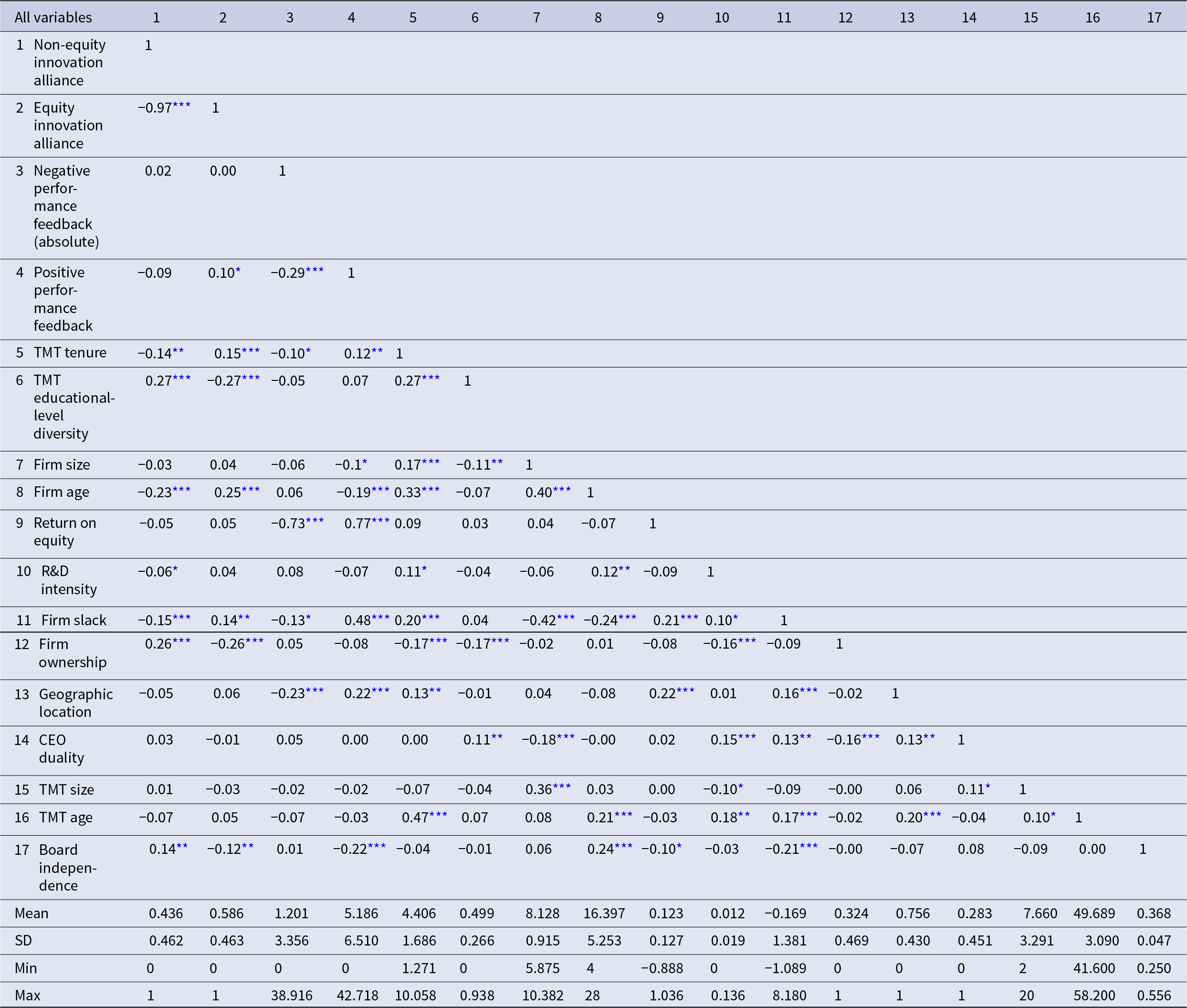
Table 2 reports the summary statistics of all variables and the correlation matrix. As shown in Table 2, the correlation between equity and non-equity innovation alliance is highly and negatively correlated (b = −0.97), indicating that most firms generally choose only one mode of innovation alliance out of two governance structures. We also checked the variance inflation factors for all variables, and an average variance inflation factor value of ‘1.30’ suggests there does not seem to be a multicollinearity problem.
Descriptive statistics and correlations

Note: n = 315.
* p < .05, **p < .01, ***p < .001.
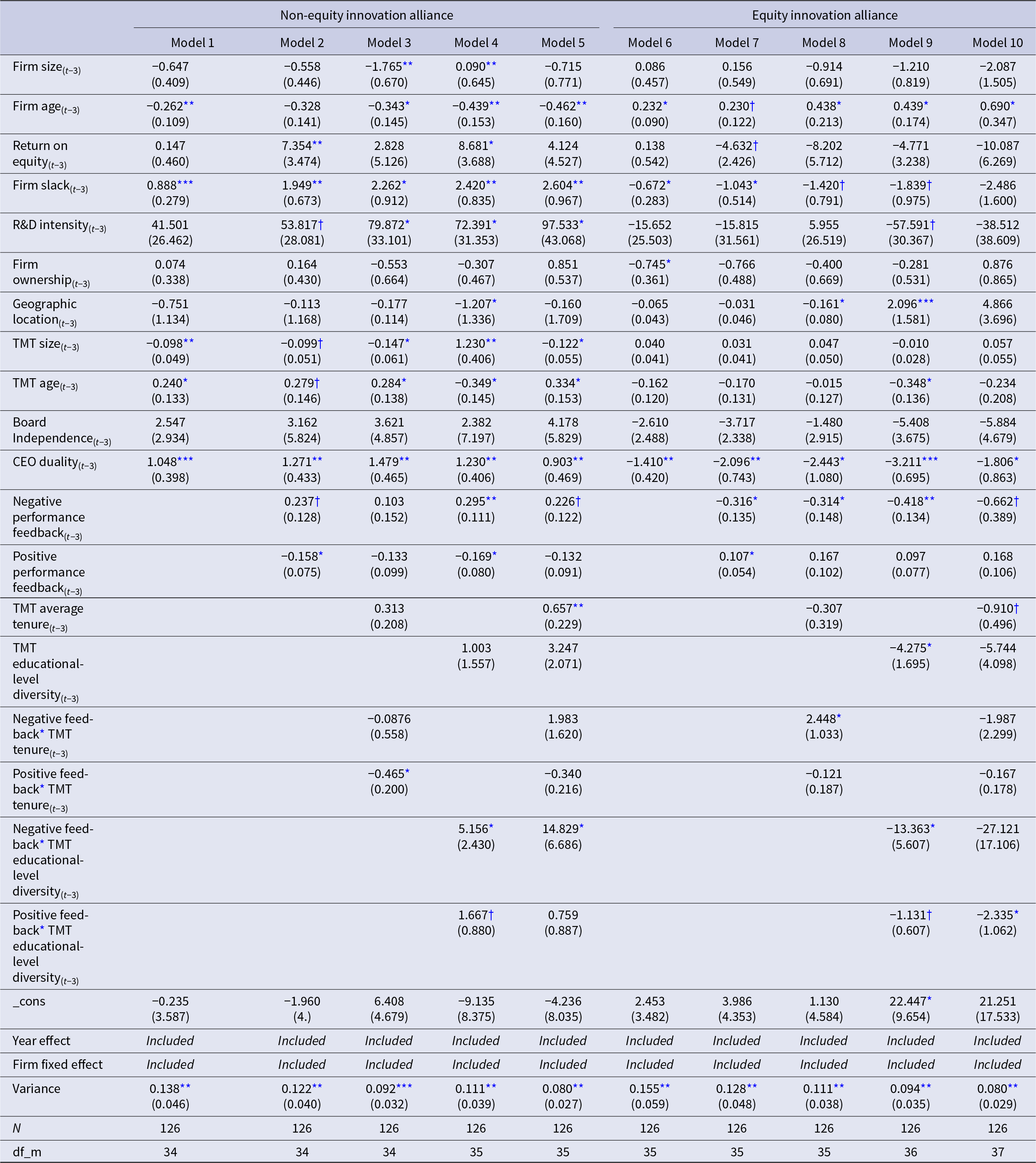
Table 3 depicts the results of our Tobit regression estimating the effects of performance feedback on the selection of innovation alliance structure. Models 1–5 place non-equity innovation alliance as the dependent variable, while Models 6–10 take equity innovation alliance as the dependent variable. Models 1 and 6 are set as baseline models where only control variables are included. Models 2 and 7 add the main effects of performance feedback, to test Hypotheses 1 and 2. The results suggest that negative performance feedback has a significant and negative effect on the propensity to the equity innovation alliance (Model 7: β = −.316, p < .05), while exerting a marginally significant and positive influence on the tendency to the non-equity innovation alliance (Model 2: β = .237, p < .1). This evidence is consistent with Hypothesis 1, indicating that firms with negative performance feedback are less likely to choose equity innovation alliance structure and are more likely to choose non-equity innovation alliances. Hypothesis 2 predicted that firms with positive performance feedback are more inclined to select equity innovation alliances than non-equity ones. Models 2 and 7 report that positive performance feedback will decrease firm’s intention to choose non-equity alliance structure (Model 2: β = −.158, p < .05) and increase firm’s propensity to equity innovation alliance (Model 7: β = .107, p < .05). Hypothesis 2 is thus supported.
Tobit regression predicting the selection of innovation alliance governance structure

Notes: Standard errors in brackets. All models include time fixed effects.
† p < .1, *p < .05, **p < .01, ***p < .001.
We then added moderator variables into the following models. Models 3 and 8 examine the moderating role of TMT tenure in the effect of social performance feedback on non-equity and equity innovation alliance structure respectively. In Model 3, the interaction term of positive performance feedback and TMT tenure is significant and negative (β = −.465, p < .05), suggesting that TMT tenure would strengthen the negative relationship between positive performance feedback and selection of non-equity innovation alliance. In Model 8, the negative relationship between negative performance feedback and equity innovation alliance is weakened when higher levels of TMT tenure are present (β = 2.448, p < .05). These results lend support to Hypotheses 3a and 3b respectively.
Models 4 and 9 assessed the moderating role of TMT’s educational-level diversity in the effect of performance feedback on equity innovation alliance. In Model 4, the interaction between TMT’s educational-level diversity and negative performance feedback is significant and positive (β = 5.156, p < .05), suggesting that TMT educational-level diversity strengthens the positive effect of negative performance feedback on the selection of non-equity alliance. The interaction term of TMT educational-level diversity and positive performance feedback is positive but only marginally significant (β = 1.667, p < .1). Model 9 predicts that TMT’s educational-level diversity moderates the impact of negative performance feedback on equity innovation alliance. The coefficient of the interaction between negative performance feedback and TMT’s educational-level diversity is negative and significant (β = −13.363, p < .05). The interaction term of positive performance feedback and TMT educational-level diversity is negative and marginally significant (β = −1.131, p < .1). The results provide partial support for Hypotheses 4a and 4b. All variables and interaction terms were added into Models 5 and 10.
Although Tobit models report the coefficients for the latent regression, the interpretation of coefficients differs with that in an ordinary least square regression (Kang, Reference Kang2007). To facilitate an accurate understanding, we computed the marginal effect of independent and control variables. As shown in Table 4, the marginal effect of negative performance feedback on the selection of non-equity alliance is positive and marginally significant (p < .1), with a coefficient of 0.117. This indicates that one unit increase in negative performance feedback would induce higher propensity of non-equity alliance by 0.117%. The marginal effect on equity alliance is negative and significant (p < .05), with a coefficient of –0.246. Therefore, the propensity to choose equity alliance would decrease by 0.246% with each-unit increase in negative performance feedback. The marginal effect of positive performance feedback on non-equity alliance is negative and significant (p < .05), with a coefficient of –0.078. This reveals that, with one unit increase in positive performance feedback, the propensity to choose non-equity would decrease by 0.078%. The marginal effect on equity alliance is significant and positive (p < .05), with a coefficient of 0.083. This implies that one unit increase in positive performance feedback would induce an increase in the propensity of equity alliance by 0.083%. Hypotheses 1 and 2 are further supported.
Marginal effects of performance feedback

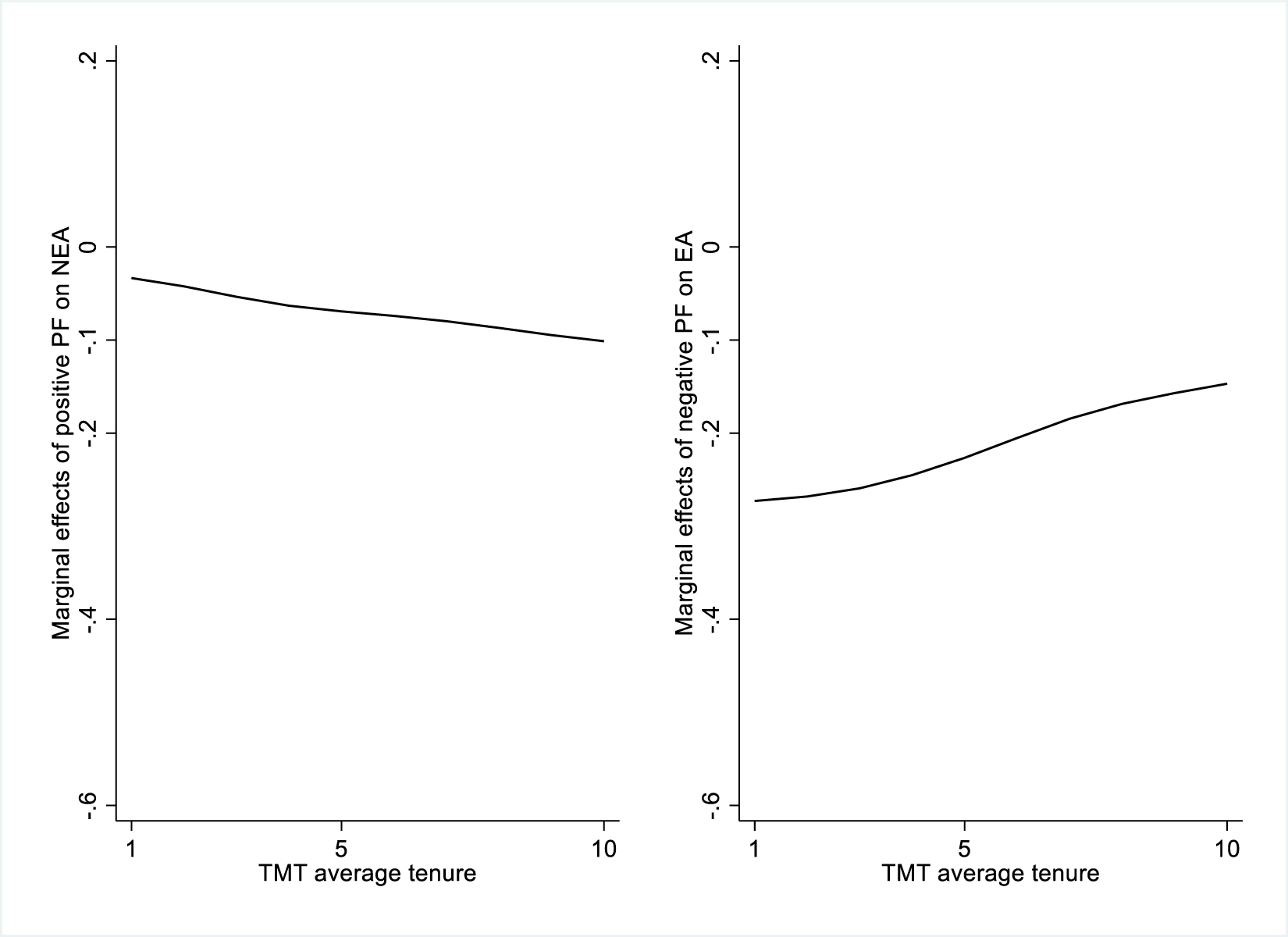
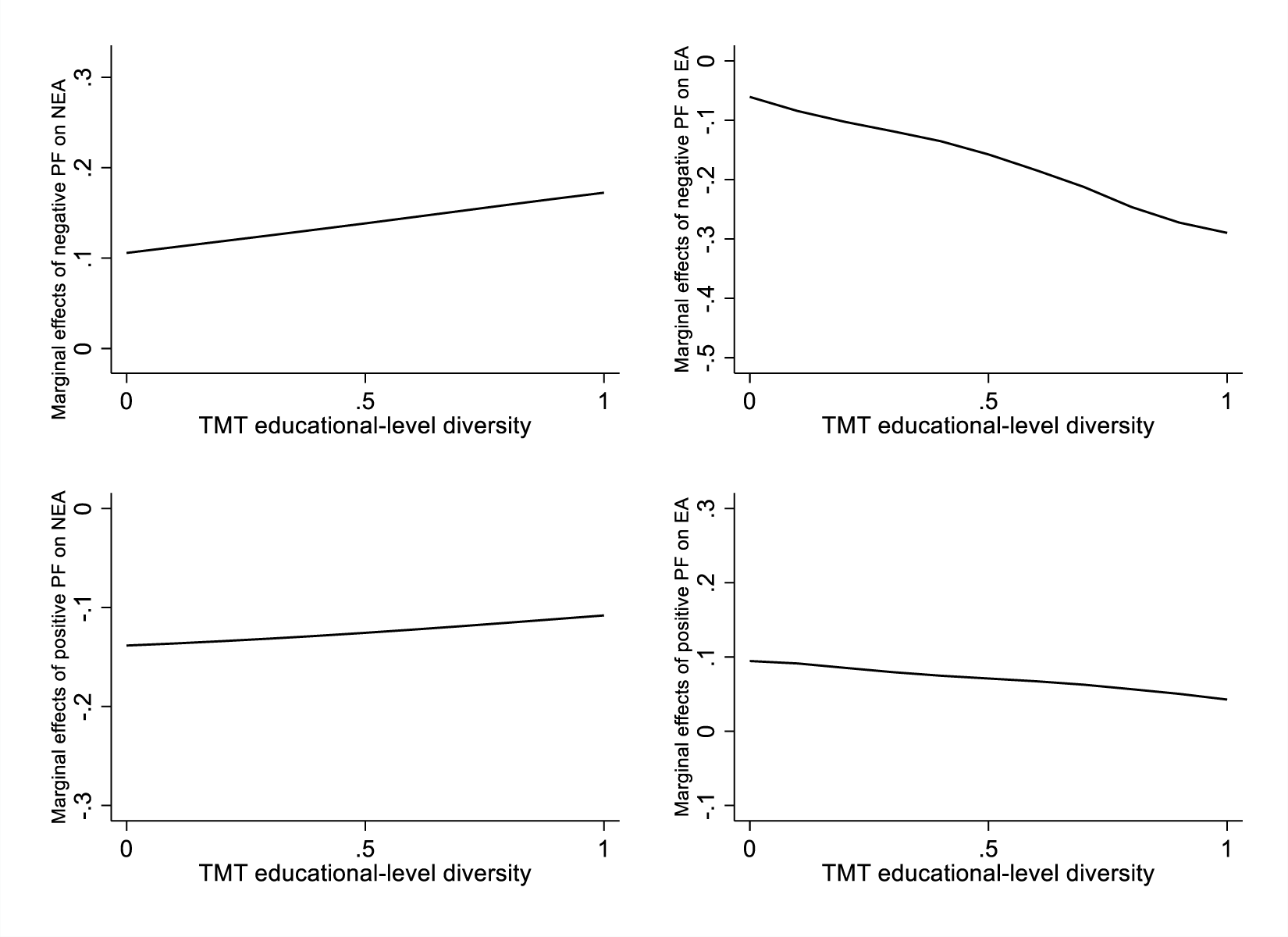
To further interpret the moderating effects of TMT characteristics in the Tobit regressions, we adopted Stata margins command to attain the graphs. Since there is not enough literature concerning the interaction terms in Tobit models, we show the interaction graphs following the explanations of nonlinear models (Karaca‐Mandic, Norton, & Dowd, Reference Karaca‐Mandic, Norton and Dowd2012). Figure 1 displays how the average marginal effects of performance feedback vary depending on different levels of TMT average tenure. Specifically, the negatively average marginal effect of negative performance feedback on equity alliance is weakened accompanied with the increase of the average tenure of TMT, while the negatively average marginal effect of positive performance feedback on non-equity alliance is strengthened as the level of TMT tenure becomes high. The result is consistent with that of Table 3, supporting Hypotheses 3a and 3b. As shown in Fig. 2, the positive and average marginal effect of negative performance feedback on non-equity is strengthened when TMT’s educational-level diversity increases, while the negatively average marginal effect on equity alliance is strengthened as the level of TMT’s educational-level diversity becomes higher. The negative and average marginal effect of positive performance feedback on non-equity is weakened when the degree of TMT’s educational-level diversity is greater, and the positively average marginal effect of positive performance feedback on equity alliance is weakened as the level of TMT’s educational-level diversity becomes higher. Therefore, Hypotheses 4a and 4b are supported. These interpretations are in line with results of Table 3.
Moderation effects of TMT average tenure.

Moderation effects of TMT educational-level diversity.

Robustness check
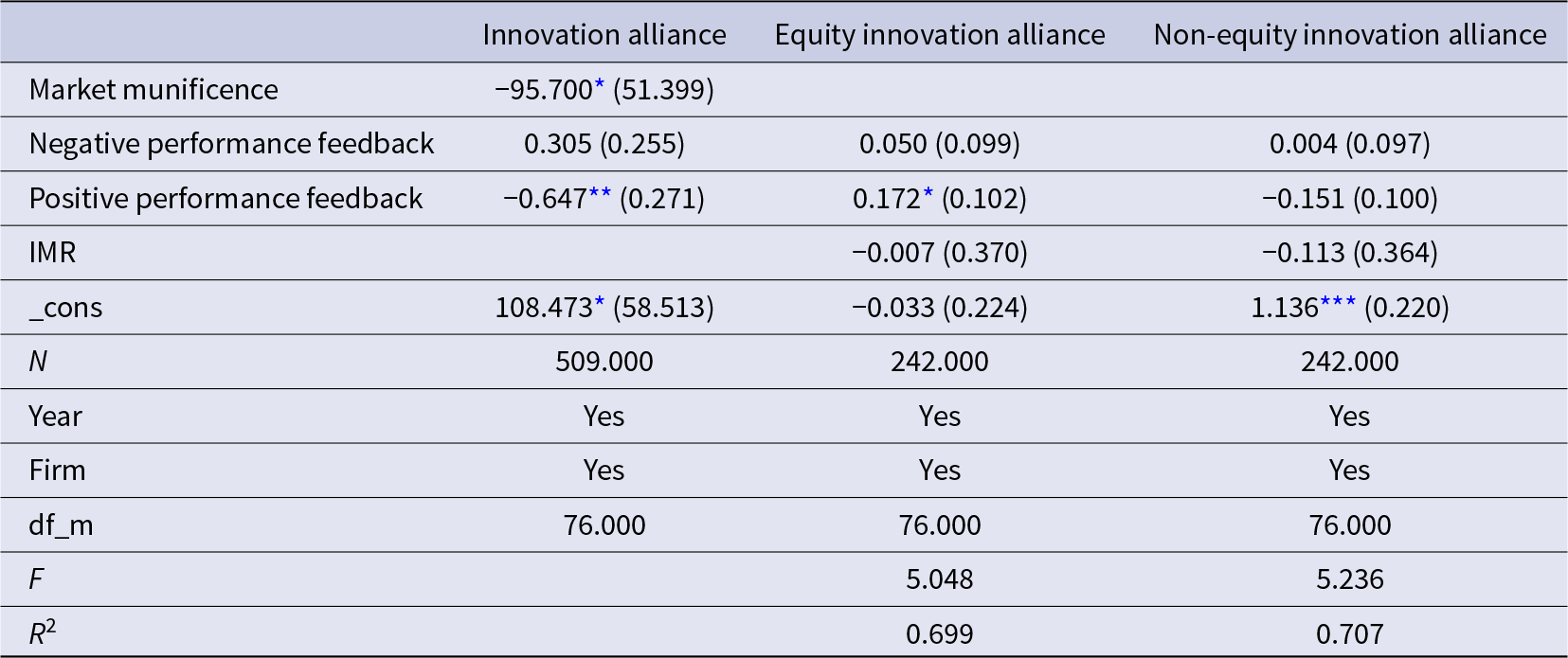
We performed robustness check through three additional analyses. First, since the sample only included firm observations with joint patents, it may induce an endogenous problem derived from the sample selection bias. We employed a two-step Heckman model to address the potential bias. Specifically, we chose instruments that may affect the decision to form innovation alliance but would not affect the selection of alliance governance structure. Following Chen, Zeng, Lin, and Ma (Reference Chen, Zeng, Lin and Ma2017) and Lohrke, Kreiser, and Weaver (Reference Lohrke, Kreiser and Weaver2006), we considered industry munificence as an identification variable. Prior research has shown that it may be associated with general uncertainty regarding technological volatility and market conditions, thus leading to the propensity of alliance formation (Dollinger & Golden, Reference Dollinger and Golden1992; Poppo & Zenger, Reference Poppo and Zenger1998). In the first step, we attained the inverse Mills ratio to correct the bias of sample selection. In the second step, the selection of innovation alliance structure was regressed on performance feedback. As shown in Table 5, the coefficients of the inverse Mills ratio are not significant, suggesting the absence of possible sample selection biases.
Heckman results

Note: IMR = inverse Mills ratio.
* p < .1, **p < .05, ***p < .01.
Second, we constructed an alternative measure of performance feedback by changing the value of α in the aforementioned equations (1) and (2). We found that when the weighted value (α) is set to be 0.6, negative performance feedback has a significantly positive effect on an adoption of non-equity innovation alliance and a negative effect on a use of equity innovation alliance; firms with positive performance feedback will have an increased propensity toward a use of equity innovation alliance rather than non-equity one. As for the moderating effect of TMT tenure, we identified that the interaction between negative historical aspiration gap and TMT tenure is significantly positive, in line with Model 10 in Table 3. These findings verify our results and lend support to the premises of search action and risk preference of firms proposed by the PFT (see Appendix Table A).
Finally, we additionally conducted fixed-effects regression analyses with cluster robust standard errors. The results of the ordinary least square analysis exhibited marginally significant relationships between different performance feedback and selection of innovation alliance structure (p < .1) (see Appendix Table B), in line with our main findings in Table 3.
Discussion
In respond to recent calls for research that examines the impact of performance feedback on interorganizational alliances (e.g., Shipilov, Li, & Greve, Reference Shipilov, Li and Greve2011; Tyler & Caner, Reference Tyler and Caner2016), we investigated how social performance feedback affects firms’ choice between equity and non-equity innovation alliance structures. To test the hypotheses, we adopted a sample of Chinese firms in pharmaceutical industry. The results suggest that below-aspiration performance motivates a firm to adopt problemistic search, ultimately increasing firm’s tendency to choose non-equity innovation alliance rather than equity alliance. Firms with above-aspiration performance will engage in slack search, leading to the selection of equity innovation alliance instead of non-equity alliance. Further, the relationship between performance feedback and alliance governance structure selection is moderated by TMTs’ average tenure and diversity of education level. TMT’s tenure weakens the relationship between negative performance feedback and non-equity innovation alliance, as well as strengthens the negative relationship between positive performance feedback and non-equity innovation alliance. TMT educational-level diversity enhances the effect of negative performance feedback on non-equity innovation alliance and weakens the negative effect of negative performance feedback on non-equity innovation alliance.
Theoretical contributions
By differentiating two types of innovation alliance governance structures (equity and non-equity) (Michelino et al., Reference Michelino, Cammarano, Lamberti and Caputo2015; Phene & Tallman, Reference Phene and Tallman2012; Reuer et al., Reference Reuer, Arino, Poppo and Zenger2016), we analyzed the relationship between performance feedback and the choice of innovation alliance structure. Our study contributes to the existing literature in three ways. First, feedback pertinent to organizational performance constitutes an important stimulus to managerial alliance structure choice (Bagherzadeh, Gurca, & Brunswicker, Reference Bagherzadeh, Gurca and Brunswicker2019; Felin & Zenger, Reference Felin and Zenger2014). Prior innovation that adopted a rational decision-making model has identified a variety of antecedents such as alliance experience, geographical distance, and environmental uncertainty to the alliance structure choice (e.g., Choi & Contractor, Reference Choi and Contractor2016; Niesten & Jolink, Reference Niesten and Jolink2017). However, this study is seemingly the first to provide valuable insights into the choice from the behavioral lens of the firm. Our results suggest that the decision of alliance structure cannot be totally ‘rational’ but is subject to different types of performance feedback and managerial knowledge bases. As such, we enrich the literature of innovation alliance governance structure (Felin & Zenger, Reference Felin and Zenger2014; Reuer et al., Reference Reuer, Arino, Poppo and Zenger2016).
Second, we create a more comprehensive understanding of the response mechanisms of social performance feedback. Existing studies have discussed the implications of performance feedback for predicting alliance formation and alliance portfolio diversity (Martinez-Noya & Garcia-Canal, Reference Martinez-Noya and Garcia-Canal2021; Su et al., Reference Su, Yu, Chen and Hou2023). We extended this stream of literature by introducing the choice of governance structures that is associated with the efficiency and success of the alliance (Michelino et al., Reference Michelino, Cammarano, Lamberti and Caputo2015). Further, scholars of performance feedback often employ organizational learning to explain the search and response behavior of firms (Kc, Staats, & Gino, Reference Kc, Staats and Gino2013; Levinthal & Rerup, Reference Levinthal and Rerup2021), but they fail to address the efficiency and costs of the learning process. Our study contributes to the learning mechanism in PFT literature by discussing both benefits and costs in the learning process under different alliance governance structures.
Finally, we identified the critical role of TMT characteristics in the selection of innovation alliance governance structure in response to performance feedback, exploring the boundary conditions of the PFT reasoning. Researchers have stressed the importance of analyzing the TMT’s role in firm response to performance (Kolev & McNamara, Reference Kolev and McNamara2022). Based on existing literature of TMT background characteristics, we chose two job-related TMT characteristics: TMT average tenure and TMT educational-level diversity (Díaz-Fernández, González-Rodríguez, & Simonetti, Reference Díaz-Fernández, González-Rodríguez and Simonetti2016; Liu et al., 2012). Our study confirms that the effect of performance feedback on innovation alliance governance structures varies when the degrees of TMT tenure and TMT educational-level diversity change. We provide advanced understanding of how TMT characteristics influence organizational response behaviors of performance feedback and affect the selection of innovation alliance governance structure.
Managerial implications
Our study has significant practical implications. Involving in an alliance exposes a firm to transaction or coordination hazards that can adversely affect the firm itself or its partner (Kale & Singh, Reference Kale and Singh2009). Non-equity innovation alliances enjoy the advantages of higher flexibility and lower setup cost (Majchrzak, Jarvenpaa, & Bagherzadeh, Reference Majchrzak, Jarvenpaa and Bagherzadeh2015), while equity innovation ones can restrain transaction costs and improve knowledge transfer efficiency (Vrande, Vanhaverbeke, & Duysters, Reference Vrande, Vanhaverbeke and Duysters2009). Thus, how a firm select an appropriate innovation alliance governance is crucial to alliance success and performance (Choi & Contractor, 2019). Our study provides useful decision-making guidance for managers when considering which innovation alliance structure to choose.
In addition, managers need to pay attention to the change of firms’ status in relation to social referents (Kim, Finkelstein, & Haleblian, Reference Kim, Finkelstein and Haleblian2015; Ye, Yu, & Nason, Reference Ye, Yu and Nason2021). When their current performance deviates from social aspirational levels, firms are recommended to use different innovation alliance governance modes to seek the effective allocation of innovation resources. Through this way, they can cope with the potential challenges or largely maintain long-term competitive advantages of firms in time. Moreover, when a firm selects an innovation alliance structure, the characteristics of the TMT such as tenure and heterogeneity of education levels should be analyzed, which provide guidance on an adjustment in the structure of the TMT. Finally, managers are expected to be aware of their cognitive limitations, which will attenuate the influence of personal attributes on the firm alliance structure decision-making.
Limitations and future research
Our study suffers several limitations, which nevertheless provide useful directions for future research. First, we measured the organizational performance feedback only based on the social referents, but failed to incorporate the historical referents grounded on the organizational performance trajectory in the past. As historical and social performance feedback represent different anchoring points (Audia & Greve, Reference Audia and Greve2006), an interesting future extension of this study would be to explore the heterogeneous organizational outcomes of historical and social performance feedback. Second, we distinguished equity from non-equity innovation alliance governance structures based on whether there are equity links between patent applicants of cooperative patents. While cooperative patents constitute a common method to measure innovation alliances (Kafouros, Wang, Piperopoulos, & Zhang, Reference Kafouros, Wang, Piperopoulos and Zhang2015), this approach has a few disadvantages. On one side, following prior research, we chose a 3-year lag to establish the casual relationship between performance feedback and the adoption of innovation structures (Fernald, Pennings, & Claassen, Reference Fernald, Pennings and Claassen2015), while the uncertainty of the lagged period has not been addressed; on the other side, managerial willingness to engage into innovation alliances is not equal to innovation outputs due to a potentially ineffective transfer from innovation inputs to patents. Thus, future research should refine the approach to measuring innovation alliance. Finally, this study takes the whole pharmaceutical manufacturing industry as the reference group. Recent developments in the PFT discourse suggest that specific reference groups are more relevant for organizations and thus a smaller peer group might do a better job (Blettner, Kotiloglu, & Lechler, Reference Blettner, Kotiloglu and Lechler2023; Hu, Blettner, & Bettis, Reference Hu, Blettner and Bettis2011). Future research could consider further examining our results using a refined reference group for social aspirations.
Conclusions
This study highlights the critical role of performance feedback in the innovation alliance governance structure choice. We found that negative performance feedback fosters firms’ selection of non-equity alliance rather than equity alliance. Meanwhile, positive performance feedback is positively associated with firms’ choice of equity alliance and negatively related to non-equity alliance. Further, TMT tenure and diversity of education level determine firms’ external search willingness and ability, respectively. Specifically, firms with longer-tenure TMTs show low levels of search willingness and risk-taking preference, which decrease a chance in choosing a non-equity innovation alliance structure in the presence of negative performance feedback. Higher levels of TMT educational-level diversity enhance the search ability by equipping firms with a wide range of perspectives, which increase a tendency of choosing a non-equity-based alliance structure. These findings underscore the importance of understanding how performance feedback influences the selection of alliance governance structure and how performance feedback and TMT characteristics jointly affect the governance structure selection.
Supplementary material
The supplementary material for this article can be found at https://doi.org/10.1017/jmo.2024.17.
Data availability statement
All data and codes are available upon request.
Author contributions
All authors contributed to the study conception and design. Conceptualization: Taoyong Su, Yongheng Chen; methodology: Yongheng Chen, Wei Liu; formal analysis and investigation: Taoyong Su; writing – original draft preparation: Yongheng Chen; writing – review and editing: Wei Liu; supervision: Junzhe Ji.
Financial support
This research did not receive any specific grant from funding agencies in the public, commercial, or not-for-profit sectors.
Conflict of interest
The author(s) declare none.
Professor Taoyong Su has a doctoral degree and is a professor of Strategy, Management, and Innovation at Tongji University, academic director of MBA Center, and deputy director of Institute of Strategy and Finance. His current research focuses on corporate strategy, management, and innovation. Yongheng Chen is a lecturer at School of Finance and Business, Shanghai Normal University, China. His current research focuses on performance feedback and firm innovation.
Yongheng Chen is a lecturer at School of Finance and Business, Shanghai Normal University, China. His current research focuses on performance feedback and firm innovation.
Wei Liu is a 4th year PhD candidate at the department of strategy and innovation in School of Economics and Management, Tongji University, China. Her current research focuses on strategy and entrepreneurial innovation.
Junzhe Ji is a senior lecturer in International Business at the Adam Smith Business School, University of Glasgow, UK. His research interests include international decision-making, Chinese SMEs and their internationalization, and micro-multinationals.