Introduction
Upper respiratory tract infection (URTI) is the most common non-preventable cause of surgery cancellation.Reference Bathla, Mohta, Gupta and Kamal 1 Inflammation of the respiratory mucosa causes airway hyper-reactivity, increased airway secretions, and increased sensitivity to the irritant effects of anaesthetic management (such as inhalation agents) and airway management. This airway hyper-reactivity after URTI may persist for six to eight weeks. During that period, anaesthesia may carry a higher risk for peri-operative respiratory adverse events, such as laryngospasm, stridor, bronchospasm, cough, breath-holding (more than 15 seconds), desaturation, bradycardia, atelectasis and pneumonia.Reference Tait, Malviya, Voepel-Lewis, Munro, Seiwert and Pandit 2 , Reference Tait and Malviya 3
Children suffer from an average of 6 URTIs every year;Reference Monto and Ullman 4 the duration of each varies from 7 to 10 days, and airway hyper-reactivity lasts for about 2 months.Reference Tait, Malviya, Voepel-Lewis, Munro, Seiwert and Pandit 2 , Reference Parnis, Barker and Van Der Walt 5 When considering these time frames, it is plausible that many children will present for surgery suffering from or having recently suffered from a URTI, and risk having a less safe procedure. If the elective surgery is postponed, this prolongs patients’ suffering, disrupts operating theatre schedules, extends waiting time, takes up parents’ time unnecessarily, and has an economic burden.
In most studies, a URTI is determined if a patient is afflicted upon admission with at least two of the following symptoms and signs: fever (over 38 °C), malaise, nasal congestion, rhinorrhoea (clear or purulent), sneezing, sore or itchy throat, cough with or without sputum, and wheezing. In such a scenario, a full active URTI is established, and most surgeons and anaesthesiologists will postpone surgery. An impending URTI is established if a patient presents with a URTI 1 or 2 days before the surgery. A recent URTI is ascertained if a patient has been suffering from a URTI for several days or even weeks, but is improving. In these circumstances, surgeons and anaesthesiologists consider whether to postpone the surgery or proceed with caution.Reference Bösenberg 6
In many ENT patients, there are persistent or intermittent URTI symptoms, and the surgical intervention aims to ameliorate these symptoms. Postponing procedures because of those very symptoms is a daily dilemma.
Evidence to postpone surgery
Cohen et al. compared the outcomes of 1283 children with pre-operative URTI with those of 20 876 children without URTI and found that the former group was 2.7 times more likely to experience respiratory-related adverse events during the peri-operative phase.Reference Cohen and Cameron 7 The authors also reported that the risk increased 11-fold in those URTI children who had an endotracheal tube (ETT). In another study of 15 183 patients, laryngospasm was more likely to occur in: children with active URTI, children who underwent airway surgery and those whose anaesthesia was supervised by less experienced anaesthesiologists.Reference Schreiner, O'Hara, Markakis and Politis 8 Desoto et al. showed that children, aged one to four years, with a URTI on the day of surgery or during the week prior to the surgery were at increased risk of developing transient hypoxaemia following elective ENT procedures, associated with endotracheal intubation.Reference DeSoto, Patel, Soliman and Hannallah 9
Kim et al. demonstrated that amongst children with active URTI, there was a higher rate of complications in passive smokers. They concluded that this factor should influence the decision to postpone surgery.Reference Kim, Kim, Lee, Kang, Jeong and Koo 10
Evidence to proceed with surgery
In 1992, Rolf and Coté conducted a prospective study to investigate the frequency and severity of desaturation events that occurred during general anaesthesia in children with and without mild URTI.Reference Rolf and Coté 11 Of the 402 paediatric patients undergoing general surgery, 30 had a URTI and 372 did not. Of the patients, 196 were managed with ETT and 206 with a facemask; 15 in each group had a URTI. The children with a URTI experienced an increased number of minor desaturation events. Intubated patients with a URTI had a higher frequency of bronchospasms compared with those children managed with a facemask. However, the authors’ conclusion was that children with a mild URTI may be safely anaesthetised, as the problems encountered are generally easily treated and without long-term sequelae.Reference Rolf and Coté 11
Tait el al. compared the differences between ETT and laryngeal mask airway use in children with a URTI undergoing surgical procedures.Reference Tait, Pandit, Voepel-Lewis, Munro and Malviya 12 There were no differences between groups in terms of the incidence of coughing, breath-holding, excessive secretions or arrhythmias; however, there were greater incidences of mild bronchospasm and desaturation events in the ETT group. All respiratory complications were easily managed without any adverse sequelae. The investigators suggested that the laryngeal mask airway is a more suitable alternative to the ETT for a child with a URTI undergoing otological procedures, if the decision is made to proceed with anaesthesia.
In another prospective study of 1078 children with a URTI undergoing elective surgery, there were no differences between children with active URTI, recent URTI (within four weeks) and asymptomatic children with respect to the incidences of laryngospasm and bronchospasm.Reference Tait, Malviya, Voepel-Lewis, Munro, Seiwert and Pandit 2 However, children with active and recent URTI had significantly more episodes of breath-holding and major desaturation events (oxygen saturation of less than 90 per cent), and a greater incidence of overall peri-operative respiratory adverse events, than children with no URTI. The study also reported a higher incidence of peri-operative respiratory adverse events in children undergoing surgical procedures involving the airway (e.g. tonsillectomy and adenoidectomy, direct laryngoscopy, and bronchoscopy), and children under the age of two years had a higher incidence of major desaturation events than older children. Although children with acute and recent URTI were at greater risk for respiratory complications, none of the events were associated with any long-term morbidity. These results suggest that most of these children can undergo elective procedures without postponement, provided that careful management is employed.
In 2007, von Ungern-Sternberg et al. studied the occurrence of peri-operative respiratory adverse events and the associated risk factors in children undergoing general anaesthesia with a laryngeal mask airway.Reference von Ungern-Sternberg, Boda, Schwab, Sims, Johnson and Habre 13 The parents completed a questionnaire regarding their child's medical history and potential symptoms of URTI. Amongst the 831 children included in the study, 27 per cent presented with a history of a recent URTI, occurring in the 2 weeks prior to anaesthesia. The occurrence of a recent URTI was associated with a two-fold increase in the incidence of laryngospasm, coughing and oxygen desaturation. This incidence was even higher in: young children, those undergoing ENT surgery and patients for whom there were multiple attempts to insert the laryngeal mask airway. The authors’ conclusion was that laryngeal mask airway use in children with recent URTIs was associated with a higher incidence of peri-operative respiratory adverse events compared with healthy children. However, the overall incidence of peri-operative respiratory adverse events was low. This suggests that if anaesthesiologists allow at least a two-week interval after URTI, they can safely proceed with anaesthesia using a laryngeal mask airway.
In 2009, von Ungern-Sternberg et al. assessed the usefulness of salbutamol pre-medication on the occurrence of peri-operative respiratory adverse events, in a prospective observational study.Reference von Ungern-Sternberg, Habre, Erb and Heaney 14 The study included 600 children (aged 0–16 years) undergoing general anaesthesia. Of these, 200 children had experienced a recent URTI and received pre-operative salbutamol 10–30 minutes prior to surgery, 200 children had suffered a recent URTI but did not receive salbutamol pre-medication, and 200 children had not experienced URTI during the 4 weeks prior to surgery. All peri-operative respiratory adverse events (laryngospasm, bronchospasm, oxygen desaturation (less than 95 per cent) and severe coughing) were recorded. The results showed that children who had suffered a recent URTI and who received salbutamol had a significantly reduced incidence of peri-operative bronchospasm and severe coughing compared with children who had experienced a recent URTI but did not receive salbutamol. However, healthy children presented with the lowest rate of respiratory complications compared with children with a recent URTI, independent of whether or not they received salbutamol pre-operatively. The authors concluded that children with a history of a recent URTI have significantly fewer peri-operative respiratory adverse events following pre-medication with salbutamol compared with no pre-medication.
The above brief review presents evidence supporting both postponing and proceeding with ENT surgery in paediatric patients with acute URTI. The findings of the studies reviewed support both a safe approach, in which surgery is postponed at the expense of planned surgical care, and a more liberal approach, in which the decision is made to proceed with surgery, but at the cost of increased though calculated anaesthetic risk.
Discussion
Children with a co-existing reactive airway due to a URTI are at greater risk for peri-operative respiratory adverse events. Hence, these children may benefit from pre-anaesthetic assessment and specifically targeted peri-operative anaesthetic management. When evaluating a child with a URTI for whom elective ENT surgery is planned, pre-operative information must be meticulously obtained for the best anaesthetic management, in order to reduce the risk of peri-operative respiratory adverse events. In general, symptoms such as nasal congestion and discharge, sore throat, and sneezing can be properly managed when diagnosed during the pre-operative anaesthetic assessment; these children should be allowed to undergo surgery. However, significant clinical findings such as dyspnoea, wheezing or fever carry increased anaesthetic risk for peri-operative respiratory adverse events, and in those cases surgery should be postponed. Therefore, some symptoms and signs should have a different effect on the decision of whether to proceed with or postpone the surgery.
One of the most significant complications in ENT paediatric surgery is bleeding during adenotonsillectomy. It is known that vascular flow increases in pharyngeal tissue during a URTI; we can therefore presume that there will be an increased risk of bleeding following surgery. However, when reviewing the literature, no such correlation was found. Further studies are required in order to assess this hypothesis.
Diagnostic tools such as white blood count and chest radiography may not be helpful in the decision making.Reference Davis, Cladis and Motoyama 15 Thus, meticulous evaluation of the symptoms and signs is crucial for decision making. In addition to careful monitoring and the appointment of an experienced anaesthesiologist, other precautions may involve consideration of a choice of anaesthetic agents, and the use of a face or laryngeal mask instead of an ETT whenever indicated and safe.
Another important factor is the anatomical region being operated on. For example, myringotomy with ventilation tube insertion is a common and relatively short procedure that does not directly involve the airway. In such cases, a laryngeal mask airway should be chosen instead of an ETT, or, even better, anaesthesia through a facemask.Reference Bösenberg 6 , Reference Tait, Pandit, Voepel-Lewis, Munro and Malviya 12 If endotracheal intubation is necessary because of airway manipulation, it should be undertaken under deep anaesthesia, along with the administration of intravenous propofol prior to intubation in order to blunt airway reactivity. Furthermore, a smaller than normal ETT should be used given the possibility of airway oedema and congestion associated with the URTI.Reference Davis, Cladis and Motoyama 15
According to Becke, peri-operative respiratory adverse events in paediatric patients with a URTI undergoing general anaesthesia can be prevented or easily managed peri-operatively in many cases.Reference Becke 16 This requires recognition of the child-specific and anaesthetic risk factors, and an appropriate anaesthetic strategy, as mentioned below.
Child-specific risk factors for peri-operative respiratory adverse events include: age (the findings vary between different studies, but in general the younger the child is the more prone he or she is to peri-operative respiratory adverse events); history of previous disease (such as asthma, croup, cystic fibrosis, ciliary dyskinesia, obstructive sleep apnoea and even passive smoke exposure); co-existing infectious disease that significantly impairs the child's general condition (e.g. acute otitis media, pneumonia and acute bronchitis); and clinical signs of a URTI during the two weeks prior to planned surgery.
Anaesthetic risk factors for peri-operative respiratory adverse events include: surgery involving the airway (e.g. tonsillectomy, adenoidectomy, nasal and laryngeal procedures, and bronchoscopy); airway management (ETT use is associated with a higher risk than a laryngeal mask airway, whereas a facemask is associated with the lowest risk for peri-operative respiratory adverse events – these factors should be considered when choosing the anaesthetic instrumentation); anaesthetic agents (e.g. desflurane has a higher risk than sevoflurane, whereas propofol has the lowest risk for peri-operative respiratory adverse events among the anaesthetic agents); and an inexperienced anaesthesiologist.
We have also considered anaesthetic agents and instrumentation choice. Salbutamol is a bronchodilator beta-mimetic agent that is effective in the prevention and treatment of peri-operative bronchospasm in asthmatic children. The pathophysiology of bronchial hyper-reactivity during and after a URTI is similar to that of asthma; therefore, salbutamol is expected to be effective in these patients and reduce the risk of peri-operative respiratory adverse events by at least 35 per cent.Reference von Ungern-Sternberg, Habre, Erb and Heaney 14 Propofol has been shown to have bronchodilating effects similar to those of volatile anaesthetics.Reference Oberer, von Ungern-Sternberg, Frei and Erb 17 Furthermore, it is many anaesthesiologists’ intravenous anaesthetic agent of choice. The ETT is a strong stimulus for a hyper-reactive airway, and its use significantly increases the incidence of peri-operative respiratory adverse events. Hence, ETT use should be avoided whenever possible. However, its use is inevitable in many ENT surgical procedures because of airway manipulation and the need for a secure airway. A laryngeal mask airway is a better alternative to the ETT, with less risk of peri-operative respiratory adverse events. The least risky method of airway management is the facemask. However, the facemask can only be used for short procedures that do not present a risk of peri-operative respiratory adverse events, such as ventilation tube insertion or frenectomy.
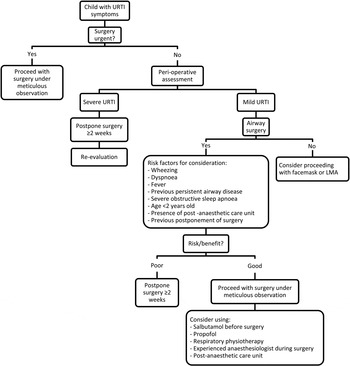
When considering ENT surgery in a child with URTI, we propose using the algorithm shown in Figure 1 for guidance in the assessment and anaesthetic management. This is a modification of the chart suggested by Tait et al.Reference Tait and Malviya 3
Algorithm for the management of a child with acute upper respiratory tract infection. URTI = upper respiratory tract infection; LMA = laryngeal mask airway

Conclusion
Children with a URTI undergoing ENT surgical procedures, especially those that involve the airway, are at increased risk for anaesthetic complications. Many of those procedures are being performed in order to alleviate chronic symptoms present in URTIs, such as rhinorrhoea, coughing, sore throat and nasal congestion. These can be easily managed peri-operatively when they are considered in the pre-operative clinical assessment by the surgeon and anaesthesiologist. However, some URTI symptoms, such as wheezing, fever and dyspnoea, are more worrisome as they increase the risk of peri-operative respiratory adverse events. In those cases, postponement of the surgery is recommended.
Other factors that should influence the decision to postpone or proceed with surgery include: personal history of persistent airway disease, obstructive sleep apnoea, passive smoking, the presence of an experienced anaesthesiologist and even previous postponement of the child's surgery. The algorithm suggested for the assessment and management of a child with acute URTI (Figure 1) may be a useful tool to aid the decision.