Introduction
Peers influence a wide variety of human behaviors (Harris, Reference Harris2002). Exposure to high levels of peer deviance (PD) in childhood and adolescence is among the strongest predictors of drug abuse (DA) (and other externalizing behaviors) (Kandel, Reference Kandel1985; Hawkins et al. Reference Hawkins, Herrenkohl, Farrington, Brewer, Catalano, Harachi, Loeber and Farrington1998; Petraitis et al. Reference Petraitis, Flay, Miller, Torpy and Greiner1998; Andrews et al. Reference Andrews, Tildesley, Hops and Li2002; Allen et al. Reference Allen, Donohue, Griffin, Ryan and Turner2003). This association could result from a causal effect of PD on DA but could arise from at least two other non-causal mechanisms. First, through peer selection, adolescents could seek out like-minded friends who share their own attitudes so that those prone to DA create a set of deviant peers (e.g. Kandel, Reference Kandel1978; Eiser et al. Reference Eiser, Morgan, Gammage, Brooks and Kirby1991; Kandel, Reference Kandel1996; Wills & Cleary, Reference Wills and Cleary1999). Second, the PD–DA association might arise from shared genetic and/or environmental risk factors. PD is predicted by a range of environmental exposures, such as social disadvantage, low religious identification and poor family functioning, that also increase the risk for DA (Oetting & Beauvais, Reference Oetting and Beauvais1987; Fergusson & Horwood, Reference Fergusson and Horwood1999). Both PD and DA are influenced by genetic risk factors that are almost certainly partially shared (Tsuang et al. Reference Tsuang, Lyons, Eisen, Goldberg, True, Lin, Meyer, Toomey, Faraone and Eaves1996; Kendler et al. Reference Kendler, Jacobson, Prescott and Neale2003, Reference Kendler, Jacobson, Gardner, Gillespie, Aggen and Prescott2007, Reference Kendler, Sundquist, Ohlsson, Palmer, Maes, Winkleby and Sundquist2012).
We have previously shown that PD assessed at age 15, where PD is defined in an unconventional way as the proportion of similar aged peers in small residential areas who go on to have future registrations for DA, robustly predicts risk for incident DA in a Swedish national sample (Kendler et al. Reference Kendler, Ohlsson, Sundquist and Sundquist2014). In the current study we sought to clarify the causal nature of this PD–DA association. We began by examining the association between DA and years residing in low or high PD communities up to the age of 15. We then repeated this analysis in co-relative pairs of first-cousin, paternal half-siblings, maternal half-siblings and full-siblings discordant for the length of exposure to low or high PD. We eliminated the problem of peer selection by using a community-level definition of PD at an age when the individual does not select their place of residence. We used the discordant co-relative design in which the central contrast is between family members of known genetic resemblance who are discordant in their exposure to PD, to control for the effect of familial factors that impact on both PD and DA, to clarify the degree to which the observed PD–DA association is causal. We predicted that the co-relative analyses would be consistent with a causal relationship between community PD and future risk for DA.
Method
Our study used linked data from multiple Swedish nationwide registries and healthcare data. Linking was achieved through the unique individual Swedish 10-digit personal ID number assigned at birth or immigration to all Swedish residents. Our database used the following: the Total Population Register, containing annual data on family and geographical status; the Multi-Generation Register, providing information on family relationships; the Swedish Hospital Discharge Register, containing all hospitalizations for Swedish inhabitants from 1964 to 2010; the Swedish Prescribed Drug Register, containing all prescriptions in Sweden from 2005 to 2009; the Out-patient Care Register, containing information from all out-patient clinics from 2001 to 2009; the Primary Health Care Register, containing out-patient primary care data on diagnoses and time for diagnoses in 2001–2007 for 1 million patients from Stockholm and middle Sweden; the Swedish Crime Register, which included national complete data on all convictions from 1973 to 2011; the Swedish Suspicion Register, which included national complete data on all individuals strongly suspected of crime from 1998 to 2011; the Swedish Mortality Register, containing causes of death; and the Longitudinal Integration Database for Health Insurance and Labour Market Studies (LISA), containing annual information on socio-economic factors on all individuals from 16 years of age. We secured ethical approval for this study from the Regional Ethical Review Board of Lund University (No. 2008/409). Our methods for identifying DA are given in the online Supplementary Material.
Sample
The database began with all individuals in the Swedish population born 1970 to 1985 who were registered in a geographical area at every year between 0 and 15 years of age; had their mother and father registered in the multigenerational register; were living in the same household as their mother, father or at least one grandparent at the age of 15; and were not registered for DA by age 15. This database included 1 369 716 individuals.
PD was calculated using geographical areas defined by Statistics Sweden on the basis of small-area market statistics (SAMS). There are approximately 9200 SAMS neighbourhoods throughout Sweden, with an average population of 1000. During our study period we had access to individual SAMS neighbourhoods at every fifth year between 1970 and 1985, and every year between 1985 and 2000. For years in which we had no access to information on SAMS areas, we used data from the SAMS neighbourhood closest in time as a proxy. DA was defined during the entire follow-up period, that is until 2011. Our PD measure was calculated for every year between 0 and 15 years of age of the individual, and based on the proportion of incident DA in the SAMS area of individuals in an 11-year interval around the age of the individual. For example for an individual born in 1985, we measured the proportion of future DA (i.e. registered as DA at any time until 2011) of individuals born between 1980 and 1990 residing in the same SAMS neighbourhood as the individual in 1985. This procedure was repeated for every year until the individual turned 15. In the creation of the PD measure, the individual and close biological relatives (twins, full and half-siblings, and first cousins) were excluded, so that the PD measure for each individual was only based on non-relatives. For a more thorough description of the PD measure see Kendler et al. (Reference Kendler, Ohlsson, Sundquist and Sundquist2014). For each year, the PD measure was categorized into thirds: low PD, intermediate PD and high PD. For example, at age 0 the low PD areas had a mean DA measure of 0.7% whereas the intermediate PD and high PD areas had mean DA measures of 2.3% and 5.4% respectively. The corresponding figures at age 15 were 1.3, 3.2 and 6.9%, reflecting the increase in the population prevalence of DA over the study period.
From the original database we created four specific datasets: (1) all individuals born into a high PD area (origin high PD, n = 532 985); (2) all individuals living in a high PD area at age 15 (destination high PD, n = 411 169); (3) all individuals born into a low PD area (origin low PD, n = 252 755); and (4) all individuals living in a low PD area at age 15 (destination low PD, n = 358 920). The relationships between the samples in these four datasets are shown in the online Supplementary Table S1. In total, 570 063 individuals were unique to one of these four datasets and 490 568 were shared between two of these groups. For all individuals, we included parental education as a proxy for family socio-economic status (SES), defined as the highest education achieved by either mother or father categorized into three levels: low education (0–9 years); middle education (10–11 years); and high education (⩾12 years).
Statistical analysis
In the four specific datasets, we looked at the association between number of years living in a high/low PD area up to age 15 and subsequent DA in individuals. Because of different exposure periods based on birth year, we used Cox proportional hazards regression. Follow-up time in number of years was measured from age 15 of the child until year of first registration for DA, death or the end of follow-up (year 2011), whichever came first. In all models, we investigated the proportionality assumption. If it was not fulfilled, we included an interaction term between log of time and number of years in the high/low PD area in the model. As siblings from the same family could be included in the analysis, we adjusted for non-independence with a robust sandwich estimator. All models were adjusted for gender and parental education. We present the hazard ratios (HRs) and their corresponding 95% confidence intervals (CIs). In the analysis of the origin high PD dataset, the HR for the duration of PD exposure reflects the change in risk of subsequent DA of one additional year that the individual did not reside in a high PD area (i.e. a value of 0 indicates that the individual always lived in a high PD neighborhood whereas a value of 15 indicates that the individual was living in a high PD neighborhood for 1 year only). Similarly, for the destination high PD dataset, the HR reflects the change in risk of subsequent DA of an additional year the individual did not reside in a high PD area. In the analysis of the origin low PD dataset, the HR reflects the change in risk of subsequent DA of an additional year the individual did not reside in a low PD area (i.e. a value of 0 indicates that the individual always lived in a low PD area whereas a value of 15 indicates they lived in a low PD area for 1 year only.) Similarly, in the analysis of the destination low PD dataset, the HR reflects the change in risk of subsequent DA of an additional year the individual did not reside in a low PD area. For each of the four groups, the level of PD could vary over time either because the family stayed in the same community but the community level of PD changed, or because the family moved from one community to another. We call these two groups ‘stayers’ and ‘movers’ respectively. Statistical analyses were performed using SAS version 9.3 (SAS Institute Inc., USA).
Co-relative design
In a second step, we sought to compare the results from the Swedish general population with results from a co-relative design. By means of the Swedish Multi-Generation Register, we identified all full-sibling pairs, all maternal and paternal half-sibling pairs and all first-cousin pairs who were discordant for the exposure (i.e. number of years in high/low PD area). We separated paternal and maternal half-siblings because, although they shared the same degree of genetic resemblance, maternal half-siblings were much more likely to live together while growing up than paternal half-siblings. Subsequent DA was investigated in relation to number of years living in a high/low PD area by stratified Cox proportional hazards models with a separate stratum for each relative pair. The co-relative design allowed us to compare effects of PD in first-cousin, half-sibling and full-sibling relative pairs who were discordant for the length of exposure to high- or low-risk environments. This discordant co-relative design controls for the effect of familial factors that impact both PD and DA and clarifies the degree to which an observed association is causal. These models provide an HR for PD that is adjusted for familial clustering, and therefore account for an array of shared genetic and environmental factors. Robust standard errors were used to adjust the 95% CIs for the fact that we had relative pairs from the same family. Follow-up time in number of years was measured from age 15 of the child until year of first registration for DA, death or end of follow-up (year 2011), whichever came first.
Results
Basic analyses
We examined the relationship between PD exposure during childhood and adolescence, and risk for subsequent DA in two complimentary ways, viewing development from the perspective of origins (community PD at birth) and destinations (community PD at age 15). We therefore examined four overlapping groups of subjects as follows: origin high PD (n = 532 985), destination high PD (n = 411 169), origin low PD (n = 252 755), and destination low PD (n = 358 920). The overlap between these groups is described in Supplementary Table S1. The percentage of movers was greater in the origin high PD and destination high PD groups (73% and 67% respectively) than in the origin low PD and destination low PD groups (41% and 51% respectively).
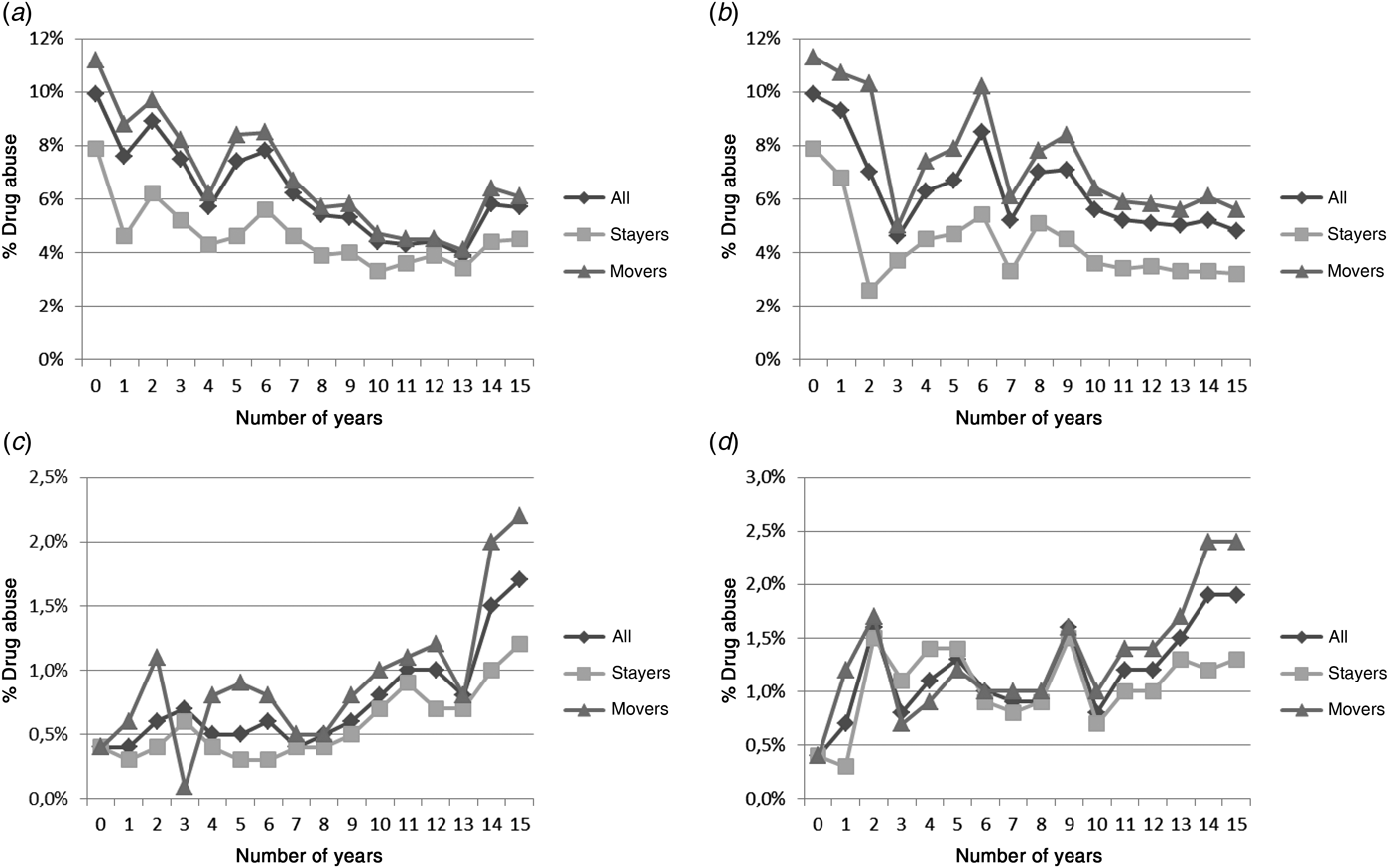
In the origin high PD group, for every year in which the individual lived in a community where the PD level was low/intermediate, the relative hazard for DA registration declined by 11% (HR 0.89, 95% CI 0.88–0.90) (Fig. 1a). The relationship was largely monotonic and similar in stayers and movers, although the trend was slightly more pronounced in the latter. In the destination high PD group (Fig. 1b), the results were very similar: for every year in which the individual resided in a community where the PD level was not high, the risk for DA declined by 11% (HR 0.89, 95% CI 0.88–0.90). Again, the association with PD risk was slightly more prominent in movers than stayers.
(a) Origin high peer deviance (PD) and (b) destination high PD per number of years in areas with low or intermediate PD. (c) Origin low PD and (d) destination low PD per number of years in areas with intermediate or high PD.

In the origin low PD group (Fig. 1c), for every year the individual lived in a community that did not have low PD, the risk for DA registration was increased by 19% (HR 1.19, 95% CI 1.14–1.23). The relationship was somewhat more prominent in movers than stayers and broadly linear with the risk for DA being especially elevated in those who spent nearly all of their childhood in communities with medium to high PD. In the destination low PD group (Fig. 1d), for every year the individual lived in a community that did not have low PD, the risk for DA registration was increased by 8% (HR 1.08, 95% CI 1.06–1.11). The relationship was relatively linear and more prominent in movers.
In all models the proportionality assumption was not fulfilled and the proportional effect of number of years within a community changed over time. However, in all models except the origin low PD, the effect was minor. For example, in the analysis for the origin high PD group, the HR after 10 years of follow-up was 0.91 compared with 0.89 at the start of follow-up whereas in the analysis for origin low PD, the HR after 10 years of follow-up was 1.08 compared to 1.19 at the start of follow-up.
Co-relative control analyses
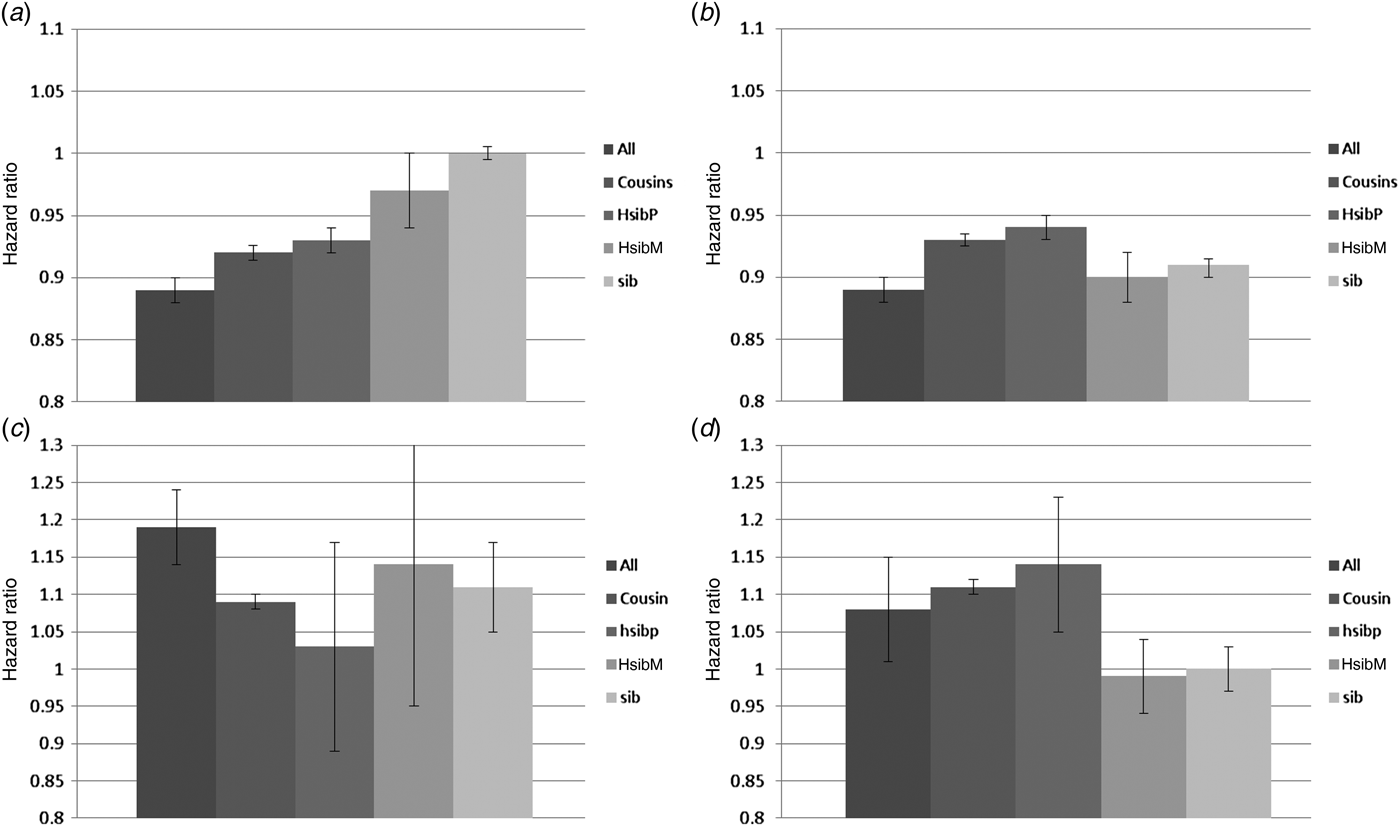
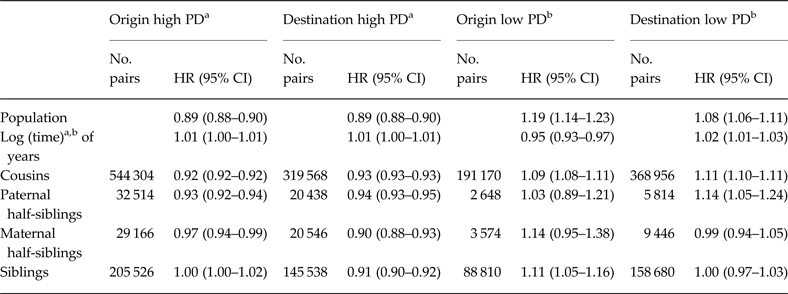
To clarify the causal relationship between PD exposure and risk for DA, we conducted co-relative control analyses for each of our four groups in four classes of relatives: first cousins, paternal half-siblings, maternal half-siblings, and full siblings. Within each co-relative pair, the relatives differed in the years of exposure to low, medium or high PD communities during the ages 0–15, and the HR represents the expected change in risk of subsequent DA associated with 1 year difference in exposure to high (or low) PD. This analysis leads to a specific set of expectations. If, for example, the observed association between high PD and DA is due to shared familial factors rather than a causal relationship, we expect that the HR for the duration of PD will approach the null (that is an HR of 1.00) with increasing genetic relatedness (i.e. the duration of PD will have a smaller effect on subsequent DA for full siblings as compared to more distant relatives). The results are presented in Table 1 and Fig. 2a–d. In the origin high PD group (Fig. 2a), the HR for DA per year of exposure to communities with medium or low PD increased in a monotonic manner from the 0.89 observed in the general population to 1.00 observed in full sibling pairs. In the destination high PD group (Fig. 2b), the results were more variable but showed no clear trend for the HR to change moving from the general population to relatives with an increasing amount of genetic and environmental sharing. In particular, the HRs for DA per year of exposure to communities with medium or low PD observed in the maternal half- and full-sibling pairs (0.90 and 0.91 respectively) were both highly significantly different from unity and similar to that observed in the general population (0.89).
(a) Origin high peer deviance (PD) and (b) destination high PD: hazard ratio (HR) for drug abuse per number of years in areas with low or intermediate PD in relative pairs discordant for exposure. (c) Origin low PD and (d) destination low PD: HR for drug abuse per number of years in areas with intermediate or high PD in relative pairs discordant for exposure. HsibP, paternal half-siblings; HsibM, maternal half-siblings; sib, full siblings.

Sample size, hazard ratios (HRs) and 95% confidence intervals (CIs) for the prediction of incident drug abuse (DA) per year of exposure in the general population and in cousins, half-sibling and full-sibling co-relative pairs

PD, Peer deviance.
All models were adjusted for gender and parental education.
a Per number of years in areas other than high PD.
b Per number of years in other areas than low PD.
In the origin low PD group (Fig. 2c), there was again some variation in the observed HRs with the HR in the paternal half-siblings being known very imprecisely. However, the general trend was for a moderate decline from the HR of 1.19 observed in the general population within the co-relative pairs. However, in the group with the greatest sharing (full siblings), the HR for DA per year of exposure to communities with medium or high PD observed in the maternal half- and full-sibling pairs remained substantially and significantly greater than unity (HR 1.10). Finally, in the destination low PD group (Fig. 2d), the HRs were fairly similar in the general population and in those relatives that rarely grew up together (cousins and paternal half-siblings) but were substantially lower and not significantly different from unity in those relatives (maternal half-siblings and full siblings) who were commonly reared together.
As shown in Supplementary Fig. S1a–d, we repeated these analyses in the stayers and movers in each of our four groups. The sample size in the two half-sibling groups was insufficient to obtain stable estimates. In the origin high PD group, in both groups the HRs were significantly lower than unity in cousins (stayers: HR 0.96, 95% CI 0.94–0.97; movers: HR 0.91, 95% CI 0.91–0.92) and essentially unity in siblings (stayers: HR 1.00, 95% CI 0.98–1.04; movers: HR 1.02, 95% CI 1.00–1.04). In the destination high PD group, the HRs were significantly lower than unity and fairly similar in the two groups in both cousins (stayers: HR 0.92, 95% CI 0.90–0.94; movers: HR 0.93, 95% CI 0.92–0.94) and siblings (stayers: HR 0.90, 95% CI 0.87–0.93; movers: HR 0.91, 95% CI 0.89–0.93). In the origin low PD group, in both groups the HRs were significantly greater than unity and similar in cousins (stayers: HR 1.09, 95% CI 1.04–1.14; movers: HR 1.10, 95% CI 1.04–1.16) and siblings (stayers: HR 1.08, 95% CI 1.01–1.15); movers: HR 1.09, 95% CI 1.00–1.17). In the destination low PD group, the HRs were significantly greater than unity in the two groups in cousins (stayers: HR 1.11, 95% CI 1.07–1.14; movers: HR 1.13, 95% CI 1.09–1.16) and essentially unity in siblings (stayers: HR 1.01, 95% CI 0.97–1.06; movers: HR 0.99, 95% CI 0.94–1.04).
Discussion
The aim of this study was to move beyond the static PD assessment of our earlier work and assess the association between the duration of exposure to community PD during childhood and adolescence, and future risk for DA. We then used a co-relative control design to clarify the causal nature of this association. Our analytic approached involved four overlapping groups of subjects that we termed: origin high PD, destination high PD, origin low PD, and destination low PD.
Before proceeding, however, we should note that our measure of PD could also be assessing a wide range of community factors that predispose to future DA. We continue to use the term PD for its convenience but recognize that the PD–DA association may be mediated by a host of processes, only some of which relate specifically to peer contact and influence.
Congruent with our prior analysis of PD assessed at the single time point of age 15, we found consistent and robust associations between the duration of exposure to levels of PD up to age 15 and the risk for future DA. In the origin and destination high PD groups, the risk for DA was decreased 11% for every year an individual resided in a low or medium PD community. In the origin and destination low PD groups, the risk for DA was increased between 8% and 19% for every year an individual resided in a community with medium or high levels of PD.
Because PD and DA share a host of genetic and environmental risk factors, even standard prospective epidemiological designs can provide limited insight into the causal nature of their association. We therefore used a co-relative design where pairs of cousins, half-siblings and full siblings were examined who differed in their years of exposure while growing up in low, medium or high PD communities. Because these relatives had increasing levels of both genetic and familial environmental sharing, if the observed association arose from these ‘confounded’ risk factors, we should observe an increasing attenuation of the association across these relative classes (that is from cousins to full siblings).
This was the pattern observed in the co-relative analyses of the origin high PD and destination low PD groups. In families where the community level of PD was improving over time, the association between PD and future DA seemed to result from shared genetic and environmental confounders. The clearest demonstration of this finding came from the full siblings. As shown in Fig. 2a, d, in such families, the HR for full siblings was estimated at unity. That is, siblings with variable lengths of exposure to high and to low PD communities while growing up did not differ in their risk for later DA.
However, a distinct pattern of results were found in the co-relative analyses of our origin low PD and destination high PD groups. In families where the community level of PD was deteriorating over time, the association between PD and future DA in co-relative pairs was consistent with a largely causal effect; that is, exposure to high PD environments in fact increased the risk for future DA. This was again most clearly seen in full siblings. Figure 2b, c shows that, in such families, the HRs for full siblings were 0.91 and 1.11 respectively. Taking the origin low PD as an example (Fig. 2c), for every year difference in exposure to an intermediate or high PD community while growing up, the exposed sibling had an 11% greater risk for DA than their co-sibling. Five and 10 years difference in exposure would then translate into estimated HRs in the exposed versus unexposed sibling of 1.69 and 2.59 respectively.
In this study we were able to examine two distinct mechanisms of change in PD exposure. In some cases (‘stayers’), the family did not move but the level of PD in the community changed. In other cases (‘movers’), the family changed residences. These represent distinct social processes, and prior work has linked frequent moving during childhood to poor developmental outcomes including lower educational attainment (Haveman et al. Reference Haveman, Wolfe and Spaulding1991) and emotional and behavior problems (Pittman & Bowen, Reference Pittman and Bowen1994). Although Sharkey & Sampson (Reference Sharkey and Sampson2010), in their analysis of the Project on Human Development in Chicago Neighborhoods, reported a distinct effect of residential mobility on subsequent exposure to PD, as indexed by witnessing violence, we found that the effect of high community PD in adolescence (at age 15) was the same for stayers and movers in both the descriptive and co-relative control analyses. However, we note that these high PD communities had greater residential mobility than the low PD communities, and thus our estimates may reflect both exposure to a specific form of PD (DA) and low community self-efficacy as reflected by the residential instability of these neighborhoods (Sampson et al. Reference Sampson, Raudenbush and Earls1997), which affected movers and stayers similarly. That is, that the relationship between duration of exposure to community PD and DA is not confounded by an individual's residential instability.
A large body of literature has developed exploring the mechanisms whereby high levels of PD encourage externalizing behaviors including DA, crime and violence, with an emphasis typically on modeling, access, reinforcement and coercion (e.g. Thornberry et al. Reference Thornberry, Krohn, Lizotte and Chard-Wierschem1993; Dishion et al. Reference Dishion, Andrews and Crosby1995, Reference Dishion, Bullock and Granic2002; Snyder, Reference Snyder, Reid, Patterson and Snyder2002; Gatti et al. Reference Gatti, Tremblay, Vitaro and McDuff2005; Granic & Patterson, Reference Granic and Patterson2006). Unfortunately, we do not have the fine-grained data that would permit us, in these analyses, to disentangle the relative importance of these or other individual mechanisms.
Because we studied entire small communities when the subjects were between 0 and 15 years of age, we should largely eliminate a key interpretative problem with prior studies of PD. That is, the observed association between PD and deviant outcomes could have arisen in part through individuals selecting their peers from among those available to them in the broader community (Kandel, Reference Kandel1978; Eiser et al. Reference Eiser, Morgan, Gammage, Brooks and Kirby1991). With our assessment approach to PD, the only way in which a child could ‘select’ their peers was by directly influencing the choice of neighborhood in which the family resided, a process that we suspect occurs only rarely and only in the case of older adolescents. Associated with this methodological strength is a methodological limitation. We have no way to determine, among the defined peer group for a particular individual within a community, those individuals with whom they socialized most frequently. This limitation should attenuate any true associations.
The concept of collective efficacy provides a useful framework for interpreting our findings on PD. Collective efficacy operates at the neighborhood level, and reflects a sense of social cohesion and willingness to act in accordance with the common good (Sampson et al. Reference Sampson, Raudenbush and Earls1997). In neighborhoods with high collective efficacy, individuals exercise informal forms of social control aimed at promoting welfare of the neighborhood, such as keeping streets and sidewalks clean, monitoring children playing outside, or reprimanding adolescent truant behavior, thereby reducing tolerance for PD (Sampson & Groves, Reference Sampson and Groves1989). Sampson et al. (Reference Sampson, Raudenbush and Earls1997) suggested collective efficacy as a mechanism to explain differences in PD (i.e. as manifest by DA and/or crime) between low and high poverty neighborhoods.
The Moving to Opportunity (MTO) experimental study of housing vouchers for low-income urban families to move to lower-poverty neighborhoods (Leventhal & Brooks-Gunn, Reference Leventhal and Brooks-Gunn2003; Gannetian et al. Reference Gannetian, Sciandra, Sanbonmatsu, Ludwig, Katz, Duncan, Kling and Kessler2012) provides the most robust comparison to our present investigation. Part of the reason why MTO was hypothesized to improve mental health outcomes for low-income families was through processes related to collective efficacy. In an analysis of children aged 0 to 11 of MTO families followed for 15 years, Gannetian et al. (Reference Gannetian, Sciandra, Sanbonmatsu, Ludwig, Katz, Duncan, Kling and Kessler2012) reported that MTO had essentially no influence on risky behavior (a composite of tobacco use, alcohol use, marijuana use and sexual activity) or delinquent behavior (an index of including selling drugs, gang involvement, theft, etc.). However, children from families in the treatment arm were more likely to be arrested for property crimes but less likely to be arrested for selling or distributing drugs (Gannetian et al. Reference Gannetian, Sciandra, Sanbonmatsu, Ludwig, Katz, Duncan, Kling and Kessler2012). There are several key distinctions between our analysis and the MTO experiment that probably contribute to the disparate results: the key community construct MTO sought to alter was neighborhood poverty, in general, and not the specific indicator of PD we examined here; the experimental treatment in the MTO was receipt of a housing voucher (of which only about 50% were used) (Sampson, Reference Sampson2008), and not moving to a different neighborhood as we examined here (i.e. MTO estimates reflect ‘intent to treat’ effects rather than the ‘treatment on the treated’ effects presented here); finally, Sweden and the USA have substantially different social welfare and justice systems, which, although not invalidating the results here, suggest caution in generalizing these findings to other settings.
Limitations
Our results should be interpreted in the context of four potentially important methodological limitations. First, our results were obtained in a Swedish population and may or may not generalize to other populations. Second, our measures of PD and DA were based on data from official medical, legal and pharmacy records. Although this approach does not rely on respondent cooperation or accurate recall, it most probably contains both false-negative and false-positive diagnoses. However, we were not grossly over- or underestimating DA prevalence because an epidemiological study of DA conducted in neighboring Norway, with similar rates of DA (Kraus et al. Reference Kraus, Augustin, Frischer, Kummler, Uhl and Wiessing2003; Hibell et al. Reference Hibell, Guttormsson, Ahlstrom, Balakireva, Bjarnason, Kokkevi and Kraus2007), found lifetime prevalence rates of DSM-III-R (APA, 1987) DA similar to those found using our registry-based methods (Kringlen et al. Reference Kringlen, Torgersen and Cramer2001). Furthermore, the validity of our assessment methods is further supported by the very high odds ratios (mean of 52.2; Kendler et al. Reference Kendler, Sundquist, Ohlsson, Palmer, Maes, Winkleby and Sundquist2012) for registration for DA across our different sources. The greatest concern is that ascertainment of DA through criminal conviction may be biased from police practices differing across communities. For example, if police were vigilant, that would increase peer rates of DA and increase the risk for any individual who resides in that community. Therefore, we repeated our key analyses eliminating criminal sources of DA registration. None of our results changed substantially.
Third, as noted earlier, our assessment of PD differed substantially from prior measures. Traditional approaches have examined current and past deviant behaviors whereas our approach measured future behaviors. Measures of PD could predict externalizing behaviors because social interactions between peers directly encourage deviance (Dishion et al. Reference Dishion, Patterson, Griesler and Huesmann1994, Reference Dishion, Andrews and Crosby1995; Wills & Dishion, Reference Wills and Dishion2004) or because the frequency of deviancy in a population reflects a broad assortment of social risk factors. In the former case, the peer interactions may themselves cause deviant outcomes. In the latter situation, PD acts as an index of broader social–cultural processes that themselves predict deviance (Sharkey & Sampson, Reference Sharkey and Sampson2010). We have limited power to discriminate between these two hypotheses with our data. We did find in prior analyses that PD in older peers was considerably more potent at predicting future DA than PD in younger peers (Kendler et al. Reference Kendler, Ohlsson, Sundquist and Sundquist2014), as might be expected if the effects of PD were mediated by direct social interaction.
Fourth, this study only assessed duration, not timing of exposure to PD and subsequent DA, and prior research has suggested that factors prior to age 5 are particularly important for influencing subsequent emotional and behavioral development (Shonkoff & Phillips, Reference Shonkoff and Phillips2000). However, our analysis of the origin versus destination effects (e.g. Fig. 1c, d) suggest that high PD in adolescence is more relevant to DA than PD in early childhood, consistent with the notion that until children enter school their primary source of behavioral expectations and constraints come from their immediate family.
Supplementary material
For supplementary material accompanying this paper, please visit http://dx.doi.org/10.1017/S0033291714001937.
Acknowledgments
This project was supported by funding from the Ellison Medical Foundation, the Swedish Research Council to K. Sundquist (K2012-70X-15428-08-3), the Swedish Research Council for Health, Working Life and Welfare (Reg. no. 2013-1836) to K. Sundquist, the Swedish Research Council to J. Sundquist (2012-2378) and ALF funding from Region Skåne awarded to J. Sundquist and K. Sundquist.
Declaration of Interest
None.