IntroductionFootnote 1
Drawing on ethnographic research with Ugandan traditional healers and musicians called basamize, this article examines the production of ideas about well-being and ethnicity through specific musical references to flora and fauna. The main hypothesis holds that ritual performances of song organize knowledge and shape ideas about personhood, illness, wellness, community, and prosperity into an ecology of well-being. Ritual songs help define such an ecology – a bit more expansively than ecologists might – as inclusive not only of physical domains, but also what many Baganda healers and musicians describe as the underlying spiritual features of those domains. The song analyzed herein demonstrates the multivalence of people and their other-than-human familiars, including animals, atmospheric phenomena, plants, and spirits. These features of the ecology hold in common their association with gathering, storage, and deployment of resources to survive and thrive, a core trope in rituals called kusamira among Baganda basamize healers of southern Uganda.
Kusamira is the infinitive verb form for the act of doing spirit mediumship; it shares a common infix stem, -sama, with the noun form basamize that refers to its practitioners.Footnote 2 Considered across decades of continuity and change, kusamira ritual habits, musical expressions, and Kiganda social infrastructures embed human beings within networks of other-than-humans in an ecology as formative for local conceptions of personhood, well-being, and ethnicity as it is ontologically and politically complex.Footnote 3 Ritual performance offers a means of understanding ethnic formation commensurate with the intricacies of Kiganda social and spiritual life both past and present. Examined through one musical example ubiquitous across Buganda and beyond, this assertion supports a shared effort, as Schoenbrun and Johnson write in the introductory essay, to recognize other phenomena apart from the descent metaphor at the heart of thinking about and making groups.
Listening to the Literature, Listening to Healers, Listening Like Healers
A rich tradition of ethnographic and historical scholarship on East Africa frequently mentions music, asserting its importance in social life, but too often neglects its presence within public healing and political practices that shaped societies and states in the region.Footnote 4 “The sound of song or instrument was seldom absent from [Baganda] homes,” wrote colonial missionary ethnographer John Roscoe, “and even accompanied them when marching or working.”Footnote 5 Likewise in Hans Cory’s work in Uganda and Tanzania and Svein Bjerke’s work in Buzinza, northwestern Tanzania also mention music and describe musical instruments, but only loosely in connection with ritual healing practices, and with sparse detail.Footnote 6 Alex Arnoux’s early twentieth century work in Rwanda and Rose Brandel’s study of music across a wide swath the region offer notable exceptions to this trend by including song texts and, in Brandel’s case, musical transcriptions. Earlier narratives sometimes included some notation in passing mentions of music, and even though Brandel offered a rare level of attention to musical details as a primary ethnographic focus, the music of indigenous healers received the same superficial treatment it had elsewhere.Footnote 7 Typically explorers, colonial administrators and colonial-era ethnographers were more likely to describe indigenous music as “barbarous” or to characterize the sounds of possessed mediums as “uttering peculiar noises and using words which the people could not understand.”Footnote 8
Some of the problem in more recent literature is practical: what do historians miss in the logistical impossibility of listening to performances long past, especially those embedded in public healing events or political spectacles? What might other scholars miss in the failure to connect the musical and other performative elements of ritual healing with social cohesion at various levels? Neil Kodesh has followed David William Cohen and David Schoenbrun in suggesting that we listen a bit differently to oral traditions as audiences within healers’ shrines might have heard them in the distant past.Footnote 9 His analysis yields analytical treasures concerning Buganda’s political complexity well outside the royal enclosure. Drawing on two years of field research across roughly twenty-five discrete field sites in two areas of southern Uganda corresponding with the precolonial kingdoms called Buganda and Busoga (figure 1), this article takes that impulse toward careful listening a step further by acknowledging that those traditions were often performed in song. In addition to their important indices of medicinal and spiritual knowledge, songs sung at these sites – mostly healers’ shrines – offer insight into practices that draw inspiration from animals and plants, forests and fields, landscapes and spirits, to shape ethnicity in the region.
The map below shows locations of the shrines and other field sites on which the research for this article focused. The area outlined left is Buganda; the area outlined right is Busoga.

Schoenbrun and Johnson’s introductory essay in this volume offers a rationale for the boundary blurring involved in various forms of group work, and the concerns of musician-healers cited here align with “the material and metaphorical resources” at the disposal of other “ethnic entrepreneurs.”Footnote 10 To their reasoned encouragement for expanding and enriching a more richly textured treatment of ethnic identification “as ways of seeing rather than objects seen,” the examples and analysis on offer in this essay ask readers to consider performance as a way of hearing as much as it is a way of being heard. This move casts Kiganda ways of hearing and doing ritual performance as ways of thinking and being about the work of group-making rather than simply as entertainment or social frivolity.
Healers and the adepts of their rituals often describe themselves as custodians of the things of tradition (ebintu eby’obuwangwa), so their songs provide useful sources for examining the contours said tradition, its ethnic and other-than-human associates, and their shifts across time and space. This is not an ecomusicology akin to behavioral animal ecology as W. Alice Boyle and Ellen Waterman suggest, though it does align with their insistence that any methodological comparison between the two should be carefully contextualized.Footnote 11 Schoenbrun and Johnson’s caution in the present volume about the potential for pernicious primordialism instead motivates an ethnomusicology of contextualized local understandings, and ultimately of ecology as expressed through kusamira ritual song. The implications here for ethnographic theory prioritize fidelity to indigenous taxonomies and indices.
What follows then is an analysis of ritual song praxis in Buganda through an example that incorporates animal, plant, spiritual and other environmental familiars into ethnolinguistically specific practices of public healing. Baganda basamize ritual healers and musicians focus their healing efforts on the potential for bad things, i.e. misfortune or illness, which they gloss as ebibi, as opposed to well-being, which they associate with blessings or emikisa. This foundational understanding in kusamira emerges from a combination of in situ and post-fieldwork analytical methods. These rely heavily on interviews and focus groups that asked musicians and healers to listen to and reflect on recordings of their ritual performances.Footnote 12
Hearing and Theorizing Groupness vis-à-vis Ecology
Proposing an ecology evident in kusamira songs weaves together related threads from historical, anthropological, and musicological research. It takes Kodesh seriously at his suggestion that we listen with historical imagination to performances of tradition within healers’ shrines. Steven Feld provided a starting point for a similar kind of listening in his mashup of the terms acoustic and epistemology to make “acoustemology.”Footnote 13 In other words, like many ethnomusicologists before and since, Feld’s approach suggested that to listen with our research participants is to at least consider listening like they might. Roger Savage and Joseph Hellweg challenge us to consider how ethnographic acoustemologies – though they use other terms – might account for music’s capacity for mimesis, i.e. how music and musical performance create conceptual representations and echoes at times indistinguishable from their originals in the immediate environment.Footnote 14 Understanding the things of Kiganda tradition as proposed here demands a specific kind of listening both to and along with basamize, the practitioners of kusamira ritual healing. These are adepts of spirit possession ritual akin to what ethnomusicologist Judith Becker calls in cross-cultural comparison “deep listeners.” Becker describes a “habitus of listening” among trancers in diverse musical traditions.Footnote 15 Offered here as a mutually supportive counterpoint for ethnographic and historiographic listening to the songs of spirit mediums and healers, such deep listening provides a basis for understanding how the performance of healing rituals shapes ethnicity in Buganda. Listening to performances of ritual healing songs as source material clarifies how basamize understand the world around them, the other-than-humans who occupy that space with them, and human capacities and frailties in relation to all of it. Following Bourdieu and Becker, I argue that basamize transpose this disposition toward performing and listening across shrine sites all over Buganda.Footnote 16 Brandel, Roscoe, Hamilton Johnson, and Stanley (cited above) – together with musical annotators from A.J. Lush to Peter Cooke – help us imagine that they have been doing so for at least the last 150 years.Footnote 17
Too often in both academic discourse and in Uganda’s more current politicized regulatory rhetoric, these understandings get flattened into a characterization of all traditional healers as herbalists. Many healers have embraced that trend in the name of professional legitimacy as they have sought acceptance from governmental and public health entities. Other healers more interested in the longevity of their practices than in shallow near-term professional successes pursue a more complex range of uses and perceptions for traditional healers. Most of these and still others contribute to a sophisticated cultural logic that employs musical instruments and songs to engage other-than-humans in the work of healing.
By listening to songs that healers use as they contain and distribute their valuable knowledge in efforts to reproduce social and spiritual relations of well-being, we access ontological perspectives in practice that reveal something of who these healers and ritual adepts are and how their “things of tradition” articulate ethnicity. Songs and their words show us that such things are not as vague and distant as the phrase might suggest. Some have suggested that such patterns reveal a kind of ethnic cognition, an understanding of groupness that depends “not simply on the content of representations (…) but on the distribution of such representations within a population.”Footnote 18 Songs offer us windows into how that kind of distribution works beyond the cognitive mind in the lived experience of how people enact, sound, dance, and embody it through performances of healing rituals across Buganda.
This move draws inspiration from the work of Victor Turner, whose work on communitas underpins the notions of group work, “groupness,” and ethnic formation proposed here in connection with the performance of healing.Footnote 19 A touchstone for the analysis of African rituals in social life, Turner’s work on communitas informs in Kiganda contexts a consideration of both the content and the distribution of kusamira ritual healing through its songs. Shared kusamira ritual experiences foster this sense of communitas just as other group-focused healing and initiation rituals do elsewhere on the continent, but here they do so with specific reference to the system of totem animals and patron spirits that Hanson, Kodesh, Ray, Schoenbrun and others have detailed elsewhere.Footnote 20 Why then revisit such a well-rehearsed theme here? A published literature replete with historical references to music and musicians and the ubiquity of kusamira ritual performances in Buganda motivate a consideration of what the actual songs can tell us that other sources have not yet revealed.
Among the possibilities, songs performed in the context of spirit mediumship offer insight on complex ecological and ontological notions. Kusamira spirit mediumship bears out Eduardo Kohn’s assertion that some people practice “inhabiting the points of view of nonhuman selves” as a strategy for generating and managing knowledge.Footnote 21 Kohn’s observation is consistent with other work on mimesis and shape-shifting as features of ritual expression elsewhere on the continent.Footnote 22 In the Kiganda kusamira case, those nonhuman selves include spirits for which people serve as mediums, an archetypical healer whom they laud in song, and a squirrel with the admirable capacity to contain and distribute valuable resources. Stories like those recounted to Kodesh at shrines in Buganda play with similar kinds of characters and themes, but the song in focus here differs in both its ubiquity across the entire region and its mixture of herbalist and spiritualist angles on what it means to be a spirit medium-healer, a musamize.
The example below refers to a particular performance with some consideration of other specific performances, but it would be impossible to discount the hundreds of other performances of the same song I heard across over two dozen field sites in southern Uganda. Taken together with the symbolic riches it offers, the breadth of this song’s distribution across Buganda and beyond are precisely what makes it a prime example for an argument about Kiganda ethnic formation. Its expressions of Kiganda-ness permeate every level of social organization from the body to the gathering present for any given performance to the clan to the kingdom to the spiritual-ecological realm that encompasses all of these domains.
Singing History and Spirituality From Landscapes into Bodies: A Song of Twins
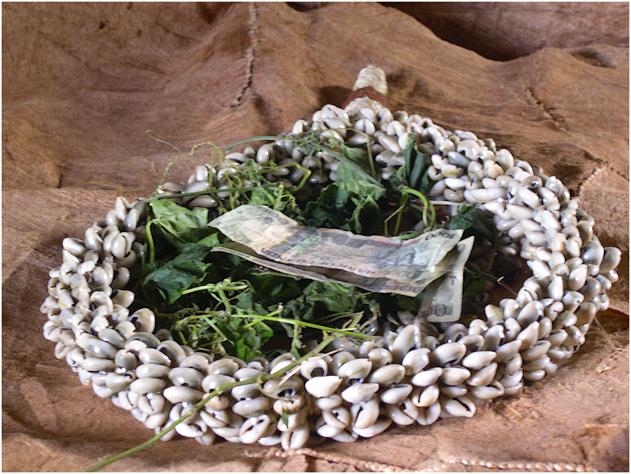
Twin repertories are important in Buganda for several reasons. First, twins manifest abundant fertility, but their arrival also signals risk to three lives and doubles parental responsibilities. Across the contexts in which people perform twin songs, their symbolism encompasses the polar potentials of risk and abundance that permeate Kiganda healers’ notions of bad things and blessings, ebibi and emikisa, respectively.Footnote 23 The polarity reflects widely held beliefs that every human being’s umbilical cord has an important spiritual function in addition to its physical function in the womb: it links each person to a spiritual twin. Although each twin has its own umbilicus, the birth of human twins changes this spiritual logic. According to multiple research participants, human twins hold special power that must be bound and contained within a power object (which Roscoe describes and one of which is pictured below).Footnote 24 The twinship ritual okusiba abalongo – tying or binding the twins – produces a physical container for the twins’ umbilical cords as part of a broader effort to contain, harness, and deploy the considerable spiritual power associated with these beliefs. Following the lengthy and highly musical rite in which they create such a power object (pictured below in figure 2), families and clans of twins keep them and treat them with special care.
balongo (twins) power object.

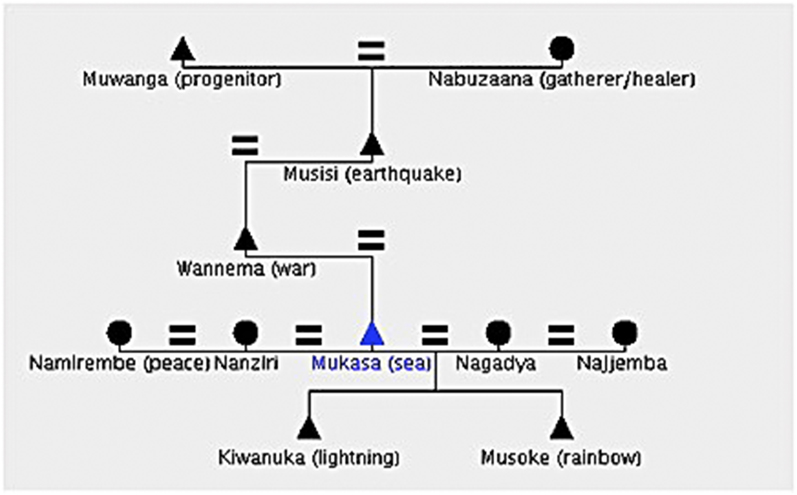
Second, ideas, objects, songs, and rituals surrounding spiritual twinship produce intimate forms of identification with the larger body politic, Buganda kingdom, and the spiritual entities associated with both Buganda and the region, all of which embed persons into networks both spiritual and topographical. Among earlier generations, Roscoe wrote that the twins he encountered were all named Mukasa (for male twins) or Namukasa (for females).Footnote 25 Naming conventions around twinship have since changed considerably in Buganda, but neither the special status of twins nor the invocation of Mukasa Ow’ennyanja (i.e. Mukasa of the Sea) has faded.Footnote 26 An archetypical father of twins (Ssalongo), Mukasa is the parent of Kiwanuka and Musoke (associated with lightning and thunder, respectively) and a major fixture in the royalist oral traditions of Buganda. According to several healers, he is also the sibling of Kibuuka Omumbaale, whose military reputation in support of the mid-eighteenth century Kabaka Nakibinge Kodesh details elsewhere.Footnote 27 Mukasa is the child of another warrior named Wannema and the grandchild of a spirit associated with earthquakes named Musisi, and the great-grandchild of Muwanga, whom some call the katikkiro or prime minister for all Lubaale spirits.Footnote 28 See spiritual “kinship” charted out below in figure 3.
Spirits as kin, generations as rough Kiganda chronology, and other-than-human associations.

Enshrined and reiterated in an oral historical tradition relatively consistent from one teller to the next, these means of understanding spirits as embedded in kinship networks demonstrate how descent serves as only one in a series of overlapping metaphors of belonging. Many of not most commentators neglected to name the “wives” of any of the “male” spirits named in this graphic, though one insisted that those represented here were only four of Mukasa’s eight wives.Footnote 29 Many others failed to name any when pressed. If we imagine the gendered shapes and affinal unions to be both less literal and less important than the linkages among these spirits, reading them instead as a rough generational chronology, the possible ways of talking about spiritual kinship expands. This reading begins to open a variety of other forms of group identification with these spirits, their animal familiars and other associations while preserving the core sense of historical tradition in the names, praise epithets, and other-than-human associations embedded in performances of eby’obuwangwa, the things of tradition. This point re-emerges in the third stanza of the song about twins as a set of possibilities concerning marriage as a metaphor for spirit mediumship. Meanwhile though, the parlance of politics and the language of local ecology bound up in durable characterizations of these spirits point to forms of group identification as tangible in the physical surround as they are spectacular in the re-telling of ancient conflicts that shaped Buganda.
These patron spirits, replete with their military and political reputations, also belong to the earth and the sky, the sea called Nalubaale (literally place of Lubaale, the guardian spirits), and their associated phenomena. Moreover, it is not only the association of Muwanga with the language of kingdom governance that links the twins of this tradition with Buganda kingdom. Twin songs and the notion of the umbilicus as a tether to a spiritual twin create a kind of parallel for every Muganda – at least in part – to what Benjamin Ray calls “the four bodies of the kabaka.”Footnote 30 In other words, 1) the body of the king, 2) his physical connection to his spiritual twin as first dwelling in the placenta and then preserved in a power object, 3) his corpse as often preserved through the containment of his jawbone, and 4) his royal spirit medium all deserve special care. The Kabaka’s four physical manifestations – a contrast to two among commoners – enhance his stature as a larger-than-life social, political, and spiritual figure.
Third, and perhaps most germane to this article’s use of music as primary source material, beliefs about twinship, clan, kingdom, landscape, and patron spirits motivate the ubiquitous use of twin songs to begin virtually every kusamira ritual and many other public events in Buganda as well. Basamize refer to the music and spiritual themes from twinship rituals each time they gather, regardless of their reason for gathering, even if it does not relate directly to twins or twinship. In this topographically diverse and exceedingly fertile region of equatorial Africa, twins’ embodiment of abundant fertility and ever-present risk link nature-associated spiritual forces with human political systems. These linkages come together in performances of twin songs that play with such linkages in idiomatic motifs called bisoko, and bisoko are sufficiently mutable within quasi-improvisatory idioms that performers adapt them and attach them to contextual specifics surrounding their performances. Singing and listening deeply to songs, Baganda basamize circulate and preserve ideas about kin (especially descent), clan, and kingdom – including its topographical features – as they go about the work of group identity.
Of all the music I have recorded in these two regions, the song example here ranks among the most ubiquitous and frequently performed tunes common to both Kiganda and Kisoga ritual healing repertories. A twin song that according to singers in both regions originated in Buganda, it often gets paired with another twin song or grouped with several others in multiples of two in order to begin a wide variety of rituals. I recorded no fewer than ten discrete performances of this song, but heard dozens more. In that research sample of over 350 discrete recordings, its level of frequency exceeds virtually any other song in the Kiganda kusamira repertory. Twin songs emerge from the kusiba abalongo or twin-tying ceremony, but as noted above, they owe their ubiquity to the practice of beginning all manner of other rituals by singing them. These other performances include not only healing rituals, but also the okwalula abaana or “hatching the children” rites detailed by Johnson, as well as other life-cycle rituals.Footnote 31
The Song, its Sections, and its Symbols
This song has three main sections, each of which has variations that enable singers to adapt to specific ritual circumstances. Although performers uniformly acknowledge the three standard sections, they frequently sing only some of the sections and they make even more conscienscious selections about variations within those sections to sing those most relevant to the particular context of a given event. This analysis begins with an overview of the basic sections, discussing a few of the frequently performed poetic variations. A subsequent ethnopoetic exegesis of these basic variations reveals lyrical references to oral histories of the region. This method used extant ethnographic and historical sources to inform interviews, focus groups, and collaborative analyses of these and many other variations. Transcriptions of those primary sources showed some variations to be more frequently used among both multiple singers and multiple performances. I then suggest that listening to this and other songs in ways shaped by local performers offers deeper understandings of public healing, social authority, and ethnic formation.
In the first section, a leader and a responsorial chorus alternate singing the exact same phrase:
Abalongo twabazaala babiri ne Ssalongo [Nnalongo]
Mayanja, mwana wange, jangu ozine abalongo!
The twins we gave birth both with Father of twins [Mother of twins]Footnote 32
Mayanja, my child, come and dance the twins!
The leading singer signals a shift to the second section by breaking with this repetitive pattern, which also implies a shift in the way the leader and the chorus interact. Now rather than singing the same phrase, the leader sings motifs called bisoko (sing.: kisoko), to which the chorus responds by alternating a semi-chorus with a full chorus.
Leader: Mpita ayita Mayanja, I call/he calls Mayanja
Mayanja mwana wange Mayanja my child
Chorus: Nkerebwe, Tree squirrel
L: gira tugende stand let’s go
C: Nkerebwe enkulu essima ng’eggulira venerable squirrel digs holes and
opens
L: Tugende, tugende gyebatuzaala Let’s go, let’s go where they produced
us
Ch: Nkerebwe, Tree squirrel
L: gira tugende stand let’s go
Ch: Nkerebwe enkulu essima ng’eggulira venerable squirrel digs holes and
opens
L: Gulira, gulira, gulira lubaale waffe open, open, open our lubaale [spirits]
Ch: Nkerebwe Tree squirrel
L: lwaleero today
Ch: Nkerebwe enkulu essima ng’eggulira venerable squirrel digs holes and
opens
Just as s/he did in the transition to the second section, the leader then uses a standard motif to signal a shift to the third section. Here the other singers will respond with the full chorus after every kisoko (i.e. there is no semi-chorus), but there are two different versions of this lyric that singers tend to use interchangeably.
L: Nabuzaana, omunozzi w’eddagala Nabuzaana, gatherer of medicines
Ch: Ggwe wabikola buli kujja You did things every time you came
ng’osagaasaganya as you fidgeted about
ggwe wabikola! you did things!
L: Nabuzaana, omuleezi w’abaana Nabuzaana, carrier of the children
Ch: Ggwe wabikola buli kujja You did things every time you came
ng’osagaasaganya as you fidgeted about
ggwe wabikola! you did things!
L: Nabuzaana, muka Muwanga Nabuzaana, [familiar] of Muwanga
Ch: Ggwe wazindabya buli kujja You attacked fiercely every time you
came
ng’osagaasaganya as you fidgeted about
ggwe wazindabya! you attacked fiercely!
These three sections typify the three main ways that leaders and singers interact in the broader kusamira repertory:
• repetitive responsory, in which the leader and the chorus sing call and respond using the same phrase;
• call and response in which a leader sings idiomatic motifs with alternating responsorial semi-chorus and chorus; and
• call and repsonse in which a leader sings idiomatic motifs with the same full chorus responding each time.
- Section 1: the twins (ekisoko ky’abalongo)
References to Mayanja in the first two sections index oral traditions that – as with the associations among other twin spirits, nature, and politics – identify and situate this spirit within Ganda landscapes both physical and spiritual. His appearance in the first two sections of this song resonates with the historic link between the colobus monkey clan and a powerful figure in the early history of Buganda, Kintu. Kodesh collected a version of this tradition from a healer named George William Kalule, who described Mayanja as a territorial spirit (musambwa) that moves in the form of a leopard and created the Mayanja River.Footnote 33 Other songs and interviews support this interpretation of the Mayanja trope. As healer and musician Ssematimba Frank Sibyangu explains, singing about a leopard is often a thinly veiled reference to the musambwa Mayanja.Footnote 34 A related interpretation parses the term for twins, abalongo, as a comparison of mother of twins Nnalongo’s husband, -ba, to a leopard, -ngo.Footnote 35 This playful way of highlighting his sexual prowess and that of Nnalongo is typical of twin songs at the kusiba abalongo ritual.
Kodesh’s interpretation of Kintu emphasizes his role as a nodal figure who scales up clanship to the level of national identification in ways sufficiently flexible to incorporate new clans into such group work. His reading of differences between how Baganda and British intellectuals heard stories about Kintu and how spirit mediums heard them makes his interpretation germane here. “By dislodging spiritual entities from their territorial bases,” Kodesh writes of Kintu, “ambitious leaders inaugurated a series of intellectual and social transformations that would have widespread ramifications for the development of complex political communities.” He centers that argument about political complexity around the relationship between clan and kingdom well beyond the confines of the royal enclosure and Kampala. Kodesh continues this thread, arguing that spiritual portability facilitated expansion of territories in which spirits, their mediums, and their devotees “might ensure collective health and prosperity.”Footnote 36 Following his notion of “portability,” this and other twin songs suggest that promoting this flexibility required idioms that eventually transcended any one particular clan, becoming what present-day basamize mediums and musicians call “the things of tradition,” “things of culture.”Footnote 37 Pressed to say where they come from or where they learned the songs, these same research consultants answer, “from our ancestors” or speak wistfully of old Buganda.Footnote 38
Healer and musician Ssematimba Frank Sibyangu mentions that references to Mayanja, a leopard, or the twins of the lubiri (glossed in some twin songs as abalongo b’embuga) connote both Mayanja and his twin sibling, Magobwe, who moves in the form of a python.Footnote 39 It is possible to locate the similarity between Mayanja and Magobwe, their twin-ness, in the same portability that enabled Kintu to scale up clan-level group identification to a much broader notion of group identity that became Buganda. The first section of the song shifts rapidly from a general reference to twinship connecting Ganda commoners and royals to a specific twin that symbolizes both a distant regional past and the enduring power of royal twinship. This shift offers a direct connection between 1) the well-being of all whose spiritual twins and human twins within their clans hold powerful potential and 2) the well-being of the kingdom. Such an interpretation suggests that it is not only the heart clan or the colobus monkey clan who hear the call to “dance the twins,” but rather that all concerned with the fertility and prosperity of their people hear and heed this call to dance. The reiteration of Mayanja’s name in the kisoko that signals a shift to the second section of the song aligns with Kalule’s statement about this musambwa’s importance as one of the mobile spiritual entities that protects Buganda and its people.
- Section 2: misambwa and clanship (ekisoko ky’emisambwa n’enkerebwe)
The second section of the tune revisits concerns over fertility and prosperity at the level of the clan (kika) and the person, but demonstrates the same concern for scaling up to larger spheres of identity. The mention of nkerebwe, the tree squirrel, indexes not only a totem for a specific clan, but also a model of access to the spirits through clanship. That is, beyond its deployment in several twinship rituals as a thinly veiled euphemism for the sexual encounter that produces children and therefore an animal metonym for human reproduction, the tree squirrel serves as a synecdoche for all totem animals and their similar capacity to open blessings to members of their associated clans (bika). This is consistent with the logic of seeking healing at one’s clan estate, a process that necessitates opening pathways of identification for new lineages to each clan and new clans to the kingdom. But these two overlapping meanings of the squirrel, like other overlapping meanings in the rest of the song, demonstrate how understandings of healing, well-being, and belonging go beyond just descent. The evidence for this lies in the first kisoko or motif that Sibyangu sings, which is among the most frequently performed bisoko for this section, urges a return to the respective birthplaces of listeners: Tugende, tugende gyebatuzaala. Clearly not all performers and listeners can claim the same birthplace, nor do all clansmen in a given clan share the same lineage as a pretext for their shared identification with a totem animal, but the squirrel totem provides convenient symbolism for applying the song’s urging to each listener’s own context of identification with totems. Nkerebwe in particular is an important animal that digs, opening and revealing blessings. Where adepts construe blessings as closely linked with human, plant, and animal fertility, they are inextricable from the domains of kinship, clanship, and broader ethnic prosperity. For it is invariably through gatherings of clanmates and others living at massabo and biggwa, shrines associated with minor and major clan estates, respectively, that people gain access to spiritual aid for well-being. These are the places to which people frequently return to participate in kusamira ritual healing, to pay appropriate tribute to their ancestral and other patron spirits in trade for their blessings (mikisa). The bisoko or poetic motifs in this song go on to name some other sources of spiritual support: the once-territorial nature spirits called misambwa, mayembe spirits for specific ritual work, and the benevolent guardians, the lubaale. Like nkerebwe, these spirits merge the domains of spirits, humans, plants, and animals, incorporating them into an ontology of constant connectedness and interdependence.
As with finding metaphorical resources in animal familiars, ritually enacting or reinforcing networks of authority and belonging constitutes a widespread practice in many areas of Africa.Footnote 40 Even the notion of totemic animal-based clanship as an expansive symbolic possibility for group identification within ritual healing has been well established in Buganda and the surrounding region.Footnote 41 The specific examination of these mechanisms for ethnic formation within songs, however, gives a sense of how these tropes became so flexible and expansive over time through repeated performance. The use of nkerebwe as a specific totem in this case has a deep history rooted in specific places associated with the squirrel clan, but its use in such a widely performed song cannot be analyzed in a spatial or musical vacuum. This is only one example among many of a metaphor for belonging that circulates around shrines, their songs, and their singers, who combine it with themes of clanship, mobility, network, and ultimately gathering or what we might call “groupness,” as the third kisoko demonstrates.
- Section 3: the gatherer of medicines (ekisoko kya Nnalongo Nabuzaana)
The singer signals a shift to the third section of the song by reference to one spirit with adept at navigating the challenges of such a connected world: enter Nabuzaana omunozzi w’eddagala, i.e. Nabuzaana, gatherer of medicines. Within kusamira song repertories, many tropes invoke a broadly similar cultural healer archetypes. Some of these are male, some female, some with particular expertise in bone setting or childbirth, but virtually all share a vast knowledge of plant medicine. Nabuzaana is a female version of this archetype from Bunyoro whose praise epithets tout her linkages to plant medicine, spiritual power, childbirth, and social assembly for ritual healing.
Many singers of this song characterize her as muka Muwanga, implying a close, permanent association somewhat like marriage.Footnote 42 Muwanga is a spirit associated with divination; tossing Muwanga’s shoes (engatto za muwanga) is a common divinatory technique for diagnosing illness or misfortune when a client pays an initial visit to a healer. This is consistent with his reputation as a strong figure of healing authority who not only begets several other spirits in the pantheon, but also points the way for the healers who consult him to his descendants’ and others’ capabilities. The marital theme could mean that Nabuzaana – once an authority figure in Bunyoro with her own spirit mediums – became in the Ganda context a medium for Muwanga, as the language of marriage often stands in for the relationship between a patron spirit and its medium. This interpretation would be consistent with the widespread belief that healers gain a significant portion of their medicinal plant knowledge not only from elders, but also from spiritual sources that guide their practices. Alternatively, if Nabuzaana came from Bunyoro and married Muwanga, her place in this prominent twin song also embeds a regional history of migration and either literal or spiritual intermarriage that informs Ganda political, social, and spiritual life. In either case, mobility comes through in the song as an emphasis on her prowess as a gatherer.
The exact nature of Nabuzaana’s relationship to Muwanga is probably less important here than her flexibility as both a figure of authority across Bunyoro, Busoga, and Buganda, and as an important nodal point in a spiritual network that mediates both healing and identity across all three regions. As with Mukasa, Mayanja, and Kintu, it is this mobility that makes her such an important figure in both domains. The same trope contributes to present-day healers’ reputations, which are founded upon a combination of efficacious methods, breadth of travels to gather medicines and medicinal knowledge, and a resulting largesse of reputation. “You did things every time you came,” so the chorus goes, “as you fidget[ed] about, you did things.” Poetic ambiguity surrounds just what those things could be, perhaps a parallel to the nesting that pregnant women do or the fidgeting that others around her do before, during, and after the birth, or perhaps a nod to her versatility and to that of other healers. Her “fidgeting” could be a reference to plucking plant medicines in the forest (omunozzi derives from okunoga, to pluck or gather), pounding them with mortar and pestle, boiling them or mixing them into tea, mixing them into topical solutions, or preparing them for aromatherapeutic burning. It could be a reference to the physical movements that typify a medium’s behavior when a spirit “climbs” it or “grabs its head.” Respondents use the Luganda verbs kulinnya (to climb) and kukwata ku mutwe (to grab the head) to describe the initial onset of possession.Footnote 43 Plucking and gathering also resemble the gathering of people (okuŋŋana) into a shrine and kasolya or roof apex that symbolizes the Kabaka’s gathering of people – symbolized here by sticks and thatch – into the roof of a house.Footnote 44 Through these activities Nabuzaana becomes in another motif a “carrier of children” (omuleezi w’abaana), another phrase with flexible meaning. The children she carries include all those who learn from her medicinal expertise, but so many of those are also carriers of spirits (abakongozzi). In all of these interpretations, Nabuzaana serves as an inspiration to “do things” that support well-being, and the doing requires assembly of both people and resources.
The song’s encouragement comes with a warning that failure to do those things – e.g. assemble people, gather medicines, prepare them, prepare women for childbirth and other people for major changes – could have negative consequences. One singer I recorded frequently replaced the phrase “you have done things” (ggwe wabikola) with “you have attacked fiercely” (ggwe wazindabya).Footnote 45 Her move seems antithetical to the otherwise largely positive mood of the song, but basamize use songs like this along with praise epithets and invocations for spirits to “finish the twins,” as indicated in musical motifs that call spirits to do just that (jangu omala abalongo). Performers and healers accomplish through the twin-tying ritual okusiba abalongo in which basamize and parents of twins bind the negative spiritual potential of twins in order to clear the pathways for other blessings (emikisa). The performance of vulgarities that characterize that ritual generate the referential motif, “come to finish the big words” (jangu omala ebigambo), a kisoko that Nakayima, Sibyangu, and others use interchangeably with jangu omala abalongo.
Asked what would happen if they somehow failed to carry out the complex and rather expensive twin tying ritual, Sibyangu echoed others I had asked this question, responding in a gravely serious tone: “If you have twins and don’t finish them, and you are a Muganda man, they will burn you. You will get spots, some white, some black. Sometimes the twins can get sick, and they can even die.”Footnote 46 Many basamize take such admonitions at face value, making spirits like Nabuzaana, Mayanja, Magobwe, and Muwanga as important to well-being as they are for their historical and spiritual significance. But since historically, this significance derived from their impact on well-being, the risks are as ethnocultural – even racial in their evocation of appearance changes – as they are physiological or medical.
Invoking those risks and situating them in contrast to the abundance of twins in this song points up the functions of both misambwa and spirit mediums as intermediaries among humans and powerful spiritual forces. Each animal indexed in the song occupies an in-between place in the natural world: Mayanja in the form of a leopard occupies both trees and land, and in the form of a river that runs from Nalubaale inland as if to carry power through Buganda; his twin Magobwe is a python, the kind that has long embodied the power of mobility between Uganda’s regions and across a porous boundary between humans and ancestors; the squirrel Nkerebwe likewise moves between trees and the ground; Nabuzaana works as a tutelary spirit to all who seek familiarity with these powers of the forest and its plants; Muwanga resides in or near Nalubaale sending its associated powers from the sea and beyond to aid human struggles.Footnote 47 In just one song, these spirits and their animal familiars begin to articulate the contours of Ganda ecology of well-being.
Healers and their songs render these entities relevant to people by articulating their interactions with other-than-humans in the world world embodied and enacted through healing rituals. Ontologically, this coming together (okuŋŋana) for ritual work resembles the ecology of well-being described here, but it also becomes that interaction in the audible, visible, tangible world. The overt concerns with well-being and fertility and links to larger natural and spiritual forces render this process of gathering scalable: men and women copulate together to reproduce, and people gather together with other-than-humans to enact social reproduction.Footnote 48 They perform this broader set of interactions at the level of integrated physiological, spiritual, and social well-being, where healers – with and sometimes as their other-than-human familiars – move between communities to gather their members and common interests into larger priorities that shape Kiganda belonging.
Conclusion
This article demonstrates how symbols and indices at work in a kusamira ritual song bind humans and other-than-humans into an ecology of illness and well-being. Songs offer fascinating ways of understanding notions of mutual inclusivity and how important they are to the people who rely on the health systems they shape. The song I have analyzed here demonstrates a symbolic alignment involving Mayanja and Magobwe on the one hand and Nabuzaana and Nkerebwe on the other. The twins bind evil, restricting its power and thereby its capacity to cause illness. Meanwhile, Nabuzaana and Nkerebwe work to gather and deploy resources that support well-being. These activities – binding and unbinding, gathering and distribution – are central to the work that healers perform in order to understand and manage illness and well-being. The broader purpose of the argument, however, is to demonstrate that these reproducible, transposable mediations between illness and well-being, animal and human, human and spirit, male and female – what basamize call the things of tradition, obuwangwa – constitute practices that shape Kiganda ethnicity. The work of performing such mediations, i.e. the work of spirit mediums and healers who perform ritual healing, reveals descent to be inadequate for describing sophisticated forms of group identification. Moreover, the appearance of figures like Nabuzaana suggest notions of ethnicity that have not and could not emerge from a vacuum, that require other “ethnic groups” and inscribe them into the migratory and political histories echoed in song. These assertions build on the work of ethnographers and historians mentioned above, so the idea that public healing has a role to play in articulating social and political identities is not new. However, since some of that literature encourages the consideration of how people perform oral tradition, I argue that using songs to examine these articulations offers valuable insight on them as complex practices of ethnicity.
Twin songs index twin rituals, spirit pantheons, and regional history, but they also challenge us to think beyond performance to some of the homologous relationships that define Ganda ethnicity and ontology. The twin song examined in this article offers multiple symbolic pairings, each akin to the next, all encompassed by the symbolism of twinship. First we have the twins themselves as a general symbolic category (abalongo), which already invokes a leopard. Then comes a reference to some of the most important twins in the Ganda pantheon, Mayanja and Magobwe, a leopard and a python. A shift from these misambwa to another animal, a squirrel which is ambiguously a totem (muziro) or a musambwa of significance broader than the clan, forms one half of the next pair. Nabuzaana completes the pair, as both are concerned with the same activities: gathering and distribution. Squirrels gather and ration food; Nabuzaana plucks and uses plant medicine. Both engage in processes that symbolize containment and distribution, as in the binding of affliction (bad things, ebibi) and the unbinding of blessings at the core of healers’ concerns. Nabuzaana also embodies other pairs: she is a spirit who might once have been human, a reminder of every human’s umbilical connection to a spiritual twin. She is a counterpart to her male familiar, Muwanga, who is powerfully associated with rocks and hills as the father of Musisi, the earthquake.Footnote 49 This pair articulates the epitome of this ecology, situating the humans in relationship to other-than-humans like spirits, plants, sea and land.
These homologous pairs seem too bounded and categorically neat on the surface, but that simplicity, that binary presentation deceives. Basamize reproduce them through the things of traditional culture, ebintu eby’obuwangwa, rendering them relevant across multiple overlapping domains. Every sharing of coffee berries at ritual demands that recipients receive them with two hands, throw two in front and two behind, and then eat two at a time. The theme of twoness extends down to the smallest detail: each individual bean is also a pair. Thier actions index the mukago ritual, a blood pact involving coffee berries that is beyond the purview of this article, but notably takes place between two people.Footnote 50 What happens after the sharing of coffee berries, however, offers yet another telling glimpse of symbolic twoness and its centrality to kusamira ritual life. At an end-of-year celebration where I had just finished this coffee berry exchange with two cousins, they instructed me and helped me to systematically destroy the banana fibers that once held the coffee berries, unbind all knots that tied those fibers together, and discard the resulting rubbish either in the bush or into a fire. When I asked why they did this, a young musamize named Haruna Mbogga answered, “you’re untying all of your bad things, all of your negative things, all of those things that you bring here, you untie them all.”Footnote 51 So go all of these pursuits that bind afflictions and unbind blessings (okusiba ebibi n’okusumulula emikisa), that define the contours of illness and well-being.
This article began by asking what possibilities we foreclose by glossing over music too quickly rather than listening deeply to what it reveals about ecology and its links to ethnic formation. A robust extant ethnographic and historical record makes it possible to draw connections between spiritual innovations that enabled ethnic entrepreneurship in the distant past and metaphors of descent, mobility, and network still resounding in shrine performances throughout Buganda today. These are repeated in the ubiquitous performance of twin songs at a wide variety of rituals, but they become even more expansive through a much broader repertory of ritual songs beyond those concerned with twinship. The particularities of how all those songs and spirits inform the contours of Kiganda ethnicity lie beyond the scope of this article, but the sheer size of the repertory and the diversity of the pantheon it invokes suggest that the contours of these ethnic formations are constantly being shaped and revised through performances of ecological and spiritual reference. For Baganda basamize then, songs offer insight into the spatial, spiritual, and animal interdependencies that shape ethnic formations long under way in their ecology of well-being and belonging.
Peter J. Hoesing is an ethnomusicologist whose research focuses on Uganda. He has published in Nova Religio, Journal of Africana Religions, and African Music, and he has a monograph on the music of Ugandan spiritual healers under contract with the University of Illinois Press. His work has garnered generous support from UNCF, UNCF Mellon Programs, the Andrew W. Mellon Foundation, and a U.S. Department of Education Fulbright-Hays Fellowship. Hoesing is a lifelong musician – a drummer and singer – who has performed all over the world. He presently serves as Director of Sponsored Programs at Dakota State University. E-mail: peterhoesing@gmail.com