In New Zealand now there's a movement strong, the unemployed sing a battle song. We'll fight the government for a better deal, the right to work they cannot steal. In towns and cities we will rise, the people now will hear our cries, for justice and a living wage, only this can satisfy our rage.Footnote 1
In January 1998, during the occupation of the Ècole Normale Supèrieure by French unemployed, Pierre Bourdieu congratulated the growing unemployed movement for their protest actions and described them as a “French exception,” a “social miracle.”Footnote 2 He had argued, only one month earlier, that the organization of the unemployed was an impossibility; that unemployed workers, without secure material resources or high levels of self-esteem, could not conceive a revolutionary project or act politically.Footnote 3 Similarly explaining the lack of political organizing among the unemployed, social theorists have argued that unemployed people experience their social status as an individual issue or personal failing rather than as a public issue of social structure.Footnote 4 These three factors—poverty, status disintegration, and a sense of personal worthlessness—are presented to explain the disinclination of the unemployed to involve themselves in mass protests against unemployment.Footnote 5 And yet, as the French example demonstrates, the unemployed have organized, have protested, and have acted politically. This article argues against French exceptionalism by way of an historical case study of another unemployed movement, one which organized nationally in New Zealand during the 1980s.Footnote 6 This organization was not a social miracle; it merely has remained invisible in the historical record so far, as had the French unemployed movement. By recognizing the changed nature of the workforce by the late twentieth century and the new shape of the working class—a class that encompasses those in insecure work and unemployed workers—organizations of the unemployed will no longer seem impossible, but explainable, and even foreseeable.
The restructuring of capital and the transformation of work led to a dramatic global repositioning of the working class, inside and outside the workforce, in the 1980s and 1990s.Footnote 7 This shift to corporate globalization caused manufacturing industries of advanced capitalist countries to go into decline, a radical increase in numbers of people in insecure employment or what Manuel Castells calls “flex-timers”Footnote 8—part-time, temporary, subcontracted, or outsourced workers—and a substantial rise in structural unemployment.Footnote 9 The working class became more heterogeneous and fragmented in nature, and the insecure proletariat found new ways to organize, sometimes contrary to the expectations of social theorists. Social theorists have analyzed the rise of new social movements in the 1980s and 1990s and described “identity politics,” the politics of gender, sexuality, race, ethnicity, or religion, as the (re)new(ed) subject positions from which to champion a set of rights, predominantly at the expense of class struggle.Footnote 10 In the words of Alain Touraine: “in a post-industrial society, in which cultural services have replaced material goods at the core of production, it is the defense of the subject, in its personality and in its culture, against the logic of apparatuses and markets, that replaces the idea of class struggle.”Footnote 11 However, unemployed workers in New Zealand combined the identity politics of race and gender with a class-based critique of society when traditional forms of class struggle, inside the trade unions, was on the decline. As I demonstrate in this article, the national organization of unemployed and beneficiaries was given a MaoriFootnote 12 name—Te Roopu Rawakore o Aotearoa—not only to honor the movement's bicultural structure (Maori unemployed were given separate representation in the organization to recognize their status as colonized subjects), but most importantly to indicate that it was a movement of people who had nothing (its literal translation), a movement of have-nots, the excluded, the dispossessed—and this was very much regarded as a matter of class. The veil of invisibility cast over women's experiences of underemployment and unemployment was torn asunder by a number of outspoken, politicized, unemployed women who formed the core leadership of Te Roopu Rawakore o Aotearoa, and thus issues of gender also came to the fore.
Transformation of the Workforce
The legacy of the 1930s depression—economic hardship, wasted labor and inadequate state relief for unemployed—influenced the social and economic policy of the first New Zealand Labour Government, elected in 1935. The fundamental philosophy of the first Labour Government, encapsulated in the 1938 Social Security Act, was that the state had a responsibility to protect a citizen's welfare “from the cradle to the grave.” Full, well-paid, productive employment was the basis of a citizen's welfare, and state provision of publicly-funded health, education, and housing assistance was a way to ensure productive workers. Income support was envisaged as a minimal and largely temporary provision to sustain people moving between well-paid jobs. Policy was centered on the creation of a strong, interventionist state. The Labour Government's external policy insulated New Zealand from overseas influences; it established protective tariffs, imposed import licenses, and created market agencies for New Zealand's primary exporters.Footnote 13 Internal economic policy focused on maintaining small-scale farming and manufacturing, with some diversification. The internal economy was regulated by price stabilization and wages were set by Arbitration Court rulings which were tied to contemporary economic conditions. Wage-earners benefited from the stabilization of the economy but the trade unions became relatively weak during this time because they depended on the state (through the Arbitration Court) for political and institutional authority.Footnote 14
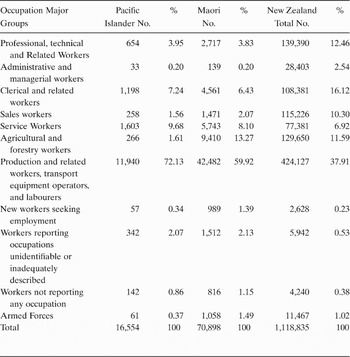
In New Zealand, prior to the Second World War, the occupations in ascendancy were those associated with processing primary produce and servicing the farming sector. However, after the war, the state sector increased in size with the development of the welfare state, and manufacturing occupations also increased. This pattern is similar to what had occurred in the United States and northwestern Europe. The New Zealand farming community declined and by 1971; only twelve percent of the labor force was directly engaged in farming.Footnote 15 The growth and diversification of the manufacturing industry was encouraged by the war effort and continued right through the 1960s, with manual laborers comprising thirty-eight percent of the workforce in 1971. The service economy expanded the most in the postwar decades and by 1971, white-collar workers made up forty-one percent of the workforce. With the continuing expansion of the white-collar workforce—salaried workers such as teachers, social service personnel, technicians, administrators, and clerical staff—came the growing participation of married women in paid employment.Footnote 16 By 1971, two-thirds of the female labor force and one-third of the male labor force were involved in white collar jobs in New Zealand. (see Table One) Footnote 17
Occupational Distribution of Maori, Pacific Islander, and Total New Zealand Population in 1971Footnote 22

In the postwar decades, the most striking change was the number of married women participating in the workforce, especially in part-time work. The percentages for married Pakeha (New Zealand women of European descent) women increased from 7.7 percent in 1945 to 19.9 percent in 1966.Footnote 18 In 1966, women comprised twenty-seven percent of the labor force, rising to thirty-five percent in 1984. However, women continued to be employed in a narrow range of occupations at lower rates of pay and with limited opportunities for advancement. The advent of equal pay in the public sector in 1960 and in the private sector in 1972 did not bring equal opportunity. In 1995, the pay gap between women and men averaged eighteen percent. This varied according to industry: Construction workers had an eight-percent wage gap (but very few women worked in construction), business and financial services had a 32.5 percent wage gap and banks were particularly bad, with a 38.3 percent wage gap.Footnote 19
An exodus of Maori from rural areas that had begun on a small scale during the Depression and the Second World War accelerated between 1961 and 1966. In 1945, one-quarter of the Maori population were living in urban areas; however, by 1966, three-fifths of the Maori population had migrated to towns and cities.Footnote 20 Three-quarters of the Maori population lived in urban centers by the mid-1970s, with one-fifth of that number living in Auckland. In 1956, 26.76 percent of Maori workers were engaged in agriculture, forestry, hunting, and fishing, and 52.96 percent were in manufacturing, construction, transportation, storage, and communications industries. While 18.6 of the non-Maori population earned over £700 per year, only 3.36 percent of Maori workers were in this income bracket. Few Maori had the opportunity to pursue professional, managerial, and clerical positions: only 6.56 percent in 1956 compared to 26.69 percent for the non-Maori population.Footnote 21 Maori workers were recruited to fill unskilled and semiskilled industrial and commercial vacancies which opened up with economic expansion in the postwar decades. Seventy percent of Maori male workers had found employment in blue-collar occupations by 1966. Pacific Islanders migrated to New Zealand in increasing numbers during the 1960s and 1970s looking for employment, which they also found predominantly in the blue-collar workforce.
As the world economy went into stagnation in the late 1970s, and New Zealand's export prices fell, there was not sufficient domestic growth to generate enough jobs for the workforce. New Zealand workers, from the late 1970s to the early 1990s, experienced a declining manufacturing sector, increased service-sector work but of a part-time and temporary nature, structural unemployment and underemployment, and rising poverty levels. This continued deterioration owes much to the policy decisions of the fourth Labour Government elected in 1984. These policies will be explained shortly.
The average number of registered unemployed recorded by the Labour Department in New Zealand had remained fairly consistently below one thousand prior to 1967. However, in that year, unemployment statistics exceeded 3,000, and rose to 6,881 in 1968. Unemployment figures decreased again until they reached 994 in 1974 before beginning to rise sharply in the late seventies.Footnote 23 From 1977 until the mid 1980s, unemployment in New Zealand rose dramatically, but government-sponsored job creation schemes, which engaged half the unemployed, obscured the fact until 1985.Footnote 24 The unemployment rate rose from 3.8 percent to 11.1 percent between September 1986 and March 1992.Footnote 25 Compared to seventeen other Organization for Economic Cooperation and Development (OECD) countries in 1991, only Ireland and Spain had higher standardized rates of unemployment than New Zealand.Footnote 26 Most jobs were lost in the manufacturing sector: between 1985 and 1989 two-thirds of the overall employment decline came from the manufacturing industry despite the fact that it employed less than a quarter of the workforce.Footnote 27 By 1993, two-thirds of all New Zealand's employed worked in services: fifty-five percent of men and seventy-one percent of women.Footnote 28 While the growth of the service industry offset some job losses, it did not halt the employment decline.
New technology not only led to the retrenchment of the workforce in New Zealand but also changed the way people were employed, increasing the numbers of temporary and part-time workers. In 1995, part-time work made up twenty-nine percent of filled jobs; this was a huge increase from five percent in 1961. Between February 1987 and August 1995, part-time jobs grew by seventy-six percent, and full-time jobs decreased by seven percent.Footnote 29 Women remained the majority of part-time workers (three-quarters in 1994), but the numbers of men engaging in part-time work grew significantly over this period.
The Population Census in 1986 revealed that more women suffered from unemployment than men: 9.1 percent compared to 5.1 percent of the working population.Footnote 30 Unemployment also affected ethnic minorities—Maori and Pacific Island peoples—more negatively, in part because they were predominantly located in the manufacturing sector. In 1989, Maori were only 5.9 percent of the labor force but 16 percent of the unemployed; their unemployment rate was 20.1 percent. Pacific Islanders had an unemployment rate of 17.2 percent.Footnote 31 Young people also made up a large percentage of the unemployed as the following table indicates.
Unemployed as a Percentage of the Full-time Labor Force in New ZealandFootnote 32
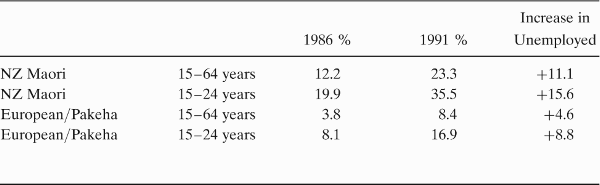
Labor-force trends indicated that “the unemployed were more likely to come from low-paying and insecure jobs, from among the disabled and the handicapped, from the oldest and youngest members of the labor force, from racial and ethnic minorities, from areas or districts with high unemployment, and from those sectors of society with the least marketable skills.”Footnote 33
“Blame the System, Not the Victim”
Those sections of society which became unemployed first—working-class women, school leavers, Maori, and Pacific Islanders—were also those that became politically organized in the late 1970s and early 1980s to protest a government that was not facing the reality of growing unemployment in New Zealand. Groups of predominantly unemployed people formed to act as advocates on behalf of unemployed and beneficiaries at the Department of Labour and the Department of Social Welfare.Footnote 34 The Palmerston North Workers' Unemployed Rights Centre was set up in 1978. Vivian Porzsolt, who was the first coordinator of the Palmerston North Centre commented in 1981: “We've had people come into the Workers' Unemployed Rights Centre in Palmerston North without a cent in their pockets. If we cannot wring the money out of the Department of Social Welfare, we must go to the Mayor's Fund or local charity groups for vouchers for food or rent. It is a disgrace that New Zealanders must submit to this sort of degradation.”Footnote 35 The Wellington Unemployed Workers' Union sprang into being at Christmas in 1979 when fifteen-thousand Temporary Employment Project (TEP) workers were made redundant. At nineteen, Jane Stevens was one of those workers, and early the following year she organized the first public meeting and protest of unemployed workers in Wellington and became the group's coordinator. Branches of the Wellington Unemployed Workers' Union were organized in working-class suburbs of Wellington, the Hutt in 1981 and Porirua in 1982.
People who initiated these groups had often experienced unemployment themselves (although this was not always the case) and recognized the human cost of joblessness, the loss of personal self-worth, dignity, and respect, which often led to depression, frustration, and an inability to motivate oneself. They connected this loss of self-worth with the breakdown of families and friendships, with mental illness, drug and alcohol abuse, and outbreaks of violence and crime. As well as the human cost, they recognized the more structural costs to New Zealand society, such as the cost of the payment and administering of benefits, the loss of production and work skills, and the consequential reduction in consumer demand.Footnote 36
The public image of unemployed people, promoted by the news media in the early 1980s, was one of the social deviant, “dole bludger” or “victim.”Footnote 37 Because of the years of full employment after the Second World War, the dominant myth, that any New Zealander could obtain a job if they wanted one, persisted, despite rising unemployment during the late 1970s. People, especially men, defined themselves socially by their paid labor. Thus, for those who became unemployed, there was a social stigma attached to an already economically disadvantageous position. Relying on the dominant work ethos, National Government politicians (like the media) were able to depict the jobless as “dole bludgers” or social deviants who did not wish to work.Footnote 38 Article headlines in major New Zealand newspapers from 1982 read: “Govt. Crackdown on Dole. Purge of the Unemployed”Footnote 39 and “Drive to End Dole Careers.”Footnote 40
Unemployed groups sought to challenge the Government's failure to create jobs and encouraged unemployed workers to view their position as a collective experience of oppression rather than as an individual's personal failure to find work.Footnote 41 Dave McPherson, the coordinator of the Hutt Unemployed Workers' Union, organized the publication of Dole-drums in 1982, which for ten years became a crucial organizing and educational tool for unemployed people nationwide. Dole-drums began with a print run of 3,000 and at its height reached a circulation of 12-13,000. In the first edition of Dole-drums, the leading headline read: “Blame the system—not the victim! Fight Unemployment!” The article continued:
There are 90,000 New Zealanders registered as unemployed or on special work! The real number of unemployed may be anything from two to three times that number. Certain groups do not gain anything from registering, so they don't bother. This includes married women and people under 16 who are not entitled to the dole. Others do not register because they believe the Government's propaganda that they will be dole bludgers, that they are too lazy to work and that there is plenty of work around if you are prepared to go out and look for it! BULLSHIT. It is the Government's fault that the unemployed do not have jobs.Footnote 42
The social stigma attached to unemployment was disputed by these newly-established organizations, and they found ways to relieve the poverty and distress of those families and individuals attempting to live on a benefit.
By 1983, twenty-two unemployed workers' centers had formed around the country. There were unemployed groups in a diverse range of places: rurally-based unemployed centers, such as Te Whare Awhina, a Maori unemployed center in the Hokianga, north of Auckland; tourist towns, such as Taupo; and farming service-towns like Feilding had unemployed centers. The main cities all had unemployed centers and some—such as Auckland, Palmerston North, Wellington, and Christchurch—had more than one.Footnote 43 Some groups were sponsored by trade unions, others by churches and community groups, and some were entirely independent. Thus it was that, in 1983, questions arose as to how to coordinate these groups more effectively to put pressure on the government to address growing unemployment.
At a meeting of over two hundred people representing thirty-one unemployed groups in 1984, Jane Stevens was elected the first coordinator of a fledgling national movement for unemployed and beneficiaries. A National Unemployed Workers' Charter was drawn up which laid down the principles unemployed groups held in common and became a movement-building tool for social change. The Charter stated that the economic and political system caused unemployment, that unemployment was not the fault of unemployed workers, that unemployment could only be solved by policies designed to serve people's needs, not private profits, that the unemployed were part of the labor movement and had the same interests as workers, and finally that, while unemployment existed, the people affected must be recognized and have their rights and welfare promoted.Footnote 44 It demanded:
1. Government and public recognition of the extent and effects of unemployment.
2. Policies aimed at meaningful work available for all, regardless of sex, sexuality, race, age, marital status or disability.
3. Equal distribution of the wealth and leisure created by the new technology.
4. An adequate income for all unemployed workers.
5. No discrimination against unemployed and temporary workers.
6. No discrimination among beneficiaries due to race, sex, sexuality, age, marital status, nationality or disability.
7. Full rights and responsibilities as Trade Unionists.
8. Recognition and support of unemployed workers' groups by the government and the trade union movement.
9. Free access to information on government department decisions and policies affecting the unemployed.
10. Full information on all benefits and entitlements; published in all main languages used in New Zealand.
11. The protection of personal privacy and dignity of all beneficiaries.Footnote 45
The movement was created by unemployed workers for unemployed workers, by people who regarded themselves as victims of the system and demanded “the right to work and a living wage for all” from the New Zealand government.
While Sir Robert Muldoon's National Government was in power, the trade unions, represented by the Federation of Labour (NZFoL), the Combined State Unions (NZCSU), and Te Roopu Rawakore o Aotearoa, were relatively united in their opposition to the government's employment policies. In the early 1980s, trade unions played a defensive game and opposed economic change that brought mass redundancies and layoffs. Campaigns and conferences were organized with unemployed workers, and financial aid was offered for setting up unemployed workers' organizations. However, in 1984, the NZFoL decided to oppose the formation of an independent unemployed movement. This change of heart occurred because the Labour Party, the traditional political wing of the labor movement, was elected to Government that year. The NZFoL and NZCSU changed their political strategy to one of nonconfrontation and uncensorious support of the Labour Government in the hope of influencing policies on labor issues.Footnote 46 Because Te Roopu Rawakore did not support the Labour Government uncritically, they were accused by some trade unionists of betraying working-class unity. And the Labour caucus, contrary to their preelection political rhetoric, instituted neoliberal economic policies which increased unemployment and exacerbated poor living conditions for working-class people.
Prior to the 1984 election, two opposing philosophies on political policy had been operating within the Labour Party. The first of these was “corporatism,” a negotiation between employers, unions and the state to develop a broad consensus on economic and social issues. A 1984 Economic Summit conference was born out of the promotion of such corporatist ideas. Representatives from different sectors of the community, business leaders, farmers, retailers, workers, and unemployed were called together at Parliament Buildings for the Economic Summit to discuss their views on economic policy. Jane Stevens, who represented Te Roopu Rawakore at the summit, stated, “I am here to demand on behalf of low income people a bigger slice of the cake and redistribution of the wealth in this country that does exist but only in the hands of a few.”Footnote 47
The second philosophy operating in the Labour Party, in contrast to corporatism, was based on the technocratic principle that democracy was a threat to economic policy. Its lead advocates, such as Roger Douglas, who became Minister of Finance, recommended divorcing economics from social policy and the political sphere, and allowing economic decisionmaking to occur in the marketplace.Footnote 48 This alternative philosophy became dominant in the fourth Labour Government, despite the corporatist platitudes of the Economic Summit. In the aftermath of the summit, the economy was radically restructured, following the methods suggested by Treasury and business leaders, rather than the suggestions of workers or unemployed.
The Fourth Labour Government adopted policies that were opposed to the concept of full employment, which had been the main economic policy of consecutive governments during the previous forty years. Rising unemployment during the later 1980s was a direct result of policy decisions made by the Labour Party during their first term as government.Footnote 49 Financial liberalization began to be instituted in December 1984, with an end to external capital controls and the later floating of the dollar in March 1985. Though the economy continued to expand and unemployment dropped during 1985 to forty-eight thousand, this was soon followed by a (government-induced) sharp rise in the exchange rate, which in turn inevitably led to increases in unemployment. The government maintained fiscal deficits by cutting domestic spending which forced up domestic interest rates, attracted foreign investors and forced up the exchange rate. Thus importing became more profitable and undermined the traded goods sector which the devaluation of the dollar in 1984 had been intended to assist. The removal of subsidies and other forms of economic protection reinforced this trend. The only money being made was by speculative investors and those in the finance, commercial property, and construction sectors. As firms found it more difficult to compete on an international scale, they reduced production and employment.
New Social Movements, Identity Politics, and the Demise of a Class Position
Verity Burgmann, a political scientist, characterizes the 1980s as a time when the Australian labor movement went into decline, and along with it an analysis of society based on class.Footnote 50 At the same time, new movements “championed the interests of those who experienced social, political, and cultural oppression, whatever their economic circumstances—a black person, a woman, a gay man—or the interests of the human race, irrespective of class.”Footnote 51 Social movements were largely antisystemic organizations run by those with “intellectual capital,” which included the middle class and those peripheral to the labor force—the unemployed, students, housewives and the retired. This new constituency utilized nonhierarchical and democratic methods of organizing (in contrast to the labor movement, which they regarded as overly bureaucratic and hierarchical); they “practised, in the present, the future social changes they sought.”Footnote 52 Constructing a shared identity remained an important part of movement building, but for some social movements, influenced by postmodernism, identity politics became an end in itself rather than a collective force underpinning protest to eliminate poverty and oppression. Politics of recognition replaced politics of redistribution, and new social movements lost their capacity to effect real change.Footnote 53
True to these descriptions of new social movements, Te Roopu Rawakore organized outside of the labor movement and political parties in the early 1980s. The movement was nonhierarchical in style, organized from the bottom up with consensus decisionmaking, and run by people made peripheral to the workforce, primarily unemployed, but also some who identified as middle-class. Those representing unemployed at national meetings forged a bicultural structure, giving Maori and Pakeha unemployed equal representation in the movement, practicing, in the present, the utopian vision they held; of a nation where power was held equally by the colonizer and the colonized. They championed the rights of women and ethnic minorities; however, they not only demanded that social, political, and cultural oppression be recognized, but that resources generated by new technologies and restructured workforces be redistributed to those who needed them. What was radically different about Te Roopu Rawakore—when compared to other social movements—was that it held class identity at the heart of its politics.
Class
The primary analytic framework utilized by New Zealand unemployed groups was based upon class or at least socioeconomic disadvantage. Becoming unemployed was perceived as a loss of status, in terms of both earning a living and being a member of the working class. Unemployed were defined by what they were not; they were not workers. As a class-in-itself, unemployed workers were shut out of the workforce and marginalized, even excluded, from production. For many this was an objective category: unemployment brought socioeconomic disadvantage and was experienced as a personal failure to find work. For others, being unemployed was understood as a form of exploitation by governments and employers; a pool of unemployed workers was used to drive wages and conditions down and increase the profits of production. Unemployed workers lost their traditional bargaining power (and the bargaining power of unions was equally reduced); they could not hold their labor for ransom and thus had to find innovative ways to put pressure on their class enemies to bring about political change. Street protest became a common tactic of the unemployed to voice their concerns. Sue Bradford, who was involved in the Auckland Unemployed Workers' Rights Centre from its inception in 1983 and became the national coordinator of Te Roopu Rawakore o Aotearoa in 1987, summed this up: “We are not workers so we can't go on strike and we're not Big Business so we don't have the money to spend on advertising. All we have left is us, people, and the strength of our convictions.”Footnote 54 The New Zealand Government, which mediated between New Zealand citizens and the global economy, was regarded as “the enemy” by the unemployed. They connected structural unemployment with government policies to lower inflation, sell off state assets, end job-creation schemes, and retrench welfare. And they clearly recognized that working-class people were the economic victims and scapegoats of these policies.
The Unemployed Workers' Charter demanded that the government recognize the unemployed as members of the working class; that they were dispossessed workers rather than bludging off the system, as they were depicted. Members of the Wellington Unemployed Workers' Union stated they believed “the Government has a vested interest in high unemployment and that it deliberately makes economic decisions that will profit its friends running the banks and factories, finance houses and insurance companies, while at the same time it ignores the basic right of working people to a decent standard of living and a fair share of the wealth of this country.”Footnote 55 Wellington unemployed centers, using survey material collected from poor areas of Wellington such as Canons Creek, argued that working-class people were more likely to suffer from unemployment than wealthy people, and among the unemployed, women, ethnic minorities, and young people were hit harder.
Gender
Unemployed workers' organizations utilized nonhierarchical ways of operating, which were introduced by women, such as Jane Stevens and Sue Bradford, who had participated in the consciousness-raising groups of the New Zealand women's liberation movement during the 1970s. The Wellington unemployed unions were strongly supportive of women's rights and encouraged women to play public roles for the unemployed centers. In this regard Stevens commented:
Women have been very prominent in the unemployed workers' movement since I've been involved. The reason being that they are the worst affected by unemployment, and it's a new area not dominated by men—it's not a male position so women could play a leading role… Women are often put down because they haven't had the same public experience as men. There are lots of articulate women out there but it's been a hard road to hoe. We're often labelled as ‘one of those feminists’ if we don't move when pushed around or when we speak up… [W]omen with the problem of racism are at the bottom of the scrapheap. We have to contend with racism and sexism.Footnote 56
Lorraine Wilson, from the Wellington Unemployed Workers' Union, was another staunch advocate of women's rights. In a Dole-drums article entitled “It's Our Right,” Wilson commented:
I see women as being up against the roughest deal. We face not only the chronic shortage of jobs (particularly for women) but also the sexist attitudes that continue to prevail in order to keep us down if not out of the workforce. We are treated as reserve labour… In this society, work is imperative to survival, and it should be recognised that no one person's survival is any more important than anybody else's. As women, our ‘right to work’ can never be overlooked. We are a strong and powerful force. We will stand up and be heard.Footnote 57
Wilson's primary concern was for married women; she described married women as given lowest priority in the work force and ineligible for an unemployment benefit because it was presumed their husband would provide for them. She encouraged all women to register with the Department of Labour to show the true levels of unemployment. Dole-drums also published women's stories of unjust treatment at Department of Social Welfare offices and encouraged women to seek assistance from unemployed centers if they were experiencing similar difficulties.Footnote 58 While women's unemployment issues did not manifest themselves structurally—a separate wing of the national unemployed and beneficiaries' movement was never established for women—women's rights informed the discourse of many unemployed centers because most centers were coordinated by women. In 1983, only seven out of the twenty-two unemployed groups listed were run by men. This predominance of women had an impact upon the way the unemployed movement was forged and the various campaigns that were run.Footnote 59
Race/EthnicityFootnote 60
Maori people, since signing the Treaty of Waitangi with the British in 1840, have experienced ongoing dispossession and marginalization in New Zealand. British colonial administrators, and later the New Zealand settler government, refused to recognize or protect Maori political, economic, and social systems and denied Maori people full access to the rights and benefits of British citizenship. The Treaty of Waitangi—at least theoretically—had offered recognition and protection of Maori society (in all its aspects), and the rights and benefits of British citizenship to Maori people, and thus it became a powerful symbol of social justice for Maori. Maori used the Treaty to legitimate a demand for the redress of the historical effects of long-term land alienation: poor health, inadequate housing, poverty, and unemployment. The Waitangi Action Committee (WAC), an Auckland-based Maori activist group, was initiated in 1979 and asserted with a new voice “te tino rangatiratanga o te iwi Maori,” that is, the sovereignty of Maori people, collectively, over their lives and resources. WAC's political philosophy was to organize a “liberation struggle against racism, sexism, capitalism, and government oppression.”Footnote 61 The tactics practiced by WAC to bring about social transformation were publishing newsletters, establishing networks with Maori and Pakeha organizations, organizing demonstrations and marches, and challenging politicians at public events. They were influenced by the Black Panthers in the United States but stopped short of armed struggle. Both Huhana Oneroa, coordinator of Te Whare Awhina, the rurally-based Maori unemployed group in Hokianga and Anna Meihana, from the Auckland Unemployed Workers' Rights Centre, were influenced by these movements and committed to Maori self-determination. They, among others, brought these principles and tactics into the unemployed movement.
In the early 1980s, Te Whare Awhina became involved in such rural issues as the impact of high unemployment, racism at the Department of Social Welfare in Kaitaia, and the remote areas clause. The remote areas clause was a Department of Social Welfare interpretation of Section 58(1)(c) of the Social Security Act, which stipulated that a person could receive an unemployment benefit only if they had “taken reasonable steps to obtain suitable work.”Footnote 62 In 1983, the remote areas clause interpretation was used to deny people benefits if they moved to an area where no work was available.Footnote 63 This issue was of special concern to Te Whare Awhina because the Hokianga was deemed “remote,” there being an endemic lack of paid work available. They began appealing cases of this nature at least as early as 1982.Footnote 64
During a Te Roopu Rawakore national meeting in 1985, 150 people occupied the Department of Social Welfare in Kaitaia. Protesters demanded that the Minister “remove the remote areas clause, revamp the Social Welfare Act to recognise papakainga and Maori values generally, and give more support to people on the land.”Footnote 65 Oneroa commented: “Many have gone to the city to work, become unemployed, and returned home. It's their own ancestral home, but they still have difficulty getting the dole and often miss out altogether.”Footnote 66 Under pressure from the unemployed, the Director of Kaitaia Social Welfare agreed to revise his interpretation of the remote areas clause and, the following day, five more people were able to receive the unemployment benefit.Footnote 67 And from reports later, the Department of Social Welfare staff treated people noticeably better. Jane Stevens recalled that for many involved this was their first action in a very economically depressed area, and it gave people a sense of achievement to stand up for their rights.Footnote 68
In 1985, half the members of Te Roopu Rawakore (affiliate groups numbered twenty-seven) were Maori, and this had a significant effect upon the way Te Roopu Rawakore was eventually structured as a bicultural organization. Although Maori unemployed had been involved in the process of the formation of Te Roopu Rawakore o Aotearoa, they felt that the organizational structure was Pakeha-dominated and oriented. Therefore, at the end of a Te Roopu Rawakore national meeting, Maori groups and individuals caucused to discuss their role in the movement as tangata whenua (indigenous peoples).Footnote 69 An article written for Dole-drums stated: “There has been a growing concern within Te Roopu Rawakore o Aotearoa about matters pertaining to Maori unemployed representation, and seeing that as Maori and as tangata whenua of Aotearoa [New Zealand] we make up the greatest percentage of the unemployment figures, it's about time we got together to decide our own destiny.”Footnote 70
Te Iwi Maori Rawakore, the Maori wing of Te Roopu Rawakore, was initiated at a meeting in Westport in July 1985. Significantly, a group of Maori women led this process: Huhana Oneroa, Anna Meihana, Angela McGregor from the Porirua Unemployed Workers' Union, Charlene Duff from the Buller Unemployed Centre, Jane Stevens, and Anna McKenzie from the Wellington Unemployed Workers' Union. The discussion centered upon whether representation should be structured around tribal areas or regions and actual centers. Because Maori representatives were often working outside their tribal areas, they decided that it made more sense to structure Te Iwi Maori Rawakore around regions and centers to combat unemployment. Each region had to elect a Maori representative to be sent to National Planning Committee meetings and to raise money for travel to national events. A Maori coordinator would be selected to share Stevens' workload as national coordinator and relieve some of the pressure in the national office. The only point of tension was the debate over whether the elected Maori coordinator should be male or female. Some of the male Maori activists attending firmly opposed the leadership role being given to a Maori woman.Footnote 71 Angela McGregor gave her opinion of this discussion: “It was expressed by some (mainly of the male species) that the person who becomes the Maori co-ordinator be male. One of the reasons being that the National Coordinator (Jane Stevens) is female and that a male should balance it up. To me it doesn't matter what sex the person was as long as they're capable of doing the job and doing it well.”Footnote 72 These proposals were taken back to the wider meeting, and the new bicultural structure was accepted.
Te Iwi Maori Rawakore became the Maori wing of the movement, and Anna Meihana was elected Tumuaki Maori, the Maori national coordinator, in 1985. People of Polynesian descent were encouraged to become involved in Te Iwi Maori Rawakore, but this wing of the movement firmly prioritized the rights of Maori. Meihana, as the new Maori coordinator, introduced herself in a Dole-drums article and explained how belonging to the Waitangi Action Committee had led to her commitment to Maori nationalism as a basis for challenging the system:
It was a real buzz finding that Maori side of me that had been missing for so long before, and in being amongst my own people fighting for self-determination and Maori sovereignty. That [Waitangi Action Committee] was a really good group to start off working in because of their uncompromising stand on Maori self-determination—They believe in Maori control[;] after all Aotearoa is our country, and so do I… I want to see us taking over and getting back what[’]s rightfully ours… and I'm glad to see the pakeha people in Te Roopu Rawakore are giving up a lot of their white privileges for us.Footnote 73
Another member of the Waitangi Action Committee, Donna Awatere, explained how struggles for justice in the 1980s were not simply about Maori nationalism. She experienced “racism, capitalism and sexism as three sides of a prism oppressing women, and especially Maori women. Thus to her, attacking on any one of these fronts [was] an integral part of fighting for a feminist revolution. She stressed, however, that feminists must not make the mistake of the male Left, trusting that the other sides of the prism will collapse if one is smashed. All must be attacked simultaneously.”Footnote 74 This philosophy of attacking racism, sexism, and capitalism simultaneously remained dominant among the leadership of Te Roopu Rawakore, although it was not an easy philosophy to put into practice. Te Roopu Rawakore o Aotearoa was a significant movement, not only because it was a national movement of unemployed but because it organized under a tripartite rubric of race, gender, and class. More similarly to other social movements organizing in the 1980s, a distinctive activist culture was formed within Te Roopu Rawakore.
Tactics of Protest
From the national office in Wellington Meihana and Stevens worked together to organize campaigns to protest government policies of welfare retrenchment and the phasing out of job-creation schemes. Government funding for community providers of temporary work schemes was an important source of money for the coordinators of unemployed workers’ centers. This funding was used to build strong organizations to lobby for the rights of unemployed and beneficiaries. When these schemes began to be cut back and phased out, unemployed centers suffered, and some collapsed in 1986. Stevens played a strong lobbying role at a Government level but when it became clear that the Labour Party had no intention of responding to suggested policy changes by unemployed workers, the tactics of protest became more important than ever. Whenever a national meeting was held in different places around the country, a march through the main town center or occupation of Department of Social Welfare buildings was instigated. Unemployment numbers continued to climb but welfare staff were at least forced to reevaluate their treatment of unemployed people, under the watchful eye of unemployed center advocates.
1987 was a difficult year for Te Roopu Rawakore; there was a leadership crisis after Stevens resigned and Meihana was left to run the national office on her own. The Labour Party was reelected with the support of the trade union national body, much to the disgust of Te Roopu Rawakore, and unemployment continued to climb. It was clear unemployment was not going to be a brief phenomenon, and the Labour government dropped all pretense of job creation. Sue Bradford, from the Auckland Unemployed Workers' Rights Centre, became the national coordinator of Te Roopu Rawakore, Huhana Oneroa, from Te Whare Awhina, was elected Tumuaki Maori, and the national office moved to Auckland in late 1987. Together, Oneroa and Bradford planned a strategy to reunite the unemployed movement around a key set of demands publicized by a national march on Wellington. This March Against Unemployment, as it was called, demanded that the government deliver more jobs, a living wage, and human rights for beneficiaries and that it honor the Treaty of Waitangi.Footnote 75
In 1988, a small band of unemployed began the trek south across the North Island, growing in number as they stopped in each small town to hold a rally, make speeches and pick up more participants from unemployed centers. By the time they reached Wellington, a crowd of two thousand rallied outside the Parliament Buildings and presented Te Roopu Rawakore's alternative employment policy to Phil Goff, Minister of Employment.Footnote 76 This strategy successfully rendered visible the plight of the unemployed, uniting unemployed groups into a cohesive force for change. Most importantly, in the long-term, it gained recognition from the trade unions, who finally decided formally to acknowledge Te Roopu Rawakore's representation of unemployed workers in late 1990.Footnote 77 It failed, however, to force the government to deliver more jobs or a living wage for unemployed workers. In terms of honoring the Treaty of Waitangi, the Labour Government continued to drag its feet on implementing the 1985 Waitangi Amendment Act.
The Waitangi Tribunal was instituted in 1975 to hear any claim by Maori people that some action of the Crown had been prejudicial to them and in conflict with the principles of the Treaty of Waitangi. The major drawback of this act was the only infractions that could be heard were those that had occurred after 1975. The Labour Party had promised that if elected in 1984 it would grant the Tribunal retrospective powers to 1840, and true to its word, it did so with the 1985 Waitangi Amendment Act. However, the tribunal did not begin hearings until 1986, and by that stage over 150 claims had been lodged, causing a backlog. The claims process was also being undermined by the Government's corporatization policies. The State-Owned Enterprises Act 1986 was instituted to allow the Government to sell off nine publicly-owned profitmaking assets to the private sector: government land, electricity, forestry, telecommunications, coal, airways, the Post Office Bank, Post Offices, and Government Property Services. Many of these assets were on land under claim. Maori went to the courts to gain safeguards for the Tribunal process, instituted in the form of the 1987 Treaty of Waitangi (State Enterprises) Bill. This Act gave the Tribunal binding power to make recommendations on claims involving land that was to be transferred by the Crown to State Owned Enterprises. However, the Act did not come into power until 1988. The Tribunal was so underresourced that only fourteen claims had been heard by then and 154 were still pending.Footnote 78 These claims for restitution dominated the Maori political agenda during the late 1980s and Maori participation in Te Roopu Rawakore campaigns suffered as a result. Maori activists became more engaged in organizing pan-tribal structures rather than building bases inside bicultural organizations such as Te Roopu Rawakore. Te Iwi Maori Rawakore failed to maintain a cohesive national structure across tribal and geographical boundaries inside Te Roopu Rawakore, and it became almost nonexistent in 1989.
Bradford continued solo as national coordinator of Te Roopu Rawakore and, like Jane Stevens, she championed national protest events as the best tactic to pressure the government on unemployment issues. In 1990, under the same heading that began the first issue of Dole-drums: “Blame the System—not the victim,” the reporter stated:
Unemployed people from around the country converged on the capital on July 10 for three days of protest to remind [the] New Zealand public Government economic policy has left over 250,000 people without jobs… . The three days of demonstrations saw unemployed take over the Business Round Table (BRT) offices, protest BRT directives to persuade government to cut social welfare benefits across the board; a traffic stopping demonstration at the NZ Reserve Bank, to protest the sale of New Zealand forests to overseas interests; and a street march to parliament to protest benefit cuts and work for the dole schemes.Footnote 79
Bradford explained that, with little resources, it made more sense for unemployed groups to come together in one city to participate in direct action on a particular unemployment issue.Footnote 80 She believed that protest action built unity between unemployed people and impacted upon the government and the public through the media.
Disintegration of Labor
The unions were hit hard by mass unemployment and Labour policies that privatized government agencies and deregulated industries. The Meatworkers' Union, a bastion of blue-collar militancy, came under threat in the 1970s and 1980s from mechanization, export of live sheep, and the dismantling of large meat works in favor of smaller satellite works.Footnote 81 Public-sector unionism was downsized in the wake of the State-Owned Enterprises Act 1986 and trade-union membership, generally, went into decline. Registered private-sector unionism decreased from 519,705 in 1981 to 486,483 in 1989, while public-sector unionism decreased from 192,800 in 1985 to 162,342 in 1989.Footnote 82 The New Zealand Council of Trade Unions (NZCTU) was formed in October 1987; an amalgamation of the Federation of Labour and Combined State Union unions that aimed to present a more centralized front of blue- and white-collar workers and act as a counterweight to the increasingly centralized power of employers. This strategy was determined in many ways by the Labour Relations Act of 1987, which required unions to have at least one thousand members before they could bargain with employers. As a result, the number of unions was reduced from 223 in 1986 to 112 in 1989.
After Labour was reelected in August 1987, the NZCTU decided to enter into what was called “strategic unionism,” following the example set by the Australian Council of Trade Unions. This was a political policy to move away from “arguing over the distribution of the proceeds of production to intervening in the process of production itself and, at the national level, in economic policy process that ultimately determined employment opportunities for union members.”Footnote 83 In exchange for a greater say in government policy, the NZCTU would take responsibility for increasing productivity and cutting wage costs, pursue a strategy of “shifting bargaining away from occupation and towards enterprise and industry, changing work methods, negotiating around improvements to productivity, and recognising the need for modern, internationally competitive production systems.”Footnote 84 However, the NZCTU gained very little political clout from this strategy and trade-union leaders were not consulted on any significant economic policy decisions.
Between 1988 and 1990, nine unions disaffiliated from the Labour Party.Footnote 85 Conflicts that had existed inside the Labour Party and the unions since 1985 finally came to a head in April 1989 when Jim Anderton, Member of Parliament, quit the Labour Party and formed the New Labour Party. Many of those who had maintained their positions of Center to Left in the Labour Party joined Anderton, along with others who had remained outside of mainstream political parties. Sue Bradford became the New Labour Party's first vice-president, although this was a position that only lasted until early 1990. In the face of disintegrating support for Labour, the National Party, New Zealand's traditionally conservative party, was elected to government in 1990.
Bruce Jesson reflected upon the decline of the unions since the mid-1980s, and diagnosed two main causes: One was their resistance to change, their insistence on the adequacy of a purely economic analysis in a newly neoliberalized economy. The other was their unwavering support for the Labour Party. He wrote:
With the benefit of hindsight it is obvious that the unions have handled the political changes of the last six years extremely badly. On the one hand, they weakened their own position with their virtually uncritical support of the Labour Government. And on the other hand, they were too resistant to change… . With the unions weakened, and their bureaucratic structures out of touch with the workforce, there are going to be large numbers of workers who are vulnerable and exploited. They will be exploited as individuals, though, in the atomized conditions of the laissez-faire economy, and the methods of unionism will not often be appropriate. This applies even more to the beneficiaries, many of whom have been pushed below the poverty line but who suffer in isolation. The situation seems to call for a new form of organisation, oriented to the rank and file rather than bureaucracies, that isn't confined to any particular occupation or industry, whose function is to expose and resist the oppressive conditions that are developing in New Zealand. Something akin to a union but broader in scope and not as rigid.Footnote 86
Te Roopu Rawakore was an example of an organization that was “orientated to the rank and file rather than bureaucracies” but by 1991, the creation of some new form of organization, akin to a union but for both workers and unemployed workers, was all but impossible. The National Government dealt a crippling economic blow to both organized unemployed and unionized workers in 1991: First, benefit cuts were instituted, which made living on a benefit barely survivable and organization increasingly impossible. The cuts included abolition of the universal family benefit, which had been paid to all children irrespective of income. Benefit entitlements were substantially tightened for those made redundant or who left jobs “voluntarily.” The household income of beneficiaries fell from seventy-two percent of the mean household income in 1981 to fifty-eight percent in 1993.Footnote 87 Second, the Employment Contracts Act was instituted, which gave employers the right to refuse to negotiate with unions, to individualize workers' contracts, and to use lockouts to gain concessions from workers. The new law devastated the union movement, and membership fell from forty-one percent of the workforce to twenty-two percent by 1995.Footnote 88
In 1991, Simon Lyndsay took over the coordination of Te Roopu Rawakore, operating from the Taranaki Unemployed Workers' Rights Centre in New Plymouth. The national operating budget was cut in half as the funding environment for Te Roopu Rawakore became increasingly difficult and the National Government continued to cut back welfare services for the poor. Lyndsay commented in late 1991: “The political events of the last year; benefit cuts, user pays health, the superannuation fiasco, the introduction of the Employment Contracts Act, Work for the Dole schemes, and of course the relentless rise in unemployment has meant that we have been forced to operate in a reactive way against those who are determined to smash the Welfare State.”Footnote 89 In the face of such policies, Te Roopu Rawakore began to fragment.
In 1992, Te Roopu Rawakore faced an internal challenge to its central ideology based on class. A young group of anarchists came to the fore in the movement in the early nineties and demanded that the philosophy of “the right to work” be replaced by “the right to welfare;” that people should not have to work if they did not want and all citizens should be provided for. The socialist understandings of the unemployed as dispossessed workers came under threat, and this led to bitter ideological battles that were never resolved. People turned on each other and as a consequence the movement fragmented into a number of isolated groups, with some groups collapsing altogether. While individual unemployed groups continued to operate, a national collective agenda no longer existed and there ceased to be an effective national voice for the unemployed.
Conclusion
Te Roopu Rawakore o Aotearoa was not a social miracle. It was born out of the struggle for recognition as dispossessed workers rather than dole bludgers, and out of a demand for the redistribution of resources gained by the state and employers when jobs were dismantled and restructured. Its emphasis on the politics of ethnicity or race and gender, together with class, make it a little unusual, but there have been a number of similar unemployed organizations, worldwide, that have arisen in response to the transformation of the workforce. It was not only the French unemployed (Bourdieu's social miracle) who began organizing marches and occupations in 1994, but Germans, Italians, Spanish, Greeks, British, and others in Europe as well. In 1997, these organizations combined their efforts to march across Europe “against unemployment, insecurity and exclusion,”Footnote 90 pursuing similar tactics to Te Roopu Rawakore's March Against Unemployment in 1988.
The global transformation of work in the late twentieth century created a heterogeneous and fragmented working class, with much of its membership either in insecure employment or unemployed. Contrary to the expectations of social theorists, some unemployed workers overcame the obstacles of poverty, low status, and a sense of personal worthlessness, and organized themselves collectively to demand the right to work in the 1980s and 1990s. Te Roopu Rawakore o Aotearoa, the New Zealand national unemployed and beneficiaries' movement, is an example of an organization that championed the rights of women and ethnic minorities while maintaining a class position at the heart of its politics. Organizers of the movement refused to take personal responsibility for being unemployed and blamed the system for removing “the right to work.” Unemployed workers demanded that resources generated by new technologies and restructured workforces be redistributed to those made peripheral to the labor force. The trade-union movement was also challenged, not only to acknowledge the unemployed as dispossessed workers, but to reform union structures and become more responsive to its membership and ex-membership.
If we, as labor historians, are going to take seriously the challenge to enrich the meaning of class in our work, then we should turn to organizations of unemployed workers to discover a new consciousness of class struggle in the postindustrial ghettos, in the small-town neighborhoods gutted of their local industry, and among the growing numbers of landless farmers who, with increasing militancy, demand the right to work and the right to live.