INTRODUCTION
The Muricidae is a large and diverse gastropod family, comprising approximately 1150 (Vokes, Reference Vokes1996) to 1300 species (Houart, Reference Houart2001) distributed worldwide (Vokes, Reference Vokes1996; Houart, Reference Houart2001). The banded murex Hexaplex trunculus (Linnaeus, 1758) and the purple dye murex Bolinus brandaris (Linnaeus, 1758) are common muricid species widely dispersed throughout the Mediterranean Sea (Gaillard, Reference Gaillard, Fischer, Bauchot and Schneider1987; Poppe & Goto, Reference Poppe and Goto1991; Houart, Reference Houart2001). In contrast, both species display a restricted distributional range along the adjacent Atlantic Ocean, limited mainly to the coasts of Portugal and Morocco, but with H. trunculus also occurring in Madeira and Canary archipelagos (Poppe & Goto, Reference Poppe and Goto1991; Macedo et al., Reference Macedo, Macedo and Borges1999; Houart, Reference Houart2001). Nevertheless, probably as a consequence of accidental introduction of juveniles together with bivalves imported for shellfish culture, both species have recently extended northwards their distributional ranges, reaching the Atlantic coasts of Spain and France, with H. trunculus being recorded in Ría de Arousa (Galicia – Spain) (Quintas et al., Reference Quintas, Rolán and Troncoso2005; Rolán & Bañon-Díaz, Reference Rolán and Bañon-Díaz2007) and in the basin of Arcachon (Gironde – France) (Merle & Filippozzi, Reference Merle and Filippozzi2005) and with B. brandaris being recorded in the inlet of O Grove (Galicia, Spain) (Bañón et al., Reference Bañón, Rolán and García-Tasende2008).
The banded murex (H. trunculus) generally occurs in the intertidal and infra-littoral zones up to 100–120 m depth (Dalla Via & Tappeiner, Reference Dalla Via and Tappeiner1981; Poppe & Goto, Reference Poppe and Goto1991) or even 200 m depth (Macedo et al., Reference Macedo, Macedo and Borges1999), although being more frequent at 0.3–30 m depth (Houart, Reference Houart2001). This species inhabits both hard and soft substrates, from rocky shores (Houart, Reference Houart2001) to sandy, sandy-muddy and muddy bottoms (Poppe & Goto, Reference Poppe and Goto1991; Macedo et al., Reference Macedo, Macedo and Borges1999; Muzavor & Morenito, Reference Muzavor and Morenito1999; Anon., 2001). The purple dye murex (B. brandaris) usually occurs in the sub-littoral zone (Dalla Via & Tappeiner, Reference Dalla Via and Tappeiner1981), but can also be found at 100 m (Muzavor & Morenito, Reference Muzavor and Morenito1999), 150 m (Houart, Reference Houart2001) or even 200 m depth (Macedo et al., Reference Macedo, Macedo and Borges1999), inhabiting sandy, sandy-muddy and muddy bottoms (Macedo et al., Reference Macedo, Macedo and Borges1999; Muzavor & Morenito, Reference Muzavor and Morenito1999; Anon., 2001).
Studies on gastropod shell morphology and its morphometric relationships are undertaken with diversified objectives, including for detailed description of the shell, species taxonomic identification, distinction between populations and analysis of sexual dimorphism. The establishment of morphometric relationships allows obtaining conversion equations relating different morphometric variables, which are quite useful for application in mathematical models used in fisheries biology and ecology, population dynamics, fisheries assessment and management. In particular, weight–length relationships have several uses, namely the estimation of weight from individual length and from length classes, conversion of growth-in-length equations to growth-in-weight for prediction of weight-at-age and subsequent use in stock assessment models, computation of population production and biomass (standing-crop biomass by means of the length-frequency distribution), calculation of condition indices, and life history and morphological comparisons between species or populations from different habitats or regions (e.g. Ricker, Reference Ricker1973; Anderson & Gutreuter, Reference Anderson, Gutreuter, Nielsen and Johnson1983; Beyer, Reference Beyer1991; Pauly, Reference Pauly1993; Richter et al., Reference Richter, Luckstadt, Focken and Becker2000). Growth is a three-dimensional process with all dimensions changing over time and the allometric principles of animal morphology have long been recognized. Indeed, relative growth and the concept of allometry was first postulated by Huxley & Teissier (Reference Huxley and Teissier1936), meaning the study of the relationship between two measurable variables of the individuals, or in the most general sense, the study of size and its consequences (Mayrat, Reference Mayrat1970; Reiss, Reference Reiss1989).
Studies on the morphometric relationships and/or relative growth of H. trunculus and B. brandaris are relatively scarce and limited to populations from the Mediterranean and Adriatic. For H. trunculus such studies were performed in the Bay of Piran (Slovenia) (Dalla Via & Tappeiner, Reference Dalla Via and Tappeiner1981), Bizerte lagoon (Tunisia) (Gharsallah et al., Reference Gharsallah, Zamouri-Langar, Missaoui and El Abed2004; Trigui El Menif et al., Reference Trigui El Menif, Lahbib, Le Pennec, Flower and Boumaiza2006; Lahbib et al., Reference Lahbib, Abidli and Trigui El Menif2009, Reference Lahbib, Abidli and Trigui El Menif2010), Gulf of Gabès (Tunisia) (Elhasni, Reference Elhasni2012) and Mersin Bay (Turkey) (Mutlu, Reference Mutlu2013), whereas for B. brandaris such studies were conducted in the Catalan coast (Spain) (Martín et al., Reference Martín, Sánchez and Ramón1995), Bay of Piran (Slovenia) (Dalla Via & Tappeiner, Reference Dalla Via and Tappeiner1981), Bizerte lagoon and small Gulf of Tunis (Tunisia) (Abidli et al., Reference Abidli, Lahbib and Trigui El Menif2012), Gulf of Gabès (Tunisia) (Elhasni, Reference Elhasni2012) and Mersin Bay (Turkey) (Mutlu, Reference Mutlu2013). In this context, the present study reports morphometric relationships and discusses relative growth in H. trunculus and B. brandaris from the Ria Formosa lagoon (southern Portugal).
MATERIALS AND METHODS
The present study reports data gathered and compiled in multidisciplinary tasks performed with H. trunculus and B. brandaris from the Ria Formosa lagoon (southern Portugal) (Figure 1) during several years, including experimental fishing surveys (Vasconcelos et al., Reference Vasconcelos, Carvalho, Castro and Gaspar2008a), marking-recapture-release experiments (Vasconcelos et al., Reference Vasconcelos, Gaspar, Pereira and Castro2006c, Reference Vasconcelos, Pereira, Constantino, Barroso and Gaspar2012c) and monthly biological sampling for diverse purposes (e.g. Vasconcelos et al., Reference Vasconcelos, Gaspar and Castro2006a, Reference Vasconcelos, Gaspar and Castrob, Reference Vasconcelos, Cúrdia, Castro and Gaspar2007, Reference Vasconcelos, Lopes, Castro and Gaspar2008b, Reference Vasconcelos, Lopes, Castro and Gasparc, Reference Vasconcelos, Gaspar, Castro and Nunes2009, Reference Vasconcelos, Moura, Barroso and Gaspar2011, Reference Vasconcelos, Moura, Barroso and Gaspar2012b). In general, sampling operations were performed in sheltered and shallow channels (2–3 m depth) in the vicinities of Culatra Island (barrier island of the Ria Formosa lagoon), usually on muddy-bottoms with seagrasses (Zostera spp.) (for further details see Vasconcelos et al., Reference Vasconcelos, Carvalho, Castro and Gaspar2008a). Individuals of both species were caught using an artisanal fishing gear baited with cockles (Cerastoderma edule) locally known as ‘wallet-line’ (Vasconcelos et al., Reference Vasconcelos, Carvalho, Castro and Gaspar2008a), which is a non size-selective fishing gear and allows collecting individuals with broad size and weight ranges. Moreover, since most data were collected monthly throughout the years and pooled for the entire study period, it is presumably not affected or biased by seasonal variations and their effects in the growth of the species.
Map of the Ria Formosa lagoon (Algarve coast – southern Portugal).

In the laboratory, individuals of H. trunculus and B. brandaris were identified, sexed, measured using a digital calliper (precision of 0.01 mm) and weighed on a top-loading digital balance (precision of 0.01 g). Although these species lack external sexual dimorphism, sexing can be performed without sacrificing the individuals, simply by allowing them to partially expose the soft parts of the organism and observing the sexual organs. However, since H. trunculus and B. brandaris are highly sensitive and severely affected by the imposex phenomenon in the Ria Formosa lagoon (Vasconcelos et al., Reference Vasconcelos, Gaspar and Castro2006a, Reference Vasconcelos, Gaspar and Barroso2010), which further complicates sexual identification, sexing required breaking the shells in a bench vice, removing the soft parts of the organism and exposing the mantle cavity for observing in detail the sexual organs in both sexes. Then, males were identified by the presence of penis and lack of capsule gland, while females were identified by the presence of vagina and capsule gland. A total of 11 morphometric parameters were recorded in both species, including the measurement of eight linear variables, namely shell length (SL), shell width (SW), total aperture length (TAL), aperture length (AL), aperture width (AW), spire length (SpL), spire width (SpW) and siphonal canal length (ShL), and the weighing of three ponderal variables, namely total weight (TWg), soft parts weight (SpWg) and shell weight (SWg) (Figure 2).
Schematic representation of the morphometric parameters recorded from the shells of (A) banded murex (Hexaplex trunculus) and (B) purple dye murex (Bolinus brandaris). SL, shell length; SW, shell width; TAL, total aperture length; AL, aperture length; AW, aperture width; SpL, spire length; SpW, spire width; ShL, siphonal canal length.

Morphometric relationships of H. trunculus and B. brandaris were established through regression analysis (least squares method), by fitting the power function to raw data (Y = aXb ) and assessing the degree of association between variables by the correlation coefficient (r). The relative growth between variables (isometry vs allometry) was analysed through the allometry coefficient (regression slope – b) of the morphometric relationships. In relationships between the same type of variables (both linear or ponderal) isometry occurs for b = 1 and in relationships between different types of variables (linear and ponderal) isometry occurs for b = 3, meaning that growth rates of both variables are identical throughout ontogeny (Huxley & Teissier, Reference Huxley and Teissier1936). Subsequently, a t-test (H 0: b = 1 or 3; H A: b ≠ 1 or 3) (Sokal & Rohlf, Reference Sokal and Rohlf1987) was applied to confirm whether the slopes (b) of the morphometric relationships were isometric (b = 1 or 3) or included in the allometric ranges (negative allometry: b < 1 or 3; positive allometry: b > 1 or 3) (Huxley & Teissier, Reference Huxley and Teissier1936). Finally, in order to assess eventual differences in relative growth between sexes, the slopes (b) of the morphometric relationships of males and females were compared using another t-test (H 0: b M = b F; H A: b M ≠ b F) (Zar, Reference Zar1996). In all statistical analyses, significance level was considered for P < 0.05.
Morphometric relationships and types of growth in H. trunculus and B. brandaris are presented both for combined sexes (confounded) and separately for males and females. However, due to the diverse types of studies and different purposes of the tasks already mentioned above, which required using either live or euthanized specimens and analysing different variables, the number of individuals sexed, measured and weighed varies according to the type of morphometric relationship. Moreover, heavily damaged specimens (mostly with anthropogenic damages inflicted during fishing and handling of the catches) were discarded and slightly damaged specimens (mainly with natural damages caused by predation or cannibalism) were only analysed for those morphometric parameters that were apparently undamaged or intact.
RESULTS
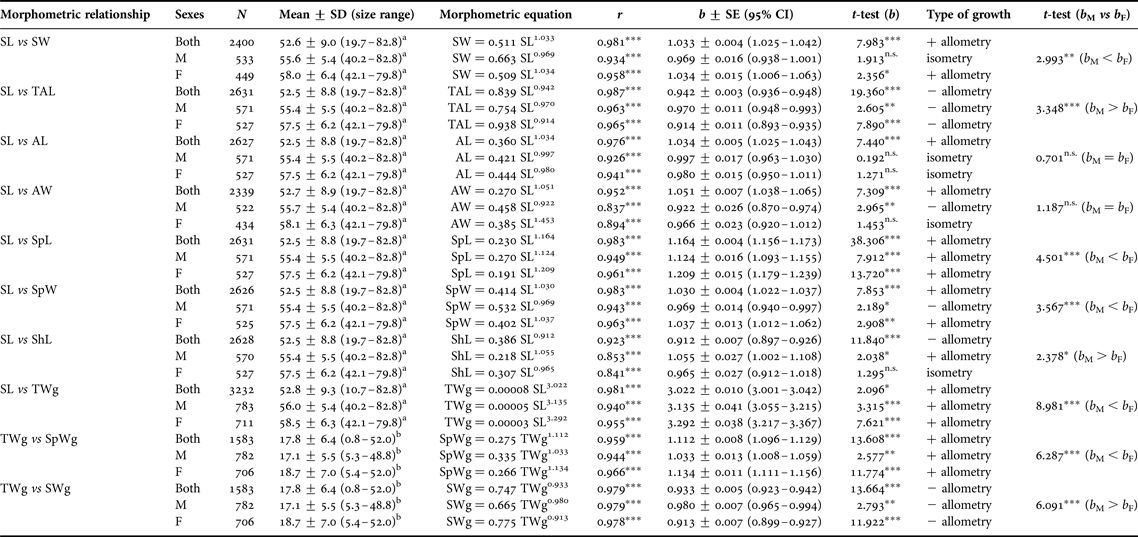
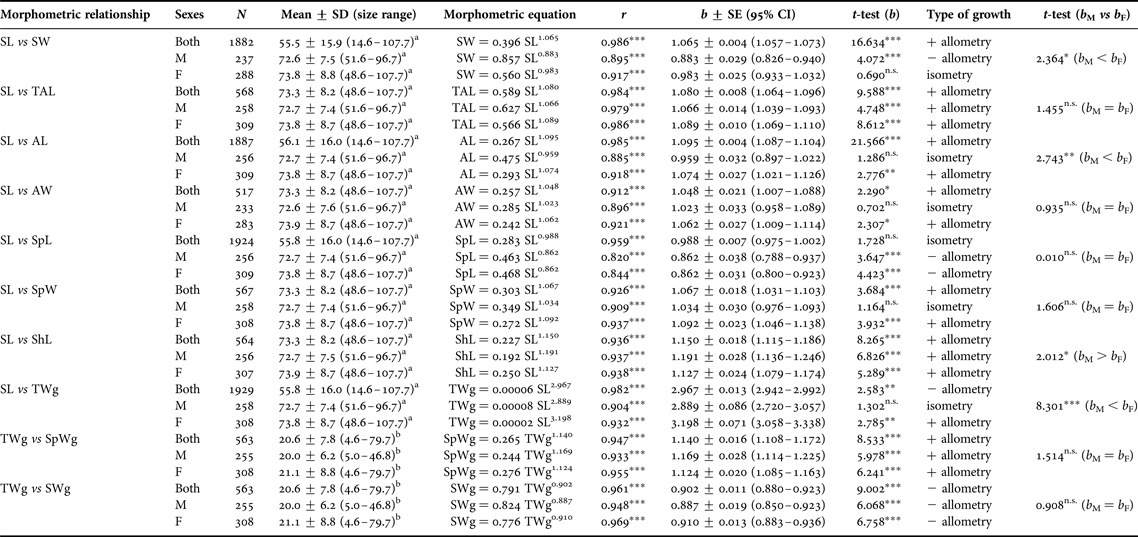
The descriptive statistics, morphometric relationships and type of growth of the banded murex and purple dye murex are compiled in Tables 1 & 2, respectively. Overall, a maximum of 3232 H. trunculus and 1929 B. brandaris were analysed, with both species comprising individuals with broad size ranges (H. trunculus: 10.7–82.8 mm SL; B. brandaris: 14.6–107.7 mm SL), i.e. fairly representative of the populations inhabiting the Ria Formosa lagoon. All morphometric relationships established for both species were highly significant (P < 0.001) and displayed invariably high correlation coefficients (H. trunculus: r = 0.837 to 0.983; B. brandaris: r = 0.820 to 0.986), which were slightly higher in H. trunculus (r > 0.900 = 86.7%; r > 0.950 = 60.0%) compared with B. brandaris (r > 0.900 = 83.3%; r > 0.950 = 33.3%) (Tables 1 & 2).
Descriptive statistics, morphometric relationships and type of growth of Hexaplex trunculus from the Ria Formosa lagoon (southern Portugal).

M, males; F, females; N, number; SD, standard deviation; r, correlation coefficient; b, allometric coefficient (regression slope); SE, standard error; 95% CI, 95% confidence interval.
Asterisks denote statistical significance level (P-value): n.s P > 0.05 (not significant); *P < 0.05; **P < 0.01; ***P < 0.001.
a Shell length (SL, mm).
b Total weight (TWg, g).
Descriptive statistics, morphometric relationships and type of growth of Bolinus brandaris from the Ria Formosa lagoon (southern Portugal).
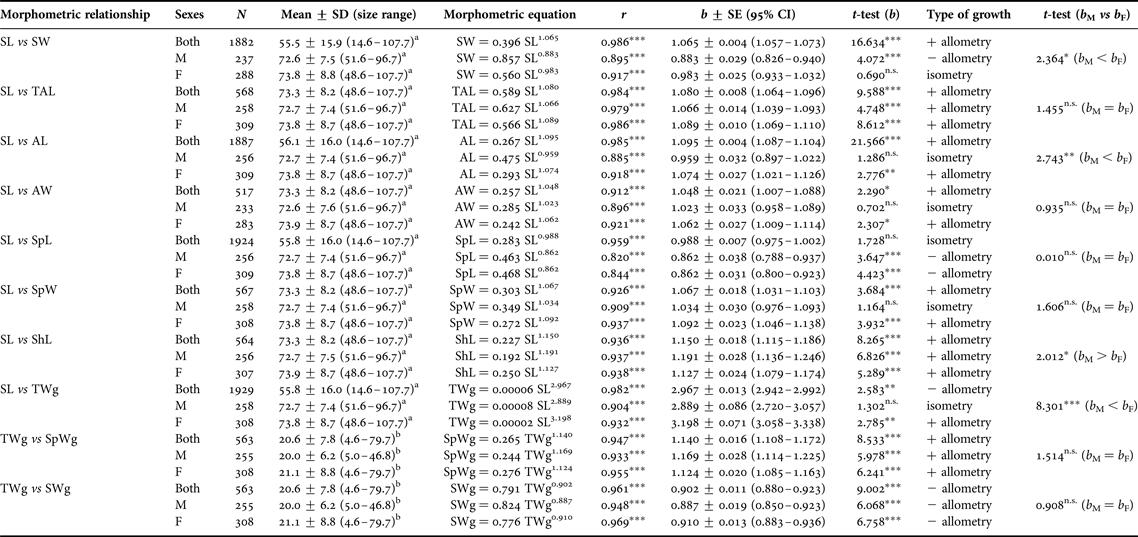
M, males; F, females; N, number; SD, standard deviation; r, correlation coefficient; b, allometric coefficient (regression slope); SE, standard error; 95% CI, 95% confidence interval.
Asterisks denote statistical significance level (P-value): n.s. P > 0.05 (not significant); *P < 0.05; **P < 0.01; ***P < 0.001.
a Shell length (SL, mm).
b Total weight (TWg, g).
The allometry coefficients of the morphometric relationships were in the ranges b = 0.912–1.209 and b = 3.022–3.292 for H. trunculus and in the ranges b = 0.862–1.191 and b = 2.889–3.198 for B. brandaris. Among the 30 morphometric relationships established for each species, H. trunculus displayed five isometries, nine negative and 16 positive allometries, whereas B. brandaris exhibited six isometries, seven negative and 17 positive allometries. Some morphometric relationships presented a consistent type of growth between sexes (combined sexes, males and females), namely five relationships in H. trunculus (three positive and two negative allometries) and four relationships in B. brandaris (three positive and one negative allometry). Among these, one morphometric relationship (SL vs TAL) displayed contrasting types of growth between species (negative allometries in H. trunculus and positive allometries in B. brandaris) and two morphometric relationships exhibited similar types of growth (negative allometries in TWg vs SWg and positive allometries in TWg vs SpWg) in both H. trunculus and B. brandaris (Tables 1 & 2).
Concerning the comparison of the type of growth between sexes, isometric growth (b M = b F), i.e. non-significant differences (P > 0.05) in the allometry coefficient (b) of males and females, occurred in two morphometric relationships for H. trunculus and in six morphometric relationships for B. brandaris, whereas statistically significant differences (P < 0.05) were detected in eight morphometric relationships for H. trunculus (three with b M > b F and five with b M < b F) and in four morphometric relationships for B. brandaris (one with b M > b F and three with b M < b F). Moreover, besides being more frequent, the comparison of the number of significant (P < 0.05), highly significant (P < 0.01) and very highly significant (P < 0.001) statistical differences between sexes, also revealed that sexual differences in the type of growth were more evident in H. trunculus (one relationship with P < 0.05, one relationship with P < 0.01 and six relationships with P < 0.001) than in B. brandaris (two relationships with P < 0.05, one relationship with P < 0.01 and one relationship with P < 0.001) (Tables 1 & 2).
DISCUSSION
Besides the general uses already mentioned above for the purposes of population dynamics and fisheries assessment and management, in the particular case of H. trunculus and B. brandaris, the establishment of morphometric relationships has further practical applications. For instance, since both species are subjected to shell damage either due to predation or during fishing and/or handling procedures, morphometric relationships allow reconstructing the original size of damaged specimens (e.g. calculating the shell length of an individual with broken siphonal canal, a frequent shell damage in both species, especially in B. brandaris due to its thinner and more fragile shell). In addition, in commercially valuable and edible species, as those in the current study, morphometric relationships involving ponderal variables (TWg and SpWg) are also useful for the estimation of meat yield (raw edible content) (Vasconcelos et al., Reference Vasconcelos, Gaspar, Castro and Nunes2009). Finally, since both H. trunculus and B. brandaris were harvested since the Roman Empire for the extraction of the purple dye (e.g. Spanier & Karmon, Reference Spanier, Karmon and Spanier1987; Reese, Reference Reese2010; Oliver, Reference Oliver2015), shell morphometric relationships are quite valuable for analysing archaeomalacological remains and interpreting archaeological deposits frequently composed by thousands of fragmented shells of these muricid species.
The broad size ranges of H. trunculus (10.7–82.8 mm SL) and B. brandaris (14.6–107.7 mm SL) analysed in the present study are highly representative of the populations inhabiting the Ria Formosa lagoon and encompass the vast majority of the sizes reported for both species throughout their distributional ranges. In fact, H. trunculus attains a maximum size comprehended between 80 mm (Poppe & Goto, Reference Poppe and Goto1991; Anon., 2001; Malaquias, Reference Malaquias and Borges2007), 85 mm (Muzavor & Morenito, Reference Muzavor and Morenito1999), 90 mm (Macedo et al., Reference Macedo, Macedo and Borges1999) or even 108 mm in shell length (Houart, Reference Houart2001), whereas B. brandaris attains a maximum size comprehended between 80–90 mm (Anon., 2001), 100 mm (Macedo et al., Reference Macedo, Macedo and Borges1999; Malaquias, Reference Malaquias and Borges2007), 110 mm (Muzavor & Morenito, Reference Muzavor and Morenito1999) or even 120 mm in shell length (Houart, Reference Houart2001). Such broad size ranges of H. trunculus and B. brandaris are quite important because morphometric relationships should be limited to the size intervals applied in the regression analyses, avoiding data extrapolation for individuals below or above those size intervals.
In general, the correlation coefficients of the morphometric relationships were slightly higher in the banded murex than in the purple dye murex, indicating greater morphological plasticity and higher variability in shell shape in B. brandaris compared with H. trunculus. Studies on the absolute growth revealed that both species display high inter-individual variability in growth rates, that extend from the embryonic, hatchling and juvenile stages (Vasconcelos et al., Reference Vasconcelos, Gaspar, Joaquim, Matias and Castro2004; Lahbib et al., Reference Lahbib, Abidli and Trigui El Menif2010) until the adult life phase (Vasconcelos et al., Reference Vasconcelos, Gaspar, Pereira and Castro2006c, Reference Vasconcelos, Gharsallah, Moura, Zamouri-Langar, Gaamour, Missaoui, Jarboui and Gaspar2012a, Reference Vasconcelos, Pereira, Constantino, Barroso and Gasparc), which might also induce variability in shell shape and relative growth of H. trunculus and B. brandaris. Higher variability in shell shape of B. brandaris compared with H. trunculus could also be due to the fact that shells of B. brandaris are thinner, weaker and more ornamented than those of H. trunculus, thus more fragile and susceptible to damage (especially in the siphonal canal and in the outer lip of the shell aperture), which might ultimately affect shell proportions and relative growth. Shell colonization by epibionts (fouling organisms) is also known to affect growth of muricid gastropods (e.g. Vasconcelos et al., Reference Vasconcelos, Cúrdia, Castro and Gaspar2007; El Ayari et al., Reference El Ayari, Abidli, Lahbib, Rodríguez González, García Alonso and Trigui El Menif2015), but it should not contribute to higher variability in shell shape in the purple dye murex than in the banded murex, because the greater ability of B. brandaris to burrow shallowly into soft-bottom sediments makes it less prone to shell epibiosis than H. trunculus (P. Vasconcelos, personal observation).
In both species, the vast majority of morphometric relationships displayed positive allometries (H. trunculus = 16; B. brandaris = 17), distantly followed by negative allometries (H. trunculus = 9; B. brandaris = 7) and by isometries (H. trunculus = 5; B. brandaris = 6), which in practice means that in most morphometric relationships the independent variable (Y) grows at a higher rate than the independent variable (X) throughout the ontogeny. In H. trunculus, positive allometries in the relationships SL vs SW, AL, AW, SpL and SpW, indicated that during growth, shell width, aperture length and width, spire length and width increase at a faster rate than shell length. On the opposite, negative allometries in the relationships SL vs ShL and TAL revealed that throughout the ontogeny the length of the siphonal canal, and consequently the length of the total aperture, increase at a slower rate than shell length. Concerning the ponderal variables, positive allometries in the relationships SL vs TWg and TWg vs SpWg indicated that during growth, both total weight and soft parts weight (raw edible content) increase proportionally more than shell length, confirming that during ontogeny H. trunculus allocates more energetic resources towards somatic growth than towards shell secretion. In B. brandaris, positive allometries in the relationships SL vs SW, TAL, AL, AW, SpW and ShL, indicated that during growth, shell width, total aperture length, aperture length and width, spire width and siphonal canal length increase at a faster rate compared with shell length, while the isometry in the relationship SL vs SpL denoted similar growth in spire length and shell length throughout ontogeny. Regarding the ponderal variables, negative allometries in the relationships SL vs TWg and TWg vs SWg, revealed that during growth, both total weight and shell weight increase proportionally less than shell length, whereas soft parts weight (raw edible content) increases at a faster rate than total weight throughout ontogeny, as confirmed by the positive allometry in the relationship TWg vs SpWg.
Gastropod shell growth, morphology and relative proportions are highly influenced by several abiotic and biotic factors. As an extreme example of morphological variability, some specimens of H. trunculus and B. brandaris caught in the Adriatic Sea presented such anomalous growth that were considered teratologic, possibly resulting from particular environmental conditions that disturbed their normal development and distorted their typical shell shape (Cecalupo et al., Reference Cecalupo, Vianello and Perini2006). In addition, the relationships between morphometric parameters can change depending on the habitat and due to physiological conditions, especially those that occur during the processes of growth, maturation and spawning, which affect the mechanisms of the shell calcification and might induce variation in shell shape and relative proportions. For all these reasons, comparisons of morphometric relationships and type of growth between species from different populations and/or geographic areas should consider the size ranges analysed and must be interpreted cautiously.
Still, some morphometric relationships and respective types of growth appear to be characteristic of the species and reasonably similar among populations from different geographic locations. For instance, in the relationship SL vs TWg of H. trunculus, positive allometries were recorded in the present study (b = 3.022), in the Bizerte lagoon (b = 3.113) (Gharsallah et al., Reference Gharsallah, Zamouri-Langar, Missaoui and El Abed2004) and in cultured individuals from the Bizerte lagoon (b = 3.390) (Lahbib et al., Reference Lahbib, Abidli and Trigui El Menif2010), whereas isometric growth (b = 3.013 ± 0.013, C.I. = 2.988–3.039) was reported in the Gulf of Gabès (Elhasni, Reference Elhasni2012). Similarly, the positive allometries registered in the present study for relationships involving aperture length (b = 1.034) and aperture width (b = 1.051) of H. trunculus, corroborate analogous information reported for the Bizerte lagoon (b = 1.104 to b = 1.126, depending on the sampling site) (Trigui El Menif et al., Reference Trigui El Menif, Lahbib, Le Pennec, Flower and Boumaiza2006). In addition, the relationships SL vs SW and SL vs AL of B. brandaris also displayed positive allometries both in the Ria Formosa lagoon (b = 1.065 and b = 1.095) and in the Catalan coast (b = 1.108 and b = 1.195) (Martín et al., Reference Martín, Sánchez and Ramón1995). On the opposite, in the present study a negative allometry was recorded in the relationship SL vs TWg of B. brandaris (b = 2.967), whereas positive allometries were reported in the Catalan coast (b = 3.093) (Martín et al., Reference Martín, Sánchez and Ramón1995) and in the Gulf of Gabès (b = 3.102 ± 0.013, C.I. = 3.076–3.128) (Elhasni, Reference Elhasni2012). In the present case, differences in the type of growth displayed in the weight–length relationships (SL vs TWg) of these species (positive allometry in H. trunculus and negative allometry in B. brandaris) are certainly due to marked differences in the main features of their shells, namely thickness, strength and ornamentation. Indeed, the contribution of shell weight to total weight is higher in H. trunculus than in B. brandaris, because its shell is stronger and lacks the protuberances that are easily damaged in B. brandaris (Dalla Via & Tappeiner, Reference Dalla Via and Tappeiner1981). These differences in shell relative weight have functional significance, with thicker and heavier shells being more protective especially under unfavourable environmental conditions, thus allowing to better cope with wave impact, aerial exposure, freezing, heating and drying (Alyakrinskaya, Reference Alyakrinskaya2005).
Although both the banded murex and the purple dye murex are known to lack external sexual dimorphism, interestingly several morphometric relationships displayed statistically significant differences in the type of growth between sexes (eight relationships in H. trunculus and four relationships in B. brandaris). For instance, in both species the relationships SL vs SW revealed proportionally higher growth in shell width in females (H. trunculus: b = 1.034; B. brandaris: b = 0.983) than in males (H. trunculus: b = 0.969; B. brandaris: b = 0.883), which is probably due to the fact that during the maturation peak females develop slightly more voluminous gonads than males and have a large and female-specific accessory sexual organ, the capsule gland responsible for the formation of the egg capsules (oothecae) that encapsulate the developing eggs and embryos, which also reaches a considerable volume during the spawning season (Ramón & Amor, Reference Ramón and Amor2002; Amor et al., Reference Amor, Ramón and Durfort2007; Vasconcelos et al., Reference Vasconcelos, Lopes, Castro and Gaspar2008b, Reference Vasconcelos, Lopes, Castro and Gasparc, Reference Vasconcelos, Moura, Barroso and Gaspar2012b; Lahbib et al., Reference Lahbib, Abidli and Trigui El Menif2009, Reference Lahbib, Abidli and Trigui El Menif2011; Elhasni et al., Reference Elhasni, Ghorbel, Vasconcelos and Jarboui2010, Reference Elhasni, Vasconcelos, Ghorbel and Jarboui2013; Gharsallah et al., Reference Gharsallah, Vasconcelos, Zamouri-Langar and Missaoui2010; Abidli et al., Reference Abidli, Lahbib and Trigui El Menif2012). Accordingly, in both species this morphological difference between sexes was also reflected in their relationships SL vs TWg, which confirmed proportionally faster growth in total weight than in shell length in females (H. trunculus: b = 3.292; B. brandaris: b = 3.198) compared with males (H. trunculus: b = 3.135; B. brandaris: b = 2.889). In both species, another shell feature potentially distinctive between sexes was identified through the relationship SL vs ShL, which revealed that during ontogeny the siphonal canal length increases at a higher rate than shell length in males (H. trunculus: b = 1.055; B. brandaris: b = 1.191) compared with females (H. trunculus: b = 0.965; B. brandaris: b = 1.127), which might be eventually due to differential burrowing behaviour and ability between sexes.
Likewise, a few other studies with the banded murex and the purple dye murex have also detected significant differences among sexes in some morphometric relationships and respective type of growth, namely in the relationship between shell length and body weight of H. trunculus from the Bizerte lagoon (males: b = 2.95; females: b = 3.15) (Lahbib et al., Reference Lahbib, Abidli and Trigui El Menif2009) and also in the relationship between shell length without siphonal canal and shell aperture width of B. brandaris from the Bizerte lagoon (males: b = 1.040; females: b = 0.959) (Abidli et al., Reference Abidli, Lahbib and Trigui El Menif2012). Nevertheless, these consistent indications of sexual dimorphism in both H. trunculus and B. brandaris should be further confirmed using more powerful techniques, such as geometric morphometric analyses of shell shape, which are most useful for detecting subtle sex-related morphological differences (e.g. Minton & Wang, Reference Minton and Wang2011; Moneva et al., Reference Moneva, Torres and Demayo2012; Avaca et al., Reference Avaca, Narvarte, Martín and van der Molen2013; Benítez, Reference Benítez and Moriyama2013).
ACKNOWLEDGEMENTS
The authors are grateful to the technical staff of the Instituto Português do Mar e da Atmosfera (IPMA, I.P.) for their helpful assistance in the sampling procedures. The authors acknowledge the Associate Editor of JMBA UK (Dr W.J. Langston) and two anonymous reviewers for their valuable comments and suggestions that improved the revised version of the manuscript.
FINANCIAL SUPPORT
This work was partially funded by a postdoctoral grant from the Fundação para a Ciência e Tecnologia (FCT – Portugal) awarded to Paulo Vasconcelos (SFRH/BPD/26348/2006) and supported by the research project ‘Desarrollo Sostenible de las Pesquerías Artesanales del Arco Atlántico – PRESPO’ (Programme INTERREG IV B, co-financed by EU, ERDF funds).