Introduction
There are currently more than 110 copper arsenate minerals and more than 40 copper phosphate minerals; however, only three among them, epifanovite (Yakovenchuk et al., Reference Yakovenchuk, Pakhomovsky, Konoplyova, Panikorovskii, Mikhailova, Bocharov, Krivovichev and Ivanyuk2017), milkovoite (Siidra et al., Reference Siidra, Nazarchuk, Pautov, Borisov and Kozin2021) and philipsburgite, have arsenate and phosphate dominating different structural sites.
Philipsburgite was originally described from the Black Pine mine, north of Philipsburg, Montana, USA, with the formula (Cu,Zn)6[(As,P)O4]2(OH)6⋅H2O by Peacor et al. (Reference Peacor, Dunn, Ramik, Sturman and Zeihen1985), who concluded that philipsburgite is isotypic with kipushite, Cu5Zn(PO4)2(OH)6⋅H2O (Piret et al., Reference Piret, Deliens and Piret-Meunier1985). They reported the empirical chemical formula Cu4.30Zn1.65[(AsO4)1.05(PO4)0.91](OH)6.03⋅1.04H2O and, based on the small predominance of As over P, defined philipsburgite as an As-dominant species.
The crystal structure study of ‘philipsburgite’ from the Middle Pit, Gold Hill mine, Tooele County, Utah, USA, with the empirical formula Cu4.69Zn1.23[(AsO4)1.72(PO4)0.36](OH)5.61⋅H2O, reported by Krivovichev et al. (Reference Krivovichev, Zhitova, Ismagilova and Zolotarev2018) revealed the existence of a site-selective As–P substitution for the two tetrahedral sites with the As1 site (designated as the T1 site herein) preferred for the incorporation of P and the As2 site (designated as the T2 site herein) preferred for the incorporation of As. The sample studied by Krivovichev et al. (Reference Krivovichev, Zhitova, Ismagilova and Zolotarev2018) exhibits As >> P with both tetrahedral sites occupied predominantly by As.
New crystal-structure studies of philipsburgite from the Black Pine (holotype), the Silver Coin and Kamariza mines revealed the ordered distribution of P and As over T1 and T2 tetrahedral sites, leading to the conclusion that philipsburgite, defined previously with the formula Cu5Zn[(As,P)O4]2(OH)6⋅H2O, should be redefined with the formula Cu5Zn[(AsO4)(PO4)](OH)6⋅H2O, i.e. as a mineral characterised by an ordered distribution of As and P. At the same time, the ‘philipsburgite’ sample studied by Krivovichev et al. (Reference Krivovichev, Zhitova, Ismagilova and Zolotarev2018) qualifies as a separate mineral species with the ideal formula Cu5Zn[(AsO4)2](OH)6⋅H2O [or Cu5Zn(AsO4)(AsO4)(OH)6⋅H2O], i.e. as the As-analogue of kipushite, which has both T1 and T2 sites predominantly occupied by As. In addition, a sample from the Yamato Mine, Yamaguchi Prefecture, Japan, described by Shirose and Uehara (Reference Shirose and Uehara2011) as philipsburgite, is noted to have a composition corresponding most closely to the As end-member.
A common occurrence of goldhillite, philipsburgite and kipushite is known from the Sa Duchessa mine, Orrida, Domusnovas, Sardinia, Italy (Olmi et al., Reference Olmi, Sabelli and Brizzi1988). The analysis of a slightly different material from the initial discovery of philipsburgite also revealed the existence of goldhillite at the Christiana mine No. 132, Kamariza mines, Greece (Supplementary Fig. S1) where philipsburgite was originally found. The empirical formula is Cu4.97Zn1.09[(AsO4)1.55(PO4)0.45](OH)6⋅H2O (P + As = 2 and O = 15 atoms per formula unit (apfu)) (B. Rieck, personal communication, October 5, 2021).
This paper describes the new mineral goldhillite as the As-dominant member of the kipushite–philipsburgite–goldhillite isomorphous series and redefines philipsburgite as an As–P-ordered intermediate species in that series, with kipushite remaining as the P-dominant member.
In the absence of structure refinement, members of the series with P:As > 3:1 can be identified as kipushite and those with As:P > 3:1 can be identified as goldhillite. Members with roughly equal amounts of P and As certainly qualify as philipsburgite; however, it is impossible to precisely specify compositional boundaries between kipushite and philipsburgite and between goldhillite and philipsburgite because the T1 and T2 may, at least theoretically, contain different amounts of P and As.
The new mineral and its name have been approved by the Commission on New Minerals, Nomenclature and Classification (CNMNC) of the International Mineralogical Association (IMA2021-034, Ismagilova et al., Reference Ismagilova, Kampf, Zhitova, Zolotarev, Ciesielczuk, Mikhailova, Belakovsky, Bocharov, Shilovskikh, Vlasenko, Nash and Krivovichev2021) and the redefinition of philipsburgite has been approved by the CNMNC (voting proposal 20-G, Miyawaki et al., Reference Miyawaki, Hatert, Pasero and Mills2021). Goldhillite is named after its type locality, the Gold Hill mine, Tooele County, Utah, USA.
Materials
Philipsburgite crystals from the following occurrences were investigated: (1) the Black Pine mine, Philipsburg, Montana, USA (holotype specimen; U.S. National Museum of Natural History, Smithsonian Institution, #161201) (BP); (2) Christiana mine No. 132, Kamariza mines, Agios Konstantinos, Lavrion district mines, Lavreotiki, East Attica, Attica, Greece (KM) (Supplementary Fig. S2); and (3) the Silver Coin mine, Valmy, Iron Point district, Humboldt County, Nevada, USA (SC). The SC sample is stored under catalogue number 76195 in the Natural History Museum of Los Angeles County (Los Angeles, California, USA).
The description of goldhillite is based on the material from the Gold Hill mine, Tooele County, Utah, USA. The holotype is from the collection of the Fersman Mineralogical Museum (Moscow, Russia), where it is stored under catalogue number 88338 (FMM). The cotype is from the collection of the Natural History Museum of Los Angeles County (NHMLA), where it is stored under catalogue number 76142.
Experimental methods and data processing
Goldhillite
The FMM sample was referred to as ‘philipsburgite’ by Krivovichev et al. (Reference Krivovichev, Zhitova, Ismagilova and Zolotarev2018). The study involved single-crystal X-ray diffraction at 100 K and electron microprobe analysis. In the present study, we report the Raman spectrum, powder X-ray diffraction data and optical data for the FMM sample, chemical data for the NHMLA sample and the room-temperature crystal structure study of FMM and NHMLA required for the complete description of a new mineral species.
The Raman spectrum of FMM goldhillite was obtained by means of a Horiba Jobin-Yvon LabRam HR 800 spectrometer equipped with an Ar+ laser (λ = 514 nm) at ~6 mW power at the sample. The Raman spectrum was recorded at room temperature in the range from 70 to 4000 cm–1 with resolution of 2 cm–1 and processed using the LabSpec (Horiba Jobin Vyon, 2008) and Origin software (OriginLab Corporation, 2009).
Powder X-ray diffraction data for the FMM sample were collected on a Rigaku R-Axis Rapid II diffractometer (Debye-Scherrer geometry, d = 127.4 mm) equipped with a rotating anode X-ray source (CoKα, λ = 1.79021 Å) and a curved image plate detector. The data were integrated using the software package Osc2Tab/SQRay (Britvin et al., Reference Britvin, Dolivo-Dobrovolsky and Krzhizhanovskaya2017). Unit-cell parameters were refined using the Le Bail methods implemented in TOPAS software (Bruker-AXS, 2009).
Single-crystal X-ray diffraction studies of goldhillite samples were carried out using an Agilent Technologies Xcalibur Eos diffractometer (for the FMM sample) and a Rigaku R-Axis Rapid II curved imaging plate microdiffractometer (for the NHMLA sample) at room temperature (293 K). The data were collected using monochromatic MoKα X-radiation at 50 kV and 40 mA. The structure data for FMM were integrated and corrected by means of the CrysAlisPro (Agilent Technologies, 2014) program package, which was also used for an empirical absorption correction using spherical harmonics, as implemented in the SCALE3 ABSPACK scaling algorithm. The FMM crystal structure was solved and refined using the SHELX program package (Sheldrick, Reference Sheldrick2015) and the Olex2 software (Dolomanov, Reference Dolomanov, Bourhis, Gildea, Howard and Puschmann2009).
Electron probe microanalyses (EPMA) of the NHMLA sample were performed at the University of Utah on a Cameca SX-50 electron microprobe with four wavelength dispersive spectrometers (WDS) and using Probe for EPMA package (Donovan et al., Reference Donovan, Kremser and Fournelle2012), at 15 kV accelerating voltage, 10 nA beam current and a beam diameter of 10 μm. Raw X-ray intensities were corrected for matrix effects with a φρ(z) algorithm (Pouchou and Pichoir, Reference Pouchou, Pichoir, Heinrich and Newbury1991). Standards used for EPMA are Cu metal for Cu, Zn metal for Zn, synthetic GaAs for As and apatite for P.
Philipsburgite
Room-temperature single-crystal X-ray diffraction studies were done for the BP (holotype philipsburgite) and SC samples using a Rigaku R-Axis Rapid II curved imaging plate microdiffractometer. The data were collected using monochromatic MoKα X-radiation at 50 kV and 40 mA. For the KM sample the measurement was done on a Bruker APEX II diffractometer equipped with a CCD area detector and an Incoatec Microfocus Source IμS (30 W, multilayer mirror and MoKα).
Chemical analyses of the KM philipsburgite sample were done by means of a JEOL Hyperprobe JXA8530F with field-emission electron gun, operated in WDS mode at 10 kV accelerating voltage, 20 nA beam current and 30 μm beam diameter. Reference materials used for KM chemical analyses were zincite for Zn, cuprite for Cu, synthetic (OH)-apatite for P and arsenopyrite for As. EPMA for SC philipsburgite was done on a Cameca SX-50 operated in WDS mode at 15 kV accelerating voltage, 10 nA beam current and 10 μm beam diameter. Standards used were Cu metal for Cu, zincite for Zn, GaAs for As, apatite for P and V metal for V.
Results
Occurrence, general appearance and physical properties of goldhillite
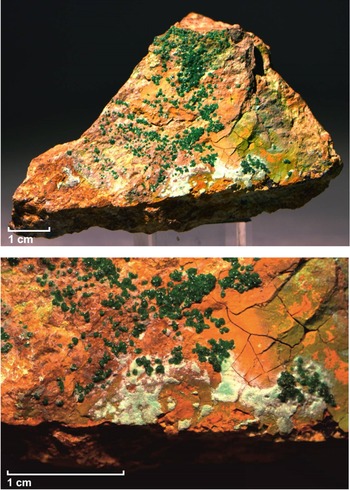
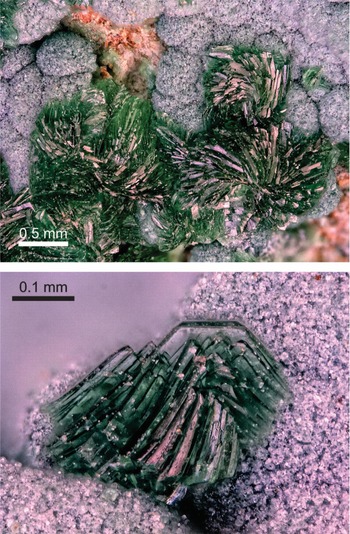
The new mineral goldhillite occurs on surfaces of fractures in a rock comprised mostly of quartz with iron hydroxides. These surfaces are covered by a clay-like material on which the holotype goldhillite aggregates has grown in association with fine-grained aggregates and thin needles (up to 0.4 mm long) of a mixite-group mineral, probably zálesíite (Fig. 1). On the cotype specimen, goldhillite has grown on botryoidal cornwallite coated with tiny crystals of conichalcite on garnet skarn matrix (Fig. 2). Previously, goldhillite from the Yamato mine (Yamaguchi Prefecture, Japan) was described as an As-dominant philipsburgite by Shirose and Uehara (Reference Shirose and Uehara2011); the mineral was found occurring in skarns within cavities of the oxidised rock in association with malachite, cornwallite, quartz and goethite. Goldhillite forms rosette-type aggregates (up to 1.5 mm in diameter) of subparallel to divergent tabular crystals, flattened on {100}, up to 1 mm across (Figs 2 and 3). The observed crystal forms are {100} (the major form), {110}, {001} and {111} (narrow lateral faces). Tablets are commonly curved. Twinning is not observed. The a:b:c ratio calculated from RT unit-cell parameters of the holotype is 1.3385:1:1.1607.
Holotype specimen # 88338 from the collection of the Fersman Mineralogical Museum with emerald green crystals of goldhillite along with a pale greenish fine-grained aggregates and fine needles (up to 0.4 mm long) of zálesíite: FOV 6 × 8 cm (upper image), FOV 3 × 2 cm (lower image). Photo: M.M. Moiseev.

Goldhillite on the cotype specimen (#76142) from the collection of the Natural History Museum of Los Angeles County with emerald green crystals of goldhillite on botryoidal cornwallite coated with tiny crystals of conichalcite.

Crystal drawing of goldhillite; clinographic projection.

Goldhillite crystals are transparent, bright emerald green with vitreous lustre and pale green streak. Fluorescence is not observed. The mineral fracture is uneven; separate crystals are brittle. Perfect cleavage on {100} is observed. The hardness on the Mohs scale is 3.5, based on scratch tests. Goldhillite is readily soluble at room-temperature in diluted 10% HCl.
The optical properties were determined on cotype goldhillite using white light. Optically, goldhillite is biaxial (−) with α = 1.747(3), β = 1.794(3) and γ = 1.796(3). The 2V angle measured directly on a spindle stage is 17(3)°. The calculated 2V value is 22.8°. Dispersion is r < v, slight. The optical orientation is Z = b, X ^ a ≈ 7° in the obtuse angle β. The pleochroism is X = light green, Y and Z = medium green; X < Y ≈ Z.
The density could not be measured because of the paucity of available material and the unavailability of nearly concentrated Clerici solution. The density calculated on the basis of the empirical formula and unit-cell volume refined from single-crystal X-ray diffraction (XRD) data is 4.199 g/cm–3 for the holotype and 4.177 g/cm–3 for the cotype.
Raman spectroscopy of goldhillite
The Raman spectrum of goldhillite is shown in Fig. 4; the assignment of the bands is provided in Table 1. In general, the spectrum of goldhillite is in good agreement with those obtained for the minerals of the kipushite–philipsburgite series studied by Ciesielczuk et al. (Reference Ciesielczuk, Janeczek, Dulski and Krzykawski2016). The stretching vibrations corresponding to hydroxyl ions are found around 3546 and 3489 cm–1, whereas those corresponding to H2O-molecules are seen as a wide band in the 3450–3100 cm–1 region. Several bands that can be assigned to arsenate anions occur in the 900–340 cm–1 region, whereas vibrations of phosphate anions have been observed in the region 1100–990 cm–1. The bands in the region 330–90 cm–1 correspond to lattice vibrations. It should be noted that the Raman spectra reported by Ciesielczuk et al. (Reference Ciesielczuk, Janeczek, Dulski and Krzykawski2016) for samples with different P/As ratios (corresponding to kipushite, intermediate member of the isomorphous series with As:P close to 1:1 and goldhillite) differ significantly in the relative intensities of phosphate (in particular, 975–970 cm–1) and arsenate (in particular, 813–809 and 847–837 cm–1) bands. Our sample shows a close resemblance to the As-dominant sample studied by Ciesielczuk et al. (Reference Ciesielczuk, Janeczek, Dulski and Krzykawski2016).
Raman spectrum of goldhillite.

Raman bands of holotype goldhillite and goldhillite, philipsburgite and kipushite by Ciesielczuk et al. (Reference Ciesielczuk, Janeczek, Dulski and Krzykawski2016).

*Mineral with As:P ratio close to 1:1, probably philipsburgite. However it is not clear whether As and P are ordered or disordered in that species (Ciesielczuk et al., Reference Ciesielczuk, Janeczek, Dulski and Krzykawski2016).
Chemical data of goldhillite and philipsburgite
Goldhillite
Electron microprobe analyses were obtained for the determination of Cu, Zn, As and P. No other elements were detected. The H2O content was calculated based upon the structure determination (Cu + Zn + As + P = 8 for goldhillite, O = 15 apfu). There was no damage caused by the electron beam.
Analytical data for the crystals of NHMLA goldhillite are given in Table 2 along with the data reported by Krivovichev et al. (Reference Krivovichev, Zhitova, Ismagilova and Zolotarev2018) for the holotype FMM specimen.
Chemical data (in wt.%) for philipsburgite from the Black Pine mine (BP), Kamariza mines (KM) and Silver Coin mine (SC), and goldhillite from the Gold Hill mine (FMM) and Los Angeles Museum (NHMLA).

* Peacor et al. (1987); ** Krivovichev et al. (Reference Krivovichev, Zhitova, Ismagilova and Zolotarev2018); § Based on the structure
n.d. – not determined
The empirical formula for cotype goldhillite (NHMLA) based on O = 15 apfu is (Cu4.62Zn1.37)Σ5.99[(As0.86P0.14)Σ1.00O4]2(OH)6⋅H2O (–0.02 H for charge balance); this is in good agreement with the empirical formula reported by Krivovichev et al. (Reference Krivovichev, Zhitova, Ismagilova and Zolotarev2018) for holotype goldhillite (FMM), (Cu4.69Zn1.23)Σ5.92(As0.86P0.18O4)2(OH)5.61⋅H2O. The ideal formula of goldhillite is Cu5Zn(AsO4)2(OH)6⋅H2O, which requires CuO 50.92, ZnO 10.42, As2O5 29.43, H2O 9.23, total 100 wt.%.
Philipsburgite
Electron microprobe analyses of philipsburgite were obtained for the determination of Cu, Zn, As, P (for KM, SC and BP) and V (for SC). No further elements were detected. The H2O content was calculated based upon the structure determination (P + As + V = 2 and O = 15 apfu).
Analytical data for the KM and SC samples are given in Table 2 along with the EPMA reported by Peacor et al. (Reference Peacor, Dunn, Ramik, Sturman and Zeihen1985) for the holotype BP sample. Table 2 provides a comparison of chemical data for goldhillite and philipsburgite.
The empirical formulas calculated on the basis of P + As + V = 2 and O = 15 apfu are (Cu5.05Zn0.99)Σ6.04[(AsO4)1.40(PO4)0.60]Σ2(OH)6⋅H2O for the KM sample and (Cu3.62Zn2.07)Σ5.69[(AsO4)0.976(PO4)1.009(VO4)0.015]Σ2(OH)6⋅H2O (+0.61 H for charge balance) for SC; that reported by Peacor et al. (Reference Peacor, Dunn, Ramik, Sturman and Zeihen1985) for holotype philipsburgite (BP) is (Cu4.30Zn1.65)Σ5.95[(AsO4)1.05(PO4)0.91](OH)6.03⋅1.04H2O. Although these formulas show significant variability in Cu vs Zn and As vs P, the results of the structure refinements (see below) are all consistent with the simplified formula Zn(Cu,Zn)5[(As,P)O4][(P,As)O4](OH)6⋅H2O and with the ideal formula Cu5Zn(AsO4)(PO4)(OH)6⋅H2O, which requires 53.96 CuO, 11.04 ZnO, 15.59 As2O5, 9.63 P2O5, 9.78 H2O, total 100 wt.%.
X-ray diffraction and crystal structure
Goldhillite
Powder X-ray diffraction data for holotype goldhillite are provided in Supplementary Table S1. The powder XRD pattern of goldhillite is in good agreement with the data reported for philipsburgite (ICDD 00-038-0384)Footnote * and the calculated pattern of kipushite (ICDD 01-084-0926). Goldhillite is monoclinic, P21/c (#14), a = 12.3808(4), b = 9.2397(5), c = 10.7862(5) Å, β = 97.536(2)°, V = 1223.24(9) Å3 and Z = 4.
The crystal structure of the holotype (FMM) sample was solved and refined to R 1 = 0.054 for 2365 independent reflections with I > 2σ(I). The goldhillite structure was refined in space group P21/c (#14) with the following unit-cell parameters: a = 12.3573(5), b = 9.2325(3), c = 10.7163(4) Å, β = 97.346(4)°, V = 1212.59(8) Å3 and Z = 4. The crystallographic information file of the FMM sample is deposited at CCDC/FIZ Karlsruhe database under the CSD number 2111718 [https://www.ccdc.cam.ac.uk/structures/] and as Supplementary material (see below).
The crystal-structure data for the cotype (NHMLA) sample were refined to R 1 = 0.043 for 2323 independent reflections with I > 2σ(I) and unit-cell parameters: a = 12.4040(9), b = 9.2692(4), c = 10.7585(5) Å, β = 97.255(7)°, V = 1227.06(12) Å3 and Z = 4. The obtained structure refinement for the NHMLA sample is completely consistent with that for the FMM sample, consequently, only the FMM structure is reported.
Details for the single-crystal X-ray data collection and structure refinement are provided in Table 3. Atom coordinates, site occupancies and isotropic displacement parameters are given in Table 4; anisotropic displacement parameters are listed in Supplementary Table S2. Selected bond lengths are given in Table 5.
Data measurement and refinement information for philipsburgite crystals from the Black Pine mine (BP), Kamariza mines (KM) and Silver Coin mine (SC) and goldhillite crystal from Gold Hill mine (FMM).

* For all four refinements, all other sites were assigned full occupancies by their ideal constituents.
Atom coordinates and equivalent isotropic displacement parameters (Å2) and site occupancies (s.o.f.) for goldhillite (FMM).

Wyck. – Wyckoff positions
Selected bond lengths (Å) for goldhillite (FMM).

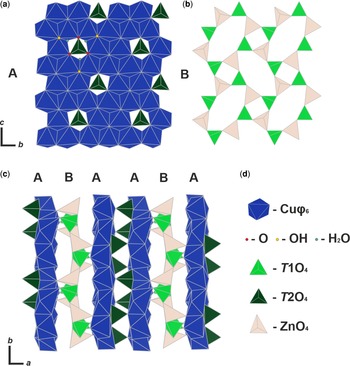
The crystal structure of goldhillite, isotypic to those of philipsburgite and kipushite (Piret et al., Reference Piret, Deliens and Piret-Meunier1985), is shown in Fig. 5. It consists of five independent Cu sites, each surrounded by six ligands forming Jahn–Teller-distorted Cuφ6 octahedra [φ = O2−, (OH)−, H2O], one Zn site and two As sites (T1 and T2) in tetrahedral coordination. The Cuφ6 octahedra share edges to form honeycomb-like layers (referred to as A-type) with open hexagonal holes covered by the T2O4 tetrahedra (Fig. 5a). Alternating corner-sharing ZnO4 and T1O4 tetrahedra form four- and eight-membered tetrahedral rings in a second type of layer (referred to as B-type) (Fig. 5b). The A- and B-type layers are stacked perpendicular to the a-axis with adjacent A-type layers linking through their T2O4 tetrahedra to form double-A layers. Single B-type layers link double-A layers, providing an overall A:B ratio of 2:1 (Fig. 5c).
The crystal structure of goldhillite: (a) the A-type layer; (b) the B-type layer; (c) crystal structure projected along the c-axis; and (d) legend, φ = O2−, (OH)−, H2O; T1 and T2 are predominantly occupied by As.

The arrangement of the O-atoms, OH-groups and H2O-molecules in the octahedral layer was determined from the analysis of bond-valence sums (BVS) incident upon the O sites. There are three types of O atoms in the layer (Fig. 5a). Atoms of type 1 are shared between Cuφ6 octahedra and T1O4 or T2O4 tetrahedra, receiving BVS close to 2 valence units (vu); these are the O atoms. Atoms of type 2 are corner-shared between three Cuφ6 octahedra, receiving BVS close to 1 vu and therefore are considered as the OH-groups. Atoms of type 3 are corner-shared between two Cuφ6 octahedra; their BVS are <0.67 vu; these atoms are considered as the O atoms of the H2O-molecules. The O–H bonds of the OH- and H2O-groups point in the direction of the tetrahedral layer. The detailed description of the hydrogen-bonding scheme was reported by Krivovichev et al. (Reference Krivovichev, Zhitova, Ismagilova and Zolotarev2018) for the sample studied at 100 K.
Philipsburgite
The crystal structure of philipsburgite was solved and refined at room temperature to R 1 = 0.052 (BP), 0.03 (KM) and 0.04 (SC) for 2308, 5485, 1686 independent reflections with I > 2σ(I), respectively.
Details for the data collections and structure refinements are given in Table 3. Atom coordinates, site occupancies and isotropic displacement parameters are listed in Table 6 (BP), Supplementary Table S3 (KM), Table S4 (SC). Anisotropic displacement parameters are provided in Table S5 (BP), Table S6 (KM) and Table S7 (SC). Bond lengths are given in Table 7 (BP), Table S8 (KM) and Table S9 (SC). Crystallographic information files for the BP, SC and KM samples are deposited at CCDC/FIZ Karlsruhe database under the CSD numbers 2111715, 2111716 and 2111717, respectively [https://www.ccdc.cam.ac.uk/structures/], and as supplementary material.
Atom coordinates and equivalent isotropic displacement parameters (Å2) and site occupancies (s.o.f.) for holotype philipsburgite (BP).

Wyck – Wyckoff position
Selected bond lengths (Å) for philipsburgite (BP).

Philipsburgite is isotypic with goldhillite and kipushite. The B-type layer of philipsburgite is constructed from corner-sharing ZnO4 and T1O4 tetrahedra with T1 predominantly occupied by P in contrast to goldhillite, where As predominates at both T1 and T2 sites and kipushite, which is P-dominant at both T1 and T2 sites.
Discussion
Philipsburgite, originally defined as the As end-member of a series with kipushite, is redefined herein as the As–P ordered intermediate species, with the formula Cu5Zn(AsO4)(PO4)(OH)6⋅H2O. Goldhillite is described as the As end-member with the formula Cu5Zn(AsO4)2(OH)6⋅H2O [or Cu5Zn(AsO4)(AsO4)(OH)6⋅H2O]. Kipushite, (Cu,Zn)5Zn(PO4)2(OH)6⋅H2O [or Cu5Zn(PO4)(PO4)(OH)6⋅H2O] is the P-dominant analogue of philipsburgite and its status as a mineral species remains unchanged. The difference between the mineral species forming this isomorphous series is the occupancy of two symmetrically independent tetrahedral sites, T1 and T2. Previous studies have shown that both As and P can occupy these sites with P preferring T1, and As preferring T2. Thus, the whole isomorphic series can be described as goldhillite (As >> P with As > 50% in both T1 and T2 sites) – philipsburgite (As ≈ P with As > 50% in the T2 site (or alternatively in the T1 site) and P > 50% in the T1 site (or alternatively in the T2 site)) – kipushite (P >> As with P > 50% in the T1 and T2 sites). The three minerals are isotypic and crystallise in the monoclinic P21/c space group. The minerals of the isomorphous series can be distinguished from each other using the As:P ratio determined from quantitative chemical analyses with P:As > 3:1 identified as kipushite, and those with As:P > 3:1 identified as goldhillite and those with P ≈ As qualified as philipsburgite. Phases having P:As ratio outside the indicated ranges can be identified by checking if P and As are ordered in the T1 and T2 sites.
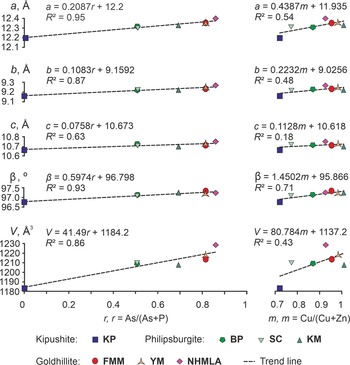
The substitution of P by As in the tetrahedral sites results in an increase of the unit-cell parameters due to the larger ionic radius of As compared to that of P. Such a dependence has been demonstrated by Shirose and Uehara (Reference Shirose and Uehara2011). In this work, we provide an updated correlation between the As/(As + P) or Cu/(Cu + Zn) (for octahedral Cu-positions) ratios and the unit-cell parameters (Fig. 6). The data show a linear correlation between the As/(As + P) ratio and the unit-cell parameters (with a goodness-of-fit, R 2, ranging from 0.63 to 0.95). The dependence of Cu/(Cu + Zn) ratio versus unit-cell parameters is less obvious, it shows a linear correlation for the a, b unit-cell parameters and the β angle (with R 2 ranging from 0.48 to 0.71) and an absence of a correlation for the c parameter (R 2 = 0.18). Probably, the Cu/(Cu + Zn) ratio contributes to the value of the unit-cell parameters, though not as significantly as the As/(As + P) ratio. The As:P ratio can also be inferred from the occupancies of the T sites and the T1–O and T2–O bond lengths, which are in the ranges 1.52–1.56 Å for kipushite (Piret et al., Reference Piret, Deliens and Piret-Meunier1985), 1.54–1.70 Å for philipsburgite and 1.59–1.71 Å for goldhillite (Fig. 7). Therefore, the unit-cell parameters increase along the sequence kipushite => philipsburgite => goldhillite; the same trend is noted for density, which is equal to 3.904, 4.040 and 4.199 g cm–3, respectively (Table 8). Thus, although minerals of the isomorphous series are isotypic and have similar powder X-ray diffraction patterns, they can be distinguished by their unit-cell parameters using the equations presented in Fig. 6.
The dependences of unit cell parameters of kipushite (KP) from Kipushi mine, Zaire (Piret et al., Reference Piret, Deliens and Piret-Meunier1985), philipsburgite (BP, SC, KM) and goldhillite (FMM, NHMLA, YM), where YM = the sample of goldhillite from Yamato mine, Yamaguchi Prefecture, Japan (Shirose and Uehara, Reference Shirose and Uehara2011), versus tetrahedral As/(As + P) (r) and octahedral Cu/(Cu + Zn) values (m).

The bond lengths (Å) of T1O4 and T2O4 tetrahedra of goldhillite (FMM) and philipsburgite (BP). Average values for goldhillite are < T1–O> ≈ 1.605 Å, <T2–O> ≈ 1.6875 Å; and for philipsburgite are < T1–O> ≈ 1.5425 Å and < T2–O> ≈ 1.685 Å.

Comparison of goldhillite, philipsburgite and kipushite.

All three minerals, goldhillite, philipsburgite and kipushite, exhibit the same crystal morphology and form transparent bright emerald-green tabular crystals with vitreous lustre. Goldhillite, philipsburgite and kipushite are biaxial (–), and possess distinct pleochroism. The pleochroism of goldhillite is light green along the X axis, and medium green along both Y and Z axes. The pleochroism of philipsburgite is pale green along the X axis, and medium green along the Y and Z axes (Peacor et al., Reference Peacor, Dunn, Ramik, Sturman and Zeihen1985). The pleochroism of kipushite is colourless along the X axis, blue along the Y axis and bright blue along the Z axis (Piret et al., Reference Piret, Deliens and Piret-Meunier1985). The values of the refraction indices increase in the sequence kipushite => philipsburgite => goldhillite (Table 8). Thus, the minerals of the goldhillite–philipsburgite–kipushite isomorphous series can also be discriminated by their optical properties.
The Raman spectrum of goldhillite differs significantly from those of philipsburgite and kipushite by the strong bands of arsenate ions (in particular, 813–809 and 847–837 cm–1) and the weak bands of phosphate ions (in particular, 975–970 cm–1) (Table 1, Fig. 4).
Thus, the goldhillite–philipsburgite–kipushite isomorphic series includes three mineral species: the As-dominant member (goldhillite, the new mineral, defined herein), an As–P ordered member (philipsburgite, redefined herein) and a P-dominant member (kipushite).
Acknowledgements
This work was supported by the Russian Foundation for Basic Research, project number 20-35-90007 (for FMM sample research) as well as by University Vienna grants IS526001 and IP532010 (the KM sample). The investigations were carried out using the equipment of the Geomodel and X-ray Diffraction Centres of Saint-Petersburg State University. Studies conducted at the Natural History Museum of Los Angeles County were supported by the John Jago Trelawney Endowment. We thank Structural Editor Peter Leverett and four anonymous reviewers for their critical comments and the journal Editors for the manuscript handling.
Supplementary material
To view supplementary material for this article, please visit https://doi.org/10.1180/mgm.2022.36
Competing interests
The authors declare none