


1. Introduction: Exit and voice in contemporary autocratizing contexts
To citizens around the world, the relevance of voice and exit has become increasingly salient amid shrinking political freedoms and a global wave of autocratization. Recent evidence documents a decline in democracy levels worldwide, with autocracies now outnumbering democracies and substantial proportions of the global population living under autocratic or autocratizing regimes (Nord et al., Reference Nord, Good God and Lindberg2026). These changes have been accompanied by growing restrictions on civil liberties, particularly freedom of expression, which have renewed scholarly interest in how citizens respond and adapt to the erosion of political and civic freedoms.
In his seminal framework of exit, voice and loyalty, Hirschman (Reference Hirschman1970) argues that individuals confronted with deterioration in firms, organizations, or states can respond through two principal mechanisms: exit, by withdrawing from the organization or system, or voice, by expressing grievances and attempting to induce change. The choice between these responses is conditioned by loyalty, which increases individuals’ willingness to remain despite dissatisfaction. By delaying exit, loyalty creates opportunities for voice to operate and increases the likelihood that dissatisfied members will seek reform rather than withdraw. Hirschman’s framework has since been widely applied to the study of political behaviour, including migration, protest, and other forms of political engagement.
Although migration, resistance, and self-censorship are often studied in separate literatures, scholars in migration and diaspora studies, protest and contentious politics, and public opinion research share a common interest in the relationship between exit and voice. This body of scholarship examines not only the conditions under which individuals choose a given course of action but also how exit and voice interact, reinforce, or substitute for one another under varying political circumstances, particularly under processes of autocratization. Existing research identifies several exit-voice dynamics.
To begin with, some scholars highlight the complementarity of exit and voice, showing that they can jointly contribute to regime change, as in the collapse of East Germany (Hirschman, Reference Hirschman1993; Pfaff and Kim, Reference Pfaff and Kim2003). Others, though, identify a nuanced, contingent complementarity-to-substitution relationship (Lui and Hsiao, Reference Lui and Hsiao2024). A growing body of research reveals the dynamics of voice-after-exit, demonstrating how diaspora activism generates boomerang effects and sustains domestic opposition movements from abroad (Keck and Sikkink, Reference Keck and Sikkink1998; Moss, Reference Moss2021; Esberg and Siegel, Reference Esberg and Siegel2023; Nugent and Siegel, Reference Nugent and Siegel2026). Related is exit-as-voice, in which migration itself constitutes an act of performative defiance due to the lack of other dissenting options, as demonstrated by political and inner exile in response to Russia’s invasion of Ukraine and military conscription (Roshchin, Reference Roshchin2025). Finally, scholars of American politics have examined the determinants of interstate migration intentions and patterns, as well as self-censorship, in response to growing restrictions on civil liberties and perceived democratic backsliding (Gibson and Sutherland, Reference Gibson and Sutherland2023; Blanchard and Norris, Reference Blanchard and Norris2025; Nelson and Witko, Reference Nelson and Witko2026). In doing so, they extend the exit-voice debate to established democracies, where it is often presumed to be least relevant given the comparatively robust opportunities for voice.
This study contributes to the exit-voice literature by examining how individuals adapt to autocratization through emigration (exit) and self-censorship (diminished voice). Drawing on evidence from Hong Kong’s authoritarian transition, it develops a unified framework that links these behaviours through the psychological mechanisms of powerlessness and secondary control. Specifically, the study examines how perceived powerlessness, which may become especially salient under rapid autocratization, and variation in individuals’ accommodative secondary control shape adaptive responses to constrained political agency. By showing how the same psychological processes can lead individuals to either leave the polity or refrain from everyday political expression, the study speaks to both literatures on migration and public opinion.
2. Case selection: Hongkongers at a crossroads
Hong Kong provides an ideal case for examining adaptation to autocratization because it has undergone a rapid and well-documented authoritarian turn, marked by the violent crackdown of the 2019 Anti-Extradition Movement, the enactment of the sweeping National Security Law, and electoral reforms that significantly curtailed political competition and democratic representation.Footnote 1 Yet, while the consequences of these developments may appear clear now, their introduction generated considerable uncertainty about the future trajectory of the regime and the scope of the emerging repressive order, the risks of dissent associated with it, and the prospects for remaining in the city. As citizens confronted a rapidly changing and increasingly restrictive political regime, they were forced to adapt to a new reality whose boundaries and implications remained highly uncertain, such as whether the fledgling repressive regime in post-NSL Hong Kong has the capacity to surveil and conduct everyday repression, as it does in mainland China (e.g., Stern and O’Brien, Reference Stern and O’Brien2012; Lee and Zhang, Reference Lee and Zhang2013). This uncertainty compelled citizens to reassess how they could respond to the new political environment, including whether to remain politically vocal, self-censor, or leave altogether.
Indeed, the highly volatile and uncertain political climate that prevailed around the period of this study produced divergent responses to the question of exit and voice among Hong Kong citizens. Notably, transnational and diaspora activism were one of the key strategies embraced by the pro-democracy movement and became particularly salient during and after the 2019 protests (Fong, Reference Fong2022; Lee, Reference Lee2023). Since the NSL went into effect, however, many Hongkongers have left the city for countries that offered lifeboat schemes and facilitated exit, such as the United Kingdom, Canada, and Australia, as well as other countries to which individuals may have better personal access (Chan et al., Reference Chan, Cheung, Chong, Lee and Wong2022; Li and Liao, Reference Li and Liao2023). The Census and Statistics Department estimated Hong Kong’s population at 7.29 million in mid-2022, down by 120,000 from the previous year. Of this decline, 113,000 was attributable to net out-migration, representing the largest population outflow since the 1997 handover. In the United Kingdom alone, the British National (Overseas) [BN(O)] visa scheme, launched in 2021, had granted more than 230,000 visas and facilitated the relocation of nearly 170,000 Hong Kong residents by February 2026 (Home Office, 2026).
Scholars have further identified several patterns and explanations underlying this political exodus. Lui and Hsiao (Reference Lui and Hsiao2024), in examining the complementarity-turned-substitution dynamics between exit and voice in Hong Kong’s protest movement, argue that while migration intentions initially encourage political participation given this ‘fallback option,’ it has later substituted for protest as repression intensifies, as those who intend to migrate were more sensitive to repressive signals. Survey data likewise indicate that regime critics contributed to the reported upsurge in emigration, as localists tend to hold more negative views of recent political developments and report greater intentions to emigrate (Chan et al., Reference Chan, Cheung, Chong, Lee and Wong2022). Yuen and Tang (Reference Yuen and Tang2026) find that politically motivated migration is driven by relational loyalty: individuals who perceive a larger distance between their liberal democratic values and those of the broader political community are more likely to form concrete emigration plans, although this perception is less predictive of migration intentions or actual emigration.
Yet emigration was not the only response to tightened political control. Many who remained in Hong Kong continued to harbour political grievances, and on this front, the dynamics seemed far more varied. In principle, heightened political volatility should promote self-censorship among politically vocal individuals; however, perceptions of threat vary considerably across individuals and groups, depending in part on their assessment of the ‘pecking order’ of impending state repression through information cascades (Lee et al., Reference Lee, Tang and Chan2023). Koo (Reference Koo2022) observes that online media outlets engaged in self-censorship even before the enactment of the NSL, as they are particularly vulnerable to political and financial retaliation by external powerholders. This is corroborated by Lee et al. (Reference Lee, Tang and Chan2023), who find that the increased legal risks posed by the NSL and other media control instruments have exacerbated self-censorship among journalists and news organizations.
That said, other evidence suggests that Hongkongers may selectively conceal some, but not all, sensitive political attitudes. For instance, using pre- and post-NSL panel survey data, Kobayashi and Chan (Reference Kobayashi and Chan2022) find that pro-democracy individuals are more likely to drop out of political polls and to underreport past attendance at antigovernment rallies. Yet somewhat surprisingly, they do not appear to conceal their disapproval of the NSL, a presumably salient and sensitive issue (Kobayashi et al., Reference Kobayashi, Song and Chan2025). At the interpersonal level, there have already been signs that Hongkongers tend to avoid potential conflict over political disagreement by reducing interpersonal communication with family or friends who hold opposing views during and after the protest movement (Kobayashi and Tse, Reference Kobayashi and Tse2022; Tse and Lee, Reference Tse and Lee2025). This tendency appears consistent in post-NSL Hong Kong, as Mak et al. (Reference Mak, Koo and Rojas2024) show that pro-democracy individuals report greater fear of surveillance and engage in active privacy management on Facebook to preserve limited space for political expression (see Urman et al. (Reference Urman, Ho and Katz2021) for similar post-NSL dynamics on Telegram usage). However, the authors also note that such strategies may be specific to platform architectures and visibility constraints, suggesting the need for further research on shifts in political engagement across broader social media ‘backchannels’.
Understanding when, why, and how individuals choose to exit or voice thus requires attention to underlying psychological mechanisms. Existing scholarship often conceptualizes self-censorship as a direct function of political repression: individuals are more likely to self-censor when they perceive greater risks of expressing sensitive views. Experimental studies similarly assume that respondents strategically withhold sensitive information under direct questioning, but are more likely to reveal such attitudes under indirect elicitation techniques such as list experiments (Blair et al., Reference Blair, Coppock and Moor2020; Rosenfeld et al., Reference Rosenfeld, Imai and Shapiro2016; Ehler et al., Reference Ehler, Wolter and Junkermann2021). However, perceptions of threat and efficacy under repression are not uniform. Some individuals experience acute powerlessness in the face of state control, while others retain a sense of agency. Even when individuals perceive themselves as powerless, they may adopt divergent coping strategies: some continue to pursue political change despite limited efficacy, whereas others adjust their preferences and accommodate to a ‘new normal’. The decision-making behind exit and voice (or the lack thereof) is thus not simply a function of repression but the outcome of an interaction between the political environment (and its perception) and variation in individual coping responses to authoritarian encroachment.
3. Powerlessness and secondary control
3.1. Powerlessness
In this study, powerlessness refers to a perceived lack of personal control over important life outcomes due to the influence of powerful external actors. It is therefore broader than regime-specific political efficacy or the belief that one can influence government decisions. However, this generalized external-control orientation becomes politically consequential in autocratizing contexts, where powerful political authorities increasingly shape the constraints under which citizens make everyday decisions.
Repression following mass mobilization can intensify feelings of powerlessness, particularly among regime critics. However, such perceptions are not necessarily confined to dissidents; regime supporters and individuals who are not strongly aligned with the opposition may also experience diminished perceived control when confronted with the overhaul of the institutional environment and the state’s overwhelming coercive capacity.
Feelings of powerlessness have been shown to reinforce the legitimacy of existing systems, leading individuals to endorse prevailing authorities, hierarchies, and governmental structures (van der Toorn et al., Reference van der Toorn, Feinberg, Jost, Kay, Tyler, Willer and Wilmuth2015). System justification theory posits that when individuals experience a gap between political ideals and perceived reality, particularly in contexts of political instability or authoritarian consolidation, they may be inclined to reduce cognitive dissonance by endorsing the status quo (Jost et al., Reference Jost, Pelham, Sheldon and Sullivan2003). In addition, autocratizing environments often increase uncertainty and reduce perceived controllability, further strengthening the psychological appeal of system-justifying beliefs as a means of restoring cognitive and emotional equilibrium. In five observational and experimental studies, van der Toorn et al. (Reference van der Toorn, Feinberg, Jost, Kay, Tyler, Willer and Wilmuth2015) demonstrated that feelings of powerlessness legitimize the authority of existing systems across various domains, including economic and social inequalities and political structures.
Relatedly, the approach-inhibition theory of power suggests that a diminished sense of power activates behavioural inhibition processes, increasing sensitivity to threat and punishment from powerful others while reducing the propensity to proactively act to control resources (Keltner et al., Reference Keltner, Gruenfeld and Anderson2003; Willardt and Schmid, Reference Willardt and Schmid2024). As a result, individuals experiencing low perceived power are less likely to engage in actions aimed at altering political conditions, contributing to behavioural restraint under conditions of repression (Jost et al., Reference Jost, Chaikalis-Petritsis, Abrams, Sidanius, van der Toorn and Bratt2011; Deng et al., Reference Deng, Guinote and Cui2018).
3.2. Secondary control
Secondary control is construed as an accommodative process by which individuals adjust aspects of themselves and accept circumstances as they are (Rothbaum et al., Reference Rothbaum, Weisz and Snyder1982; Morling and Evered, Reference Morling and Evered2006). While primary control refers to strategies aimed at modifying the external environment to align with one’s preferences, secondary control becomes particularly relevant when primary control is constrained. At the same time, individuals may differ in their general tendency to rely on such accommodative responses.
The psychological literature debates multiple conceptualizations of secondary control, including whether it is a coping strategy or a relatively stable individual difference in accommodative orientation (Band and Weisz, Reference Band and Weisz1988; Morling and Fiske, Reference Morling and Fiske1999; Skinner et al., Reference Skinner, Edge, Altman and Sherwood2003; Carver and Connor-Smith, Reference Carver and Connor-Smith2010). Regarding whether secondary control primarily maintains personal control or facilitates adaptation to the environment, Skinner defined it narrowly as maintaining control, distinguishing it from accommodation. In contrast, Morling and Evered argued that these concepts overlap, particularly in contexts such as East Asia, where interdependent self-construals are prevalent (Morling and Evered, Reference Morling and Evered2006). They proposed that secondary control encompasses both aspects. Following Morling and Evered (Reference Morling and Evered2006), this study focuses on the accommodative, or fit-focused, dimension of secondary control and conceptualizes it as a dispositional tendency to adjust one’s goals, expectations, and interpretations to fit situational constraints when direct control over the external environment is limited. This does not imply that secondary control is a fixed or situation-invariant trait. Rather, its use may vary across contexts, especially when the environment constrains opportunities for primary control, while individuals differ in their inclination to adopt such accommodative strategies.
Secondary control is particularly relevant in environments where primary control is constrained. When opportunities for direct environmental influence are limited, individuals may regulate distress by adjusting expectations, interpretations, or aspirations rather than attempting to change external conditions. Prior research has shown that such control-related orientations are associated with a range of political attitudes and behaviours, including trust in authority, responses to threat, and political preferences (Kay et al., Reference Kay, Gaucher, Napier, Callan and Laurin2008; Greenaway et al., Reference Greenaway, Louis, Hornsey and Jones2014; Harell et al., Reference Harell, Soroka and Iyengar2016; Hoffman and Shelby, Reference Hoffman and Shelby2017; Nyhan and Zeitzoff, Reference Nyhan and Zeitzoff2018).
4. Study 1: Emigration
As discussed earlier, individuals experiencing a strong sense of powerlessness are more likely to perceive the social and political system as legitimate or difficult to challenge through system justification, even when it operates against their own interests. This mechanism links powerlessness to emigration intentions because exit requires individuals to reject accommodation to the existing order and undertake a major proactive life change. Furthermore, feelings of powerlessness trigger the behavioural inhibition system (BIS), making it more difficult for individuals to take actions to alter the status quo and achieve their goals (Steidle et al., Reference Steidle, Werth and Gockel2013). Therefore, those who feel powerless are less likely to seek major changes in their lives, leading them to accept the post-NSL reality.
H1: Feelings of powerlessness are negatively associated with the intention to emigrate.
By contrast, individuals with a stronger accommodative secondary-control orientation tend to adapt more readily to an authoritarian political environment. They can maintain a sense of personal control by adjusting their goals, expectations, and interpretations to situational constraints, thereby feeling less need to emigrate.
H2: Secondary control is negatively associated with the intention to emigrate.
Furthermore, secondary control is predicted to moderate the effect described in H1. The key point is that powerlessness and secondary control are not expected to operate as purely additive forces. Rather, they represent partially substitutable psychological routes to in situ adaptation. When secondary control is low, feelings of powerlessness should have a stronger negative association with emigration intentions. Individuals who feel less powerless retain a sense of agency and are less likely to justify or passively accept the new political status quo; if they also lack accommodative secondary control, they may experience greater difficulty adjusting to the new political environment and thus become more likely to consider exit. By contrast, when secondary control is high, even individuals who do not feel powerless can reduce distress by adjusting their goals, expectations, and interpretations to fit the changed environment. Their emigration intentions are therefore expected to be lower regardless of their level of powerlessness. In this sense, secondary control compresses the difference between low- and high-powerlessness individuals, weakening the negative association between powerlessness and emigration intention predicted in H1.
H3: The association predicted in H1 is weaker when secondary control is high.
4.1. Data
Data for the study were collected through an online survey of Hong Kong residents aged 18–69 years in August and September 2021, using quota sampling to align gender and age distributions with census data. A total of 1,580 valid responses were obtained. Male respondents comprised 47% of the sample, with a mean age of 38.7 years (SD = 11.9).
4.2. Measurement
The full survey instrument is available in SI1 in Supplementary Information.
4.2.1. Intention to emigrate
Intention to emigrate was measured with a single item on a six-point scale, these being ‘Never,’ ‘Thought about it, but do not have a definite plan’, ‘Plan to emigrate after ten years’, ‘Plan to emigrate within ten years’, ‘Plan to emigrate within five years’, and ‘Plan to emigrate within two years’. This measure was rescaled to a binary variable with 0 indicating ‘never’ and 1 indicating some consideration or plan to emigrate − 45.6% of the sample is coded 1.
4.2.2. Powerlessness
Feelings of powerlessness were measured using the ‘powerful others’ component of the internality, powerful others, and chance scale (Levenson, Reference Levenson and Lefcourt1981). Five Likert items, such as ‘I feel like what happens in my life is mostly determined by powerful people’ and ‘My life is chiefly controlled by powerful others’, were measured on five-point scales and averaged to range from 0 to 1 (Cronbach’s alpha = 0.73, M = 0.60, SD = 0.16).
4.2.3. Secondary control
We operationalize secondary control as accommodative secondary control, that is, an individual-difference orientation toward adjusting one’s goals, expectations, and interpretations to situational constraints when direct control over the environment is limited. This construct was measured using four items from the Flexible Goal Adjustment Scale developed by Brandtstädter and Renner (Reference Brandtstädter and Renner1990). While the scale was originally developed to assess accommodative coping, flexible goal adjustment closely corresponds to the accommodative, or fit-focused, aspect of secondary control emphasized in our theory. Prior work has likewise conceptualized accommodation as secondary control and used flexible goal adjustment as an empirical indicator of this construct (Tobin and Raymundo, Reference Tobin and Raymundo2010). The items included ‘When everything seems to be going wrong, I can usually find a positive side’ and ‘Faced with a disappointment, I remind myself that other things in life are just as important’. Responses were measured on five-point scales and averaged to range from 0 to 1 (Cronbach’s alpha = 0.72, M = 0.63, SD = 0.15).
4.2.4. Control variables
Demographic and political attitudes were controlled for, including age, gender, education (0: associate degree or less, 0.5: bachelor’s degree, 1: master’s degree or above), political interest (range 0–1, M = 0.53, SD = 0.26), political identification, measured through respondents’ self-placement among the three major political camps in Hong Kong politics at the time of the survey (1: pro-establishment (50.19%), 2: pan-democrat (30.82%), 3: localist (18.99%), with pro-establishment as the reference group).Footnote 2
4.3. Analysis
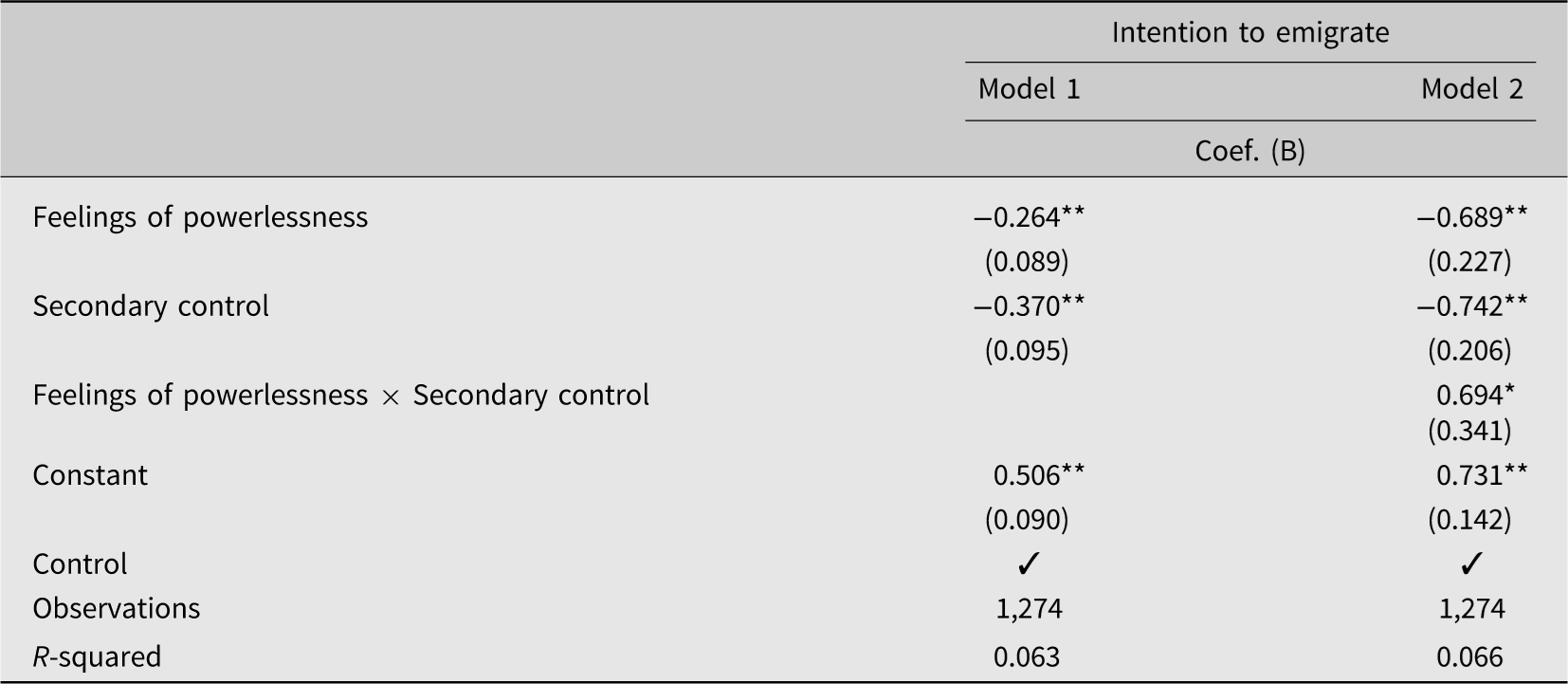
Two ordinary least squares (OLS) regression models were estimated with the intention to emigrate as the dependent variable (Table 1).Footnote 3 Model 1 did not include the interaction term between powerlessness and secondary control, whereas Model 2 included it.
Regression models predicting the intention to emigrate

Table 1. Long description
A table comparing regression models predicting intention to emigrate. The table has 7 rows and 4 columns. The columns are labeled ‘Feelings of powerlessness’, ‘Secondary control’, ‘Feelings of powerlessness × Secondary control’, and ‘Constant’. The rows are labeled ‘Model 1’ and ‘Model 2’ under the ‘Coef. (B)’ header, with additional rows for ‘Control’, ‘Observations’, and ‘R-squared’. Row 1: Feelings of powerlessness, Model 1: -0.264, Model 2: -0.689. Row 2: Secondary control, Model 1: -0.370, Model 2: -0.742. Row 3: Feelings of powerlessness × Secondary control, Model 1: (not applicable), Model 2: 0.694. Row 4: Constant, Model 1: 0.506, Model 2: 0.731. Row 5: Control, both models: checkmark. Row 6: Observations, both models: 1,274. Row 7: R-squared, Model 1: 0.063, Model 2: 0.066.
Standard errors in parentheses.
**p < 0.01, *p < 0.05.
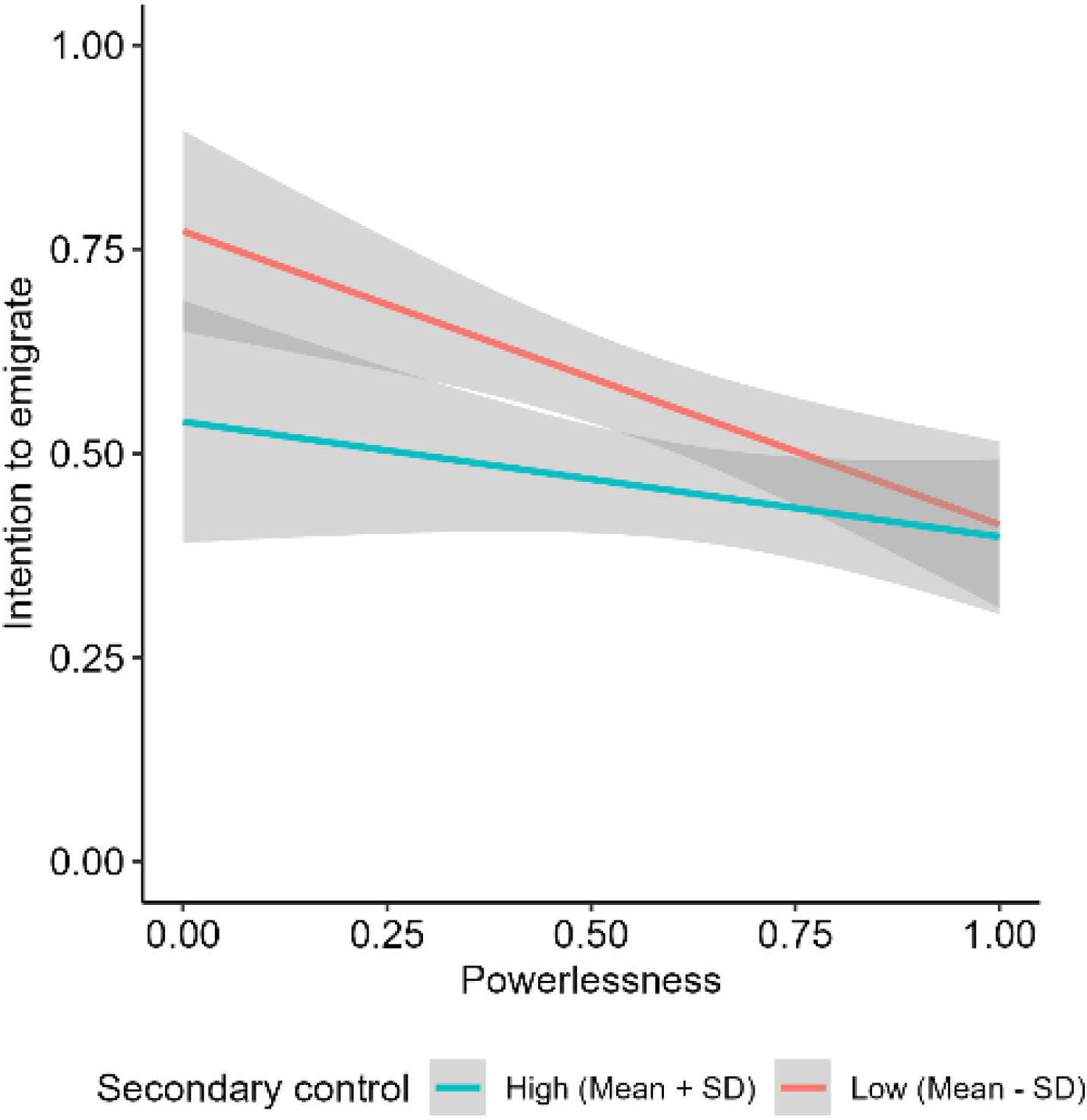
Model 1 shows that feelings of powerlessness and secondary control are negatively associated with the intention to emigrate, supporting H1 and H2. In Model 2, the interaction term between feelings of powerlessness and secondary control has a significantly positive effect. To provide a more intuitive understanding of the interaction effect, the relationships between powerlessness and the predicted dependent variables were illustrated for those with higher (M + SD) and lower (M – SD) levels of secondary control (Figure 1). The predicted values were calculated by fixing the control variables at their mean values, except for political identity. Political identity was fixed to be pan-democrat.
Interaction effect between powerlessness and secondary control.

Figure 1 illustrates the interaction effect on intentions to emigrate. Overall, a stronger sense of powerlessness tends to be associated with lower intentions to emigrate, supporting H1. However, the slope of this relationship varies: the relationship between powerlessness and emigration intentions is weaker when secondary control is high. Therefore, this interaction supports H3. The robustness check of the interaction effects using extreme boundary analysis is reported in SI3 of the Supplementary Information (Sala-i-Martin, Reference Sala-i-Martin1997).
5. Study 2: Self-censorship
Individuals with heightened feelings of powerlessness are, by definition, acutely aware of the power wielded by authorities, which amplifies their fear of political repression. According to Anderson and Berdahl (Reference Anderson and Berdahl2002), individuals with high levels of powerlessness exhibit an activated BIS, increasing sensitivity to threats and punishments. This heightened sensitivity, particularly to risks such as provoking authority figures, increases the likelihood of engaging in self-censorship (Deng et al., Reference Deng, Guinote and Cui2018).
H4: Feelings of powerlessness are positively associated with self-censorship.
By contrast, individuals disposed to exercise secondary control can adjust themselves to align with their environment. Consequently, if the new political environment suppresses dissenting voices and demands navigation within ambiguous ‘red lines’, they are likely to adopt adaptive behaviours accordingly. Moreover, those with a stronger accommodative secondary-control orientation are not necessarily committed to maintaining their pre-NSL beliefs (Lee et al., Reference Lee, Yuen and Tang2024). Even if they hold sensitive opinions, they can self-censor those views while shifting their life goals and moving forward. Based on this reasoning, the following hypothesis is proposed.
H5: Secondary control is positively associated with self-censorship.
As proposed in H4, powerlessness should increase self-censorship by heightening sensitivity to threat and punishment. However, secondary control can also produce expressive restraint through a different route: individuals with stronger accommodative secondary-control orientations may adjust their behaviour to fit the constraints of the new political environment, even when they do not feel especially powerless. Thus, when secondary control is low, powerlessness should have a stronger positive association with self-censorship because threat sensitivity is the primary route to expressive restraint. When secondary control is high, however, individuals may be more likely to self-censor regardless of their level of powerlessness because accommodative adjustment itself encourages adaptation to ambiguous red lines and repressive expectations. The interaction hypothesis therefore examines whether secondary control attenuates the association between powerlessness and self-censorship by providing an alternative psychological route to expressive restraint.
H6: The association predicted in H4 is weaker when secondary control is high.
5.1. Data
A two-wave online panel survey was fielded before and after the NSL and related political crackdown. The first wave of the survey was collected from Hongkongers aged 18–69 years in April 2020, yielding 1,543 valid responses from the Dynata online panel. The sample is 57.29% female, the mean age of respondents is 36.28 years (SD = 10.38), 40.70% have secondary education, 45.69% have tertiary education, and 13.61% have postgraduate education. The second wave was conducted in July 2021, a year after the NSL legislation was enacted. Of the first-wave respondents, 593 completed the second wave. Those whose gender did not match the first wave and whose age differed from it by more than 2 years were excluded from the following analyses as unreliable respondents (n = 94). Four hundred ninety-nine valid responses were retained in the second wave (retention rate = 32.34%).
5.2. Measurement
Powerlessness, secondary control, and control variables were measured in the same way as in Study 1. The full survey instrument is available in SI4 in Supplementary Information.
5.2.1. Self-censorship
In the first wave, after measuring the respondents’ usage of several social media platforms, including Facebook, WhatsApp, and Instagram, which have previously been identified as prominent sites for protest mobilization (Lee and Chan, Reference Lee and Chan2018), three items were measured on a five-point Likert scale: ‘avoided sharing political news for fear of offending someone’, ‘avoided expressing political opinions for fear of offending someone’, and ‘avoided commenting on others for fear of offending someone’.Footnote 4 These three items were summed and rescaled to range from 0 to 1. The mean levels of self-censorship on Facebook were 0.56 (SD = 0.28) in Wave 1 and 0.58 (SD = 0.32) in Wave 2. On WhatsApp, the mean levels were 0.52 (SD = 0.30) in Wave 1 and 0.56 (SD = 0.33) in Wave 2, whereas on Instagram, the mean levels were 0.44 (SD = 0.32) in Wave 1 and 0.52 (SD = 0.33) in Wave 2.
5.3. Analysis
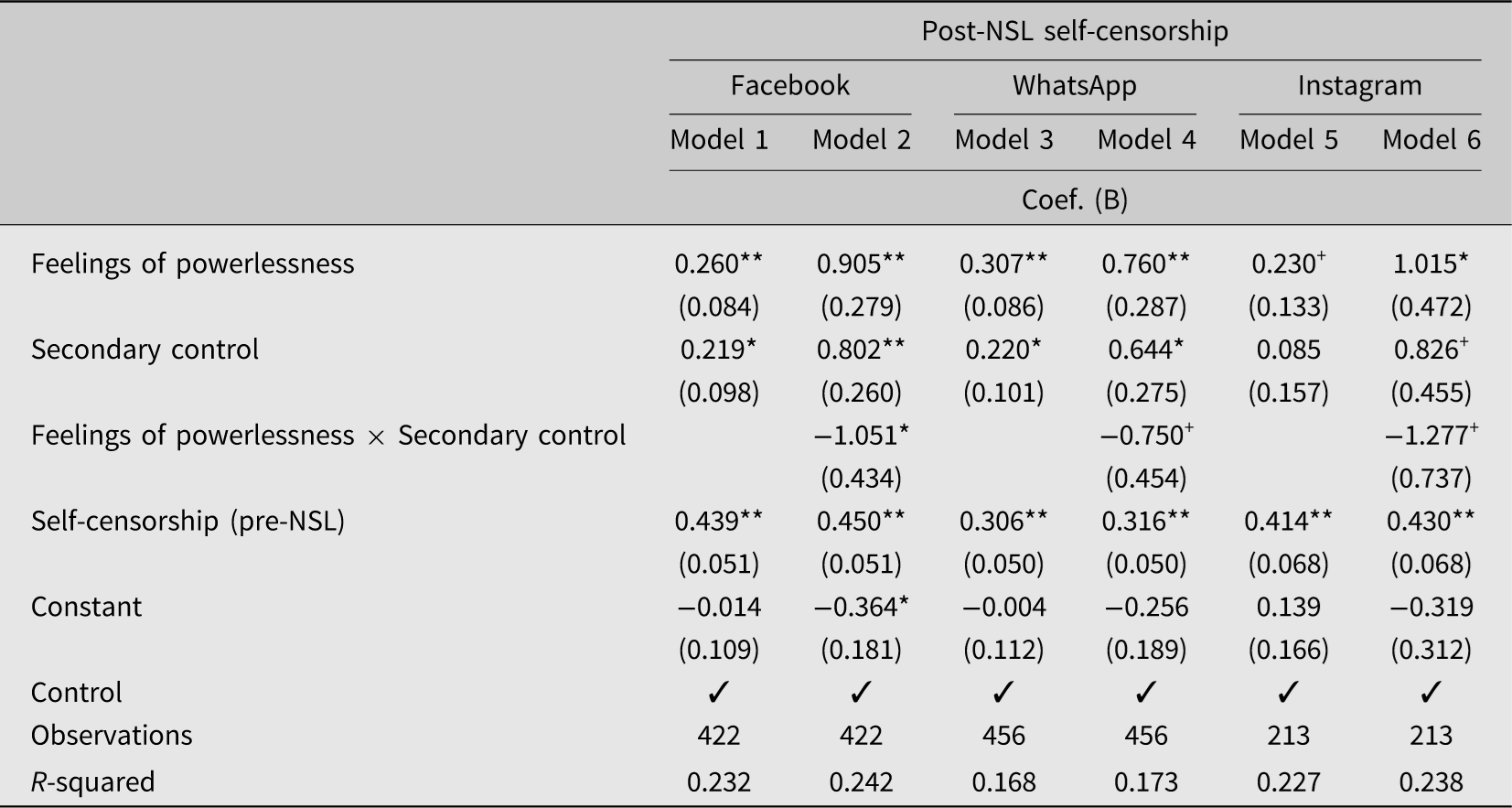
Two OLS regression models were estimated for each of the three platforms, as shown in Table 2.Footnote 5 In addition to the control variables, we include self-censorship in Wave 1 as the lagged dependent variable. Including lagged dependent variables effectively controls for the time-invariant unobserved confounders, enhancing the internal validity of inference. In Models 1, 3, and 5, the main effects of powerlessness and secondary control were tested, whereas in Models 2, 4, and 6, the interaction term between powerlessness and secondary control was additionally included. Note that the number of observations varies across platforms because nonusers skipped these questions. In the second wave, respondents who indicated prior use of such platforms were asked the same set of questions.
Regression models predicting post-NSL self-censorship

Table 2. Long description
A table with six regression models predicting post-NSL self-censorship across Facebook, WhatsApp, and Instagram. The table has 8 rows and 7 columns. Column headers are: Facebook Model 1, Facebook Model 2, WhatsApp Model 3, WhatsApp Model 4, Instagram Model 5, Instagram Model 6. Row labels are: Feelings of powerlessness, Secondary control, Feelings of powerlessness x Secondary control, Self-censorship (pre-NSL), Constant, Control, Observations, R-squared. Row 1: Feelings of powerlessness, 0.260, 0.905, 0.307, 0.760, 0.230, 1.015. Row 2: Secondary control, 0.219, 0.802, 0.220, 0.644, 0.085, 0.826. Row 3: Feelings of powerlessness x Secondary control, -1.051, -0.750, -1.277. Row 4: Self-censorship (pre-NSL), 0.439, 0.450, 0.306, 0.316, 0.414, 0.430. Row 5: Constant, -0.014, -0.364, -0.004, -0.256, 0.139, -0.319. Row 6: Control, Check, Check, Check, Check, Check, Check. Row 7: Observations, 422, 422, 456, 456, 213, 213. Row 8: R-squared, 0.232, 0.242, 0.168, 0.173, 0.227, 0.238.
Standard errors in parentheses.
**p < 0.01, *p < 0.05, +p < 0.1.
Models 1, 3, and 5 show that feelings of powerlessness were significantly positively associated with self-censorship across the three platforms, although the association was at the 10% level on Instagram due to the smaller sample size. These results support H4, which posits that feelings of powerlessness are positively associated with self-censorship. The three models also show that secondary control is positively associated with self-censorship on Facebook and WhatsApp, but not Instagram. These results partially support H5.
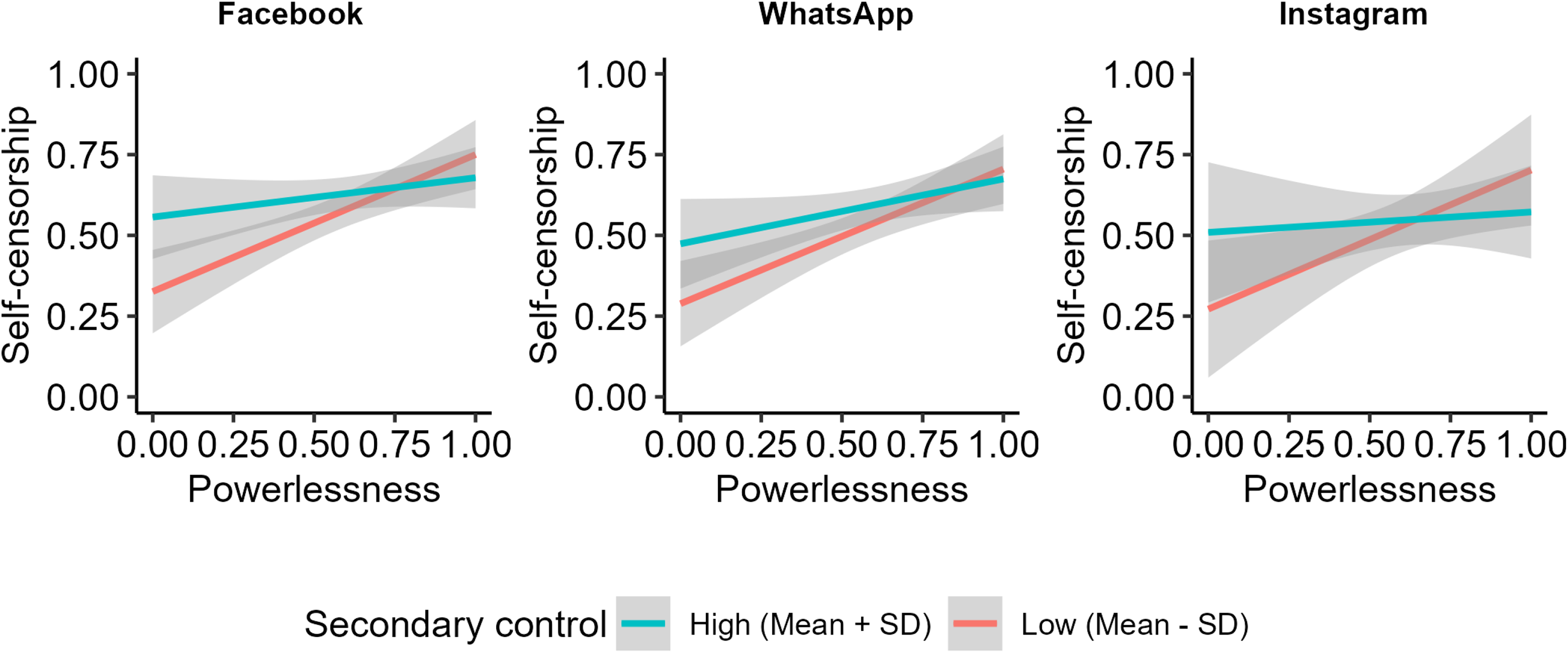
Models 2, 4, and 6 show that the interaction between powerlessness and secondary control is significant for self-censorship across the three platforms, although the effect was at the 10% level for WhatsApp and Instagram. Given the relatively small sample size, there is a potential concern regarding the statistical precision of these results, making it essential to assess the substantive significance of the interaction effects. To illustrate the substantive significance of the interaction effects, we plotted the predicted values for individuals with higher (M + SD) and lower (M – SD) secondary control (Figure 2). The predicted values were calculated by fixing the control variables at their mean values, except for political identity, which was set to the pan-democrat level, as in Study 1.
Interaction effect between powerlessness and secondary control (Study 2).

Figure 2. Long description
Three line graphs depict the interaction effect between powerlessness and secondary control on self-censorship across different social media platforms. Panel A: The line graph for Facebook shows the relationship between powerlessness and self-censorship. The x-axis represents powerlessness ranging from 0.00 to 1.00, and the y-axis represents self-censorship ranging from 0.00 to 1.00. Two lines are shown: one for high secondary control (Mean + SD) in cyan and another for low secondary control (Mean - SD) in red. The cyan line shows a slight increase in self-censorship with increasing powerlessness, while the red line shows a more pronounced increase. Panel B: The line graph for WhatsApp shows a similar relationship. The x-axis represents powerlessness ranging from 0.00 to 1.00, and the y-axis represents self-censorship ranging from 0.00 to 1.00. The cyan line for high secondary control shows a slight increase in self-censorship with increasing powerlessness, while the red line for low secondary control shows a more pronounced increase. Panel C: The line graph for Instagram shows the relationship between powerlessness and self-censorship. The x-axis represents powerlessness ranging from 0.00 to 1.00, and the y-axis represents self-censorship ranging from 0.00 to 1.00. The cyan line for high secondary control shows a slight increase in self-censorship with increasing powerlessness, while the red line for low secondary control shows a more pronounced increase.
Figure 2 illustrates the interaction effects on self-censorship. The three graphs demonstrate a consistent pattern. Overall, there is a clear tendency for a stronger sense of powerlessness to be associated with higher levels of self-censorship. However, the slope of this relationship varies, with the association between powerlessness and self-censorship becoming weaker when secondary control is high. These findings, therefore, provide substantive support for H6. As in Study 1, the robustness check of the interaction effects using extreme boundary analysis is reported as SI6 in the Supplementary Information (Sala-i-Martin, Reference Sala-i-Martin1997).
6. Discussion
The adaptation of citizens under conditions of increasing political repression has important implications for political behaviour, including patterns of exit, expression, and collective action (Lee et al., Reference Lee, Yuen and Tang2024). However, existing research has tended to examine adaptive responses such as emigration, self-censorship, and transnational political engagement in isolation. By contrast, this study develops a framework linking two forms of adaptation, emigration and self-censorship, through the roles of perceived powerlessness and secondary control.
The central contribution of this study is to show that perceived powerlessness and secondary control are systematically linked to distinct forms of political adaptation under repression. Powerlessness is associated with lower emigration intentions and higher self-censorship. Similarly, secondary control is associated with lower emigration intentions and, in most models, higher self-censorship. These direct relationships help explain why some citizens respond to shrinking political freedoms through exit-oriented strategies, whereas others adapt in place by reducing political expression.
The interaction analyses provide an additional, more conditional implication of this framework. They suggest that powerlessness and secondary control do not operate only as independent additive predictors but may also function as partially substitutable psychological routes to adaptation. By ‘substitutable’, we mean that both orientations can encourage in situ adaptation, but through different mechanisms: powerlessness does so by making the existing order appear difficult to challenge and by inhibiting proactive change, whereas secondary control does so by helping individuals adjust their goals, expectations, and behaviour to fit the new environment. When secondary control is high, individuals may adapt in place even if they do not feel especially powerless, thereby reducing the explanatory role of powerlessness. These interaction patterns should therefore be interpreted as refining, rather than overturning, the main relationships between psychological orientations and adaptive behaviour.
A broader implication of these findings is that political adaptation under ongoing repression may generate heterogeneous behavioural trajectories even among individuals who share similar political orientations. Rather than responding uniformly to deteriorating political conditions, some individuals withdraw from the political system by considering emigration, whereas others remain but adapt by suppressing their political expression. Over time, this divergence may reshape the composition of opposition communities by selectively reducing the participation of some individuals while increasing self-censorship among those who remain. Such changes could weaken the capacity for collective action and facilitate authoritarian consolidation by reinforcing informational asymmetries and preference falsification (Kuran, Reference Kuran1997). At the same time, these implications should be interpreted as suggestive rather than deterministic.
Several limitations should be noted. First, the analysis is based on observational survey data, which inhibits strong causal inference regarding the relationship between psychological orientations and adaptive behaviour. While the theoretical framework assumes that powerlessness and secondary control shape behavioural responses to political conditions, the cross-sectional design does not fully rule out alternative ordering or reciprocal relationships. For example, deciding not to emigrate, or being constrained from doing so, may lead individuals to rely more strongly on secondary control as an adaptive strategy for remaining in Hong Kong. Future research could more directly assess causal mechanisms through experimental designs, for example, by manipulating perceptions of political efficacy or control, or through longitudinal designs that examine how emigration decisions and accommodative secondary control shape one another over time.
Second, the measure of self-censorship in Study 2 likely understates the full range of self-censorship behaviour, as individuals facing higher perceived political risks may disengage from platforms entirely or shift to private or offline communication channels. As a result, the analysis may capture a more moderate segment of the population that continues to participate in online communication. Nonetheless, the presence of significant effects even within this more conservative measure suggests that the underlying psychological processes operate even at lower thresholds of expressive constraint. Future research should therefore incorporate broader behavioural indicators of self-censorship, including platform exit and offline expression.
Third, Study 1 examines emigration intentions among Hong Kong residents who remained in the city at the time of the survey. As a result, the analysis cannot fully account for selective out-migration that may have occurred prior to data collection. If individuals who felt highly powerless and were also strongly inclined or able to emigrate had already left Hong Kong, the observed relationship between powerlessness and emigration intention among remaining residents may partly reflect such selection. The findings should therefore be interpreted as evidence about emigration intentions among current residents, rather than about actual emigration behaviour in the broader pre-exodus population.
Finally, our measure captures the accommodative dimension of secondary control, particularly flexible goal adjustment, rather than the full conceptual domain of secondary control. Future research could examine whether the findings are replicated using alternative measures of secondary control.
Overall, the findings suggest that adaptation to repression is not a uniform response to political threat, but a psychologically differentiated process. Powerlessness and secondary control help explain why some citizens consider exit while others remain and adjust by narrowing their political expression.
Supplementary material
The supplementary material for this article can be found at https://doi.org/10.1017/S1468109926100450.
Funding statement
This study was supported by the City University of Hong Kong Strategic Research Grant (Project Nos. 7005331 and 7005406).
Competing interests
The authors declare no potential conflicts of interest with respect to the research, authorship, and/or publication of this article.


 Open access

