Complicated intra-abdominal infections (CIAIs) are the second most common cause of infectious mortality among intensive care unit patients.Reference Brun-Bulsson, Boyon and Carlet 1 Optimal anti-infective use in patients with CIAI is challenging given that inactive antimicrobial therapy has been associated with unfavorable outcomes in multiple studies and that excessive antimicrobial use results in the emergence of difficult-to-treat multidrug-resistant organisms (MDROs).Reference Paul, Shani, Muchtar, Kariv, Robenshtok and Leibovici 2 – Reference Sartelli, Catena, Coccolini and Pinna 4 Currently, available data are limited regarding the benefits of adherence to the 2010 IDSA/SIS CIAI guidelines on clinical outcomes.Reference Solomkin, Mazuski and Bradley 5 The purpose of this study was to assess whether adherence to the IDSA/SIS guidelines improve the likelihood of receiving initial active empiric therapy in patients with CIAIs and whether adherence to the IDSA/SIS guidelines is associated with improved clinical outcomes.
METHODS
This investigation was a retrospective cohort study of patients with community-onset culture-positive CIAIs admitted to Nebraska Medicine (a 627-bed academic medical center) between January 2010 and June 2011. Our local institutional review board approved this study.
Patients were identified via the electronic medical record and were included if a confirmed diagnosis of a culture-positive community-onset CIAI had been made by the primary medical team. Patients were only included once and only the first positive culture was assessed. Exclusion criteria were defined as follows: <13 years of age; intra-abdominal cultures only positive for skin flora; cultures only from outside facilities; only site of infection was a superficial wound, genitourinary infection, cholecystitis; or undergoing treatment for other concurrent infections.
Community-onset CIAI classifications were adapted based on recommendations from the IDSA/SIS CIAI guidelines.Reference Solomkin, Mazuski and Bradley 5 Patients were classified as having a healthcare-associated CIAI if ≥1 of the following criteria were applicable: invasive device at admission; history of methicillin-resistant Staphylococcus aureus (MRSA) infection/colonization; or history of surgery, hospitalization, dialysis, or residence in a long-term care facility in the previous 12 months. Patients were classified as having high-risk community-acquired CIAI if they met any of the following criteria: >70 years of age, immunocompromised, albumin <1.5 g/dL, or sequential organ failure assessment score >4.Reference Vincent, Moreno and Takala 6 Patients not meeting the high-risk criteria were considered to have a mild-to-moderate community-acquired CIAI.
Based on patient classification and corresponding antimicrobial recommendations from the IDSA/SIS guidelines, patients were evaluated for appropriate empiric therapy.Reference Solomkin, Mazuski and Bradley 5 Appropriate therapy for mild-to-moderate community-acquired CIAI includes antimicrobial coverage for anaerobes and Enterobacteriaceae (ie, ampicillin/sulbactam or fluoroquinolones considered inappropriate based on our local resistance patterns), high-risk community-acquired and healthcare-associated CIAI includes previous coverage plus Pseudomonas, and vancomycin-susceptible Enterococcus (VSE). In patients with healthcare-associated CIAI, vancomycin-resistant Enterococcus (VRE) antimicrobial coverage was appropriate if patients were colonized with VRE or had had a liver transplant with a suspected hepatobiliary tree source. Coverage for MRSA was appropriate only for healthcare-associated infections with previous MRSA colonization.
If patients were not receiving the appropriate empiric therapy, non-adherence was further classified as too narrow or too broad, based on guideline recommendations.
The primary end point of this study was the percentage of patients on initial active therapy in guideline-concordant and -discordant groups. The secondary end points were time to active therapy, length of stay, CIAI recurrence within 30 days of discharge, and 30-day mortality.
Pearson χ2 and Fisher’s exact tests were used to compare categorical data. The Student t test and the Mann-Whitney U were used for continuous variables. All tests were 2-tailed, and P values <0.05 were considered statistically significant. Statistical analyses were performed using SPSS (v 20.0; Chicago, USA).
RESULTS
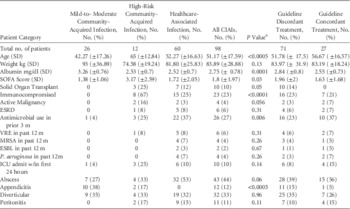
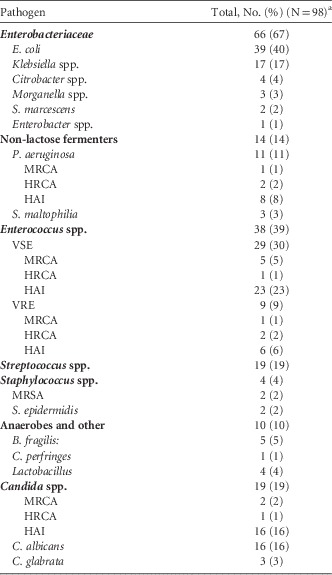
Of the 448 records reviewed, 98 patients were included. Overall, 350 patients were excluded: 99 with cultures only from outside facilities, 97 with a surgical wound infection only, 64 with recurrent CIAIs, 51 undergoing treatment for other infections, 34 with cultures only positive for skin flora, and 5 patients <13 years of age. Patient demographics and microbiology results are presented in Tables 1 and 2, respectively. Of 60 healthcare-associated CIAI patients, 82% were classified into this group due to hospitalization within the prior 12 months.
Baseline Characteristics

NOTE. CIAIs, complicated intraabdominal infections; ESBL, extended spectrum β-lactamase; ESRD, end-stage renal disease; ICU, intensive care unit; MRSA, methicillin-resistant Staphylococcus aureus; SOFA, Sequential Organ Failure Assessment; SD, standard deviation; VRE, vancomycin-resistant Enterococcus.
a Comparisons among the mild-to-moderate community-acquired, high-risk community-acquired, and healthcare-associated groups.
Microbiology of 98 Complicated Intra-abdominal Infections

NOTE. HAI, healthcare-associated infection; HRCA, high-risk community-acquired infection; MMCA, mild-to-moderate community-acquired infection; MRSA, methicillin-resistant Staphylococcus aureus; VRE, vancomycin-resistant Enterococcus spp.; VSE, vancomycin-susceptible Enterococcus spp.
a 59 polymicrobial infections; 170 total organisms reported.
Only 27.6% of patients received guideline-concordant empiric therapy. Antimicrobial therapy was too broad in 38.8% of patients and was too narrow in 40.8% of patients; 7.1% of regimens were both too broad and too narrow. Therapy that was too narrow was given to 19.2% of patients with mild-to-moderate community-acquired infections, 50% of patients with high-risk community-acquired infections, and 48.3% of patients with healthcare-associated infections (P=.033). Regimens were considered too narrow if they lacked coverage for the following conditions when indicated: VSE (N=17), VRE (N=7), Enterobacteriaceae (N=18), Pseudomonas (N=20), anaerobes (N=9), or MRSA (N=3). Therapy that was too broad was given to 76.9% of patients with mild-to-moderate community-acquired infections, 16.7% of patients with high-risk community-acquired infections, and 27.7% of patients with healthcare-associated infections (P<.001). Regimens were considered too broad if there was inappropriate coverage for Pseudomonas (N=19), fungi (N=9), MRSA (N=3), VRE (N=1), or included double anaerobic coverage (N=7).
There were no statistically significant differences in the primary and secondary end points between guideline-concordant/guideline-discordant groups. Empiric active therapy was given to 70% of patients in the guideline-concordant group and 66% of patients in the guideline-discordant group (P=.694). In the guideline-concordant group, average days to active therapy was 0.78, while in the guideline-discordant group, average days to active therapy was 1.1 (P=.299). Average length of stay for patients in the guideline-concordant group was 14.1 days, and in the guideline-discordant group it was 22.3 days (P=.146). In-hospital mortality was 0% for the guideline-concordant group and 10% for the guideline-discordant group (P=.185). The rate of 30-day readmission was 15% for the guideline-concordant group and 18% for the guideline-discordant group (P=.774). Infection recurred within 30 days post-discharge at rate of 4% in the guideline-concordant group and 10% in the guideline-discordant group (P=.439). When patients treated with empiric therapy that was too narrow per guidelines were compared with those that received guideline-concordant therapy, the mean time to active therapy was longer (1.8 vs 0.8 days; P=.024) and mortality was higher (14.2% vs 0%; P=.077). No differences were noted between those who received therapy that was too broad and guideline-concordant patients.
DISCUSSION
Overall adherence to the IDSA/SIS guideline was low and was not associated with improved clinical outcomes. Patients classified as having high-risk community-acquired or healthcare-associated CIAIs had more resistant organisms. This supports the guideline recommendation of broader coverage among those patients. Importantly, increased time to active therapy (P=.024) and a higher mortality rate (P=.077) was observed in the patient subgroup that received therapy that was too narrow per IDSA/SIS guidelines. In total, 40.8% of patients received therapy that was too narrow; this finding indicates an important opportunity for improving antimicrobial use and patient outcomes.Reference Paul, Shani, Muchtar, Kariv, Robenshtok and Leibovici 2 In a cohort of patients with secondary intra-abdominal infections, Sturkenboom et alReference Sturkenboom, Goettsch and Picelli 3 reported similar results. Inappropriate initial antimicrobial therapy (defined as not active for aerobic and anaerobic Gram-negative bacteria) was an independent predictor of clinical failure (OR, 3.4; 95% CI, 1.3–9.1) and greater mortality (10.7% vs 4.8%).
The primary driver of drug resistance is antimicrobial use and misuse, and we found that the use of unnecessarily broad-spectrum antimicrobial therapy was common.Reference Shlaes, Gerding and John 7 Kurup et alReference Kurup, Liau and Ren 8 highlighted the importance of antibiotic stewardship programs; prolonged, improper, and unregulated use of antibiotics were key factors in the rapid rise of resistance. Dubrovskaya et alReference Dubrovskaya, Papadopoulus, Scipione, Altshuler, Phillips and Mehta 9 concluded that after implementation of an inpatient guideline for CIAI, improvement in antimicrobial prescribing was marked by a significant decrease in ciprofloxacin use and an increase in cefoxitin use. Popovski et alReference Popovski, Mercuri and Main 10 identified the need for risk stratification and local susceptibility pattern assessment to guide empiric treatment; their internal guideline for risk stratification (adapted from national guidelines) resulted in a significant decrease in the use of ciprofloxacin and an increase in the use of ceftriaxone.Reference Popovski, Mercuri and Main 10 Collectively, these data support the need for the development of tailored inpatient guidelines for CIAIs based on the local patient population and resistance patterns.
We are aware of several limitations to this study. It was retrospectively conducted at a single center. Although time to active therapy, length of stay, and mortality were all lower in the guideline adherent group, the study did not have sufficient power to detect a difference. The small size of this study precluded multivariate analysis. Furthermore, only culture-positive patients were included, which does not reflect all patients with cIAI. We could not determine whether adequate source control was achieved, and this may have influenced outcomes irrespective of antimicrobial use.
To our knowledge, this is the first study to assess the association between adherence to the IDSA/SIS CIAI guidelines and clinical outcomes. Our study supports the need for the implementation of customized institutional guidelines adapted from the IDSA/SIS CIAI guidelines.
ACKNOWLEDGMENTS
Financial support: No financial support was provided relevant to this article.
Potential conflicts of interest: All authors report no conflicts of interest relevant to this article.