The effectiveness of alcohol-based hand rub (ABHR) is known to be closely correlated with the amount of time it takes for the product to dry on the hands (ie, drying time), which depends primarily on the volume applied.Reference Macinga, Shumaker and Werner1,Reference Wilkinson, Ormandy, Bradley, Fraise and Hines2 One recent study found a linear relationship between drying time and the log reduction of bacteria on hands that was independent of application volume.Reference Suchomel, Leslie, Parker and Macinga3 Limited evidence suggests that there is considerable variation in the amount of ABHR used per application by healthcare providers. This variability in volume applied may be due to dispenser malfunction or, more likely, user preference.Reference Kohan, Ligi, Dumigan and Boyce4–Reference Dalziel, McIntyre, Chand, McWilliam and Ritchie6 A recent study found that healthcare professionals (HCPs) frequently applied amounts of ABHR that took <5 seconds to <15 seconds to dry, which also suggests that the volume of ABHR applied was quite variable.Reference Stahmeyer, Lutze, von, Chaberny and Krauth7 Some HCPs believe that the amount delivered by some dispensers is excessive and takes too long to dry, and as a result, they apply doses lower than recommended.Reference Wilkinson, Ormandy, Bradley, Fraise and Hines2,Reference Leslie, Donskey and Zabarsky5,Reference Macdonald, Mckillop, Trotter and Gray8 This issue is pertinent because application of small amounts of ABHR may not be sufficient to cover all surfaces of the hands and reduce bacteria on hands to the degree recommended by regulatory agencies.Reference Goroncy-Bermes, Koburger and Meyer9–Reference Zingg, Haidegger and Pittet12 We sought to identify the volume of ABHR used by nurses.
Methods
A prospective, observational study was conducted in the inpatient setting at a single, large, academic medical center. Nurses working in 8 hospital units (5 adult and pediatric inpatient wards and 3 intensive care units) were invited to participate in the study. All participating nurses were providing hands-on patient care. Nurses who volunteered to participate were each given pocket-sized, 125-mL ABHR bottles with a flip-top electronic memory cap that recorded the number of times the bottle was opened. It utilized a proprietary custom cap that employed magnetic detection and recorded events to a nonvolatile memory (see US patent no. 9580210 for more detail). Nurses were instructed in the safe use of these personal ABHR bottles to prevent cross contamination. The ABHR product used was a commercially available gel containing 70% ethanol. A similar product was used in the hospital but was dispensed as a foam rather than as a gel. Each unit was observed on 3 separate days. During each shift, nurses were instructed to use ABHR from the electronic-cap bottle for all hand hygiene opportunities where they would normally use ABHR. The electronic cap recorded the number of bottle openings. Nurses were repeatedly instructed to use the volume of ABHR they felt was best and were blind to the objectives of the study.
At the beginning of each shift, each nurse was provided with a new electronic cap bottle containing 125 mL ABHR. The bottles were collected at the end of the shift after use. The mass of ABHR used from each bottle was determined by weighing each bottle before and after use by nurses, and the number of uses was collected from the electronic cap at the end of each shift. The volume (mL) of ABHR used from each bottle was calculated by dividing the mass of ABHR used by the density of the product (0.8698 gm/mL). For each nurse, the average volume of ABHR used per application was calculated by dividing the volume used from each bottle by the number of times the electronic bottle cap had been opened.
Participants’ hand surface area was estimated using a validated method as an average of both left and right hands.Reference Lee, Choi and Kim13 Hand sizes were classified as either small (≤375 cm2), medium (375–424 cm2), or large (≥425 cm2).Reference Bellissimo-Rodrigues, Soule, Gayet-Ageron, Martin and Pittet11
A brief, self-administered survey was distributed and collected from all study participants. The survey obtained 9-point Likert-scale responses regarding subject perception of the ABHR, and open-ended questions were used to collect participants’ thoughts regarding the appropriate volume of ABHR, ABHR drying time, and the participants’ understanding of the rationale for recommended ABHR volume and use.
Statistical analysis
Linear mixed-effects models were used to analyze the dose volumes with a random effect for nurses that accounted for the repeated doses measured on different days from the same nurse; and a second random effect for unit that accounted for the possible correlation among nurses who work in the same hospital unit. Covariates for hand surface area and the number of applications were included. Fixed effects were also included to compare doses between ICUs versus non-ICUs and to compare doses among small, medium, and large hand sizes.
The investigation was approved by the Yale Human Investigations Committee.
Results
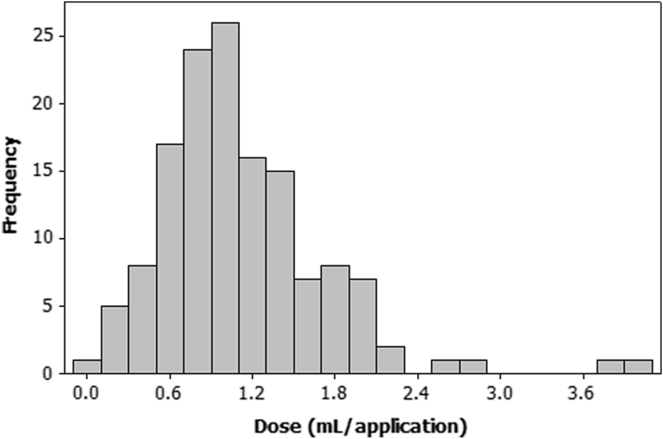
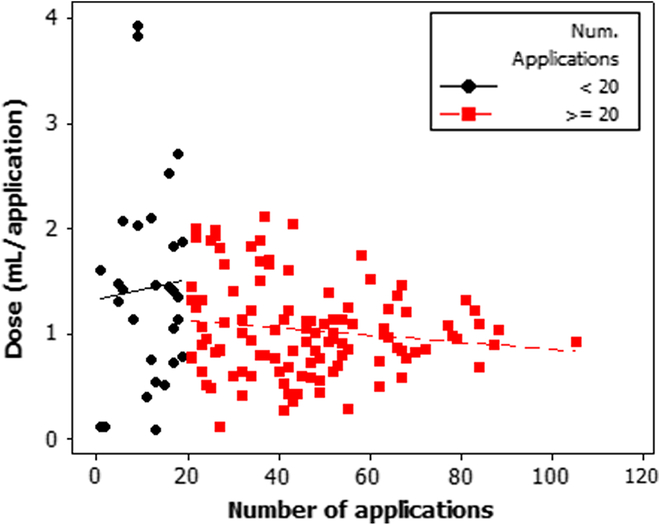
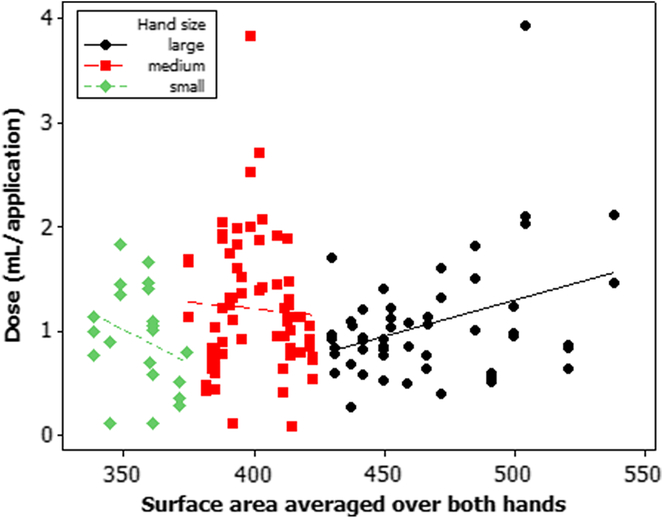
In total, 53 nurses participated in the study, with 5–13 nurses from each of 8 hospital units. Two units were ICUs and employed 22 (42%) of the 53 participating nurses. Each nurse participated in the study 1–3 days, for a total of 140 nurse shifts of ABHR use, and 7 nurse shifts were excluded because the electronic devices used to count ABHR uses malfunctioned. Furthermore, 74% of volunteers provided 3 shifts of ABHR use data. The overall average volume ABHR used was 1.09 mL per application (standard deviation [SD], 0.61 mL). The middle 95% ranged from 0.19 to 2.34 mL (Fig. 1). The average hand surface area was 417 cm2 (SD, 46 cm2): 9 (17%) participants had small hands, 24 (45%) had medium-sized hands, and 20 (38%) participants had large hands. We detected a statistically significant negative correlation (P = .007) between dose volume and the number of applications (Fig. 2) even though the ABHR dose volume decreased by only 0.006 mL per use (SD, ± 0.002 mL) as the number of applications increased (based on a mixed-effects regression of dose volume vs number of applications). We found no significant correlation between hand surface area and preferred average dose size in aggregate (P = .569) or when each hand-size group was analyzed independently (P = .246) (Fig. 3).
Frequency histogram of the mean number of alcohol-based hand rub (ABHR) doses by nursing shift.

Dose volume as a function of the number of alcohol-based hand rub (ABHR) uses per nursing shift.

Dose as a function of the nurse participants’ hand surface area (cm2). Hand size is classified as small (≤375 cm2), medium (375 – 424 cm2), or large (≥425 cm2). The line represents the correlation between mean dose and hand size by hand surface-area strata.

The average volume of ABHR per hand hygiene event was greater among non-ICU versus ICU staff, but the difference was not significant (1.18 vs 0.96 mL per application; P = .251). Most of the variation in ABHR dose volume occurred between nurse subjects, with less variation due to differences between units or within individual subject use across shifts. The variation in the doses was large (SD, 0.61 mL/dose) compared to the average dose differences among hospital units. The largest average difference of 0.73 mL per dose was between 2 non-ICU medicine units. The unit using the greatest average volume per dose specializes in the care of patients with infectious diseases. Overall, 56% of the variability in dose volume was related to nurse-to-nurse differences; 37% was related to day-to-day differences (eg, differences in the application technique employed by the same nurse on different days); and 6% was related to unit-to-unit differences. We detected no statistically significant differences, on average, among units with respect to either the number of applications (P = .4297) or hand size (P = .4421).
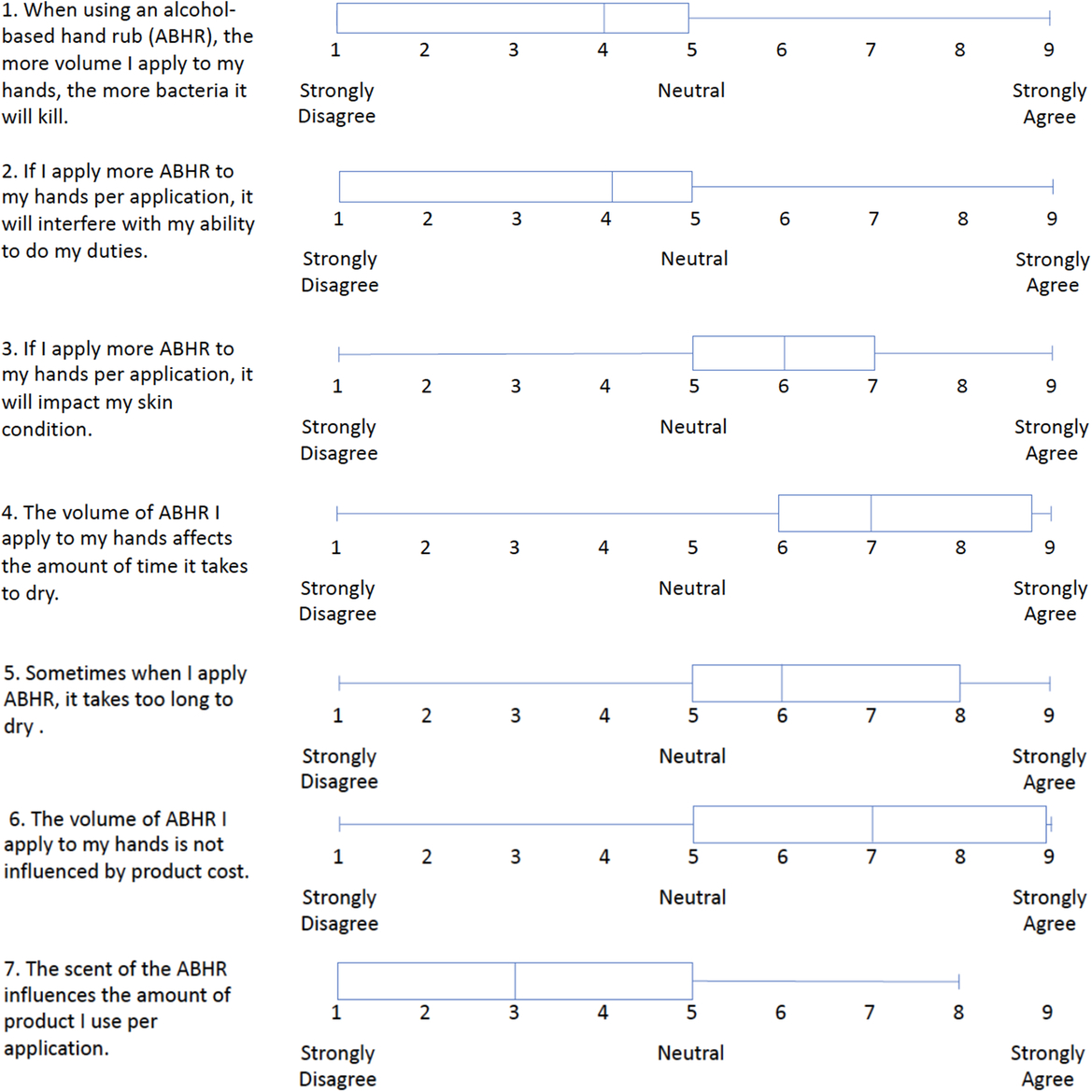
Survey results showed that nursing staff were generally not aware that the volume of ABHR used is correlated with the proportion of bacteria killed and were not concerned that if a greater volume of ABHR was used, it would interfere with their duties. The participants were slightly concerned that applying a greater volume of ABHR would impact the condition of their skin. The participants noted that sometimes ABHR takes too long to dry; they agreed that cost does not influence their dose; and they disagreed about whether the scent of the ABHR product used at the institution influenced the preferred volume of ABHR used (Fig. 4). Responses from the open-ended questions (data not shown) showed an understanding that the volume of ABHR used should be sufficient to cover both the front and back of the hands to the wrists and an assumption that the standard, touch-free dispensers used throughout the hospital provided an evidence-based amount of ABHR.
Box-and-whisker plots illustrating the nurses Likert scale responses where the bar shows the range, the box shows the interquartile range, and the vertical mark shows the median.

Discussion
Given the belief of some nurses that the amount of ABHR routinely delivered by dispensers is excessive and takes too long to dry, there is a need to identify the amount of ABHR per application that meets US Food and Drug Administration (FDA) criteria for effectiveness and has a drying time that is acceptable to most healthcare staff. We found that the average dose of ABHR used by nurses (1.09 mL per application) was similar to the dose provided by the hospital’s standard touch-free dispensers, which deliver 1.1 mL per dose. The extent to which the automated dispensers used in the hospital influenced nurses’ choices on ABHR volume could not be determined by the study design utilized. Notably, a small study by Leslie et alReference Leslie, Donskey and Zabarsky5 involving 19 nurses was conducted in another hospital where ABHR was routinely obtained from manual, as opposed to automated, dispensers. The investigators used the same type of bottle with an electronic cap to assess nurses’ preferences for the volume of ABHR to apply to hands. On average, the volume of a liquid formulation containing 80% (v/v) ethanol applied by nurses was 0.73 mL (range, 0.27–1.61 mL), which was lower than that recommended by the manufacturer. In contrast to our study, the average volume used per application in that study varied significantly among the 5 participating wards.Reference Leslie, Donskey and Zabarsky5 Another recent study by Dalziel et alReference Dalziel, McIntyre, Chand, McWilliam and Ritchie6 determined that the median volume of ABHR used in a survey of Scottish hospitals was a median volume of 1.0 mL, similar to findings in the present study. Notably, the Scottish study used a more indirect method of determining the median volume of ABHR used per hand hygiene event.
Males used somewhat larger volume of ABHR per day than females, as reported in at least 1 earlier study.Reference Pittet, Allegranzi and Sax15 Although this may have been related to hand size, frequency of use could not be excluded as an alternate explanation. We found that the amount of ABHR used slightly but significantly decreased as hand hygiene was performed more frequently. This finding supports the use of automated dispensers of ABHR rather than manual pumps to ensure the provision of a proper amount. Our study was not designed to explore the reasons for this. Future assessment of the drivers of ABHR dose should consider hand hygiene frequency and the inverse relationship with dose.
Another important finding of our study was that nurses with large hands did not use significantly more ABHR per application than those with small hands. This finding was in alignment with a recent study showing the volume of ABHR selected by HCPs with large hands and those with small hands, from an offering of 1, 2, or 3 mL, was similar.Reference Zingg, Haidegger and Pittet12 This finding raises the question of whether or not those with large hands were able to apply ABHR to all surfaces of their hands for effective decontamination. However, whether it is necessary to cover all surfaces of the hands to adequately reduce the number of bacteria on the hands has not been established with certainty.Reference Bellissimo-Rodrigues, Soule, Gayet-Ageron, Martin and Pittet11,Reference Reilly, Price and Lang14 Likewise, the maximum safe level of pathogenic microbes on or transferred by healthcare staff hands also remains uncertain.
This study has several limitations. The study was conducted in a single large academic medical center in the United States, involved only inpatient units, and enrolled only nurses. We did not assess hand hygiene technique, the degree to which nurses covered all surfaces of their hands, or antimicrobial efficacy and the survey was not tested to determine its reliability or validity. Finally, we were not able to assess time as a variable as the electronic caps solely recorded bottle openings and only assessed hand hygiene performed using ABHR from the special bottle. Therefore, we were unable to measure the density of hand hygiene or episodes of hand hygiene in which soap and water was used, the distribution of hand hygiene episodes over the shifts, or how these variables may have affected the volume of ABHR used.
In conclusion, our findings suggest that there is substantial variability among nurses in the volume of ABHR used per application. Importantly, we found no correlation between hand surface area and preferred volume of ABHR applied. The volume of ABHR dose preferred was shown to be inversely correlated with the number of applications of ABHR per shift on most units. Further research to understand differences and drivers between wards (eg, ICUs compared with non-ICUs) and factors that influence nurses’ hand hygiene behaviors and preferred volume of ABHR is needed. Based on earlier studies and our findings, the preferred ABHR dose volume may or may not be sufficient to provide appropriate reduction of bacteria on hands, depending in part on the product formulation used.Reference Bellissimo-Rodrigues, Soule, Gayet-Ageron, Martin and Pittet11,Reference Macinga, Edmonds, Campbell, Shumaker and Arbogast16 These findings should contribute to future considerations for product formulation and the design of automated dispensers of ABHR.
Acknowledgments
We thank the nurses who participated in this project and Yale New Haven Hospital nurses and nursing leadership for their support. We also thank GOJO technical personnel Dave Macinga and Rachel Leslie for their input on study design and Jackson Wegelin for engineering the bottle with counting cap.
Financial support
ABHR, electronic cap bottles and other materials necessary for the study were provided by GOJO Industries.
Conflicts of interest
J.M.B. is a consultant to Diversey, Global Life Technologies, and GOJO Industries and has received honorarium from Sodexo Healthcare. J.M.B. has also received travel support from Diversey and GOJO Industries.