





Introduction
Attention-deficit/hyperactivity disorder (ADHD) is a neurodevelopmental disorder characterized by difficulty concentrating and focusing on tasks, impaired impulse control, and excessive or inappropriate movement. The lifetime prevalence of ADHD is approximately 3%–7%. The disorder negatively impacts multiple domains, including interpersonal relationships and professional functioning (Polanczyk et al., Reference Polanczyk, De Lima, Horta, Biederman and Rohde2007; Sayal et al., Reference Sayal, Prasad, Daley, Ford and Coghill2018). In the Diagnostic and Statistical Manual (DSM), ADHD is divided into inattentive, hyperactive, or combined subtypes based on symptomatology. The hyperactive subtype is most common in preschool children, and the combined and inattentive subtypes are more common in older children, adolescents, and adults (Willcutt, Reference Willcutt2012). ADHD often remits during adolescence but persists into adulthood in approximately one-third of cases (Uchida, Spencer, Faraone, & Biederman, Reference Uchida, Spencer, Faraone and Biederman2018).
ADHD and substance use disorder (SUD) comorbidity
ADHD is highly comorbid with other psychiatric disorders (Sobanski et al., Reference Sobanski, Brüggemann, Alm, Kern, Deschner, Schubert, Philipsen and Rietschel2007), most commonly substance use disorders (SUDs) (Katzman et al., Reference Katzman, Bilkey, Chokka, Fallu and Klassen2017). A recent meta-analysis estimated the prevalence of current ADHD in individuals with SUDs to be 20% (Rohner, Gaspar, Philipsen, & Schulze, Reference Rohner, Gaspar, Philipsen and Schulze2023). Furthermore, approximately 30%–50% of people with ADHD will meet lifetime criteria for a SUD (Fuller-Thomson, Lewis, & Agbeyaka, Reference Fuller-Thomson, Lewis and Agbeyaka2022). ADHD has been associated with more severe substance use and an earlier age of onset among individuals with cocaine and/or opioid dependence (Arias et al., Reference Arias, Gelernter, Chan, Weiss, Brady, Farrer and Kranzler2008). Risk for SUDs appears relatively consistent across ADHD subtypes (Capusan, Bendtsen, Marteinsdottir, & Larsson, Reference Capusan, Bendtsen, Marteinsdottir and Larsson2019).
Although the presence of comorbidity between ADHD and SUDs is well characterized, gaps remain regarding causality and specific risk factors. For example, prior studies are hindered by heterogeneity in the assessment of ADHD, some of which rely upon screening questionnaires rather than diagnostic interviews (Rohner et al., Reference Rohner, Gaspar, Philipsen and Schulze2023). Additionally, there is a lack of knowledge regarding risk for specific SUDs and drug types, with many prior published cohorts focusing on only one or two SUDs (Rohner et al., Reference Rohner, Gaspar, Philipsen and Schulze2023). Finally, to our knowledge, there has not been a study published examining the relations between ADHD diagnosis and the prevalence, severity, and age of onset of a broad range of SUDs in a deeply phenotyped SUD-enriched cohort since 2008 (Arias et al., Reference Arias, Gelernter, Chan, Weiss, Brady, Farrer and Kranzler2008). Thus, there is a need for an updated analysis to provide further insight into the association of ADHD and multiple SUD diagnoses in a population that may have particularly severe symptomology or are enriched for less common SUDs. An updated analysis in a larger sample will also increase power and potentially identify relationships that would have been missed in prior studies.
Genetic studies
In addition to epidemiological studies, the genetic relationships between ADHD and a range of SUD traits have been examined (Koller et al., Reference Koller, Mitjans, Kouakou, Friligkou, Cabrera-Mendoza, Deak, Llonga, Pathak, Stiltner, Løkhammer, Levey, Zhou, Hatoum, Kember, Kranzler, Stein, Corominas, Demontis, Artigas and Polimanti2024). ADHD has a significant genetic component, with a twin heritability estimate of 0.74 (Faraone & Larsson, Reference Faraone and Larsson2019). Studies aimed at elucidating the molecular genetic basis of ADHD include genome-wide association studies (GWAS), the largest of which to date identified 27 independent loci and showed a single nucleotide polymorphism (SNP)-based heritability of 0.14 (Demontis et al., Reference Demontis, Walters, Athanasiadis, Walters, Therrien, Nielsen, Farajzadeh, Voloudakis, Bendl, Zeng, Zhang, Grove, Als, Duan, Satterstrom, Bybjerg-Grauholm, Baekved-Hansen, Gudmundsson, Magnusson and Borglum2023). Risk of SUDs is also genetically influenced, with twin heritability estimates of approximately 0.50, and SNP heritability estimates of 0.07–0.27, depending on the SUD (Deak & Johnson, Reference Deak and Johnson2021). GWAS have also shown genetic pleiotropy between ADHD and SUDs (Vilar-Ribó et al., Reference Vilar-Ribó, Sánchez-Mora, Rovira, Richarte, Corrales, Fadeuilhe, Arribas, Casas, Ramos-Quiroga, Ribasés and Soler Artigas2021), with significant, moderate genetic correlations between ADHD and problematic tobacco use (PTU) (rg = 0.41), cannabis use disorder (CanUD) (rg = 0.61), problematic alcohol use (PAU) (rg = 0.38), and opioid use disorder (OUD)(rg = 0.34) (Demontis et al., Reference Demontis, Walters, Athanasiadis, Walters, Therrien, Nielsen, Farajzadeh, Voloudakis, Bendl, Zeng, Zhang, Grove, Als, Duan, Satterstrom, Bybjerg-Grauholm, Baekved-Hansen, Gudmundsson, Magnusson and Borglum2023).
Some studies have used polygenic scores (PGSs), individual measures of genetic risk that reflect the additive contribution of multiple SNPs in an individual’s genome, to assess whether ADHD PGSs predict other disorders, including SUDs. For example, in the Danish iPSYCH sample, a PGS for ADHD was associated with risk for SUDs in individuals with ADHD (Wimberley et al., Reference Wimberley, Agerbo, Horsdal, Ottosen, Brikell, Als, Demontis, Børglum, Nordentoft, Mors, Werge, Hougaard, Bybjerg-Grauholm, Hansen, Mortensen, Thapar, Riglin, Langley and Dalsgaard2020). A phenome-wide association study (PheWAS) in the Penn Medicine Biobank showed that a PGS for ADHD was most significantly associated with tobacco-related phenotypes (Kember et al., Reference Kember, Merikangas, Verma, Verma, Judy, Abecasis, Baras, Cantor, Coppola, Economides, Lotta, Overton, Reid, Shuldiner, Beechert, Forsythe, Fuller, Gu, Lattari and Bućan2021). Additionally, a recent study showed that PGS for OUD, CanUD, and PAU were significantly associated with ADHD (Koller et al., Reference Koller, Mitjans, Kouakou, Friligkou, Cabrera-Mendoza, Deak, Llonga, Pathak, Stiltner, Løkhammer, Levey, Zhou, Hatoum, Kember, Kranzler, Stein, Corominas, Demontis, Artigas and Polimanti2024).
Although genetic liability for ADHD may be an important risk factor in the development of SUDs, irrespective of an ADHD diagnosis, prior studies have not controlled for the genetic liability to the SUD(s) in question. Given high levels of genetic correlation between ADHD and SUDs, it is unclear how much these associations are driven by shared genetic risk across the disorders. Additionally, many prior studies use PGS derived from GWAS of ADHD that are much smaller than those currently available, which may be underpowered to detect an association of ADHD PGS with other phenotypes. Finally, despite recent GWAS of SUDs that include participants of East Asian (Zhou et al., Reference Zhou, Kalayasiri, Sun, Nuñez, Deng, Chen, Justice, Kranzler, Chang, Lu, Shi, Sanichwankul, Mutirangura, Malison and Gelernter2022), admixed American, and African ancestries (Levey et al., Reference Levey, Galimberti, Deak, Wendt, Bhattacharya, Koller, Harrington, Quaden, Johnson, Gupta, Biradar, Lam, Cooke, Rajagopal, Empke, Zhou, Nunez, Kranzler, Edenberg and Gelernter2023), most genetic research on ADHD has been limited to participants of European-like ancestry. This limits the scope of the findings and contributes to disparities in who may ultimately benefit from genetic research and its clinical applications.
In summary, ADHD is a common neurodevelopmental disorder with a large genetic contribution and significant risk for psychiatric comorbidities, particularly SUDs. Genetic studies have identified genetic loci shared by ADHD and SUDs, and in some early studies, ADHD PGSs were associated with risk for SUDs in individuals with ADHD, and conversely, genetic liability for some SUDs may be associated with ADHD.
Present study
This study uses phenotypic and genotypic information from the Yale-Penn sample, a deeply phenotyped sample of individuals ascertained for the presence of SUDs or as healthy controls to provide further insight into the relations between ADHD and SUDs. This study complements prior work in the Yale-Penn sample, including a PheWAS that analyzed PGS for various SUDs (Kember et al., Reference Kember, Hartwell, Xu, Rotenberg, Almasy, Zhou, Gelernter and Kranzler2023) and a PheWAS study that examined associations of PGS for somatic and psychiatric traits (Hartwell et al., Reference Hartwell, Jinwala, Milone, Ramirez, Gelernter, Kranzler and Kember2024). We also extend prior work from an earlier version of our cohort (Arias et al., Reference Arias, Gelernter, Chan, Weiss, Brady, Farrer and Kranzler2008) by providing ADHD prevalence rates among individuals with different SUDs, elucidating the phenotypic associations between ADHD and SUD diagnoses and related phenotypes, and examining the association of substance-related PGS with an ADHD diagnosis and criterion count (CC) and an ADHD PGS with SUD diagnoses, this time with a sevenfold larger sample. We conducted analyses that controlled for ADHD or substance-specific PGS, when available. Genetic analyses were conducted in both European-like and African-like ancestry cohorts. We hypothesized that meeting DSM-IV criteria for ADHD would be associated with greater odds of SUDs, polysubstance use, and earlier onset of SUD. Furthermore, we hypothesized that PGS for ADHD would be associated with SUDs, including after controlling for substance-related PGS in both African and European-like ancestry participants. Finally, we hypothesized that PGS for different substance-related phenotypes would be associated with ADHD in both African and European-like ancestry participants.
Methods
Sample
The Yale-Penn sample is a large, deeply phenotyped sample comprising individuals ascertained for genetic studies of cocaine, opioid, or alcohol dependence and as healthy controls at 5 U.S. sites (Gelernter et al., Reference Gelernter, Kranzler, Sherva, Almasy, Koesterer, Smith, Anton, Preuss, Ridinger, Rujescu, Wodarz, Zill, Zhao and Farrer2014). The study was approved by the institutional review board at each site, and participants provided written informed consent and were paid for their participation. Participants with one or more SUDs were recruited at substance use treatment facilities, psychiatric services, and through advertisements in local media. Control participants were recruited through advertisements and in outpatient medical settings. Recruitment for the Yale-Penn sample began in 2000 and concluded in 2018. All participants (n = 14,040) were included in the phenotypic analyses, and 10,275 individuals were included in genetic analyses. Detailed demographic and diagnostic descriptions of the sample are available in Supplementary Table S1.
Semi-structured assessment for drug dependence and alcoholism
Interviews were conducted using the Semi-structured Assessment for Drug Dependence and Alcoholism (SSADDA), an in-depth, semi-structured psychiatric interview specifically developed for assessing individuals with substance use or related disorders. The SSADDA queries demographic information and assesses the presence of psychological, physical, and psychiatric symptoms potentially related to SUDs or common comorbidities. The instrument has demonstrated inter-rater reliability for DSM-IV psychiatric and substance use disorder diagnoses (Pierucci-Lagha et al., Reference Pierucci-Lagha, Gelernter, Chan, Arias, Cubells, Farrer and Kranzler2007). Although the SSADDA was developed to identify DSM-IV diagnoses, adequate information was obtained to yield DSM-5 SUD diagnoses (Denis, Gelernter, Hart, & Kranzler, Reference Denis, Gelernter, Hart and Kranzler2015; Peer et al., Reference Peer, Rennert, Lynch, Farrer, Gelernter and Kranzler2013). Individuals were considered as having multiple SUDs if they met diagnostic criteria for two or more SUDs, and this was coded as a binary variable. Because the SSADDA assesses ADHD symptoms present by age 7 (as per DSM-IV), rather than before age 12 (as per DSM-5), it is not possible to estimate the prevalence of DSM-5 ADHD in the sample. Thus, although ADHD criterion A symptoms – specific symptoms that are associated with different facets of hyperactivity and/or inattention – were assessed for all participants, questions on professional, academic, or personal dysfunction secondary to ADHD symptoms were not assessed among individuals who reported symptom onset after age 7. To address this limitation, we created a variable ‘symptoms by age’ that includes the number of individuals who met DSM-5 criterion A symptoms for ADHD by age 12, although information regarding professional, academic, or personal dysfunction for these individuals was not available.
Genotyping
Samples from participants were genotyped in three different batches, using the Illumina HumanOmni1-Quad microarray, the Illumina HumanCoreExome array, or the Illumina Multi-Ethnic Global array (Illumina Inc). The Michigan Imputation Server was used for imputation with the phase 3 1000 genomes as a reference panel. Individuals with genotype call rates <98% were excluded, and SNPs with minor allele frequencies <1% were removed before imputation. Ancestry was determined by comparing genotype data to reference populations, and principal component analyses (PCA) were conducted using Eigensoft (Price et al., Reference Price, Patterson, Plenge, Weinblatt, Shadick and Reich2006). Specifically, SNPs common to participants and 1000 Genomes phase 3 reference panels were utilized to create principal components (PCs). Participants were then assigned to the ancestral population to which they were closest based on 10 PCs. Further details regarding quality control, genotyping, and ancestry mapping have been previously published and described (Kember et al., Reference Kember, Hartwell, Xu, Rotenberg, Almasy, Zhou, Gelernter and Kranzler2023).
Polygenic scores
Polygenic scores (PGSs) were calculated for participants with genotyping data available. For European-like ancestry participants (n = 5424), PGSs were calculated for ADHD (Demontis et al., Reference Demontis, Walters, Athanasiadis, Walters, Therrien, Nielsen, Farajzadeh, Voloudakis, Bendl, Zeng, Zhang, Grove, Als, Duan, Satterstrom, Bybjerg-Grauholm, Baekved-Hansen, Gudmundsson, Magnusson and Borglum2023), smoking initiation (SMKint) (Xu et al., Reference Xu, Li, McGinnis, Vickers-Smith, Dao, Sun, Kember, Zhou, Becker, Gelernter, Kranzler, Zhao and Justice2020), AUD and problematic alcohol use (PAU) (Zhou et al., Reference Zhou, Sealock, Sanchez-Roige, Clarke, Levey, Cheng, Li, Polimanti, Kember, Smith, Thygesen, Morgan, Atkinson, Thursz, Nyegaard, Mattheisen, Borglum, Johnson, Justice and Gelernter2020), OUD (Kember et al., Reference Kember, Vickers-Smith, Xu, Toikumo, Niarchou, Zhou, Hartwell, Crist, Rentsch, Davis, Justice, Sanchez-Roige, Kampman, Gelernter and Kranzler2022), and lifetime cannabis use (CAN) (Pasman et al., Reference Pasman, Verweij, Gerring, Stringer, Sanchez-Roige, Treur, Abdellaoui, Nivard, Baselmans, Ong, Ip, van der Zee, Bartels, Day, Fontanillas, Elson, de Wit, Davis, MacKillop and Vink2018) using European-like ancestry only discovery samples. For African-like ancestry participants (n = 4851), PGSs were calculated for SMKint (Xu et al., Reference Xu, Li, McGinnis, Vickers-Smith, Dao, Sun, Kember, Zhou, Becker, Gelernter, Kranzler, Zhao and Justice2020), AUD (Zhou et al., Reference Zhou, Sealock, Sanchez-Roige, Clarke, Levey, Cheng, Li, Polimanti, Kember, Smith, Thygesen, Morgan, Atkinson, Thursz, Nyegaard, Mattheisen, Borglum, Johnson, Justice and Gelernter2020), and OUD (Kember et al., Reference Kember, Vickers-Smith, Xu, Toikumo, Niarchou, Zhou, Hartwell, Crist, Rentsch, Davis, Justice, Sanchez-Roige, Kampman, Gelernter and Kranzler2022) using African-like ancestry only discovery samples.
ADHD PGSs were also developed for African-like ancestry participants, despite only the presence of a European ancestry discovery sample due to its centrality to this study’s aims. Two ADHD PGSs were initially developed for African-like ancestry participants, one utilizing European linkage disequilibrium (LD) blocks and another utilizing African LD blocks. Because the PGS based on African LD blocks were more strongly associated with ADHD phenotypes, it was chosen for subsequent analyses.
All PGSs were based on summary statistics from large discovery samples with Yale-Penn participants (the target sample) removed when applicable and were calculated using PRS-CS, a Bayesian continuous shrinkage approach. The ‘auto’ option in PRS-CS was chosen to estimate shrinkage priors (Ge et al., Reference Ge, Chen, Ni, Feng and Smoller2019). Details regarding GWAS chosen are given in Supplementary Table S2.
Statistical analyses
All analyses were run in R (R Core Team, 2023). We used Fisher’s exact test to determine the significance of the odds ratios (ORs) for different demographic variables and for each SUD category among participants who met DSM-IV criteria for ADHD. We used t-tests to compare the age of onset of earliest SUD and age at reported first substance use between individuals with and without a DSM-IV ADHD diagnosis. Individuals were considered cases for a disorder if they met diagnostic criteria per the DSM-IV (ADHD and tobacco dependence) or DSM-5 (all other SUDs). For phenotypic analyses, individuals were considered controls only if they met no diagnostic criteria for both ADHD and the SUD being analyzed. Individuals meeting one or more diagnostic criteria but not for the full diagnosis of ADHD or the particular SUD analyzed were excluded from case/control analyses.
Logistic regressions were used to evaluate the association of PGS with binary diagnostic phenotypes, and linear regressions were used for continuous phenotypes and diagnostic criterion counts (CCs). All regression analyses controlled for sex, age, and the first 10 ancestry-specific principal components. We repeated analyses controlling for ADHD PGS to assess associations of substance-related PGS with ADHD diagnosis and CC. When possible, we also controlled for relevant substance-related PGS when testing the association of ADHD PGS with SUD diagnoses and CCs. To correct for multiple comparisons, we utilized a false discovery rate (FDR) value of 0.05 within analytic families; all listed p-values are corrected and noted in tables (Benjamini & Hochberg, Reference Benjamini and Hochberg1995). All continuous variables in regression analyses were standardized, and all PGS analyses were ancestrally stratified.
Results
Phenotype-related analyses
Individuals meeting DSM-IV criteria for ADHD in this cohort were significantly more likely to be male (OR = 1.73, 95% confidence interval [CI] =1.41–2.13), identify as White (OR = 1.98, CI = 1.62–2.42), and be younger (t value = 6.6) than those not meeting criteria. Individuals with ADHD also had significantly increased odds of every SUD analyzed, with the highest ORs for AUD (OR = 6.20 4.39–9.01) followed by tobacco dependence (OR = 5.17, 3.86–7.03), StUD (OR = 3.81, CI = 2.91–4.93), CanUD (OR = 3.75, CI = 3.02–4.69), CUD (OR = 3.25, CI = 2.57–4.15), and OUD (OR = 2.72, CI = 2.23–3.31). Individuals with ADHD were also significantly more likely to have more than one SUD diagnosis and meet criteria for more SUD diagnoses in total than those without ADHD. Finally, individuals with ADHD had a younger reported age of first-time substance use and were significantly younger at the onset of their first SUD than those without ADHD (Table 1). This pattern remained when we used less stringent criteria for an ADHD diagnosis (i.e. including individuals who met criterion A with onset before age 12) (Supplementary Table S3).
Prevalence and odds ratios of select demographic variables and SUDs by DSM-IV ADHD, total sample, organized by binary and continuous variables
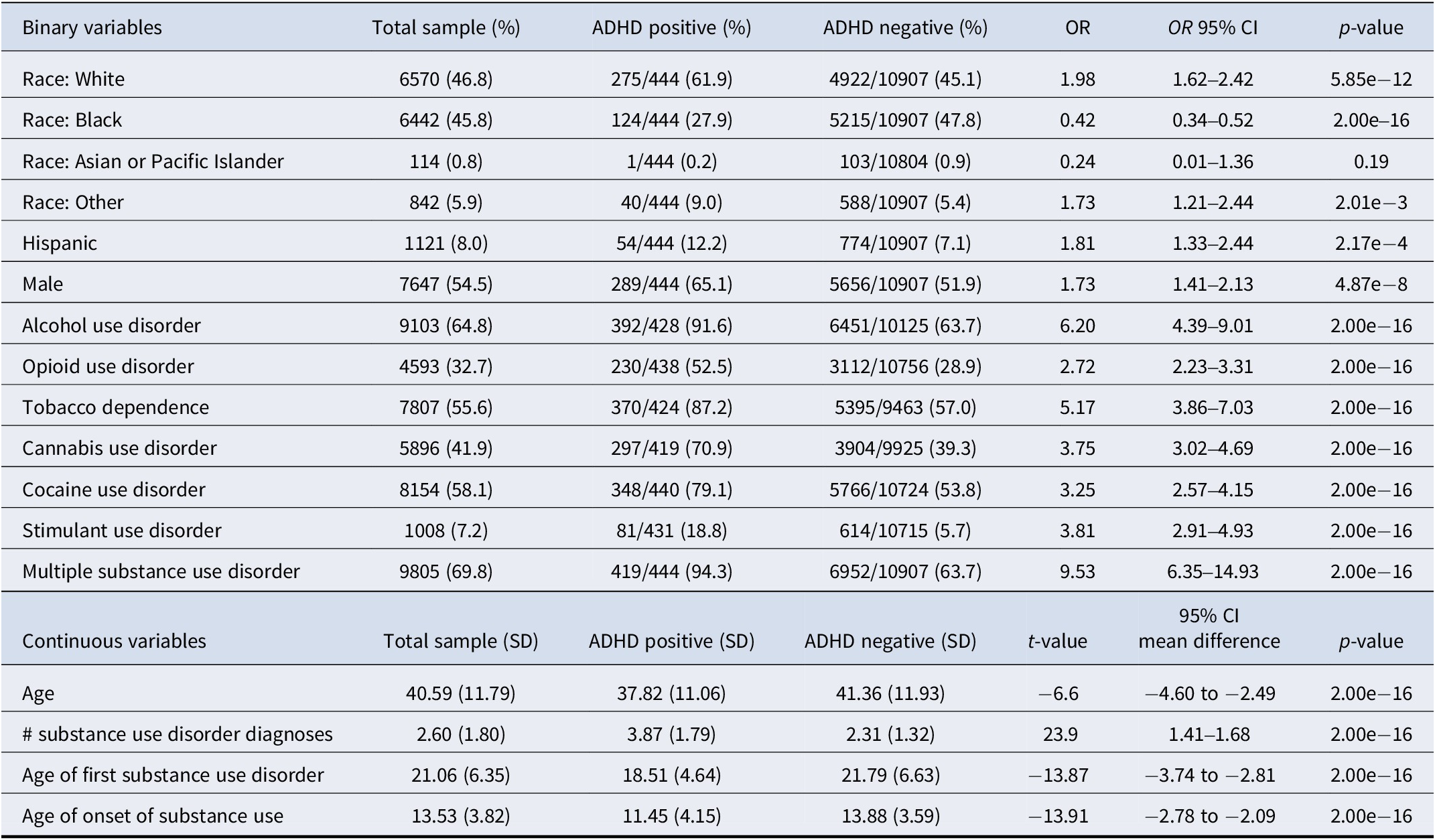
Table 1. Long description
The first table contains binary variables with columns for Total sample percentage, A D H D positive percentage, A D H D negative percentage, O R, O R 95 percent C I, and p-value.
* Race White: Total 46.8 percent; A D H D positive 61.9 percent; A D H D negative 45.1 percent; O R 1.98; p-value 5.85e minus 12.
* Race Black: Total 45.8 percent; A D H D positive 27.9 percent; A D H D negative 47.8 percent; O R 0.42; p-value 2.00e minus 16.
* Race Asian or Pacific Islander: Total 0.8 percent; A D H D positive 0.2 percent; A D H D negative 0.9 percent; O R 0.24; p-value 0.19.
* Race Other: Total 5.9 percent; A D H D positive 9.0 percent; A D H D negative 5.4 percent; O R 1.73; p-value 2.01e minus 3.
* Hispanic: Total 8.0 percent; A D H D positive 12.2 percent; A D H D negative 7.1 percent; O R 1.81; p-value 2.17e minus 4.
* Male: Total 54.5 percent; A D H D positive 65.1 percent; A D H D negative 51.9 percent; O R 1.73; p-value 4.87e minus 8.
* Alcohol use disorder: Total 64.8 percent; A D H D positive 91.6 percent; A D H D negative 63.7 percent; O R 6.20; p-value 2.00e minus 16.
* Opioid use disorder: Total 32.7 percent; A D H D positive 52.5 percent; A D H D negative 28.9 percent; O R 2.72; p-value 2.00e minus 16.
* Tobacco dependence: Total 55.6 percent; A D H D positive 87.2 percent; A D H D negative 57.0 percent; O R 5.17; p-value 2.00e minus 16.
* Cannabis use disorder: Total 41.9 percent; A D H D positive 70.9 percent; A D H D negative 39.3 percent; O R 3.75; p-value 2.00e minus 16.
* Cocaine use disorder: Total 58.1 percent; A D H D positive 79.1 percent; A D H D negative 53.8 percent; O R 3.25; p-value 2.00e minus 16.
* Stimulant use disorder: Total 7.2 percent; A D H D positive 18.8 percent; A D H D negative 5.7 percent; O R 3.81; p-value 2.00e minus 16.
* Multiple substance use disorder: Total 69.8 percent; A D H D positive 94.3 percent; A D H D negative 63.7 percent; O R 9.53; p-value 2.00e minus 16.
The second table contains continuous variables with columns for Total sample S D, A D H D positive S D, A D H D negative S D, t-value, 95 percent C I mean difference, and p-value.
* Age: Total 40.59; A D H D positive 37.82; A D H D negative 41.36; t-value minus 6.6; p-value 2.00e minus 16.
* Number of substance use disorder diagnoses: Total 2.60; A D H D positive 3.87; A D H D negative 2.31; t-value 23.9; p-value 2.00e minus 16.
* Age of first substance use disorder: Total 21.06; A D H D positive 18.51; A D H D negative 21.79; t-value minus 13.87; p-value 2.00e minus 16.
* Age of onset of substance use: Total 13.53; A D H D positive 11.45; A D H D negative 13.88; t-value minus 13.91; p-value 2.00e minus 16.
Note: OR, odds ratio; ADHD, attention deficit/hyperactivity disorder; p-values listed are Benjamini–Hochberg FDR-adjusted.
PGS analyses
European-like ancestry cohort
Genetic analysis was performed on 5424 individuals of European-like ancestry as defined by principal component analysis (PCA). Among these participants, the ADHD PGS was significantly positively associated with a DSM-IV ADHD diagnosis (OR = 1.54, CI = 1.33–1.78), ADHD DSM-IV CC (β = 0.13, CI = 0.09–0.16), total number of criterion A ADHD symptoms (β = 0.15, CI = 0.11–0.20), and meeting ADHD criterion A symptom count (meeting more than 6 symptoms) before age 12 (OR = 1.41, CI = 1.30–1.53). The ADHD PGS was also more strongly associated with symptoms of hyperactivity than inattentiveness (β = 0.16, CI = 0.13–0.19 vs β = 0.08, CI = 0.04–0.13, respectively), and this was statistically significant (z = 2.82) (Supplementary Table S4).
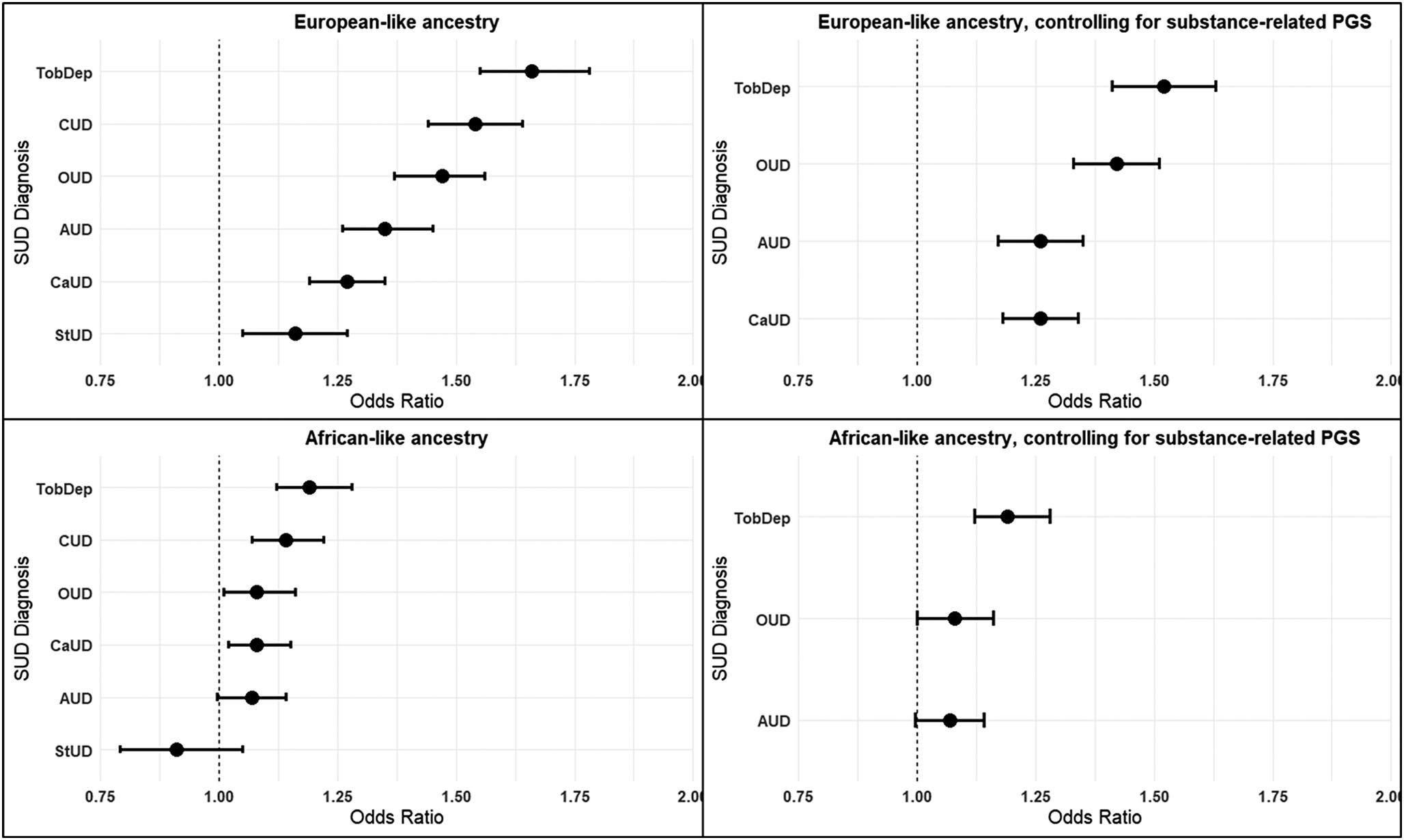
The ADHD PGS was significantly positively associated with nearly every SUD diagnosis and SUD CC analyzed. The strongest associations were with DSM-IV tobacco dependence and the Fagerström Test for Nicotine Dependence (FTND) (OR = 1.66, CI = 1.55–1.78 and β = 0.22, CI = 0.19–0.25, respectively) including after controlling for the SMKint PGS (OR = 1.52, CI = 1.41–1.63 and β = 0.18, CI = 0.15–0.21). ADHD PGS was also strongly associated with CUD (OR = 1.54, CI = 1.44–1.64) and CUD CC (β = 0.18); OUD and OUD CC (OR = 1.47, CI = 1.37–1.56 and β = 0.17, CI = 0.14–0.20), including after controlling for OUD PGS (OR = 1.42, CI = 1.33–1.51 and β = 0.15); AUD and AUD CC (OR = 1.35, CI = 1.26–1.45 and β = 0.12, CI = 0.09–0.15), including after controlling for AUD PGS (OR = 1.26, CI = 1.17–1.35 and β = 0.09, CI = 0.06–0.12); and CanUD and CanUD CC (OR = 1.27, CI = 1.19–1.35 CI: and β = 0.07, CI = 0.04–0.10), including after controlling for CanUD PGS (OR = 1.26, CI = 1.17–1.35 and β = 0.07, CI = 0.04–0.10). Additionally, ADHD PGS was significantly associated with meeting criteria for multiple SUDs (OR = 1.62, CI = 1.51–1.74). Although statistically significant, the smallest association was with DSM-5 StUD diagnosis (OR = 1.16, CI = 1.05–1.27) (Table 2) (Figure 1). Additionally, ADHD PGS added a significant proportion of variance for AUD CC, OUD CC, FTND, and CanUD CC than substance-specific PGS alone (Supplementary Table S5).
ADHD PGS associations with SUD diagnosis and criterion count, European-like ancestry
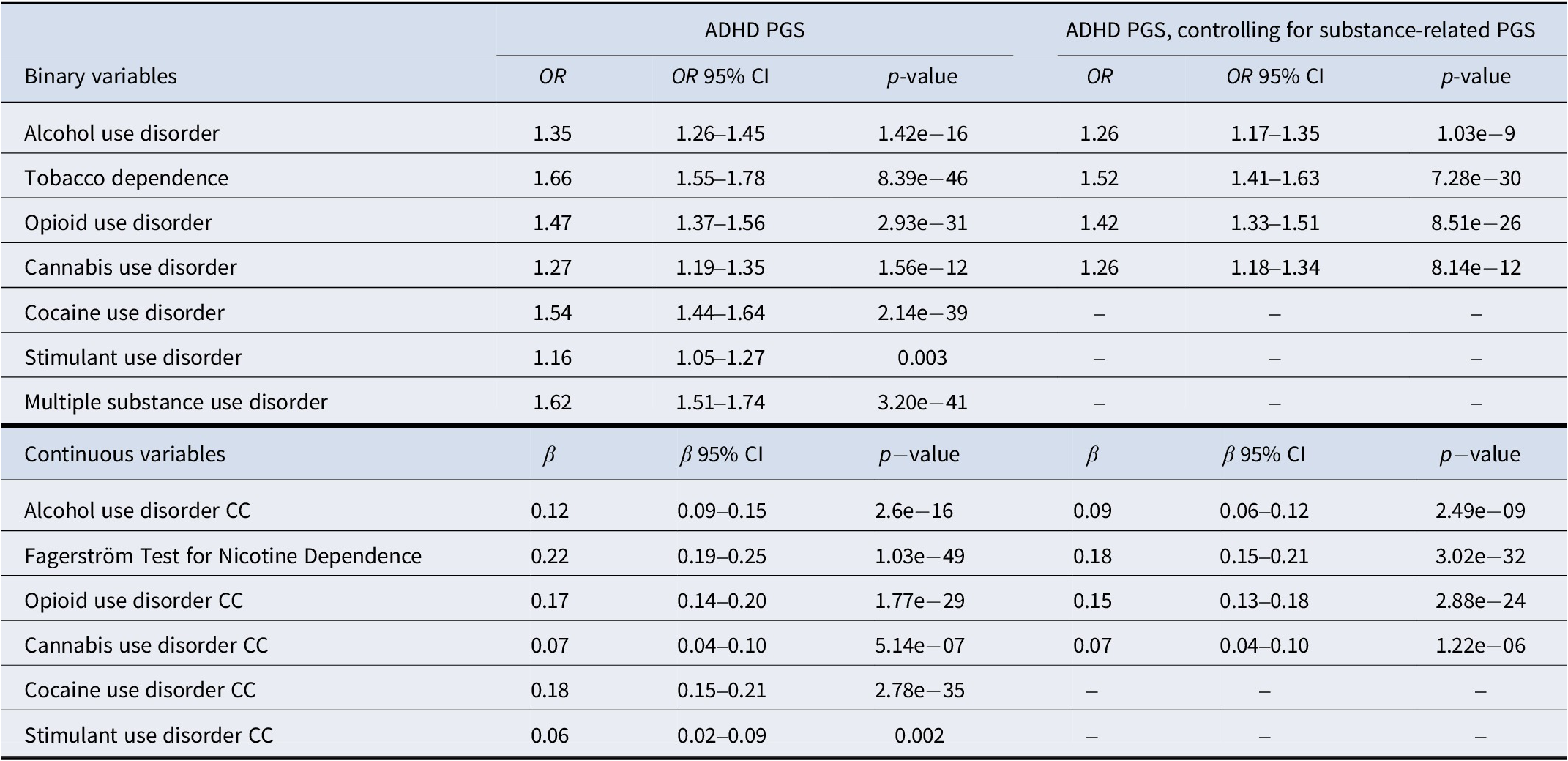
Table 2. Long description
The table is divided into two main sections: Binary variables and Continuous variables. It compares A D H D P G S alone against A D H D P G S controlling for substance-related P G S.
Binary variables (O R, 95% C I, p-value):
* Alcohol use disorder: 1.35 (1.26–1.45, p=1.42e-16) vs 1.26 (1.17–1.35, p=1.03e-9).
* Tobacco dependence: 1.66 (1.55–1.78, p=8.39e-46) vs 1.52 (1.41–1.63, p=7.28e-30).
* Opioid use disorder: 1.47 (1.37–1.56, p=2.93e-31) vs 1.42 (1.33–1.51, p=8.51e-26).
* Cannabis use disorder: 1.27 (1.19–1.35, p=1.56e-12) vs 1.26 (1.18–1.34, p=8.14e-12).
* Cocaine use disorder: 1.54 (1.44–1.64, p=2.14e-39).
* Stimulant use disorder: 1.16 (1.05–1.27, p=0.003).
* Multiple substance use disorder: 1.62 (1.51–1.74, p=3.20e-41).
Continuous variables (beta, 95% C I, p-value):
* Alcohol use disorder C C: 0.12 (0.09–0.15, p=2.6e-16) vs 0.09 (0.06–0.12, p=2.49e-09).
* Fagerström Test for Nicotine Dependence: 0.22 (0.19–0.25, p=1.03e-49) vs 0.18 (0.15–0.21, p=3.02e-32).
* Opioid use disorder C C: 0.17 (0.14–0.20, p=1.77e-29) vs 0.15 (0.13–0.18, p=2.88e-24).
* Cannabis use disorder C C: 0.07 (0.04–0.10, p=5.14e-07) vs 0.07 (0.04–0.10, p=1.22e-06).
* Cocaine use disorder C C: 0.18 (0.15–0.21, p=2.78e-35).
* Stimulant use disorder C C: 0.06 (0.02–0.09, p=0.002).
Note: P G S for cocaine and stimulant use disorders were not available for the controlled analysis. All p-values are Benjamini-Hochberg F D R-adjusted.
Note: CC, criterion count; PGS, polygenic score; OR, odds ratio; ADHD, attention deficit/hyperactivity disorder; SUD, substance use disorder; PGS for cocaine use disorder and stimulant use disorder were not available; p-values listed are Benjamini–Hochberg FDR-adjusted.
Odds ratios of SUD diagnoses by ADHD PGS, with and without controlling for substance-related PGS in participants of African-like and European-like ancestry. Note: TobDep, ‘DSM-IV tobacco dependence’; AUD, ‘DSM-5 alcohol use disorder’; OUD, ‘DSM-5 opioid use disorder’; CUD, ‘DSM-5 cocaine use disorder’; CaUD, ‘DSM-5 cannabis use disorder’; StUD, ‘DSM-5 stimulant use disorder’. PGSs were not available for cocaine use disorder, stimulant use disorder, or cannabis use disorder in African-like ancestry.

Figure 1. Long description
The multi-panel forest plot consists of four panels. Each panel has a y-axis labeled S U D Diagnosis and an x-axis labeled Odds Ratio ranging from 0.75 to 2.00, with a vertical dashed line at 1.00 representing the null effect.
Top-left panel: European-like ancestry. Six diagnoses are listed from top to bottom. Tob Dep has the highest odds ratio at approximately 1.65. C U D is at 1.55. O U D is at 1.48. A U D is at 1.35. Ca U D is at 1.28. St U D is at 1.15. All confidence intervals are entirely above 1.00.
Top-right panel: European-like ancestry, controlling for substance-related P G S. Four diagnoses are shown. Tob Dep is at 1.52. O U D is at 1.42. A U D is at 1.26. Ca U D is at 1.26. All remain above 1.00, though odds ratios are slightly lower than the uncontrolled panel.
Bottom-left panel: African-like ancestry. Six diagnoses are shown. Tob Dep is at 1.20. C U D is at 1.14. O U D is at 1.08. Ca U D is at 1.08. A U D is at 1.07. St U D is the only point below the null line, at approximately 0.92, with a confidence interval crossing 1.00.
Bottom-right panel: African-like ancestry, controlling for substance-related P G S. Three diagnoses are shown. Tob Dep is at 1.19. O U D is at 1.08. A U D is at 1.07. The confidence intervals for O U D and A U D touch or cross the 1.00 null line.
The SMKint PGS was the only substance-related PGS significantly associated with both an ADHD diagnosis and CC (OR = 1.32, CI = 1.14–1.52, and β = 0.08, respectively), although the magnitude of both associations was reduced when controlling for the ADHD PGS (OR = 1.21, CI = 1.04–1.40, and β = 0.05, CI = 0.02–0.09). The PGS for OUD was significantly associated with ADHD CC (β = 0.05, CI = 0.02–0.08) but non-significant when controlling for the ADHD PGS. PGSs for AUD, PAU, OUD, and CAN were not associated with either a DSM-IV ADHD diagnosis or CC, irrespective of whether we controlled for ADHD PGS (Table 3).
SUD PGS associations with ADHD diagnosis and CC, including independently of ADHD PGS, European-like ancestry
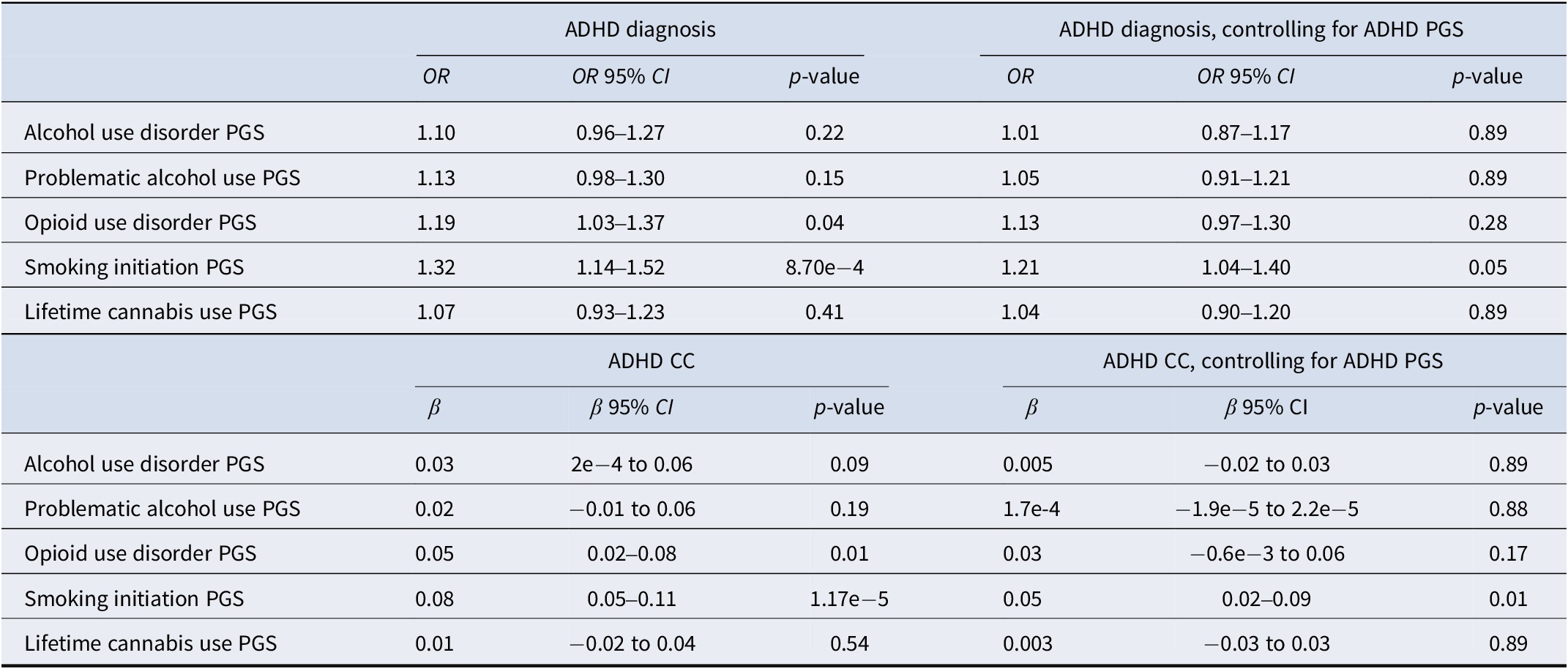
Table 3. Long description
The first table displays A D H D diagnosis associations. Rows list P G S for Alcohol use disorder, Problematic alcohol use, Opioid use disorder, Smoking initiation, and Lifetime cannabis use. Columns provide O R, 95% C I, and p-value for two conditions: A D H D diagnosis alone and A D H D diagnosis controlling for A D H D P G S. Significant findings include Smoking initiation P G S with an O R of 1.32 (p-value 8.70e-4) and Opioid use disorder P G S with an O R of 1.19 (p-value 0.04). When controlling for A D H D P G S, Smoking initiation remains significant at O R 1.21 (p-value 0.05).
The second table displays A D H D criterion count (C C) associations using beta coefficients. Rows are identical to the first table. Columns provide beta, 95% C I, and p-value for A D H D C C alone and A D H D C C controlling for A D H D P G S. Smoking initiation P G S shows the strongest association with a beta of 0.08 (p-value 1.17e-5), which remains significant when controlling for A D H D P G S with a beta of 0.05 (p-value 0.01). Opioid use disorder P G S also shows a significant association with A D H D C C (beta 0.05, p-value 0.01). All p-values are Benjamini-Hochberg F D R-adjusted.
Note: PGS, polygenic score; OR, odds ratio; CI, confidence interval; ADHD, attention deficit/hyperactivity disorder; CC, criterion count; p-values listed are Benjamini–Hochberg FDR-adjusted.
African-like ancestry cohort
Genetic analyses included 4851 individuals of African-like ancestry, as determined by PCA. Among these individuals, the PGS for ADHD was significantly associated with ADHD CC (β = 0.05, CI = 0.02–0.08), meeting ADHD criteria A by age 12 (OR = 1.19, CI = 1.08–1.31), and the number of hyperactivity symptoms (β = 0.05, CI = 0.02–0.08), and was nominally significant for ADHD DSM-IV diagnosis (OR = 1.29, CI = 1.06–1.56) Supplementary Table S4). The ADHD PGS was significantly associated with DSM-IV tobacco dependence (OR = 1.19, CI = 1.12–1.28) and the FTND (β = 0.07, CI = 0.04–0.09), including after controlling for SMKint PGS (OR = 1.19, CI = 1.12–1.28 and β = 0.07, CI = 0.04–0.09 respectively). ADHD PGS was also significantly associated with CUD diagnosis and CUD CC (OR = 1.14, CI = 1.07–1.22, and β = 0.05, CI = 0.02–0.07). Finally, ADHD PGS was associated with meeting criteria for multiple SUD (OR = 1.15, CI = 1.08–1.23). ADHD PGS was not associated with AUD, CanUD with or without controlling for AUD or cannabis use PGS. Additionally, ADHD PGS was not associated with StUD (Table 4). ADHD PGS added a significantly greater proportion of variance for FTND above SMKint PGS, but did not do so for AUD CC or OUD CC (Supplementary Table S5).
ADHD PGS associations with SUD diagnosis and criterion count, African-like ancestry
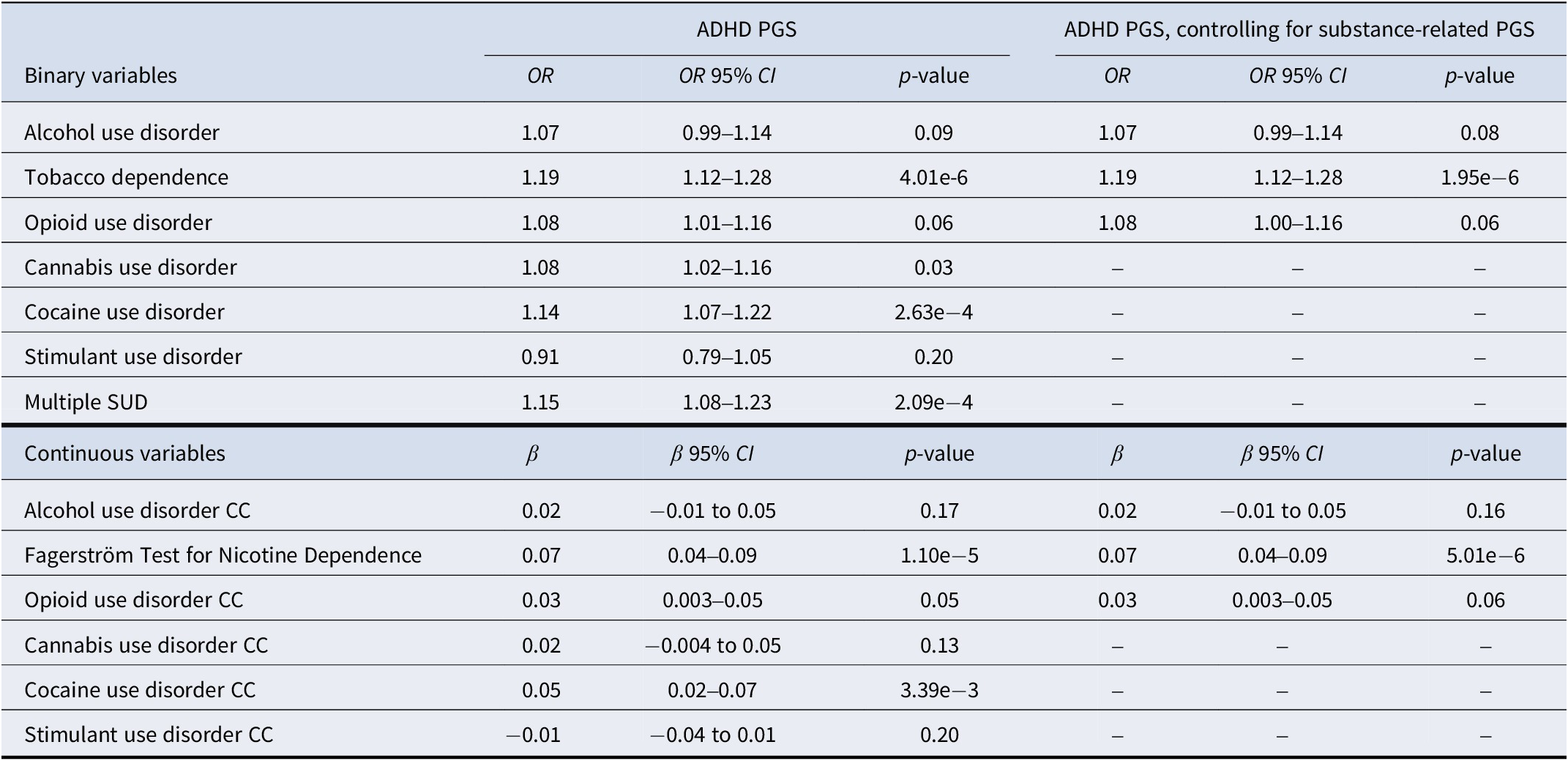
Table 4. Long description
The table is divided into two main sections: A D H D P G S and A D H D P G S controlling for substance-related P G S. Each section includes columns for Odds Ratio O R or beta, 95 percent Confidence Interval C I, and p-value.
Binary variables section:
* Alcohol use disorder: O R 1.07, C I 0.99 to 1.14, p 0.09. Controlled: O R 1.07, C I 0.99 to 1.14, p 0.08.
* Tobacco dependence: O R 1.19, C I 1.12 to 1.28, p 4.01 e minus 6. Controlled: O R 1.19, C I 1.12 to 1.28, p 1.95 e minus 6.
* Opioid use disorder: O R 1.08, C I 1.01 to 1.16, p 0.06. Controlled: O R 1.08, C I 1.00 to 1.16, p 0.06.
* Cannabis use disorder: O R 1.08, C I 1.02 to 1.16, p 0.03. Controlled: No data.
* Cocaine use disorder: O R 1.14, C I 1.07 to 1.22, p 2.63 e minus 4. Controlled: No data.
* Stimulant use disorder: O R 0.91, C I 0.79 to 1.05, p 0.20. Controlled: No data.
* Multiple S U D: O R 1.15, C I 1.08 to 1.23, p 2.09 e minus 4. Controlled: No data.
Continuous variables section:
* Alcohol use disorder C C: beta 0.02, C I minus 0.01 to 0.05, p 0.17. Controlled: beta 0.02, C I minus 0.01 to 0.05, p 0.16.
* Fagerström Test for Nicotine Dependence: beta 0.07, C I 0.04 to 0.09, p 1.10 e minus 5. Controlled: beta 0.07, C I 0.04 to 0.09, p 5.01 e minus 6.
* Opioid use disorder C C: beta 0.03, C I 0.003 to 0.05, p 0.05. Controlled: beta 0.03, C I 0.003 to 0.05, p 0.06.
* Cannabis use disorder C C: beta 0.02, C I minus 0.004 to 0.05, p 0.13. Controlled: No data.
* Cocaine use disorder C C: beta 0.05, C I 0.02 to 0.07, p 3.39 e minus 3. Controlled: No data.
* Stimulant use disorder C C: beta minus 0.01, C I minus 0.04 to 0.01, p 0.20. Controlled: No data.
Note: CC, criterion count; PGS, polygenic score; OR, odds ratio; ADHD, attention deficit/hyperactivity disorder; CI, confidence interval. PGSs were not available for cannabis use disorder, cocaine use disorder, or stimulant use disorder; p-values listed are Benjamini–Hochberg FDR-adjusted.
None of the three substance-related PGS tested (AUD, SmkInt, or OUD) were associated with ADHD diagnosis or ADHD CC, with or without controlling for ADHD PGS (Supplementary Table S6).
Discussion
This study reported ADHD prevalence rates among individuals with various SUDs, associations between ADHD and SUD diagnoses and related traits, and associations of substance-related PGS with an ADHD diagnosis and criterion count (CC) and an ADHD PGS with SUD diagnoses in a very large and deeply phenotyped sample. In alignment with our hypothesis, meeting criteria for a DSM-IV lifetime ADHD diagnosis was associated with much greater odds of a variety of SUDs. Individuals with ADHD had a significantly earlier age of substance use initiation and an earlier age of onset of a SUD diagnosis and greater likelihood of having multiple SUDs. Notably, genetic liability for ADHD was associated with multiple SUD diagnoses and symptoms in both the European-like and African-like ancestry cohorts, present even when controlling for substance-related PGS (when available). Our hypothesis that genetic liability for substance-related traits would be associated with ADHD diagnosis was largely not supported.
Our phenotypic results align with prior findings that ADHD is associated with a general increased risk of SUDs and that individuals with ADHD are more likely to have an earlier onset of substance use and multiple SUD diagnoses. In our sample, meeting DSM-IV criteria for ADHD was most robustly associated with AUD, followed by tobacco dependence, StUD, CanUD, and CUD. Prior studies (Arias et al., Reference Arias, Gelernter, Chan, Weiss, Brady, Farrer and Kranzler2008; Capusan et al., Reference Capusan, Bendtsen, Marteinsdottir and Larsson2019), including longitudinal ones (Fuller-Thomson et al., Reference Fuller-Thomson, Lewis and Agbeyaka2022), have shown the strongest associations of ADHD diagnosis and symptoms with AUD, CanUD, and CUD. Furthermore, prior studies have also shown that ADHD is associated with an earlier onset of substance use (Arias et al., Reference Arias, Gelernter, Chan, Weiss, Brady, Farrer and Kranzler2008; Kousha, Shahrivar, & Alaghband-Rad, Reference Kousha, Shahrivar and Alaghband-Rad2012) and polysubstance use (Icick et al., Reference Icick, Moggi, Slobodin, Dom, Mathys, Van Den Brink, Levin, Blankers, Kaye, Demetrovics, Van De Glind, Velez-Pastrana and Schellekens2020). Our study advances these findings by examining the associations of ADHD diagnosis and symptoms with SUDs and related phenotypes in a large sample enriched for SUDs, allowing for close examination of substance use onset and polysubstance use.
Our PGS analyses complement our phenotypic findings and augment prior research on the genetic relationship between ADHD and SUDs. Genetic liability to ADHD has been associated with various SUD-related phenotypes (Vilar-Ribó et al., Reference Vilar-Ribó, Sánchez-Mora, Rovira, Richarte, Corrales, Fadeuilhe, Arribas, Casas, Ramos-Quiroga, Ribasés and Soler Artigas2021; Wimberley et al., Reference Wimberley, Agerbo, Horsdal, Ottosen, Brikell, Als, Demontis, Børglum, Nordentoft, Mors, Werge, Hougaard, Bybjerg-Grauholm, Hansen, Mortensen, Thapar, Riglin, Langley and Dalsgaard2020), particularly AUD and CanUD. Additionally, a recent PheWAS study in a general biobank sample found that ADHD PGS was most significantly associated with tobacco and nicotine-related phenotypes (Kember et al., Reference Kember, Merikangas, Verma, Verma, Judy, Abecasis, Baras, Cantor, Coppola, Economides, Lotta, Overton, Reid, Shuldiner, Beechert, Forsythe, Fuller, Gu, Lattari and Bućan2021). In comparison, we found the strongest associations with tobacco dependence, CUD, and OUD. While our findings highlight a potentially particularly strong relationship with nicotine dependence, the fact that associations were significant among the different SUDs examined suggests that genetic liability to ADHD encompasses a generalized risk for addiction through shared mechanisms such as decreased emotional regulation and risk-seeking. This aligns with prior work that identified a genetic externalizing factor that was significantly associated with traits related to ADHD, self-regulation, and SUDs (Karlsson Linnér et al., Reference Karlsson Linnér, Mallard, Barr, Sanchez-Roige, Madole, Driver, Poore, de Vlaming, Grotzinger, Tielbeek, Johnson, Liu, Rosenthal, Ideker, Zhou, Kember, Pasman, Verweij, Liu and Dick2021). Finally, our finding that ADHD PGS was significantly associated with meeting multiple SUD further bolsters the notion that genetic liability to ADHD may be associated with greater or more severe substance use.
Our findings examining substance-related PGS associations with ADHD diverge from those from a recent study by Koller et al. (Koller et al., Reference Koller, Mitjans, Kouakou, Friligkou, Cabrera-Mendoza, Deak, Llonga, Pathak, Stiltner, Løkhammer, Levey, Zhou, Hatoum, Kember, Kranzler, Stein, Corominas, Demontis, Artigas and Polimanti2024). While Koller et al. found that PGS for OUD, CanUD, and PAU – but not problematic tobacco use (PTU) – were associated with significantly increased odds for ADHD, smoking initiation was the only substance-related PGS associated with ADHD in our study. This divergence could be due to multiple differences between studies; for example, the sample studied by Koller et al. had a much higher rate of ADHD and was not ascertained for SUDs and also used a different discovery sample for the CanUD PGS. Additionally, the underlying genetic architecture of PTU likely differs from smoking initiation in important ways. For example, smoking initiation may primarily map onto genetic variants related to sensation-seeking or risk-taking, whereas PTU may also reflect specific responsiveness to nicotine.
A major contribution of this work is the ability to isolate the contribution of ADHD genetic liability to risk for SUDs by controlling for substance-specific PGS. To our knowledge, this is the first study to systemically assess the relationships between ADHD PGS and SUDs while controlling for potential pleiotropy with substance-related PGS. In doing so, this research is able to identify the potentially unique contribution of ADHD genetic liability to SUDs beyond shared genetic influences. Additionally, controlling for ADHD PGS allows for clearer understanding of the relationship between substance-related PGS and ADHD, as highlighted in the attenuation of the association of ADHD PGS with tobacco use disorder and CUD in our study. Another notable strength of our study is the inclusion of both European-like and African-like ancestry samples. Results in the two population groups followed a similar pattern, with ADHD PGS most significantly associated with OUD and smoking-related phenotypes and PGS for SUDs inconsistently associated with ADHD diagnosis or criterion count. These cross-ancestry results strengthen the robustness and generalizability of our findings.
These results are relevant to characterizing the pleiotropy between ADHD and SUDs. While prior Mendelian Randomization (MR) studies have been mixed, many have found that ADHD has causal effects on multiple SUDs, including CanUD and smoking (Koller et al., Reference Koller, Mitjans, Kouakou, Friligkou, Cabrera-Mendoza, Deak, Llonga, Pathak, Stiltner, Løkhammer, Levey, Zhou, Hatoum, Kember, Kranzler, Stein, Corominas, Demontis, Artigas and Polimanti2024; Soler Artigas et al., Reference Soler Artigas, Sánchez-Mora, Rovira, Richarte, Garcia-Martínez, Pagerols, Demontis, Stringer, Vink, Børglum, Neale, Franke, Faraone, Casas, Ramos-Quiroga and Ribasés2020; Treur et al., Reference Treur, Demontis, Smith, Sallis, Richardson, Wiers, Børglum, Verweij and Munafò2021; Vilar-Ribó et al., Reference Vilar-Ribó, Sánchez-Mora, Rovira, Richarte, Corrales, Fadeuilhe, Arribas, Casas, Ramos-Quiroga, Ribasés and Soler Artigas2021). Although we did not address causality, the consistency and magnitude of the associations between ADHD PGS and multiple SUD diagnoses, and dearth of findings that substance-related PGSs were causal for ADHD, is consistent with a causal role for ADHD in the development of SUDs. Other methodologies, such as genomic structural equation modeling (gSEM), may complement these results by using summary statistics from multiple phenotypes to further parse out the unique contribution of ADHD PGS.
Of note, the rate of ADHD in our sample (3.2% in the entire cohort, 3.3% in those with genotype data) is markedly lower than in prior published SUD cohorts, with a recent meta-analysis finding a prevalence of approximately 20% (Rohner et al., Reference Rohner, Gaspar, Philipsen and Schulze2023). While our lower prevalence may reflect underreporting due to reliance on retrospective self-report of childhood symptoms, it is possible that cases as determined through a semi-structured interview are defined more strictly than through self-report or diagnostic codes. Similar genetics-focused cohorts report prevalence rates more similar to ours; for example, the Collaborative study on the Genetics of Alcoholism (COGA) reported a prevalence of approximately 3%–11% (depending on specific study wave) in SUD case patients and families (Dick et al., Reference Dick, Balcke, McCutcheon, Francis, Kuo, Salvatore, Meyers, Bierut, Schuckit, Hesselbrock, Edenberg, Porjesz, Hesselbrock, Foroud, Dick, Hesselbrock, Edenberg, Liu, Plawecki and Bucholz2023). Our relatively low prevalence of ADHD in comparison to SUDs, however, may explain why ADHD PGS was more significantly associated with certain SUD phenotypes than ADHD-related phenotypes. It may also contribute to the lack of association of the substance-use related PGS with the ADHD phenotype in our sample, although substance-related PGSs were not associated with ADHD CC either (which is measured in all participants), indicating low prevalence of ADHD in the sample may not be a significant reason for these results.
This study has limitations. Notably, it was conducted in subjects who were oversampled for SUD diagnoses, and thus associations with PGS may not generalize to other populations. The relationships between ADHD and some of the SUDs in our study may not be completely representative given the over-representation of CUD and OUD in our sample. Despite modest associations, the associations of ADHD PGS with ADHD phenotypes were not as strong among participants of African-like ancestry, which was expected given the necessity of using a European-like ancestry discovery sample for ADHD PGS. Additionally, African-like populations have the greatest genetic diversity so that the on-average smaller LD blocks may reduce the power of PGS (Campbell & Tishkoff, Reference Campbell and Tishkoff2008). As noted, ADHD phenotyping relied entirely on adults’ retrospective report of symptoms from childhood, and the low prevalence of ADHD in our sample indicates that some cases were likely missed, reducing statistical power.
Overall, these data provide further evidence that an ADHD diagnosis is associated with SUDs, an earlier onset of substance use, and a greater likelihood of multiple SUD diagnoses. These data also suggest that genetic liability for ADHD is an important independent risk factor for multiple SUDs in individuals of both European and African ancestry. We did not find that genetic liability for PAU, AUD, CanUD, or OUD was associated with an ADHD diagnosis or symptoms, consistent with ADHD exerting greater causal effects on SUDs than vice versa, although the relatively low prevalence of ADHD in our sample may have reduced the effects of substance-related PGS on ADHD risk. Results from this study indicate that early detection and treatment of ADHD may be important not only for management of symptoms of ADHD but for future substance abuse risk (Quinn et al., Reference Quinn, Chang, Hur, Gibbons, Lahey, Rickert, Sjölander, Lichtenstein, Larsson and D’Onofrio2017). Future studies should examine these associations in larger, more diverse genetic discovery samples to ensure greater statistical power, generalizability, and equity.
Supplementary material
The supplementary material for this article can be found at http://doi.org/10.1017/S0033291725103103.
Data availability statement
Yale-Penn data are available through dbGAP (study accession numbers phs000425.v1.p1, phs000952.v1.p1, phs000277.v2.p1). Summary statistics used to calculate PGS are available from the originating studies.
Acknowledgments
We thank the Yale-Penn participants.
Author contribution
M.R.S., R.L.K., H.R.K., and J.C.G. conceived and designed study; M.R.S. and Z.P. conducted data analysis; J.G. and H.R.K. acquired the data; M.R.S. interpreted the data and wrote the manuscript; all authors contributed to revising the manuscript for intellectual content.
Funding statement
Dr. Kranzler is supported by the Veterans Integrated Service Network’s Mental Illness Research, Education and Clinical Center; U.S. Department of Veterans Affairs grant I01 BX004820 and NIAAA grant R01 AA030056. Dr. Kember is supported by NIAAA grant K01AA028292. Dr. Gray is supported by NIAAA grant R01AA030041 and Department of Defense grant HU0001-22-2-0066.
Competing interests
Dr. Kranzler is a member of advisory boards for Altimmune and Clearmind Medicine; a consultant to Sobrera Pharmaceuticals, Altimmune, and Lilly Pharmaceuticals; the recipient of research funding and medication supplies for an investigator-initiated study from Alkermes; a member of the American Society of Clinical Psychopharmacology’s Alcohol Clinical Trials Initiative, which was supported in the last 3 years by Alkermes, Dicerna, Ethypharm, Imbrium, Indivior, Kinnov, Lilly, Otsuka, and Pear; and an inventor on U.S. provisional patent ‘Multi-ancestry Genome-wide Association Meta-analysis of Buprenorphine Treatment Response’. Dr Gelernter is paid for editorial work by the journal ‘Complex Psychiatry’. The remaining authors have no conflicts to disclose.
Ethical standards
The authors assert that all procedures contributing to this work comply with the ethical standards of the relevant national and institutional committees on human experimentation and with the Helsinki Declaration of 1975, as revised in 2008.
Disclaimer
The contents of this publication are the sole responsibility of the authors and do not necessarily reflect the official policy or position of the Uniformed Services University of the Health Sciences or the Department of Defense. Moreover, the opinions and assertions herein are those of the authors and do not necessarily reflect the official views of the Henry M. Jackson Foundation for the Advancement of Military Medicine, Inc.




 Open access

