INTRODUCTION
The control of gastro-intestinal parasitism using chemotherapeutic strategies is under threat due to the emergence of anthelmintic resistance (Kaplan, Reference Kaplan2004; Wolstenholme et al. Reference Wolstenholme, Fairweather, Pritchard, Von Samson-Himmelstjerna and Sangster2004; Jabbar et al. Reference Jabbar, Iqbal, Kerboeuf, Muhammad, Khan and Afaq2006; Papadopoulos et al. Reference Papadopoulos, Gallidis and Ptochos2012), and this threatens the sustainability of livestock systems (Waller, Reference Waller2006; Besier, Reference Besier2007; Papadopoulos, Reference Papadopoulos2008). Numerous alternative strategies, including the maintenance of refugia (van Wyk, Reference van Wyk2001; Soulsby, Reference Soulsby2007; Jackson and Waller, Reference Jackson and Waller2008; Leathwick et al. Reference Leathwick, Hosking, Bisset and McKay2009) and targeted selective treatment (TST) (van Wyk et al. Reference van Wyk, Hoste, Kaplan and Besier2006; Kenyon et al. Reference Kenyon, Greer, Coles, Cringoli, Papadopoulos, Cabaret, Berrag, Varady, van Wyk, Thomas, Vercruysse and Jackson2009; Besier, Reference Besier2012; Kenyon and Jackson, Reference Kenyon and Jackson2012) have been proposed to reduce the rate of development of anthelmintic resistance and maintain sustainable parasite control.
Maintaining a proportion of the nematode population in refugia (i.e. unexposed to anthelmintic) preserves susceptible parasite genotypes, thus slowing the development of anthelmintic resistance (van Wyk, Reference van Wyk2001; Nielsen et al. Reference Nielsen, Kaplan, Thamsborg, Monrad and Olsen2007; Soulsby, Reference Soulsby2007; Torres-Acosta and Hoste, Reference Torres-Acosta and Hoste2008). However, various factors affect parasite epidemiology and hence the parasite population in refugia, including environmental conditions (Morgan and van Dijk, Reference Morgan and van Dijk2012), host immune response (Laurenson et al. Reference Laurenson, Kyriazakis and Bishop2012b) and management practices (Leathwick et al. Reference Leathwick, Hosking, Bisset and McKay2009). Further, drenching frequency has also been associated with the emergence of anthelmintic resistance (Jackson and Coop, Reference Jackson and Coop2000; Coles, Reference Coles2005; van Wyk et al. Reference van Wyk, Hoste, Kaplan and Besier2006). As such, refugia-based strategies aim to reduce drenching frequency and administer anthelmintics at appropriate times when the proportion of the total nematode population on pasture is high.
As well as considering the frequency and timing of treatment, TST strategies also reduce the number of anthelmintics treatments administered, and thus increase the nematode population in refugia, by selective treatment of only those animals that will benefit most from treatment (van Wyk et al. Reference van Wyk, Hoste, Kaplan and Besier2006; Kenyon et al. Reference Kenyon, Greer, Coles, Cringoli, Papadopoulos, Cabaret, Berrag, Varady, van Wyk, Thomas, Vercruysse and Jackson2009). Thus, a TST approach provides a strategy capable of exploiting the over-dispersion of parasitic nematodes within the host population (Sreter et al. Reference Sreter, Molnar and Kassai1994; Bishop and Stear, Reference Bishop and Stear1997; Hoste et al. Reference Hoste, Le Frileux and Pommaret2001). However, the implementation of TST regimes requires determinant criteria for the identification of animals susceptible to parasitism. The optimal determinant criterion would be the trait that provides the highest level of flock performance for a given percentage of animals drenched. Various phenotypic traits have previously been proposed, including parasitological traits such as fecal egg count (FEC) as an indicator of host resistance (Cringoli et al. Reference Cringoli, Rinaldi, Veneziano, Mezzino, Vercruysse and Jackson2009; Gallidis et al. Reference Gallidis, Papadopoulos, Ptochos and Arsenos2009), and performance traits such as live weight (Leathwick et al. Reference Leathwick, Waghorn, Miller, Atkinson, Haack and Oliver2006a,Reference Leathwick, Miller, Atkinson, Haack, Alexander, Oliver, Waghorn, Potter and Sutherlandb) and weight gain (Waghorn et al. Reference Waghorn, Leathwick, Miller and Atkinson2008; Stafford et al. Reference Stafford, Morgan and Coles2009; Gaba et al. Reference Gaba, Cabaret, Sauvé, Cortet and Silvestre2010) as indicators of host resilience. However, whilst each trait has been independently evaluated for use as the determinant criteria in a TST regime (Kenyon and Jackson, Reference Kenyon and Jackson2012), a direct comparison of the effectiveness of the different traits in identifying susceptible animals for treatment has yet to be carried out.
Field studies investigating refugia-based strategies and TST regimes have focused on the short-term impacts upon flock performance, due to the difficulty of measuring changes in the frequency of resistance genotypes within nematode populations (Gilleard, Reference Gilleard2006). On the other hand, simulation studies have previously been used to provide insights into the long-term relationship between such control strategies and the emergence of anthelmintic resistance (Barnes et al. Reference Barnes, Dobson and Barger1995; Leathwick et al. Reference Leathwick, Vlassoff and Barlow1995; Learmount et al. Reference Learmount, Taylor, Smith and Morgan2006; Dobson et al. Reference Dobson, Barnes, Tyrrell, Hosking, Larsen, Besier, Love, Rolfe and Bailey2011). However, these simulation studies have been restricted to modelling nematode epidemiology (Gaba et al. Reference Gaba, Cabaret, Sauvé, Cortet and Silvestre2010), thus making comparison to performance-based field studies difficult. The aim of this study was to use an appropriate mathematical model to make a comparison of traits previously proposed for use as determinant criteria for TST regimes and investigate the impacts of TST regimes and drenching frequency on both sheep performance and the emergence of anthelmintic resistance, both in the short and long term.
MATERIALS AND METHODS
The mathematical model of Laurenson et al. (Reference Laurenson, Bishop and Kyriazakis2011, Reference Laurenson, Kyriazakis, Forbes and Bishop2012a) that describes the epidemiology of Teladorsagia circumcincta, an abomasal nematode parasite of importance to the UK sheep industry, and the impact of host nutrition, genotype and gastro-intestinal parasitism on a population of growing lambs was used as the basis of this study. Several modifications were made to the model, including the addition of a new module to provide a description of anthelmintic resistance genotypes within the nematode population and the differing phenotypic susceptibility of such genotypes to anthelmintic treatment. A brief overview of the existing model (host–parasite interaction model and epidemiological model), as well as a more in-depth description of the new module (anthelmintic resistance model), are given below.
The host–parasite interaction model
In the model of Laurenson et al. (Reference Laurenson, Bishop and Kyriazakis2011), gastrointestinal parasitism of a growing lamb is assumed to result in endogenous protein loss (Yakoob et al. Reference Yakoob, Holmes, Parkins and Armour1983), modelled as a function of parasitic burden (Vagenas et al. Reference Vagenas, Bishop and Kyriazakis2007). To counteract this protein loss, each animal invests in an immune response that affects the rates of nematode establishment, fecundity and mortality (Louie et al. Reference Louie, Vlassoff and Mackay2005), and thus reduces parasitic burden. However, components of the immune response (e.g. cytokines) are associated with a reduction in food intake (Greer et al. Reference Greer, Huntley, Mackellar, McAnulty, Jay, Green, Stankiewicz and Sykes2008; Kyriazakis, Reference Kyriazakis2010), commonly known as (parasite-induced) anorexia. The combination of protein loss due to parasitism, investment in immunity and anorexia, result in the lamb acquiring insufficient nutrient resources to fulfil requirements for optimal growth, and thus lamb growth rate reduces.
The individual lamb model was extended to a population level (Laurenson et al. Reference Laurenson, Kyriazakis, Forbes and Bishop2012a) by including between-animal variation in optimal growth rate, body composition at maturity, maintenance requirements, and the ability to mount an immune response (rate of acquisition, as well as initial and final rates for establishment, mortality and fecundity). Initial input parameters involved in these functions were assumed to be normally distributed and all traits, other than those associated with host resistance, were assumed to be uncorrelated (Doeschl-Wilson et al. Reference Doeschl_Wilson, Vagenas, Kyriazakis and Bishop2008). Hence, correlations between output traits such as growth rate and FEC occur as a consequence of the functions that underlie the model rather than as a result of direct input (Laurenson et al. Reference Laurenson, Kyriazakis, Forbes and Bishop2012a). Resistance traits were assumed to be strongly correlated (r = +0·5), as a function of overlapping effector mechanisms (components of the Th2 immune response) (Jenkins and Allen, Reference Jenkins and Allen2010). Further, random environmental variation in daily food intake was included to achieve a genetic correlation between food intake and growth rate of approximately 0·8 (Cammack et al. Reference Cammack, Leymaster, Jenkins and Nielsen2005).
The model was parameterized such that lamb growth characteristics were similar to those of Scottish Blackface sheep, parasitological parameters matched those of Coop et al. (1982, 1985) for lambs infected with T. circumcincta, and the between-animal variance of each trait matched those of Bishop et al. (Reference Bishop, Bairden, McKellar, Park and Stear1996) and Bishop and Stear (Reference Bishop and Stear1997).
Epidemiological model
In the epidemiological module of Laurenson et al. (Reference Laurenson, Kyriazakis, Forbes and Bishop2012a), the grazing pasture was defined by the number of hectares and grass available for grazing (Sibbald et al. Reference Sibbald, Shellard and Smart2000), taking into account grass growth and grass consumed on a daily basis. This pasture was assumed to be initially contaminated with a number of eggs and larvae arising from a ewe population removed from pasture at lamb weaning. Subsequent larval contamination of pasture was assumed to arise from eggs excreted by lambs, taking into account egg to infective larvae development time (Young et al. Reference Young, Anderson, Overend, Tweedie, Malafant and Preston1980), a mortality rate for infective larvae (Gibson and Everett, Reference Gibson and Everett1972) and the removal of infective larvae from pasture through grazing. Lambs were assumed to graze randomly across the pasture, leading to an expected larval intake directly proportional to food intake. Thus, the epidemiological model was linked to the host–parasite interaction model through food intake and eggs excreted by the population of lambs.
Anthelmintic resistance model
Anthelmintic resistance was assumed to be conferred by 2 alleles, resistant (R) and susceptible (S) (Barnes et al. Reference Barnes, Dobson and Barger1995; Leathwick et al. Reference Leathwick, Vlassoff and Barlow1995; Learmount et al. Reference Learmount, Taylor, Smith and Morgan2006), in agreement with the monogenic mechanism for benzimidazole resistance (Elard and Humbert, Reference Elard and Humbert1999). The resistance genotypes of the initial population of infective T. circumcincta larvae on pasture were assumed to arise from random mating setting the initial frequency of the R allele at 0·01 (Barnes et al. Reference Barnes, Dobson and Barger1995), assuming Hardy–Weinberg equilibrium. All genotypes were assumed to be equally fit (Barrett et al. Reference Barrett, Jackson and Huntley1998; Elard et al. Reference Elard, Sauve and Humbert1998), such that in the absence of anthelmintic drenching the frequency of R remains the same throughout the simulated grazing season. The allele conferring anthelmintic resistance (R) was modelled to be recessive (Elard and Humbert, Reference Elard and Humbert1999; Silvestre and Cabaret, Reference Silvestre and Cabaret2002). Anthelmintic drenching was assumed to reduce the population of infective larvae and adult nematodes resident within a host by 99% for heterozygous (RS) and homozygous susceptible genotypes (SS), and by 1% for homozygous resistant genotypes (RR). Further, the oral administration of anthelmintic was assumed to be effective on the day of administration, with no residual effects (Borgsteede, Reference Borgsteede1993). Thus in the first instance, anthelmintic drenching caused a 99% reduction in parasitic burden and, with imposition of density-dependent effects on parasite fecundity, a 96·9% reduction in FEC, similar to the post-treatment efficacies for T. circumcincta reported by Sargison et al. (Reference Sargison, Jackson, Bartley, Wilson, Stenhouse and Penny2007).
The total population of each resistance genotype was tracked on a daily basis in hosts and on pasture, along with the frequency of R. Further, the nematode population in refugia (unexposed to anthelmintic) was calculated daily. Defining the frequency of the R allele at time point t in worm age cohort i in sheep j to be p, and the corresponding frequency for the S allele to be 1-p = q, then daily the transition of allele frequencies is:
 $$p_{i + 1,j,t + 1} = \left( {\displaystyle{{\,p_{i,j,t}^2 \omega _{RR} + p_{i,j,t} q_{i,j,t} \omega _{RS}} \over {\,p_{i,j,t}^2 \omega _{RR} + 2p_{i,j,t} q_{i,j,t} \omega _{RS} + q_{i,j,t}^2 \omega _{SS}}}} \right)$$
where ω RR, ω RS and ω SS describe the relative daily survival rates for the 3 genotypes. These values are all in unity if no drench is applied, and 0·99, 0·01 and 0·01, respectively, for RR, RS and SS genotypes on the day of drenching.
Likewise, the allele frequency for R in new eggs on pasture at time t is the allele frequency from each worm age class, weighted by each host's age-class contribution to new eggs on pasture, i.e.
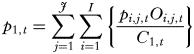 $$p_{1,t} = \sum\limits_{\,j = 1}^J {\sum\limits_{i = 1}^I {\left\{ {\displaystyle{{\,p_{i,j,t} O_{i,j,t}} \over {C_{1,t}}}} \right\}}} $$
where O i,j,t is the egg production from female worms of worm age cohort i at time point t in sheep j, and C 1,t is the total number of new eggs on pasture at this time-point. Frequency p for the entire larval population is then simply the weighted average across all worm age cohorts.
Simulation procedure and in silico experimental design
A population of 10 000 lambs was simulated to be grazing on a medium-quality pasture (crude protein = 140 g kg−1 DM, metabolizable energy = 10 MJ kg−1 DM (AFRC, 1993)), at a density of 30 lambs ha−1 for a period of 4 months from weaning to 6 months of age. The lambs were assumed to be initially parasitologically naïve and the initial larval contamination of pasture was set to 3000 T. circumcincta larvae kg−1 DM pasture. Lambs initially ingest around 1 kg DM d−1 and thus this level corresponds to a trickle challenge level shown by Coop et al. (Reference Coop, Sykes and Angus1982) to lead to subclinical infections.
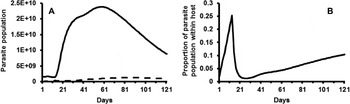
To determine the most appropriate drenching occasions during the grazing season, a simulation was run to determine the total population of nematodes (eggs, larvae and adult worms) and the parasitic population (larvae and adult worms) resident within a host population given no anthelmintic treatment (Fig. 1). The initial proportion of the nematode population resident within the host population rose rapidly until day 13 as larvae were ingested from pasture, and decreased again after ingested larvae matured to adult worms and started contributing eggs, causing a rapid expansion of the nematode population on pasture (infective larvae + eggs) on day 14. Following this period, the proportion of nematodes within host rose steadily for the remainder of the simulated grazing season. As a consequence, day 30 was chosen as the first drenching occasion due to the low proportion of the nematode population resident within host and a high total population of nematodes, thus representing a high refugia pool. Day 60 was chosen as the second drenching occasion due to this being the time-point at which the highest total parasite population was predicted. Finally, day 90 was chosen as the third drenching occasion, such that drenching would occur at 30-day intervals and thus represent a neo-suppressive control strategy (Sargison et al. Reference Sargison, Jackson, Bartley, Wilson, Stenhouse and Penny2007). Hence, 4 scenarios were created to represent a range of drenching frequencies, namely, no treatment (no drenches), drenching at day 30 (1 drench), drenching on days 30 and 60 (2 drenches) and drenching at 30-day intervals (3 drenches).
(A) Total parasite population (solid line) and parasite population within host (dashed line), (B) proportion of parasite population within host; for a population of 10 000 lambs grazing on a medium-quality pasture with an initial pasture contamination of 3000 Teladorsagia circumcincta larvae kg−1 DM pasture.

Targeted selective treatment (TST) was achieved by drenching a percentage of the lamb population according to a given determinant criterion. The determinant criteria evaluated for use in a TST regime included live weight (LW, kg), growth rate (kg d−1), FEC (eggs g−1 DM feces), a combination of LW and FEC, and random selection. LW was assumed to be measured the day prior to treatment with lighter lambs preferentially drenched. Growth rate was calculated assuming that lambs were weighed at the start of the grazing season and on the day prior to each treatment, with lambs preferentially drenched according to the lowest weight gain since the last weighing. FEC measurements were assumed to be taken 5 days prior to treatment to allow time for the samples to be processed and analysed, with a random sampling error with a variance of 0·2 (Bishop et al. Reference Bishop, Bairden, McKellar, Park and Stear1996; Stear et al. Reference Stear, Boag, Cattadori and Murphy2009) added to recorded values. Subsequently, lambs with the highest FEC were preferentially drenched. The combination of LW and FEC was achieved by using sampled FEC and LW measured as described above. Log-transformed FEC (ln(FEC + 1)) and LW were weighted according to their respective standard deviations, and the traits combined by adding negative LW to log-transformed FEC. Lambs were then preferentially drenched according to the highest values. Finally, random selection was achieved using a random number generator to identify the lamb IDs to be drenched. In order to investigate a range of TST scenarios, treatment was assumed to occur for each of the 10th percentiles (10%, 20%, …, 90%, 100%) of the host population as indicated by each of these determinant criteria.
‘Short-term’ effects
To investigate the short-term impact of drenching frequency and TST strategies on sheep perfomance and the emergence of anthelmintic resistance, the population of lambs was simulated over a single grazing season for each of the drenching frequencies and TST scenarios, initially using FEC as the determinant criterion due to this trait being the most effective criterion investigated here (see below). Output traits recorded included performance traits such as average empty body weight (EBW, kg), epidemiological traits such as pasture contamination (PC, larvae kg−1 DM grass), parasitological traits such as average worm burden (WB) and average FEC (eggs g−1 DM feces), and anthelmintic-resistance traits such as the proportion of worms in refugia and the frequency of R in the nematode population on pasture.
Subsequently, to compare the various determinant criteria described above, the population of lambs was grazed over a single grazing for each of the TST scenarios and each of the determinant criteria for a single drenching occasion on day 30. Results for additional drenches are not reported here, as they give a similar pattern of results when comparing determinant criteria. Output traits recorded included average EBW, average FEC and the frequency of R in the nematode population on pasture at the end of the grazing season (day 121).
‘Long-term’ effects
To investigate the long-term effects of drenching frequency and TST regimes on sheep performance and the emergence of anthelmintic resistance, the population of lambs was simulated over several years under each of the drenching frequencies and for each of the TST scenarios using FEC as the determinant criterion for anthelmintic treatment, as our results showed FEC to be the most effective criterion (see below). Each year, all input parameters remained the same except that the initial frequency of R was set to the final value from the previous year, thus making the assumption that little selective pressure was placed on the nematode population between the simulated seasons. This is equivalent to a new population of lambs being introduced at the start of each grazing season at pasture. Anthelmintic treatment was abandoned once resistance was determined to be present within the parasite population according to a FEC reduction test as described by Coles et al. (Reference Coles, Bauer, Borgsteede, Geerts, Klei, Taylor and Waller1992). As such, drenching was stopped if the reduction in FEC, in comparison to an appropriate control population, was less than 95% 10 days post-anthelmintic treatment and the lower bound of the 95% confidence level (as calculated using the variance of reduction) was less than 0·9.
Output traits recorded included average EBW, the frequency of R in the nematode population on pasture and the total number of anthelmintics administered before resistance was reported. Further, in order to determine the net benefit of anthelmintic treatment on sheep performance; the increase in EBW attributable to TST, until anthelmintic usage was halted, was calculated by comparing the EBW of the treated population with that of an undrenched population, and summing the benefits across time.
RESULTS
‘Short-term’ effects with FEC as the determinant criterion
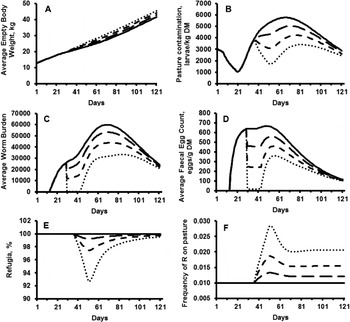
Figure 2 provides a description of the impact of drenching differing proportions of the sheep population, as determined by FEC for a single anthelmintic treatment administered on day 30, over a single grazing season. In brief, the higher the percentage of the population drenched, the greater the reductions in PC, average WB and average FEC. These reductions in WB and PC resulted in reductions in the impacts of parasitism on average weight gain and consequently increased final average EBW at day 121. Following anthelmintic treatment, the percentage refugia on pasture reduced as the eggs produced from nematodes exposed to anthelmintic treatment developed to infectious larvae. Thus, the higher the percentage of the lamb population drenched, the greater the reduction in refugia. The reduction in refugia peaked around 20 days after the anthelmintic was administered, coinciding with the maximum reduction in PC. Following this, and in the absence of a further anthelmintic treatment, the percentage refugia increased again as the population of infective larvae exposed to anthelmintic treatment was reduced via the mortality rate of infectious larvae on pasture and the ingestion of infective larvae by the grazing sheep population. By the end of the simulated grazing season the PC, average WB, average FEC, and percentage refugia were similar for all percentages of the lamb population drenched.
(A) Average empty body weight (kg), (B) pasture contamination (larvae kg−1 DM pasture), (C) average worm burden, (D) average fecal egg count (eggs g−1 DM), (E) refugia, %, (F) frequency of R on pasture; for 10 000 lambs grazing on pasture initially contaminated with 3000 Teladorsagia circumcincta larvae kg−1 DM and either given no anthelmintic drench (solid line), 20% of lambs drenched (long dash), 50% of lambs drenched (short dash), or all lambs drenched (dotted). Anthelmintic treatment was administered on day 30, and the percentage of lambs drenched was determined using FEC.

However, the same trend was not predicted for the frequency of R within the nematode population on pasture. Following anthelmintic treatment, the frequency of R on pasture rapidly increased due to the high frequency of R within the surviving parasitic burdens of the host population. The eggs produced by this population took 7 days to develop to infective larvae on pasture (Young et al. Reference Young, Anderson, Overend, Tweedie, Malafant and Preston1980), and thus there was a period following anthelmintic treatment in which lambs ingested larvae from pasture where the frequency of R was unaffected by the anthelmintic treatment. Thus the frequency of R on pasture, after peaking around 20 days post-anthelmintic treatment, reduced as the frequency of R within the host population was diluted by new susceptible adult worms establishing. The frequency of R on pasture stabilized around 40 days following anthelmintic treatment with increasing drenching percentages of the host population leading to increasing final frequencies of R on pasture at the end of the grazing season.
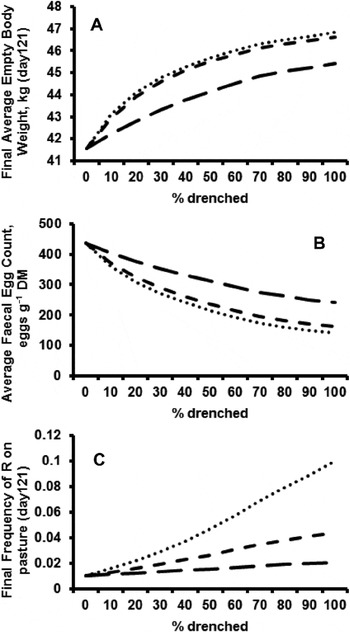
Figure 3 gives the final average EBW, average FEC and final frequency of R on pasture for populations of lambs drenched at differing percentiles as determined by FEC, for the differing drenching frequencies. For all drenching frequencies, the final average EBW increased and the average FEC decreased, with increased percentage of the population drenched. The relationship between final average EBW (or average FEC) and percentage of the population drenched was curvi-linear with anthelmintic drenching having a decreasing impact on final average EBW and average FEC as the percentage of the population given anthelmintic treatment increased.
(A) Final (day 121) average empty body weight (kg), (B) average (days 14–121) fecal egg count (eggs g−1 DM), (C) frequency of R on pasture; for 10 000 lambs grazing on a pasture initially contaminated with 3000 Teladorsagia circumcincta larvae kg−1 DM and drenched by percentage of population according to FEC either once (on day 30, long dash), twice (on days 30 and 60, short dash), or 3 times (days 30, 60 and 90, dotted).

However, each drenching occasion did not have equal impact on the final average EBW and average FEC. Whilst a single anthelmintic treatment on day 30 had an impact on both final average EBW and average FEC for all of the differing percentages of the population drenched, the administration of a second drench on day 60 only increased this impact by ∼58% (rather than doubling it) and the administration of a third drench at day 90 only added a further 6%. Thus, the third drench on day 90 had only a minimal impact on the final average EBW and average FEC.
The final frequency of R on pasture increased with increasing drenching frequency and proportion of the host population drenched. The increase in the frequency of R for the 2 drench scenario was around 3-fold that predicted for the 1-drench scenario, whilst the same values for the 3-drench scenario were around 7-fold for the same comparison. Thus, increasing the drenching frequency reduced the benefits derived from each anthelmintic treatment whilst increasing the rate of emergence of anthelmintic resistance.
Comparison of determinant criteria
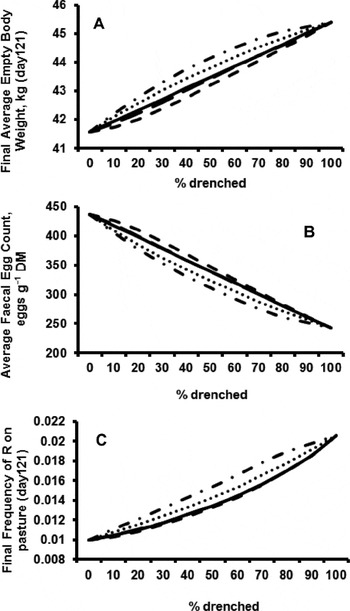
Figure 4 gives the final average EBW, average FEC and final frequency of R for the populations of lambs drenched at differing percentiles as determined either randomly or by LW, growth rate, FEC or the combination of LW and FEC, and given a single drench on day 30. As previously mentioned, the optimal determinant criterion for use in a TST regime may be considered to be the trait that provides the highest level of flock performance (in terms of weight gain) for a given percentage of animals drenched. As such, a good determinant criterion would produce a convex curvi-linear relationship between final average EBW and percentage drenched. Random selection of lambs, included as a control against which the determinant criteria could be evaluated, was predicted to result in a linear relationship between final EBW and percentile of the lamb population, similarly for average FEC.
(A) Final (day 121) average empty body weight (kg), (B) average (days 14–121) fecal egg count (eggs g−1 DM), (C) frequency of R on pasture, for 10 000 lambs grazing on a pasture initially contaminated with 3000 Teladorsagia circumcincta larvae kg−1 DM and drenched on day 30 by percentage of population either randomly (solid line) or according to fecal egg count (dash dot), live weight (long dash), growth rate (short dash) or the combination of fecal egg count and live weight (dotted).

Using FEC as the determinant criterion was predicted to result in the best relationship between EBW (or FEC) and percentage drenched, with ever-reduced percentages of the population drenched being predicted to result in slightly greater marginal increases in EBW and decreases in FEC. Using the combination of LW and FEC was predicted to be the second best determinant criterion, with the beneficial impacts of using this marker being predicted to be half-way between those predicted for FEC alone and drenching randomly. However, using LW as the determinant criterion was predicted to give little to no improvement in comparison to randomly selecting animals. Further, using growth rate as the determinant criterion was predicted to give concave relationships between output traits and the proportion drenched, and hence was worse than selecting animals randomly for treatment.
The predictions for final frequency of R on pasture for each of the determinant criteria being assessed are shown in Fig. 4C. Criteria that had more favourable impacts on average FEC, such as using FEC as the determinant criterion, resulted in higher predicted frequencies of R in comparison to random selection of lambs. However, for all determinant criteria, the final frequency of R reduced with reducing percentiles of the population drenched.
‘Long-term’ effects
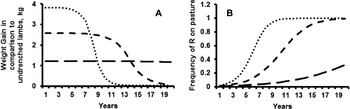
Figure 5 gives an example of how the frequency of R and the average EBW gain attributable to anthelmintic treatment change over time (years) for differing drenching percentiles for a single drench at day 30, using FEC as the determinant criterion. In these examples the simulation was allowed to continue past the point at which the anthelmintic failed the FEC reduction test. Drenching higher percentages of the lamb population was initially predicted to result in higher average EBW gain. However, increasing the percentage of the population drenched also caused an increase in the rate at which anthelmintic resistance emerged in the parasite population, with the frequency of R increasing earlier for higher drenching percentages. This increase in the frequency of R caused decreased anthelmintic efficacy and therefore the average EBW gain decreased as the frequency of R in the nematode population on pasture increased. Thus, drenching higher proportions of the host population initially led to an increased average EBW gain, but a shorter duration of anthelmintic efficacy.
(A) Average weight gain in comparison to undrenched lambs (kg), (B) frequency of R on pasture; for 10 000 lambs grazing on pasture per year and initially contaminated with 3000 Teladorsagia circumcincta larvae kg−1 DM. Either 20% (long dash), 50% of (short dash), or all lambs were given anthelmintic treatment on day 30 (dotted) using FEC as the marker for TST over a period of 20 years.

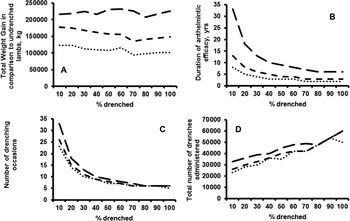
Figure 6A gives the total benefits of differing drenching frequencies for all drenching percentiles, using an FEC reduction test as a criterion for when to abandon the anthelmintic drenching. The FEC reduction test (Coles et al. Reference Coles, Bauer, Borgsteede, Geerts, Klei, Taylor and Waller1992) was found to result in an anthelmintic drench failing if the frequency of R on pasture was equal to or greater than 0·2 prior to the anthelmintic treatment being administered, representing a frequency of R just prior to the large and rapid reductions in efficacy as predicted in Fig. 5. The total EBW gain attributed to anthelmintic treatment until resistance was reported was predicted to increase with decreasing drenching frequency, as might be expected from the predictions given in Fig. 3. However, the total EBW gain attributed to anthelmintic treatment was predicted to be largely independent of the percentage of the host population drenched. Whilst total additional weight gain (i.e. the benefits of the anthelmintic summed across all animals and all years) was largely unaffected, decreasing the drenching frequency and percentage of the population drenched was predicted to result in increased duration of efficacy (Fig. 6B) and number of drenching occasions (Fig. 6C), whilst decreasing the total number of anthelmintic treatments administered (Fig. 6D).
(A) Total weight gain in comparison to undrenched lambs across the life time of anthelmintic (kg), (B) duration of efficacy (years), (C) number of drenching occasions, (D) total number of drenches administered; for 10 000 lambs grazing on a pasture initially contaminated 3000 Teladorsagia circumcincta larvae kg−1 DM each year up to 33 years and given an anthelmintic drench at day 30 (long dash), days 30 and 60 (short dash), or days 30, 60 and 90 of each grazing season (dotted).

DISCUSSION
Refugia-based strategies, including TST, have previously been suggested as a method of reducing the rate of development of anthelmintic resistance whilst retaining sustainable levels of parasitic control. Most field studies investigating these strategies have focused on the short-term (4–12 months) impacts of such strategies on performance traits (Kenyon and Jackson, Reference Kenyon and Jackson2012), due to the difficulty in assessing small changes in anthelmintic resistance over short time-periods (Besier, Reference Besier2012). Although, Leathwick et al. (Reference Leathwick, Miller, Atkinson, Haack, Alexander, Oliver, Waghorn, Potter and Sutherland2006b) reported a field study that investigated the impact of drenching adult ewes and lambs on the development of anthelmintic resistance over a 5-year time-period. Conversely, most modelling studies have tended to focus on the long-term (20–40 years) impact of such strategies on the emergence of anthelmintic resistance (Barnes et al. Reference Barnes, Dobson and Barger1995; Leathwick, Reference Leathwick2012), although shorter-term (9–12 months) investigations of the impacts of drenching on the development of anthelmintic resistance have also been reported (Leathwick et al. Reference Leathwick, Vlassoff and Barlow1995; Learmount et al. Reference Learmount, Taylor, Smith and Morgan2006). Here we used modelling to link performance traits and anthelmintic resistance, over both short and long time horizons, when evaluating various TST strategies.
In principle, 3 factors influence the effectiveness of TST, namely, (i) the proportion of animals drenched at each treatment, (ii) the number and timing of treatments and (iii) the determinant criterion used to rank animals for treatment. In terms of the first factor and for all determinant criteria, decreasing the proportion of the lamb population drenched was predicted to reduce the benefits of anthelmintic treatment on average EBW, but decrease the rate at which anthelmintic resistance develops (reduce the increase in the frequency of the R allele). Further, the short-term impact of anthelmintic drenching on the frequency of R was predicted to be similar to the profile described by Leathwick et al. (Reference Leathwick, Vlassoff and Barlow1995), where a simulation model for nematode infections in lambs was used to explore the impact of anthelmintic drenching on the development of anthelmintic resistance. These results reflect the trade-off between resistance management and the effective control of parasitism (Besier, Reference Besier2012).
Refugia-based strategies usually involve alterations to the timing and frequency of anthelmintic drenches, such that animals are drenched at a time when a high refugia pool is present on pasture. The investigation into drenching frequency, the second factor identified above, predicted that with each consecutive drench the impact on EBW reduced such that the third drenching occasion had minimal impact on EBW. However, each consecutive drench was predicted to have an increasing impact on the frequency of resistance alleles, with this change coinciding with reductions in refugia. Further, increasing proportions of the nematode population in refugia at the time of drenching were predicted to lead to a decreased impact on the frequency of R. Thus, these predictions provide support for the use of refugia-based strategies, with reduced drenching frequencies leading to increasing performance benefits and decreased rate of emergence of anthelmintic resistance.
In terms of the third factor, numerous determinant criteria have previously been proposed for use in TST regimes, including indicators of host resistance (FEC) and host resilience (LW and weight gain). However, FEC has only been evaluated as a determinant criterion for TST by assessing the impact on milk production in adult ewes (Cringoli et al. Reference Cringoli, Rinaldi, Veneziano, Mezzino, Vercruysse and Jackson2009; Gallidis et al. Reference Gallidis, Papadopoulos, Ptochos and Arsenos2009), and thus no comparison could be made between experimental studies and the predictions for impact on lamb growth. In the comparison reported here, using FEC as the determinant criterion was predicted to allow the highest level of performance (average EBW) for all percentages of the flock drenched, whereas LW and growth rate were predicted to give little to no improvement in comparison with selecting animals at random. In fact, the use of growth rate resulted in a worse relationship between the number of anthelmintics administered and the average EBW than selecting animals at random. FEC may be considered a good determinant criterion due to it being an appropriate indicator of parasitic burden, even when factors such as sampling error, fecal dilution and the density-dependent effects on fecundity are taken into account. However, performance traits, such as LW and growth rate, are both affected by many factors other than gastrointestinal parasitism. Such factors may include the link between food intake and growth rate (Cammack et al. Reference Cammack, Leymaster, Jenkins and Nielsen2005), such that lambs with a faster growth rate ingest more grass and are exposed to a greater parasitic challenge than lambs with a slower growth rate. Currently all experimental studies investigating TST regimes have only compared the selectively treated groups to a scenario in which all animals are treated, whilst failing to evaluate the determinant criteria against a group where an equal number of animals are randomly selected to remain untreated.
It is informative to re-evaluate published studies on this topic. Leathwick et al. (Reference Leathwick, Waghorn, Miller, Atkinson, Haack and Oliver2006a) used LW to identify the 10% heaviest lambs which then remained untreated for flock drenches administered at 28-day intervals over a period of 8 months. The average LW gain of the group in which this targeted selective treatment was implemented was then compared with a group where all lambs received treatment on each drenching occasion. Whilst no significant differences were reported between groups for mean monthly LW gain, our analysis of their reported results suggests that the total LW gain across the entire experimental period for the group in which targeted selective treatment was implemented was reduced by 12% in comparison to the group where all animals received treatment. However, our simulations predicted only a 2% reduction in total weight gain, under the same scenario. In a field study investigating the impact of TST regimes on the development of anthelmintic resistance, Leathwick et al. (Reference Leathwick, Miller, Atkinson, Haack, Alexander, Oliver, Waghorn, Potter and Sutherland2006b) used LW to identify the 15% heaviest lambs which then remained untreated for flock drenches administered on 6 occasions per year (at 21 to 28-day intervals) for a period of 5 years. For T. circumcincta infections, no significant differences were reported between this TST group and a group where all lambs were treated on each drenching occasion. The mean efficacy of albendazole (across treatment groups) against T. circumcincta, measured as the percentage reduction in worm counts, was reported to be 25%, 15% and 22% in the final 3 years of the study. A re-parameterization of our model to match the experimental conditions of this field study yielded predicted anthelmintic efficacies (using worm counts) of 92%, 68%, 35%, 19% and 12% for years 1 to 5 for the TST group, and 85%, 42%, 17%, 11%, 10% for the group where all lambs were treated. Thus, on average the simulated values are close to the reported values. Finally, Gaba et al. (Reference Gaba, Cabaret, Sauvé, Cortet and Silvestre2010) used an LW and FEC index, similar to that outlined here, to selectively treat 10% of lambs within a group for a monthly drenching regime. The average LW gain and FEC of this group were then compared with a group where all lambs received a monthly drench. Whilst no significance was attained, the selectively treated group was reported to have a 7·7% reduction in total LW gain, and a 35% increase in FEC, in comparison to the group where all lambs were treated. Simulation of this scenario with our model predicted a 10% reduction in total weight gain and a 40% increase in FEC, i.e. closely matching the published results.
Although our simulations appear to be in good agreement with reported experiments of TST, it should be noted that evaluating model predictions by comparison to field studies may be constrained by differences in climatic conditions, population sizes, species compositions, management practices and levels of drug resistance. For example, in the studies of Leathwick et al. (Reference Leathwick, Waghorn, Miller, Atkinson, Haack and Oliver2006a) a mixed-species infection was identified including parasitism with H. contortus and, as such, the impacts of parasitism on weight gains may be expected to differ from simulations where only T. circumcincta infections have been modelled. In the study performed by Gaba et al. (Reference Gaba, Cabaret, Sauvé, Cortet and Silvestre2010) only 12 lambs were included in each group thus, despite the apparent agreement of our simulations with the reported results, the study size may be too small to make an objective comparison. Currently, there are insufficient field studies investigating TST regimes and differing determinant criteria to make an adequate comparison to the predictions reported here; however, our model predictions provide a starting point from which expectations may be developed.
The long-term impact of drenching frequency and TST regimes on the frequency of the R allele reported here are very similar to those reported in previous simulation studies (Barnes et al. Reference Barnes, Dobson and Barger1995; Gaba et al. Reference Gaba, Cabaret, Sauvé, Cortet and Silvestre2010; Leathwick, Reference Leathwick2012). However, the long-term impacts of drenching frequency and TST regimes on sheep performance have not previously been investigated. Whilst no major differences were predicted in total weight gain benefits (summed across all animals and years) across the differing TST percentiles for the lifetime of the anthelmintic, reducing the proportion of the lamb population drenched increased the duration of anthelmintic efficacy and reduced the total number of drenches administered before resistance was reported. This last observation is not necessarily a negative result, as it reflects a reduction in the number of unnecessary drenches, and hence less wasted money. Treatments which are effectively targeting lambs with a high parasitic burden may, as a consequence, be expected to have a greater impact on the emergence of anthelmintic resistance due to the fact that they more effectively apply selection pressure for resistance, creating a catch-22 situation. Lastly, reducing the frequency of anthelmintic treatment was predicted to lead to increased total gain in EBW and a prolonged duration of anthelmintic efficacy. Thus, in the long term, reducing the drenching frequency increased total (long-term) sheep productivity, whilst reducing the proportion of animals treated increased the duration of efficacy and reduced unnecessary drenches.
The description of anthelmintic resistance used in this model was such that resistance was under monogenic control (Elard and Humbert, Reference Elard and Humbert1999), conferred by a recessive allele (Silvestre and Cabaret, Reference Silvestre and Cabaret2002), with all genotypes being assumed to be equally fit (Barrett et al. Reference Barrett, Jackson and Huntley1998; Elard et al. Reference Elard, Sauve and Humbert1998). However, resistance to anthelmintics such as avermectins and levamisole appear to be multigenic (Gilleard, Reference Gilleard2006), the mode of inheritance of anthelmintic resistance may differ between anthelmintic drugs, and the fitness of resistant and susceptible genotypes may also differ (Leignel and Cabaret, Reference Leignel and Cabaret2001). Alterations in any of these assumptions may be expected to alter the rate at which anthelmintic resistance develops (Barnes et al. Reference Barnes, Dobson and Barger1995). In particular, modelling resistance as multigenic or including decreased fitness for genotypes with greater resistance will reduce the rate of emergence of anthelmintic resistance. Hence, the scenarios investigated here may represent greater risk situations than sometimes seen under field conditions.
In summary, this study has provided insights into the short- and long-term impacts of TST regimes and drenching frequency on both sheep production and the emergence of anthelmintic resistance, providing valuable information previously absent from published literature; these insights may also have more general implications into the use of chemotherapeutics against parasites where drug resistance may be an issue. Specifically, FEC was identified as an appropriate trait for use as a determinant criterion in TST strategies; however, the optimal proportion of the lamb population to be treated is a trade-off between short- and long-term evolution risks for anthelmintic resistance. Paradoxically, the TST strategies most likely to give good short-term parasite control are those that are most efficient at exerting selective pressure on the parasite population.
The results presented in this paper consider baseline scenarios, and do not account, for example, for further management strategies that may be employed due to the availability of limited resources or due to a combination of control strategies being used (Laurenson et al. Reference Laurenson, Kyriazakis and Bishop2012b). In order to acquire a deeper understanding of the practicality of implementing such strategies an in-depth analysis of the associated economic and logistical factors would be required. Such factors may be expected to affect the conclusions drawn in this paper regarding which determinant criteria may provide the best indicator for TST, especially in terms of practical implementation. For example, with current technologies using a FEC monitoring scheme to assess the FEC of individual sheep would be time consuming and expensive, and thus may offset the potential production benefits identified here. In this case farmers may continue dosing all sheep, albeit with suboptimal anthelmintics.
ACKNOWLEDGEMENTS
All authors contributed equally to the research, including model construction, design and conduct of the experiments, and interpretation of the outcomes.
FINANCIAL SUPPORT
Y.C.S.M.L. was funded by a Biotechnology and Biological Sciences Research Council (BBSRC) CASE Studentship in conjunction with Merial, with further financial support from Biosciences Knowledge Transfer Network (Biosciences KTN). The contribution from S.C.B. was funded by a BBSRC Institute Strategic Programme Grant.