INTRODUCTION
Without a known cure for amyotrophic lateral sclerosis (ALS), treatment remains aimed at slowing disease progression, symptom management, and maintaining quality of life (QoL) (Hardiman et al., Reference Hardiman, van den Berg and Kiernan2011; Kiernan et al., Reference Kiernan, Vucic and Cheah2011; Turner et al., Reference Turner, Hardiman and Benatar2013). Solely focusing on physical function is not sufficient to maintain a satisfactory QoL (Ganzini et al., Reference Ganzini, Johnston and Hoffman1999; Simmons et al., Reference Simmons, Bremer and Robbins2000; Winhammar et al., Reference Winhammar, Rowe and Henderson2005); psychosocial factors play an equal role (McLeod & Clarke, Reference McLeod and Clarke2007). Identifying and managing psychological morbidity remains paramount. Developing and implementing appropriate treatment for psychological distress relies on diagnostic certainty, combined with an understanding of risk factors that predispose and precipitate distress.
Measures of depression are frequently employed to assess psychological morbidity in patients with ALS. However, identifying the signs and symptoms of depression is often complicated because standard psychological assessment of depression involves evaluating somatic symptoms (American Psychiatric Association, 2000) that may be a direct result of ALS. Delineation is further complicated by the overlap between symptoms of depression and grief related to anticipated losses (Kübler-Ross, Reference Kubler-Ross1969). Patients with ALS must deal with multiple psychological and social issues related to loss of health and autonomy, all of which may exacerbate feelings of grief (McLeod & Clarke, Reference McLeod and Clarke2007; Taylor, Reference Taylor2006).
Assessment of general mental health risk factors is not routinely undertaken in ALS, making it difficult to determine whether depressive symptoms are natural responses to a diagnosis of a terminal illness or form part of a major depressive disorder (Averill et al., Reference Averill, Kasarskis and Segerstrom2007). Some studies have briefly examined personal history of depression, where approximately one third of ALS patients described a previous depressive episode (Ferentinos et al., Reference Ferentinos, Paparrigopoulos and Rentzos2011; Hammer et al., Reference Hammer, Hacker and Hautzinger2008; Rabkin et al., Reference Rabkin, Albert and Del Bene2005). As such, it remains to be determined whether a previous psychiatric history increases the likelihood of developing subsequent depressive symptoms in the context of ALS.
The results of studies on disease-related correlates of depression have been mixed. While some have identified associations between depression and disease characteristics, including site of onset (Oh et al., Reference Oh, Sin and Schepp2012) and time since ALS diagnosis (Hillemacher et al., Reference Hillemacher, Grassel and Tigges2004; Kubler et al., Reference Kubler, Winter and Ludolph2005; Matuz et al., Reference Matuz, Birbaumer and Hautzinger2010), other studies have found no such relationships (Atassi et al., Reference Atassi, Cook and Pineda2011). Perhaps surprisingly, functional impairment does not appear to be critical (Bungener et al., Reference Bungener, Piquard and Pradat2005; Clarke, Hickey, O'Boyle & Hardiman, Reference Clarke, Hickey and O'Boyle2001; Grehl et al., Reference Grehl, Rupp and Budde2011; Lule et al., Reference Lule, Hacker and Ludolph2008), with depression prevalence and severity remaining constant despite disease progression (Gauthier et al., Reference Gauthier, Vignola and Calvo2007; Rabkin et al., Reference Rabkin, Albert and Del Bene2005). Accordingly, the present study aimed to determine the prevalence of depressive symptoms in ALS patients attending a specialized multidisciplinary clinic, and to explore the relative contribution of general mental health and disease-related risk factors.
METHODS
Patients were prospectively recruited from a specialized multidisciplinary clinic where they were assessed by a neurologist and a multidisciplinary team consisting of a physiotherapist, dietitian, social worker, occupational therapist, speech pathologist, and ALS care coordinator. Patients were typically reviewed at the clinic every three months. One week prior to their appointment at the clinic, patients were invited to complete a medical and psychiatric history questionnaire as well as a validated measure of depression. Only patients with definite, probable, or laboratory-supported probable ALS according to the revised El Escorial criteria (Brooks et al., Reference Brooks, Miller and Swash2000) were included in this study, which was approved by the South Eastern Sydney Local Health District Human Research Ethics Committee. Informed consent was obtained from all participants.
Medical and Psychiatric History
Patients were asked to complete a structured questionnaire on general demographic information (e.g., age, gender, marital status, and level of education) and medical and psychiatric history. Medical history included any medical problems, previous operations, hospital admissions, medications, and allergies. Psychiatric history included previous and current mental health disorders and their treatment as well as illicit drug history.
Functional Impairment
Patients were assessed using the revised Amyotrophic Lateral Sclerosis Functional Rating Scale (ALSFRS–R) (Cedarbaum et al., Reference Cedarbaum, Stambler and Malta1999), a 12-item measure of bulbar, fine motor, gross motor, and respiratory function. Each item was rated on a 4-point scale ranging from 0 (poor function) to 4 (normal function). A total score of 48 indicated normal physical function.
Patients also completed the Addenbrooke's Cognitive Examination–Revised (ACE–R) (Mioshi et al., Reference Mioshi, Dawson and Mitchell2006), a brief multidomain cognitive assessment designed to detect early cognitive symptoms in dementia that has been widely applied in ALS (Lillo et al., Reference Lillo, Mioshi and Burrell2012a ; Reference Lillo, Savage and Mioshi2012b ; Mioshi et al., Reference Mioshi, Lillo and Yew2013). The ACE–R utilizes five subscales: attention/orientation, memory, fluency, language, and visuospatial. A total score below 88 identifies changes in cognitive functioning.
Depression
ALS patients completed the Depression, Anxiety, and Stress Scale–21 (DASS–21) (Lovibond & Lovibond, Reference Lovibond and Lovibond1995), a 21-item measure of depression, anxiety, and stress. The depression scale measured psychological symptoms of depression such as dysphoria and hopelessness rather than somatic symptoms of depression (e.g., lack of energy and disturbed sleep), which could be confounded with ALS symptoms. Each item was rated on a 4-point scale ranging from 0 (did not apply to me at all) to 3 (applied to me very much, or most of the time). The total score ranged from 0 to 42. The cutoff scores defining severity of depressive symptoms relative to the general population were: 0–9 (normal), 10–13 (mild), 14–20 (moderate), 21–27 (severe) and 28+ (extremely severe). A total score above 9 was used to identify patients experiencing depressive symptoms.
Statistical Analysis
Data were screened and analyzed using IBM SPSS Statistics for Windows (v. 21.0, IBM, released 2012). Descriptive statistics (including mean, standard deviation, and distribution) were calculated to determine the characteristics of the sample and to check variables for any violation of the assumptions underlying statistical techniques. Independent-samples t tests for continuous variables and completed chi-square tests for independence for categorical variables (with a Yates Correction for Continuity value when there were two categories in each variable) were employed to determine differences in mental health and disease-related factors between patients with and without symptoms of depression. Direct logistic regression was utilized to assess the impact of mental health and disease-related factors on the likelihood that patients would report depressive symptoms.
RESULTS
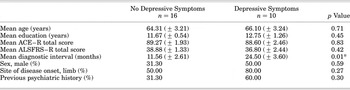
The patient cohort consisted of 27 ALS patients (11 males, 16 females) aged between 42 and 84 years (65.11 ± SE 2.21 years). The majority of patients had limb-onset ALS (59%), with an average diagnostic interval from symptom onset to ALS diagnosis of 16.04 ± SE 2.39 months. The mean ALSFRS–R score was 37.78 ± SE 1.22, which indicated an early stage of the disease. The majority of patients did not have a previous psychiatric history (56%). There were no significant differences in physical function (t(24) = 0.81, p = 0.42), general cognition (t(23) = 0.22, p = 0.83), and previous psychiatric history (χ2(1, n = 26) = 1.07, p = 0.30, φ = 0.28) between patients with and without symptoms of depression (Table 1). Patients with depressive symptoms had a significantly longer diagnostic interval (24.50 ± SE 3.60 months) than patients without depressive symptoms (11.56 ± SE 2.61 months; t(24) = –2.97, p < 0.05, two-tailed).
Patient characteristics according to severity of depressive symptoms

*p ≤ 0.05. The standard error of the mean is provided in parentheses.
Risk Factors for Depression
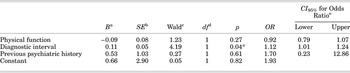
At the time of initial assessment, 62% of ALS patients had no depressive symptoms, while 15% had mild, 19% had moderate, and 4% had extremely severe symptoms of depression. Direct logistic regression was performed to assess the impact of mental health and disease-related factors on the likelihood that patients would develop depressive symptoms. The model contained three independent variables (physical function, diagnostic interval, and previous psychiatric history). The full model containing all predictors yielded significant results (χ2(3, n = 26) = 9.21, Odds Ratio (OR) = 1.12, p < 0.05), indicating that the model was able to distinguish between patients with and without depressive symptoms. The model as a whole explained between 30 (Cox and Snell R 2) and 41% (Nagelkerke R 2) of the variance in depressive symptoms and correctly classified 89% of cases. Only diagnostic interval made a unique statistically significant contribution to the model, recording an OR of 1.12 (Table 2). This indicated that, for every additional month between symptom onset and diagnosis of ALS, patients were 1.12 times more likely to report symptoms of depression, while controlling for other factors in the model.
Logistic regression predicting the likelihood of developing depressive symptoms

*p≤0.05.
aBeta value.
bStandard error of the coefficient.
cWald test.
dDegrees of freedom.
e 95% confidence interval.
DISCUSSION
The present study aimed to determine the prevalence of depressive symptoms in ALS and to identify predictors. Only a small proportion of ALS patients receiving multidisciplinary care reported depressive symptoms. A longer diagnostic interval was the key risk factor for depression, irrespective of general mental health risk factors sufficient by themselves to prompt a psychological assessment. These findings indicate the extent to which illness experiences influence manifestation of depressive symptoms in ALS, with implications for the timely assessment and treatment of psychological morbidity in this patient population.
Diagnostic systems such as the Diagnostic and Statistical Manual of Mental Disorders (DSM–IV–TR) (American Psychiatric Association, 2000) were not intended to take into account the breadth of psychological responses secondary to a disease (van Egeren, Reference van Egeren, Camic and Knight2004). These responses include apprehension related to using adaptive devices and the mild or subthreshold depressive symptoms that are often experienced by patients with ALS (Norris et al., Reference Norris, Que and Bayat2010). As such, the classification of such responses as “mental illnesses” without the presence of significant psychopathology (Periyakoil & Hallenbeck, Reference Periyakoil and Hallenbeck2002) may lead to overdiagnosis and treatment of “normal” responses that may develop following a diagnosis of a terminal illness.
Although the general consensus has been that depression is rare in ALS, much less is known about how the clinical presentation of depression fits into existing diagnostic systems such as the DSM-IV–TR. Investigation of depression in ALS by Clarke and colleagues (Reference Clarke, McLeod and Smith2005) suggested that ALS patients experience more frequent demoralization, hopelessness, and grief compared to patients with advanced cancer. Patients with advanced cancer were found to be considerably more anhedonic (Clarke et al., Reference Clarke, McLeod and Smith2005). Taken together, these findings suggest that depression in ALS is largely defined by unique illness experiences and do not necessarily reflect the hallmark symptoms of depression, particularly pervasive sadness and anhedonia (American Psychiatric Association, 2000).
The devastating nature of ALS requires patients to adapt to multiple losses (McLeod & Clarke, Reference McLeod and Clarke2007), and, as such, emotional expressions of grief such as feelings of sadness and hopelessness can be expected. Mild or subthreshold depressive symptoms may form part of the normal grieving process (Kübler-Ross, Reference Kubler-Ross1969) that accompanies being diagnosed with a terminal illness rather than a depressive disorder as defined by the DSM–IV–TR. It is therefore not surprising that previous psychiatric history, an established mental health risk factor, was not predictive of depressive symptoms in the early stages of ALS.
Grief is thought to vary over time and does not generally affect self-esteem. In contrast, depression is all-encompassing and accompanied by an unstable self-image (Periyakoil & Hallenbeck, Reference Periyakoil and Hallenbeck2002). Available evidence suggests that self-esteem (Goldstein et al., Reference Goldstein, Atkins and Landau2006) as well as depression severity and prevalence in ALS (Gauthier et al., Reference Gauthier, Vignola and Calvo2007; McElhiney et al., Reference McElhiney, Rabkin and Gordon2009; Rabkin et al., Reference Rabkin, Albert and Del Bene2005) are relatively stable across time and disease severity. These findings would support the notion that grief reactions in ALS are more common than clinically significant depressive symptoms, which in turn has treatment implications.
It has been argued that a certain level of depression in terminal illness may be adaptive because it enables patients to prepare for the end of life (Taylor, Reference Taylor2006). The process of anticipatory grief seldom requires pharmacological intervention. In fact, long-term use of therapy to manage anticipatory grief may hinder patients from coming to terms with losses (Periyakoil & Hallenbeck, Reference Periyakoil and Hallenbeck2002). In view of the current findings, psychological support focusing on anticipated loss of the “healthy self” may be particularly useful, especially in the early stages of the disease, given that the average length of the diagnostic interval is about 14 months (Leigh et al., Reference Leigh, Abrahams and Al-Chalabi2003) due to the absence of specific tests and biomarkers for ALS (Kiernan et al., Reference Kiernan, Vucic and Cheah2011). Of relevance, individuals with suspected ALS have been shown to experience marked distress during the diagnostic phase (O'Brien et al., Reference O'Brien, Whitehead and Jack2011; Vignola et al., Reference Vignola, Guzzo and Calvo2008).
The results of the present study should be considered in light of design and methodological issues common to this body of research. In particular, recruitment of patients from a specialized multidisciplinary care clinic might result in selection bias, with patients who are coping well more likely to participate in research in the first place. A multidisciplinary approach to care in ALS has been associated with better quality of life (van den Berg et al., Reference van den Berg, Kalmijn and Lindeman2005) and prolonged survival time (Traynor et al., Reference Traynor, Alexander and Corr2003). It is also possible that subtle cognitive and behavior changes affected a patient's ability to accurately communicate depressive symptoms.
In conclusion, the present study has identified that risk factors for depression in ALS are not necessarily similar to general mental health risk factors. The illness experiences of patients with ALS play a critical role in clinical manifestation of depression, which in turn determines how depression is conceptualized, assessed, and best treated in this patient population.
ACKNOWLEDGMENTS
We thank all participants who took part in the present study. Funding support from the National Health and Medical Research Council of Australia (grant number 1037746) and the Motor Neurone Disease Research Institute of Australia is gratefully acknowledged.