





Non-technical Summary
The cladoxylopsids are a group of Early Devonian to early Carboniferous plants known primarily for including the first species that grew as trees. They are also hypothesized to have given rise to the living horsetails and ferns and, thus, hold the key to understanding the deep evolutionary history and relationships of these groups. Despite these aspects of evolutionary importance and the fact that the group was recognized more than one-and-a-half centuries ago, the study of cladoxylopsids poses challenges due to their complexity and (in some cases) size, and the group has consequently remained relatively understudied. Fossil discoveries and substantial progress in our understanding of the group over the last 30 years have nevertheless increased our knowledge of these plants in areas such as the diversity and evolution of their vascular tissue organization, lateral appendages, growth patterns and architecture; their geographic distribution over time; and the pattern of evolutionary relationships within the group. This review, aimed at providing an entry point to the study of this particularly challenging group, addresses their taxonomic history and the current status and diversity of the different subgroups (iridopterids, and pseudosporochnalean and cladoxylalean cladoxylopsids); their distribution across time and space; and evolutionary trends in their anatomy, morphology, and developmental patterns. Reviewing these aspects led us to identify the main gaps in our understanding of cladoxylopsids and to formulate a series of outstanding questions.
Introduction
The cladoxylopsids, a group of seed-free plants that range from the Early Devonian (Gerrienne, Reference Gerrienne1992; Durieux et al., Reference Durieux, Lopez, Bronson and Tomescu2021; Chu et al., Reference Chu, Durieux and Tomescu2024) into the early Carboniferous (Mississippian) (Bertrand, Reference Bertrand1935; Durieux et al., Reference Durieux, Decombeix and Harper2026), are likely the most underappreciated major lineage of early Paleozoic tracheophytes. The Devonian period witnessed the first major tracheophyte radiation that gave rise to all of the major groups of the clade represented today—lycophytes, sphenophytes, ferns, and seed plants. During the Devonian, multiple lineages within these groups underwent broad diversification (Gensel and Berry, Reference Gensel and Berry2001; Toledo et al., Reference Toledo, Bippus and Tomescu2018, Reference Toledo, Bippus, Atkinson, Bronson and Tomescu2021; Durieux et al., Reference Durieux, Lopez, Bronson and Tomescu2021) and evolved key structures, e.g., leaves (Tomescu and Whitewoods, Reference Tomescu and Whitewoods2024), seeds (Gerrienne et al., Reference Gerrienne, Meyer-Berthaud, Fairon-Demaret, Streel and Steemans2004), deep rooting systems (Morris et al., Reference Morris, Leake, Stein, Berry and Marshall2015), and woody axes (Gerrienne et al., Reference Gerrienne, Gensel, Strullu-Derrien, Lardeux, Steemans and Prestianni2011; Hoffman and Tomescu, Reference Hoffman and Tomescu2013). Among all of these lineages and evolutionary innovations, it has recently become apparent that cladoxylopsids were the first group to acquire a distinct identity, from a morphological standpoint, from among the diverse plexus of early euphyllophytes present in the Early Devonian floras. Something that has not been emphasized enough is that subsequent to their early rise, in a geologically short span of time (~20 Myr), the cladoxylopsids reached impressive taxonomic diversity and a level of morphological disparity paralleled only much later in a few other lineages (Durieux et al., Reference Durieux, Lopez, Bronson and Tomescu2021; Chu et al, Reference Chu, Durieux and Tomescu2024). They are also the first euphyllophyte group to have evolved tall statures (arboreousness), by the Middle Devonian (Goldring, Reference Goldring1927; Berry and Fairon-Demaret, Reference Berry and Fairon‐Demaret2002; Stein et al., Reference Stein, Mannolini, Hernick, Landing and Berry2007; Meyer-Berthaud et al., Reference Meyer-Berthaud, Soria, Decombeix, Vecoli, Clément and Meyer-Berthaud2010; Giesen and Berry, Reference Giesen and Berry2013; Davies et al., Reference Davies, McMahon and Berry2024). Additionally, specific groups among the cladoxylopsids are thought to have represented the ancestral stocks from which ferns and equisetophytes evolved (Skog and Banks, Reference Skog and Banks1973; Stein et al., Reference Stein, Wight and Beck1984; Kenrick and Crane, Reference Kenrick and Crane1997; Rothwell, Reference Rothwell1999). Yet, for all their multifaceted importance, cladoxylopsids have been typically sidelined, if not downright ignored, in discussions of euphyllophyte evolution—‘neontological’ studies rarely mention, let alone thoroughly consider, their presumably crucial connections to living lineages. In addition, on the paleobotanical realm, no targeted phylogenetic studies have to date addressed deliberately and thoroughly their position among the diverse living and extinct euphyllophyte lineages. This is at least in part due to their autapomorphies—they are unlike any of the other groups that succeeded them in plant history—and to the complexity of the organization of these plants. Together, these features make the cladoxylopsids a daunting group to study, especially given the fragmentary state of plant fossils that offer only partial glimpses into the structure of any given species, greatly hindering holistic understanding of these complex plants. Our review of the diversity, structure, systematics, and evolution of cladoxylopsids aims to provide a baseline and framework for addressing the key evolutionary questions raised by this old and important group.
Describing and classifying cladoxylopsid diversity
Early work
The first report of a cladoxylopsid was published by Unger in 1854, and based on it, Unger created the order Cladoxyleae. The diagnosis of the group, which Unger provided later in his 1856 study (p. 178), stated that the plants would be mostly trees and, more importantly for the subsequent studies, that the plants possessed multiple vascular bundles that can fuse or divide along their course through the axes and can be aligned radially around a parenchymatous central zone. In these pioneering studies, Unger (Reference Unger1854, Reference Unger1856) also defined the first cladoxylopsid genus, Cladoxylon Unger, Reference Unger1856, with three species (Cladoxylon mirabile Unger, Reference Unger1856; Cladoxylon dubium Unger, Reference Unger1856; and Cladoxylon centrale Unger, Reference Unger1856), and provided the first reports of two other species that were later included in the genus as Cladoxylon radiatum Bertrand, Reference Bertrand1935 and Cladoxylon taeniatum Solms-Laubach, Reference Solms-Laubach1896 (see Bertrand, Reference Bertrand1935).
The decades that followed Unger’s publications saw work on the taxonomy of the group, which led to the Cladoxyleae being renamed as order Cladoxylales (Hirmer, Reference Hirmer1927) and finally as class Cladoxylopsida (Pichi‐Sermolli, Reference Pichi-Sermolli and Turrill1959). This class (i.e., Cladoxylopsida sensu lato; Berry and Stein, Reference Berry and Stein2000) today includes the orders Iridopteridales and Pseudosporochnales, as well as several taxa referred to as nonpseudosporochnalean cladoxylopsids (Y. Wang and Berry, Reference Wang and Berry2006; Meyer-Berthaud et al., Reference Meyer-Berthaud, Soria and Young2007). The main strokes of this system of classification have recently received support from phylogenetic studies (Durieux et al., Reference Durieux, Lopez, Bronson and Tomescu2021; Chu et al., Reference Chu, Durieux and Tomescu2024), which have refined it by identifying grades and clades within the cladoxylopsids s.l.
The Cladoxylopsida and its subdivisions have been defined since their establishment primarily on anatomical criteria. However, Skog and Banks (Reference Skog and Banks1973) first proposed morphological criteria for distinguishing the Iridopteridales. Much earlier, Potonié and Bernard (Reference Potonié and Bernard1904) provided the first comprehensive description of the morphology of a representative of Pseudosporochnales, Pseudosporochnus krejcii Potonié and Bernard, Reference Potonié and Bernard1904. In that study, they described the genus based on their own specimens and material described earlier by Stur (Reference Stur1882), who had interpreted them as algae. However, the first association of morphological criteria to species with cladoxylopsid anatomy only occurred in the 1960s, by Leclercq and Banks (Reference Leclercq and Banks1962) for Pseudosporochnus Potonié and Bernard, Reference Potonié and Bernard1904 and Leclercq and Schweitzer (Reference Leclercq and Schweitzer1965) for Calamophyton Kräusel and Weyland, Reference Kräusel and Weyland1926.
Current diversity and classification
The three groups currently included in the cladoxylopsids s.l.—the Iridopteridales, the Pseudosporochnales (pseudosporochnalean cladoxylopsids), and the cladoxylalean (nonpseudosporochnalean) cladoxylopsids—can be defined based on anatomical and morphological criteria. Their relationships have been revised in the latest phylogenetic studies (Durieux et al., Reference Durieux, Lopez, Bronson and Tomescu2021; Chu et al., Reference Chu, Durieux and Tomescu2024), which were conducted under the as yet untested assumption that the cladoxylopsids s.l. are monophyletic.
Iridopteridales
Erected by Stein (Reference Stein1982), the group includes the former Ibykales (Skog and Banks, Reference Skog and Banks1973) and Iridopteridineae (Arnold, Reference Arnold1940). Historically, the group has been characterized by the following anatomical criteria (which, however, have not been documented in all the species included; see Table 1): (1) a deeply ribbed (lobed) actinostele with protoxylem strands exclusively at the rib tips; (2) nodes bearing (potentially) two types of lateral appendages, both of which are (3) supplied by single vascular traces diverging from a single lobe; (4) whorled organotaxis; and (5) metaxylem tracheid size decreasing toward the periphery of the xylem (Stein, Reference Stein1982; Berry and Stein, Reference Berry and Stein2000; Cordi and Stein, Reference Cordi and Stein2005; Meyer-Berthaud et al., Reference Meyer-Berthaud, Soria and Young2007; Berry et al., Reference Berry, Stein and Cordi2022). In terms of morphology, iridopterids are characterized by ultimate appendages with three-dimensional dichotomous branching and recurved tips and ellipsoidal sporangia borne at the tips of ultimate appendage segments (Stein, Reference Stein1982; Berry et al., Reference Berry, Stein and Cordi2022).
Iridopteridales species and characters traditionally defining the group
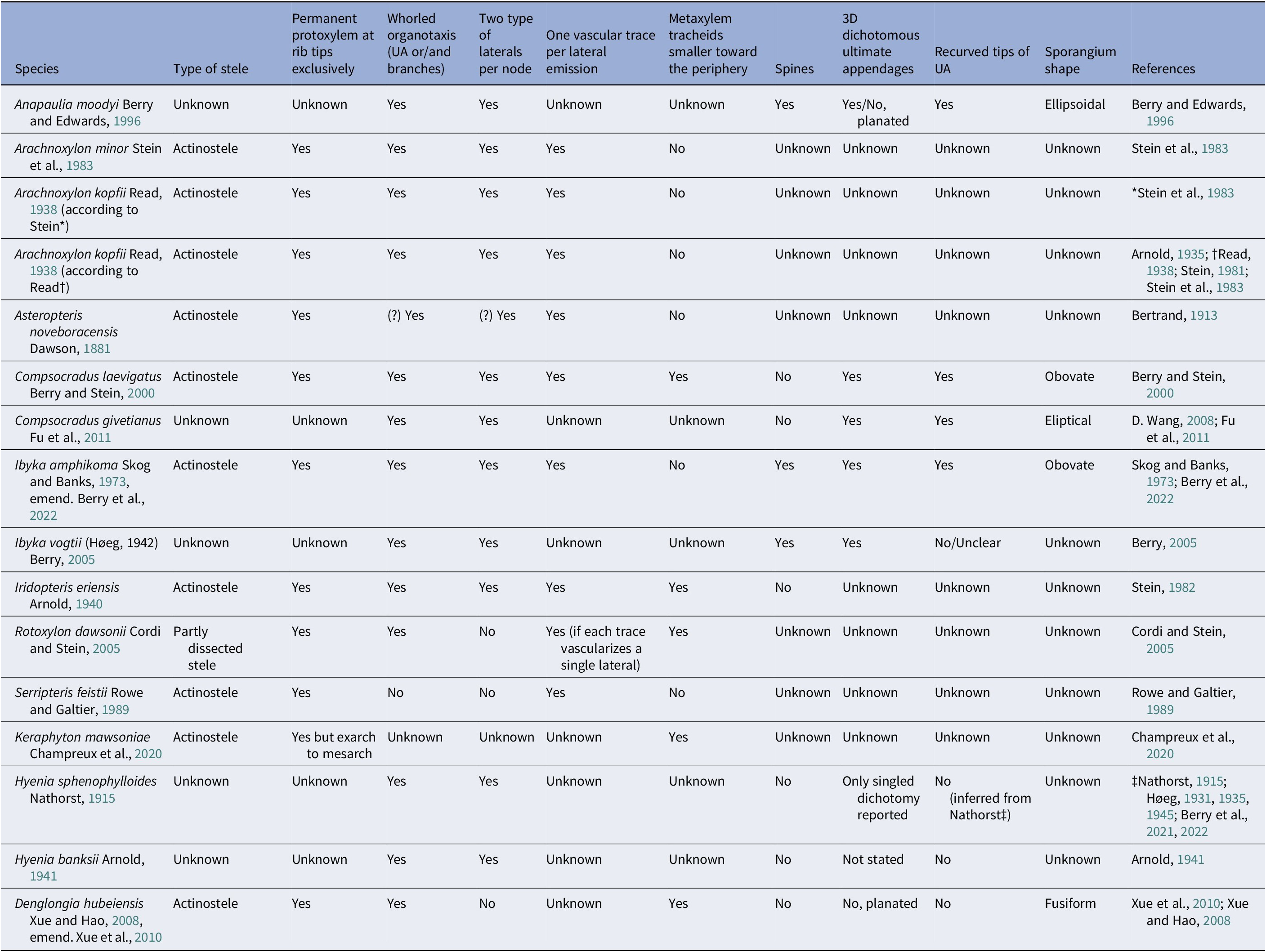
Table 1. Long description
The table consists of 12 columns: Species, Type of stele, Permanent protoxylem at rib tips exclusively, Whorled organotaxis (U A or/and branches), Two type of laterals per node, One vascular trace per lateral emission, Metaxylem tracheids smaller toward the periphery, Spines, 3 D dichotomous ultimate appendages, Recurved tips of U A, Sporangium shape, and References.
Key data points for selected species include:
* Anapaulia moodyi: Unknown stele, whorled organotaxis, spines present, planated appendages, ellipsoidal sporangium.
* Arachnoxylon minor, A. kopfii, and Asteropteris noveboracensis: All feature an Actinostele and permanent protoxylem at rib tips.
* Compsocradus laevigatus: Actinostele, whorled organotaxis, obovate sporangium, and metaxylem tracheids smaller toward the periphery.
* Ibyka amphikoma: Actinostele, whorled organotaxis, spines present, and obovate sporangium.
* Rotoxylon dawsonii: Partly dissected stele, whorled organotaxis, and metaxylem tracheids smaller toward the periphery.
* Denglongia hubeiensis: Actinostele, whorled organotaxis, no spines, planated appendages, and fusiform sporangium.
Most species listed (10 out of 16) are confirmed to have an Actinostele or are unknown. Whorled organotaxis is a near-universal trait among the species where data is available, except for Serripteris feistii.
According to the latest review of the group (Berry et al., Reference Berry, Stein and Cordi2022) and phylogenetic studies (Durieux et al., Reference Durieux, Lopez, Bronson and Tomescu2021; Chu et al., Reference Chu, Durieux and Tomescu2024), the Iridopteridales currently include seven genera encompassing nine species (see Supplementary Data 1 and corresponding references in Supplementary Data 2): Asteropteris noveboracensis Dawson, Reference Dawson1881; Arachnoxylon kopfii Read, Reference Read1938; Arachnoxylon minor Stein et al., Reference Stein, Wight and Beck1983; Iridopteris eriensis Arnold, Reference Arnold1940; Ibyka amphikoma Skog and Banks, Reference Skog and Banks1973, emend. Berry et al., Reference Berry, Stein and Cordi2022; Ibyka vogtii (Høeg, 1942) Berry, Reference Berry2005; Compsocradus laevigatus Berry and Stein, Reference Berry and Stein2000; Compsocradus givetianus Fu et al., Reference Fu, Wang, Berry and Xu2011; and Anapaulia moodyi Berry and Edwards, Reference Berry and Edwards1996. In addition, five satellite genera encompassing six species have been considered as closely related or belonging to the Iridopteridales: Rotoxylon dawsonii Cordi and Stein, Reference Cordi and Stein2005; Hyenia sphenophylloides Nathorst, Reference Nathorst1915 (according to Berry et al., Reference Berry, Stein and Cordi2022); Hyenia banksii Arnold, Reference Arnold1941 (according to Berry et al., Reference Berry, Stein and Cordi2022); Keraphyton mawsoniae Champreux et al., Reference Champreux, Meyer-Berthaud and Decombeix2020; Serripteris feistii Rowe and Galtier, Reference Rowe and Galtier1989; and Denglongia hubeiensis Xue and Hao, Reference Xue and Hao2008, emend. Xue et al., Reference Xue, Hao and Basinger2010. Although the latest phylogenetic studies have not included Keraphyton Champreux, Meyer-Berthaud, and Decombeix, Reference Champreux, Meyer-Berthaud and Decombeix2020 and Hyenia Nathorst, Reference Nathorst1915, they recovered Serripteris Rowe and Galtier, Reference Rowe and Galtier1989 and Denglongia Xue and Hao, Reference Xue and Hao2008, emend. Xue et al., Reference Xue, Hao and Basinger2010 as a grade transitional between the Iridopteridales and the other cladoxylospid, and Rotoxylon Cordi and Stein, Reference Cordi and Stein2005 as a cladoxylopsid sensu stricto (Durieux et al., Reference Durieux, Lopez, Bronson and Tomescu2021; Chu et al., Reference Chu, Durieux and Tomescu2024). In these studies, the Iridopteridales have been recovered as a paraphyletic grade consisting of two clades: an Ibyka-Anapaulia clade and a ‘core iridopterids’ clade, with epidermal extensions and whorled taxis of the ultimate appendages, respectively, as synapomorphies (see Berry et al., Reference Berry, Stein and Cordi2022 for a different viewpoint).
Cladoxylopsids sensu stricto
The broad group of cladoxylopsids s.s. includes taxa that are not placed in the Iridopteridales or are satellite to that order. This term was first used to replace the traditional Pseudosporochnales after a group referred to as nonpseudosporochnalean cladoxylopsids was segregated from the latter by Y. Wang and Berry (Reference Wang and Berry2006) and Meyer-Berthaud et al. (Reference Meyer-Berthaud, Soria and Young2007). The first hint of the existence of nonpseudosporochnalean cladoxylopsids, not named as such at the time, was provided by Cordi and Stein (Reference Cordi and Stein2005), who recognized that some taxa (e.g., Pietzschia Gothan, Reference Gothan1927; Metacladoxylon Z. Wang and Geng, Reference Wang and Geng1997; and Cladoxylon) display combinations of characters from both iridopterids and pseudosporochnaleans. Both the Pseudosporochnales and the nonpseudosporochnalean cladoxylopsids have been recovered as monophyletic in the latest phylogenetic studies, in which the latter are referred to as cladoxylalean cladoxylopsids (Durieux et al., Reference Durieux, Lopez, Bronson and Tomescu2021; Chu et al., Reference Chu, Durieux and Tomescu2024).
The cladoxylopsids s.s. possess deeply lobed and dissected steles with mesarch protoxylem strands located either only at the rib tips, or at the tips as well as along the midplanes of the ribs. Their nodes bear a single type of lateral that is vascularized by traces diverging from multiple xylem ribs (Meyer-Berthaud et al., Reference Meyer-Berthaud, Soria and Young2007; Durieux et al., Reference Durieux, Lopez, Bronson and Tomescu2021).
Pseudosporochnales
This order, erected by Emberger (Reference Emberger1944), currently includes four genera with 11 species (Supplementary Data 1): five species of Pseudosporochnus; three species of Calamophyton (Weyland, Reference Weyland1925); Lorophyton goense Fairon-Demaret and Li, Reference Fairon-Demaret and Li1993; and two species of Wattieza Stockmans, Reference Stockmans1968. In addition, the genera Eospermatopteris Goldring, Reference Goldring1924 and Duisbergia Kräusel and Weyland, Reference Kräusel and Weyland1929 represent the trunk of Wattieza and Calamophyton, respectively (Stein et al., Reference Stein, Mannolini, Hernick, Landing and Berry2007; Giesen and Berry, Reference Giesen and Berry2013). The Early Devonian Adelocladoxis praecox Durieux et al., Reference Durieux, Lopez, Bronson and Tomescu2021 was recovered as sister to this clade (Durieux et al., Reference Durieux, Lopez, Bronson and Tomescu2021) or in a polytomy with the pseudosporochnalean and cladoxylalean clades (Chu et al., Reference Chu, Durieux and Tomescu2024). Pseudosporochnalean cladoxylopsids are characterized by the presence of digitately dissected branches (not present in the juvenile specimen of Lorophyton Fairon-Demaret and Li, Reference Fairon-Demaret and Li1993) and regularly arranged sclerenchymatous groups in the cortex, which were recovered as a synapomorphy of the clade. They also possess an irregular arrangement of the ultimate appendages, which are not recurved at the tips, and can be either entirely dichotomous or consisting of a main axis that bears alternate to whorled dichotomous units (Berry and Fairon-Demaret, Reference Berry and Fairon-Demaret1997; Berry, Reference Berry2000; Y. Wang and Berry, Reference Wang and Berry2006; Meyer-Berthaud et al., Reference Meyer-Berthaud, Soria and Young2007).
Cladoxylalean cladoxylopsids
This group, initially referred to as nonpseudosporochnalean cladoxylopsids (Y. Wang and Berry, Reference Wang and Berry2006; Meyer-Berthaud et al., Reference Meyer-Berthaud, Soria and Young2007; Durieux et al., Reference Durieux, Lopez, Bronson and Tomescu2021), include six genera with 18 species: Panxia gabata (Y. Wang and Berry, Reference Wang and Berry2006) emend. Xue et al., Reference Xue, Huang, Wang, Wang and Hao2016; Rhipidophyton acanthum Berry and Wang, Reference Berry and Wang2006; Polypetalophyton wufengenis (Geng, Reference Geng, Li and Cui1995) emend, Hilton et al., Reference Hilton, Geng and Kenrick2003; four species of Pietzschia; nine species of Cladoxylon; and two species of Polyxylon (Read and Campbell, Reference Read and Campbell1939) emend. Chambers and Regan, Reference Chambers and Regan1986. Phylogenetic analyses by Durieux et al. (Reference Durieux, Lopez, Bronson and Tomescu2021) and Chu et al. (Reference Chu, Durieux and Tomescu2024) have also included in the clade Metacladophyton ziguinum (Z. Wang and Geng, Reference Wang and Geng1997) emend. D. Wang and Lin, Reference Wang and Lin2007 (note that Metacladoxylon tetraxylum Z. Wang and Geng, Reference Wang and Geng1997 was not included in those analyses); Rotoxylon dawsonii; Rhymokalon trichium Scheckler, Reference Scheckler1975; Xenocladia medullosina Arnold, Reference Arnold1940 (Arnold, Reference Arnold1952); and Paracladoxylon kespekianum Chu, Durieux, and Tomescu, Reference Chu, Durieux and Tomescu2024. As mentioned above, this group possesses a combination of iridopteridalean and pseudosporochnalean characters (Table 2). Its members seem to possess a main axis with dissected stele bearing planar branching systems (Y. Wang and Berry, Reference Wang and Berry2006), recognized as a synapomorphy for the clade including Panxia (Y. Wang and Berry, Reference Wang and Berry2006) emend. Xue et al., Reference Xue, Huang, Wang, Wang and Hao2016, Polyxylon, and Pietzchia (Durieux et al., Reference Durieux, Lopez, Bronson and Tomescu2021). In addition, their ultimate appendages, when known, seem to be pseudomonopodial, with a ‘central axis’ bearing alternately/oppositely arranged dichotomous units (Z. Wang and Geng, Reference Wang and Geng1997; Hilton et al., Reference Hilton, Geng and Kenrick2003; Y. Wang and Berry, Reference Wang and Berry2006; Durieux et al., Reference Durieux, Decombeix and Harper2026). The ‘central axes’ of the ultimate appendages have bilateral symmetry and abaxial-adaxial polarity (known in Cladoxylon taeniatum [see Durieux et al., Reference Durieux, Decombeix and Harper2026], Metacladoxylon tetraxylum [see Z. Wang and Geng, Reference Wang and Geng1997]; bilateral symmetry in Cladoxylon waltoni Long, Reference Long1968 and Cladoxylon radiatum). Notably, none of them show evidence of two types of lateral per node or sclerotic nests in the outer cortex (Table 2).
Cladoxylalean cladoxylopsids and comparisons using characters traditionally defining pseudosporochnaleans and iridopteridaleans. UA = ultimate appendages
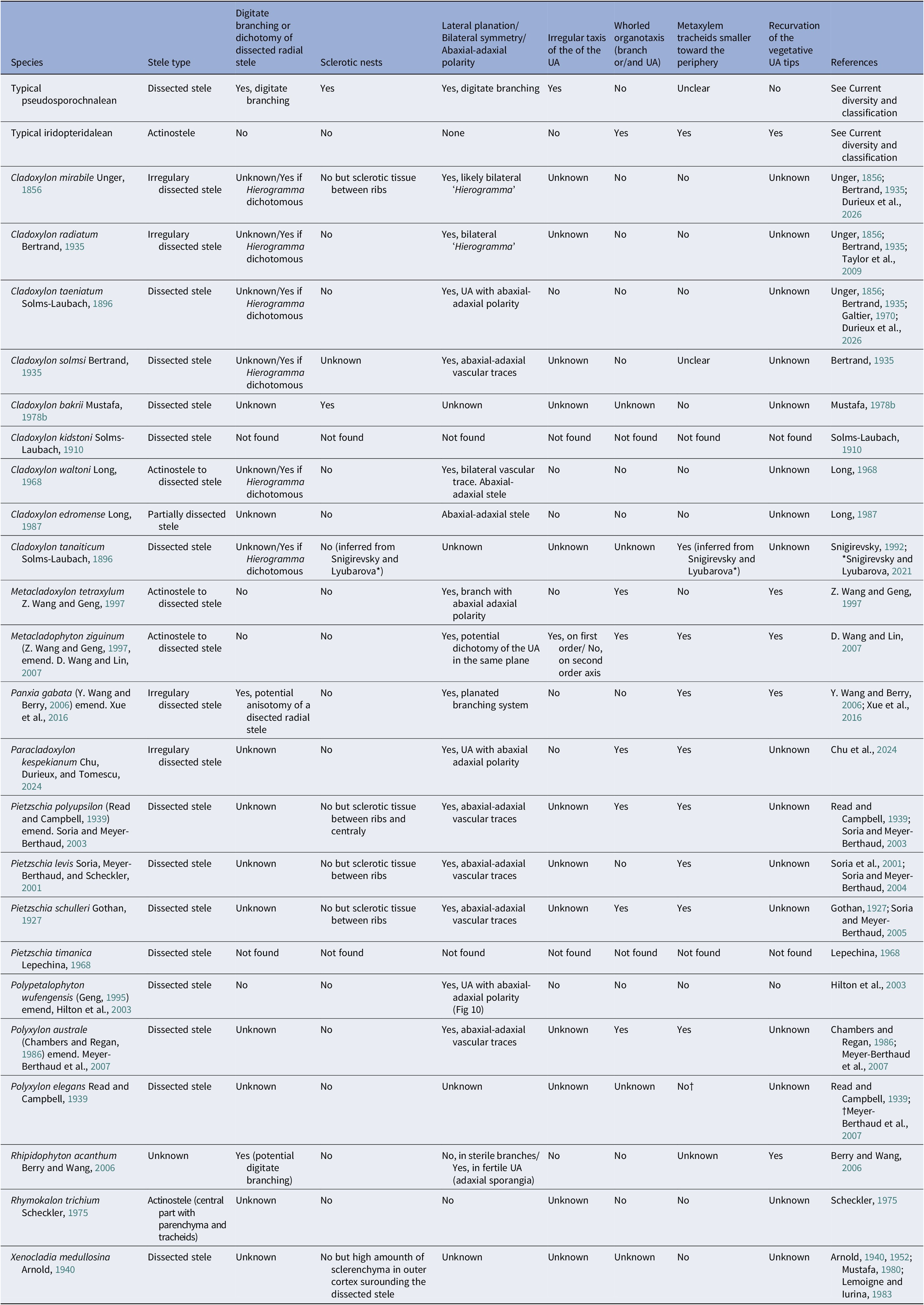
Table 2. Long description
The table compares various species across ten columns: Species, Stele type, Digitate branching or dichotomy of dissected radial stele, Sclerotic nests, Lateral planation/Bilateral symmetry/Abaxial-adaxial polarity, Irregular taxis of the U A, Whorled organotaxis (branch or/and U A), Metaxylem tracheids smaller toward the periphery, Recurvation of the vegetative U A tips, and References.
Key entries include:
* Typical pseudosporochnalean: Dissected stele, Yes to digitate branching, Yes to sclerotic nests, No to whorled organotaxis.
* Typical iridopteridalean: Actinostele, No to digitate branching, No to sclerotic nests, Yes to whorled organotaxis.
* Cladoxylon mirabile: Irregularly dissected stele, Yes to bilateral symmetry, No to whorled organotaxis.
* Metacladophyton ziguinum: Actinostele to dissected stele, Yes to whorled organotaxis, Yes to metaxylem tracheids smaller toward periphery, Yes to recurvation.
* Panxia gabata: Irregularly dissected stele, Yes to planated branching, No to whorled organotaxis, Yes to recurvation.
* Pietzschia species (polyupsilon, levis, schulleri): Dissected stele, No sclerotic nests but sclerotic tissue between ribs, Yes to bilateral symmetry, and Yes to metaxylem tracheids smaller toward periphery.
* Polypetalophyton wufengensis: Dissected stele, No to digitate branching, No to whorled organotaxis, No to recurvation.
* Rhymokalon trichium: Actinostele with central parenchyma, No to lateral planation, No to whorled organotaxis.
U A stands for ultimate appendages. Data points marked as Unknown, Not found, or Unclear are noted for several species including Cladoxylon kidstoni and Pietzschia timanica.
Taxa incertae sedis
The classification outlined above is corroborated from published taxonomic placements and those derived from our own inferences, with or without phylogenetic support. However, there remain several taxa with unresolved exact placement. Xinicaulis lignescens Xu et al., Reference Xu, Berry, Stein, Wang, Tang and Fu2017 and Jerana modica Meyer-Berthaud et al., Reference Meyer-Berthaud, Bert, Decombeix, Lacand, Ramel, Becker, Klug, El Hassani and Tahiri2024 are two such cladoxylopsids incertae sedis: they can be assigned to the cladoxylopsids s.s. based on their dissected steles, but further taxonomic precision has not been provided in their descriptions, and they have not yet been included in any phylogenetic study. Nevertheless, in the case of Jerana Meyer-Berthaud et al., Reference Meyer-Berthaud, Bert, Decombeix, Lacand, Ramel, Becker, Klug, El Hassani and Tahiri2024, its numerous similarities with Pietzschia suggest that it is a cladoxylalean cladoxylopsid. Astralocaulis Hueber, Reference Hueber1971 (see Harris, Reference Harris1929) was hypothesized to represent part of the root system attached to the stem of an arborescent cladoxylopsid s.s. (Soria and Meyer-Berthaud, Reference Soria and Meyer-Berthaud2004). Dixopodoxylon goense Fairon-Demaret, Reference Fairon-Demaret1969 might also represent a cladoxylopsid root, based on its similarity with Pietzschia roots (Soria and Meyer-Berthaud, Reference Soria and Meyer-Berthaud2004). Voelkelia refracta Solms-Laubach, Reference Solms-Laubach1896 and Stenoxylon ludwigii Solms-Laubach, Reference Solms-Laubach1910 can also be included among the cladoxylopsids s.s. based on their dissected stele (see Bertrand, Reference Bertrand1935). However, information on these species is so scarce that they will not be included in our discussions further. This also applies to ‘Chiasmoxylon hueberii’ Sebby, Reference Sebby1972, a taxon that has some iridopterid characters but has only been reported in an unpublished doctoral dissertation by Sebby (Reference Sebby1972). Two Early Devonian plants, Foozia minuta Gerrienne, Reference Gerrienne1992 and Protohyenia janovii Ananiev, Reference Ananiev1957 (Ananiev and Zakharova, Reference Ananiev and Zakharova1986) have been assigned to the cladoxylopsids s.l. based primarily on morphological criteria (see below), but their more precise affinities within the group are not resolved.
Cladoxylopsids, the ‘permanent protoxylem group,’ and the moniliformopsid conundrum
In a seminal paper, Beck and Stein (Reference Beck and Stein1993) proposed a separation of Middle Devonian and younger actinostelic euphyllophytes into two groups, based on their protoxylem architecture. One of these, the ‘radiate protoxylem’ group, was defined by multiple mesarch protoxylem strands located along the midplanes of the actinostele’s xylem lobes plus one strand at the center of the xylem, with all protoxylem strands derived by branching and longitudinal divergence from the central protoxylem. Beck and Stein included in this group the Stenokoleales, early lignophytes (aneurophyte progymnosperms and early seed plants), and some taxa incertae sedis, e.g., Gothanophyton Remy and Hass, Reference Remy and Hass1986, which they separated from a second group that included iridopterids, cladoxylopsids, and sphenopsids. They recognized this second group, the ‘permanent protoxylem’ group, by the lack of a central protoxylem strand and mesarch protoxylem strands located only at the tips of the actinostele’s xylem lobes, with little or less conspicuous protoxylem present internally from those (Stein, Reference Stein1993); the strands at the lobe tips only branched to produce protoxylem strands that departed into the traces to lateral appendages.
Subsequently, in a phylogenetic analysis that included four relevant taxa, Kenrick and Crane (Reference Kenrick and Crane1997) recovered the three genera belonging to the ‘permanent protoxylem’ group (Ibyka Skog and Banks, Reference Skog and Banks1973, emend. Berry et al., Reference Berry, Stein and Cordi2022; Pseudosporochnus; Rhacophyton Crépin, Reference Crépin1875) forming a clade; and for the fourth one, the lignophyte (progymnosperm) Tetraxylopteris Beck, Reference Beck1957—a member of the ‘radiate protoxylem’ group—forming a clade with the basal euphyllophyte Pertica Kasper and Andrews, Reference Kasper and Andrews1972. These results were taken by Kenrick and Crane to provide support for Beck and Stein’s separation of the ‘permanent’ and ‘radiate protoxylem’ groups, which they named the Moniliformopses and Radiatopses, respectively (although of their two radiatopsids, protoxylem architecture was documented only in Tetraxylopteris but not in Pertica, the anatomy of which remains unknown).
In discussing their results, Kenrick and Crane (Reference Kenrick and Crane1997) suggested that (1) their radiatopsid clade (Pertica-Tetraxylopteris) also includes the seed plants, due to their lignophyte clade membership alongside progymnosperms (Tetraxylopteris); and (2) their moniliformopsid clade (Ibyka-Pseudosporochnus-Rhacophyton) is a sphenopsid-fern clade (p. 241), with Ibyka more closely related to sphenopsids and Pseudosporochnus and Rhacophyton more closely related to the living ferns. However, Kenrick and Crane (Reference Kenrick and Crane1997) were also careful to point out (p. 241) that for solid support, the relationships that they recovered among early euphyllophytes would require a more detailed treatment than theirs, and (p. 139) that rigorous testing of their assumptions of close relationships between sphenopsids, living ferns, and the members of their moniliformopsid clade, and between the latter and their radiatopsids require more detailed analyses including a broader sampling of early fossil taxa. Indeed, no phylogenetic analysis to date has included all of the taxa discussed in Kenrick and Crane’s (Reference Kenrick and Crane1997) hypothesis; the only analyses currently available have included only some of the taxa discussed there. A recent analysis by Rastier et al. (Reference Rastier, Capel, Fischer and Prestianni2025) has found support for a sister-group relationship between Ibyka—plus another iridopterid, Compsocradus (Berry and Stein, Reference Berry and Stein2000) emend Fu et al., Reference Fu, Wang, Berry and Xu2011—and the sphenopsid clade. However, that analysis focused on the evolution and systematics of sphenopsids and did not include Rhacophyton or any fern-grade taxon, to (1) test for the latter’s relationships with Pseudosporochnus, and (2) test for the potential(ly disruptive) effects that the polarization of characters associated with inclusion of fern taxa would have on the pattern of relationships supported in their absence. Likewise, Rothwell’s (Reference Rothwell1999) analysis that included Cladoxylon (a close relative of Pseudosporochnus, which was not included in that analysis) and Rhacophyton alongside living and extinct sphenopsids and ferns, recovered those two taxa in a clade that was more closely related to sphenopsids and, together with the latter, to the lignophytes, than they were to the living ferns. Thus, to date, Kenrick and Crane’s (Reference Kenrick and Crane1997) hypothesis remains untested empirically, and it is still unclear how closely related iridopterids are to sphenopsids, and the pseudosporochnalean cladoxylopsids and the rhacophyte ‘ferns’ are to the living ferns. Therefore, the relationships between the fossil taxa that form the ‘permanent protoxylem’ group/moniliformopsids and the ‘radiate protoxylem’ group/radiatopsids, and different living euphyllophyte lineages remain unresolved to date due to an absence of studies deliberately focused on them.
For the cladoxylopsids s.l., a well-sampled study—i.e., including as outgroups representatives of multiple lineages of noncladoxylopsid euphyllophytes (e.g., rhacophyte, zygopterid and stauropterid ‘ferns,’ stenokolealeans, and lignophytes)—has yet to be conducted to test their monophyly, which has been taken for granted based on their membership in the ‘permanent protoxylem’ group/Moniliformopses. However, the ‘permanent protoxylem’-‘radiate protoxylem’ group dichotomy is not as well defined as Beck and Stein (Reference Beck and Stein1993) saw it. On one hand, some cladoxylopsids have protoxylem strands also along the midplanes of the lobes of xylem, or strands located in a central position (Bertrand, Reference Bertrand1935; Lemoigne and Iurina, Reference Lemoigne and Iurina1983; Stein, Reference Stein1993; Leclercq and Lele, Reference Leclercq and Lele1968; Soria and Meyer-Berthaud, Reference Soria and Meyer-Berthaud2005; Chu et al., Reference Chu, Durieux and Tomescu2024), as in the radiatopsids; however, unlike in radiatopsids, the strands seem to have entirely independent trajectories and do not originate from each other by branching. On the other hand, some radiatopsids do not have a central protoxylem strand (May and Matten, Reference May and Matten1983; Scheckler et al., Reference Scheckler, Skog and Banks2006; Rothwell et al., Reference Rothwell, Dunn and Scott2022), as proposed in the definition of the group. All of these introduce uncertainty in the circumscription of the two groups, thus questioning their utility and validity—along with those of the radiatopsid and moniliformopsid concepts—as taxonomic or phylogenetic entities.
Despite the caveats outlined above, Kenrick and Crane’s (Reference Kenrick and Crane1997) moniliformopsid concept was revisited, from a different perspective, by Pryer et al. (Reference Pryer, Schneider, Smith, Cranfill, Wolf, Hunt and Sipes2001). Finding support in molecular data for a clade that included living ferns and Equisetum Linnaeus, Reference Linnaeus1753, to the exclusion of seed plants, Pryer et al. (Reference Pryer, Schneider, Smith, Cranfill, Wolf, Hunt and Sipes2001) applied to that clade the same name—Moniliformopses (or moniliforms)—that Kenrick and Crane (Reference Kenrick and Crane1997) defined for the Ibyka-Pseudosporochnus-Rhacophyton clade. However, to date, it is still unclear how closely related iridopterids are to sphenopsids, and the pseudosporochnalean cladoxylopsids and the rhacophytalean ‘ferns’ are to the living ferns. The phylogenetic relationships between Ibyka and the sphenopsids (including Equisetum) have never been tested, and the only analyses that have included Rhacophyton and Cladoxylon (a close relative of Pseudosporochnus; Durieux et al., Reference Durieux, Lopez, Bronson and Tomescu2021) do not recover them in the same clade as the living ferns (Rothwell, Reference Rothwell1999; Rothwell and Nixon, Reference Rothwell and Nixon2006). In other words, the relationships between Ibyka, Pseudosporochnus, and Rhacophyton on one hand, and the living ferns and Equisetum on the other hand, are either unexplored or not of close relatedness. Thus, it is unfortunate that the same name (Moniliformopses) has been used for two groups that are entirely different in terms of membership and not even closely related phylogenetically, based on current knowledge. Even more unfortunate is that forgoing any consideration of this situation, the plant systematics community in the 21st century has uncritically embraced Pryer et al.’s (2021) nomenclature, perpetuating the application of a name (Moniliformopses/moniliforms/monilophytes) to a group (living ferns and Equisetum) different from and not clearly related to that for which the name was formally defined.
Rise and spread of cladoxylopsids
Earliest cladoxylopsids
The earliest cladoxylopsids recognized to date are Emsian. The oldest of them, Foozia minuta, was described from the lower Emsian of Belgium based on adpressions with some cellular preservation in the xylem. Similar to Foozia Gerrienne, Reference Gerrienne1992, Protohyenia janovii (see Ananiev and Zakharova, Reference Ananiev and Zakharova1986) is known from adpressions with cellular preservation in the xylem documented in the upper Emsian of southern Siberia (Russia). Both of these early representatives share xylem interpreted as multifasciculate (although it could have been just deeply lobed; see below), with tracheids bearing scalariform to circular bordered pits, and fine filiform lateral appendages more-or-less isotomously branched bearing terminal, paired fusiform sporangia. Koeppenia eifeliensis Schweitzer, Reference Schweitzer2000, an adpression from the lower Emsian of Germany, is very similar to both Foozia and Protohyenia Ananiev, Reference Ananiev1957, even though it has not been discussed as a cladoxylopsid.
Two anatomically-preserved cladoxylopsids have been described from mid- to upper Emsian rocks in Quebec (Canada). One of them, Adelocladoxis praecox (see Durieux et al., Reference Durieux, Lopez, Bronson and Tomescu2021), is an actinostelic form with dichotomously branched filiform appendages bearing terminal fusiform sporangia (although it is unknown whether the sporangia were paired). The other one, Paracladoxylon kespekianum (see Chu et al., Reference Chu, Durieux and Tomescu2024) has complex dissected xylem and lateral appendages that might have had pseudomonopodial organization and dorsiventral polarity. Both Adelocladoxis Durieux et al., Reference Durieux, Lopez, Bronson and Tomescu2021 and Paracladoxylon Chu, Durieux, and Tomescu, Reference Chu, Durieux and Tomescu2024 have tracheids with circular bordered pits, and they are both recovered in phylogenetic analyses (Durieux et al., Reference Durieux, Lopez, Bronson and Tomescu2021; Chu et al., Reference Chu, Durieux and Tomescu2024) among the cladoxylopsids s.s. (and Paracladoxylon specifically as a cladoxylalean cladoxylopsid). The same rock layers that yielded Adelocladoxis and Paracladoxylon also host a few other forms of cladoxylopsid affinity that are currently studied by one of us (AMFT; e.g., Frazier and Tomescu, Reference Frazier and Tomescu2023). Upper Emsian strata in Poland have yielded another, as yet unnamed, anatomically-preserved plant with complex dissected xylem (Filipiak et al., Reference Filipiak, Kenrick, Wawrzyniak, Kondas and Strullu-Derrien2022) assignable to the cladoxylopsids s.s.
Throughout the Early Devonian, the euphyllophytes formed a plexus of taxa that, although generally regarded as structurally simple, populate an ample morphospace. It is thus notable that the cladoxylopsids are the only group to stand out with its own individuality among these earliest euphyllophytes. In adpressions, they have been recognized by their multifascicular xylem—which could have been just simply deeply lobed, because its architecture is not known from direct anatomical observations and is only inferred from the pronounced and consistent longitudinal striations present on axes—and by their filiform lateral appendages that are much thinner than the subtending axes and bear terminal paired fusiform sporangia (Ananiev and Zakharova, Reference Ananiev and Zakharova1986; Gerrienne, Reference Gerrienne1992). Judging by the lateral appendage criterion, an even older adpression from Wyoming (USA) dated to the latest Lochkovian–earliest Pragian and bearing lateral branches significantly thinner than the main axis (see Tomescu and Whitewoods, Reference Tomescu and Whitewoods2024, fig. 9H, p. 15), might also be an early cladoxylopsid. When anatomically preserved, the xylem architecture and ‘permanent’ mesarch protoxylem strands are diagnostic of cladoxylopsids. Also notable is the fact that all the early cladoxylopsids in which the secondary wall thickenings of tracheids have been documented have bordered pits (like all of the younger members of the group), which set them apart from all of the other coeval early euphyllophytes (characterized by Psilophyton-type tracheids; Kenrick and Crane, Reference Kenrick and Crane1997) and could represent another diagnostic feature useful especially for recognizing early representatives of the group.
Geography and ecology of the cladoxylopsid expansion
The presence as early as the Early Devonian, in the mid- to late Emsian (Fig. 1.1), of derived members of the cladoxylopsid plexus—Adelocladoxis (a cladoxylopsid s.s.) and Paracladoxylon (a cladoxylalean cladoxylopsid; Chu et al., Reference Chu, Durieux and Tomescu2024)—indicates that distinct groups were already present in Laurussia (as also supported by other Emsian occurrences). These, along with the Siberian Protohyenia, show that by Emsian time, the cladoxylopsids had already populated at least two paleocontinents, on either side of the Equator (Fig. 1.1). Together, these earliest occurrences indicate that the Cladoxylopsida originated before the Emsian and underwent a currently undetected pre-Emsian phase of diversification (Durieux et al., Reference Durieux, Lopez, Bronson and Tomescu2021, p. 2091).
Paleogeographic distribution of the Iridopteridales, the Pseudosporochnales, and the cladoxylalean cladoxylopsids from their first record in the Lower Devonian until their last one in the Visean: (1) Emsian; (2) Middle Devonian; (3) Upper Devonian; (4) lower Carboniferous. Maps modified from Kocsis and Scotese (Reference Kocsis and Scotese2021). The cladoxylopsids that do not belong to any of these groups in the phylogenies of Durieux et al. (Reference Durieux, Lopez, Bronson and Tomescu2021) and Chu et al. (Reference Chu, Durieux and Tomescu2024) (i.e., Adelocladoxis Durieux et al., Reference Durieux, Lopez, Bronson and Tomescu2021; Denglongia Xue and Hao, Reference Xue and Hao2008, emend. Xue et al., Reference Xue, Hao and Basinger2010; Serripteris Rowe and Galtier, Reference Rowe and Galtier1989) are simply referred to as cladoxylopsids s.s. All others (e.g., Protohyenia Ananiev, Reference Ananiev1957; Foozia Gerrienne, Reference Gerrienne1992; and Dixopodoxylon Fairon-Demaret, Reference Fairon-Demaret1969) are listed as ‘cladoxylopsids incertae sedis.’
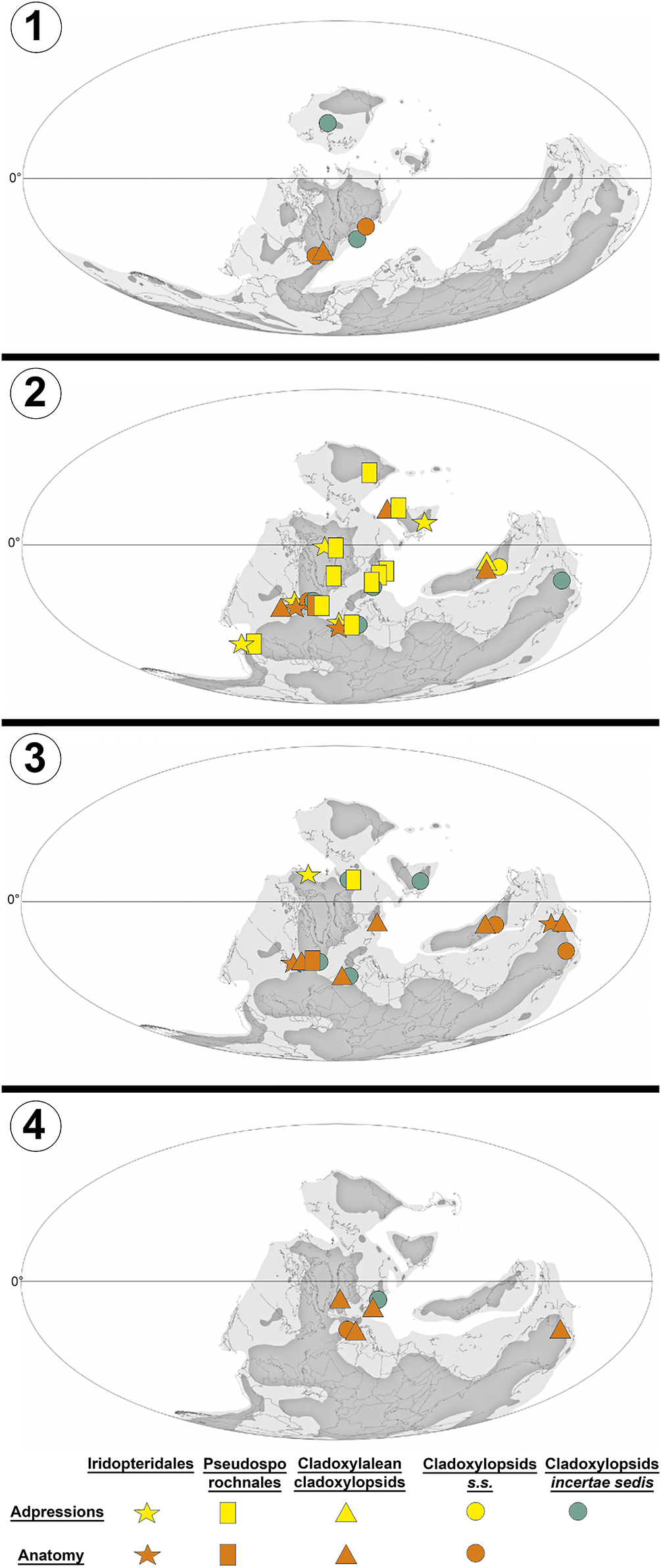
Figure 1. Long description
Four oval global maps show the distribution of Iridopteridales, Pseudosporochnales, Cladoxylalean cladoxylopsids, Cladoxylopsids s. s., and Cladoxylopsids incertae sedis across different geological periods.
* Map 1 Emsian: Shows a sparse distribution with a teal circle in the Northern Hemisphere and a cluster of orange triangles and circles in the Southern Hemisphere near the eastern coast of a central landmass.
* Map 2 Middle Devonian: Displays a significant increase in fossil records. Yellow squares and stars are concentrated in the Northern Hemisphere and equatorial regions. A dense cluster of orange triangles, stars, and yellow squares appears along the southwestern and southern coasts of the central landmass. A teal circle and orange triangle are located on a separate landmass to the East.
* Map 3 Upper Devonian: Shows a shift in distribution. Yellow stars and squares remain in the North and equatorial zones. The Southern Hemisphere distribution is dominated by orange triangles and circles, particularly along the southern coastlines and eastern landmasses.
* Map 4 lower Carboniferous: Shows a reduced number of records. Distribution is limited to a few orange triangles and one teal circle located primarily in the equatorial and Southern Hemisphere coastal regions.
Legend at the bottom defines the symbols:
* Iridopteridales: Yellow star for Adpressions, orange star for Anatomy.
* Pseudosporochnales: Yellow square for Adpressions, orange square for Anatomy.
* Cladoxylalean cladoxylopsids: Yellow triangle for Adpressions, orange triangle for Anatomy.
* Cladoxylopsids s. s.: Yellow circle for Adpressions, orange circle for Anatomy.
* Cladoxylopsids incertae sedis: Teal circle for Adpressions.
Cladoxylopsids reached their maximum geographic expansion in the Middle Devonian (Fig. 1.2). The Pseudosporochnales were the most widely distributed; from north to south, they occupied Siberia, Kazakhstan, and West Junggar (present-day records located in central Kazakhstan and Xinjiang; for detailed analyses of the paleogeography of the Kazakhstan terranes and Junggar basin during the Paleozoic, see Domeier and Torsvik, Reference Domeier and Torsvik2014 and Xu et al., Reference Xu, Marshall, Wang, Zhu, Berry and Wellman2014), Laurussia (numerous localities in Europe and North America), and northwestern Gondwana (Venezuela, Morocco). They appear to have been absent in the east, unless the Astralocaulis collected in Queensland (represented as a cladoxylopsid incertae sedis in Fig. 1.2) corresponds to the root system of a pseudosporochnalean cladoxylopsid, and its Middle Devonian age, assigned by Harris (Reference Harris1929), is correct (Supplementary Data 3). Thus, the Pseudosporochnales straddled a wide climatic gradient, ranging from arid to tropical and warm temperate climates (Capel et al., Reference Capel, Cleal, Servais and Cascales-Miñana2023, fig. 5). They also played a major role in the establishment of the first forest ecosystems, which had delayed but far-reaching effects across the Earth’s biomes (Li et al., Reference Li, Qiu, Algeo, Zhao and Chen2026). Eifelian forests in Germany (Lindlar) and Somerset were occupied by Calamophyton trees < 3 m tall (Giesen and Berry, Reference Giesen and Berry2013; Davies et al., Reference Davies, McMahon and Berry2024). Although they exceeded this height, the contemporary Pseudosporochnus forests in Belgium (Goé) remained of moderate size (Berry and Fairon-Demaret, Reference Berry and Fairon‐Demaret2002). The detailed structure (composition and spatial organization) of these Eifelian forests is poorly understood. To date, the first forest communities that were complex and composed of tall trees have been identified in the Givetian localities of New York State (Stein et al., Reference Stein, Berry, Hernick and Mannolini2012, Reference Stein, Berry, Morris, Hernick and Mannolini2020). Their composition varied depending on local environmental conditions. In the poorly-drained and disturbed environments represented at Riverside quarry near Gilboa, Wattieza-Eospermatopteris, which reached heights of 10 m or more, were the only canopy trees, alongside rare lycopsids. The known understory consisted of woody aneurophytalean progymnosperms (Stein et al., Reference Stein, Berry, Hernick and Mannolini2012). By contrast, in the drier landscapes represented at a quarry near Cairo (Egypt), Wattieza-Eospermatopteris formed a forest in association with even larger archaeopterids (Stein et al., Reference Stein, Berry, Morris, Hernick and Mannolini2020). The composition of its understory is unknown. Cladoxylopsids representing groups other than the pseudosporochnalean clade are known from a smaller number of localities in the Middle Devonian, but the presence of cladoxylalean cladoxylopsids in South China, where both the Pseudosporochnales and the Iridopteridales are absent, is worth noting.
The Upper Devonian saw the disappearance of cladoxylopsids from Siberia and a marked decline in the global distribution of the Pseudosporochnales, the last records of which date to the Frasnian, in North Timan (Russia) and New York State (USA) (Stein and Hueber, Reference Stein and Hueber1989; Orlova et al., Reference Orlova, Jurina and Snigirevsky2016; Fig. 1.3). The Iridopteridales also declined and were no longer present in Xinjiang (West Junggar). Only the genus Keraphyton (Champreux et al., Reference Champreux, Meyer-Berthaud and Decombeix2020) recorded in the Famennian of Australia might represent the group in the Late Devonian, although, despite sharing characters with the iridopterids, the affinities of Keraphyton, which is based on a single axis, are not unequivocally resolved. By contrast, it is at the end of the Devonian, during the Famennian, that the cladoxylalean cladoxylopsids reached the eastern part of Gondwana (present-day Australia) for the first time (Meyer-Berthaud et al., Reference Meyer-Berthaud, Decombeix, Girard, Steemans, Blanchard, Champreux and Evreïnoff2021; Fig. 1.3). This group persisted beyond the Devonian-Carboniferous boundary and, together with Serripteris and Voelkelia Solms-Laubach, Reference Solms-Laubach1896 (both recorded as cladoxylopsids s.s. in Fig. 1.4), they are the last known representatives of the Cladoxylopsida, in the lower Carboniferous (Solms-Laubach, Reference Solms-Laubach1910; Long, Reference Long1968, Reference Long1987; Rowe and Galtier, Reference Rowe and Galtier1989), at which time they occurred exclusively in the Southern Hemisphere, close to the Equator.
Trends in morphological evolution
Stelar architecture
Stelar architecture encompasses a broad range of diversity among cladoxylopsids, ranging from actinosteles with few lobes seen among iridopterids to much-dissected steles with up to 100 ribs or vascular segments, as seen among cladoxylopsids s.s. Arnold (Reference Arnold1952) was the first to formulate hypotheses on the evolution of the steles in this group, proposing a transition from a terete protostele toward an actinostele (as exemplified by Asteroxylon Kiston and Lang, Reference Kidston and Lang1920), followed by dissection of the latter. Within this framework, Lemoigne and Iurina (Reference Lemoigne and Iurina1983) hypothesized gradual stele dissection starting with only some of the ribs disconnected from the central xylem region, and progressing toward a stele with completely disconnected vascular segments. The latter are arranged radially around a central parenchymatous region with or without discrete central vascular bundles, a hypothesis reiterated by Stewart and Rothwell (Reference Stewart and Rothwell1993, p. 222–224). Lemoigne and Iurina (Reference Lemoigne and Iurina1983) nevertheless pointed out that such supposed evolutionary transitions could also either represent, or be recapitulated in, successive developmental stages of cladoxylopsids like Xenocladia Arnold, Reference Arnold1940.
These hypotheses are generally supported by phylogenetic studies of the cladoxylopsid plexus (Durieux et al., Reference Durieux, Lopez, Bronson and Tomescu2021; Chu et al., Reference Chu, Durieux and Tomescu2024). Thus, the circular to elliptical basal shape of appendage traces that become H-shaped (actinostelic) distally in the iridopterid Arachnoxylon kopfii (Sebby, Reference Sebby1972; Stein, Reference Stein1981, Reference Stein1982; Stein et al., Reference Stein, Wight and Beck1983), which is part of a basal grade of cladoxylopsids, supports the hypothesized evolutionary transition from haplostele to actinostele in the group. The second step of the evolution of the stele in the cladoxylopsids is the gradual dissection of the actinostele and the increase in the number of ribs. This is supported by the phylogenetic placement of the actinostelic taxa, which form a basal grade among cladoxylopsids s.l., and by the distribution of stele architecture among the cladoxylalean cladoxylopsids (Fig. 2; Table 2). The earliest diverging cladoxylalean cladoxylopsids possessed incompletely dissected steles, i.e., wherein some of the ribs are connected at the center of the stele (e.g., Cladoxylon mirabile, Cladoxylon radiatum, Rotoxylon, Metacladoxylon, Panxia, Paracladoxylon). By contrast, the most derived members of the clade (i.e., Xenocladia, Polyxylon, Pietzschia) possessed entirely dissected steles with large central parenchymatous areas that host central vascular bundles, corresponding to the most derived condition of cladoxylopsid steles (Fig. 2). Additionally, the transition from actinostele to a dissected stele is observed in the development of Cladoxylon waltonii (see Long, Reference Long1968) and Metacladophyton (Z. Wang and Geng, Reference Wang and Geng1997) emend. D. Wang and Lin, Reference Wang and Lin2007, and the increase in the number of ribs has been observed in epidogenetic phases of Pietzschia levis Soria, Meyer-Berthaud, and Scheckler, Reference Soria, Meyer-Berthaud and Scheckler2001 (Soria and Meyer-Berthaud, Reference Soria and Meyer-Berthaud2004) and Xinicaulis lignescens.
Simplified phylogenetic tree of the cladoxylopsids from Chu et al. (Reference Chu, Durieux and Tomescu2024, fig. 51) with discussed stele and ultimate appendages characters mapped. Large black branches represent monophyletic groups, and the large gray branch represents a paraphyletic grade. ‘CIA clade’ includes Compsocradus givetianus Fu et al., Reference Fu, Wang, Berry and Xu2011; Ibyka amphikoma Skog and Banks, Reference Skog and Banks1973, emend. Berry et al., Reference Berry, Stein and Cordi2022; and Anapaulia moodyi Berry and Edwards, Reference Berry and Edwards1996. ‘Core iridopterids’ includes Arachnoxylon minor Stein, Wight, and Beck, Reference Stein, Wight and Beck1983; Arachnoxylon kopfii Read, Reference Read1938; Asteropteris noveboracensis Dawson, Reference Dawson1881; Compsocradus laevigatus Berry and Stein, Reference Berry and Stein2000; and Iridopteris eriensis Arnold, Reference Arnold1940. ‘Transitional cladoxylopsids’ includes Denglongia huebeiensis Xue and Hao, Reference Xue and Hao2008, emend. Xue et al., Reference Xue, Hao and Basinger2010 and Serripteris feistii Rowe and Galtier, Reference Rowe and Galtier1989. ‘XPP clade’ includes Xenocladia medullosina Arnold, Reference Arnold1940; Pietzschia schulleri Gothan, Reference Gothan1927; Pietzschia levis Soria, Meyer-Berthaud, and Scheckler, Reference Soria, Meyer-Berthaud and Scheckler2001; Pietzschia polyupsilon (Read and Campbell, Reference Read and Campbell1939) emend. Soria and Meyer-Berthaud, Reference Soria and Meyer-Berthaud2003; and Polyxylon australe (Chambers and Regan, Reference Chambers and Regan1986) emend. Meyer-Berthaud et al., Reference Meyer-Berthaud, Soria and Young2007. UA = ultimate appendages. Translucent UA mapped on the tree represents the UA from taxa for which there is no definitive evidence about their types (i.e., dichotomous or pseudomonopodial).
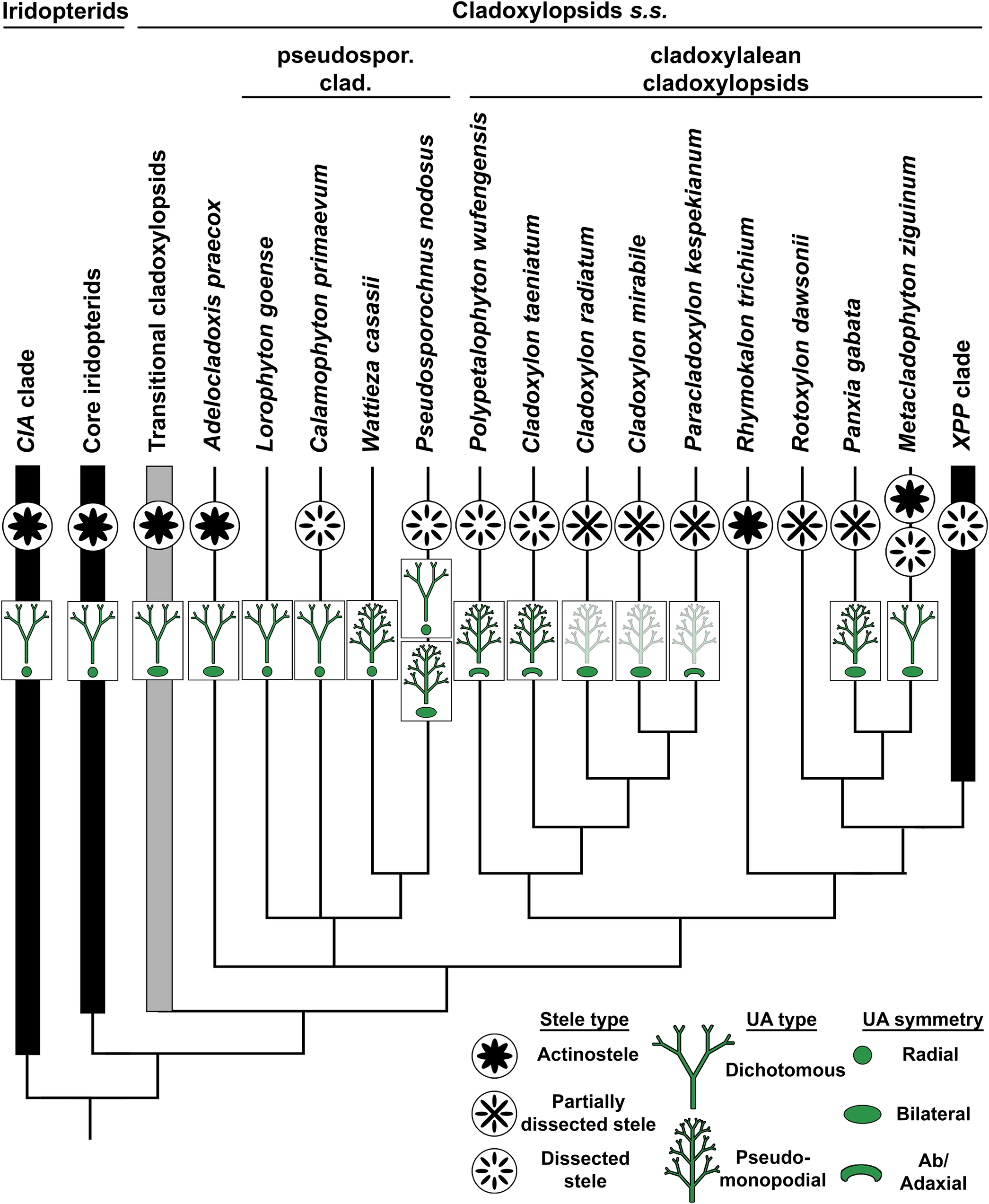
Figure 2. Long description
A phylogenetic tree with vertical branches. At the top, taxa are grouped under Iridopterids and Cladoxylopsids s. s. The Cladoxylopsids s. s. are further divided into pseudospor. clad. and cladoxylalean cladoxylopsids.
From left to right, the terminal branches are:
1. C I A clade: Black branch, actinostele, dichotomous U A, radial symmetry.
2. Core iridopterids: Black branch, actinostele, dichotomous U A, radial symmetry.
3. Transitional cladoxylopsids: Gray branch, actinostele, dichotomous U A, radial symmetry.
4. Adelocladoxis praecox: Actinostele, dichotomous U A, radial symmetry.
5. Lorophyton goense: Dissected stele, dichotomous U A, radial symmetry.
6. Calamophyton primaevum: Dissected stele, dichotomous U A, radial symmetry.
7. Wattieza casasii: Dissected stele, dichotomous U A, radial symmetry.
8. Pseudosporochnus nodosus: Dissected stele, two U A types: dichotomous with radial symmetry and pseudomonopodial with radial symmetry.
9. Polypetalophyton wufengensis: Dissected stele, pseudomonopodial U A, radial symmetry.
10. Cladoxylon taeniatum: Dissected stele, pseudomonopodial U A, radial symmetry.
11. Cladoxylon radiatum: Partially dissected stele, translucent pseudomonopodial U A, radial symmetry.
12. Cladoxylon mirabile: Partially dissected stele, translucent pseudomonopodial U A, radial symmetry.
13. Paracladoxylon kespekianum: Partially dissected stele, translucent pseudomonopodial U A, radial symmetry.
14. Rhymokalon trichium: Actinostele, no U A mapped.
15. Rotoxylon dawsonii: Partially dissected stele, no U A mapped.
16. Panxia gabata: Partially dissected stele, pseudomonopodial U A, bilateral symmetry.
17. Metacladophyton ziguinum: Two stele types (actinostele and partially dissected), pseudomonopodial U A, bilateral symmetry.
18. X P P clade: Black branch, dissected stele, no U A mapped.
A legend at the bottom defines symbols:
- Stele type: Actinostele (solid black star), Partially dissected stele (star with white center), Dissected stele (star with many white segments).
- U A type: Dichotomous (simple branching), Pseudomonopodial (central axis with lateral branches).
- U A symmetry: Radial (circle), Bilateral (oval), Ab forward slash Adaxial (crescent).
In summary, an evolutionary sequence of stelar architecture among cladoxylopsids s.l. is supported by the pattern of phylogenetic relationships in the group and is recapitulated in the ontogeny of some of the taxa. Interestingly, the evolutionary transitions in stelar architecture are paralleled by an increase in plant diameter (Fig. 3) as well as by transitions in the lateral organ morphology (see below). These correlations are consistent with hypotheses that have proposed as a driver in the evolution of cladoxylopsid stelar architectures the redistribution of a ‘vascular identity specifier’ (i.e., auxin) modulated by changes in apical meristem size and in lateral organ size and complexity (Wight, Reference Wight1987; Stein, Reference Stein1993; Tomescu, Reference Tomescu2021; Durieux et al., Reference Durieux, Lopez, Bronson and Tomescu2021).
Scatter plots of the vascular system diameter (in mm) as a function of the number of lobes/ribs measured on anatomically preserved cladoxylopsids (N = 38). Note that Spearman correlation = 0.84, suggesting a high correlation between these two characters. (1) Scatter plot with black = actinostelic taxa; gray = taxa showing actinostelic and dissected stele; red = taxa with a dissected stele. (2) Scatter plot with black = taxa without secondary xylem; red = taxa with secondary xylem; gray = taxa with tissues not officially recognized as secondary xylem but sharing numerous similarities. For details of the data, see Supplementary Data 4.
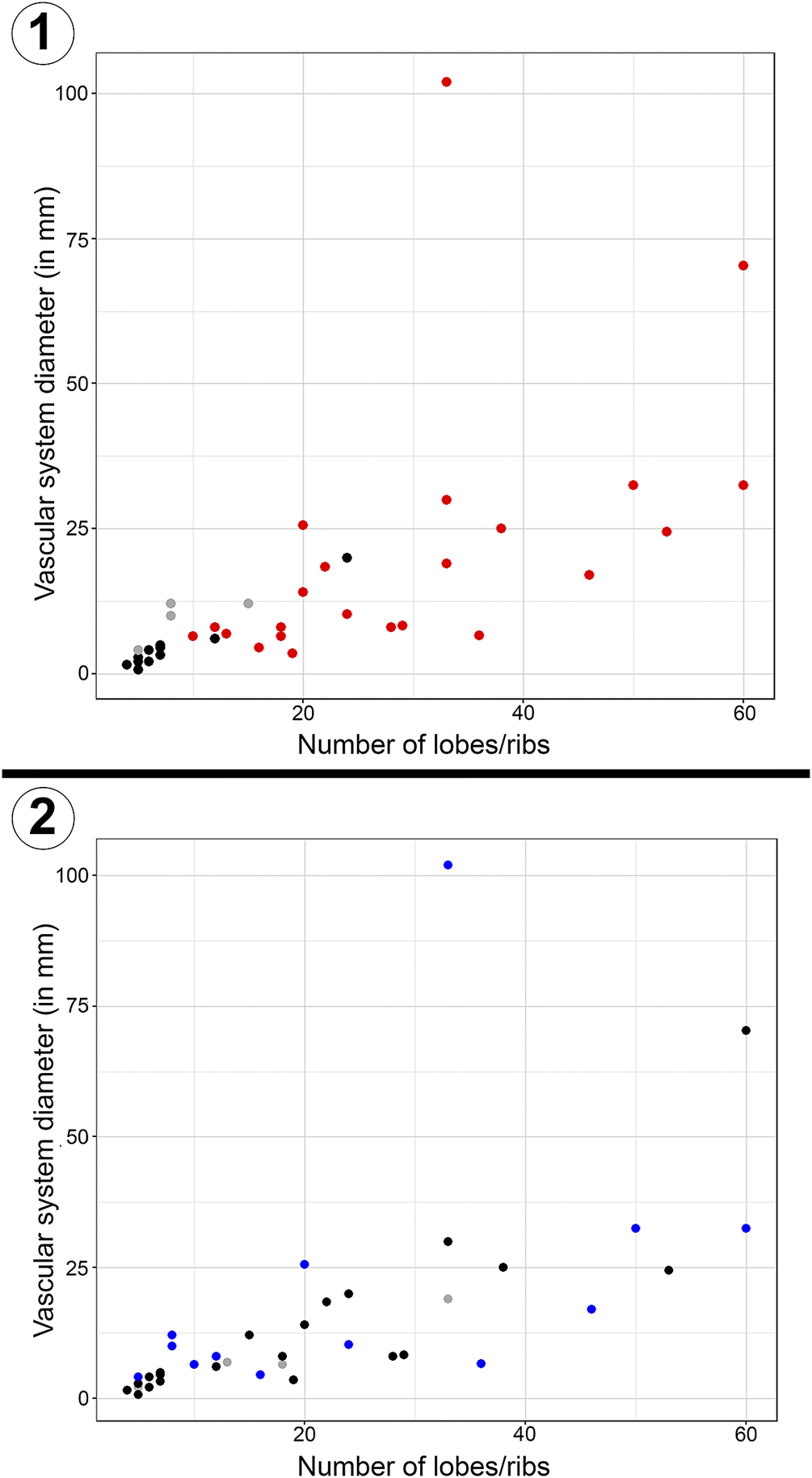
Figure 3. Long description
Both scatter plots share an X-axis representing the Number of lobes or ribs ranging from 0 to 60 and a Y-axis representing the Vascular system diameter in millimeters ranging from 0 to 100. The data points show a linear increase where higher lobe counts correspond to larger diameters.
* Panel 1 (Top): Categorizes taxa by stele type. Black dots (actinostelic) are clustered at the bottom-left (low values). Gray dots (mixed actinostelic and dissected) are slightly higher. Red dots (dissected stele) dominate the middle and upper-right regions, including a significant outlier at approximately 33 lobes and 102 millimeters.
* Panel 2 (Bottom): Categorizes taxa by xylem type. Black dots (no secondary xylem) are distributed across the lower and middle range. Blue dots (with secondary xylem) appear across the entire range, including the high outlier. Gray dots (tissues similar to secondary xylem) are sparse and located in the lower-middle section of the plot.
Ultimate appendages
All cladoxylopsids possess as their highest orders of branching axes that are either (1) branching more-or-less isotomously in their entirety, or (2) small pseudomonopodial systems consisting of a ‘central axis’ that bears lateral isotomous ultimate segments. These small branching systems of the highest orders are typically referred to as ultimate appendages, especially if entirely isotomously branched, but the second type has been termed ‘lateral branching systems’ in pseudosporochnaleans (Berry and Fairon-Demaret, Reference Berry and Fairon-Demaret1997; Berry, Reference Berry2000). However, the term ‘lateral branching system’ can be confusing, because it can apply to any branch (and its offshoots) that is borne on an axis of the next lower order (e.g., the digitate branches, which bear ultimate appendages, of the pseudoporochnaleans). Additionally, the co-occurrence of isotomous and pseudomonopodial small branching systems of the highest orders on the same plant (e.g., in Pseudosporochnus; Berry and Fairon-Demaret, Reference Berry and Fairon-Demaret1997) suggests that they are organographically equivalent. Consequently, here we refer to both of these two types of small branching systems of the highest orders as ‘ultimate appendages.’ It is then worth noting that in plants in which the anatomy of ultimate appendages of the pseudomonopodial type is known, it suggests that their base was petiole-like (see Cladoxylalean cladoxylopsids in the Current diversity and classification section; Durieux et al., Reference Durieux, Decombeix and Harper2026).
The homology of ultimate appendages across the cladoxylopsid plexus has been articulated by Durieux et al. (Reference Durieux, Lopez, Bronson and Tomescu2021). Approaching the question for phylogenetic purposes (character construction and scoring), they pointed out the vexing nature of recognizing ultimate appendages, i.e., determining where, in going along the successive orders of branching from lowest to highest, the base of an ultimate appendage starts. Durieux et al. (Reference Durieux, Lopez, Bronson and Tomescu2021) proposed that ultimate appendages are recognized by their determinate development; the fact that they are reiterated, with consistent morphology, throughout the plant body (and sometimes on different orders of branching); and their possession of the simplest anatomy among the different orders of branching recognized in a plant.
Ultimate appendages are isotomous and three-dimensional in iridopterids, in which they can be borne on all orders of branching, as well as in the pseudosporochnaleans Lorophyton and Calamophyton (Leclercq and Andrews, Reference Leclercq and Andrews1960; Fairon-Demaret and Li, Reference Fairon-Demaret and Li1993; Fairon-Demaret and Berry, Reference Fairon-Demaret and Berry2000; Berry, Reference Berry2000; Berry et al., Reference Berry, Stein and Cordi2022). Ultimate appendages of the pseudomonopodial type, with dichotomous segments arranged alternately or in whorls, are found in two other pseudosporochnaleans, Wattieza and Pseudosporochnus; in the latter, they co-occur with isotomous ultimate appendages (Berry and Fairon-Demaret, Reference Berry and Fairon-Demaret1997; Berry, Reference Berry2000). Whether isotomous or pseudomonopodial, the ultimate appendages of pseudosporochnaleans lack regular taxis. When they are known in the cladoxylalean cladoxylopsids, the ultimate appendages have regular taxis; they are pseudomonopodial, with alternate to opposite dichotomous units, and their stalks have bilateral to abaxial-adaxial polarity, except in Metacladophyton ziguinum (Z. Wang and Geng, Reference Wang and Geng1997) emend. D. Wang and Lin, Reference Wang and Lin2007 (Fig. 2; Table 2).
The specific features and distribution of the different types of ultimate appendages across the phylogeny of the group (Fig. 2) provide the elements for outlining a hypothesized evolutionary sequence. This sequence starts with the transition from an exclusively isotomous lateral appendage with determinate growth and progresses toward pseudomonopodial appendages, involving the advent of bilateral symmetry, and then of abaxial-adaxial polarity. This sequence has already been hypothesized for the independent evolution of leaves in other euphyllophyte groups (Sanders et al., Reference Sanders, Rothwell and Wyatt2009; Tomescu, Reference Tomescu2009; Galtier, Reference Galtier2010; Tomescu and Whitewoods, Reference Tomescu and Whitewoods2024). In the lignophyte clade, for instance, seed-plant leaves evolved from determinate lateral organs that became subsequently bilaterally and abaxial-adaxially polarized starting from their proximal ends (Sanders et al., Reference Sanders, Rothwell and Wyatt2009; Galtier, Reference Galtier2010). Thus, the ultimate appendages of cladoxylopsids represent a new example among euphyllophytes of an independent (and incomplete, in this case) pathway of evolution of lateral appendages toward true leaf structure and identity, from precursors consisting of lateral branching systems (Kenrick and Crane, Reference Kenrick and Crane1997).
In parallel with the stepwise evolution of ultimate appendages toward leaf identity, the cladoxylopsids also show the acquisition of planation and of abaxial-adaxial polarity elsewhere in their branching systems. Although the iridopterids possess three-dimensional branches, the pseudosporochnaleans have digitate branches that divide in the same plane (planation) and some cladoxylalean cladoxylopsids have branches with abaxial-adaxial polarity, e.g., plants in the genus Pietzschia (Soria and Meyer-Berthaud, Reference Soria and Meyer-Berthaud2005) and possibly Cladoxylon waltonii and Cladoxylon edromense Long, Reference Long1987 (Long, Reference Long1968, Reference Long1987). However, in the latter two species, it is unclear what position abaxial-adaxially polarized branches occupy in the hierarchy of their branching architecture.
An evolutionary scenario can also be proposed for the positioning and taxis of the cladoxylopsid ultimate appendages. The phylogenetic distribution of these characters suggests that ultimate appendages evolved from being produced on axes of all orders to produced only on higher orders of branching and possibly only on branches of the highest order in the cladoxylalean cladoxylopsids. In terms of ultimate appendage taxis, it seems to be regular at least in some of the iridopterids, in which they co-occur with branches at nodes, whereas in the cladoxylopsids s.s., it is irregular in pseudosporochnaleans and regular in the cladoxylaleans. Thus, the basal iridopterids possess regularly arranged ultimate appendages on axes of all orders; transitional cladoxylopsids bear only branches on their main axis and, when known (i.e., Denglongia [Xue and Hao, Reference Xue and Hao2008]), ultimate appendages have regular taxis on branches of multiple orders; the pseudosporochnaleans also bear ultimate appendages on branches of all orders, with irregular taxis (Stein and Hueber, Reference Stein and Hueber1989; Berry and Fairon-Demaret, Reference Berry and Fairon-Demaret1997; Berry, Reference Berry2000), and the cladoxylalean cladoxylopsids likely bear ultimate appendages exclusively on axes of the highest order with regular organotaxis (e.g., Panxia [Y. Wang and Berry, Reference Wang and Berry2006], Polypetalophyton (Geng Reference Geng, Li and Cui1995) emend, Hilton et al., Reference Hilton, Geng and Kenrick2003, Cladoxylon taeniatum [see Durieux et al., Reference Durieux, Decombeix and Harper2026]; in Pietzschia, the main axis and its branches bear no ultimate appendages, which suggests that they might also have been borne only on axes of the highest order) (Table 2). A notable exception to the latter is the cladoxylalean Metacladophyton ziguinum (see D. Wang and Lin, Reference Wang and Lin2007), in which ultimate appendages have regular taxis, but they can also have irregular taxis—like the pseudosporochnaleans—depending on the axis order that bears them. If the ultimate appendages of pseudosporochnaleans and Metacladophyton ziguinum have irregular taxis, that would imply that this feature, typically used to identify a lateral appendage as a leaf (Sanders et al., Reference Sanders, Rothwell and Wyatt2009; Tomescu, Reference Tomescu2009) and proposed as the most plesiomorphic uniting feature of leaf precursors (Tomescu and Whitewoods, Reference Tomescu and Whitewoods2024), shows a reversal in these derived cladoxylopsid s.l. taxa.
Sporangia
Consistent with their early euphyllophyte identity, the plesiomorphic sporangium condition in cladoxylopsids consists of ellipsoidal to fusiform sporangia borne in pairs at the tips of the ultimate segments of fertile ultimate appendages. When documented, the dehiscence of these sporangia proceeds along a single longitudinal opening, similar to those of the basal euphyllophyte Psilophyton Dawson, Reference Dawson1859 (e.g., Banks et al., Reference Banks, Leclercq and Hueber1975). This plesiomorphic condition seems to have persisted all across the iridopterids and through the pseudosporochnalean cladoxylopsids, with differences among genera being related to the morphology of the fertile ultimate appendages rather than to the morphology of the sporangia themselves (Berry and Edwards, Reference Berry and Edwards1996; Berry, Reference Berry2000; D. Wang and Lin, Reference Wang and Lin2007; Xue and Hao, Reference Xue and Hao2008; Fu et al., Reference Fu, Wang, Berry and Xu2011). The few cladoxylalean cladoxylopsids in which sporangia are known suggest that sporangial characters evolved away from the plesiomorphic form: the sporangia are terminal and fusiform but not paired in Polypetalophyton (Hilton et al., Reference Hilton, Geng and Kenrick2003), and they are not fusiform and probably not paired in Panxia (Y. Wang and Berry, Reference Wang and Berry2006).
Cladoxylopsid architecture
Iterative versus hierarchized architecture: a debatable taxonomic dichotomy
Devonian cladoxylopsids display morphologies, the diversity and complexity of which can be appreciated from the numerous reconstructions now available. Architectural analysis (Barthélemy and Caraglio, Reference Barthelemy and Caraglio2007) allows this complexity to be organized by defining the different types of morphological components of the plants, their sequence of production, and their topological arrangement, as well as various aspects of their geometry (e.g., dimensions, branching angle). Architectural analysis also records the changes in form during growth, particularly those due to branching.
This type of analysis is particularly useful for recognizing two types of architectural features that have been used to separate systematic groups within the Cladoxylopsida: the repetition of architectural elements and their co-occurrence. Thus, the Iridopteridales have been traditionally thought to be distinguished by (1) their so-called ‘iterative’ architecture, i.e., one that repeats the same branching pattern in different orders of axes; (2) their whorled to pseudowhorled organotaxy; and (3) the presence of both branches and ultimate appendages within the same nodes (Berry and Stein, Reference Berry and Stein2000; Meyer-Berthaud et al., Reference Meyer-Berthaud, Soria and Young2007). By contrast, the cladoxylopsids s.s., particularly the Pseudosporochnales, have been regarded as possessing a ‘hierarchized’ architecture (Meyer-Berthaud et al., Reference Meyer-Berthaud, Soria and Young2007), wherein each order of branching has distinctive features that do not repeat those of the other orders.
Architectural analysis demonstrates that the structural dichotomy between iridopterids and pseudosporochnaleans, as traditionally conceived, is not as clear-cut and is, therefore, debatable (to facilitate comparisons below we refer to the axes of all taxa as first-order, second-order, third-order, and, eventually, fourth-order axes; Figs. 4, 5). Take, for example, three taxa with iridopterid affinities that are unanimously accepted—Ibyka, Anapaulia Berry and Edwards, Reference Berry and Edwards1996, and Compsocradus Berry and Stein, Reference Berry and Stein2000, emend. Fu et al., Reference Fu, Wang, Berry and Xu2011 (Durieux et al., Reference Durieux, Lopez, Bronson and Tomescu2021; Chu et al., Reference Chu, Durieux and Tomescu2024). Of these, Ibyka is the only taxon that clearly shows the three iridopterid characters listed above (Fig. 4.1). In Compsocradus, laterals are arranged in loose whorls on the first- and second-order axes, whereas the ultimate appendages do not exhibit any precise pattern along the third-order axes (Fu et al., Reference Fu, Wang, Berry and Xu2011, p. 719; Fig. 4.2). In Anapaulia, both the first- and second-order axes exhibit a whorled branching pattern (Fig. 4.3), but ultimate appendages have not been documented on the second-order axes, which consequently cannot be considered repeated structures.
Compared architectural models of three Iridopteridales (1–3) and two cladoxylopsids s.s. showing some iridopteridalean features (4, 5): (1) Ibyka amphikoma Skog and Banks, Reference Skog and Banks1973, emend. Berry et al., Reference Berry, Stein and Cordi2022; (2) Compsocradus (Berry and Stein, Reference Berry and Stein2000) emend Fu et al., Reference Fu, Wang, Berry and Xu2011; (3) Anapaulia Berry and Edwards, Reference Berry and Edwards1996; (4) Metacladoxylon tetraxylum Z. Wang and Geng, Reference Wang and Geng1997 (cladoxylalean cladoxylopsid); (5) Denglongia Xue and Hao, Reference Xue and Hao2008, emend. Xue et al., Reference Xue, Hao and Basinger2010 (transitional cladoxylopsid).
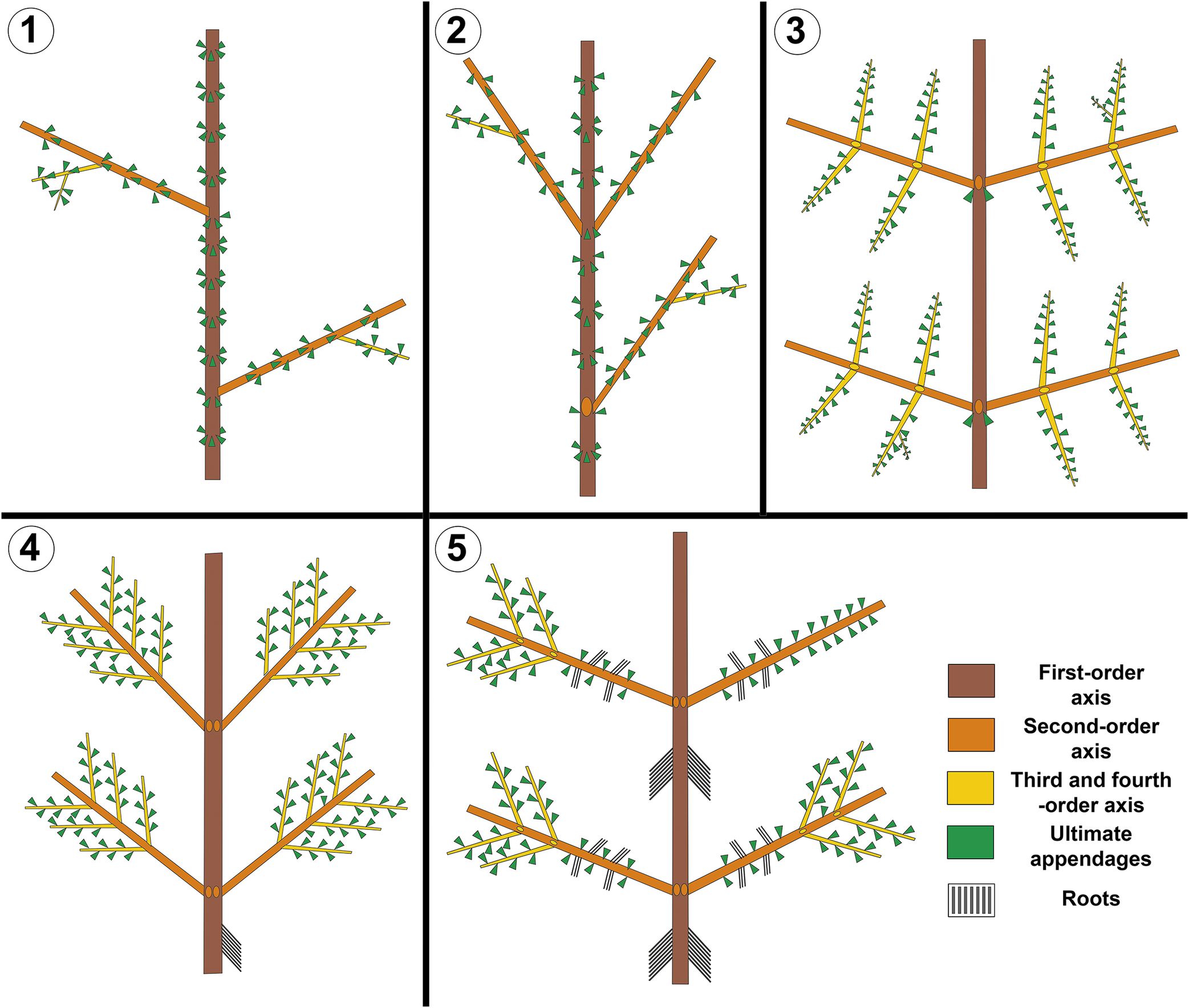
Figure 4. Long description
A multi-panel diagram showing five numbered plant architectural models and a legend.
Legend at bottom-right:
* Brown square: First-order axis.
* Orange square: Second-order axis.
* Yellow square: Third and fourth-order axis.
* Green triangle: Ultimate appendages.
* Gray striped square: Roots.
Panel 1 (Ibyka amphikoma): A vertical brown first-order axis with small green triangular appendages. Two orange second-order axes branch off at different heights, also bearing green appendages.
Panel 2 (Compsocradus): A vertical brown axis with three orange second-order axes branching upward in a staggered arrangement. Green appendages are distributed along all axes.
Panel 3 (Anapaulia): A vertical brown axis with two pairs of opposite orange second-order axes. Each orange axis branches into multiple yellow third and fourth-order axes, all tipped with green appendages.
Panel 4 (Metacladoxylon tetraxylum): A vertical brown axis with two pairs of opposite orange second-order axes. These branch extensively into yellow higher-order axes, creating dense, fan-like structures of green appendages. Small gray root-like structures appear at the base of the main stem.
Panel 5 (Denglongia): Similar to panel 4, featuring a vertical brown axis with two pairs of opposite orange branches. It shows more complex branching into yellow axes and green appendages. Distinct gray root clusters are located at the base and at the junctions where the second-order axes meet the first-order axis.
In Metacladophyton, a taxon with possible iridopterid affinities according to Berry and Stein (Reference Berry and Stein2000), each order of axes has its own characteristics: the first-order axis is the only one to produce lateral axes in whorls, and only axes of the most distal order bear ultimate appendages (Fig. 4.4). Similarly, in Denglongia, another taxon with iridopterid features interpreted as a transitional cladoxylopsid by Durieux et al. (Reference Durieux, Lopez, Bronson and Tomescu2021), both the first- and second-order axes exhibit a whorled branching pattern and produce adventitious roots (Fig. 4.5). However, the second-order axes bear ultimate appendages, whereas the first-order axes do not. These two orders of axes cannot therefore be considered as repeated structures. Together, these comparisons show that the concept of ‘iterative’ architecture does not apply to the majority of Iridopteridales and related taxa, and it does not account for the entire breadth of morphological diversity observed within taxa assigned to this group.
In the cladoxylopsids s.s., particularly the Pseudosporochnales, the first-order branches differ significantly from the massive stem (trunk) that supports them, consistent with the idea that they have a ‘hierarchized’ architecture (Meyer-Berthaud et al., Reference Meyer-Berthaud, Soria and Young2007). However, pseudosporochnalean branches divide dichotomously, producing a sequence of orders of axes that are similar from one order to the next—a pattern that can be described as iterative (Fig. 5.1). The ultimate appendages of the Pseudosporochnales, which are also dichotomous, developed along all the orders of axes that make up the branches. Those of the genus Rhipidophyton Berry and Wang, Reference Berry and Wang2006, which shares some, but not all, architectural characteristics of the Pseudosporochnales, are the sole exceptions (Fig. 5.2). Additionally, there is no clear gradation from a branching pattern that would be lateral proximally and dichotomous distally; instead, lateral and dichotomous branching patterns are intermixed in pseudosporochnalean branches. Thus, the ‘hierarchized’ architecture traditionally thought to characterize the cladoxylopsids s.s., particularly the Pseudosporochnales (Meyer-Berthaud et al., Reference Meyer-Berthaud, Soria and Young2007), is also debatable.
Compared architectural models of cladoxylopsids with a distinctive first-order axis, i.e., a trunk: (1) Calamophyton Kräusel and Weyland, Reference Kräusel and Weyland1926 (Pseudosporochnales); (2) Rhipidophyton Berry and Wang, Reference Berry and Wang2006 (cladoxylopsid of uncertain affinities); (3) Pietzschia Gothan, Reference Gothan1927 (cladoxylalean cladoxylopsids). The Pietzschia model combines traits of Pietzschia levis Soria, Meyer-Berthaud, and Scheckler, Reference Soria, Meyer-Berthaud and Scheckler2001 for the epidogenetic stem base and traits of Pietzschia schulleri Gothan, Reference Gothan1927 for the rest of the plant. Most colors as in Figure 4; dark blue = fertile ultimate appendages.
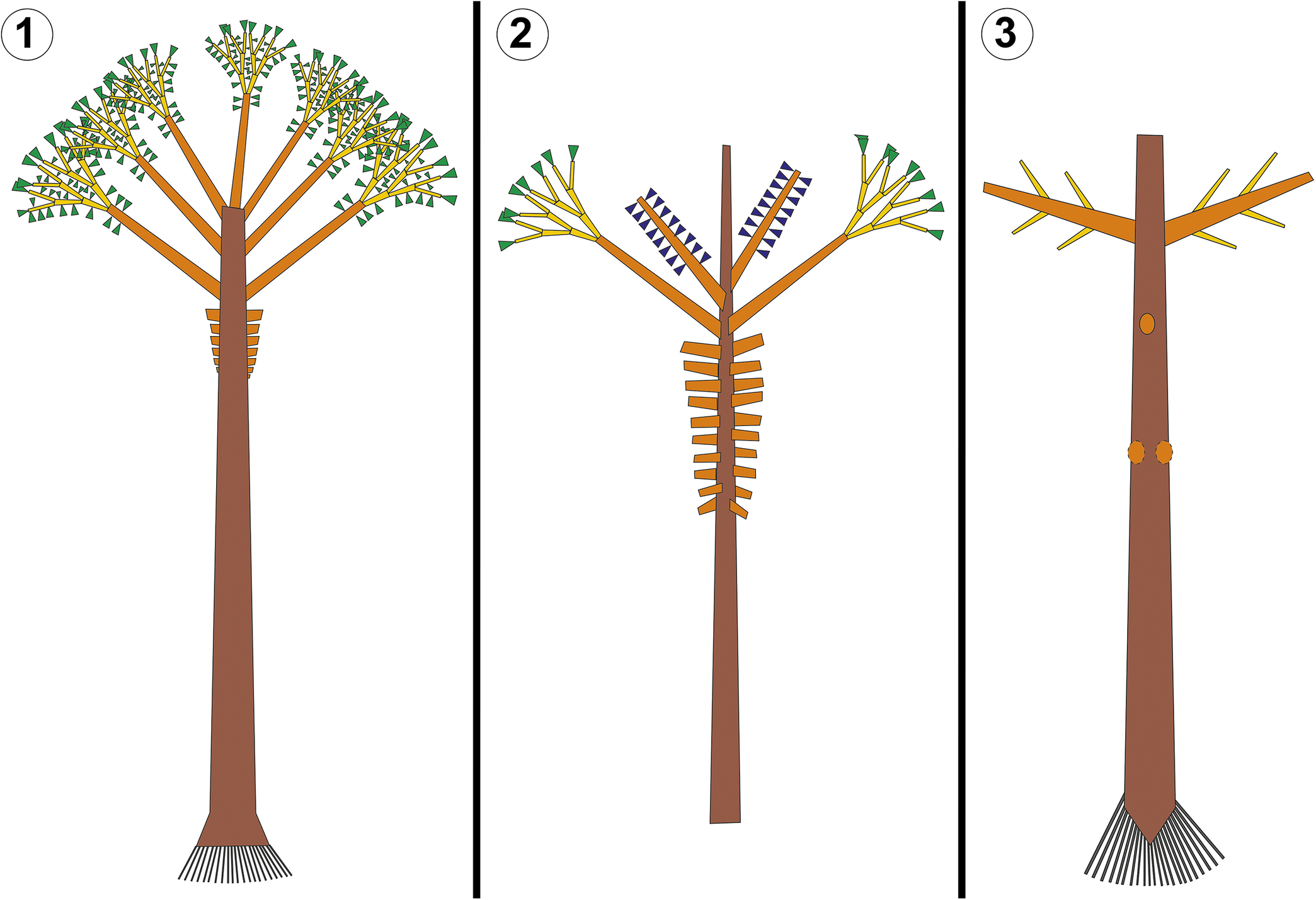
Figure 5. Long description
A three-panel diagram illustrating architectural models of ancient plants.
* Panel 1 shows Calamophyton. It features a tall, brown trunk tapering slightly toward the top. At the base, a dense cluster of fine, dark roots extends downward. The upper portion of the trunk has several horizontal, orange, shelf-like scars. The crown consists of multiple long, orange branches radiating upward and outward, each terminating in complex, fan-like green structures.
* Panel 2 shows Rhipidophyton. The trunk is similar to panel 1 but shorter. It has a higher density of horizontal orange scars along the mid-section. The crown features two main orange branches radiating outward with green fan-like tips. Between these branches, several smaller, dark blue triangular structures, representing fertile appendages, are arranged in vertical rows along the upper trunk.
* Panel 3 shows Pietzschia. The trunk has a flared, bulbous base with long, radiating dark roots. The trunk is brown with a few circular orange scars. Near the top, two thick, orange branches extend horizontally, each with smaller yellow secondary branches. The very top of the trunk is a blunt, vertical extension.
Growth models and habits
The ontogenetic approach initiated by Eggert (Reference Eggert1961, Reference Eggert1962) on Paleozoic lycophytes and sphenophytes, and applied to other groups (e.g., progymnosperms and pteridosperms; Scheckler, Reference Scheckler1976; Masselter et al., Reference Masselter, Speck and Rowe2006), represents another way of investigating the complexity of plant structures. It highlights the links between anatomy and external morphology at various stages in the development of entire plants or individual organs. Depending on the size and complexity of the primary body, or of its proxy represented by the primary vascular system (i.e., stele), Eggert distinguished three ontogenetic stages. Epidogenesis corresponds to an expansion of the primary body in parallel with elongation. It characterizes the earlier development of a plant, and can also occur at branch bases. Menetogenesis corresponds to a phase when the size of the primary body remains constant longitudinally. Apoxogenesis corresponds to a decrease in size and complexity of the primary body with elongation. These stages, which characterize primary growth, are associated with variable amounts of secondary tissues in the taxa that exhibit secondary growth. In the cladoxylopsids, the ontogenetic approach is particularly useful for comparing the developmental patterns of large growth forms, e.g., trees, and for hypothesizing about the growth habits of taxa represented only by isolated anatomical sections of fragmentary specimens.
The ontogenetic approach has been applied to a few species of cladoxylopsids s.s., but rarely to the Iridopteridales, for which the available relevant information is scarce—to our knowledge, only one case of epidogenesis has been reported in Arachnoxylon Read, Reference Read1938 (Stein et al., Reference Stein, Wight and Beck1983). Within the cladoxylopsids s.s., attention has mainly focused on the largest species, reconstructed as trees (Berry and Fairon-Demaret, Reference Berry and Fairon‐Demaret2002; Soria and Meyer-Berthaud, Reference Soria and Meyer-Berthaud2004; Meyer-Berthaud et al., Reference Meyer-Berthaud, Soria, Decombeix, Vecoli, Clément and Meyer-Berthaud2010; Giesen and Berry, Reference Giesen and Berry2013; Xu et al., Reference Xu, Berry, Stein, Wang, Tang and Fu2017). Despite sharing the same habit, the arboreous cladoxylopsids differ in several ways in their morphology and growth pattern.
Morphologically, the four major taxa of Pseudosporochnales—Pseudosporochnus, Calamophyton-Duisbergia, Wattieza-Eospermatopteris, and Lorophyton—are reconstructed as tree-sized plants ranging from 2–>10 m in height, the type specimen of Lorophyton corresponding to a juvenile (Fairon-Demaret and Li, Reference Fairon-Demaret and Li1993; Berry and Fairon-Demaret, Reference Berry and Fairon‐Demaret2002; Stein et al., Reference Stein, Mannolini, Hernick, Landing and Berry2007; Giesen and Berry, Reference Giesen and Berry2013). They all possess an orthotropic trunk bearing a crown of digitate branches (Fig. 5.1) arranged differently in the four taxa: broadly offset rows in Pseudosporochnus, vertical ranks in Duisbergia and Wattieza, and helically in Lorophyton. As the plant grows in height, the oldest branches are shed, from their base in Pseudosporochnus or distal to it in Calamophyton (Berry and Fairon-Demaret, Reference Berry and Fairon‐Demaret2002; Giesen and Berry, Reference Giesen and Berry2013). The branches bear ultimate appendages lacking regular taxis that dichotomize three-dimensionally and can bear erect (Pseudosporochnus model [Berry and Fairon-Demaret, Reference Berry and Fairon‐Demaret2002]) or recurved sporangia (e.g., in Calamophyton, Lorophyton, and Wattieza [see Berry, Reference Berry2000]) at the tips. Numerous adventitious roots with little or no branching are present on the underside and around the swollen base of the trunks.
The growth patterns of pseudosporochnalean trees have been hypothesized based on morphological features and not on patterns of anatomical change, which have, however, been used in characterizing the growth patterns of their branches. Indeed, the determinate growth of pseudosporochnalean branches, inferred from their multiple dichotomies and ephemeral lifespan has been validated by anatomical analyses performed on the branches of Calamophyton primaevum Kräusel and Weyland, Reference Kräusel and Weyland1926 (previously Cladoxylon scoparium Kräusel and Weyland, Reference Kräusel and Weyland1926) and Pseudosporochnus hueberi Stein and Hueber, Reference Stein and Hueber1989. The branches of these taxa lack secondary tissues and show an acropetal decrease in the amount of primary xylem, indicating their apoxogenetic character.
Several ontogenetic models that emphasize different aspects of trunk growth have been proposed for the Pseudosporochnales (Giesen and Berry, Reference Giesen and Berry2013; Xu et al., Reference Xu, Berry, Stein, Wang, Tang and Fu2017). Berry and Fairon-Demaret (Reference Berry and Fairon‐Demaret2002) hypothesized a significant role of the secondary xylem that surrounds the individual xylem ribs in increasing trunk girth. By contrast, Meyer-Berthaud et al. (Reference Meyer-Berthaud, Soria, Decombeix, Vecoli, Clément and Meyer-Berthaud2010) proposed a model inspired by that of Pietzschia (see below) in which the maximum size of the trunk is determined by primary growth, following a short epidogenetic phase. In this model, the trunk has a determinate growth characterized by a long apoxogenetic phase; the secondary xylem, which is not accompanied by the development of a secondary cortex, remains within the boundaries of the primary body and does not contribute to the enlargement of the trunk. The base of the trunk, covered by the root mantle, is enlarged by diffuse proliferation in the parenchymatous central region. In the Calamophyton model proposed by Giesen and Berry (Reference Giesen and Berry2013), the trunk has an indeterminate growth characterized by an extended epidogenetic phase followed by a menetogenetic phase of primary growth, and by the production of secondary xylem—supported by the presence of secondary xylem in an anatomically preserved trunk of Duisbergia (Mustafa, Reference Mustafa1978a)—at all levels of the trunk below the apex. This model of growth has been expanded to Eospermatopteris-Wattiezza (Giesen and Berry, Reference Giesen and Berry2013) and has received support from the anatomy of Xinicaulis Xu et al., Reference Xu, Berry, Stein, Wang, Tang and Fu2017, a genus of cladoxylopsids with uncertain affinities, but that shares the anatomical structure inferred for Eospermatopteris (Xu et al., Reference Xu, Berry, Stein, Wang, Tang and Fu2017). Based on Xinicaulis and Eospermatopteris trunk base casts (Boyer, Reference Boyer1995), the largest pseudosporochnalean cladoxylopsid trees are hypothesized to have grown a large body by an extensive phase of epidogenesis involving the acropetal dissection of the xylem ribs and by the production of significant amounts of secondary xylem, accompanied by “diffuse secondary growth in ground and inner cortical tissues” (Xu et al., Reference Xu, Berry, Stein, Wang, Tang and Fu2017, p. 12013).
Among the nonpseudosporochnalean cladoxylopsids, the genus Pietzschia also includes tree-sized individuals, the largest of which exceeded 2 m in height (Pietzschia schulleri Gothan, Reference Gothan1927; Soria and Meyer-Berthaud, Reference Soria and Meyer-Berthaud2005). Pietzschia is represented by numerous anatomically preserved specimens, which have enabled detailed ontogenetic analyses, and the proposal of a growth model for the genus (Soria et al., Reference Soria, Meyer-Berthaud and Scheckler2001; Soria and Meyer-Berthaud, Reference Soria and Meyer-Berthaud2004, Reference Soria and Meyer-Berthaud2005; Meyer-Berthaud et al., Reference Meyer-Berthaud, Soria, Decombeix, Vecoli, Clément and Meyer-Berthaud2010). Pietzschia plants had a short obconical base, covered by a mantle of adventitious roots (Soria and Meyer-Berthaud, Reference Soria and Meyer-Berthaud2004; Fig. 5.3), that shows acropetal increase in the amount of primary xylem, corresponding to an epidogenetic phase of growth. Above that, the trunk can show a short menetogenetic phase of growth, but soon becomes conical, tapering apically and showing acropetal reduction in the cross-sectional area of vascular tissues (apoxogenetic growth). The orthotropic trunk bore planated branches produced starting shortly before the end of the epidogenetic phase and arranged helically in Pietzschia levis or in whorls in Pietzschia polyupsilon (Read and Campbell, Reference Read and Campbell1939) emend. Soria and Meyer-Berthaud, Reference Soria and Meyer-Berthaud2003 and Pietzschia schulleri (Soria et al., Reference Soria, Meyer-Berthaud and Scheckler2001; Soria and Meyer-Berthaud, Reference Soria and Meyer-Berthaud2003, Reference Soria and Meyer-Berthaud2004, Reference Soria and Meyer-Berthaud2005). The width and amount of primary xylem in the first-order branches decrease distally. This, along with the apoxogenesis of the main trunk, indicates that the growth model of Pietzschia consists mainly of determinate units (Meyer-Berthaud et al., Reference Meyer-Berthaud, Soria, Decombeix, Vecoli, Clément and Meyer-Berthaud2010). The branches were probably shed in Pietzschia schulleri (see Soria and Meyer-Berhaud, Reference Soria and Meyer-Berthaud2005), in which two orders of branching have been preserved, with distichously arranged second-order branches (preserved only at their very base). No ultimate appendages are known in Pietzschia, which does not possess secondary tissues or evidence of branch dichotomy.
Recently, the first architectural model of a nonarborescent cladoxylopsid was proposed for Cladoxylon taeniatum. This model is based on detailed analyses of anatomical changes during ontogeny in a large number of isolated axes, some of which bear laterals (Durieux et al., Reference Durieux, Decombeix and Harper2026). Cladoxylon taeniatum is reconstructed with a main axis bearing helically arranged ultimate appendages possessing adaxial-abaxial polarity and pseudomonopodial architecture (with alternate to opposite isotomous lateral segments). The structure of the primary body (i.e., the number, size, and arrangement of the primary xylem ribs) and the amount of secondary tissues indicate a basal epidogenetic phase followed by an extended apoxogenetic phase of growth in the main axes of Cladoxylon taeniatum. This ontogenetic model can underpin two hypotheses about the growth habit of the plant. One hypothesis is that Cladoxylon taeniatum was an erect, self- to semiself-supporting plant resembling Pietzschia, but comprising secondary tissues. An alternative hypothesis is that Cladoxylon taeniatum had rhizomatous growth. This latter hypothesis is supported by an ontogenetically older specimen that has a significant amount of secondary tissues, including periderm, and a root trace that diverges from the vascular trace of an aerial organ; those two traces diverge at very different angles and have differently positioned secondary xylem, consistent with the inference that the subtending axis was a horizontal rhizome with aerial branches and adventitious roots growing in opposite directions, as is typical in plants with unipolar rhizomatous growth.
In summary, as discussed above, the cladoxylopsids s.l. encompass a significant amount of diversity from an architectural standpoint. However, some relationships among anatomical variables seem to hold true across the entire group, independent of architecture. Thus, in all cladoxylopsids with a dissected stele: (1) apoxogenesis and epidogenesis phase of growth are associated with, respectively, increase or decrease of the number of ribs or of the amount of primary xylem inside each ribs; (2) the number of ribs changes between axes of different orders; (3) the largest axes of tree-sized cladoxylopsids possess a stele with a large central parenchymatous zone surrounded by numerous radially elongated xylem ribs; (4) exclusively isotomous ultimate appendages/dichotomous units are supplied by a vascular trace that diverges from a single stele rib; and (5) in axis segments immediately basal to a dichotomy, the organization is altered with some ribs crossing the axis through its center or by the radial or tangential elongation of the central bundles.
Outstanding questions
Current understanding of cladoxylopsids has gaps, large and small. Major unanswered questions regard the ontogeny and architecture of these plants, e.g., the characterization of the different stages of growth of a pseudosporochnalean trunk, its associated rooting structures, and their corresponding anatomy, or the characterization of the growth and habit of iridopteridaleans. Speaking of roots, although cladoxylopsid roots are among the oldest euphyllophyte roots known in the fossil record (Giesen and Berry, Reference Giesen and Berry2013; Hetherington et al., Reference Hetherington, Berry and Dolan2020), our understanding of their anatomy is limited to but a few instances (Harris, Reference Harris1929; Soria et al., Reference Soria, Meyer-Berthaud and Scheckler2001; Meyer-Berthaud et al., Reference Meyer-Berthaud, Bert, Decombeix, Lacand, Ramel, Becker, Klug, El Hassani and Tahiri2024; Xu et al., Reference Xu, Berry, Stein, Wang, Tang and Fu2017; and intriguing structures published recently by Stein et al., Reference Stein, Berry, Hernick and Mannolini2023). Their development, especially in relation to the ontogeny of the whole plants has never been addressed.
The autapomorphic vascular architecture of cladoxylopsids raises functional questions, like those related to the possible advantages and constraints conferred by the dissected vascular system: did it offer mechanical or hydraulic advantages that could explain the evolutionary success of the group in the Devonian and its broad morphological diversification? If so, how could it have contributed to the construction of the first cladoxylopsid trees, mechanistically and in comparison to the vascular systems of living plants with analogous monocaulous arboreous habits (tree ferns and palms)?
The ‘permanent protoxylem’ of cladoxylopsids raises questions related to development and architecture: how does the distribution of protoxylem strands in the axes of different taxa relate to the vascular supply of their lateral appendages? And how might homeostasis and the distribution of hormones and morphogens in and around apical meristems be involved in the specification and early development of these appendages? When integrated in an evo-devo framework with equivalent data from other euphyllophyte lineages, e.g., those traditionally associated with the evolution of seed plants (Toledo et al., Reference Toledo, Bippus, Atkinson, Bronson and Tomescu2021), which are themselves in a similar state of incomplete exploration, the cladoxylopsid data will provide key insights on the evolution of leaves and, more generally, of euphyllophyte organography.
The reproductive biology of cladoxylopsids is another poorly developed area of knowledge. Sporangia have been documented in only about one-quarter of the known taxa and we know little about them beyond their overall shape, (sometimes) dehiscence pattern, and positioning on the plants. We also know virtually nothing about sporangium-wall anatomy and the spore content. It is notable that all cladoxylopsids s.l., except for the cladoxylalean cladoxylopsids, seem to have retained until the Late Devonian and longer than other euphyllophyte groups (e.g., progymnosperms), the plesiomorphic trimerophyte condition with terminal paired sporangia. This raises questions about whether this and any aspects of reproductive biology associated with it could have influenced the evolutionary trajectory of different cladoxylopsid lineages, e.g., the fact that most of those with plesiomorphic sporangia seem to have gone extinct by Famennian time. And, because we know so little about their sporangia and spores, could any members of the group (especially among cladoxylalean cladoxylopsids, the sporangia of which are the least well known but seem to have been different from those of other cladoxylopsids) have evolved heterospory, which is known to have originated independently multiple times among the vascular plants (Bateman and DiMichele, Reference Bateman and DiMichele1994)?
Beyond ontogeny, form, and function, key questions regard the phylogeny of and within the cladoxylopsid plexus. First, the monophyly of all the lineages and taxa considered as part of the cladoxylopsid plexus—which was never tested explicitly and thoroughly in a cladistic framework—needs to be addressed by targeted studies that include enough of the relevant outgroups to provide unassailable answers. Other important questions should be addressed by more broadly sampled studies aimed at clarifying with good levels of support (1) the relationships between the different cladoxylopsid lineages, and (2) the relationships between cladoxylopsids, other Devonian-Carboniferous pteridophytic euphyllophyte lineages (zygopterids, rhacophytaleans, stauropterids), and equisetophyte lineages (including basal sphenophytes, e.g., Rotafolia D.-M. Wang, Hao, and Wang, Reference Wang, Hao and Wang2005, as well as Pseudoborniales, Sphenophyllales, Calamitales), and including crown-group fern lineages (eusporangiate and leptosporangiate). Answers to all of these questions will provide critical insights on hotly debated issues in plant phylogeny. Such issues include the ancestry and deep relationships of ferns (extinct and living) and equisetophytes, the phylogenetic position of Equisetum, and its relationships with the different fern lineages. Answers to these questions will help address the meaning and usefulness of the monilophyte concept and will provide sounder foundations for understanding the overall pattern of relationships between all of the major euphyllophyte lineages, including the relationships between different pteridophytic lineages, on one hand, and the seed plants and related lignophyte lineages, on the other hand.
Future fossil discoveries and their integration into renewed studies of the group have the potential to answer many of the questions above, but while waiting for them, we should not neglect the much more immediate untapped potential of known, previously described specimens. Reassessed in light of the knowledge accumulated over the last 40 yr of discovery and using improved or new methods of imaging and investigation, these specimens have the potential to provide answers to many of the critical questions regarding cladoxylopsid anatomy, morphology, phylogeny, and evolution.
Conclusions
Despite having been recognized >150 yr ago, substantial progress in our understanding of cladoxylopsids was made over the last 30 yr. First, taxonomically, we now recognize three main groups among the cladoxylopsids s.l.: the Iridopteridales, which probably form a grade basal to the cladoxylopsids s.s. clade, within which the pseudosporochnalean cladoxylopsids and cladoxylalean cladoxylopsids form two distinct clades. However, the sets of defining characters discussed for each of these three cladoxylopsid groups do not apply universally within each group, a situation that reflects gaps in our understanding of the morphology of these groups of their relationships. Second, the application of architectural models led to improved understanding of the morphology and development of cladoxylopsids in each group, especially those that had evolved the tree habit. These advances, combined with improved comprehension of phylogenetic relationships, suggest hypotheses on the evolution of cladoxylopsid stele architecture (toward increased dissection of the xylem volume) and ultimate appendages (toward pseudomonopodial and dorsiventral organization). Currently, cladoxylopsids are known from all around the world, spanning the Early Devonian to the early Carboniferous. Available data reveal a previously unrecognized feature of cladoxylopsid evolutionary history—they were the earliest group to acquire morphological identity from among the plexus of early euphyllophytes, in the Early Devonian, >400 Myr ago and probably before the Emsian. This makes them the oldest recognizable euphyllophyte lineage. They are also the earliest euphyllophyte lineage to have evolved by the Emsian tracheids with bordered pits of modern aspect, and include some of the oldest (Emsian) euphyllophytes with regular taxis of ultimate appendages. The group radiated throughout the Early Devonian and thereafter, generating a broad diversity of Middle Devonian and younger representatives. However, as early as the end of the Early Devonian, cladoxylopsids already covered a considerable span of morphological disparity, especially in terms of stele architecture and branching patterns. Their ultimate appendages provide some of the oldest (Emsian) evidence for a euphyllophyte group that had already made big strides along pathways leading to the evolution of leaves. The group was widely spread geographically by the Middle Devonian, during which cladoxylopsids reached worldwide distribution and were the first group of plants that evolved the tree habit. Their geographic distribution started shrinking in the Late Devonian and the group went extinct sometime during the early Carboniferous. Despite the large body of knowledge accumulated about cladoxylopsids, critical questions remain to be addressed for reaching a fuller understanding of their structure, development, and taxonomy. Additionally, the monophyletic status of the cladoxylopsids needs to be thoroughly tested by studies based on broader taxon sampling. Such studies should also resolve the phylogenetic placement of the different cladoxylopsid groups among the euphyllophytes and address the issue of the ‘permanent’ versus ‘radiate’ protoxylem groups and, thus, shed light on the origin and deep relationships of plant lineages that are still present in the modern flora.
Acknowledgments
We thank the editors and the Journal of Paleontology for the invitation to contribute to this special issue. We also thank H. Xue and an anonymous reviewer for their insightful comments that helped us improve the manuscript. AMFT acknowledges the fossil collection work done by the late F.M. Hueber for the National Museum of Natural History, Smithsonian Institution (USA), which made available the Emsian plant fossil material including cladoxylopsids from Quebec; W.A. DiMichele, C. Hotton, and J. Wingerath, who facilitated the loans of that material for study; the contributions of E. Frasier and J. McLean for documenting as yet unnamed cladoxylopsids from the Smithsonian material; the Cottonwood Canyon (Wyoming) field collecting teams of Humboldt State University (currently Cal Poly Humboldt) students; and funding from the American Philosophical Society and the Cal Poly Humboldt Sponsored Programs Foundation. AMAP (botAny and Modelling of Plant Architecture and vegetation) is a joint research unit that associates Montpellier University, CNRS (UMR 5120), CIRAD (UMR 51), INRAE (UMR 931), and IRD (UR 123).
Author contributions
TD, BM-B, and AMFT contributed equally to conceptualization; investigation; and writing, review, and editing the text. TD and BM-B prepared the illustrations.
Competing interests
The authors declare none.
Data availability statement
Supplementary data are available from the Zenodo Repository: https://doi.org/10.5281/zenodo.21473585

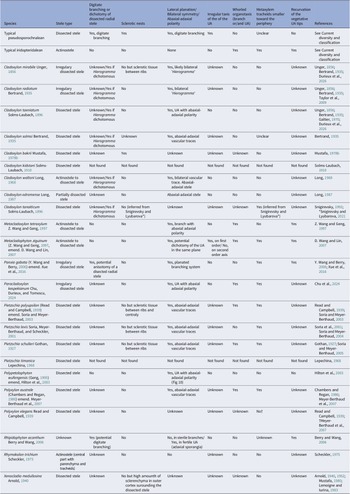


 Open access

